

Achilles: Hero of the Trojan War, Mortal Flame, and Eternal Legend
Half-mortal, half-divine, and wholly consumed by glory: Achilles stands at the center of the Trojan War not as a simple warrior, but as a study in rage, grief, and what it costs a man to choose legend over life.
Contents
The sea is still when Thetis rises from it. She comes not to celebrate but to mourn, cradling her son's head in her silver hands while the Greek camp burns with grief around them. Achilles has just learned that Patroclus is dead. He opens his mouth and the sound that comes out is not a battle cry. It is something older, rawer: a howl that reaches the ocean floor where his mother's sisters weep in answer.
That scene, in Book 18 of Homer's Iliad, is the pivot on which the whole epic turns. Before it, Achilles, hero of the Trojan War, is an absence: sulking in his tent, nursing a wound to his pride that has cost the Greek alliance thousands of dead. After it, he becomes something terrible and brief, like a fire that consumes the last of its fuel in a single night. Homer understood something that later poets, sculptors, and filmmakers keep rediscovering: Achilles is not interesting because he is the greatest warrior. He is interesting because he knows exactly what his greatness will cost him, and chooses it anyway.
His story moves through prophecy, rage, love, grief, and a death foretold from the moment of his birth. It is one of the oldest fully realized character studies in Western literature, and it has not aged a single day.
The Birth That Carried a Warning
Achilles was born of an impossible union. His father, Peleus, was a mortal king of Phthia in Thessaly; his mother, Thetis, was a Nereid, one of the fifty sea-nymphs who attended Poseidon. The marriage itself was not freely chosen. Zeus and Poseidon had both pursued Thetis until the Titan prophet Themis revealed that the son born of her would surpass his father in greatness. Neither god wanted a son mightier than himself, so Thetis was handed to a mortal, ensuring her offspring would be something less than a new ruler of the cosmos.
That origin already encodes the paradox Achilles will live: born of a goddess, condemned to die like a man.
The prophecy circulated around him from infancy. The centaur Chiron, who raised Achilles on Mount Pelion and fed him on the marrow of lions and the entrails of bears (according to the Achilleid of Statius), understood the boy's dual nature from the start. Chiron trained him in music, medicine, and the arts of war in equal measure. The philosopher-warrior, the healer who also kills: Achilles would carry both registers his entire short life.
The immortality question was addressed differently across sources. In the version most readers know today, Thetis dipped the infant Achilles in the river Styx, rendering every part of him invulnerable except the heel by which she held him. This image does not appear in Homer at all. It surfaces in later texts, notably Statius's Achilleid (late 1st century CE) and Hyginus's Fabulae. Homer's Achilles is mortal in every part: what protects him is divine armor and superlative skill, not magical skin.
The distinction matters. Homer's version is more psychologically honest. Achilles is not protected by a loophole. He is simply the best, until he isn't.

The Choice at the Heart of Everything
Before the war, there was a choice. Not the famous choice of Paris, who awarded the golden apple to Aphrodite and set the whole catastrophe in motion, but Achilles' own private fork in the road.
His mother Thetis had learned, through divine foreknowledge, that two fates awaited her son. He could live a long, quiet life in Phthia, dying obscure and forgotten. Or he could sail to Troy, fight brilliantly, die young, and be remembered forever.
Homer refers to this double fate repeatedly in the Iliad. In Book 9, Achilles himself articulates it with shocking clarity:
"My mother Thetis tells me that there are two ways in which I may meet my end. If I stay here and fight, I shall not return home but my name will live for ever: whereas if I go home my name will die, but it will be long ere death shall take me."
He has already chosen. He chose Troy before the poem begins. The rage, the withdrawal, the grief - all of it plays out against the background of a man who has already signed the contract. What makes the Iliad so painful is that Achilles knows the invoice will come due, and he keeps living as if it might not.
His time on Skyros complicates the picture further. Thetis, terrified of losing him, disguised the young Achilles as a girl and hid him among the daughters of King Lycomedes. There he lived as Pyrrha (the red-haired girl), and there he fathered a son, Neoptolemus, on Deidamia, Lycomedes' daughter. The hero who will become the embodiment of masculine martial glory spent part of his adolescence in a dress. The myth does not treat this as shameful; it treats it as a mother's desperate act. The disguise fails when the Greek envoy Odysseus, needing Achilles for the war, spreads out gifts including weapons. Achilles reaches for the sword without thinking. The body betrays the costume.
Rage: The Word That Opens the Iliad
Menis. Rage. The very first word of the Iliad in Greek announces its subject:
"Sing, goddess, the rage of Achilles, son of Peleus."
Not "the war." Not "the hero." The rage. Homer locates the engine of his entire poem inside one man's emotion.
The cause is specific and, in Homeric terms, legitimate. King Agamemnon, commander of the Greek forces, had taken a captive woman named Chryseis as his prize. Her father, Chryses, a priest of Apollo, came to ransom her. Agamemnon refused insultingly. Apollo sent plague. A Greek assembly demanded Agamemnon return her. He complied, but only after seizing Briseis, Achilles' own war prize, as compensation for his loss.
In the Homeric honor economy, this is not a minor slight. A warrior's geras (prize) represented his public standing, the visible proof of his worth to the community. Agamemnon had stripped Achilles of that proof in front of the entire army. Achilles' response was to withdraw from fighting entirely, praying to Thetis to ask Zeus to let the Greeks suffer without him.
The Greeks do suffer. Hector, Troy's greatest champion, pushes them back to their ships. Hundreds die in engagements that Achilles could have ended in an afternoon. Agamemnon's embassy in Book 9 offers extraordinary gifts, including the return of Briseis and a daughter in marriage. Achilles refuses everything. The stubbornness is not simple pride. It is a man testing the logic of the heroic code to its breaking point, asking what glory is worth if the king who awards it is corrupt.
Achilles in the Iliad
A mortal of exceptional but vulnerable body; rage driven by honor (time); motivated by love for Patroclus without explicit romantic framing; does not die on the page; weeps openly and is admired for it; ultimately shows mercy to Priam.
Achilles in Later Tradition
Acquires the invulnerable body with the one weak heel; in Plato's Symposium and later texts, the bond with Patroclus is read as a passionate love relationship; killed by Paris guided by Apollo; his shade in the Underworld expresses regret for choosing glory; armor passed to Odysseus, sparking the madness of Ajax.
Patroclus: The Death That Unlocks the War
When Achilles finally consents to let someone act on his behalf, he sends Patroclus into battle wearing his divine armor, a set forged by Hephaestus. The plan is limited: frighten the Trojans back from the ships, then return. Patroclus pushes too far, reaches the walls of Troy, and meets Hector.
Hector kills him. Apollo, fighting on the Trojan side, knocks Patroclus's helmet off first; Euphorbus wounds him; Hector delivers the killing blow. Even that death is distributed, not singular, as if no one man could claim credit for ending someone under Achilles' protection.
The relationship between Achilles and Patroclus is the emotional center of the Iliad, and scholars have argued for centuries about its precise nature. Homer calls Patroclus Achilles' hetairos (companion); he never uses the word erastes (lover). Yet the grief Achilles shows surpasses anything he shows for his own impending death. In Book 18, he rolls in the ashes, tears his hair, and refuses food. Thetis rises from the sea in answer to cries Homer compares to those of an eagle robbed of its young.
Plato, writing in the Symposium roughly 400 years after Homer, had the character Phaedrus argue that the gods honored Achilles above Orpheus specifically because Achilles chose to die for Patroclus, framing the bond as a love-relationship. Later readers from Alexander the Great onward have understood it the same way. Alexander, who carried a copy of the Iliad annotated by Aristotle, reportedly visited the tomb of Achilles at Troy and called him blessed for having Patroclus as a companion and Homer as a herald.
The ambiguity is probably deliberate. Homer does not need to name the bond to make its depth felt. What the reader understands is this: when Patroclus dies, something in Achilles that had been slowly suffocating under pride and withdrawal suddenly has nothing left to protect. The only option remaining is revenge.

Achilles and Hector: The Duel the War Hinged On
The armor Hephaestus forges for the returned Achilles is described in Book 18 with extravagant detail: the shield alone depicts the whole world, cities at war and at peace, farmers harvesting, dancers turning, the ocean running around the rim. Wearing it, Achilles looks less like a man and more like a moving cosmology.
He enters battle and the slaughter is immediate and overwhelming. The river Scamander, gorged with Trojan dead, rises against him in a supernatural attempt to stop him, and Hephaestus must drive it back with fire. This scene, often called the Theomachy or battle of the gods embedded inside the human war, makes explicit what has always been implicit: when Achilles, hero of the Trojan War, is at full force, he strains the boundary between mortal and divine.
Hector, who had stood his ground against every other Greek, runs from Achilles. Three full circuits of Troy's walls before Athena tricks him into turning and facing his death. The duel is short. Achilles knows Hector's body because he has worn that armor; he drives his spear into the one gap Hector left exposed. Before dying, Hector prophecies that Paris and Apollo will kill Achilles at the Scaean Gate.
What follows is one of the poem's most disturbing passages. Achilles ties Hector's body to his chariot and drags it around Patroclus's tomb each morning for twelve days. Apollo preserves the body from corruption. The gods are appalled. In Book 24, Zeus himself instructs Thetis to tell Achilles that this cannot continue.
Then comes Priam.
The aged king of Troy crosses enemy lines alone at night, guided by Hermes in disguise, carrying ransom for his son's body. He kneels before Achilles and says something that no enemy has yet said to him: he invokes Achilles' own father, Peleus, the old man who also waits for a son who will never come home. Achilles weeps. Priam weeps. They sit across from each other, king and killer, and grieve together in the firelight.
Homer gives that meeting an entire book. It is the Iliad's ending: not a victory, not a funeral pyre for Achilles, but two men acknowledging each other's humanity across the blood between them. Hector is returned. The poem closes on Troy, not on the Greek camp.
The Death Homer Does Not Show
The Iliad ends before Achilles dies. His death is prophecied, discussed, alluded to repeatedly, but never narrated within the poem itself. For that, readers must go to other sources.
The Aethiopis, a now-lost epic from the Greek Epic Cycle summarized by Proclus, continued the story. Achilles killed the Ethiopian warrior-king Memnon (son of Eos, goddess of dawn) and the Amazon queen Penthesilea. Both victories carried their own grief: after killing Penthesilea, Achilles reportedly wept over her beauty; in some accounts, he had loved her even as he killed her.
His own death came from Paris, who fired an arrow guided by Apollo to the one point that could kill him. In Statius's version, that was the heel. In earlier accounts, the location varies: throat, ankle, or simply an unguarded moment of mortal vulnerability. The consistency across versions is not the wound's location but its cause: a god had to cheat to end Achilles. No human warrior could do it honestly.
His shade descended to the Underworld, where Homer in the Odyssey has him say something startling. When Odysseus meets him among the dead and calls him glorious among the living and mighty among the dead, Achilles replies:
"Do not speak to me soothingly about death, glorious Odysseus. I should prefer to be a serf, working for another man, even a landless man who had not much to live on, than to be king over all the dead."
The man who chose glory over long life, given the view from the other side, has second thoughts. It is a devastating ten lines. It does not negate the choice, but it complicates it in a way that only Homer could manage.

Achilles Across Cultures: Echoes of the Warrior Who Cannot Be Saved
The pattern Achilles represents - the supreme fighter whose very greatness marks him for early death, the man who chooses fame over years, the hero undone by a hidden vulnerability - appears across traditions with enough consistency to suggest it addresses something real in how cultures process martial heroism.
Arjuna, the great warrior of the Mahabharata, shares structural kinship with Achilles. Both receive divine weapons and divine parentage (Arjuna is son of Indra). Both withdraw from battle at a critical moment, undone by something other than fear (Arjuna by moral crisis; Achilles by honor-wound). Both require divine intervention to re-enter the fight: Krishna's discourse becomes the Bhagavad Gita; Thetis commissions new armor from Hephaestus.
The Norse hero Sigurd, slayer of Fafnir, carries a similar fatal flaw: a single spot left vulnerable by the leaf that fell on his back when Fafnir's blood rendered him invincible. He, too, is betrayed by people who should have protected him. He, too, dies in his prime, celebrated in song.
These parallels do not reduce Achilles to an archetype. They show that the archetype keeps needing reinvention because the problem it addresses, the cost of being extraordinary in a world built for the ordinary, never goes away.
How the Ancient World Remembered Him
Alexander the Great's veneration of Achilles was not casual. According to Arrian's Anabasis (written in the 2nd century CE, drawing on earlier sources), Alexander visited Troy in 334 BCE before beginning his Persian campaign. He anointed the tombstone believed to be Achilles', ran a race around it naked as traditional offerings required, and declared him happy for having a friend like Patroclus and a poet like Homer.
Alexander modeled his military style partly on the reckless personal courage associated with Achilles, charging into battle at the front of his companions rather than directing from the rear. His chief companion, Hephaestion, was understood by contemporaries as occupying a Patroclus-like role in his life.
The Romans absorbed Achilles through Greek cultural transmission. Virgil constructed his own perfect Roman hero, Aeneas, partly as a moral counter-image to Achilles: where Achilles is driven by rage and personal glory, Aeneas is driven by pietas, duty to the gods, family, and future Rome. The contrast is explicit in the Aeneid, where Aeneas encounters Achilles' shade (through reference) and the text positions the controlled, mission-driven Trojan as a superior model of heroism.
This did not diminish Achilles' appeal. Roman audiences loved the Iliad precisely because Achilles was not virtuous in the Roman civic sense. He was something older and wilder: a force of nature in human shape.
Frequently asked questions about Achilles, hero of the Trojan War
Frequently asked questions
Was Achilles a real historical person?
No credible archaeological or textual evidence confirms a historical individual named Achilles. The Trojan War itself may have some basis in Late Bronze Age Aegean conflicts around 1200 BCE, but the figures Homer depicts are literary constructions drawing on centuries of oral tradition. Scholars such as Martin West and Gregory Nagy have traced the Achilles tradition to very old Indo-European warrior-hero archetypes, suggesting his story preserves patterns far older than any single conflict.
Did Homer actually write the Iliad?
The question of Homeric authorship has been open since antiquity. Modern scholarship, drawing on work by Milman Parry and Albert Lord on oral-formulaic composition in the 20th century, understands the Iliad as the product of a long oral tradition performed by bards (aoidoi) before being fixed in written form, probably in the 8th or 7th century BCE. Whether a single poet called Homer shaped the final text, or whether the name stands for a tradition, remains genuinely unresolved. The internal artistry of the poem suggests at minimum a powerful organizing intelligence behind its final form.
What is the Achilles heel myth and where does it come from?
The image of Thetis dipping the infant Achilles in the Styx does not appear in Homer. Its fullest early telling comes from Statius's unfinished Latin epic the Achilleid, composed around 95 CE, and is mentioned by Hyginus in his Fabulae. The heel as the fatal weak point may also appear in fragments of the lost Cypria and Aethiopis. By the Roman period the detail was widely known; today "Achilles heel" is a medical anatomical term for the tendon connecting calf muscle to heel bone, named in 1693 by the Dutch anatomist Philip Verheyen.
What was the relationship between Achilles and Patroclus?
Homer's text calls Patroclus Achilles' closest companion (hetairos) but does not label the relationship sexually. The grief Achilles shows is without parallel in the poem, and Patroclus is the only death that breaks his withdrawal. Beginning with Plato's Symposium (385-370 BCE), ancient writers explicitly read a romantic bond into the relationship. Aeschylus wrote a now-fragmentary play, Myrmidons, in which the two were lovers. Modern scholarship generally accepts that ancient audiences understood the bond as potentially erotic, while acknowledging Homer himself leaves it deliberately open.
Why does Achilles return Hector's body at the end of the Iliad?
The return of Hector's body in Book 24 is driven by divine pressure, Zeus orders it, and by the unexpected encounter with Priam. The old king's appeal works because he invokes Peleus, Achilles' own aging father, activating the one emotional register Achilles has never been able to armor against: grief for the people his choices will leave behind. The act does not signal a change of heart toward the war. It is a moment of recognition between two men already destroyed by the same conflict, separated only by which side they stand on.
How does Achilles die, and why does it matter who kills him?
The Iliad ends before Achilles' death; the Aethiopis and later sources including Statius describe Paris firing an arrow guided by Apollo. That particular combination (a secondary warrior, a missile weapon, a god's guidance) is deliberate. Paris is not a front-line fighter; the arrow requires no face-to-face courage; Apollo's involvement means no human could honestly claim to have beaten Achilles in equal combat. His death is engineered around him, not won against him, which preserves his undefeated status while still killing him. The Greeks found that distinction meaningful enough to build it carefully into the tradition.
Achilles After Homer: The Unfinished Argument About Heroism
The Iliad closed in the 8th century BCE. The argument about what Achilles means has not closed since.
Every generation that faces war, or glory, or the question of what a person owes to the community versus to themselves, picks up the text and finds it still warm. In the 5th century BCE, Athenian tragedians wrote plays now lost (Sophocles wrote at least two on Achillean subjects; Euripides' Iphigenia at Aulis shows Achilles in a different moral mode, willing to protect Iphigenia from sacrifice even at risk to himself). The Symposium made him a philosophical test case. The Aeneid used him as a foil. Shakespeare's Troilus and Cressida (1602) gave him satirical treatment, reducing him to a vain celebrity waiting in his tent.
The 20th century brought two significant reinventions. Simone Weil's 1940 essay "The Iliad, or the Poem of Force" read the poem through the lens of Nazi occupation, arguing that Homer understood force as the true subject of war, and that Achilles' rage was not glorified but examined. Weil's essay changed how classicists read the poem. Pat Barker's The Silence of the Troy trilogy (2018-2022) recounts the Trojan War through Briseis, the captive woman both Achilles and Agamemnon use as a token, giving a voice to the figure the original poem silences.
What none of these retellings, from Alexander's veneration to Barker's feminist recovery, have done is make Achilles simple. He remains the Achilles of the Trojan War, the one who chose the short bright arc. But the resonance of that choice keeps changing shape depending on who is doing the choosing, and who is paying the price alongside him.
That open quality is perhaps Homer's greatest achievement: a character so fully rendered that each century finds something new to argue with him about.
Read the full book
Want the whole story?
The complete edition is an instant PDF download here, with a paperback on Amazon for selected titles.
Mythology
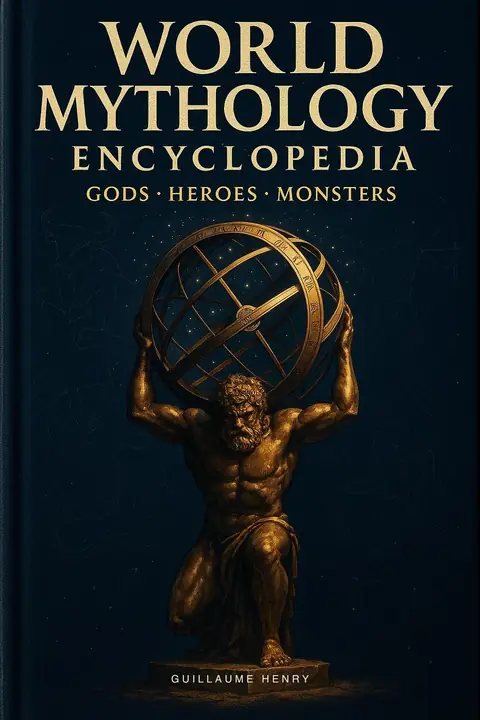
The World Mythology Book: The Gods, Heroes and Myths of Every Culture
The Gods, Heroes and Myths of Every Culture, in One Volume
The whole of world mythology in a single volume: Greek, Norse, Egyptian, Japanese, Hindu, Celtic, Slavic, Mesoamerican and African myths gathered side by side, each drawn from the primary sources.