

Atalanta the Swift Huntress: Myth, Character, and Legacy
Abandoned at birth, raised by a bear, and never outrun by a mortal man: Atalanta stands apart from every other figure in Greek myth, a huntress whose story cuts across heroism, desire, and divine punishment.
Contents
The wolves did not come. The she-bear did. When the infant girl was left on a Boeotian hillside by a father who wanted a son, it was a bear who nursed her, and the wilderness that raised her. She grew up knowing how to track, how to run, how to draw a bow before she understood the society that had discarded her. By the time Atalanta the swift huntress entered the myths that Greeks would retell for centuries, she had already become something their culture rarely imagined: a woman who asked nothing of men and lost nothing for it.
Her story comes down to us in pieces scattered across Hesiod, Ovid's Metamorphoses, Apollodorus's Bibliotheca, and the lyric tradition surrounding the Calydonian Boar Hunt. Each fragment sharpens a different edge of the same figure: the athlete, the virgin devotee of Artemis, the unwilling bride, the woman turned to stone by divine caprice. Together they form one of the most psychologically dense portraits in the entire Hellenic tradition.
She did not fit. That was the point.
The Abandoned Daughter: Origins and Upbringing
The ancient sources give her father different names. Apollodorus calls him Schoeneus of Boeotia; other traditions name Iasus of Arcadia. The detail that matters in both is the same: a father who wanted male heirs left his daughter on a mountainside to die of exposure.
Atalanta's survival came not from divine intervention in the conventional sense but from the natural world itself. A she-bear, sacred to Artemis, suckled the infant. Hunters eventually found the girl and brought her up among them. The wildness did not leave her when she learned to speak. She hunted the same slopes that had sheltered her as a baby. She prayed at no man's altar.
Her devotion to Artemis was total and literal. Artemis in the Greek imagination was not merely a goddess of hunting but the guardian of thresholds: between girlhood and womanhood, between the civilised polis and the ungoverned forest. Atalanta lived permanently on that threshold. She swore chastity, not as a priestess bound by institution, but as a personal compact with the wild life that had preserved her.
When her father eventually acknowledged her, demanding she marry and produce heirs, Atalanta responded with the most famous athletic condition in Greek legend. Any man who wished to marry her had to outrun her. Those who tried and lost were put to death with her own spear. The race was not metaphor. It was a working system.

The Calydonian Boar Hunt: First Among Heroes
The Calydonian Boar Hunt was the great military expedition of the generation before Troy. King Oeneus of Calydon neglected Artemis in his harvest offerings. The goddess punished him by sending a monstrous boar that ravaged crops, killed livestock, and drove farmers from their fields. Oeneus's son Meleager assembled the best hunters in Greece: Castor and Polydeuces, Theseus, Amphiaraus, Jason, and others whose names appear in both the Iliad and the Argonautica. The list reads as a roll call of the heroic generation.
Meleager also invited Atalanta.
The other hunters objected. A woman had no place on a war expedition, they argued, and some refused to hunt alongside her. Meleager overruled them. He was already in love with her, or so Ovid's telling implies, though his account in Metamorphoses Book VIII draws the emotional tension with considerable care, never reducing Meleager's admiration to simple lust.
Atalanta drew first blood. Her arrow struck the boar in the flank before any of the male hunters had closed the distance. It was a decisive shot, not the killing blow but the wound that slowed the animal and turned the hunt. Meleager eventually delivered the death stroke. He awarded Atalanta the boar's hide and tusks as the first real injury to the beast.
His uncles, Plexippus and Toxeus, took the prize from her. A woman, they said, could not receive such an honour. Meleager killed them for it.
That sequence of events - Atalanta earns the prize, men refuse her the prize, Meleager enforces her right at lethal cost - triggers the famous curse strand of the Meleager myth: his mother Althaea, furious at the death of her brothers, throws a piece of wood into the fire. Years earlier, the Fates had told her that her son would live only as long as that piece of wood survived burning. Meleager dies. The Calydonian Boar Hunt ends not in triumph but in fire and grief.
Atalanta the swift huntress is the pivot on which the entire tragedy turns. She did not cause it by any fault, but her presence in a male space exposed every fault already there.

The Footrace: Speed as Sovereignty
The racing challenge appears most fully in Ovid and in the fragments of the lyric tradition, and it works on multiple levels simultaneously.
At its literal level it is a mortal trial: Atalanta runs a fixed course; the suitor runs the same course; Atalanta wins, the suitor dies. By the time Hippomenes (called Melanion in some sources) arrives, many men have already been killed. The course is littered with evidence of her speed.
Hippomenes is different from the others not because he is faster but because he is cleverer about his limitations. He prays to Aphrodite, who gives him three golden apples from the garden of the Hesperides. During the race, he throws one at a time across Atalanta's path. She pauses each time to pick it up. The pauses cost her the race.
The exchange between mortal cunning and divine gift raises a sharp question the sources never quite answer: did Atalanta let herself be distracted, or did the divine golden apples carry irresistible compulsion? Ovid presents her as genuinely torn, watching Hippomenes and feeling something shift. Whether that shift is admiration, desire, or simple surprise at a man who thought rather than sprinted, the text holds ambiguous.
Atalanta's Boar Hunt Role
Active aggressor: draws first blood, earns a prize by skill, exposes male hierarchy by outperforming it. The hunt frame belongs to Artemis, virgin wildness, and martial excellence.
Atalanta's Footrace Role
Reluctant quarry: she has set the rules but is outmanoeuvred by Aphrodite's instrument. The race frame belongs to Eros and matrimonial compulsion. She loses not to speed but to gold.
The golden apples function as a technology of seduction, a gift from the goddess of love dropped into the arena of athletic purity. Atalanta's chastity vow was always a defiance of Aphrodite as much as a devotion to Artemis, and Aphrodite, who tolerates no mortal indifference to her domain, engineers the reversal.
She wins the man. She loses the race. She loses, one could argue, herself.
Artemis and Aphrodite: The Theological Fault Line
Atalanta's entire arc maps onto the oldest conflict in Greek religious imagination: the tension between Artemis and Aphrodite, between the untouched and the eros-bound, between the wild margin and the domestic centre.
Artemis claimed the young, the liminal, the unwed. Her realm was the hunt, the forest, the threshold before social integration. Girls in many Greek cities made ritual dedications to Artemis at puberty, acknowledging the goddess's claim over their youth before transitioning to Aphrodite's realm of marriage and reproduction. This ritual sequence was expected. Atalanta refused the transition.
Her refusal was not merely personal stubbornness. It was a theological position. She acted as though Artemis's claim need not be temporary, as though the threshold could be a permanent address rather than a corridor. Greek myth consistently punishes that position. Actaeon saw Artemis bathing and was torn apart by his own hounds. Hippolytus devoted himself exclusively to Artemis, spurned Aphrodite's domain, and was destroyed. Atalanta's punishment arrives, fittingly, through speed itself: she is distracted by beauty (the golden apples) rather than by brutal force.
Ovid adds the final cruelty. After the marriage, Hippomenes forgets to thank Aphrodite for her help. The goddess's resentment falls on both of them. The couple desecrates a shrine of Cybele (or, in some versions, Rhea) by making love inside it. The goddess punishes them by transforming them into lions, forced to pull her chariot for eternity. The irony is dense: Atalanta, who ran wild and free, ends up yoked to a vehicle.
Artemis appears nowhere in the final transformation scene. Her devotee is taken by another divinity's rage, in punishment for a mortal man's forgetfulness. Atalanta did not even cause her own destruction.

Atalanta and the Argonauts: A Disputed Voyage
Some ancient sources include Atalanta among the crew of the Argo, Jason's famous ship that sailed for the Golden Fleece. Apollonius of Rhodes, in his Argonautica, does not include her, and this omission is generally treated as deliberate. He notes that Jason specifically excluded her to avoid conflicts among the crew over her presence.
Earlier sources are less consistent. Diodorus Siculus includes her in some lists of Argonauts. The Bibliotheca of Pseudo-Apollodorus handles the two Atalanta traditions (Boeotian and Arcadian) as potentially separate figures, which may explain the inconsistency: a huntress named Atalanta from Arcadia might logically have joined Jason's crew from that region, while the Boeotian Atalanta of the footrace tradition stayed home.
What the Argonaut question reveals is how Atalanta the swift huntress functioned in the Greek imaginative ecosystem. She was the right shape for heroic adventure. She fit the catalogue of great expedition members as naturally as Castor or Peleus. The tension was social rather than martial: it was never her competence that made her presence controversial, but the disruption her presence caused among men who had not agreed to the threshold she occupied.
Speed as Symbol: What the Footrace Means
No other mortal woman in Greek myth holds athletic ability as her defining characteristic. Penelope is clever. Helen is beautiful. Clytemnestra is ruthless. Atalanta runs.
Speed in Greek myth is almost always divine property. Hermes runs. Achilles runs. To run faster than other mortals places a figure at the threshold of the human and the heroic. For a woman to hold that attribute makes her a category disruption: she has heroic capacity without the social license to exercise it. The footrace literalises that disruption. She outruns every man until the moment she is made to stop.
The race also operates as a legal mechanism. Greek marriage customs are not running races, but the logic of the trial by contest is familiar from other parts of the tradition. Penelope's suitors compete for her with bow and arrow. Hippodamia's suitors race her father's horses. The trial-by-competition structure formalises a bride's value as something that must be earned at cost. Atalanta's version inverts the usual power: here the woman sets the terms, the woman enforces the forfeit, and the woman chooses her own prize conditions. This inversion is exactly what makes the story scandalous enough to survive.
Scholars like Walter Burkert, writing on Greek religion and ritual, have noted that Atalanta's race may encode an older ritual context, possibly connected to Artemisian transition rites where young women ran competitively at sanctuaries before marriage. Whether or not the myth has a direct ritual root, the image is consistent: the swift huntress runs at the edge of two worlds, and stopping her requires divine intervention, not mortal force.
Cross-Cultural Parallels: The Untamed Woman Who Outruns Men
The figure of the woman who cannot be caught by ordinary suitors recurs in traditions far from the Aegean. In Irish mythology, Fionn Mac Cumhaill's pursuit of Diarmuid and Gráinne echoes the same chase structure: the desired woman sets impossible conditions, the chase becomes identity-defining, and love (or its instrument) ultimately arrests the flight. The specifics differ sharply, but the narrative grammar is the same.
In Hindu tradition, the Mahabharata's Draupadi is not a runner, but her svayamvara (the self-choice ceremony) operates on the same logic: a trial of skill, supervised by the woman, determines who earns her. Arjuna wins through archery rather than foot speed, but the underlying architecture - the impossible contest, the divine help, the stakes tied to masculine ego - maps cleanly onto Atalanta's race.
More striking still is the parallel with the Japanese deity Ame-no-Uzume, a figure associated with wild, boundary-crossing female power that the Olympian order cannot easily contain. The cross-cultural resonance is not about borrowing or diffusion. These are independent solutions to the same imaginative problem: how does a culture represent a woman who has outgrown the frame built for her?
Atalanta is Greece's answer. It is not a comfortable one.
Frequently Asked Questions about Atalanta the Swift Huntress
Frequently asked questions
What are the two main versions of the Atalanta myth, and how do they differ?
Ancient sources describe a Boeotian Atalanta, whose story centres on the footrace and the golden apples, and an Arcadian Atalanta, associated with the Calydonian Boar Hunt and sometimes listed among the Argonauts. Pseudo-Apollodorus in the Bibliotheca treats them as possibly two separate figures who share a name and a core identity. Most later readers merge them into a single coherent biography, but the regional split is real and the ancient sources never fully harmonised the traditions.
Who gave Hippomenes the golden apples, and why?
Aphrodite gave Hippomenes three golden apples from the garden of the Hesperides, the same mythic orchard associated with Heracles's eleventh labour. She did so because Hippomenes prayed to her before the race. Ovid's telling in Metamorphoses Book VIII is the fullest account. Aphrodite's motivation goes beyond helping one young man: she had long bristled at Atalanta's chastity vow, which was an implicit rejection of the goddess's entire domain.
Why were Atalanta and Hippomenes turned into lions?
After winning the race and marrying Atalanta, Hippomenes failed to give thanks or make offerings to Aphrodite. The goddess, insulted by his forgetfulness, inflamed both of them with desire so strong they violated the sanctuary of Cybele (or in some versions, Rhea) by consummating their relationship inside it. The offended goddess transformed them into lions and yoked them to her chariot. The punishment is doubly cruel for Atalanta: the woman who refused to be domesticated ends up literally pulling a cart.
What role does Artemis play in Atalanta's myth?
Artemis is the silent structuring force of Atalanta's entire early life. A bear sacred to Artemis nurses the abandoned infant. Atalanta takes a chastity vow aligned with Artemis's own virginal nature. Her skill in hunting mirrors Artemis's own attributes. Yet Artemis never intervenes directly to protect her devotee from Aphrodite's counter-moves. Some scholars read this absence as the myth's most pointed theological statement: even the wildest and most devoted of Artemis's followers cannot permanently escape the social order Aphrodite represents.
Did Atalanta actually join the Argonauts?
The ancient sources disagree. Apollonius of Rhodes, writing the Argonautica in the third century BCE, explicitly excludes her, noting that Jason feared the discord a woman's presence would cause among his crew. Some earlier lists of Argonauts, preserved in Diodorus Siculus and other sources, do include her. The discrepancy likely reflects the two regional traditions: the Arcadian Atalanta, a contemporary of Jason geographically and generationally, would logically have been included; the Boeotian Atalanta's connection is less direct.
Is there a real historical or ritual basis behind the footrace myth?
Some scholars, including Walter Burkert, have proposed that Atalanta's race encodes dim memories of Artemisian transition rites at Greek sanctuaries, where young women ran competitively before marriage. Running festivals sacred to Hera at Olympia (the Heraia, which predates the men's Olympics at the same site) give those proposals some supporting context. No direct evidence connects the myth to a specific cult, but the structural fit between athletic female ritual and the Atalanta story is close enough to keep the hypothesis active in scholarship.
Atalanta in the Modern Imagination: The Myth Refuses to Stay Put
Atalanta the swift huntress has rarely stayed quietly in the ancient texts. Renaissance painters fixed on the footrace as an allegory of virtue overcome by temptation, placing Guido Reni's and Guercino's versions of the race in aristocratic collections across Europe. The golden apple offered by Hippomenes became a morality-tale prop, a warning about beauty as distraction.
The twentieth century reversed the reading. Second-wave feminist scholars and writers reclaimed Atalanta as the myth's real subject rather than its cautionary tale. Anne Carson, in her translation and commentary work on Greek lyric, has highlighted how Atalanta's autonomy is the only genuinely original element in a myth otherwise built from recycled heroic fixtures: the expedition, the contest, the divine punishment. What survives when you strip those scaffolds away is a girl raised by a bear who could run faster than men, and a culture that needed three golden apples and an angry goddess to stop her.
In contemporary young adult fiction and graphic novel retelling, she frequently appears re-imagined as a protagonist whose story does not end with the race or the lions. Writers give her the ending the myth refused. This impulse says something real about how her story still functions: not as a fable about female pride punished, but as an open question about what Greek heroic culture could have done with a woman it was never designed to accommodate.
The footrace has not finished. She is still running.
Read the full book
Want the whole story?
The complete edition is an instant PDF download here, with a paperback on Amazon for selected titles.
Mythology
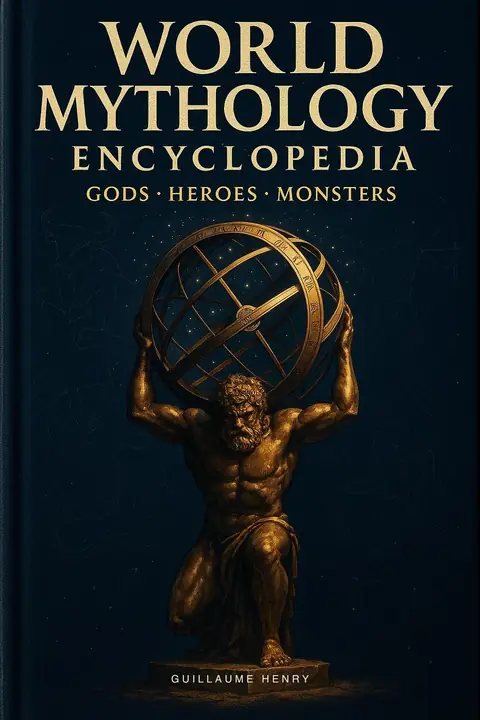
The World Mythology Book: The Gods, Heroes and Myths of Every Culture
The Gods, Heroes and Myths of Every Culture, in One Volume
The whole of world mythology in a single volume: Greek, Norse, Egyptian, Japanese, Hindu, Celtic, Slavic, Mesoamerican and African myths gathered side by side, each drawn from the primary sources.