
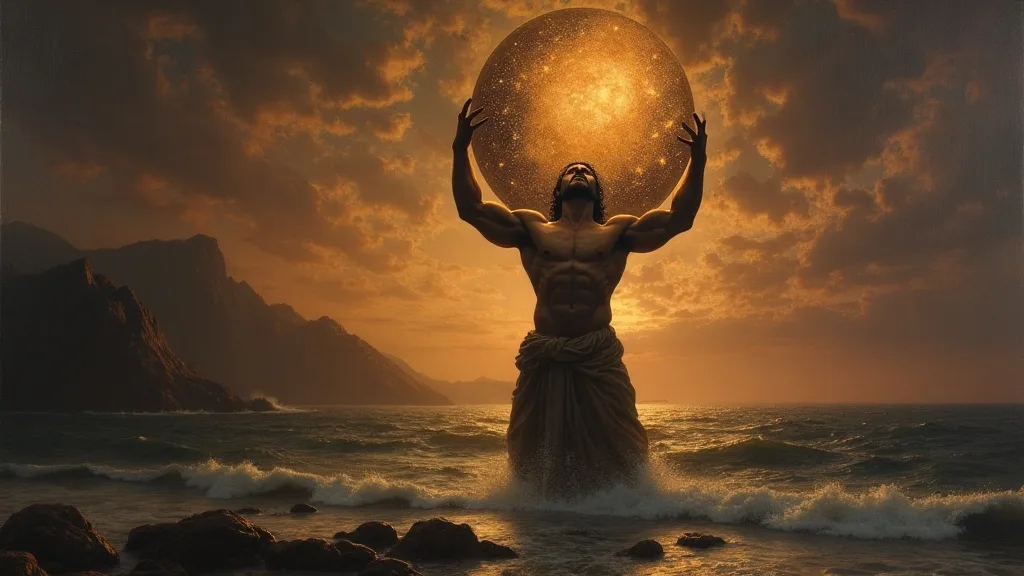
Atlas, Bearer of the Heavens: Titan, Cosmographer, and Eternal Sentinel
Atlas holds the sky not as punishment alone, but as cosmic necessity. Greek mythology's most iconic Titan carries a weight that shaped geography, astronomy, and the human imagination for three millennia.
Contents
The sky does not fall. It has never fallen. And according to the Greeks, there is a reason for that: a Titan stands at the edge of the known world, shoulders braced, arms locked upward, holding the weight of the heavens so the cosmos does not collapse in on itself. His name is Atlas, bearer of the heavens, and his posture is one of the most recognizable images the ancient world ever produced.
He is not a minor figure, shuffled to the margins of Olympian politics. Atlas anchors the entire Greek cosmological order. Remove him, and the sky meets the earth, the stars lose their track, the gods lose their stage. He is infrastructure made divine, a punishment that doubles as a cosmic function, a Titan whose suffering is also a service.
What surprises most readers is how layered he becomes the longer you look. The Hesiodic Theogony, the Homeric Odyssey, Pindar, Ovid, Apollodorus: each source adds a new dimension. Atlas is father of the Pleiades and the Hesperides, the man who almost tricked Herakles into carrying his burden forever, the guardian of golden apples, and the figure whose name eventually gave the Atlantic Ocean and the entire continent of Africa's northern range their meaning.
Atlas in the Family Tree of Titans
Atlas belongs to the first generation of Titans, the children of Ouranos (Sky) and Gaia (Earth). His father in most traditions is the Titan Iapetos, whose name likely connects to the Proto-Indo-European root for "to strike" or "to pierce." His mother is the Oceanid Klymene (sometimes given as Asia in alternate genealogies). That parentage places Atlas firmly in the lineage of cosmic boundary-keepers: Iapetos also fathered Prometheus and Epimetheus, the brothers whose theft of fire and opening of Pandora's jar set the human story in motion.
Atlas's siblings are a remarkable cluster of figures associated with human fate and cosmic order:
- Prometheus (pro-metheus, "forethought"), the fire-giver and champion of humanity
- Epimetheus (epi-metheus, "afterthought"), who accepted Pandora despite Prometheus's warning
- Menoitios, struck down by Zeus's thunderbolt for his reckless pride, condemned to Erebos
Atlas himself fathered several significant lineages. By the Oceanid Pleione, he sired the seven Pleiades, the star cluster that ancient Greeks used as a seasonal agricultural calendar. The heliacal rising of the Pleiades in May signaled the start of the sailing season; their setting in November announced winter's approach. Every Greek farmer who watched that cluster cross the horizon was, indirectly, watching Atlas's daughters.
By the Hesperid nymph Hesperis (or sometimes Pleione in alternate sources), he fathered the Hesperides, the nymphs of the evening and the western garden where golden apples grew under their care. The Titan Kalypso, the nymph who detained Odysseus on the island of Ogygia for seven years (as Homer records in Odyssey Book 1), is also named as Atlas's daughter. Homer calls Atlas "baneful-minded" (oloophron) in that passage, a detail that hints at a darker, more dangerous character than later tradition preserves.
The sea-goddess Elektra and Maia, mother of Hermes by Zeus, round out the most frequently cited daughters. Through Maia alone, Atlas becomes the grandfather of the messenger god, a genealogical detail that quietly connects the Titan's cosmological role to Hermes's function as guide between realms.
The War that Condemned Him: Atlas and the Titanomachy
The sentence Atlas carries was handed down after the Titanomachy, the ten-year war between the older Titans and the Olympian gods led by Zeus. Hesiod describes the conflict in the Theogony (lines 617-735) with genuine epic weight: mountains were used as missiles, the sea boiled, the earth shook, and Tartaros itself echoed with the noise. The Titans, Atlas among them, fought from Mount Othrys; the Olympians fought from Mount Olympos.
When Zeus and his siblings won, the defeated Titans were hurled into Tartaros, that deep pit beneath the earth, bound in chains and guarded by the Hekatoncheires (the Hundred-Handers). But Atlas received a singular fate. Pindar, in his Pythian Odes (4.289), names him standing at the pillars of earth and sky, distinct from the imprisoned Titans. Hesiod confirms: Atlas stands at the western edge, near the singing Hesperides, holding up the wide sky with his head and tireless hands. He is not imprisoned. He is stationed.
Why the different treatment? Ancient commentators debated this. One reading is that Atlas, as leader of the Titan forces, received a sentence calibrated to his specific offense: he had overreached toward heaven, so he must now hold heaven up for eternity, close to the sky but never part of it. Another reading, less punitive and more structural, sees Atlas as a necessary cosmological appointment: someone must hold the sky, and only a Titan of his strength could do it. The punishment and the function are inseparable. Zeus is not simply cruel; he is efficient.
Herakles, the Golden Apples, and the Almost-Escape
The most theatrically rich episode in Atlas's mythology arrives during the Eleventh Labor of Herakles. Herakles is sent to fetch the golden apples of the Hesperides, which grow in Atlas's garden at the world's western edge, tended by Atlas's own daughters. The apples are guarded by the serpent Ladon, coiled around the tree. The problem for Herakles is access: how does a mortal hero, however strong, enter a divine garden?
The answer is Atlas. Herakles makes the Titan a proposal: if Atlas will retrieve the apples himself (his daughters, after all, will allow him), Herakles will hold the sky in the meantime. Atlas agrees. He shrugs the sky onto Herakles's shoulders, retrieves the apples, returns, and then pauses.
He does not want to take the sky back.
The stratagem Atlas proposes varies slightly between sources. Apollodorus's Bibliotheka (2.5.11) gives the most complete version: Atlas returns with the apples and tells Herakles he will carry them to Eurystheus himself, leaving Herakles to hold the sky permanently. Herakles, thinking fast, pretends to agree but asks Atlas to hold the sky for just a moment while he adjusts a pad for his head. Atlas obliges. The moment he takes the sky back, Herakles grabs the apples and walks away.
This episode rewards careful reading. Atlas is not purely sympathetic here. He schemes. He recognizes that the burden he carries is transferable, that another body could hold what he holds, and he tries to seize that freedom. Herakles matches him trick for trick. The result is stalemate: both return to their assigned roles, nothing changes cosmologically, and the apples reach Eurystheus's hands. But the story lodges something in the imagination: Atlas once almost passed his burden to someone else. The sky came close to changing shoulders.
Atlas (Titan)
- Son of Iapetos and Klymene
- Condemned to hold the sky after the Titanomachy
- Stationed at the western edge of the world, near the Hesperides
- Father of the Pleiades, Hesperides, Kalypso, Maia
- Represents cosmic endurance, the weight of structural duty
- Outwitted (temporarily) by Herakles
- Immortalized in geographic naming: Atlas Mountains, Atlantic Ocean
Prometheus (Titan)
- Son of Iapetos and Klymene (same parents)
- Condemned to daily torture on Mount Caucasus after stealing fire
- Chained to a rock in the Caucasus range, not at a world-edge
- Father of Deucalion, ancestor of the post-flood human race
- Represents defiant beneficence, the cost of giving knowledge
- Eventually freed by Herakles
- Immortalized in cultural metaphor: "Promethean" ambition
Perseus, Medusa's Head, and the Birth of Mountains
A second myth connects Atlas to another of Greek mythology's great heroes. Perseus, returning from his killing of the Gorgon Medusa, flies over the western lands carrying the severed head in his bag. He asks Atlas for hospitality: a place to rest, shelter for the night.
Atlas refuses. He has heard a prophecy that a son of Zeus will one day come to steal the golden apples, and Perseus, son of Zeus by Danae, fits the description too well. The refusal is not inhospitable spite alone; it is calculated self-protection.
Perseus, insulted and unable to force his way past the Titan, draws out Medusa's head and holds it toward Atlas. The Titan turns to stone. His body becomes the Atlas Mountains of northwestern Africa, the range the Greeks called the backbone of the world's western edge. His head becomes the peak where clouds gather; his arms and shoulders become the ridgelines; snow lies on his stone hair like a permanent crown.
Ovid tells this version in Metamorphoses (4.627-662) with particular vividness, one of his best short transformations. The episode adds a geological dimension to Atlas's mythology: the Titan is not just holding the sky up as a biological entity, he is physically fused with the landscape. The mountains are his body. That identification between the Titan and the terrain of northwestern Africa persisted into Roman cartography, where Mons Atlas named the range we still call the Atlas Mountains today.
Atlas as Astronomer and Navigator: The Mythological Tradition
A secondary tradition, running partly alongside the cosmic-punishment mythology and partly as a rationalist alternative, presents Atlas not as a brute-strength cosmological prop but as the first astronomer. This version appears in Diodoros Sikolos (Library of History 3.60) and in fragments of the mythographer Palaiphatos. In this reading, Atlas "carried the sky" metaphorically: he was the first to understand the celestial sphere, to map the stars, to chart the movements of the planets. He invented astronomy and spherical geometry, and later generations, awed by the abstraction, literalized the metaphor into the image of a Titan holding the actual vault of heaven.
This euhemeristic reading has modern parallels. We still name atlases (books of maps) after him. The Mercator atlas of 1595 featured a frontispiece showing Atlas at his calculations, not at his labor, a deliberate distinction that recovers the astronomer from the condemned prisoner.
The two traditions do not cancel each other. They layer. The astronomer who understood the sky and the Titan condemned to hold it occupy the same symbolic space: both are defined by their intimate, unending relationship with the heavens, one through knowledge, the other through duty.
The Daughters of Atlas: Pleiades, Hesperides, Kalypso, Maia
Atlas's mythological reach extends through his children in ways that shape the entire Greek cosmos. His daughters are worth cataloguing carefully, because each one operates in a domain that reflects her father's position at the edge of the known world.
The Pleiades were the seven daughters Atlas had with the Oceanid Pleione. Their names in Hesiod and later sources are Alkyone, Merope, Kelaino, Elektra, Sterope, Taygete, and Maia. After their death, or after being pursued by Orion for seven years, they were placed in the sky as the star cluster we still call the Pleiades in the constellation Taurus. Merope is traditionally the dimmest of the seven, said to hide her face in shame for having married a mortal (Sisyphos) while her sisters married gods.
The Hesperides guarded the garden at the world's edge where golden apples grew, a gift from Gaia to Hera at her wedding to Zeus. Their number varies between three and seven in different sources. The serpent Ladon, whom Herakles killed or circumvented, coiled around the apple tree as an additional guardian.
Kalypso, named in Odyssey Book 1 as daughter of Atlas, held Odysseus on her island Ogygia for seven years. Homer is pointed: she kept him against his will, offering immortality if he would stay with her. That offer mirrors Atlas's own condition; Ogygia is described as remote, at the navel of the sea, its location undefined, like a second western edge. Kalypso inherits her father's marginality.
Maia, the eldest and most beautiful of the Pleiades in most traditions, retreated to a cave on Mount Kyllene in Arkadia where she bore Hermes to Zeus. The infant Hermes promptly invented the lyre, stole Apollo's cattle, and negotiated himself into the Olympian order in a single day, as told in the Homeric Hymn to Hermes. Through Maia, Atlas is the grandfather of the god of travelers, thieves, and messengers.

The Atlas Mountains, the Atlantic, and Geographic Legacy
The Titan's name mapped itself onto the physical world in ways that outlasted Greece, Rome, and the medieval period. The Atlas Mountains of Morocco, Algeria, and Tunisia carry his body. The Atlantic Ocean derives its name from the Sea of Atlas, the waters west of the mountain range that marked the edge of the known Mediterranean world. Beyond it lay the unknown, which is to say, Atlas's domain.
Plato placed Atlantis in that same western ocean, naming the legendary island-civilization after Poseidon's eldest son by Kleito, who was also called Atlas. Whether Plato intended a deliberate echo of the Titan or was using a shared root meaning "to carry" or "to endure" is a question scholars have not settled. The coincidence, if it is one, is remarkable: both the Titan and Plato's Atlantean king bear the same name, occupy the same western geography, and are associated with civilizations at the world's edge.
The Romans extended the range. Mauretania, the region of modern Morocco and Algeria, was called the land beneath Atlas. Roman soldiers marching west to the edge of the empire literally walked toward the mountain that bore his name. The Titan had become geography.
Atlas in Philosophical and Allegorical Reading
The Stoics and later Neoplatonist philosophers found Atlas irresistible as an allegory. For the Stoics, the Titan represented the rational pneuma (breath or spirit) that held the cosmos in tension, the organizing principle without which the universe would fly apart. The sky needing to be held was not a primitive cosmological claim but a structural truth about cosmic order.
Neoplatonists, following Plotinus and Porphyry, read Atlas as the World Soul (Anima Mundi), the intermediary between the intelligible realm and the material cosmos. The soul "bears" the heavens in the sense that it animates and sustains the material world without being identical to it. That reading transformed a myth of punishment into a myth of ontological function: Atlas carries the sky because the sky requires a soul to hold it in being.
These readings were not idle speculation. They shaped how educated Romans and later Renaissance scholars understood the myth. Albrecht Dürer's engravings, the frontispieces of early modern atlases, and the architectural use of Atlas figures (atlantes or telamons, the male equivalents of caryatids) as structural columns in buildings all draw on the idea of Atlas as necessary support, not mere condemned prisoner.
Atlas Across World Mythologies: Parallel Sky-Bearers
The image of a figure holding the sky is not unique to Greece. Several traditions independently developed similar cosmological solutions to the same structural question: what prevents sky and earth from merging?
In ancient Egyptian cosmology, Shu, the god of air and light, stands between the earth-god Geb (lying flat) and the sky-goddess Nut (arched above), holding Nut aloft with raised arms. Shu is not punished; he is appointed. His posture mirrors Atlas's exactly, but the moral valence is opposite: Shu is a cosmic functionary in good standing, not a condemned Titan.
In Hindu cosmology, the Cosmic Tortoise and the World Elephant figure in a vertical stack of world-support: the earth rests on the back of elephants who stand on a tortoise who floats on a cosmic ocean. The mechanism is distributed, not individualized, but the cosmological anxiety it addresses is identical: what holds things up?
Norse tradition offers Ymir, whose body becomes the world, and the four dwarves (Norðri, Suðri, Austri, Vestri) who hold up the sky-vault made from Ymir's skull, stationed at the four cardinal points. Four sky-holders rather than one; the labor is shared rather than individualized. The comparison with Atlas sharpens the Greek myth's characteristic move: concentrating cosmic labor in a single, named, suffering figure.
The Mesoamerican Bacabs of Maya cosmology, four deities stationed at the world's corners to hold up the sky, provide another parallel. Like the Norse dwarves, the Bacabs distribute the labor. The Greek choice to concentrate it in Atlas alone gives his myth its particular emotional weight.
Atlas in Modern Reception: From Renaissance Atlases to Science Fiction
The word atlas, meaning a book of maps, entered European languages because of Gerardus Mercator. His posthumously published 1595 collection of maps featured Atlas on its cover holding the celestial sphere, not a geographic map. The choice was deliberate: Atlas as the astronomer-knower, not just the carrier. Subsequent cartographers copied the image, and by the seventeenth century, atlas had generalized to mean any comprehensive geographic collection.
The architectural use of atlantes (singular: atlas, plural: atlantes) flourished in Hellenistic and Roman architecture. Male figures used as structural columns, arms raised to support a ceiling or entablature, appear in the Temple of Olympian Zeus at Agrigento in Sicily (Akragas), built around 480 BCE. Eighteen colossal atlantes once stood between the outer columns of that temple, each nearly eight meters tall. The building was never completed, possibly because of the Carthaginian sack of the city in 406 BCE, but fragments survive and one reconstructed figure lies in the Agrigento regional museum.
In literature, Ayn Rand's Atlas Shrugged (1957) uses the Titan as its central metaphor: what happens when the productive bearers of civilization shrug off their burden? The political reading is Rand's own, but the mythological subtext is accurate to Hesiod: Atlas could transfer his burden. The Herakles episode proved it. The question is whether he should.
Science fiction and fantasy have found Atlas useful precisely because his image is transferable. The carrier of ultimate weight, the sentinel at the world's edge, the figure whose endurance holds civilization together: these are templates that reappear in characters ranging from Superman to the character of Atlas in DC Comics (where the name has been used for multiple figures) to the space launch company that literally named a rocket after him.
Frequently Asked Questions about Atlas, Bearer of the Heavens
Frequently asked questions
Does Atlas hold the earth or the sky in Greek mythology?
In the original Greek sources, Atlas holds the sky (ouranos or ouranos aitheros), not the earth. Hesiod's Theogony (lines 517-520) is explicit: he stands at the western edge holding up the broad heavens with his head and hands. The globe-bearing image familiar from Renaissance sculpture derives from a Roman conflation of the celestial sphere (which Atlas, as a sky-holder and proto-astronomer, was associated with) and the terrestrial globe. Classical Greek sources are consistent: the sky is his burden.
Why was Atlas punished differently from the other Titans after the Titanomachy?
The other defeated Titans were imprisoned in Tartaros, bound in chains and guarded by the Hekatoncheires. Atlas alone was stationed at the western edge of the world as a cosmological support. Ancient sources do not explain the difference explicitly. Scholarly readings suggest two possibilities: Atlas, as a military leader of the Titans, received a punishment calibrated to his pride (he reached toward heaven, so he holds heaven forever), or Zeus recognized that the cosmos required someone to hold the sky and appointed the strongest available figure. The punishment and the function collapse into one.
What is the connection between Atlas and the Pleiades star cluster?
The Pleiades are Atlas's seven daughters by the Oceanid Pleione. After their deaths, or after being pursued by Orion, the gods placed them in the sky as the star cluster in the constellation Taurus. The cluster's name in Greek (Pleiades) connects to plein (to sail) because their heliacal rising in May marked the opening of the Mediterranean sailing season. Every ancient Greek sailor who used the Pleiades for navigation was, within the mythological logic, guided by Atlas's daughters.
How did Atlas almost escape his burden during the Labors of Herakles?
During the Eleventh Labor, Herakles needed the golden apples of the Hesperides. Rather than fight through Ladon the serpent, he offered Atlas a deal: hold the sky temporarily while Atlas retrieved the apples from his own daughters. Atlas agreed. Returning with the apples, Atlas proposed to carry them to Eurystheus himself, leaving Herakles to hold the sky indefinitely. Herakles countered by asking Atlas to hold it a moment longer while he adjusted a pad on his head. The moment Atlas took the sky back, Herakles walked away with the apples. The episode appears most fully in Apollodorus's Bibliotheka (2.5.11).
Why does the Atlantic Ocean bear Atlas's name?
Greek and Roman geographers named the ocean west of the Atlas Mountains the "Sea of Atlas" (Atlantis thalassa in Greek, Mare Atlanticum in Latin) because it lay beyond the mountain range they identified with the Titan. The Atlas Mountains of northwestern Africa marked the extreme western limit of the known Mediterranean world. The ocean beyond them was Atlas's sea, the waters at the edge of the world where Atlas stood. The name transferred from the myth to the mountains to the ocean, and it has remained for two and a half millennia.
Is there a connection between Atlas the Titan and Plato's Atlantis?
Plato (Timaeus 24e, Critias 114a) names Atlantis's first king Atlas, son of Poseidon and the mortal woman Kleito. Plato's Atlas is a distinct figure from the Titan, though both names share the same root, likely from the Greek tlao (to carry, to endure). Plato situates Atlantis in the Atlantic Ocean, the same western sea associated with the Titan. Whether Plato deliberately invoked the Titan's mythology or simply used a geographic name derived from the same root is debated; most classicists read it as a deliberate resonance, not coincidence.
The Titan Who Became Infrastructure: Atlas's Unresolved Afterlife
Atlas does not get freed. That absence is worth sitting with. The hero cycle of Greek mythology is built on the principle of resolution: Prometheus is eventually unchained by Herakles, the Titans in Tartaros are sometimes said to be released in the Golden Age, even the dead in Elysium find a kind of peace. Atlas stands at the western edge for eternity with no release scheduled and no prophecy of one.
That unresolved status is partly what makes him so available to later cultures. He is not a story with an ending. He is a condition. The weight does not diminish. The arms do not tire in any final sense. He simply continues, which is why he maps so readily onto modern anxieties about the burden of knowledge, the cost of leadership, the exhaustion of holding something vast together by sheer endurance.
The architectural tradition of atlantes understood this intuitively. When a Roman architect placed a stone Atlas-figure at the base of a column, watching visitors enter a temple or a civic building, the message was structural and symbolic simultaneously: this weight is real, someone bears it, and the bearing is what makes civilization possible. The figure did not grimace or strain. It endured. That distinction between anguish and endurance may be the deepest thing the myth proposes.
Scholars like Walter Burkert (Greek Religion, 1985) have noted that Atlas belongs to a category of pre-Olympian figures whose function the Olympians could not absorb or replace. Zeus could not hold the sky himself; that was not his role. He needed a Titan for the task, which means the Titanomachy did not, in the end, fully replace the old order. It redeployed it. Atlas is the proof that the Titans were not defeated in any absolute sense. They were reassigned.
The sky still does not fall. Someone is still standing at the western edge.
Read the full book
Want the whole story?
The complete edition is an instant PDF download here, with a paperback on Amazon for selected titles.
Mythology
The World Mythology Book: The Gods, Heroes and Myths of Every Culture
The Gods, Heroes and Myths of Every Culture, in One Volume
The whole of world mythology in a single volume: Greek, Norse, Egyptian, Japanese, Hindu, Celtic, Slavic, Mesoamerican and African myths gathered side by side, each drawn from the primary sources.