

Bellerophon, Rider of Pegasus: Hubris, Glory, and the Fall from Heaven
Bellerophon tamed the winged horse Pegasus, slew the Chimera, and nearly reached Olympus itself. His story is Greek mythology's sharpest lesson in what happens when a mortal climbs too high.
Contents
The golden bridle appeared in a dream. Athena (or Poseidon, depending on which ancient source you follow) placed it in Bellerophon's hands while he slept at a temple in Corinth. When he woke, he found the bridle real and solid in the dirt beside him. He walked to the spring of Pirene on the Acrocorinth where Pegasus drank each morning, slipped the golden bit into the great horse's mouth, and the sky opened up to him.
That moment, a young man with a bridle standing at the edge of a spring while a winged horse bent its neck, is one of the most perfectly compressed images Greek myth ever produced. It holds everything the story is about: divine favour, mortal ambition, the threshold between what humans are allowed and what they dare to reach for.
The Crime, the Exile, and a Letter That Demanded Death
Bellerophon rider of Pegasus enters the mythological record already under a cloud. Born in Corinth as the son of Glaucus (grandson of Sisyphus in most traditions), or in some strands as a son of Poseidon himself, he killed a man early in life. The identity of the victim changes across sources: sometimes it is his own brother Deliades, sometimes a Corinthian tyrant named Bellerus, whose name may in fact be the etymological root of Bellerophon's own title, meaning something close to "slayer of Bellerus."
Exile was the prescribed remedy for blood guilt. Bellerophon traveled to the court of King Proetus in Tiryns to undergo ritual purification. Proetus cleansed him and welcomed him as a guest. It was a fatal act of hospitality.
Anteia, Proetus's queen (called Stheneboea in some versions, including Euripides' lost tragedy), desired Bellerophon and propositioned him directly. He refused her. The rejection, private and total, became a wound she could not let close. She went to Proetus and turned the story inside out: Bellerophon had approached her, she said. He had dishonoured her.
Proetus believed his queen. But Greek law of xenia, sacred hospitality, forbade a host from killing his own guest. So Proetus reached for a workaround. He wrote a letter, sealed it, and sent Bellerophon to deliver it personally to Iobates, king of Lycia in Asia Minor. Iobates was Anteia's father. The letter instructed him to kill the bearer.
Homer in Iliad VI describes these marks as semata lugra, "baneful signs," written on a folded tablet. This passage is one of the earliest references to writing in all of Greek literature, and it carries a peculiar weight: literacy here is not power but a death warrant the carrier cannot read.

Iobates fed Bellerophon, entertained him for nine days, and only on the tenth day unfolded the tablet. He read his son-in-law's command. And like Proetus, Iobates balked at killing a guest under his own roof. He chose a different method. He would send the young man on a mission no human being could survive.
The Chimera: Three Heads, One Fire, One Rider
The Chimera was a breathing catastrophe. Homer calls it "lion in front, serpent behind, goat in the middle," breathing fire. Later sources - Hesiod's Theogony most systematically - give it three heads: the lion's at the front, a goat's growing from its back, a snake's neck as its tail. It had been devastating Lycia, burning crops and villages. Iobates sent Bellerophon against it, expecting the creature to provide a clean and deniable death.
Pegasus made the difference. From the air, Bellerophon could not be reached by the lion's claws or the serpent's fangs. He drove the Chimera back with arrows, then, in the most inventive detail the myth preserves, he crammed lead onto the tip of his spear and thrust it into the creature's fire-breathing mouth. The Chimera's own heat melted the lead, which poured down its throat and killed it from within.
Iobates tried again. He sent Bellerophon against the Solymi, a fierce tribe in the Lycian highlands. Bellerophon crushed them. He sent him against the Amazons, the warrior women of the Black Sea coast. Bellerophon scattered them too. Finally Iobates assembled an ambush of the finest Lycian warriors and sent them against the hero on his return. Bellerophon and Pegasus annihilated that force as well.
Iobates understood then. He was not dealing with a guilty man running from blood-crime. He was dealing with someone the gods clearly favoured. He produced the letter from Proetus, asked Bellerophon to explain himself, heard the truth, and gave his own daughter in marriage along with half the kingdom of Lycia.
For a time, Bellerophon was exactly what Greek myth allows a mortal hero to be: tested to his limits, vindicated by endurance, rewarded by a king who had the wisdom to recognise divine favour when he encountered it.

Pegasus: The Horse Who Belongs to Heaven
Pegasus deserves his own frame before the story's final turn.
He was not Bellerophon's creation or discovery. He was born from the blood that fell into the sea when Perseus severed Medusa's head. The name Pegasus likely connects to the Greek pege, "spring" or "source of water," and wherever his hooves struck the earth, springs gushed up. The most famous of these was Hippocrene on Mount Helicon, the spring that fed the Muses' inspiration.
Pegasus was Poseidon's creature in essence: born from a god of water and Medusa, a goddess transformed into a monster. His whiteness, his wings, his wild freedom before Bellerophon bridled him, all of this placed him in a liminal space between the divine and the animal. He did not belong to the mortal world. He was on loan to it.
After Bellerophon's fall (which we are coming to), Pegasus flew on to Olympus alone, where Zeus kept him and used him to carry his thunderbolts. He became, finally, a constellation. The horse always belonged to the sky, not to any man.
Bellerophon
Son of Glaucus (or Poseidon), mortal hero. Won his wings through divine gift: the golden bridle given in a dream. Earned his ascent through genuine trials: the Chimera, the Solymi, the Amazons. His fall was triggered by deliberate overreach, a conscious decision to fly to Olympus, which makes it hubris in the classical sense.
Icarus
Son of Daedalus, a craftsman's child. His wings were built, not given by any god. His flight was imposed by circumstance: escape from Crete. His fall came from forgetting a warning rather than deliberately defying the gods. Greek tradition tends to read it as the recklessness of youth rather than hubris proper.
The Ascent to Olympus and the Fall
Bellerophon's error is introduced by Pindar, who shapes it with a kind of sorrowful precision. He writes in Isthmian 7: the hero, flushed with triumphs, began to want more. He wanted to stand on Olympus with the gods themselves.
He mounted Pegasus and began to climb. Not to deliver a message, not to carry out a divine commission, but simply to arrive. To be there.
Zeus sent a gadfly. The insect stung Pegasus beneath the belly. The horse bucked violently, and Bellerophon fell. He tumbled back down through the sky he had almost conquered and landed in the Aleian Plain of Cilicia.
He survived. That is perhaps the cruelest element of the myth. He was not killed. He wandered the Aleian Plain alone, lame, blinded in some accounts, "devouring his own heart" in Homer's spare phrase from Iliad VI, "avoiding the paths of men." He lived out his years in solitude and grief, stripped of Pegasus, stripped of divine favour, unable to explain himself to anyone because the gods do not explain their silences.
No tomb was built for him. No cult of the kind that honoured Heracles or Achilles gathered around his name. He simply disappeared into his own shame.

Hubris as Architecture: What the Myth Actually Argues
Greek mythology is not simply a collection of stories. It encodes a theory of the cosmos, and the Bellerophon cycle is one of its clearest structural arguments.
The word hubris in classical Greek meant something more specific than modern "arrogance." It was the act of deliberately dishonoring someone, of treating boundaries as optional, of placing yourself where you had no right to stand. When Bellerophon aimed Pegasus at Olympus, he was not merely being vain. He was refusing the category of "mortal." He was saying, in effect, that his achievements had made him something other than human.
Greek myth punishes this not because the gods are insecure, but because the entire edifice of the cosmos rests on categorical distinctions. Zeus sits atop Olympus not as an arbitrary tyrant but as the enforcer of those distinctions. When a mortal crosses the line, the response is structural, not personal.
Compare Heracles, who also climbed Olympus, but did so only after death and apotheosis granted by Zeus himself. The journey was earned through suffering, then formally sanctioned. Or compare Prometheus, who crossed a boundary in the opposite direction, bringing divine fire down rather than carrying human ambition up, and suffered eternal punishment for it. The Greek cosmological system has clear borders, and the myths mark every place where someone tested them.
Bellerophon is not a villain in this story. He was genuinely heroic: he took on the Chimera without guarantee of survival, treated Anteia's accusation with honour, and served Iobates faithfully even while being manipulated. His tragedy is that heroism, taken one step too far in the wrong direction, becomes hubris without the hero necessarily being aware of the transition.
Cross-Cultural Echoes: The Winged Rider Who Fell
The pattern Bellerophon embodies, the mortal who rides an extraordinary mount toward a divine threshold and plummets back, appears with striking consistency across cultures distant from the Aegean.
In Mesopotamian tradition, the Akkadian hero Etana rode an eagle toward the heaven of Anu, king of the gods, seeking the Plant of Birth to cure his childlessness. The eagle carried him up through the levels of heaven until he looked down and saw the sea as a stream, the land as a courtyard. Etana's nerve failed, the eagle folded its wings, and both fell. The earliest version of this myth dates to the Old Babylonian period, roughly 2000-1600 BCE, making it older than the Greek Bellerophon tradition.
In Irish mythology, the hero Cú Chulainn's chariot-horse, Liath Macha (the Grey of Macha), is born from a supernatural lake and participates in battles that transcend ordinary human warfare. The horse is not a gift to be ridden toward heaven, but the dynamic of a mortal man whose extraordinary mount marks him as operating at the edge of the human, is the same.
Sanskrit epic tradition gives us the flying chariot Pushpaka Vimana, which carries both Ravana and, later, Rama across the sky in the Ramayana. Aerial transport in that tradition marks divine or semi-divine status; the moment a fully human figure climbs aboard, the implications shift.
None of this means Greeks borrowed from Mesopotamia or that all these myths share a single source. What it suggests is that the cognitive structure, the image of a human being on an aerial mount approaching a divine ceiling and being turned back, maps onto something that multiple ancient cultures independently found necessary to articulate.
The Sources: What the Ancients Actually Said
Bellerophon appears in Greek literature across a span of roughly eight centuries. The major records:
- Homer, Iliad VI (700s BCE): The fullest narrative account, told by Glaucus, Bellerophon's grandson, on the battlefield of Troy. Homer does not describe the fall explicitly here, but the reference to Bellerophon wandering the Aleian Plain "devouring his own heart" makes the aftermath vivid.
- Hesiod, Theogony (700s BCE): Describes Pegasus and the killing of the Chimera. Hesiod does not elaborate on Bellerophon's later fate.
- Pindar, Olympian 13 and Isthmian 7 (early 400s BCE): Pindar gives the most ceremonious account of Bellerophon's bridle, the spring at Pirene, and the ascent to Olympus. He handles the fall with conspicuous delicacy, as if it pains him to say it outright.
- Euripides, Stheneboea and Bellerophontes (400s BCE, both lost): Euripides appears to have written at least two dramas treating parts of this myth. Fragments suggest his Bellerophontes followed the hero's desolation in the Aleian Plain and may have given him a bitter speech questioning the justice of the gods.
- Apollodorus, Bibliotheca (1st-2nd century CE): The mythographer provides a systematic account that draws together the Proetus, Iobates, Chimera, and fall sequences. Useful as a late synthesis.
- Hyginus, Fabulae (2nd century CE): A Latin summary tradition that preserves details not found in the Greek sources.
The gaps between these accounts matter. Homer, our earliest witness, tells the story through a third party and never explains why Bellerophon fell. Pindar adds the aspiration to Olympus. The lost Euripidean dramas likely added psychological texture now beyond recovery. What survives is a myth with clear bones but significant interpretive space.
Bellerophon in the Hellenistic and Roman World
The hero's story did not stop circulating after the classical period. Hellenistic art favoured the dramatic scene of Bellerophon mounted on Pegasus above the Chimera, a composition found on painted pottery, bronze fibulae, and mosaic floors from the eastern Mediterranean.
Roman mosaic traditions in Britain, Gaul, and North Africa reproduced this scene extensively. The Hinton St. Mary mosaic from Dorset (now in the British Museum), dated to the 4th century CE, places a portrait presumed to be Christ in its central roundel and Bellerophon killing the Chimera in its corner panels. The implication is that by late antiquity, Bellerophon's triumph over a fire-breathing monster had become legible as a symbol of good conquering evil, overlaid with early Christian iconography without any sense of contradiction.
This visual persistence suggests that the image of the winged rider killing the monster was culturally legible far beyond any specific Greek theological content. It could migrate across belief systems because its core drama, a figure on a white winged horse defeating a creature of destructive fire, works as pure visual argument.
The name itself moved through medieval Europe in unexpected directions. The Byzantine tradition kept Pegasus in the astronomical literature (as a constellation it never lost its name). Versions of the winged horse story fed into medieval romances through the Islamic transmission of classical texts, eventually contributing to images like the Buraq, the luminous steed who carried Muhammad on the Isra, the Night Journey to Jerusalem and the heavens.
Frequently asked questions about Bellerophon and Pegasus
Frequently asked questions
Was Bellerophon the son of Poseidon or the son of Glaucus?
The ancient sources disagree, and both versions circulated simultaneously in antiquity. Homer in the Iliad treats Glaucus (son of Sisyphus) as Bellerophon's father without qualification. Pindar and later mythographers introduce the tradition of divine paternity via Poseidon, which would explain Bellerophon's extraordinary abilities and Pegasus's obedience, since both hero and horse would then share a divine father. The two versions are not mutually exclusive in Greek mythological logic: "divine parentage" often functions as a way of explaining excellence rather than a literal genealogical claim.
How did Bellerophon tame Pegasus if the horse was born wild and free?
The key instrument is the golden bridle given by Athena (in some versions Poseidon) during a dream at the temple of Athena in Corinth. Pindar in Olympian 13 gives the fullest account: Bellerophon slept in the sanctuary, Athena appeared and gave him the bridle, and he found it beside him on waking. The supernatural origin of the bridle signals that the taming was divinely sanctioned, not a feat of human horsemanship alone. Without that gift, Bellerophon would have had no means of controlling a creature that belonged, in essence, to the divine sphere.
What happened to Pegasus after Bellerophon fell?
Pegasus flew on to Olympus uninjured and entered the service of Zeus. According to several ancient sources including Hesiod, Zeus kept him there to carry the thunderbolts. Eventually Pegasus was placed among the stars as the constellation Pegasus, visible in the northern sky. His post-Bellerophon life underscores the point the myth makes structurally: the horse always belonged to the divine order; his time with Bellerophon was a loan, not a permanent transfer.
Did Bellerophon die from his fall, or did he survive?
He survived physically but was utterly broken. Homer's description in Iliad VI is the most famous summary: he wandered the Aleian Plain "devouring his own heart," alone, "avoiding the paths of men." Some later sources add lameness or blindness. He received no heroic death, no divine apotheosis, and no cult. His end was obscurity, which Greek tradition sometimes treats as worse than death. He simply ceased to be part of the story, which is the myth's most precise punishment.
Is the Chimera purely mythological, or does it have a real-world basis?
The Chimera was consistently located at Yanartaş (ancient Chimaera) in Lycia, modern south-western Turkey, a site where natural methane vents produce perpetual flames from the rock face. Ancient travellers who encountered these flames and heard local accounts may have contributed to the monster's fire-breathing attribute. The site was well-known in antiquity; Pliny the Elder mentions it, and the flames still burn today. This does not "explain" the myth but it places one of its most vivid details in a real landscape.
How does Bellerophon's story differ from that of Icarus?
Both fall from the sky, but the structural logic differs. Icarus fell because he ignored a warning and flew too close to the sun, an act of youthful recklessness more than calculated defiance. Bellerophon fell because he aimed deliberately at Olympus after a career of genuine achievements, which is hubris in its classical form: the belief that earned greatness grants access to the divine sphere. Icarus's story is about caution; Bellerophon's is about the permanent ceiling placed on mortal ambition, however heroic.
Bellerophon's Ghost in Modern Storytelling
Bellerophon's story has not produced a single dominant modern adaptation the way the Odyssey or the Perseus cycle have. No Homer wrote his return. No Dante placed him in a recognisable circle. And that absence is worth thinking about.
The myths that generate the most enduring retellings tend to be ones where the protagonist's moral status remains genuinely ambiguous (Achilles, Antigone) or where the ending contains seeds of recovery (Odysseus, Persephone). Bellerophon offers neither. He did everything right until the one moment he did not, and after that moment there was nothing left to tell. He wandered a plain, alone, for the rest of his life.
What he offers instead is a pressure-test for any story about ambition. Writers from Marlowe's Tamburlaine to Milton's Satan to Mary Shelley's Frankenstein have placed their protagonists in the same structural position: exceptional achievement, divine threshold, catastrophic refusal to stop. The Bellerophon pattern runs underneath all of them, even when no one is consciously invoking it.
Scholars like Gregory Nagy (in The Best of the Achaeans) and Charles Segal (in Pindar's Mythmaking) have examined how the Bellerophon episode in the Iliad functions as a kind of shadow mirror for Achilles: another man of extraordinary gifts, another clash between personal greatness and cosmic limit. The hero who falls from the sky never names what he was reaching for. He just falls. And that open silence is what keeps the myth alive, because every reader fills it with their own ceiling.
The spring at Pirene on the Acrocorinth above old Corinth still exists, reduced now to a cistern cut in ancient stone. The site at Yanartaş in Turkey still burns. The constellation Pegasus rises every autumn in the northern hemisphere, a large empty square of stars that the Greeks saw as a horse mid-flight. And the question the myth asks, at what point does a mortal's reach become the reason for their fall, has not found an answer that makes the asking unnecessary.
Read the full book
Want the whole story?
The complete edition is an instant PDF download here, with a paperback on Amazon for selected titles.
Mythology
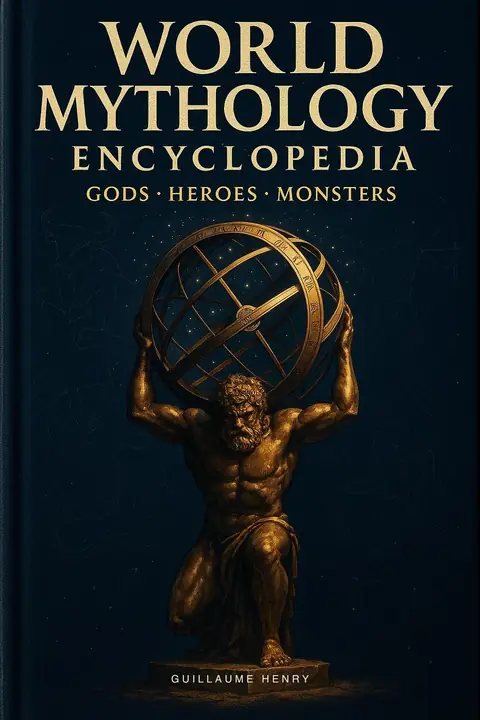
The World Mythology Book: The Gods, Heroes and Myths of Every Culture
The Gods, Heroes and Myths of Every Culture, in One Volume
The whole of world mythology in a single volume: Greek, Norse, Egyptian, Japanese, Hindu, Celtic, Slavic, Mesoamerican and African myths gathered side by side, each drawn from the primary sources.