
Cronus the Titan King: Ruler of the Golden Age, Devourer of His Children
Cronus ruled the cosmos before Zeus drew breath. His story moves from cosmic castration to golden utopia to a paranoid king swallowing his own heirs. Here is the full account.
Contents
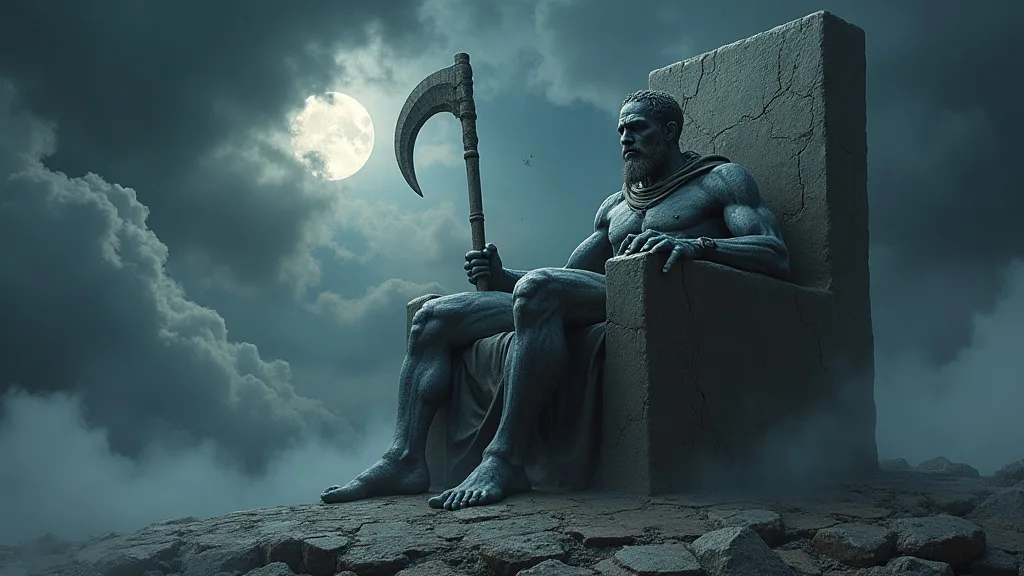
The sickle was already waiting. Cronus the Titan king did not forge it in secret or improvise his father's overthrow on impulse. Gaia, the Earth, had pressed the grey flint blade into his hands long before the moment of violence, and Cronus alone among his siblings was willing to take it. When his father Ouranos descended to lie with the Earth as night fell, Cronus reached from his hiding place and castrated the sky.
That single act collapsed an entire cosmology and built a new one. Ouranos bled into the sea, and from that blood rose the Erinyes, the Giants, the Meliai nymphs, and eventually Aphrodite herself. Cronus threw the severed parts into the waves and turned to claim the throne of the cosmos. He had not yet done anything a Greek audience would call wrong. He had obeyed his mother, freed his imprisoned Titan siblings, and ended the tyranny of a father who had shoved his own children back into the earth rather than let them see daylight.
Then he chained those same siblings back underground. Power teaches its own lessons fast.
The Titan Family Tree: Where Cronus Fits
Hesiod's Theogony sets out the genealogy with unusual precision for archaic poetry. Gaia and Ouranos produced twelve Titans in the first generation: six brothers (Oceanus, Coeus, Crius, Hyperion, Iapetus, and Cronus) and six sisters (Theia, Rhea, Themis, Mnemosyne, Phoebe, and Tethys). Cronus was the youngest son, which carries specific weight in archaic Greek cosmology, where the youngest child frequently inherits the role of revolutionary or trickster.
His consort was Rhea, his own Titan sister. Theirs was not a union of affection so much as a cosmic necessity: the paired generation that would produce the Olympians. Cronus and Rhea's children are the most recognized names in Greek religion:
- Hestia, goddess of the hearth
- Demeter, goddess of grain and harvest
- Hera, eventual queen of the Olympians
- Hades, lord of the underworld
- Poseidon, ruler of the seas
- Zeus, the youngest, who would overthrow Cronus just as Cronus had overthrown Ouranos
The pattern is not subtle. The Theogony (lines 453-500) makes it explicit: a prophecy, spoken first by Gaia and Ouranos, warned Cronus that one of his own children would unseat him. He responded by swallowing each infant immediately after birth.
The Prophecy and the Swallowing
Hesiod describes the swallowing with blunt economy. Cronus received each child from Rhea and "swallowed them down," allowing no challenger to grow inside his own house. The Greek word katapino (to swallow down, to consume entirely) appears in the Theogony with a directness that leaves no allegorical escape route. This was not metaphor. The children lived, compressed and motionless, inside their father's stomach.
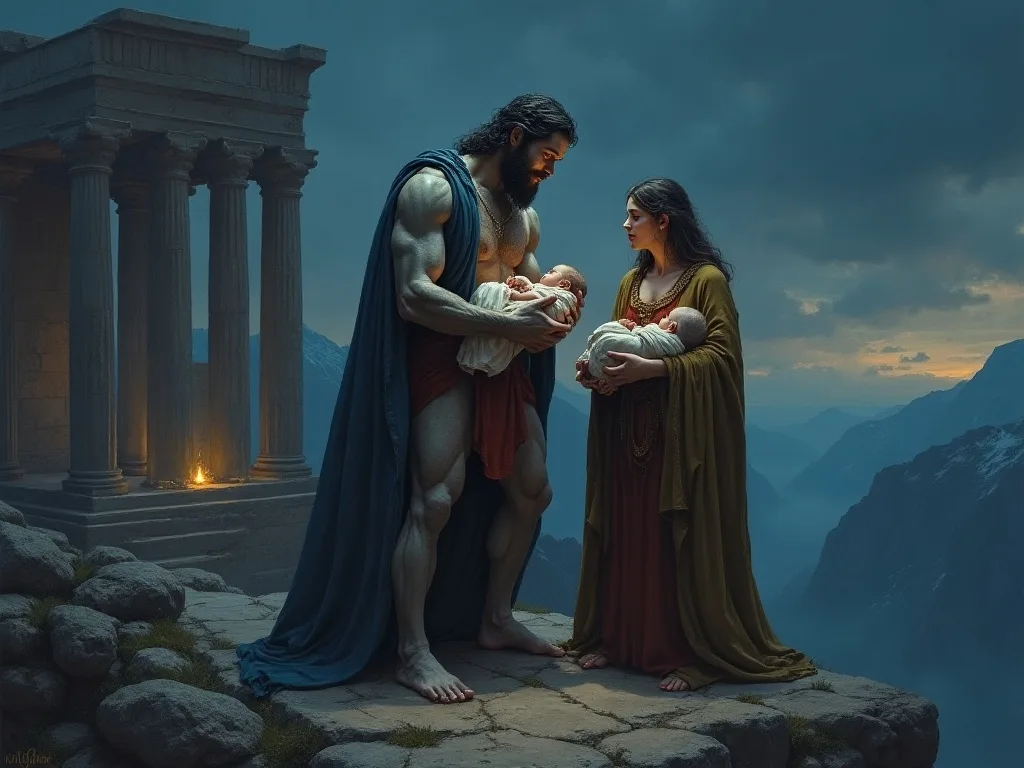
Rhea, watching five children disappear, asked Gaia and Ouranos for help when the sixth pregnancy began. The plan they offered was straightforward: she traveled to Crete, delivered the infant Zeus in secret on Mount Dicte or Mount Ida (ancient sources disagree on the specific peak), and wrapped a stone in swaddling clothes. Cronus swallowed the stone without suspicion.
Zeus grew in Crete, nursed by the goat Amaltheia and guarded by the Kouretes, warrior priests who clashed their shields to drown the infant's cries whenever Cronus might be listening. This detail is one of the few in Greek myth that reads almost cinematically: the king of the cosmos, deaf to the existence of his own heir because bronze shields were banged loud enough across a hillside.
When Zeus was grown, he returned. He gave Cronus a drug, described by some later sources as an emetic, possibly honey-wine mixed with a substance provided by Metis. Cronus vomited up all five siblings in reverse order of swallowing, beginning with the stone. Zeus set that stone at Delphi, where it was venerated as the omphalos, the navel of the world, well into the historical period.
The Titanomachy: Ten Years of War
The siblings who emerged from Cronus's stomach were not weakened by their confinement. The war that followed, the Titanomachy, lasted ten years according to the Theogony (lines 617-735). The Titans held Mount Othrys. The Olympians held Mount Olympus. Neither side could gain decisive advantage until Zeus freed the Hecatoncheires (the Hundred-Handed giants, Cottus, Briareos, and Gyges) and the Cyclopes from Tartarus, where Cronus had imprisoned them.
The Cyclopes gave Zeus his thunderbolts, Poseidon his trident, and Hades his helm of invisibility. Armed with these, and with the Hecatoncheires hurling boulders by the hundreds at a time, the Olympians broke the Titan lines. Cronus and most of his Titan brothers were defeated and cast into Tartarus, bound in chains beneath the earth, guarded by the Hecatoncheires who had so recently been their fellow prisoners.

The reversal is precise and deliberate. Cronus had imprisoned the Hecatoncheires and Cyclopes underground after inheriting the cosmos from Ouranos, repeating the exact error his father had made with the Titans. He freed himself by helping Gaia; he was destroyed when Zeus did the same thing on a larger scale.
The Golden Age: What Cronus Actually Ruled
The political theology of Cronus is complicated by Hesiod's second major work. In Works and Days (lines 109-126), the age of Cronus's reign is described as a golden age for humanity. People lived without toil, without grief, without old age; the earth gave fruit without being worked; they died as if falling into sleep. Cronus himself is the presiding figure of this era of effortless abundance.
This creates an interpretive problem that ancient commentators noticed and that modern scholars still debate. How is the figure who swallowed his children and imprisoned the Cyclopes also the patron of a utopian age? Several readings have been proposed:
- The allegorical reading: Cronus as Time consuming all things, including his own offspring (the hours, the years). This was popular among later Stoic philosophers who preferred systematized allegory to narrative.
- The dual-tradition reading: the Golden Age tradition and the monster-father tradition come from separate local cults that Hesiod grafted together without fully reconciling them. Some scholars, including Walter Burkert in Structure and History in Greek Mythology, argue that the Kronos-devourer figure may have Near Eastern roots (Kumarbi, the Hurrian god, swallowed and spat out the storm god's predecessors in similar fashion) while the Golden Age Kronos is a separate Greek agricultural tradition.
- The Roman synthesis: the Romans identified Cronus with their god Saturn, patron of agriculture and of the festival Saturnalia, and leaned heavily into the Golden Age aspect, softening the devouring father into a benevolent king of abundance.
Pindar, writing in the fifth century BCE, placed the Islands of the Blessed under Cronus's governance in a post-Tartarus afterlife (Olympian Ode 2). This suggests at least one tradition in which Cronus was eventually released and rehabilitated. Aeschylus's lost Prometheus Unbound may have touched the same idea.
Cronus and His Near Eastern Parallels
The myth of a sky-father castrated by his son, followed by the son swallowing his own heirs, does not appear in isolation. Two Near Eastern traditions predate or parallel the Greek account closely enough that most classicists now consider some form of cultural transmission probable.
The Hurrian myth of Kumarbi, preserved in Hittite texts from the second millennium BCE, describes the storm god Anu being castrated by Kumarbi, who bites off and swallows Anu's genitals. Kumarbi becomes pregnant as a result and eventually produces the storm god Teshub, who defeats him. The structural parallel with the Ouranos-Cronus-Zeus sequence is almost perfect. Hittite texts circulated across the Aegean world during the Bronze Age, and Greek-speaking communities on the Anatolian coast had direct access to these traditions.
The Phoenician cosmogony preserved by Philo of Byblos (drawing on even earlier sources attributed to Sanchuniathon) describes a figure called El who castrates his own father and overthrows the sky, then later deals with his own children in ways that echo the Titan narratives. El's Semitic name (meaning "god") appears in Ugaritic texts alongside Baal, the storm god who defeats the older divine generation, a pattern that maps onto the Zeus-Cronus conflict.
The conflict between Zeus and Typhon, which follows the Titanomachy in Hesiod, belongs to the same cross-cultural pattern: each generation of cosmic rulers must defeat a final monstrous challenger before the new order stabilizes. Cronus's story is one chapter in a much older inheritance.
Symbols, Attributes, and Sacred Sites
Cronus the Titan king carried specific attributes that anchored him in Greek religious imagination:
- The sickle or harpe: the curved grey-flint blade Gaia gave him for the castration of Ouranos. The harpe appears in vase paintings and sculpture as Cronus's defining weapon. It also connects him to the harvest, to the cutting of grain, which fed the Saturn-Cronus agricultural synthesis in later tradition.
- The grain sheaf: associated with his role as king during the Golden Age, when the earth produced without human labor.
- The serpent: some traditions placed serpents in his iconography, connecting Titan-era cosmology to the chthonic forces Cronus ultimately shared with Tartarus.
Cult sites for Cronus were sparse compared to the Olympians, which itself tells a story. A hill in Athens called the Kronieion was associated with him, as was the sanctuary at Olympia, where the Kronia festival was held annually before the Olympic games. During the Kronia (a midsummer festival, exact dates varying by city-state), social hierarchies were briefly inverted: masters served their slaves, recalling the undifferentiated equality of the Golden Age. The Saturnalia in Rome replicated this structure on a larger and more elaborate scale.
At Olympia, ancient ritual custom required sacrifices to Cronus to be conducted on the hill of Kronos before the main Olympic ceremonies began, suggesting he retained genuine religious standing well into the classical period, not merely as a remembered tyrant but as a figure of ancestral power.
Cronus, Saturn, and the Roman Reinvention
When Roman religion absorbed the Greek mythological tradition, Cronus merged with the indigenous Latin deity Saturn, whose character was already distinct. Saturn was an agricultural god, possibly pre-Italic, associated with sowing, seed-time, and the abundance of the earth. The Romans placed his temple in the Forum, at the foot of the Capitoline Hill; the state treasury was kept there. His festival, the Saturnalia, ran from December 17th through December 23rd and was one of the most popular celebrations of the Roman year.
The Saturnalia preserved the inversion of hierarchy that the Greek Kronia had practiced: gambling was permitted openly, gifts were exchanged, and the social order was theatrically suspended for a week. The philosopher Macrobius, writing around 400 CE, collected extensive analysis of Saturn's theology in his Saturnalia, demonstrating that the identification with Cronus remained intellectually serious even in late antiquity.
Saturn also gave his name to the sixth planet and to Saturday (dies Saturni), preserving the Titan king's presence in the daily rhythm of the Western calendar more durably than almost any other Greek deity.
Cronus in Modern Imagination
Francisco Goya painted Saturn Devouring His Son between 1820 and 1823, one of the Black Paintings he applied directly to the plaster walls of his house, the Quinta del Sordo, outside Madrid. The image does not reference the calm agricultural Saturn of Roman civic religion. It shows a wide-eyed figure consuming a human body with frantic urgency, the face a mask of terror rather than malice. Art historians read the painting as Goya's meditation on the destructive irrationality of power, but it also works as mythological portraiture: Cronus acting not from cruelty but from fear, and that fear making him monstrous.
Rick Riordan's Percy Jackson series reimagined Cronus (spelled "Kronos") as the primary antagonist, a shattered Titan lord reassembling himself across multiple volumes. This version leaned into the Time-Kronos conflation and into the father-as-destroyer reading, giving Cronus a strategic intelligence that Hesiod never particularly credited him with. Whatever its mythological liberties, this portrayal introduced the Titan tradition to an enormous new audience.
In astrology, Saturn's influence (called Saturnine, inherited directly from the Cronus-Saturn identification) represents discipline, limits, time, and mortality. The adjective has survived in English long after the mythology that created it receded from general knowledge.
Hesiod's cosmology continues to generate scholarly attention: classicists at major universities have spent the last thirty years tracing the Near Eastern transmission routes that brought Kumarbi's story into the Aegean world, gradually establishing that the Theogony is not an isolated Greek invention but the western end of a corridor of mythological exchange stretching from the Hittite heartland to the Argolid.
What the Omphalos Stone Remembers
The stone Rhea wrapped in swaddling clothes was, in a sense, the founding object of Greek religious geography. Set at Delphi after Cronus vomited it up, it marked the omphalos, the navel of the world, the point where earth and heaven were closest and where the oracle of Apollo spoke. Ancient visitors to Delphi could see it. Pausanias, writing in the second century CE, confirmed its presence there.
The logic is compressed but coherent. The stone that fooled the Titan king, the placeholder for the god who would undo him, ends up at the most sacred site in the Greek world. Every consultation of the Delphic oracle was conducted, in a sense, in the shadow of Cronus's defeat. The king who swallowed his children to prevent the future ended up literally marking the spot where the future was most reliably asked about.
That is mythology working at its most architecturally precise. The Titan's error becomes the oracle's foundation stone.
Frequently Asked Questions About Cronus the Titan King
Frequently asked questions
Is Cronus the same as Chronos, the god of time?
No, though the conflation is ancient and persistent. Cronus (Greek: Kronos) is the Titan king, son of Ouranos and Gaia, father of the Olympians. Chronos (Greek: Khronos) is the personification of Time as an abstract force, sometimes depicted as a serpent or an aged man holding the zodiac wheel. They are distinct figures in classical Greek theology. The Orphic tradition, which was more allegorically inclined than Hesiod, did sometimes merge the two, and Stoic philosophers later made the identification systematic. The Roman Saturn further blurred the categories. But in Hesiod, the primary source, the two are separate.
What is the primary source for the myth of Cronus swallowing his children?
Hesiod's Theogony (composed around 700 BCE) is the fullest and most authoritative ancient account, covering the castration of Ouranos (lines 154-210), the swallowing of the Olympians (lines 453-500), and the Titanomachy (lines 617-735). Hesiod's Works and Days (lines 109-126) provides the Golden Age description. Homer references Cronus and the Titans but does not narrate the myths at length. Later sources, including Pindar, Diodorus Siculus, Apollodorus, and the Roman Ovid, add details and variant traditions.
Why did Cronus swallow his children rather than simply exile or kill them?
The Theogony frames it as a response to prophecy: Gaia and Ouranos warned Cronus that his own child would overthrow him, as he had overthrown his father. Swallowing kept the potential usurper alive but contained, inside his own body where no outside force could aid them. The irony Hesiod builds into the narrative is that this method preserved the Olympians intact and ready to emerge as fully formed adults once Zeus administered the emetic. Killing them outright might, in the mythological logic, have scattered divine power in ways that could not be recalled.
What is the connection between Cronus and the Roman Saturnalia?
The Romans identified Cronus with their agricultural deity Saturn, whose festival the Saturnalia was celebrated from December 17th onward. The Saturnalia preserved a Greek practice (the Kronia) in which social hierarchies were temporarily suspended, gift-giving was common, and festivity replaced ordinary civic life. The connection to Cronus comes through the Golden Age tradition: his reign was remembered as a time before social distinctions, and the festival annually re-enacted that primordial equality. The Saturnalia's December timing also influenced the timing of later midwinter festivals across Europe.
Was Cronus ever worshipped as a god in ancient Greece?
Yes, though cult sites were fewer than those of the Olympians. Olympia maintained a hill called the Kronieion where sacrifices to Cronus preceded the main Olympic ceremonies. Athens held an annual Kronia festival in his honor during the month of Hekatombaion (midsummer). Some traditions, including a passage in Pindar's Second Olympian Ode, placed Cronus as ruler of the Islands of the Blessed in a post-Tartarus role, suggesting cults that imagined his eventual rehabilitation rather than permanent imprisonment. He retained genuine religious standing into the classical period, not merely as a defeated enemy.
How does the myth of Cronus compare to the Hurrian god Kumarbi?
The structural parallel is close enough that most classicists consider Near Eastern influence on the Greek tradition likely. In the Hurrian Song of Kumarbi (preserved in Hittite tablets from approximately 1400-1200 BCE), the god Kumarbi bites off and swallows the genitals of the sky god Anu during a battle, becomes impregnated, and eventually produces the storm god Teshub, who defeats him. This maps almost exactly onto the Ouranos-Cronus-Zeus sequence. The Hittite empire had extensive contact with the Aegean world during the Bronze Age, and the mythological corridor between Anatolia and Greece is now well-documented in scholarship by Martin West (The East Face of Helicon, 1997) and others.
The Titan's Afterlife in Scholarly Debate
The question that animates current classical scholarship is not really about Cronus himself but about what his myth is: an independent Greek invention, a Near Eastern import, or a synthesis of several local traditions that Hesiod normalized into a single narrative sequence.
Martin West's The East Face of Helicon (1997) is the landmark work here. West traced specific lexical and structural parallels between Hesiod's Theogony and Mesopotamian, Hurrian, and Phoenician cosmogonies with enough precision to make the case for genuine transmission rather than coincidence. Walter Burkert's earlier The Orientalizing Revolution (1992) had pointed in the same direction. The academic consensus in 2026 leans toward a hybrid model: Greek-speaking communities on the Anatolian coast and in trading contact with Phoenician merchants absorbed cosmogonic narratives over centuries and refracted them through local religious needs.
This means Cronus the Titan king is, among other things, a data point in the history of mythological transfer across the eastern Mediterranean. His story carries the fingerprints of Kumarbi, of El, possibly of the Babylonian Enuma Elish (where the older generation of gods, the Anunnaki, are displaced by the younger Igigi). The Greek genius was not invention but transformation: taking cosmological raw material and reshaping it into narrative, into character, into the brilliant structural irony of the devouring father whose strategy of containment produces exactly the contained power that defeats him.
The omphalos stone at Delphi stood in plain sight for centuries. Every pilgrim who climbed to the oracle walked past the monument to Cronus's mistake. That is not an accident of sacred geography. It is a civilization making a point about the relationship between fear, power, and the inescapability of the future.
Read the full book
Want the whole story?
The complete edition is an instant PDF download here, with a paperback on Amazon for selected titles.
Mythology
The World Mythology Book: The Gods, Heroes and Myths of Every Culture
The Gods, Heroes and Myths of Every Culture, in One Volume
The whole of world mythology in a single volume: Greek, Norse, Egyptian, Japanese, Hindu, Celtic, Slavic, Mesoamerican and African myths gathered side by side, each drawn from the primary sources.