

Eros, God of Desire: Myth, Power, and the Arrow That Shaped Olympus
Eros is far older and stranger than the chubby archer of Roman valentines. From Hesiod's primordial force to Homer's mischievous son of Aphrodite, the Greek god of desire reshaped the cosmos itself.
Contents
The arrow left the bow before anyone could stop it. A golden point, fletched with white feathers, caught the light for half a heartbeat and then buried itself in the chest of a god. The god staggered, looked at a mortal woman, and forgot every vow he had ever made. That moment, repeated across countless myths, is the signature of Eros, god of desire: not a feeling humans choose, but a force that chooses them.
Greek thinkers struggled to pin him down. Was he a primordial power that preceded the Olympians, a spontaneous ignition that set creation moving? Or was he the winged, capricious son of Aphrodite who loosed arrows for sport? Both answers were given, by different poets in different centuries, and the tension between them is exactly what makes Eros worth understanding.
What follows traces both versions of this god, the symbols he carried, the family relationships ancient sources assigned him, and the strange afterlife he has enjoyed in philosophy, art, and modern popular culture.
Eros Before Olympus: The Primordial Force in Hesiod
Theogony, line 120 and following: Hesiod lists what came first. Chaos yawned open. Gaia solidified. Tartarus gaped below. And then, without parent, without cause, Eros appeared, described as "the most beautiful among the immortal gods, who unloosens the limbs and overcomes the mind and wise counsel of all gods and all humans within their breasts."
This is not a love story. This is physics. Hesiod's Eros is the attractive principle that causes matter to combine, that pulls unlike things toward each other and holds them long enough for new forms to arise. Gaia could not produce Ouranos by herself without that urge toward union; Ouranos could not father the Titans on Gaia without it. Eros is the condition of possibility for every subsequent generation.
The pre-Socratic philosopher Parmenides gave this same role to Eros in his cosmology. Empedocles used the name Philia (love) for a similar binding force, which he set against Neikos (strife) as the two engines driving all natural change. Later, the Orphic tradition produced an even more elaborate primordial Eros, sometimes called Phanes or Protogonos ("first-born"), who hatched from a cosmic egg and carried the seeds of all living things inside his body. The Orphic Hymns address him as "double-natured," glittering with golden wings, roaring like thunder, bearing the face of both male and female.
These early traditions have almost nothing to do with romantic pursuit. They locate desire at the root of existence. Everything that exists, exists because something reached toward something else.

The Olympian Eros: Son of Aphrodite, Terror of Gods
Somewhere between Hesiod and the lyric poets of the sixth and fifth centuries BCE, a second Eros crystallized. This one has parents, a body, a bow, and a sense of humor so cruel it borders on malice.
Homer's Iliad does not feature Eros as a character, but the erotic complications that drive the Trojan War, Paris's desire for Helen, Achilles's love for Patroclus, the seduction of Zeus by Hera on Mount Ida, carry his signature throughout. Homer's Odyssey is subtler still: the pull that draws Odysseus home rather than toward Circe or Calypso is itself a form of desire, the desire for belonging rather than pleasure.
The lyric poet Sappho, writing on Lesbos in the late seventh century BCE, gave Eros a specific personality. Her famous fragment 130 calls him glukupikron, "bittersweet," and amachanon, "irresistible." He is not gentle. He creeps up "like a mountain wind falling on oaks." Sappho's Eros leaves the body wrecked: knees trembling, voice gone, skin burning with a fine fire.
By the classical period, Eros had acquired a family tree. Most accounts name him the son of Aphrodite and Ares, the war god, a parentage that neatly explains why desire so often looks like conflict. Plato's Symposium, however, records a competing genealogy through the mouth of the comic poet Aristophanes and then a serious one from the priestess Diotima: born of Poros (Resource) and Penia (Poverty) at a feast on the day of Aphrodite's birth, he is neither rich nor poor, neither mortal nor divine, always hungry, always contriving.

Symbols, Bow, and the Logic of Golden Arrows
The weapons of Eros are well documented from at least the fifth century BCE onward. He carries two types of arrow. A golden-tipped arrow, when it strikes, produces instant, overwhelming desire. A lead-tipped arrow produces equally overwhelming aversion. The myth of Apollo and Daphne, told by Ovid in the Metamorphoses (Book I), is the defining illustration: Apollo mocked Eros's small bow, and Eros answered by shooting Apollo with gold and Daphne with lead, setting off a chase that ended only when Daphne was transformed into a laurel tree.
Ovid's version is Roman, drawing on Greek precedents, but the symbolic logic is already present in earlier Greek lyric: love is not chosen, it is inflicted. The arrows make this literal. No one, not even Apollo, stands above Eros's range.
His other standard attributes include:
- Wings (usually depicted on the back, occasionally at the ankles in archaic images)
- A torch, used either to light passion or to burn and purify
- A lyre, connecting him to the harmonics of desire and musical longing
- A blindfold, introduced mainly in Hellenistic and later Roman art, signaling that love disregards rank, beauty, or sense
The blindfold is worth pausing on. Earlier Greek art shows Eros wide-eyed and watchful. The blindfold enters later, partly as an Alexandrian joke about love's irrationality, and it sticks so firmly that the entire later Western tradition of Cupid (his Roman counterpart) pictures him sightless. The blinding of Eros is a theological statement about free will: if love were reasonable, it would not need a god.
The Family Tree: Eros Among the Olympians
Ancient sources never agreed completely on Eros's parentage, which is itself a sign of his unusual status. Below is the range of lineages attested in primary sources:
| Source | Father | Mother |
|---|---|---|
| Hesiod, Theogony | None (primordial) | None |
| Simonides (fr. 575 PMG) | Ares | Aphrodite |
| Plato, Symposium (Diotima's speech) | Poros | Penia |
| Cicero, De Natura Deorum I.36 | Hermes | Artemis |
| Orphic Hymns | Primordial Egg | None |
Whatever the parentage, his siblings in the most common classical version include Anteros (the god of requited love, who punished those who scorned the love of others), Himeros (longing, specifically for something absent), and Pothos (yearning, particularly for the unattainable). Together this group formed the Erotes, a collective of winged love deities who formed part of Aphrodite's retinue. Hesiod's singular cosmic force had multiplied into an entire bureaucracy of desire.
Anteros is the least celebrated of this group but perhaps the most interesting. He was worshipped at Athens with his own altar, at the gymnasium in the Academy, and his myth carries a strange ethical charge: he weighs the love offered and the love returned, and if the scales are unequal, he takes back what was given. The myth of Meles and Timagoras, recorded by Pausanias in the Description of Greece (I.30.1), ends with Timagoras jumping from the Acropolis after Meles told him to do so as a test of devotion, and then Meles, overcome by guilt and grief, jumping after him. Anteros is the god of consequences.
Eros and Psyche: The Only Myth Where He is the Hero
Nearly every myth featuring Eros casts him as an instrument, the mechanism by which someone else falls in love. The story of Eros and Psyche is the single sustained narrative in which he is the protagonist, and it turns the usual structure inside out.
The story appears in its fullest form in Apuleius's Metamorphoses (also called The Golden Ass), written in Latin around 160 CE, though Apuleius indicates he is drawing on older Greek material. Psyche is a mortal woman of such extraordinary beauty that people begin venerating her instead of Aphrodite. Aphrodite, furious, sends Eros to make Psyche fall in love with something contemptible. Eros looks at Psyche and accidentally scratches himself with his own arrow.
What follows is a long, layered fairy tale. Eros visits Psyche only in darkness, refusing to let her see him. Her jealous sisters convince her that her unseen husband is a monster. She lights a lamp while he sleeps, sees the god, and a drop of hot oil from the lamp wakes him. He flees. Psyche spends the rest of the myth crossing Aphrodite's impossible tasks: sorting an enormous heap of mixed seeds overnight, fetching fleece from violent golden rams, bringing a box of beauty from Persephone in the underworld itself. She completes them all, partly through help from sympathetic creatures and partly through her own nerve. Eros, finally, intercedes with Zeus. Psyche is made immortal. They marry properly in the light.
The myth encodes something Plato's Phaedrus also argues: genuine love cannot remain invisible. It must be seen to survive. The soul (which is what Psyche means in Greek) must face desire directly, without the comfortable darkness.
Eros in Philosophy: Plato's Ladder of Beauty
Plato's Symposium, written around 385 BCE, is the single most influential philosophical treatment of Eros in antiquity. Seven speakers at a dinner party each deliver a speech praising love. The speech Plato attributes to the historical priestess Diotima (through Socrates) transforms Eros from a god into a daimon, an intermediary between mortal and divine.
In Diotima's account, Eros is not beautiful, as everyone assumes. He is a lover of beauty, which means he lacks it. He is a philosopher in the original sense: someone who desires wisdom because he does not yet possess it. This reframing is radical. The Eros god of desire becomes the model for all intellectual striving. To want to know something is an erotic act.
Diotima then describes what she calls the "ladder of beauty" or scala amoris. The lover begins by being attracted to a single beautiful body. Properly guided, he comes to see that all beautiful bodies share one quality, and he transfers his love to beauty itself rather than its instances. He rises further: beautiful souls, beautiful activities, beautiful knowledge, until he arrives at the form of Beauty as such, which is eternal, unmixed, and the source of all beautiful things below it.
This is not an ascent away from Eros but through him. The Symposium insists that physical desire, if followed honestly and intelligently, leads upward. Eros is the engine, not an obstacle to transcend. Plotinus, writing six centuries later in the Enneads, built his entire mystical philosophy on this foundation: the soul's ascent toward the One is an erotic movement, a reaching toward what it came from.
Cross-Cultural Echoes: Desire as Cosmic Principle
Eros is not the only deity in world mythology to function both as a cosmic binding force and as a personified agent of passion. The parallels are close enough to suggest a shared intuition about desire's nature.
Eros (Greek)
Primordial force in Hesiod; also depicted as a winged archer with golden arrows. Blinds gods and mortals alike. The Symposium elevates him to a bridge between mortal and divine. His arrows cause both desire and aversion.
Kama (Hindu)
Kama, the Hindu god of desire, carries a bow of sugarcane strung with bees and shoots flower-tipped arrows. He too acts on gods: he disturbs Shiva's meditation on behalf of the other gods, and Shiva destroys him with a third-eye blast before eventually restoring him. His name gives Sanskrit its root for erotic desire.
The Norse tradition offers Freyr, whose desire for the giantess Gerdr nearly costs him his magical sword, a weapon he will need at Ragnarok. Like Eros, Freyr's desire overrides strategic calculation. In the Skírnismál, the price of love is literally the instrument of survival.
Ishtar in Mesopotamian tradition carries an overlapping portfolio: desire, war, and the raw force of generation. Her descent into the underworld in the Epic of Descent drains the world of all erotic and reproductive energy while she is gone, plants wither and animals stop mating, revealing that without desire, life itself stalls. Hesiod's primordial Eros makes the same claim from the other direction: desire is not decorative. It is structural.

Eros in Ancient Art and Cult
By the Hellenistic period (roughly 323-31 BCE), Eros had become one of the most represented figures in Greek and then Greco-Roman art. Praxiteles carved a famous statue of him for the city of Thespiae in Boeotia, a work so admired that copies circulated across the Mediterranean for centuries. None of the originals survive, but Roman copies give a sense of the pose: a young man, not yet a child, leaning against a tree, wings folded, with an expression that reads as knowing rather than innocent.
The infantilization of Eros into a pudgy toddler (putto in Italian) is largely a Hellenistic innovation that the Romans enthusiastically adopted. Greek vase painting from the sixth and fifth centuries BCE shows a beautiful adolescent, winged and armed, not a baby. The shift to infancy softened what Hesiod and Sappho had understood: desire is not harmless. Reducing the god to a cherub made him decorative. The earlier images kept him dangerous.
His cult center was at Thespiae, where he was worshipped in the form of a rough, unworked stone, an aniconic cult image that may preserve something genuinely archaic. He also had a significant cult at Sparta, where he was invoked before battles: warriors dedicated their lives to each other, and Eros was the bond of that commitment. The Sacred Band of Thebes, 150 pairs of male lovers who fought as a single unit, understood their military cohesion in exactly these terms. Plutarch, in the Life of Pelopidas, records that they were never defeated until Alexander the Great broke them at the Battle of Chaeronea in 338 BCE.
Eros and Cupid: The Roman Transformation
The Romans identified Eros with their native god Cupid (Cupido, from cupere, "to desire"). The identification was so complete that Cupid and Eros became effectively interchangeable in literary sources from Ovid onward. But the Roman tradition introduced some notable shifts.
Ovid's treatment in the Metamorphoses makes Cupid more playfully malicious than Greek sources suggest. He shoots Apollo not because Apollo is vulnerable but because Apollo insulted him. The arrow is punishment. In Virgil's Aeneid, Cupid disguises himself as Aeneas's son Ascanius and sits in Dido's lap at dinner, slowly inflaming her passion for Aeneas, a scene of calculated emotional manipulation that the Greek Eros rarely stoops to so explicitly.
The Roman poets also fixed the Valentine's-card image: small, fat, winged, blindfolded, armed with bow and quiver. This is the Cupid that survived the medieval period, the Renaissance, and the Baroque, reappearing on playing cards, in opera sets, in Boucher's ceiling paintings, and eventually on February greeting cards across the English-speaking world. His Greek predecessor, the force that preceded Chaos, would barely recognize him.
Modern Eros: Freud, Fiction, and the Arrow Revisited
Sigmund Freud borrowed the name directly. In his later theoretical work, particularly Beyond the Pleasure Principle (1920), Freud organized the psyche around two fundamental drives: Eros, the life instinct (encompassing sexual drive, self-preservation, and the impulse to bind things together), and Thanatos, the death instinct. Freud's Eros is explicitly Hesiodic: a unifying force that opposes entropy and dissolution. The choice of name was deliberate. Freud understood that he was identifying the same principle Hesiod had, the pull that holds matter and organisms together against the tendency to fall apart.
Herbert Marcuse's Eros and Civilization (1955) extended this into social theory: Eros represents the human capacity for joy, play, and unrepressed connection that industrial civilization systematically suppresses in favor of productivity. Marcuse's Eros is a political figure, the repression of desire is how authority sustains itself.
In fiction, the arrow's logic remains active wherever a character falls suddenly, involuntarily in love. C.S. Lewis's description of being "surprised by joy" in his autobiography of the same name reads like a precise account of being struck by a golden arrow. Percy Shelley's "Epipsychidion" revisits the Platonic ladder in romantic verse. Even contemporary romance fiction, whatever its other qualities, operates on the premise Hesiod established: desire arrives, it is not assembled from rational preferences. The god has changed faces many times. The arrow still flies.
Frequently Asked Questions About Eros, God of Desire
Frequently asked questions
Is Eros the same as Cupid?
Eros is the Greek god; Cupid (Cupido) is his Roman counterpart. The Romans identified them completely, and from Ovid onward the two names are essentially interchangeable in literary sources. The main practical difference is that Cupid, in Roman visual art and later in Renaissance and Baroque painting, became consistently depicted as a small child with a blindfold, while earlier Greek images show Eros as a beautiful adolescent or young man. The theology is shared; the iconography diverged.
What did Eros look like in ancient Greek art?
Greek vase painting from the sixth and fifth centuries BCE depicts Eros as a winged adolescent male, often shown in pursuit scenes or hovering near lovers. The infantile pudgy Cupid is mainly a Hellenistic invention, popularized after roughly 300 BCE and enthusiastically adopted by Rome. The famous Praxiteles statue at Thespiae, known only through Roman copies, showed a graceful young man leaning casually, wings folded, with an expression described by ancient admirers as serene but slightly unsettling.
What is the difference between the primordial Eros and the Olympian Eros?
Hesiod's Eros in the Theogony is one of the first four things to exist, a cosmogonic force with no parents, responsible for the universe's tendency to combine and generate. The Olympian Eros, attested in the lyric poets from the sixth century BCE onward, is the winged son of Aphrodite (usually by Ares), who uses arrows to cause desire in specific individuals. Ancient Greeks held both traditions simultaneously; some philosophers, especially Plato, tried to reconcile them by arguing that the personal god of love points toward the same principle the cosmic Eros embodies.
Where was Eros worshipped in ancient Greece?
His primary cult center was Thespiae in Boeotia, where he was venerated as a rough, unworked stone, an archaic aniconic image suggesting the cult was very old. He also had an altar at the gymnasium in Athens's Academy and was associated with Sparta's warrior culture, where pre-battle rites invoked him as the bond between fighting companions. The Sacred Band of Thebes explicitly consecrated their military brotherhood to Eros and Anteros.
What is the story of Eros and Psyche, and where does it come from?
The full story comes from Apuleius's Metamorphoses (around 160 CE), though he draws on earlier Greek sources. Psyche, a mortal of extraordinary beauty, is sent by Aphrodite to be destroyed by Eros, who instead falls in love with her. Their relationship collapses when Psyche, persuaded by her sisters, lights a lamp to look at her sleeping husband. He flees. Psyche undertakes a series of impossible tasks set by a jealous Aphrodite, including a descent into the underworld, before Zeus grants her immortality and the couple reunite. The myth has been read as an allegory of the soul (psyche) achieving union with divine love (eros) through suffering and perseverance.
How did Freud use the concept of Eros?
In Beyond the Pleasure Principle (1920), Freud defined Eros as the life drive, the instinct toward union, binding, and self-preservation, which he contrasted with Thanatos, the death drive oriented toward dissolution and return to an inorganic state. The choice of the name Eros was deliberate and acknowledges Hesiod's cosmogonic principle. Freud's Eros is not merely sexual; it includes all the psychic energy that builds connections, whether between cells, between people, or between communities.
The Unresolved Question: What Eros Actually Wants
Scholars have debated for centuries whether the two traditions, primordial binding force and winged personal god, can be reconciled or whether Greek religion simply held both without needing to choose. The most honest answer is: both. Greek polytheism was comfortable with a god who operated at multiple scales simultaneously. The same Eros who makes Achilles grieve for Patroclus is the same force that caused matter to coalesce from Chaos. The scale changes; the mechanism does not.
What the ancient sources consistently refuse to do is make Eros benevolent in a simple sense. He is not against mortals, but he is not on their side either. Sappho's "bittersweet" and "irresistible" stay accurate across twenty-seven centuries. The modern reduction to hearts and red arrows is a long retreat from something the Greeks kept clearly in focus: that the force holding the universe together is the same one that can undo a person completely. That is not a coincidence. It is a definition.
Aphrodite and her retinue of Erotes represent only one aspect of a Greek theological system that placed desire at the center of both cosmology and ethics. For the full architecture of that system, including how Eros relates to Persephone's seasonal cycle and to Apollo's pursuit of truth, Greek mythology rewards sustained attention rather than quick summaries.
Read the full book
Want the whole story?
The complete edition is an instant PDF download here, with a paperback on Amazon for selected titles.
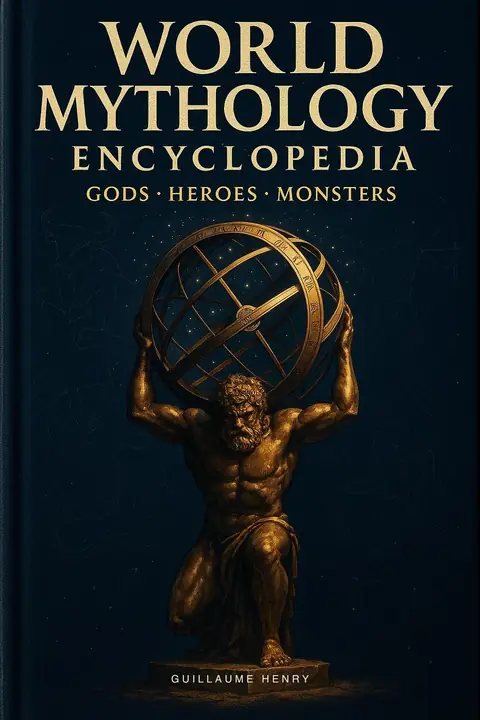
Mythology
The World Mythology Book: The Gods, Heroes and Myths of Every Culture
The Gods, Heroes and Myths of Every Culture, in One Volume
The whole of world mythology in a single volume: Greek, Norse, Egyptian, Japanese, Hindu, Celtic, Slavic, Mesoamerican and African myths gathered side by side, each drawn from the primary sources.