

Hephaestus God of the Forge: Smith, Outcast, and Divine Architect of Olympus
Hephaestus built the palaces of Olympus, forged the armor of Achilles, and chained a Titan to a mountain. Yet the gods threw him from the sky. Here is the full story of the divine smith.
Contents
The fire came first. Long before Hephaestus shaped the shield of Achilles or bolted Prometheus to his rock, the Greeks understood that craft itself was dangerous - that the person who could bend iron to human will occupied a strange place between mortal and divine. Hephaestus, the only Olympian who worked with his hands, carried that strangeness in his limp.
He was the god who built the golden houses of the other gods. He was the god those same gods cast from heaven. He forged lightning bolts for Zeus and golden automata that walked by themselves. He trapped his own mother in a chair. He created Pandora, the first woman, from clay. No other figure in the Greek pantheon holds so many paradoxes at once: supreme maker and social outcast, indispensable servant and occasional rebel, the most productive of all the Olympians and the least loved.
That combination made him deeply human. Homer mentions him more than almost any other god, because the forge is where humans first rivaled the divine. Understanding the Hephaestus god of the forge means understanding what ancient Greeks believed about skill, suffering, beauty, and the strange price that mastery sometimes demands.
The Two Stories of Hephaestus' Birth and Fall
Primary sources give two different accounts of how Hephaestus came to be lame, and scholars have debated for centuries which tradition is older.
In the Iliad (Book 1, around 750 BCE), Hephaestus tells it himself. During a quarrel between Hera and Zeus, he tried to defend his mother. Zeus grabbed him by the ankle and hurled him from Olympus. He fell for a full day - Homer gives that specific detail - and landed on the island of Lemnos, where the Sintian people nursed him back to some semblance of health. The fall, by this account, happened after his birth. He was born whole and was broken by divine violence.
Hesiod, in the Theogony (around 700 BCE), tells a different story. Here Hera bore Hephaestus alone, without a father, because she wanted to match Zeus's unilateral production of Athena. But the child she produced disappointed her: he was lame from birth. She threw him from Olympus herself, in disgust. He fell into the sea. The sea-nymph Thetis caught him and raised him in her underwater grotto.

These two versions are not simply contradictory errors. They reflect different theological pressures. Homer needed a scene of filial loyalty - Hephaestus siding with Hera, then paying for it. Hesiod needed to explore divine shame and the mythology of birth outside normal generative order. Both versions agree on one point: the god of fire was expelled from the sky. Both versions agree that he survived, and that he returned to Olympus not by supplication but by leverage.
The leverage was a chair.
The Throne Trap: How Hephaestus Reclaimed His Place
This myth appears in multiple ancient sources and is among the most psychologically vivid in the entire Greek tradition. After his fall, Hephaestus built a golden throne - impossibly beautiful, the kind of thing only a god could make - and sent it as a gift to Olympus, addressed to Hera.
Hera sat in it. The throne locked around her. No god on Olympus could free her. The chains were invisible, and every attempt to break them failed. Hera hung suspended, trapped by her own son's craftwork, unable to move and unable to hide how it had happened.
The gods begged Hephaestus to return and free her. He refused. Ares went to retrieve him by force. Hephaestus drove Ares off with torches. The problem required a different kind of diplomacy.
Dionysus, newly arrived on Olympus and already understanding how humans and gods could be softened, went to find Hephaestus. He got him drunk on wine - not difficult, evidently - and brought him back to Olympus swaying on the back of a mule, surrounded by satyrs and the whole chaotic procession of his retinue. This is one of the most reproduced scenes in all of archaic Greek vase painting. The "Return of Hephaestus" appears on more than a hundred surviving black-figure and red-figure vases, from the seventh century BCE onward.
Back on Olympus, Hephaestus freed Hera in exchange for his full reinstatement among the twelve and, in some versions, for the hand of Aphrodite in marriage. The trapped goddess, the drunken return, the negotiated seat at the divine table: it is one of the few myths in which an Olympian successfully used his professional skill as political power.
The Workshop of the Gods: What Hephaestus Actually Made
The forge of Hephaestus appears most vividly in Iliad Book 18, one of the most extraordinary passages in Homer. Thetis comes to ask for new armor for her son Achilles, whose original set has been taken from the corpse of Patroclus. Homer describes the workshop in detail: twenty bellows working at once, responding to a single command from their master; the anvils, the tools, the bronze, tin, silver, and gold all set out. Hephaestus, sweating and limping, greets Thetis warmly - she was, after all, the one who sheltered him after his fall from the sea.
What he produces for Achilles is the Shield (hoplon), and Homer spends more than 130 lines describing it. The Shield of Achilles is not simply armor; it is a cosmological object. Hephaestus engraves on it:
- The earth, the sky, the sea, and the sun and moon
- Two cities: one at peace (with a wedding procession, a law court, music) and one at war (siege lines, ambush, the god of Strife visible in the melee)
- Plowing fields, a harvest feast, a vineyard under harvest
- A herd of cattle attacked by lions while the herdsmen are helpless
- A dance floor where young men and women circle, "like a potter's wheel"
- The great river Oceanus running around the outermost rim

This is, in effect, a summary of the entire human world as Homer understood it. The craftsman god did not make a weapon. He made a mirror of civilization. Ancient and modern scholars alike have read the Shield as a statement about art itself: that genuine techne (craft, skill) contains the entire world within it.
Beyond the Shield, the list of Hephaestus' creations in primary sources includes:
- Achilles' armor (full set, Iliad 18)
- Hermes' winged sandals and golden staff (Odyssey 5)
- The palaces of all twelve Olympians, including his own, described in Iliad 1 as "gleaming bronze, imperishable"
- Talos, the giant bronze man who circled Crete three times daily, guarding it against invaders (Apollonius of Rhodes, Argonautica)
- Automata, golden female servants who assisted in his workshop and could "speak, think, and work" - the oldest robots in Western literature (Iliad 18)
- The golden net with which he trapped Ares and Aphrodite in the act of adultery (Odyssey 8)
- Pandora, the first human woman, sculpted from earth and water and animated by the gods' collective gifts, commissioned by Zeus as punishment for humanity after Prometheus stole fire (Works and Days)
- Chains for Prometheus, with which Zeus ordered him to bind the Titan to Mount Caucasus
- Hephaestus' own throne on Olympus, described as wheeled, so he could move around his workshop despite his limp
No other Olympian has a comparable list of concrete objects attached to their mythology. Athena is goddess of craft alongside him, but her domain is strategy and weaving; Hephaestus alone is the god of fire itself, of the physical transformation of raw matter.
Hephaestus and Aphrodite: A Marriage Built for Comedy
Among the twelve Olympians, Hephaestus stands apart as the one whose domestic life is narrated with something close to slapstick. His wife was Aphrodite, goddess of erotic beauty - the most beautiful of goddesses paired with the most physically awkward of gods. The Greeks were not subtle about the irony.
In Odyssey Book 8, the blind bard Demodocus sings this story at the Phaeacian court as entertainment. Ares and Aphrodite are sleeping together in Hephaestus' own bed. Helios, the sun, who sees everything, reports it to the smith god. Hephaestus neither weeps nor confronts them directly. Instead, he works. He forges a net of unbreakable bronze chains, so fine they are invisible, and strings it around the bed. Then he pretends to leave for Lemnos. Ares and Aphrodite go to the bed. The net closes. They are trapped, naked, intertwined, unable to move.
Hephaestus then invites the other gods to come and look. The goddesses stay away out of propriety, but all the male gods come: Poseidon, Hermes, Apollo. They laugh. Hermes tells Apollo he would gladly be in Ares' position even with the chains. Apollo asks Hermes if he means it. Hermes says yes, and names the number of chains he'd be willing to wear if Aphrodite looked at him like that.
The scene reads as comedy, but it carries a real structural point. Hephaestus asked Poseidon to guarantee that Ares would pay the agreed penalty. Poseidon promised. Eventually, after negotiation, Hephaestus released them. Justice was served by craft, not by violence. This was, in the Greek imagination, precisely the kind of solution a forge god should find.
Family Tree: Parents, Siblings, and Children
The genealogy of Hephaestus is cleaner than most Olympians', though the variant birth traditions complicate the parentage.
Parents:
- Zeus (father, in most traditions including Homer's)
- Hera (mother, in all traditions)
- Hera alone (parthogenetic birth, in Hesiod's Theogony)
Siblings:
- Ares, god of war (full brother in all traditions)
- Athena, goddess of wisdom (half-sister, born from Zeus's skull)
- Hebe, goddess of youth
- Eileithyia, goddess of childbirth
- In some sources: Eris, goddess of strife
Consorts and children:
- Aphrodite (wife, in Homer and most Attic sources)
- Charis, "Grace," (wife in the Iliad, in a tradition that predates the Aphrodite marriage story)
- Erichthonius, the legendary early king of Athens: born when Hephaestus tried to assault Athena, spilled his seed on the earth, and Athena placed the infant she found there into a basket guarded by serpents - a myth that links both Hephaestus and Athena to the founding of Athens
- Thalia (possible), a Grace
- In some traditions, the Kabeiroi, a group of chthonic craftsman-deities associated with Lemnos and Samothrace
- Cacus, the fire-breathing giant of Roman tradition, in some late Latin sources
Symbols, Sacred Sites, and the Volcanic Connection
The primary symbols of Hephaestus in ancient iconography are the hammer, tongs, anvil, and the pilos - the conical felt cap worn by craftsmen and sailors in the ancient Greek world. He is almost always shown with a beard, wearing a short workman's tunic rather than the flowing robes of other Olympians. His lameness is frequently depicted, though artists varied in how they rendered it: some show one leg shorter, others show a turned foot, others simply a crutch.
His sacred sites clustered, notably, on volcanic islands and near natural fires. Lemnos was his primary cult center, and the volcanic activity of that island was directly identified with his presence. Strabo (1st century BCE) records that the island's ancient inhabitants, the Sintians, maintained a cult of Hephaestus predating the Olympic-period myths. Etna in Sicily was also associated with his forge in later traditions - Virgil, in the Aeneid, placed his workshop beneath Etna rather than Olympus, and the Cyclopes became his assistants there rather than the golden automata of Homer.

The Roman equivalent, Vulcan, absorbed much of this volcanic geography. The Latin word volcano comes directly from his name. But Vulcan in Roman tradition was primarily a god of destructive fire - fire that burned cities - rather than the creative fire of craft. This inversion of emphasis is significant: where Hephaestus is defined by what he makes, Vulcan is defined more by what fire destroys. The Romans celebrated the Vulcanalia on August 23rd, a festival at which small animals were thrown into fire as a propitiatory offering.
Hephaestus Among the World's Divine Smiths
The Hephaestus god of the forge archetype appears across cultures with remarkable consistency, suggesting that the figure of the divine craftsman responds to something deep in how societies process the mystery of skilled making.
Hephaestus (Greek)
Supreme craftsman of the Olympic pantheon. Lame, socially marginal, married to the most beautiful goddess. Makes armor, divine objects, automata. Expelled from heaven and returns by leverage. Associated with volcanic fire.
Goibniu / Luchta (Celtic)
The Irish smith gods of the Tuatha De Danann. Goibniu brews the ale of immortality; Luchta (also called Creidhne) forges the weapons that cannot miss. No lameness tradition, but they too sit slightly outside the warrior hierarchy, defined by what they produce rather than whom they defeat.
The Norse smith Loki - a trickster rather than a dedicated craftsman, but responsible for creating the greatest treasures of the Aesir, including Mjolnir, Thor's hammer - shares Hephaestus' position as an outsider whose skills the pantheon cannot do without. The more direct Norse parallel is Volundr (Old Norse Volundr, anglicized as Wayland the Smith), who appears in the Poetic Edda and the Old English Deor. Volundr is captured, hamstrung by a king who wants to control his skill, imprisoned on an island, and eventually escapes by making a pair of wings. He also takes revenge through craft: he murders the king's sons and makes drinking cups from their skulls, assaults the king's daughter, and finally flies away. The parallels with Hephaestus are precise: lameness, island exile, revenge through making, escape. Many scholars consider these traditions to share a common Proto-Indo-European ancestor - the wounded smith who cannot be owned.
In Hindu tradition, Vishvakarman (Vishvakarman or Tvashtri) serves as architect and weaponsmith of the devas - he built the flying city of Lanka and forged the vajra (thunderbolt) of Indra. Like Hephaestus, he is the maker of divine instruments but never the wielder of them.
Hephaestus in Homer, Hesiod, and the Tragedians
The primary sources for Hephaestus span roughly eight centuries of Greek literary production, and his portrayal shifts meaningfully across them.
In Homer, he is warm, witty, and self-aware. In Iliad Book 1, when he hobbles across Olympus with his cup to defuse the tension between Zeus and Hera, the gods laugh - and Homer's word for that laughter (asbestos gelos, "inextinguishable laughter") is the same word he uses for fire that cannot be put out. Hephaestus knows they are laughing at him. He makes them laugh deliberately. It is a rare moment of social intelligence from a god who is elsewhere treated as clumsy: he uses the same skill that makes him forge the perfect object to forge the perfect social moment.
In Hesiod's Works and Days, Hephaestus is the executor of Zeus's will in the Pandora myth, but the emphasis falls on the object he makes, not on him personally. Pandora is described with the same care Homer gives the Shield: golden crown, embroidered veil, flowers, gold jewelry. She is, in a sense, a masterwork in the tradition of the automata - a being made rather than born.
Aeschylus gave Hephaestus a speaking role in Prometheus Bound (5th century BCE), in the opening scene where he chains Prometheus to the Caucasian rock on Zeus's orders. Aeschylus' Hephaestus is neither comic nor triumphant. He pities Prometheus. He says so, directly. He chains him anyway, because he has no choice against Zeus's command, but he works as slowly as he can, and his lines express genuine regret. This is among the most nuanced characterizations of the god in all surviving Greek tragedy: a figure who possesses both power and compassion, and who understands that obedience to the king of the gods is not the same thing as justice.
The philosopher Plato, in the Symposium, has Aristophanes use Hephaestus as a thought experiment: if the god appeared to two people in love and offered to fuse them permanently, would they say yes? The answer Aristophanes imagines is always yes. Hephaestus, maker of permanent bonds, becomes here a figure for the deepest human desire for union.
Hephaestus in Modern Imagination: From Antiquity to Pop Culture
The modern reception of Hephaestus has followed two divergent tracks.
In fine art, he remained a figure of serious treatment through the Renaissance and Baroque periods. Diego Velázquez's The Forge of Vulcan (1630, Prado, Madrid) is the most famous canvas: Apollo has arrived at the forge to tell Hephaestus/Vulcan that Aphrodite is sleeping with Ares. The smiths in the painting are depicted as physically real workers, sweating, muscular, startled. The subject is Olympian gossip, but Velázquez painted it as a scene of labor, treating the forge and its workers with the same gravity a Spanish painter would give a royal court.
Peter Paul Rubens painted the god repeatedly, as did Luca Giordano and later Giovanni Battista Tiepolo. By the 18th century the forge had become a symbol of industrial and scientific progress; Hephaestus appeared in allegories of manufacturing alongside steam engines and furnaces.
In contemporary fiction, the god's character fractures into several distinct archetypes. In Rick Riordan's Percy Jackson series, Hephaestus appears as a sympathetic, emotionally wounded father figure whose cabin at Camp Half-Blood is full of gadgets. His children inherit mechanical genius and social awkwardness in equal measure. This captures something genuine about the original myth: the cost of the gift, the outsider who belongs everywhere and nowhere.
The divine craftsman archetype, now detached from the specific name Hephaestus, runs through science fiction and fantasy under different names: the eccentric inventor, the AI creator, the weaponsmith who builds the thing that destroys them. Tony Stark - Iron Man - is explicitly coded as a Hephaestus figure: genius engineer, physical injury that defines him, creates the tool that both saves and traps him, married (eventually) to the most glamorous person in his world. The myth proves sturdy because its central tension is real: mastery at the cost of belonging.
Frequently Asked Questions About Hephaestus
Frequently asked questions
Why was Hephaestus the only lame Olympian?
The primary sources offer two explanations. In Homer's Iliad (Book 1), Hephaestus was lame because Zeus threw him from Olympus after he intervened in a quarrel, injuring him in the fall. In Hesiod's Theogony, he was born lame, and Hera threw him out because of that disability. Most scholars read the lameness as mythologically functional rather than etiological: the divine craftsman must be marked as different, unable to fight or chase, so that his power is located entirely in his hands and mind. Comparative folklore supports this; wounded or lame smith figures appear in Norse, Celtic, and Vedic traditions, suggesting a common archetype.
Was Hephaestus the son of Zeus or Hera alone?
Both traditions coexisted in antiquity. Homer consistently treats him as the son of both Zeus and Hera. Hesiod's Theogony presents him as Hera's son alone, born parthenogenetically in response to Zeus's unilateral birth of Athena. Later writers including Apollodorus generally followed Homer. The Hesiodic tradition emphasizes Hera's shame and the myth of divine rejection; the Homeric tradition emphasizes his loyalty to Hera and Zeus's violence against him. Neither tradition was considered canonical above the other; ancient readers knew both.
What is the connection between Hephaestus and the island of Lemnos?
Lemnos, a volcanic island in the northern Aegean, was Hephaestus' primary cult center in historical antiquity. Both the Iliad and later sources agree that after his fall from Olympus he landed on Lemnos. The island has genuine volcanic features, including hot springs and natural gas vents that may have burned continuously, and these were interpreted as evidence of the god's presence. The pre-Greek inhabitants of Lemnos, the Sintians or Pelasgians, had a cult of a fire deity that the arriving Greeks identified with Hephaestus. Strabo documents this identification. A ritual fire ceremony on Lemnos, described by ancient sources, involved extinguishing all fires on the island and relighting them from a sacred flame brought by ship from Delos.
Did Hephaestus really create the first woman, Pandora?
Yes, according to Hesiod. In both the Theogony and Works and Days, Hephaestus sculpts Pandora from earth and water on Zeus's orders. The creation is described in terms directly parallel to metalworking: he shapes her as a craftsman shapes raw material. Each god then adds a gift (hence her name, "all-gifted" in Greek, pan meaning "all" and dora meaning "gifts"). Athena clothed and taught her weaving; Aphrodite gave her grace and desire; Hermes gave her a deceitful mind and lying words. She was created as punishment for humanity after Prometheus stole fire. The myth directly links the theft of fire, the punishment of the Titan, and the origin of women in a single causal chain, with Hephaestus as the craftsman who makes the instrument of divine retribution.
Who were the golden automata in Hephaestus' workshop?
Homer describes them in Iliad Book 18 when Thetis visits the forge. They are golden female figures who act as Hephaestus' assistants; Homer says they have intelligence, speech, strength, and skill. They are effectively the first robots in Western literature. Scholars of early Greek thought, including the classicist Adrienne Mayor in Gods and Robots (2018), have argued that these automata represent the Greeks' earliest thinking about artificial life and the limits of craft. Hephaestus also made Talos, the bronze giant, and the self-propelling bellows in his forge, suggesting that artificial animation was a consistent theme attached to this god across multiple sources.
What is the difference between Hephaestus and the Roman god Vulcan?
Hephaestus and Vulcan share an identification that began at least by the 4th century BCE, but they carry different emphases. Hephaestus in Greek tradition is primarily the divine craftsman: the maker of beautiful objects, armor, divine furniture. His fire is creative fire. Vulcan in early Roman tradition was primarily a god of destructive fire: conflagrations, volcanic eruption, the fire that burned fields and cities. The Vulcanalia (August 23rd) was a propitiatory festival intended to avert dangerous fire, not to celebrate craft. Virgil, in the Aeneid, moved Vulcan's forge under Mount Etna and gave him the Cyclopes as workers, which imported Greek elements into Roman tradition. But the emotional character of the two gods differs: Hephaestus is a protagonist with family drama, humiliation, revenge, and artistic triumph; Vulcan in native Roman religious practice was more impersonal - a force to be appeased.
The Wounded Maker and What He Built That Outlasted Heaven
The myths of Hephaestus circle one persistent question: what is the relationship between suffering and extraordinary skill? The Greek answer was not sentimental. They did not say suffering ennobles. They said, more precisely, that the same exclusion that marks a person as broken can be the condition of their most powerful work. Hephaestus cannot fight like Ares. He cannot run. He cannot charm like Aphrodite or dominate like Zeus. What he can do is sit at a forge and make something that no one else in the cosmos could make.
The Shield of Achilles is the proof. It is a map of the entire human world - marriages, lawsuits, plowing, dancing, the lion at the throat of the heifer - forged by a god who was thrown away twice and who learned to express in bronze what he could never say at the table of the Olympians. When Thetis comes to ask for armor, she finds him working. He is always working. The 130 lines Homer devotes to the Shield are, arguably, Homer's own statement about the nature of art: that the person who makes the most complete image of human life is not the person who lived it most fully, but the one who watched it from a difficult distance and hammered it into permanent form.
The lame god on his wheeled throne, rolling between his twenty bellows with the golden women at his sides, holds his place among the Olympians not because they love him but because without him they would have neither their palaces nor their weapons nor the chains that keep their enemies bound. He understood this. When Hera sat trapped in his golden chair, she was held not by force but by craftsmanship. That distinction mattered to the Greeks. It should still matter to us.
Read the full book
Want the whole story?
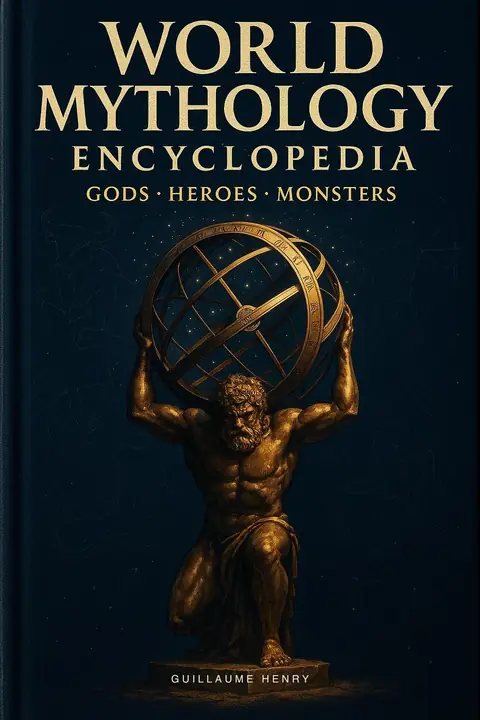
The complete edition is an instant PDF download here, with a paperback on Amazon for selected titles.
Mythology
The World Mythology Book: The Gods, Heroes and Myths of Every Culture
The Gods, Heroes and Myths of Every Culture, in One Volume
The whole of world mythology in a single volume: Greek, Norse, Egyptian, Japanese, Hindu, Celtic, Slavic, Mesoamerican and African myths gathered side by side, each drawn from the primary sources.