

Heracles and the Twelve Labors: Myth, Meaning, and the Making of a Hero
Heracles was not born a hero. He was made one, labor by labor, through madness, exile, and inhuman endurance. This is the full story behind the myth that shaped Western civilization's idea of the hero.
Contents
The lion's pelt is still warm. Heracles drapes it over his shoulders in the hills outside Nemea, its gaping jaw framing his face like a second skull. He is perhaps nineteen years old. He has just strangled the creature with his bare hands because no arrow could pierce its hide, and because Eurystheus of Mycenae, shaking in his bronze throne, has commanded it.
This is where most people begin the story. But the real beginning is harder to look at. Before Nemea, before any labor, Heracles stood in the ruins of his own home and realized that the bodies on the floor were his children. He had killed them himself, in a divine madness sent by Hera, the goddess who would pursue him from birth to near-death and beyond. The Twelve Labors were not a heroic career. They were a sentence. Penance for a crime that was also a punishment, inflicted on a man whose only offense was existing.
That paradox is what keeps Heracles the twelve labors hero alive after three millennia. He is not a morally clean figure like Achilles in his better moments, or a cunning puzzle-solver like Odysseus. He is excessive, damaged, often brutal, and capable of extraordinary tenderness. He carries the full contradiction of being half-divine in a fully mortal world.
The Birth of a Man the Gods Could Not Ignore
Heracles was born at Thebes, the son of Zeus and Alcmene, a mortal woman of impeccable lineage. Zeus had disguised himself as Alcmene's husband Amphitryon to father the child, a deception that guaranteed Hera's fury before the infant drew his first breath.
The first attempt on his life came in the cradle. Hera sent two serpents into the nursery. The infant Heracles, according to Pindar's First Nemean Ode, woke, grabbed one snake in each hand, and squeezed until they went limp. His twin, the fully mortal Iphicles, screamed. Heracles looked at the dead snakes with what witnesses reportedly described as something like curiosity.
His education was thorough and violent. He studied wrestling with the hero Autolycus, archery with the centaur Eurytus, music with Linus (whom he killed with a lyre during a lesson, allegedly in justified self-defense), and chariot-driving with Amphitryon. The centaur Chiron, who also tutored Achilles and Asclepius, sometimes appears in later traditions as a moral instructor. What emerges from all these teachers is a figure trained for war but resistant to the finer courtesies of civilization.
Young Heracles married Megara, the daughter of King Creon of Thebes, and by all accounts the marriage was good. Then Hera struck.
Madness, Murder, and the Price of Innocence
The goddess sent lyssa, divine frenzy, into Heracles' mind. In Euripides' tragedy Heracles, written around 416 BCE, the playwright gives us the most psychologically penetrating account. Heracles returns from a successful rescue of his father Amphitryon from the tyrant Lycus, full of righteous energy, and then his mind breaks. He hallucinates enemies where there are none. He kills his children. He kills Megara. He nearly kills Amphitryon. When the madness lifts and he sees what surrounds him, Heracles wants to die.
Theseus, his friend, talks him back from the edge. Euripides' Theseus does not offer comfort exactly; he offers solidarity. "Suffering is the common lot of noble men," he says, in essence. Heracles accepts this with terrible dignity and chooses to keep living, which may be the bravest thing he does in the entire mythological cycle.
The Oracle at Delphi prescribed the path forward: serve Eurystheus, king of Mycenae and Tiryns, for twelve years. Complete whatever labors the king assigned. In doing so, Heracles would both expiate the blood guilt and, the Oracle whispered, achieve immortality.
Eurystheus, a small and frightened man elevated above Heracles by Hera's earlier manipulation of Zeus, spent considerable energy devising tasks that should have been fatal. He was not entirely wrong to be afraid.

The Twelve Labors: A Full Retelling
The canonical twelve, codified by Apollodorus in his Bibliotheca (written perhaps in the first or second century CE, drawing on much earlier sources), divide neatly into two groups: six set in the Peloponnese, six that stretch out to the edges of the known world.
Labor 1: The Nemean Lion
The lion of Nemea was no ordinary beast. Its skin was invulnerable to every weapon. Heracles' arrows bounced off. He tried his sword. He eventually drove the animal into its cave, blocked one entrance with a boulder, and wrestled it into submission by brute strangulation. He used the lion's own claws to skin it, since only those claws could cut the hide. The pelt became his armor, the gaping jaw his helmet, and Eurystheus' terror became permanent: according to Apollodorus, the king thereafter received Heracles' reports only through a herald, sometimes hiding in a large bronze storage jar buried in the earth.
Labor 2: The Lernaean Hydra
The Hydra was a water-serpent of Lerna with anywhere from seven to nine heads depending on the source, and a breath that could kill. The critical problem: cut off one head, two grow back. Heracles brought his nephew Iolaus. While Heracles severed heads with his sword, Iolaus cauterized each stump with a burning torch before the regeneration could begin. The immortal central head was buried under a heavy boulder. Heracles dipped his arrows in the Hydra's poisonous blood, a decision that would matter at the very end of his life.
Eurystheus later disqualified this labor because Iolaus had helped. The argument was petty, but legally it mattered for the count.
Labor 3: The Ceryneian Hind
A deer sacred to Artemis, with golden horns and bronze hooves. Heracles spent a full year tracking it across Greece and into the far north, a patience utterly unlike his usual approach. He finally pinned it with an arrow through the legs (careful not to draw blood, careful not to anger Artemis), caught it, and carried it back. Artemis and Apollo blocked his path. Heracles explained the situation. Artemis, apparently satisfied, let him pass.
Labor 4: The Erymanthian Boar
A massive boar on Mount Erymanthus. Heracles drove it into deep snow, exhausted it, and carried it back alive on his shoulders. On this journey he also stopped at the cave of the centaur Pholus, was hospitably received, and the opening of a communal wine jar provoked a brawl with other centaurs. In the melee, Heracles accidentally wounded Chiron with one of his Hydra-poisoned arrows. Chiron, immortal, could not die but could not heal; he eventually surrendered his immortality to free Prometheus from his rock. The collateral damage that followed Heracles everywhere was real and lasting.
Labor 5: The Augean Stables
Augeas, king of Elis, kept divine cattle that had filled thirty years of accumulated dung in their stables. Heracles agreed to clean the stables in a single day, negotiating one tenth of the cattle as payment (a deal Augeas never intended to honor). Heracles diverted two rivers, the Alpheus and the Peneus, through the stables and washed them clean by evening. Augeas refused payment, claiming the rivers had done the work. This dispute later led to Heracles sacking Elis. Eurystheus disqualified this labor too, since Heracles had taken payment, however notional.

Labor 6: The Stymphalian Birds
Bronze-feathered birds nesting near Lake Stymphalia, whose feathers they could fire like arrows and whose droppings poisoned crops. Athena provided bronze krotala (noise-making clappers, akin to castanets) forged by Hephaestus. Heracles rattled them from a hilltop, flushed the birds into the sky, and shot them down with his arrows. The ones that escaped supposedly flew to the Black Sea, where the Argonauts encountered their descendants.
Labor 7: The Cretan Bull
Poseidon had sent a magnificent bull to King Minos of Crete as a sign of divine favor. Minos refused to sacrifice it as promised, and Poseidon drove the bull mad. It was the same bull that fathered the Minotaur. Heracles sailed to Crete, wrestled the bull into submission barehanded, and brought it back across the Aegean. Eurystheus released it. It wandered to Marathon, where it became the Marathon Bull, later dealt with by Theseus.
Labor 8: The Mares of Diomedes
Diomedes, king of the Thracian Bistones, kept mares that he fed on human flesh, specifically on shipwrecked sailors and unwary guests. Heracles captured the mares and fed Diomedes to his own horses, after which the animals calmed considerably. He brought them back to Eurystheus, who released them on Mount Olympus. They were eventually torn apart by wild animals.
Labor 9: The Belt of Hippolyta
Hippolyta was queen of the Amazons and wore a golden belt (zoster) given to her by Ares as a mark of authority. Admete, daughter of Eurystheus, wanted it. Heracles sailed with a company of heroes to the Amazon coast near the Black Sea. Hippolyta, according to Apollodorus, was actually willing to give him the belt. But Hera disguised herself as an Amazon warrior and spread the rumor that Heracles planned to kidnap their queen. Battle broke out. Heracles killed Hippolyta and took the belt.
This labor reads as tragic: a conflict born from a lie, killing someone who had offered peace. Some scholars read it as a displaced memory of Greek-Scythian tensions along the northern Black Sea coast.
Labor 10: The Cattle of Geryon
Geryon was a three-bodied (or three-headed, sources differ) giant on the island of Erytheia, far to the west in the outer Ocean. To reach him, Heracles crossed the Libyan desert, grew furious at the heat, and fired an arrow at the sun. Helios was impressed rather than offended and lent him his golden cup-boat to cross the Ocean. At the edge of the Mediterranean, Heracles erected two great pillars: the Pillars of Heracles, which the Greeks identified with the Strait of Gibraltar.
He killed Geryon's herdsman Eurytion and the two-headed dog Orthrus (brother of Cerberus), then Geryon himself with an arrow through all three bodies simultaneously, a shot that required piercing through two of the bodies to kill the third. He drove the cattle back across Europe in a journey that took years and spawned numerous regional myths wherever he passed through.
Labor 11: The Apples of the Hesperides
The golden apples guarded by the Hesperides (daughters of the Titan Atlas) and the serpent Ladon at the western edge of the world were a wedding gift from Gaia to Hera. To find out where the garden was, Heracles had first to catch Nereus, the shape-shifting Old Man of the Sea, and wrestle the truth out of him. He also, on this journey, freed Prometheus from his eagle and his rock on Mount Caucasus.
The subtlety of this labor lies in what Heracles did not do. He persuaded Atlas, who held up the sky, to fetch the apples himself while Heracles took the weight of the heavens temporarily. Atlas, tasting freedom, offered to deliver the apples to Eurystheus personally, leaving Heracles under the sky forever. Heracles agreed, then asked Atlas to hold the sky for just a moment while he adjusted the padding on his shoulders. Atlas complied. Heracles picked up the apples and walked away.
It is one of the few times in the cycle where Heracles wins by wit rather than force.
Labor 12: Cerberus from the Underworld
The final labor was the most explicit about what was being tested. Eurystheus ordered Heracles to bring back Cerberus, the three-headed hound guarding the entrance to the realm of the dead, using no weapons.
Heracles descended through the cave at Taenarum in Laconia. He had himself initiated into the Eleusinian Mysteries beforehand, a detail preserved by Apollodorus, suggesting that the ritual purification was necessary to enter and return from Hades. In the underworld he met the shade of Meleager, whom he pitied; he wrestled Thanatos (Death personified) to free the mortal Alcestis in a related tradition; he terrified most of the dead by his mere presence.
Hades granted him permission to take Cerberus, but only if he subdued the hound without weapons. Heracles seized Cerberus by the throat, armored by his lion-pelt against the serpent-tail, and dragged the three-headed dog up into the sunlight. Eurystheus, confronted with this particular problem, hid in his jar again and begged Heracles to return the animal. Cerberus went back to his post. The Labors were complete.
The Life Beyond the Labors: Heracles as Soldier, Husband, and Casualty
The Twelve Labors are the center, but not the whole, of the myth. Before the madness, between individual labors, and after the penance, Heracles lived a chaotic secondary biography that filled entire volumes of the ancient mythographers.
He sacked Troy in an earlier generation than the famous war, avenging King Laomedon's treachery over the payment of horses. He fought the gods themselves: he wounded Ares and Hades with arrows, a transgression the myths treat with unusual casualness, as though Heracles occupied a category outside normal theological rules.
He participated in the Argonaut expedition at least for part of the journey, though the Argonautica of Apollonius of Rhodes has him left behind at Mysia, searching for his young companion Hylas who was taken by water nymphs. The image of Heracles walking inland alone, calling Hylas' name into the reeds, is one of the most unexpectedly tender images in all of ancient epic.
He married Deianira after wrestling the river god Achelous for her hand, a bout that cost Achelous one of his horns, which the Naiads filled with fruits and flowers and called it the cornucopia.

The Death That Was Not a Death: Apotheosis on Mount Oeta
The centaur Nessus provides the mechanism of Heracles' ending. Crossing the river Evenus with Deianira, Heracles let the centaur ferry his wife across while he swam. Nessus assaulted Deianira mid-river. Heracles shot him with a Hydra-poisoned arrow from the opposite bank. Dying, Nessus whispered to Deianira: take some of my blood. It is a love charm. If Heracles ever loves another woman, smear it on his robe and his love will return to you.
Years later, Heracles captured the princess Iole. Deianira, believing Nessus' lie, soaked a ceremonial robe in the blood and sent it to her husband. When Heracles put it on during a sacrifice, the Hydra venom in the centaur's blood activated. It burned through his flesh. He tore at the robe but it had fused to his skin. He threw his attendant Lichas into the sea in agony. He was brought to Mount Oeta.
The accounts of what happened next are remarkably consistent. Heracles built his own funeral pyre. No one would light it until the hero Philoctetes (or Poeas in some versions) agreed, receiving in exchange Heracles' great bow and his Hydra-poisoned arrows. Those same arrows would, a generation later, be required to end the Trojan War, a mythological line of causation that the Greeks found meaningful.
The pyre burned. The mortal part of Heracles was consumed. What rose was divine. Hera herself, in a resolution that the myths mark as extraordinary, was reconciled with her enemy. He married Hebe, goddess of youth. He became a god.
Pindar, in his First Nemean Ode, calls this the final purpose of the labor: not punishment but purification. The suffering was the process by which the human was separated from the divine. Heracles died into his own godhood.
Heracles Across Cultures: The Mythological Resonance
The Greeks themselves identified Heracles with foreign heroes wherever they found parallel myths. The Phoenician Melqart, worshiped at Tyre and Carthage, was called Heracles by Greek writers and shared the pyre-apotheosis. The Romans took Heracles as Hercules with minimal theological alteration, building him temples at major crossroads and cattle markets, where his role as protector of travelers and livestock made practical sense. The Ara Maxima in Rome, one of the oldest altars in the city, was dedicated to him.
The comparative mythologist Walter Burkert, in Structure and History in Greek Mythology and Ritual (1979), read the Labors as a sequence of ritual purifications, each monster representing a form of pollution (miasma) that the hero absorbs and neutralizes. The Hydra's regenerating heads become the model for every problem that multiplication makes worse. The Augean Stables are literal filth transformed by ingenuity. Burkert's reading does not explain away the myth but layers it.
The Mesopotamian hero Gilgamesh, who killed the Bull of Heaven and traveled to the ends of the earth seeking immortality, shares structural DNA with Heracles in ways that classical scholars debated throughout the twentieth century. Both descend to the underworld. Both carry the weight of companion deaths as moral wounds. Both are ultimately denied the immortality they seek in their mortal form.
The Vedic hero Indra, who slays the serpent Vritra to release cosmic waters, has been compared to Heracles wrestling the Hydra. Martin West's The East Face of Helicon (1997) traces multiple points of contact between Greek heroic mythology and Near Eastern and Indo-Iranian traditions. The labor cycle as a narrative template - a hero assigned impossible tasks by a hostile authority, completing them through a combination of strength, wit, and divine aid, and emerging transformed - appears across cultures precisely because it maps onto a genuine psychological structure.
Heracles in Tragedy, Philosophy, and the Moral Imagination
Euripides' Heracles is not the only dramatic treatment, but it is the deepest. The philosopher Prodicus, a contemporary of Socrates, invented the parable of "Heracles at the Crossroads," in which the young hero is approached by two women: Arete (Virtue) and Kakia (Vice, or Pleasure). The story, preserved in Xenophon's Memorabilia, presents Heracles choosing the hard path deliberately. This Heracles became the Stoic and Cynic hero: the philosopher as endurance athlete.
The Cynics adopted Heracles formally. Diogenes of Sinope identified his own simple, laboring, shameless life with the hero's. Epictetus in his Discourses calls Heracles back repeatedly as the model of someone who, bearing divine nature inside a human frame, chooses difficulty as a form of self-knowledge.
The Stoics read the pyre on Mount Oeta as a purification of the rational soul from its physical envelope: the logos returning to the divine fire from which it came. Heracles, in this reading, had not been punished by the universe. He had been educated by it, one murderous, exhausting, impossible task at a time.
This double nature, the brute force and the philosophical archetype, is precisely why Heracles resists being collapsed into either. He is not the reasonable Odysseus, not the beautiful Achilles, not the pious Aeneas. He is the hero as damage and dignity, as catastrophic strength turned, at enormous cost, toward something that might be called goodness.
For readers who want to trace how this tradition feeds into other heroic cycles, the stories of Perseus and Theseus are the closest Greek relatives: both receive divine parentage, both perform monster-killing labors, both carry moral ambiguity that the myths refuse to resolve.
The Labors as Geography: Where the Myths Were Rooted
One detail that rewards attention is how precisely the Twelve Labors were localized across the Greek world. The Nemean lion: Nemea in the northeastern Peloponnese, whose biennial Nemean Games Heracles was said to have founded. The Lernaean Hydra: Lerna, a genuine marshy lake in Argolis with a historical cult. The Stymphalian birds: Lake Stymphalia, identified with a real lake in Arcadia whose name it still bears. The cave at Taenarum: the southernmost tip of the Mani peninsula in Laconia, where a historical cave descends to the sea and was identified in antiquity as an entrance to the underworld.
The geographic anchoring of the labors was not accidental. Every city and sanctuary with a claim on Heracles gained religious, economic, and political prestige. The Nemean Games rivaled Olympia. The Eleusinian sanctuary benefited from the tradition that Heracles underwent initiation there. The Temple of Zeus at Olympia, whose metopes depicted the Twelve Labors carved between roughly 470-456 BCE, used the cycle to claim Heracles as the founder of the Olympic Games. Myth and power ran together along the same roads.
Frequently Asked Questions About Heracles and the Twelve Labors
Frequently asked questions
Why did Heracles have to perform the Twelve Labors?
The Oracle at Delphi prescribed the Labors as penance after Heracles killed his own children during a fit of divinely induced madness. The goddess Hera sent the madness as part of her long persecution of the hero, born of her jealousy over Zeus' affair with Alcmene. Blood guilt in Greek religion was not simply a moral stain; it was a ritual pollution that contaminated the killer and required specific purification, typically set by the Delphic oracle. The twelve years of service to Eurystheus fulfilled that requirement and, the oracle promised, would lead to immortality.
Are the Twelve Labors listed in the same order in all ancient sources?
No. The order varies significantly between Apollodorus (whose second-century CE Bibliotheca gives the most complete list), Diodorus Siculus, Pindar, and Euripides. Apollodorus disqualifies the Hydra and Augean Stables labors, requiring two replacement tasks to reach twelve. The list of twelve was canonized largely through the sculptural program of the Temple of Zeus at Olympia, completed around 456 BCE, which depicted each labor on the twelve metopes flanking the two porches. That visual monument standardized the count even where the literary sources remained inconsistent.
What is the difference between Heracles and Hercules?
Heracles is the Greek name; Hercules is the Latin form used in Roman religion and mythology. The Romans identified their own pre-existing deity with the Greek hero, building on an earlier Etruscan figure called Hercle. The Roman Hercules kept the general outline of the Twelve Labors but acquired distinctly Roman characteristics: he became a protector of commerce and travelers, worshiped at the Ara Maxima in the Forum Boarium cattle market in Rome. The Romans also tended to emphasize the Stoic, virtue-selecting Heracles of the Prodicus parable more heavily than the tragic, violent figure of Euripides.
How does Heracles compare to other ancient heroes who perform impossible tasks?
The labor-cycle pattern appears in several ancient traditions. Gilgamesh of Mesopotamia fights monsters at the edges of the world and descends to the underworld seeking immortality. Samson in the Hebrew Bible possesses divine strength and is repeatedly betrayed by intimacy. The Vedic tradition includes heroes assigned impossible tasks as tests of divine favor. Structural anthropologists, including Georges Dumézil and Walter Burkert, have argued that the labor-cycle narrative reflects a cross-cultural myth pattern about purification through ordeal, where the hero must neutralize forms of pollution or chaos before entering a new ontological state. Heracles is the most elaborated and geographically distributed example in the Western record.
What primary sources are available for the myth of Heracles?
The major ancient sources include Pindar's Epinician Odes (fifth century BCE), which reference multiple labors in celebratory contexts; Euripides' tragedy Heracles (c. 416 BCE), the fullest psychological portrait; Apollonius of Rhodes' Argonautica (third century BCE) for the Argonaut episode; Diodorus Siculus' Bibliotheca Historica (first century BCE); and Apollodorus' Bibliotheca (first or second century CE), the most systematic mythographic compilation. Sophocles' Trachiniae dramatizes the death of Heracles through Deianira's perspective. Theocritus, Ovid in his Metamorphoses, and Seneca's tragedy Hercules Furens also provide substantial material.
Did Heracles become a god after his death?
Yes, according to the mainstream Greek and Roman tradition. After the pyre on Mount Oeta consumed his mortal body, the divine element of Heracles, inherited from his father Zeus, ascended to Olympus. He was deified, reconciled with Hera, and married Hebe, the goddess of youth. This apotheosis was unusual: most Greek heroes received cult as powerful dead, worshiped at their tombs, not as Olympian gods. Heracles occupied both categories simultaneously; Pindar in his Fifth Nemean Ode explicitly notes that he was honored both as a hero among mortals and as a god among the Olympians. The two cults, heroic and divine, coexisted in Greek religious practice.
The Unfinished Hero: Heracles in Modern Imagination
The story of Heracles did not end in antiquity. It passed through Stoic philosophy into Christian allegory (the pyre read as prefiguring resurrection), through Renaissance humanist art (where painters from Cranach to Rubens depicted the Crossroads parable), through Baroque opera, through nineteenth-century classical scholarship, and finally into the popular culture of the twentieth and twenty-first centuries.
What modern retellings most often miss, or choose not to carry, is the weight of the infanticide. Film and animation versions typically begin the story after Hera has robbed Heracles of his divine memory or scattered his powers; the murders are softened or displaced. The ancient tragic version, where Heracles knows exactly what he did and chooses to keep living with the knowledge, is the more demanding story and the more honest one.
Simone Weil, writing on affliction and heroism in the 1940s, pointed to exactly this quality in ancient Greek tragedy: the refusal to make suffering redemptive in a clean narrative sense. Heracles at the end of Euripides' play is not healed. He is functional. He will continue. That is the version that keeps its teeth.
The philosopher Bernard Williams, in Shame and Necessity (1993), argued that the Greeks had a more psychologically honest account of moral luck and undeserved suffering than post-Kantian ethics allows. Heracles is his implicit exemplar: a man who bears guilt for acts he did not choose, and who cannot and does not simply discharge that guilt by pointing to its involuntary nature. He labors anyway. The Labors are not a cure. They are what a person does when there is no cure.
That reading, three thousand years after the first telling, may be why Heracles the twelve labors hero outlasts every simpler story about strength. He is not the strongest man who ever lived. He is the man who survived being the strongest man who ever lived, and paid every bill that came with it.
Read the full book
Want the whole story?
The complete edition is an instant PDF download here, with a paperback on Amazon for selected titles.
Mythology
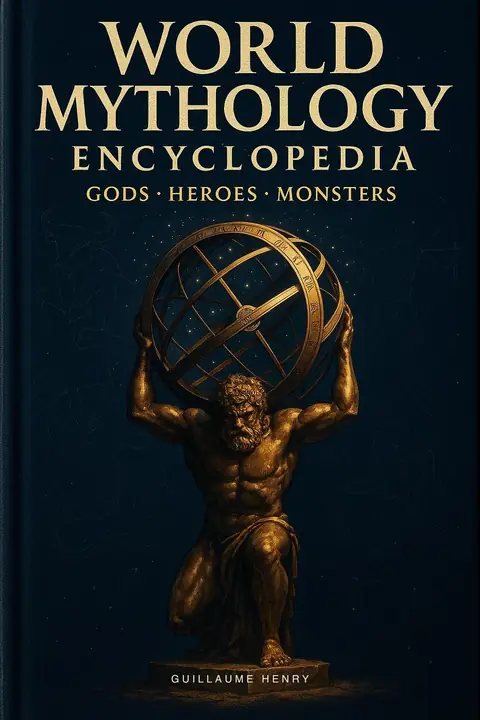
The World Mythology Book: The Gods, Heroes and Myths of Every Culture
The Gods, Heroes and Myths of Every Culture, in One Volume
The whole of world mythology in a single volume: Greek, Norse, Egyptian, Japanese, Hindu, Celtic, Slavic, Mesoamerican and African myths gathered side by side, each drawn from the primary sources.