

Pegasus the Winged Horse: Origin, Myths, Symbolism and Legacy
Born from Medusa's severed neck, Pegasus soared from the darkest moment in Greek myth to become poetry's own emblem. Here is every origin, every myth, every symbol unpacked.
Contents
The blood hit the sea. Medusa's neck, freshly opened by Perseus's bronze blade, poured two impossible things onto the seafoam: Pegasus the winged horse and his brother Chrysaor, the golden-sworded giant. No egg, no cradle, no slow gestation. One of antiquity's most beloved creatures entered the world through an act of lethal violence, and that paradox colored every myth that followed him.
That origin matters more than most readers realize. Pegasus was not born tame. He sprang from the blood of a monster and the seed of a god, carrying within him the double charge of terror and transcendence. Ancient Greeks understood this instinctively. They placed him in myths about ambition, divine favor, and the hairline boundary between heroism and hubris.
He was also, somehow, the horse of the Muses, guardian of a spring that made poets sing. The same creature born from slaughter became the symbol of inspiration itself. That leap, from wound to wonder, is the heart of the Pegasus story.
The Birth of Pegasus: Blood, Sea, and the Gorgon's Legacy

Pegasus the winged horse sprang from the neck of Medusa at the moment Perseus, guided by Athena and Hermes, beheaded her on the edge of the western world. Hesiod names the site near the streams of Oceanus, the great river encircling the world's rim. The name "Pegasus" itself derives, according to ancient grammarians, from the Greek pege, meaning "spring" or "source of water," a reading confirmed by his later role as creator of sacred springs.
His father was Poseidon, who had lain with Medusa before Athena transformed her into the snake-haired Gorgon. That divine paternity explains much. Poseidon was lord of horses as much as lord of the sea: ancient cult sites at Corinth honored him explicitly as Hippios, the horse-god. Pegasus inherited both domains, sea and sky, fluid power made airborne.
The ancient accounts diverge on one detail. Hesiod (Theogony 280-286) says Pegasus sprang from the neck itself. Later mythographers claimed he burst from the blood pooling in the sand where the head fell. The discrepancy is minor but revealing: both versions insist the creature emerged from Medusa's wound, not from Poseidon's deliberate act of creation. He was a byproduct of violence, not a planned gift.
Immediately after his birth, Pegasus flew to Olympus and took up residence near the halls of Zeus, carrying the god's thunderbolts. This detail, preserved in the Theogony (line 286), is often overlooked: before any hero ever saddled him, Pegasus served Zeus himself.
Hippocrene: How a Hoof Strike Created the Spring of the Muses
Mount Helicon in Boeotia held the oldest sanctuary of the nine Muses in the Greek world. The Roman geographer Pausanias visited in the second century CE and described it in detail (Description of Greece 9.31). At its heart ran a spring called Hippocrene, "Horse Spring," and every ancient source agreed on its origin: Pegasus struck the rock with his hoof, and water burst out.
That spring became the Muses' own water. Poets who drank from it received the gift of verse. The association sounds decorative until you sit with the genealogy: Pegasus, born from the blood of Medusa, creates the very source from which human poetry flows. The chain runs from monster to murder to song. Ancient Greeks rarely let beauty exist without a wound somewhere in its ancestry.
Hesiod himself opens the Theogony by drinking from the Muses' spring on Helicon, though he names the water source Aganippe, not Hippocrene. Ovid, writing in the Metamorphoses (Book 5, lines 256-263), gives the fuller account: the Muses told Perseus's story, and in the telling described how Pegasus created Hippocrene. The spring became a permanent fixture in Roman literary culture, so embedded that Juvenal, satirizing pretentious poets in the first century CE, mocked those who "exhaust Hippocrene" without producing anything worth reading.
The symbolism is precise. Springs belong to the earth. Wings belong to the sky. Pegasus uniquely bridges them: his earthly hooves generate the waters of inspiration, while his wings carry him toward Olympus. He is a hinge figure, connecting mortal creative effort to divine source.
Bellerophon and the Chimera: The Myth That Made Pegasus Famous

Most Greeks knew Pegasus the winged horse primarily through the story of Bellerophon, the hero of Corinth. The myth is old enough that Homer references Bellerophon in the Iliad (Book 6, lines 155-202), though without naming Pegasus directly. The full version, with the winged horse at its center, crystallized by Pindar's Olympian 13 and later in Apollodorus's Library (2.3.1-2).
Bellerophon arrived at the court of King Iobates of Lycia carrying a letter he could not read. Its message: kill the bearer. Iobates had received it from the Argive king Proetus, who wanted Bellerophon dead after his wife falsely accused the hero of attempting to seduce her (the "Potiphar's wife" motif, which recurs in the Joseph story of Genesis and the Egyptian tale of Anubis's brother Bata). Rather than murder a guest outright and violate the laws of xenia (sacred hospitality), Iobates sent Bellerophon on a mission he expected to be fatal: kill the Chimera.
The Chimera was a fire-breathing composite monster, lion in front, goat in the middle, serpent at the tail. No man on foot could approach it. But the seer Polyidus told Bellerophon to seek out Pegasus, and the goddess Athena (in some versions Poseidon) provided a golden bridle.
Bellerophon found the winged horse drinking at the spring Pirene in Corinth, slipped the golden bridle over his head, and the horse submitted without struggle. The bridle, divine-made, was the key. Ordinary rope would not hold a creature born of Poseidon.
Mounted on Pegasus, Bellerophon approached the Chimera from the air, raining arrows and driving a lead-tipped lance into its mouth. The creature's own fire melted the lead, the molten metal poured into its throat, and it died. Iobates sent Bellerophon on further missions: against the Solymians, against the Amazons, against a troop of Lycian warriors. He survived everything. Iobates eventually recognized divine favor and gave him his daughter in marriage.
The partnership of Bellerophon and Pegasus is the earliest sustained human-animal hero team in Western literature. They share the logic later applied to Achilles and his divine horses, to Arjuna and his chariot driven by Krishna, to Odin and Sleipnir: the hero's power is genuine, but it requires an extraordinary mount to become fully realized.
The Fall of Bellerophon: Hubris and the Horse That Survived
The Chimera story has a dark sequel that most pop-culture versions quietly drop. After his victories, Bellerophon grew proud. He decided to fly Pegasus all the way to Mount Olympus, to sit among the gods as an equal. Zeus, who tolerated much from heroes, sent a gadfly to sting Pegasus. The horse reared. Bellerophon fell.
Pindar is careful here. In Isthmian 7 he calls Bellerophon's ambition "the sweetest madness," and the Olympian 13 version is almost tender in its sympathy for the hero before the fall. But the message is precise: no mortal, however gifted, climbs to Olympus on his own terms. The gods decide who crosses that threshold.
Bellerophon survived the fall, maimed and blinded by brambles according to some accounts, and wandered the earth alone, "devouring his own heart," as Homer puts it in the Iliad's brief mention. Pegasus, unburdened, continued to Olympus and resumed his service to Zeus. The horse suffered no punishment. He had not chosen to fly there; he had been ridden there. The guilt lay entirely with the rider.
This moral geometry is consistent across Greek mythology: the divine animal is not culpable for the human who misuses it. Compare Helios's horses, which pulled Phaethon across the sky in a catastrophic arc. The horses obeyed a command they could not refuse. The punishment fell on Phaethon, not on them.
Pegasus in Corinthian Cult and Coinage
The city of Corinth claimed Pegasus as its founding symbol with a conviction that bordered on civic religion. The winged horse appeared on Corinthian coins from at least the sixth century BCE, so consistently that the stater minted there was nicknamed polos ("colt") by traders across the Mediterranean. Corinthian merchants carried Pegasus in their pockets from Egypt to the Black Sea.
The reason is geographic and mythological at once. Pirene, the sacred spring where Bellerophon first bridled the winged horse, sat inside Corinth's walls on the Acrocorinth. Pausanias visited it and described it as a permanent, free-flowing source, never running dry even in Corinthian summers (Description of Greece 2.3.3). For a trading city built on two harbors, a spring that never failed was a serious practical blessing, and its divine origin in the hoof-strike of Pegasus gave that spring civic meaning.
Corinth also hosted the Isthmian Games, one of the four great Panhellenic festivals, held in honor of Poseidon. Pegasus, as Poseidon's son, fit the sanctuary's patron perfectly. Athletic and poetic competition happened under the gaze of the god who had fathered the horse of the Muses. The circularity was intentional.
Symbolism: What Pegasus Actually Meant to Ancient Greeks
Strip away the narrative and three symbolic registers emerge clearly.
The boundary between mortal and divine. Pegasus moves freely between earth and Olympus. He drinks at mortal springs and carries Zeus's thunderbolts. He is the only creature in Greek myth who habitually crosses that boundary without transgression. Mortals who try to follow him (Bellerophon) are thrown back. The horse himself is exempt because he belongs to both realms.
Poetic inspiration as dangerous gift. Hippocrene is not a safe spring. Drinking deeply from it produces not peace but obsession. The Greek word for poetic frenzy, entheos ("god-inside"), carries the same double charge as Pegasus's origin: the divine presence that enables creation also risks consuming the person who receives it. Hesiod warns in the Theogony that the Muses can grant beautiful lies as easily as truth.
The winged horse as emblem of controlled power. Pegasus is not tamable by ordinary means. He submits only to the golden bridle, a divine instrument. This is a precise Greek idea: raw power (the monster's blood) transforms into usefulness only through divine mediation (Athena's golden bridle). Without that mediating instrument, power remains chaos.
Pegasus Across Other Traditions: Parallels Worth Noting
No direct borrowing from other cultures is provable, but the structural parallels are striking enough to reward attention.
The Vedic Uchaishravas, the seven-headed white horse that emerged from the churning of the cosmic ocean (Samudra Manthan) in the Mahabharata and the Vishnu Purana, shares the sea-origin logic. Both Pegasus and Uchaishravas arise from a liquid source (blood/ocean), both are associated with divine royalty, and both are considered the most perfect of horses. The Samudra Manthan episode even frames the horse's emergence as a byproduct of a violent cosmic process, the churning that also produced poison (Halahala) before it produced amrita, the nectar of immortality.
In Norse tradition, Sleipnir, Odin's eight-legged horse, also transcends normal boundaries. He travels between the nine worlds, carrying Odin between Midgard and Hel. Like Pegasus, Sleipnir's parentage is strange and divine: he was born from Loki in mare form and the giant stallion Svadilfari. Both horses are the finest of their kind precisely because their origins lie outside normal reproduction.
The Arabian Buraq, the luminous steed that carried Muhammad on the Isra and Mi'raj (the Night Journey to Jerusalem and the ascent through the seven heavens), is often cited in comparative mythology. Buraq's function, carrying a mortal to the divine threshold and back, maps closely onto Pegasus's Olympus-service role. The difference is directional: Muhammad returns; Bellerophon falls.
Pegasus in Hellenistic and Roman Art
By the Hellenistic period (roughly 323-31 BCE), Pegasus had become one of the most reproduced figures in Mediterranean visual culture. He appears on terracotta plaques from Tarentum, on relief pottery from Athens, on bronze mirrors from Etruria. The image stabilized: white horse, large eagle wings folded against the body or spread wide, often shown mid-gallop above a rocky landscape.
Roman artists inherited this image wholesale. On the Arch of Septimius Severus in Rome, completed in 203 CE, Pegasus appears in a spandrel as an emblem of imperial apotheosis, the emperor's soul carried heavenward after death. This was a deliberate political use of the symbol: the winged horse now marked the moment a Roman emperor crossed from mortal to divine status. The violence of the origin had been refined into something ceremonial.
Pompeian wall paintings from before 79 CE show Bellerophon astride Pegasus attacking the Chimera, painted with the loose, confident brushwork of narrative murals meant to be read quickly at a glance. The myth was common enough knowledge that painters could render it in shorthand: a horse with wings, a three-part monster below, a hero with a lance. Anyone walking past knew the story.

Pegasus in Modern Reception: From Renaissance Allegory to Pop Culture
The Renaissance found Pegasus useful as an emblem for poetic ambition and for the aspiration of the newly literate classes to classical learning. The Medici academy in Florence adopted Pegasus as a symbol for their intellectual project. Giorgio Vasari painted Pegasus above the Sala dei Cinquecento in the Palazzo Vecchio. Cesare Ripa's Iconologia (1593), the handbook of Renaissance allegory, lists Pegasus under "Fame," "Poetry," and "Glory."
By the seventeenth century, the horse had become an almost heraldic emblem: the Inns of Court in London adopted him as a symbol for legal argument and eloquence. He appears on the gate of Middle Temple, carved in stone, where he has remained since 1562. Travelers walk past him daily without knowing they are looking at a creature born from the neck of a Gorgon.
The twentieth century multiplied him. Walt Disney's Fantasia (1940) opened with a sequence of Pegasus colts playing in pastoral landscapes, white and color-dappled, the violence entirely removed. The 1997 Disney Hercules made Pegasus the hero's personal companion from birth, an invention that flattens the myth but stuck in two generations of popular memory. The Clash of the Titans films (1981 and 2010) restored something closer to the Bellerophon myth, though with considerable compression.
Rick Riordan's Percy Jackson series (2005-2009) gave Pegasus a species: "pegasi" as a category of winged horses, all descended from the original. This is an invention with no ancient precedent, but it reflects something real about how mythological creatures generate families in the popular imagination.
The logo of Mobil Oil, a red Pegasus, dates to 1911 and was formally adopted in 1931. It was chosen to evoke speed, energy, and sky-reach for a petroleum company. For decades it was one of the most recognized commercial logos in the world, a further domestication of the Gorgon's blood.
Frequently Asked Questions About Pegasus the Winged Horse
Frequently asked questions
Who were Pegasus's parents in Greek mythology?
His mother was Medusa, the Gorgon, and his father was Poseidon, the god of the sea and horses. Poseidon had lain with Medusa before Athena transformed her. When Perseus beheaded Medusa, Pegasus sprang from the wound, inheriting both the sea-god's power and Medusa's formidable nature. Hesiod records this genealogy in the Theogony (lines 278-286).
What is the connection between Pegasus and the Muses?
Pegasus created the spring Hippocrene on Mount Helicon by striking the rock with his hoof. That spring became sacred to the nine Muses and was considered the source of poetic inspiration. The Roman poet Ovid gives the fullest account in Metamorphoses Book 5. The connection made Pegasus an enduring emblem of poetry, creativity, and artistic aspiration across both Greek and Roman culture.
Did Bellerophon actually ride Pegasus to Olympus?
Yes, according to the myth. After his many victories, Bellerophon grew proud and attempted to fly Pegasus to Olympus to join the gods. Zeus sent a gadfly to sting the horse, who reared and threw Bellerophon. The hero survived but was maimed and spent his remaining days wandering alone. Pegasus continued on to Olympus unharmed and resumed carrying Zeus's thunderbolts. Pindar treats this myth in Olympian 13 and Isthmian 7.
Is Pegasus ever mentioned in Homer's Iliad or Odyssey?
No. Homer mentions Bellerophon and his campaigns in the Iliad (Book 6) but does not name Pegasus there. The winged horse's literary debut as a named figure comes in Hesiod's Theogony, composed around 700 BCE. Pindar gave the myth its most developed classical form in the fifth century BCE. Attributing Pegasus to Homer is one of the most common popular misconceptions about Greek mythology.
What did Pegasus symbolize to ancient Greeks?
He carried several distinct meanings simultaneously. He represented the liminal zone between mortal and divine, since he crossed freely between earth and Olympus. His creation of Hippocrene made him an emblem of poetic inspiration. His taming by a golden bridle expressed the Greek idea that raw divine power requires mediated control to become useful to humanity. Later, in Roman Imperial imagery, he signified apotheosis, the soul's ascent to divine status after death.
Are there similar winged horse figures in other world mythologies?
Several traditions feature divine horses with extraordinary powers, though direct borrowing is not documented. The Vedic Uchaishravas emerged from a primordial churning of the ocean, paralleling Pegasus's sea-adjacent birth. Norse mythology's Sleipnir, born of Loki and a giant stallion, similarly transcends normal boundaries, carrying Odin between worlds. The Islamic Buraq carries a mortal to the divine threshold and back. Each tradition uses the extraordinary horse to mark the boundary between human and divine realms.
The Gorgon's Gift: Why Pegasus Still Flies
There is a detail in Hesiod's account that tends to get overlooked in popular retellings. After Pegasus sprang from Medusa's neck, he flew immediately toward Olympus. He did not wait. He did not linger at the site of his mother's death. He went, without hesitation, toward the highest point available.
Ancient Greeks read that directness as a sign of his nature. Born from violence and divine seed, he oriented himself instinctively toward the divine. He was not tainted by his monster mother because he was also Poseidon's son, and Poseidon's horses always ran toward the horizon.
What keeps Pegasus the winged horse alive in the imagination is precisely the tension between those two heritages. Every subsequent culture that picked him up, the Renaissance allegorists, the Romantic poets, the Disney animators, the oil company brand managers, simplified that tension in one direction or another. They kept the wings and the grace. They dropped Medusa's blood.
The full myth is stranger and more interesting than any of its descendants. A creature emerges from the most monstrous source in Greek mythology and immediately becomes the most beautiful, the most sky-oriented, the most inspired. He makes a spring that makes poetry. He lets a hero kill a fire-breathing monster. He goes to Olympus and carries Zeus's lightning.
Then he stays there, uncorrupted, while the hero who rode him falls.
That is not a children's story. That is a precise Greek argument about where beauty actually comes from, and what it costs the people who get closest to it, and why the horse itself, unlike any human who touches it, can bear the full charge of that proximity without breaking.
Poets have been drinking from Hippocrene ever since.
Read the full book
Want the whole story?
The complete edition is an instant PDF download here, with a paperback on Amazon for selected titles.
Mythology
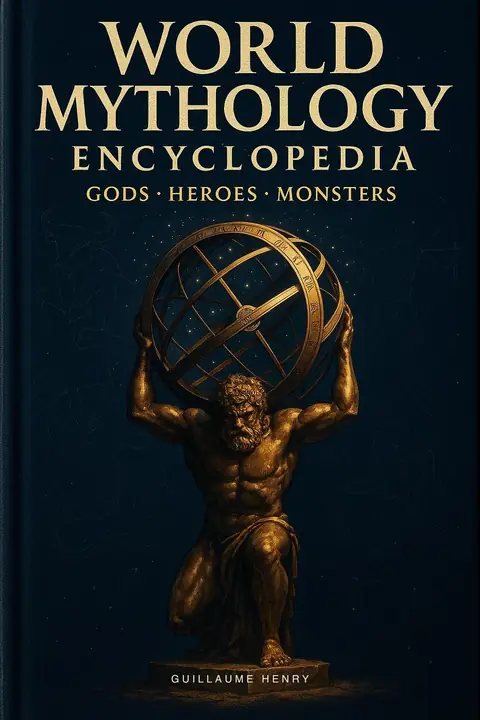
The World Mythology Book: The Gods, Heroes and Myths of Every Culture
The Gods, Heroes and Myths of Every Culture, in One Volume
The whole of world mythology in a single volume: Greek, Norse, Egyptian, Japanese, Hindu, Celtic, Slavic, Mesoamerican and African myths gathered side by side, each drawn from the primary sources.