

Poseidon, God of the Sea: Storms, Horses, and the Shaker of Earth
Poseidon ruled oceans, earthquakes, and horses with equal fury. From Homer's Iliad to the founding myths of Athens, meet the most volatile Olympian in the Greek pantheon.
Contents
The sea off Cape Sunion has a particular quality at dusk. The water turns the color of hammered bronze, and the wind shifts without warning. Ancient Greek sailors recognized that shift as a mood change, not a weather pattern. Something beneath the surface had taken notice.
Poseidon, god of the sea, was not merely a personification of water. He was its will, its rage, its occasional generosity. He split continents, raised islands from nothing, and could level a city with a single strike of his trident before the dust had settled. Homer calls him Ennosigaios, "the Earth-shaker," a title that carries more dread than any of the epithets belonging to his brother Zeus. Zeus ruled from above. Poseidon ruled from below, from the deep foundations of things, and that made him harder to ignore.
He sat at the center of some of the most consequential myths in the Greek tradition: the contest for Athens, the creation of the horse, the blinding of the Cyclops that cursed Odysseus across ten years of sea. His anger outlasted battles, and his grudges outlasted generations. Before the first sail was cut for the first Greek trading vessel, Poseidon had already been worshipped on the mainland for centuries. He was old. He was patient, when patience suited him. And when it did not, the ocean floor cracked open.
The Origins of Poseidon: Older Than Olympus
The story most people know begins with the Titan Cronus, who swallowed his children whole to prevent any of them from unseating him. Poseidon was the second child of Cronus and Rhea, swallowed and held in darkness until his youngest brother Zeus forced Cronus to disgorge them all. That liberation, described in Hesiod's Theogony, launched the Titanomachy: the ten-year war between the Olympians and the Titans.
But the Linear B evidence complicates any clean narrative of Poseidon as simply a post-Titanic Olympian import. At Pylos, the administrative center of Mycenaean power before its collapse around 1180 BCE, the tablets record Po-se-da-o receiving more offerings than any other deity, including the figure who would become Zeus. He may have been a chthonic earth deity first, a god of subterranean water and seismic force, whose domain only later expanded to include the open ocean as Greek civilization became a maritime one.
This origin as an earth deity survives in his most persistent title. Earthquakes in Greek were called seismoi, but Poseidon's direct involvement was captured in Ennosigaios and the closely related Enosichthon, "he who shakes the earth." The sea and the earthquake shared the same logic in the ancient Greek mind: both were sudden, both were vast, both operated beyond human control.

The Trident, the Horse, and the Division of the World
After the Titanomachy, the three brothers divided the cosmos. According to Book 15 of the Iliad, Zeus recalls this arrangement with pointed bluntness: the three drew lots. Zeus took the sky, Hades took the underworld, and Poseidon received the sea. The earth and Olympus remained common ground. Poseidon accepted this division, but never with full grace. He spent the entirety of the Iliad maneuvering around Zeus's authority, backing the Greeks when Zeus backed the Trojans, withdrawing and returning based on his own calculations of what he could get away with.
His primary weapon and symbol was the trident, called triaina in Greek. Hephaestus forged it, along with Zeus's thunderbolts, as payment from the Cyclopes during the Titanomachy. With it, Poseidon could shatter rock, raise storms, and still the sea again when anger passed. The trident's three prongs connected to ancient triple symbolism: some scholars link it to the three-tined fishing spear used on Greek coasts, others see it as representing Poseidon's triple domain of sea, earthquake, and horse.
The horse stands as his most unexpected association. Poseidon was called Hippios, "of the horse," and credited by several ancient sources with creating the first horse. The most vivid account appears in the myth of Athens's founding. Poseidon and Athena competed for patronage of the city on the Acropolis. Poseidon struck the rock with his trident; salt water gushed from the cleft, and from the spray he conjured a horse. Athena planted an olive tree. The twelve Olympians judged (with some sources noting that Cecrops, the king, cast the deciding vote), and the olive tree won. Poseidon, furious, flooded the Attic plain.
The contest is told by multiple sources, including Pseudo-Apollodorus in the Library and Pausanias, who claimed the marks of the trident strike were still visible on the Acropolis in his own day, the 2nd century CE. Both the salt spring and the marks were shown to visitors as physical proof of divine anger.
Poseidon's Palace and the Court Beneath the Waves
Homer gives Poseidon a palace in the depths near Aegae, which most ancient commentators identified with the coast of Achaea in the northern Peloponnese. The Iliad describes him harnessing his bronze-hooved horses and driving his golden chariot across the sea-surface, the waves parting to let him through, dolphins and sea creatures leaping around his wheels in recognition.
His wife was Amphitrite, a sea goddess and one of the fifty Nereids, daughters of the old sea god Nereus. The courtship was not gentle: Amphitrite initially fled Poseidon's advances and hid among her sisters. The dolphin Delphinus found her and conveyed Poseidon's plea with such eloquence that she relented. In gratitude, Poseidon placed Delphinus among the stars as the constellation Delphinus, still visible in the night sky.
Their children included Triton, the messenger god with a human torso and a fish tail, who blew his great conch shell to raise or calm the seas. The image of Triton blowing his horn became one of the most recognizable figures in Mediterranean art, reappearing in Roman mosaic work, Renaissance fountains, and eventually in the name of a moon of Neptune.
Poseidon, like Zeus, fathered children far beyond his legitimate household. His lovers included mortal women, nymphs, and occasionally beings that defied easy categorization. The results were proportionally extraordinary.
The Children of Poseidon: Giants, Cyclopes, and Tragic Heroes
The catalogue of Poseidon's offspring reads like a roster of everything that endangered civilization in Greek myth. Polyphemus, the Cyclops blinded by Odysseus in Book 9 of the Odyssey, was his son. The blinding triggered the most consequential divine grudge in the epic: Poseidon could not kill Odysseus outright because the Fates had determined Odysseus would reach home, but he could make the journey last ten years and kill every one of his companions. He did.
Antaeus was the giant of Libya who challenged all travelers to wrestling matches and was undefeatable as long as he kept contact with his mother, the earth. Heracles eventually held him aloft and crushed him. Poseidon fathered Antaeus with Gaia herself, a pairing that reinforced his ancient connection to earth as well as sea.
Orion, the great hunter, appears in some traditions as a son of Poseidon, inheriting from his father the ability to walk on water. Theseus, the hero of Athens who killed the Minotaur, claimed Poseidon as his divine father in one strand of tradition, which gave the city of Athens a complicated relationship with the god who had already lost a patronage contest to Athena. The Bacchylides ode Dithyramb 17 plays directly on this: Minos challenges Theseus to prove his divine parentage by retrieving a ring from the sea floor, and Poseidon provides his son with safe passage and a coral crown.
Chrysaor and Pegasus, the winged horse, were born from the severed neck of Medusa when Perseus beheaded her. Medusa had been a mortal woman before Athena transformed her into a Gorgon, and some versions of the myth record that Poseidon had lain with her in one of Athena's temples, which was the offense that triggered the transformation. The winged horse born from that union became the steed of Bellerophon, and later, in Roman retellings, of Perseus himself.

Poseidon Across the Iliad and Odyssey: The God in Action
Homer's two epics offer the most sustained portrait of Poseidon operating at full divine capacity. In the Iliad, written down around the 8th century BCE from a tradition of oral poetry centuries older, Poseidon's resentment of Troy has a specific origin: he and Apollo had built the walls of Troy for King Laomedon, and Laomedon refused to pay them. Apollo eventually forgave the insult (or channeled it differently); Poseidon never did. His support for the Greeks throughout the war was not abstract: in Book 13 he disguises himself as the seer Calchas and walks through the Greek camp injecting courage directly into soldiers' spines.
His confrontation with Zeus in Book 15 is the most revealing passage for understanding his character. Zeus sends Iris to order him back from the battle. Poseidon's reply runs to forty lines and includes the blunt assertion that he and Zeus are equals, that the lot-draw did not make him inferior. He eventually withdraws, but makes sure Zeus understands it is a choice, not obedience.
In the Odyssey, the god operates through the mechanisms of weather and sea rather than direct presence. He sends the storm that breaks Odysseus's raft in Book 5. He turns the Phaeacian ship to stone as it returns home after delivering Odysseus to Ithaca, a punishment for the Phaeacians' habit of helping travelers that he had been waiting to deliver. The act is both petty and devastating, and Homer presents it without judgment. That is simply how Poseidon operates.
Odysseus spends a decade at sea because he made an enemy of the god who owned the sea. The lesson Greek sailors drew from this was practical: you do not sail without propitiating Poseidon, and you certainly do not mock his son.
Sacred Sites, Festivals, and Worship Practices
Poseidon's most famous sanctuary stood at Cape Sounion, the southernmost tip of Attica, where the white marble columns of his temple are still visible today. Sailors rounding the cape would see those columns and know they were making an offering whether they planned to or not: the visual sight of his temple was considered a form of acknowledgment. The current temple dates to around 444 BCE, built in the same decade as the Parthenon on the Acropolis.
The sanctuary at Isthmia, near Corinth, hosted the Isthmian Games, one of the four great Panhellenic festivals alongside the Olympics, Nemean Games, and Pythian Games. The Isthmian Games honored Poseidon and were held every two years. Athletes competed in chariot racing, wrestling, and music. Pindar wrote several Isthmian Odes for victors, and the prestige of the games placed Poseidon firmly in the civic consciousness of mainland Greece.
At Onchestos in Boeotia, Poseidon had a grove mentioned in both the Homeric Hymn to Apollo and in Hesiod's Theogony. Horses were a central part of worship here: chariots were sent through the grove with no driver, and how the horse chose to move through the trees was interpreted as divine communication.
Horse sacrifice was recorded at other sites. At Argos, black bulls and horses were driven into a spring sacred to Poseidon. The color black carried the association with subterranean and chthonic powers, linking back to his primordial earth-shaker aspect.
Poseidon and His Roman Counterpart Neptune
Neptune was the Roman god of fresh water and the sea, identified with Poseidon during the period of interpretatio romana, when Greek and Roman religious figures were mapped onto each other. But the identification was never a perfect fit. Neptune's original domain was freshwater, rivers, and springs; the ocean was secondary. He had nothing like Poseidon's role as earth-shaker, and his temperament in Roman religious literature was considerably calmer.
The Roman festival of the Neptunalia, held on July 23, involved building huts of leafy branches near the Tiber and sheltering in them. This agricultural, freshwater-adjacent celebration has almost no equivalent in Poseidon's Greek cult. The two figures share the trident as a symbol and the sea as a domain, but Poseidon carried an older, more seismically charged mythology that Neptune never fully absorbed.
The name Neptune later traveled further. In 1846, when astronomers identified the eighth planet from the sun and found it to be an enormous blue sphere, the name Neptune was chosen for its obvious visual resonance. One of Neptune's largest moons received the name Triton, Poseidon's herald son. The naming convention continued for other moons: Proteus, Nereid, Larissa. The old god's family spread across the outer solar system without anyone sacrificing a horse.
Poseidon Compared: Sea Gods Across Traditions
The archetype of a sea deity who is also fundamentally unpredictable and capable of geological violence appears across multiple mythological traditions, though the specific attributes diverge significantly.
Poseidon (Greek)
Poseidon governs the open sea, earthquakes, and horses. His temperament is volcanic: slow to forgive, quick to respond to disrespect. He holds grudges across entire epic cycles (the Trojan War, Odysseus's voyage) and interacts directly with human affairs through storms, floods, and divine disguise. His worship was bound to civic festivals and specific geographic landmarks.
Njord (Norse)
Njord rules wind and sea in Norse tradition, one of the Vanir gods who came to Asgard as a hostage-peace exchange. He is the father of Freyr and Freya. His domain is specifically coastal and maritime; he has no earthquake function. His mythology is calmer and his interactions with human sailors are less adversarial. He is married briefly to the giantess Skadi, a mismatch the Eddas treat with quiet humor rather than divine fury.
The Mesopotamian sea god Enki (later Ea in Akkadian tradition) shared with Poseidon the association of water with creative intelligence, but Enki was primarily a god of wisdom, magic, and fresh water rather than oceanic storm force. The ocean goddess Tiamat from the same tradition was, if anything, the more destructive water power, closer in temperament to Poseidon's worst moments.
In Hindu tradition, Varuna began as a cosmic overseer of the sky and moral order (rita), but by the later Vedic period had become specifically associated with the sea and waters, carrying a conceptual shift that parallels Poseidon's own contested domain. Varuna wielded a noose rather than a trident, but his role as enforcer of cosmic order and judge of human transgressions had a structural similarity to Poseidon's habit of punishing those who broke oaths or showed disrespect.
The Iconography of Poseidon: How Artists Drew a God
In Archaic Greek art (roughly 700-480 BCE), Poseidon was indistinguishable from Zeus except by context and the trident. Both were depicted as mature, bearded men of great physical power. The distinction became more consistent in the Classical period: Poseidon's hair was sometimes shown wet, his body slightly heavier, more elemental. He appeared on the east pediment of the Parthenon (now largely reconstructed from fragments) in the contest against Athena.
The Artemision Bronze, recovered from the sea off Cape Artemision in 1928 and now in the National Archaeological Museum in Athens, shows either Poseidon about to hurl his trident or Zeus about to throw a thunderbolt. Scholars continue to argue which. The figure dates to around 460 BCE, stands over two meters tall, and captures the god mid-throw with an authority that no description quite matches. The extended arm, the weight shifted onto the back foot, the absolute stillness of the face despite the violence of the pose: this is what the Greeks imagined when they thought about divine power.
In Roman mosaic work, Neptune appears frequently in the center of elaborate sea-themed floor compositions, surrounded by Tritons, sea nymphs, and fish, a domestication of Poseidon's energy that reflects the difference between the two cultures' relationships with the ocean. Greek mosaic Neptune tends toward the same formal severity as the Artemision figure. Roman Neptune is often more relaxed, a patron of the baths as much as the open water.

Poseidon in Modern Storytelling and Popular Culture
Poseidon never really left. He spent the 20th century accumulating new roles. The 1972 film The Poseidon Adventure used his name for a ship struck by a tidal wave at New Year's Eve, choosing the most marketable divine association for nautical catastrophe. The name carries weight precisely because the mythology still functions.
Rick Riordan's Percy Jackson and the Olympians series, beginning in 2005, cast Poseidon as the father of the protagonist Percy Jackson and gave him a major role across five novels and two sequel series. The portrayal drew on genuine Homeric attributes (the sea powers, the temperamental relationship with Zeus, the rivalry over Athens) while translating them into a contemporary American setting. The series introduced Greek mythology to a generation of readers with more narrative directness than any classroom curriculum managed, and Poseidon specifically became one of the more sympathetically rendered Olympians in popular reception.
The 2023 Disney series Percy Jackson and the Olympians carried this further into streaming culture. Poseidon's visual representation, a weathered but contained authority figure rather than the furious earth-shaker of the epics, reflects modern discomfort with divine rage, but the underlying mythological architecture remains intact.
Video games have returned to him repeatedly. God of War (2005) features him as a boss encountered by Kratos; Age of Mythology includes him as a major playable deity with civilization-building bonuses tied to his horse and naval associations. Each iteration strips away nuance but preserves the structural logic: the sea, the trident, the volatile temperament.
What none of these retellings quite captures is the specific Greek understanding of Poseidon as a force of geological time. The earthquakes he caused were not expressions of personality. They were reminders of what lay beneath the thin crust of civilization. Every Greek city on a seismic fault line understood that the ground itself was subject to divine mood. That knowledge shaped how people built temples, poured libations, and chose their harbors. Modern storytelling turns Poseidon into a character. The ancient Greeks lived in his body.
Frequently Asked Questions About Poseidon, God of the Sea
Frequently asked questions
Why was Poseidon considered both a sea god and an earthquake god?
The ancient Greeks observed that earthquakes and tsunamis often arrived together along their coastlines, which led naturally to a single divine source for both. Poseidon's title Ennosigaios ("Earth-shaker") appears in Homer and persisted throughout antiquity. His older Mycenaean identity may have been primarily chthonic (earth-related) before Greek civilization's maritime expansion made the sea his primary domain. The two aspects were never separated in Greek religion.
Did Poseidon really create the horse, according to Greek myth?
Several ancient sources credit Poseidon with creating the first horse, most directly in the context of his competition with Athena for patronage of Athens. Pseudo-Apollodorus in the Library (3.14.1) describes him striking the Acropolis rock and producing a horse. Other traditions say he produced the first horse during the Titanomachy to demonstrate his power. His epithet Hippios ("of the horse") was worshipped independently at sites in Thessaly and Arcadia, confirming this association was widespread and old.
What is the difference between Poseidon and Neptune?
Poseidon was a Greek deity with a documented Mycenaean history stretching back at least to 1200 BCE, carrying earthquake, horse, and sea functions. Neptune was originally a Roman freshwater deity whose domain was later expanded to include the sea under Greek influence. Neptune lacked Poseidon's earthquake function and his temperament in Roman religion was milder. The two were formally identified during Rome's cultural borrowing from Greece, but their original mythological profiles were distinct.
Why did Poseidon lose the contest for Athens to Athena?
Ancient sources give slightly different verdicts. Pseudo-Apollodorus says the Olympians judged and Athena's olive tree was more useful than Poseidon's salt spring or horse. Varro (cited by Augustine in City of God 18.9) adds that the male gods voted for Poseidon and the female gods for Athena, with women being one vote more numerous, which led to the women of Athens losing their voting rights as political appeasement of the furious sea god. The myth almost certainly reflects a historical religious transition: a cult of Poseidon once dominant on the Acropolis eventually ceding to Athena's cult as Athens became a land-based political rather than purely maritime power.
What primary sources are most important for understanding Poseidon?
Homer's Iliad (especially Books 13-15) and Odyssey (Book 5, Book 9, Book 13) provide the fullest literary portrait. Hesiod's Theogony covers his birth, the Titanomachy, and his place in the divine genealogy. Pseudo-Apollodorus's Library compiles the wider mythological tradition, including the Athens contest and his many offspring. Pindar's Isthmian Odes show him in a civic religious context. For his prehistoric role, Michael Ventris and John Chadwick's decipherment of Linear B (published 1953) established the Mycenaean evidence for Po-se-da-o.
Who were Poseidon's most important children in Greek mythology?
The range is deliberately extreme. Triton, his son with Amphitrite, was his herald and a respected sea deity. Theseus, the founder-hero of Athens, claimed Poseidon as his divine father. Polyphemus the Cyclops was his son, and the blinding of Polyphemus by Odysseus triggered the divine grudge that defined the Odyssey. Pegasus, the winged horse, was born from Poseidon's union with Medusa. Antaeus, the Libyan giant killed by Heracles, was also his. The pattern across these children reflects Poseidon's own dual nature: some build civilizations, others consume them.
The Unresolved Question of Poseidon's Primacy
Something gets lost when Poseidon is filed neatly under "god of the sea." The Mycenaean evidence suggests he may once have held a position closer to Zeus's own: a sovereign earth deity rather than a junior brother who drew the short straw in a cosmic lottery. The story of the lot-draw in Book 15 of the Iliad may be exactly what it appears to be on the surface, a political myth that naturalizes an existing power arrangement. It may also record, in compressed form, a genuine religious displacement: the demotion of an older earth-shaking deity as the sky-god cult of Zeus became dominant across the Greek-speaking world.
This debate matters because it changes how we read every myth Poseidon appears in. If he was once paramount, then his persistent resentment of Zeus across both epics is not mere petulance. It is the memory of a prior sovereignty, preserved in story because it could not be preserved in cult. The grudge against Troy, the decade-long persecution of Odysseus, the fury after losing Athens: these read differently if Poseidon once held a position that Zeus now occupies.
Hades, the third brother, accepted his underground realm with apparent equanimity. Poseidon never did accept the sea as a limit. His trident kept striking things that were not sea. The earth cracked open and he reminded everyone that his domain went all the way down, past the seafloor, into the foundations the cities were built on. That is the older Poseidon, the one beneath the mythology that Homer inherited. The one the sailors at Cape Sounion were watching for at dusk, when the wind shifted and the bronze water changed without warning.
Read the full book
Want the whole story?
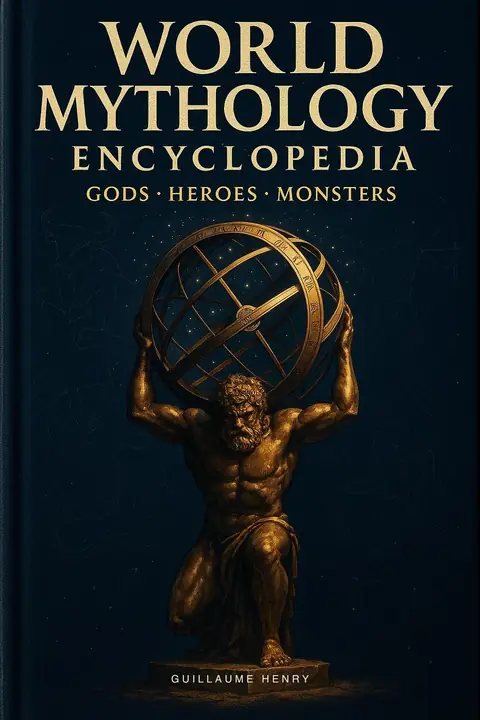
The complete edition is an instant PDF download here, with a paperback on Amazon for selected titles.
Mythology
The World Mythology Book: The Gods, Heroes and Myths of Every Culture
The Gods, Heroes and Myths of Every Culture, in One Volume
The whole of world mythology in a single volume: Greek, Norse, Egyptian, Japanese, Hindu, Celtic, Slavic, Mesoamerican and African myths gathered side by side, each drawn from the primary sources.