

Selene: Goddess of the Moon, Keeper of Night's Light
Selene drove her silver chariot across the Greek sky every night, her crescent crown lighting the world below. She loved a sleeping mortal, carried fifty daughters by Zeus, and survived the rise of Artemis to remain the moon's oldest name.
Contents
The horses are already at the horizon. Two white stallions, their manes catching the last thermal off the warm Aegean, pull a silver chariot up from the rim of Okeanos and into the vault of night. The driver wears a crescent of pale gold on her brow, long robes trailing like spilled milk across the dark. Below, fishermen check the tide. Farmers watch for frost. A shepherd on Mount Latmos lifts his eyes without knowing why.
That driver is Selene, goddess of the moon, and she has been making this crossing since before Olympus had a name.
She is older than the Olympian order, older than the quarrels of Zeus and the ambitions of Poseidon. The Greeks who first named her were not spinning metaphor. They believed the disc of light overhead was literally her body, her radiance, her attention given freely to a sleeping world. What follows is her full story: where she came from, who she loved, what she carried, and why a figure so ancient still commands attention.
Selene's Place in the Greek Cosmos: Titan Blood, Divine Light
Selene belongs to the second generation of Titans, the cosmic beings who preceded the Olympians and shaped the physical world. Her parents are Hyperion, Titan of heavenly light, and Theia, Titaness of sight and the shining sky. That genealogy, recorded in Hesiod's Theogony (lines 371-374), makes her a sibling of Helios the sun and Eos the dawn.
The three together form a complete daily cycle. Eos rises first, burning rose and amber across the eastern edge of the world. Helios follows, driving his fiery quadriga through the sky's high arch. At dusk he descends into the western river of Okeanos, rests, and sails east again beneath the earth while Selene takes the vault. The rhythm is mechanical in its perfection and mythological in its personality: each sibling has desires, loves, and griefs of their own.

The Titans were not defeated powers, not entirely. Cronus and the war-making Titans were chained in Tartarus after the Titanomachy. Hyperion's children were spared. The Greeks needed the sun to rise and the moon to cross the sky, so Helios and Selene kept their offices under the new Olympian dispensation. They served the order of Zeus not from submission but from cosmic necessity. The lights could not go out.
Hesiod also calls Selene Mene in the Homeric Hymn to Selene (Hymn 32), a short poem that survives intact and remains the richest single source on her character. The hymn praises her radiance, notes the brightness of her body reflected on earth, and describes her union with Zeus directly - a detail that complicates the picture of Selene as a merely peripheral figure.
The Family of Selene: Sisters, Lovers, and Fifty Daughters
The family mathematics are worth laying out clearly. Selene's immediate kin:
- Hyperion (father) - Titan of heavenly light
- Theia (mother) - Titaness of sight and radiance
- Helios (brother) - the Sun, driver of the solar chariot
- Eos (sister) - the Dawn, mother of the winds
Those relationships give her a family of equals, each sovereign over a domain of light. But her romantic and parental relationships expand the network considerably.
Her most famous entanglement is with Endymion, the sleeping shepherd of Mount Latmos in Caria. Ancient sources are not uniform on the details. Apollodorus (Library 1.7.5) says Selene fell in love with him and asked Zeus to grant him eternal sleep so she could visit him forever. Other versions, including fragments preserved by Theocritus and later by Cicero, say Endymion chose sleep himself - that he asked Zeus for immortality without aging, and the god granted it in the peculiar form of endless unconscious rest. Either way, the image persists: Selene descending each night to a cave on Latmos to lie beside a man who cannot wake, whose youth never fades because nothing in him moves.
By Endymion, according to Pausanias (Description of Greece 5.1.4), Selene bore fifty daughters. Their names are not recorded individually in surviving texts, though scholars have connected them to the fifty months of the Olympiad cycle, a four-year period of 50 lunar months. The daughters may have personified lunar time itself.
Her unions with Zeus produced different offspring. The Homeric Hymn to Selene (32.14-16) names Pandia, "the all-bright one", described as beautiful among the immortals. Some ancient sources also credit Zeus and Selene with Ersa, the dew, whose name captures the moisture left by a cool night sky. The Dioscuri - Castor and Pollux in Latin tradition - were occasionally associated with Selene's light in later syncretistic accounts, though their primary parentage in Greek myth belongs to Leda.
Selene (Greek)
Titan-born, older than the Olympian order. Selene IS the moon: her body, her movement, her light. She drives a chariot pulled by two white horses (or oxen in some sources). Her love life is extensive: Endymion, Zeus, Pan. She holds no virgin oath. Her power is cosmic and elemental rather than martial or civic.
Artemis (Greek)
Olympian, daughter of Zeus and Leto. Artemis is goddess of the hunt, wilderness, and childbirth who acquired lunar associations through gradual syncretism, particularly in Hellenistic and Roman periods. She carries a bow, leads the Hunters, and is fiercely chaste. Her lunar identity is borrowed from Selene, not original to her.
The Endymion Myth: Love, Sleep, and the Problem of Immortality
No story attached to Selene has endured longer or traveled further than the love of Endymion. Strip away the prettiness and the myth raises an unsettling question: what does it mean to love someone who cannot be present?
Selene sees the shepherd by her own light. That is the implied mechanism. She shines down, and in the shining, she notices him. In some versions he is a king; in others a hunter; in most he is simply a young man of exceptional beauty asleep on a hillside. She descends. She wants him to remain as he is.
The request to Zeus - give him eternal sleep - reads on one level as possessiveness: she controls the terms of the relationship by removing the possibility of his refusal. On another level the myth is about the tragedy of asymmetry between a deity's endless time and a mortal's brief span. Selene's nightly crossing never stops. She cannot be with Endymion the way a human lover can be with another. The only stable form of the relationship is one where he waits, always, in the same cave, the same youth, the same soft breathing.

Pausanias (Description of Greece 5.1.5) notes that the tomb of Endymion was shown at Heracleia near Latmos in his own day (second century CE), and that the Eleans also claimed him, calling him their ancient king. This dual claim suggests the myth was genuinely widespread and locally adapted. The cave on Mount Latmos was a real place where, in the Byzantine period, Christian monks later built a monastery on top of the ancient sacred site. The overlap is not coincidental. The moon's pull on the landscape of Latmos never entirely disappeared.
Keats would make Endymion the subject of his first major poem in 1818. The romantic tradition turned Selene's love into an allegory of the poet's pursuit of beauty. That reading was available to ancient audiences too, though they may have weighted the theological vertigo more heavily: a Titan goddess who wants, who descends, who visits the dead-alive, is doing something stranger than falling in love.
Symbols, Iconography, and Sacred Attributes
Ancient artists and poets agreed on a consistent set of symbols for Selene. Knowing them makes it possible to identify her in any tradition that inherited Greek imagery.
The crescent crown is her most immediate sign. Greek vase painters typically placed a thin crescent, either worn like a diadem or rising from her forehead, to mark her identity. Later Hellenistic and Roman artists sometimes gave her the full disc of the moon as a halo, blending her image with that of the lunar deity more broadly.
The silver chariot driven by two horses (the Homeric Hymn specifies hippoi, horses) is her vehicle. Some sources say oxen; Nonnus in the Dionysiaca (written in late antiquity) gives her a team of two white horses named Chronos and Aster. The chariot connects her visually to her brother Helios, whose own four-horse team blazes across representations in Greek and Roman art from the Parthenon friezes onward.
White or silver robes appear consistently in literary descriptions. The Homeric Hymn (32.7-9) describes her light as her body glowing through her garments, the sheen of her dress indistinguishable from the radiance she casts.
Torches appear in her hand in some representations, particularly where she overlaps with Hecate and Artemis in the triformis tradition - the three-faced goddess of Hellenistic religion that merged all three lunar figures into a single cult image.
Her sacred animals varied by source, but bulls appear in several Greek magical papyri invoking her, and the crescent horns of a bull were explicitly compared to her crescent shape in ancient commentary. Oxen appear as her chariot animals in some versions precisely because of this horn association.
Selene Across the Greek Magical Papyri and Mystery Traditions
The philosophical and ritual traditions of late antiquity treated Selene with unusual seriousness. In the Greek Magical Papyri (Papyri Graecae Magicae, PGM), a collection of ritual texts from Greco-Roman Egypt spanning roughly the 2nd century BCE to the 5th century CE, Selene appears as one of the most frequently invoked deities for night-time operations.
PGM IV.2241-2358 contains a hymn to Selene that assigns her an extraordinary range of attributes: she governs fate, the tides, dreams, and the transformation of the dead. The text calls her by multiple names - Artemis, Hecate, Persephone - reflecting the syncretism that had folded three distinct lunar figures into a single theological entity by the Hellenistic period.
This is where Selene goddess of the moon sheds her purely Olympian manners and enters the domain of mystery. She becomes the ruler of the intermediate zone between the living and the dead, the mistress of the sublunar world. Neoplatonic philosophers, particularly Proclus (5th century CE), treated the moon as the boundary membrane of the cosmos: souls descended through the lunar sphere on their way into bodies, and ascended back through it on their return to the divine. Selene governed that threshold.
That philosophical weight is easy to miss if Selene is only read as a pretty charioteer. She is also the oldest boundary in Greek cosmological thought: the line between what is divine and permanent above, and what is changeable and mortal below.
Selene and Her Celestial Counterparts Across Mythologies
No tradition is an island. The Greeks themselves knew their Titans had cousins in neighboring cosmologies, and modern comparative mythology draws those lines more precisely.
Nanna/Sin (Sumerian/Akkadian) is the male moon god of Mesopotamia, riding a crescent boat across the sky. The gender difference is striking: in the oldest Near Eastern traditions the moon is masculine. The Greeks inverted that polarity. Selene's femininity may reflect Aegean traditions that predated Greek contact with Near Eastern religion.
Khonsu (Egyptian), the moon god of Thebes, shares Selene's role as a nocturnal traveler, though he is primarily associated with healing and time-keeping rather than love. The Egyptian mythological tradition mapped the lunar cycle onto Osirian death-and-resurrection theology rather than a charioteer's nightly crossing.
Tsukuyomi (Japanese Shinto) is the moon deity born from the right eye of Izanagi, immediately after Amaterasu the sun emerged from the left eye. Like Selene and Helios, Tsukuyomi and Amaterasu are siblings whose estrangement explains why the sun and moon no longer share the same sky. The Japanese mythological tradition places that sibling split at the center of its lunar theology.
Māui and the moon in Polynesian mythology involves a different relationship: the moon as a source of fire that Māui attempts to slow or regulate, connecting lunar movement to tidal and agricultural time. The control of the moon's passage is a recurring theme across cultures, whether it is Selene descending to visit Endymion or a Polynesian demigod grabbing its leash.

The Norse mythological tradition offers Mani, the male moon-driver chased eternally across the sky by the wolf Hati, whose name means "the one who hates." Mani and his sister Sol (the sun) are mortals elevated to cosmic function, an inversion of the Greek scheme where the cosmic drivers are Titans of divine birth. That inversion reflects a different cosmological anxiety: the Norse sky is under permanent threat of being consumed, while the Greek sky runs with reliable, if emotionally complicated, precision.
Selene in Modern Reception: Poetry, Art, and Popular Culture
She never vanished. That is the honest statement about Selene's afterlife in Western culture.
The Romantic poets found her immediately useful. Keats built Endymion (1818) around her. Shelley addressed her directly in "To the Moon" (1824), casting her as the embodiment of beautiful exhaustion: a figure who has seen everything and can fix nothing. Both poets read her through Hesiod and Apollodorus, which they knew in translation, and through earlier English verse that had kept the figure alive since the Renaissance.
In visual art, Selene with Endymion became a standard subject for European painters from the 17th century onward. Nicolas Poussin painted the scene around 1630 (now at the Detroit Institute of Arts). Annibale Carracci's version from c. 1597-1600 (Galleria Borghese, Rome) shows her descending with her crescent crown, the shepherd's chest bare and still. These paintings were not arcane commissions. They hung in ducal collections and were reproduced as engravings for wider audiences, keeping Selene's image circulating for two centuries before Romanticism made her a household reference.
Contemporary speculative fiction and fantasy literature have returned to Selene repeatedly, often stripping her Titan genealogy in favor of her emotional storyline. The sleeping-mortal trope appears in dozens of fantasy novels, sometimes credited to Selene explicitly, sometimes borrowed without attribution. Video game mythology systems, from the Hades series to assorted role-playing engines, have reintroduced her to audiences who may not have encountered her through the primary texts.
The moon itself keeps rebranding her. Each new wave of public attention to lunar exploration - the Apollo missions, the Artemis program named, pointedly, after her Olympian successor - generates renewed interest in who the Greeks thought lived in that light. The lunar orbiting spacecraft SELENE (Selenological and Engineering Explorer), launched by JAXA in 2007, carries her name in its acronym deliberately. The Titan who crossed the sky every night now has a satellite doing the same work from a different direction.
Frequently Asked Questions About Selene, Goddess of the Moon
Frequently asked questions
What is the difference between Selene, Artemis, and Hecate as moon goddesses?
They represent three different layers of Greek religious history. Selene is the original personification of the moon itself, a Titan whose role is purely cosmological. Artemis is an Olympian goddess of the hunt who acquired lunar associations through gradual syncretism, particularly in Hellenistic sources. Hecate is a Titaness associated with crossroads, magic, and the underworld who was pulled into the lunar complex because of her nocturnal domain. By the Roman period, all three were sometimes fused into a single "triformis" deity, but in archaic Greek religion they were entirely distinct.
Who were Selene's parents and siblings in Greek mythology?
Her father was Hyperion, Titan of heavenly light, and her mother was Theia, Titaness of sight and radiance. Both are named by Hesiod in the Theogony (lines 371-374). Her siblings were Helios (the Sun) and Eos (the Dawn), together forming the complete cycle of daily light. This makes Selene part of a pre-Olympian cosmic order that persisted functionally even after the Titanomachy, because the Greeks required the heavenly bodies to continue operating.
Why did Selene fall in love with Endymion, and what happened to him?
The ancient sources do not give a single reason beyond his beauty. The Homeric Hymn to Selene (32) mentions her love without explaining its origin. Apollodorus (Library 1.7.5) says she asked Zeus to grant him eternal sleep so she could visit him indefinitely on Mount Latmos in Caria. The myth's core tension is the asymmetry between divine endlessness and mortal time: eternal sleep was the only arrangement that preserved him at the moment she desired him. By Endymion, Selene bore fifty daughters, which ancient scholars connected to the fifty lunar months of the four-year Olympiad.
What are Selene's primary symbols and how were they depicted in ancient art?
Her most consistent symbol is the crescent crown, worn as a diadem or rising from her forehead in Greek vase painting. She drives a silver chariot pulled by two white horses, distinguishing her from Helios's four-horse solar team. White or silver robes appear in all major literary descriptions. Bulls and their crescent-shaped horns were connected to her in magical papyri, and torches appear in her hand in representations that overlap with the Hecate tradition. The Homeric Hymn to Selene (Hymn 32) is the single most complete literary source for her attributes.
Is Selene mentioned in Homer?
Yes, though briefly. Homer uses the name Mene (a variant of Selene meaning "moon") in the Iliad when describing night. The Homeric Hymns, which are not all by Homer himself but belong to the same early tradition, include Hymn 32, dedicated entirely to Selene, and Hymn 31 to Helios. These hymns are the richest surviving sources on the character and iconography of both siblings. Hesiod's Theogony provides the genealogical framework, naming her parents and placing her within Titan cosmology.
How did Selene's cult change when Artemis took over her lunar role?
The shift happened gradually across the Archaic and Classical periods. Artemis absorbed the lunar role because her domain (wilderness, night, the chase) made the association natural, and because she was Olympian while Selene remained a Titan without a major civic cult center. Selene did not disappear: she retained her distinct identity in philosophical and magical traditions well into late antiquity, as the Greek Magical Papyri confirm. In Neoplatonic cosmology (Proclus, 5th century CE), Selene remained the specific mistress of the lunar sphere through which souls passed between the divine and mortal realms.
The Lunar Sphere as Threshold: Selene's Philosophical Legacy
The strangest thing the Greeks did with Selene was make her a door.
Neoplatonic cosmology, developed systematically by Plotinus (3rd century CE) and extended by Proclus and Iamblichus in the 4th and 5th centuries, positioned the moon as the outermost boundary of the material world. Everything below the moon was subject to change, decay, and time. Everything above it was eternal, unchanging, divine. Souls descended through the lunar sphere on their way into bodies, acquiring the lower faculties of emotion and sensation as they passed through. They shed those faculties again on the return journey upward.
This is a philosophical abstraction, but it was built on the older mythological image: Selene at the boundary between divine and mortal, descending to touch a sleeping man, ascending before dawn. The myth encoded the theology. A Titan who crosses that line every single night, who loves what is mortal without becoming mortal herself, who keeps her crescent crown while the man beneath her never wakes into the same world she inhabits - that is precisely the kind of figure a cosmologist needs when drawing the line between permanence and change.
The Artemis program, with its stated goal of returning humans to the lunar surface, borrows the moon's oldest cultural grammar without quite naming it. The Greeks understood the moon as both literal light and metaphysical threshold. Selene governed both. She is not a metaphor. She is the oldest Greek name for the fact that the night has a face, and that face has always looked, with specific and inexplicable attention, at the world below.
Read the full book
Want the whole story?
The complete edition is an instant PDF download here, with a paperback on Amazon for selected titles.
Mythology
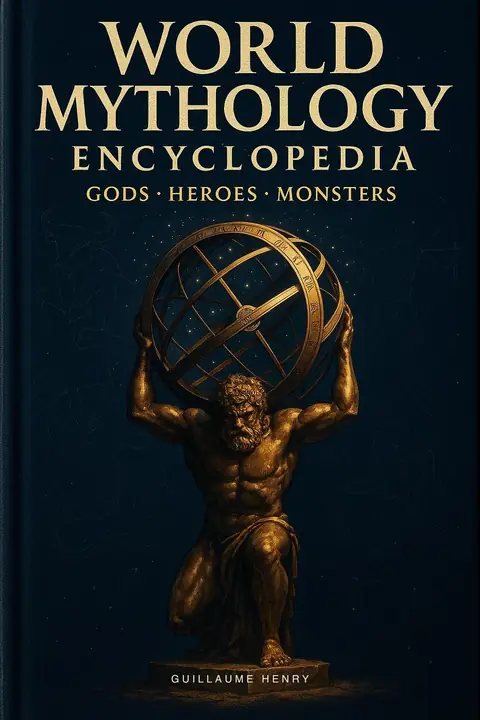
The World Mythology Book: The Gods, Heroes and Myths of Every Culture
The Gods, Heroes and Myths of Every Culture, in One Volume
The whole of world mythology in a single volume: Greek, Norse, Egyptian, Japanese, Hindu, Celtic, Slavic, Mesoamerican and African myths gathered side by side, each drawn from the primary sources.