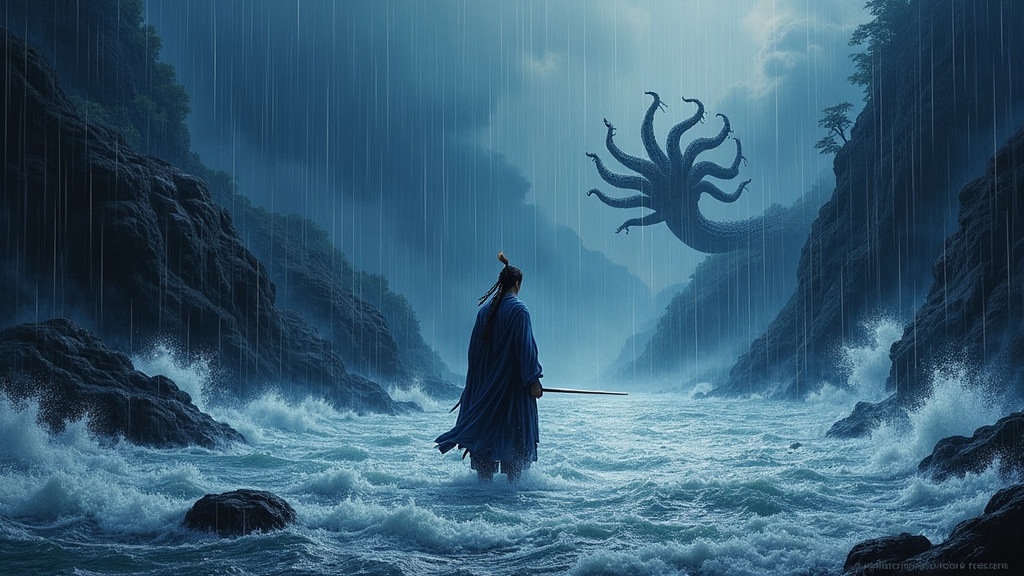

Amaterasu: The Sun Goddess Who Hid the World in Darkness
Amaterasu, the Japanese sun goddess, rules the High Plain of Heaven and holds the cosmos together. Her retreat into a cave nearly extinguished all light - and her return reshaped the divine order forever.
Contents
The cave was sealed with a boulder. Inside, Amaterasu, the sun goddess of ancient Japan, sat in darkness she had chosen herself. Outside, the heavens went cold. Rice paddies withered. Evil spirits rose in the suddenly moonless dark, and the eight million kami of the Japanese pantheon stood helpless before a world that had simply stopped being lit.
That moment, described in the Kojiki (712 CE) and the Nihon Shoki (720 CE), Japan's two oldest chronicles, is one of mythology's most quietly devastating images: a goddess of absolute radiance choosing absence. What drove her there, how the other kami coaxed her back, and what her story reveals about the cosmic architecture of Shinto - those questions have occupied poets, priests, and scholars for more than thirteen centuries.
Amaterasu does not arrive in her myths the way Zeus arrives, in thunder and coercion. She arrives in light, born from the left eye of the primordial god Izanagi as he purifies himself in a stream after escaping the underworld. That birth alone speaks volumes: light as the gift of return, of cleansing, of the living world reasserting itself against death.
Born from a God's Eye: Amaterasu's Origins in the Kojiki
Izanagi no Mikoto and his wife Izanami no Mikoto created the Japanese islands and filled them with kami. But Izanami died giving birth to the fire god Kagutsuchi, and Izanagi, grief-stricken, followed her into Yomi, the land of the dead. What he found there shattered him: Izanami had already rotted, her body crawling with maggots and thunder deities. He fled, rolling a great stone across the entrance to Yomi, and then went to the river mouth at Ahaji to wash the defilement of death from his body.
From that ritual purification - one of the oldest acts in Shinto liturgy - three sovereign deities were born. When Izanagi washed his left eye, Amaterasu-Omikami ("Great Divinity Illuminating Heaven") came into being. When he washed his right eye, the moon god Tsukuyomi appeared. When he washed his nose, the storm god Susanoo sprang forth.
Izanagi immediately assigned each child a domain. Amaterasu received the Takamagahara, the High Plain of Heaven, and with it the responsibility that underlies all Shinto cosmology: maintaining the order and fertility of the living world. The assignment was not merely administrative. It was structural. Without Amaterasu, the cosmos has no centre.

The Nihon Shoki offers alternate versions of this birth - in some, Amaterasu and Tsukuyomi are born together from a mirror Izanagi holds up, their reflections becoming deities. That variation matters: it suggests the compilers of Japan's myths understood they were preserving a layered oral tradition, not a single authoritative text. The Kojiki's account, dictated by the memorist Hieda no Are and transcribed by O no Yasumaro, has become canonical, but both chronicles inform a complete picture.
The Break with Tsukuyomi: Why the Sun and Moon No Longer Meet
Before the cave myth dominates Amaterasu's story, there is an earlier rupture: her permanent estrangement from her brother Tsukuyomi. The Nihon Shoki records it plainly.
The food goddess Ukemochi prepared a feast for Tsukuyomi by facing the land and spitting out cooked rice, then turning to the sea and vomiting fish, then turning to the mountains and regurgitating game. Tsukuyomi found the method disgusting and killed her on the spot. When Amaterasu heard what her brother had done, she declared that she would never look at him again. From that day, she and Tsukuyomi inhabit different parts of the sky, separated by a single night - which is why the sun and the moon never share the same sky at the same time.
The myth is brief but structurally precise. It explains a natural phenomenon (day and night) through moral rupture. It also positions Amaterasu as the judge of cosmic propriety: she does not merely govern light; she governs the ethical order that light implies. That double role - luminous and judicial - will reappear, amplified, in the cave episode.
Susanoo's Rage and the Retreat into the Rock Cave
Susanoo, assigned to rule the seas, refused his charge. He wept and raged until the mountains shook, demanding instead to join their dead mother Izanami in the underworld. Izanagi, infuriated, banished him. Before departing for Yomi, Susanoo went to say farewell to Amaterasu in the High Plain of Heaven.
Amaterasu suspected an invasion. She armed herself, binding her hair in battle knots and slung a quiver over her back. Susanoo insisted his intentions were innocent; to prove it, they performed a ritual exchange: each chewed the other's possessions and breathed out new kami. From Amaterasu's jewels, Susanoo produced five male deities; from his sword, Amaterasu produced three goddesses. Both sides claimed victory in the contest.
Then Susanoo's behavior escalated. He trampled the rice paddies Amaterasu had planted, filled in her irrigation ditches, and defiled her sacred weaving hall by throwing a flayed horse through its roof. One of her weaving maidens died in shock. Whether from grief over her weaving woman or from terror at her brother's violence - the Kojiki leaves the exact emotion deliberately ambiguous - Amaterasu withdrew into the Ama-no-Iwato, the Heavenly Rock Cave, and sealed it shut.

The consequences were immediate and catastrophic. The Kojiki lists them with documentary calm: darkness covered heaven and earth; the cries of demons filled every corner of the world; eighty myriad calamities arose together. This is not metaphor. In the logic of Shinto, Amaterasu's withdrawal was a literal withdrawal of solar energy, which underpins agriculture, ritual purity, and the very possibility of human life.
The Dance that Recalled the Sun: Ame-no-Uzume and the Laughter of Heaven
Eight million kami gathered outside the cave and deliberated. Their solution was not force. It was theatre.
Ame-no-Koyane and Futodama recited liturgies. A long-tailed rooster crowed. The Yata no Kagami, the sacred eight-span mirror, was hung on a sakaki tree along with jewels and sacred cloth. And then Ame-no-Uzume, the goddess of dawn and revelry, climbed atop an overturned tub and began to dance. Her dance grew wild. She loosened her clothing. The assembled kami erupted in laughter so enormous it shook the heavens.
Amaterasu heard laughter where she expected mourning. Curiosity overwhelmed her resolve. She pushed the boulder aside just far enough to ask what was happening. Ame-no-Uzume replied that a new deity, even more splendid than Amaterasu, had arrived to replace her. At that moment, the mirror was positioned so that Amaterasu saw her own light reflected back at her. Startled by her own radiance, she pushed the stone further open. The strong god Ame-no-Tajikarao, who had positioned himself beside the entrance, seized her hand and pulled her out. Another kami immediately stretched a rope across the cave entrance so she could not retreat. Light returned to the world.
The scene is one of the most psychologically rich passages in Japanese mythology. The kami do not command Amaterasu out. They do not threaten her. They create a situation in which she is drawn by curiosity, surprised by her own reflection, and gently but firmly prevented from going back. The mirror becomes a trap made of wonder, not coercion.
The Three Imperial Treasures: A Sun Goddess Governs the Earth
After her return, Amaterasu turned to the problem of the terrestrial world. It was governed by kunitsukami, earthly kami, who refused to yield easily. Her envoys failed one after another. Eventually, after years of negotiation that the Kojiki recounts in remarkable political detail, the earthly realm submitted.
Amaterasu then sent her grandson Ninigi no Mikoto down to the Japanese islands to rule. She gave him three objects that would become the Sanshu no Jingi, the Three Imperial Treasures of Japan:
- The Yata no Kagami (the eight-span mirror), which had lured her from the cave - symbol of wisdom and self-knowledge.
- The Yasakani no Magatama (the curved jewel of eight feet) - symbol of benevolence and prosperity.
- The Kusanagi no Tsurugi (the grass-cutting sword, originally obtained by Susanoo from the tail of the eight-headed serpent Yamata no Orochi) - symbol of valor and the legitimate use of force.
These three objects are not merely regalia. In Shinto understanding, they are the physical embodiment of Amaterasu's three qualities: clarity, compassion, and power. The actual objects, or what are held to be their sacred counterparts, are housed today at the Grand Shrine of Ise, at the Atsuta Shrine in Nagoya, and within the Imperial Palace in Tokyo. They are never displayed publicly.
Ninigi descended to the peak of Mount Takachiho in Kyushu. His great-great-grandson, according to traditional chronology, became Jimmu, the first emperor of Japan. Every emperor since has claimed descent through this lineage. The imperial house is not merely the political ruler in traditional Shinto understanding; it is the terrestrial extension of Amaterasu's governance.

The Grand Shrine of Ise: Where the Sun Goddess Lives Today
The Jingu at Ise, on the Kii Peninsula in Mie Prefecture, is the most sacred site in Shinto. It consists of two primary precincts: the Outer Shrine (Geku), dedicated to the food goddess Toyouke-Omikami, and the Inner Shrine (Naiku), dedicated to Amaterasu herself. The innermost sanctuary of Naiku houses the Yata no Kagami, the sacred mirror.
Visitors do not enter the inner sanctuary. They approach through four wooden torii gates, along gravel paths shaded by ancient cedar, to a point from which they can see the thatched roof of the shrine above a high wooden fence. The architecture - shimmei-zukuri style, raised on stilts, built entirely without nails - is among the oldest continuous architectural traditions in the world.
Every twenty years, the shrine is completely demolished and rebuilt on an adjacent plot of land using exactly the same specifications. This practice, called Shikinen Sengu, has continued since at least 690 CE, making the most recent rebuilding (2013) the 62nd such cycle. The logic is Shinto's own: purity is not preserved by hardening against change but by constant, disciplined renewal. Amaterasu, in this reading, is not a static monument but a living presence requiring living attention.
Some twelve million pilgrims visit Ise annually, a number that has not fundamentally changed for centuries. The approach routes - the ancient Kumano Kodo paths, the Ise-ji coastal trail - are themselves UNESCO-inscribed heritage.
Amaterasu and the Imperial Cult: Thirteen Centuries of Sacred Governance
The political consequences of Amaterasu's mythological position have been enormous and, at times, deeply contested. Because the emperors of Japan claim descent from her through Ninigi, the imperial institution has historically carried a divine sanction different from, say, European divine-right monarchy. The emperor was not merely chosen by a deity; he was the deity's biological heir.
This theology reached its sharpest political expression during the Meiji Restoration (1868) and the subsequent State Shinto period (1868-1945). Amaterasu was elevated as the supreme national deity; her mirror, jewel, and sword appeared on military standards. Ise became the pilgrimage destination for soldiers departing for war. The Kokutai ideology - the "national body" doctrine - treated the emperor's divine descent from Amaterasu as a political fact rather than a religious metaphor.
The defeat of 1945 and Emperor Hirohito's "humanity declaration" of January 1946 formally separated the imperial house from claims of literal divine descent. Yet the ceremonial structure remains. The Daijosai, the accession rite that every new emperor performs (most recently Emperor Naruhito in 2019), involves a night-long ritual communion with Amaterasu whose precise details are not made public. The line between religion and state is carefully maintained in modern constitutional terms; the line between symbolism and belief remains, as it has always been, a matter of individual conscience.
Cross-Cultural Echoes: Sun Goddesses in World Mythology
Amaterasu occupies an interesting position in comparative mythology because she is a female solar deity in a tradition where the sun is not automatically assigned to masculine power. In contrast, the Norse tradition gives us Sol, the goddess who drives the sun chariot - though she is overshadowed in the sources by the male Aesir. The Inca tradition has Mama Quilla, a lunar goddess, with the solar Inti coded masculine.
Amaterasu (Shinto)
- Female deity; born from Izanagi's eye at a moment of purification
- Withdraws from the world voluntarily; coaxed back by collective ritual and laughter
- Governs through lineage: her grandson Ninigi becomes the terrestrial ruler
- Primary sacred object: the mirror - wisdom and self-reflection
- Worshipped continuously at Ise for at least 1,300 years
Ra (Egyptian)
- Male deity; self-created (Ra-Atum) or born from the primordial waters
- Travels through the underworld each night and must defeat Apophis to rise again
- Governs directly: the pharaoh is Ra's son on earth
- Primary sacred object: the was sceptre - authority and dominion
- Worshipped at Heliopolis; temple tradition disrupted multiple times by conquest
The contrast with Ra is instructive. Both are supreme solar deities whose authority underpins a royal lineage. But Ra's cosmology is one of constant combat, a nightly journey through Duat where he is threatened, dismembered, and reborn. Amaterasu's crisis is interior, relational, and resolved through community. The mythology reflects real theological differences in how each tradition frames divine power: Egyptian cosmology is martial and cyclical; Shinto cosmology is communal and purificatory.
Closer in spirit is the Hittite myth of Telipinu, a deity who withdraws from the world in anger and must be coaxed back through elaborate ritual, restoring fertility and order. The structural similarity to the cave myth has prompted genuine scholarly debate: were these myths in contact through early Bronze Age diffusion, or did they independently solve the same narrative problem of "what happens when the divine source of life withdraws"? The consensus remains open.
Amaterasu in Modern Japan: From Manga to Living Ritual
Amaterasu has not faded into the archival past. She appears as a white wolf in Clover Studio's 2006 video game Okami, where players help her restore light to a darkened land - a premise drawn almost directly from the cave myth. The game's art direction, modeled on Japanese ink painting, introduced millions of international players to Shinto iconography with unusual fidelity.
In manga and anime, Amaterasu is frequently invoked. The Naruto franchise names a powerful fire technique after her; the Noragami series treats the kami as contemporary urban presences, with Amaterasu hovering at the periphery of the action as a supreme, rarely approached power. These adaptations vary widely in theological accuracy, but they share a consistent intuition: Amaterasu is the one whose absence would end everything.
Contemporary Shinto practice maintains a ritual calendar centered on Amaterasu at Ise. The Kannamesai festival in October, when the first rice of the harvest is offered to Amaterasu before anyone eats, is among Japan's oldest continuous public ceremonies. Rice is not merely food in this context; it is the substance through which Amaterasu's gift of solar energy becomes human sustenance. The festival makes that chain of dependency visible and deliberate.
For the roughly 3 to 4 million people who identify as active Shinto practitioners, and for many more who maintain household kamidana (deity shelves) without formal affiliation, Amaterasu remains a living presence. The ofuda (paper amulet) from Ise, distributed to households across Japan, is renewed annually. The old rhythm of receiving her light, using it, and returning thanks has not been interrupted.
Frequently Asked Questions About the Amaterasu Sun Goddess
Frequently asked questions
What are the primary sources for Amaterasu's myths?
The two foundational texts are the Kojiki (712 CE), Japan's oldest chronicle, dictated by the memorist Hieda no Are and transcribed by O no Yasumaro at Emperor Genmei's command, and the Nihon Shoki (720 CE), compiled by Prince Toneri's editorial committee. Both texts draw on older oral traditions and local clan genealogies. Where the two accounts differ - particularly on Amaterasu's birth and the cave episode - scholars treat the variants as evidence of competing regional traditions rather than errors.
Why did Amaterasu hide in the cave, and what does the myth mean?
The immediate cause was Susanoo's violent rampage in the High Plain of Heaven: he destroyed rice paddies, defiled the sacred weaving hall, and caused the death of a weaving maiden. Amaterasu's retreat is sometimes read as a solar eclipse myth, sometimes as a seasonal metaphor for winter's darkness. Scholars like Matsumura Takeo have argued it reflects ancient shamanic rituals of divine withdrawal and recall. Whatever its origin, its narrative function is precise: it establishes that the kami community, not any single deity, holds the cosmos together. Amaterasu's return requires collective creativity, not merely individual will.
What are the Three Imperial Treasures, and where are they kept today?
The Sanshu no Jingi are the Yata no Kagami (mirror), the Yasakani no Magatama (curved jewel), and the Kusanagi no Tsurugi (sword). The mirror is enshrined at the Naiku precinct of the Grand Shrine of Ise in Mie Prefecture and is never shown publicly. The jewel is kept within the Imperial Palace in Tokyo. The sword is housed at Atsuta Shrine in Nagoya. What are kept publicly accessible are replicas; the originals, or objects considered their sacred equivalents, remain permanently hidden from view.
Is Amaterasu still worshipped today?
Yes, actively. The Grand Shrine of Ise receives approximately twelve million visitors annually. The Shikinen Sengu rebuilding cycle, last completed in 2013, continues a tradition documented since 690 CE. Every Japanese imperial accession includes the Daijosai ritual, which involves a night of ceremonial communion with Amaterasu. Ofuda amulets from Ise are distributed to millions of households across Japan each year and renewed annually as part of standard Shinto household practice.
How does Amaterasu relate to the Japanese emperor?
Traditional Shinto genealogy makes every emperor a direct descendant of Amaterasu through the line Amaterasu - Ninigi - Hoori - Ugayafukiaezu - Emperor Jimmu. This lineage gave the imperial institution its sacred authority for more than a millennium and was codified as State Shinto doctrine between 1868 and 1945. Emperor Hirohito's 1946 declaration formally renounced claims of literal divine descent, and the postwar constitution defines the emperor as a symbol of the state with no political power. The ceremonial and ritual connections to Amaterasu remain, however, maintained through the imperial household's Shinto rites.
Is Amaterasu unusual as a female sun deity?
Somewhat. The majority of the world's prominent solar deities are male - Ra, Apollo, Inti, Surya. Female solar deities do exist, including the Norse Sol, the Hittite sun goddess of Arinna, and the Baltic Saule, but they occupy the centre of their tradition's solar theology less definitively than Amaterasu does in Shinto. Some scholars, including Matsumae Takeshi, have suggested that Amaterasu absorbed the attributes of an older shamanistic female sun deity associated with the Yamato clan before the Kojiki was compiled. Her supremacy as a female solar figure is, in any case, unambiguous in the Shinto canon.
The Mirror Still Reflects: What Amaterasu Reveals About Shinto's Core Logic
The story of the cave is, ultimately, a story about what light requires to return. It does not return because a hero defeats the darkness. It returns because eight million beings decide, together, to make the act of its return irresistible. They do not storm the boulder; they create a world outside it worth returning to. The laughter, the dance, the mirror that shows Amaterasu her own face - these are acts of collective imagination, and they work.
That logic runs through Shinto practice at every scale. Purity is not a permanent state; it is something renewed, continuously, through ritual attention. The shrine at Ise is rebuilt rather than preserved because the kami requires a living relationship, not an archive. The ofuda is replaced each year because gratitude is a practice, not a transaction. Amaterasu is the sun goddess, yes - but what her myths preserve, with extraordinary precision, is the Shinto conviction that the sacred and the human are bound together in an ongoing, reciprocal, and genuinely fragile act of maintenance.
Lose that attention, the cave myth says, and the light goes out.
Free 25-page sample
Want the whole story?
Take the first 25 pages free. If it pulls you in, the full edition is yours as an instant PDF download, with a paperback on Amazon for selected titles.
Japanese
The Japanese Mythology and Yokai Book: Amaterasu, Susanoo, Kami, and the Sacred Stories of Japan
Amaterasu, Susanoo, Yokai, Kami, and the Sacred Stories of Japan
The Kojiki, the Nihon Shoki, and the bestiaries of Toriyama Sekien. Every kami, every yokai, every ghost story.