
Baba Yaga: Witch of the Forest at the Edge of the World
Baba Yaga is the great ambiguous witch of Slavic mythology, a forest crone who devours heroes, guides seekers, and guards the boundary between the living and the dead.
Contents
The Crone at the World's Edge
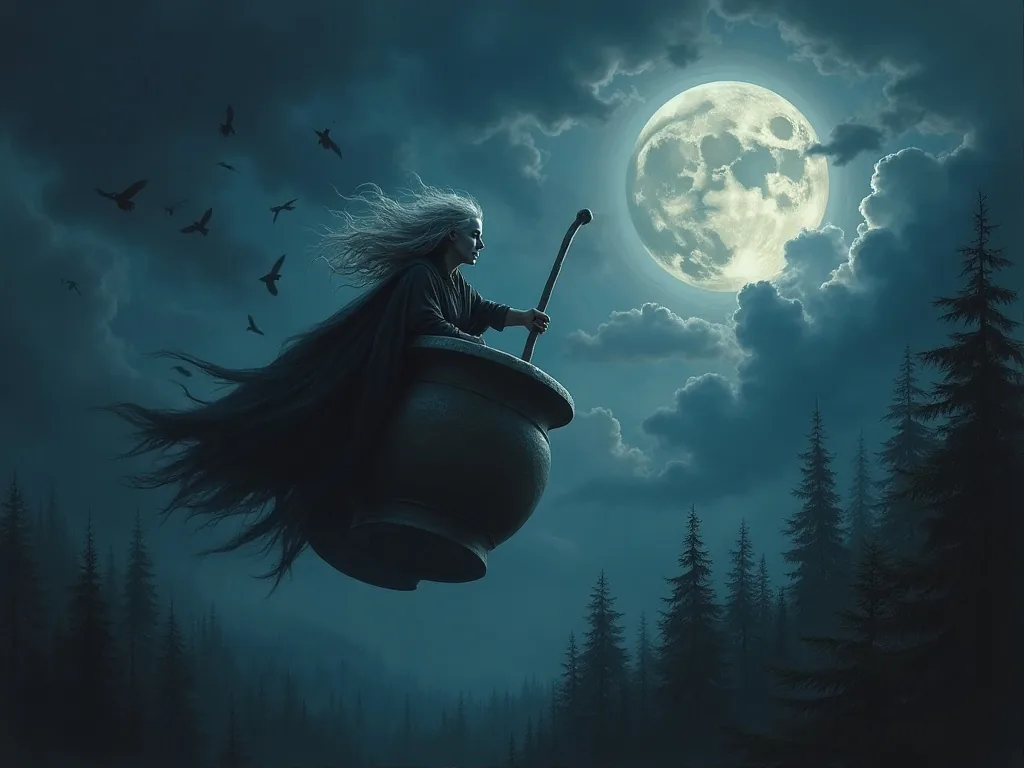
She appears at the margins. Not in palaces, not in temples, but at the trembling boundary where the ordered human world dissolves into something older, darker, and genuinely alive. Baba Yaga, the baba yaga witch of the forest, is one of the most recognizable and least reducible figures in Slavic mythology. She is a hag who flies through the night sky in a mortar, steering with a pestle, sweeping away her tracks with a birch broom. She lives in a revolving hut balanced on chicken legs, deep inside forests so thick that daylight forgets to enter. She is terrifying. She is generous. She eats heroes for breakfast and then hands their successors the magical tools they need to save the world.
That paradox is not a contradiction. It is the entire point.
Origins and Names
The etymology of "Baba Yaga" has occupied Slavic philologists for centuries, and no single answer has prevailed. "Baba" is straightforward: an old woman, a grandmother, in many Slavic languages. "Yaga" is far more contested. Proposals link it to a Proto-Slavic root meaning "illness" or "horror," to a South Slavic word for "wicked woman," and to an older Indo-European root connected to concepts of suffering and movement. Some scholars, including Vladimir Propp in his foundational work on Russian folklore morphology, connect her deeply to archaic ancestor-worship traditions and to figures of the guardian of the dead found across Eurasian steppe cultures.
She appears across an enormous geographic spread. In Russian byliny and skazki (fairy tales), she is Baba Yaga Kostyanaya Noga, Baba Yaga of the Bone Leg. In Polish folklore she surfaces as Jaga or Jedza. Related crone figures appear in Ukrainian, Belarusian, Serbian, and Slovak tradition. The sheer breadth of her presence suggests she is not a local invention but a sediment laid down over millennia.
The Bone Leg
The epithet "Kostyanaya Noga" (Bone Leg) is among her most persistent attributes. In many tales, one of her legs is skeletal, a leg of bone protruding from beneath her skirts. Interpretations vary. Some ethnologists read it as a marker of her liminal nature: one foot in the world of the living, one already in the realm of the dead. Others connect it to the practice of burying the dead in raised wooden huts on posts, a custom documented archaeologically in parts of ancient Russia and Siberia, making Baba Yaga herself a kind of animated burial structure.
The Izba on Chicken Legs
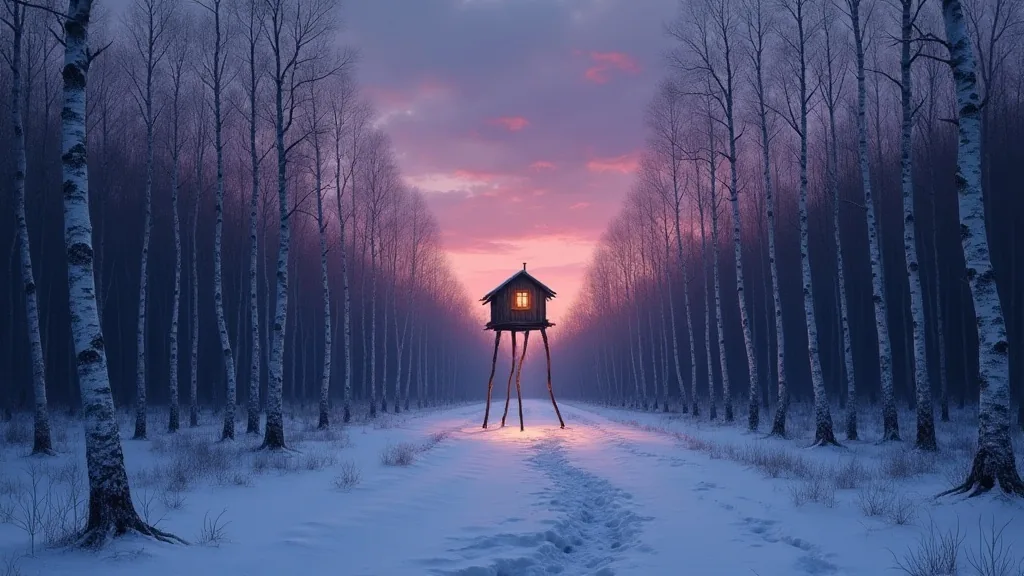
No element of her mythology is more visually arresting than the izbushka na kuryikh nozhkakh: the little hut on chicken legs. It stands in the deep forest, sometimes described as spinning continuously, sometimes turning its blind back to approaching travelers and its door only when the proper words are spoken.
The formula a hero must utter varies by tale, but a typical version runs: "Turn your back to the forest, your front to me." Only then does the hut comply.

The hut itself defies casual explanation. Scholars have proposed that it echoes the raised storage structures common throughout Siberia and the Russian north, built on posts to keep animals and decay away from food supplies. Others read the spinning hut as a cosmological symbol: the axis of the world, a pivot between realms. The chicken legs may carry totemic significance, the hen being an animal long associated in Slavic folk belief with the boundary between the household and the spirit world. Roosters were sacrificed at thresholds; hens were buried beneath foundations.
Whatever its origins, the hut functions narratively as a liminal checkpoint. To enter it is to cross from the familiar world into the domain of myth itself.
The Three Roles of Baba Yaga
Vladimir Propp identified three distinct functional types in which Baba Yaga appears across Russian fairy tales. They are not three different characters; they are three faces of the same being.
The Devourer
In this guise she is predatory and unambiguous in her hunger. She kidnaps children. She attempts to roast heroes in her great oven. She sniffs the air and announces "I smell Russian flesh!" (Chuy, chuy, russkim dukhom pakhnet). In tales such as "Vasilisa the Beautiful," she sets impossible tasks for the girl who arrives at her door, threatening death if they are not completed. Her mortar and pestle, associated elsewhere with domestic labor and medicine, become instruments of something far older and more dangerous in her hands.
The Donor
And yet she gives. In countless tales, after the hero correctly performs the ritual of greeting, after they have eaten, bathed, and slept in her hut, Baba Yaga provides. She gives the magic horse that outpaces the wind. She hands over the glowing skull, the ball of yarn that leads through impossible terrain, the map to Koschei the Deathless's kingdom. Her gifts are not given lightly; they are earned through correct ritual behavior, through courage, through the ability to ask the right questions.
The Guardian of the Border
In her third role she is neither enemy nor helper but gatekeeper. She sits at the boundary between the world of the living (Nav and Yav in some Slavic cosmological frameworks) and grants passage only to those who are worthy. Heroes who reach her but fail to observe the correct courtesies are consumed. Those who approach with the proper ritual knowledge pass through into the deeper mythological world, where Koschei hides his death in a needle, inside an egg, inside a duck, inside a chest, buried under an oak tree on the island of Buyan.
Vasilisa the Beautiful and the Skull of Light
The tale of Vasilisa the Beautiful is perhaps the richest single narrative in which Baba Yaga appears, and it encapsulates all three of her aspects. Vasilisa, a young girl mistreated by her stepmother and stepsisters, is sent into the forest deliberately to fetch fire from Baba Yaga's hut, a death sentence dressed as an errand.
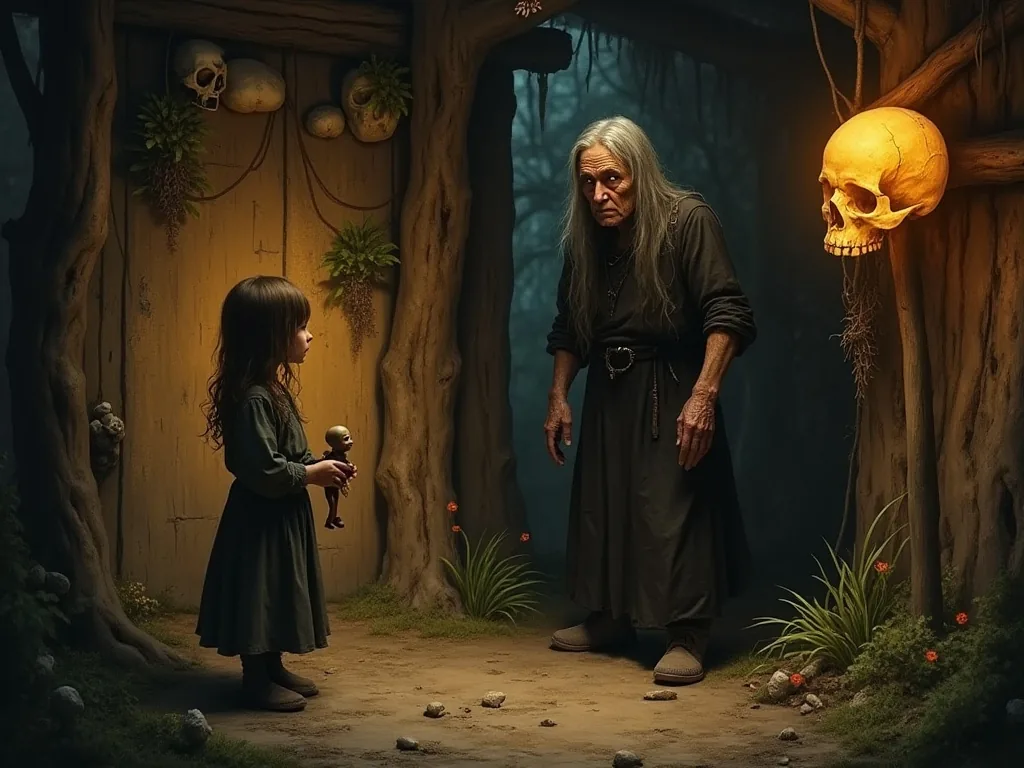
Vasilisa survives because she carries a blessing from her dead mother: a small wooden doll that she feeds and consults, and that performs the impossible tasks Baba Yaga sets each night. Recognizing the girl's heritage and the protection she carries, Baba Yaga does not eat her. She gives her fire, in the form of a glowing skull mounted on a pole, whose eyes burn with terrifying light. When Vasilisa brings the skull home, its gaze incinerates the wicked stepmother and stepsisters.
The tale is dense with archaic material: the doll as ancestor spirit, fire as divine gift requiring dangerous acquisition, the crone as mediator between the dead mother's blessing and the living world. Baba Yaga here functions as the instrument through which inherited spiritual power is tested and confirmed.
Baba Yaga and the Dead
The connection between Baba Yaga and death is not metaphorical. It is structural. She faces the forest (the realm of the dead) rather than the human settlement. She smells the living (their scent offends or alerts her). She feeds visitors a meal that in some interpretations mirrors funerary feasting, the ritual meal offered to the dead. Her hut resembles a burial structure. Her bone leg is literally skeletal.
Some researchers, including the ethnographer Andreas Johns in his detailed study of the figure, argue that Baba Yaga preserves the memory of a goddess or spirit of the dead who predates Christianization. With the conversion of Slavic peoples beginning in the ninth and tenth centuries, earlier religious figures were not simply erased; they migrated into folklore, stripped of formal worship but preserved in narrative. Baba Yaga may be a fragment of a much larger and now mostly lost pre-Christian Slavic cosmology.
Koschei the Deathless and the Greater Mythological World
Baba Yaga rarely stands alone. In the complex of Russian fairy tales, she is almost always a threshold figure pointing toward a deeper antagonist or a greater treasure. Koschei Bessmertnyi (Koschei the Deathless) is the figure who waits beyond her. He is death personified, the undying sorcerer-king who cannot be killed by conventional means. His death is hidden in an object nested inside other objects: the classic "death-in-an-egg" motif that has parallels in Norse mythology (the death of Baldr involving mistletoe), in South Asian tales, and in ancient Egyptian myth.
Baba Yaga knows where Koschei's death is hidden. She often tells the hero. In this sense she is not simply the witch of the forest; she is the one who holds the knowledge of how death can be undone, which makes her one of the most cosmologically significant figures in the entire Slavic mythological corpus.
Living Legacy and Cultural Afterlife
Baba Yaga has not remained sealed inside medieval manuscripts. She has traveled. She surfaces in nineteenth-century Russian opera (Modest Mussorgsky's "Pictures at an Exhibition" includes a movement titled "The Hut on Fowl's Legs"). She appears in Tchaikovsky's orchestral work. She is a recurring figure in the illustrated books of Ivan Bilibin, whose Art Nouveau depictions of her hut and mortar defined a visual language for Russian fairy tale illustration that persists to this day.
In the twentieth century she entered Western popular consciousness through fantasy literature, role-playing games, and cinema. Neil Gaiman has drawn on her archetype. The video game industry has revisited her repeatedly. She appears in Andrzej Sapkowski's Witcher universe as a direct ancestor of the wild forest witch archetype. Each appropriation necessarily strips away layers of the original complexity, but the core of the figure proves stubbornly resistant to flattening. She remains disturbing precisely because she cannot be sorted into villain or hero.
The Ethics of the Deep Forest
What Baba Yaga ultimately teaches, across all her tales and all her transformations, is something about the nature of knowledge and the cost of it. The forest she inhabits is not merely a setting; it is a moral condition. To enter it is to leave behind the protections of the village, the family, the daylit world of ordinary obligations. What you encounter there will not be fair. It will not be kind. It will demand something from you, often something you cannot predict in advance.
The heroes who survive do so not through strength alone but through correct ritual behavior, through patience, through respect for powers older than themselves. They eat when offered food. They sleep when offered rest. They ask nothing before they have given the proper greeting. In this sense, Baba Yaga is a teacher of a very old and very serious kind: the kind who will kill you without a moment's regret if you approach carelessly, and give you everything you need if you approach with wisdom.
She is the forest's own intelligence, and the forest has been here longer than any of us.
Read the full book
Want the whole story?
The complete edition is an instant PDF download here, with a paperback on Amazon for selected titles.
Slavic
The Slavic Mythology Book: Perun, Veles, Mokosh, and the Sacred Stories of Pre-Christian Russia and the Balkans
Thunder Gods, Serpent Lords, and the Witch in the Chicken-Leg Hut
The mythology of the Slavs before Cyril and Methodius: Perun's thunder against Veles' serpent coils, Mokosh's weaving, Baba Yaga's mortar flight, and the four-faced idols that stood in sacred groves.