
Agni, God of Fire: The Sacred Flame in Hindu Cosmology
Agni is the celestial god of fire and sacrifice in Hindu mythology, present in every ritual from birth to death. As both destroyer and purifier, he carries prayers from earth to heaven and embodies transformation itself.
Contents
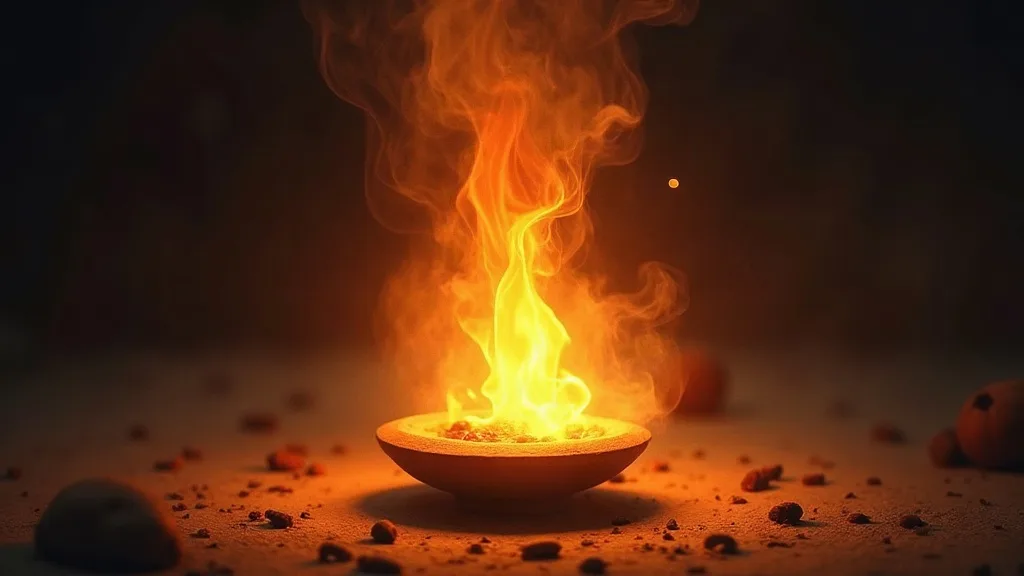
Smoke rises from a wood fire, carrying prayers upward. The flames dance, neither solid nor liquid, neither creation nor destruction. For thousands of years, Hindus have seen in that fire the face of Agni, one of the most essential deities in the Hindu pantheon. He is not remote like some gods; he lives in every kitchen hearth, every ritual flame, every cremation pyre. To understand Agni is to understand how Hindus experience the sacred in the material world.
The Rigveda, Hinduism's oldest text written between 1500 and 1200 BCE, opens not with the supreme god but with Agni. The first hymn addresses him directly: "Agni I praise, the household priest." This placement was no accident. Agni was the intermediary, the messenger who carried offerings from the human realm to the gods in heaven. Without fire, there were no sacrifices. Without sacrifice, there was no connection between mortals and the divine. Agni was therefore indispensable, present before all else.
Origins and Birth of the Cosmic Fire
Agni does not arrive into Hindu mythology fully formed. His origins shift depending on which text you consult, reflecting how the tradition accumulated layers of meaning over centuries. In the Rigveda, Agni exists from the beginning of creation; some hymns speak of him as one of the primal forces. Yet other texts tell of his birth, usually from multiple parents, suggesting that fire itself can kindle many ways.
One origin story places Agni among the children of Brahma or as born from the cosmic waters at the moment of creation. The Mahabharata, an epic poem compiled over many centuries, describes Agni as growing weaker and exhausted after burning the Khandava Forest in a great conflagration. He hid himself, lost his shine. The gods had to restore and reignite him through ritual. This narrative captures something true about fire itself: it burns out without fuel, without oxygen, without attention. Agni is not a constant; he requires maintenance, feeding, honor.
The most striking image of Agni's multiplicity appears in the Atharva Veda, another early sacred text. It says Agni has seven forms or manifestations. The fire in the home is Agni. The fire in lightning is Agni. The fire in the sun is Agni. The fire hidden in wood, waiting to be struck into existence, is also Agni. In this way, every flame across creation carries his presence. He is not confined to temples or priests; he fills the cosmos.
Agni's Role in Vedic Sacrifice and Ritual
For the ancient Hindus, Agni god of fire was not merely symbolic but operational. Sacrifice (yajna) was the engine of the cosmos itself. The gods had performed sacrifices to create and maintain the universe. When humans replicated those sacrifices with fire, they participated in cosmic maintenance. Agni made that ritual possible.
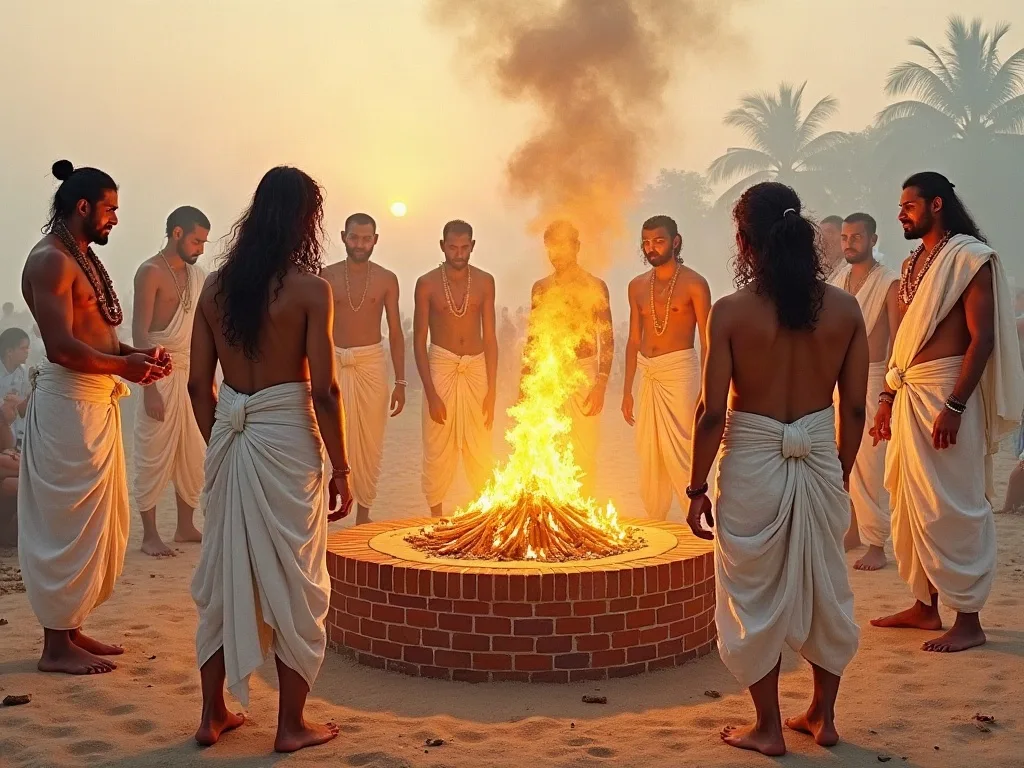
In Vedic sacrifice, the priest would kindle a fire in a carefully prepared pit. Ghee (clarified butter), grains, herbs, and meat were offered into the flames. As they burned, Agni was understood to consume the offering and transform it. The smoke rose heavenward, carrying the gift to the gods themselves. Without Agni's consumption and transformation, the offering never reached its destination. The god of fire was the actual conduit, not a symbolic one.
The Yajurveda, a Vedic text focused on ritual procedures, contains detailed instructions for maintaining sacred fires. Some were lit at sunrise and kept burning until sunset. Others were kindled for specific purposes and extinguished with ritual care. The act of kindling fire itself required precision: the friction of wood on wood, the angle of the sticks, the words spoken while striking. Every detail mattered because Agni was present in that moment of ignition, emerging from potential into actuality.
Agni embodied a paradox central to Hindu thought: he was both destroyer and creator. The same flame that consumed the offering reduced the material world to ash. Yet from that destruction came transformation. The offering, burned away, was transformed into something ethereal, capable of reaching the heavens. This is why Agni became inseparable from the concept of purification. Fire burns away impurities. It cleanses. It prepares the way.
Agni in the Puranas and Later Traditions
As Hinduism evolved and the Puranas (mythological narratives) expanded the tradition, Agni remained central but took on new dimensions. He was not demoted; instead, his story grew more complex. The Puranas present Agni as a deity with his own personality, relationships, and adventures.
In many Purana stories, Agni appears as one of the Ashta Dikpala, the eight guardians of directions. Each cardinal point and intermediate direction has a presiding deity, and Agni guards the southeast. This role reflects an older idea: the five elements (earth, water, fire, air, ether) are distributed through space and time. Agni does not exist everywhere equally; he has his proper place and character, though his influence radiates from that position.
The Bhagavata Purana and Vishnu Purana contain narratives where Agni himself faces crisis or requires intervention. One story tells of Agni becoming overheated and exhausted after burning the Khandava Forest at Lord Krishna's request. The god needed cooling water from the sea and spiritual restoration. This story humanizes Agni; even a cosmic principle requires balance and renewal. It reflects the Hindu understanding that nothing, however exalted, exists in isolation or perpetual abundance. All beings cycle through vitality and depletion.
Another motif presents Agni as the divine witness. Because fire purifies and consumes, it sees everything. In ritual contexts, Agni is invoked as the observer of oaths and covenants. When you swear by fire, you swear before Agni himself, the cosmic witness. This made Agni not just a utility but a moral force. His presence at a ritual guaranteed its authenticity.
Iconography and Worship of the Fire God
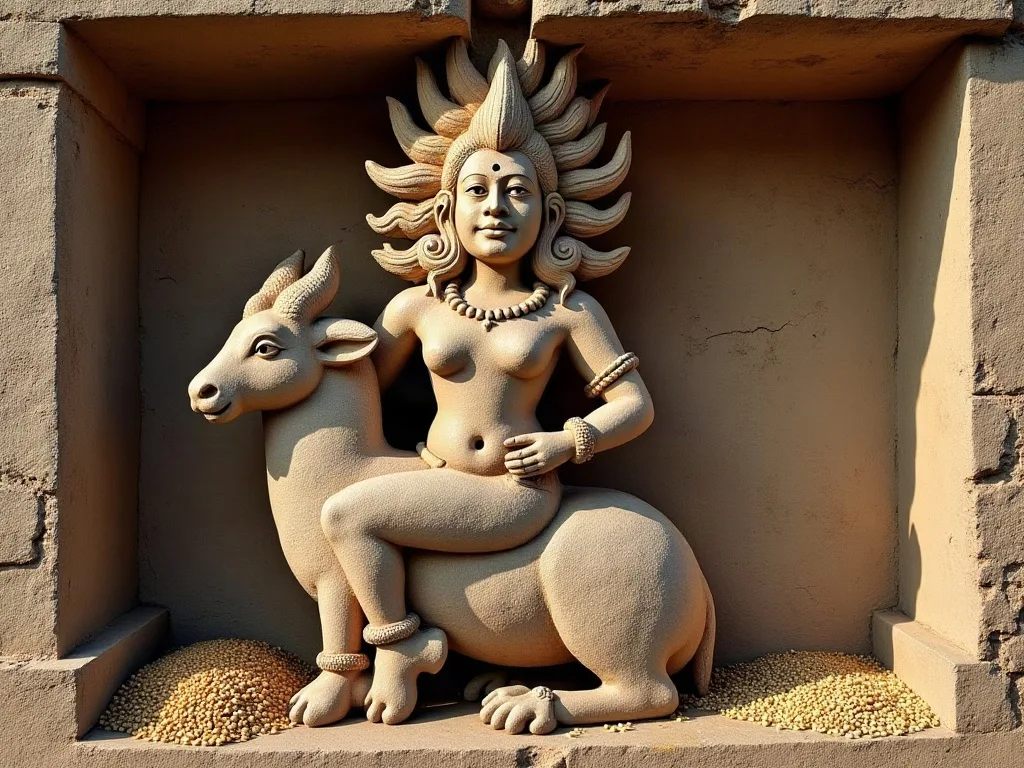
Agni god of fire is depicted with striking visual consistency across Hindu art and iconography. He rides a ram (or goat), and this vehicle appears in sculptures and paintings throughout South Asia. The ram symbolizes virility and the forward thrust of energy, fitting for the fire god. Agni is typically shown with reddish or golden skin, sometimes with multiple faces or arms, emphasizing his multivalent nature. His hair flows upward like flames. He wears a sacred thread and holds ritual implements: a spoon for offering ghee, sometimes a staff or trident.
The most recognizable image is Agni with his flame halo, eyes bright, body lean and energetic. He is never depicted as corpulent or static. Even in stone and paint, Agni radiates movement and urgency. This aesthetic reflects his functional reality: fire is constant motion, transformation, activity.
In South Indian temples, Agni shrines are common, though Agni rarely receives the elaborate temple worship that Shiva or Vishnu command. His worship is more often domestic and cyclical. Hindus honor Agni daily at the cooking hearth. At major festivals, special fires are kindled. During the new moon festival, the fire ritual intensifies. At Diwali, the festival of lights, oil lamps and candles embody Agni's purifying presence throughout homes.
The practice of Agnihotra, a simplified daily fire ritual, persists in many Hindu households today. A small fire is kindled at dawn or dusk. Mantras (sacred syllables and phrases) are chanted. Offerings of ghee, grains, and herbs are made. This ritual requires no temple, no priest, no expensive paraphernalia. It can be performed by any devotee. The practitioner kneels before the fire, speaks the ancient words, and maintains the most basic covenant between human and divine: acknowledgment and offering. Agni in the hearth responds to Agni in consciousness.
Agni Across Vedic and Tantric Paths
Hindu practice encompasses many schools and approaches. Vedic ritual specialists (Brahmins trained in the Vedas) maintain an older, more formal relationship with Agni. The Soma sacrifice, described in the Rigveda, is the most prestigious and complex Vedic ritual, and Agni plays a central role. These rituals are rare now, practiced by a handful of families who guard the knowledge through oral transmission and training.
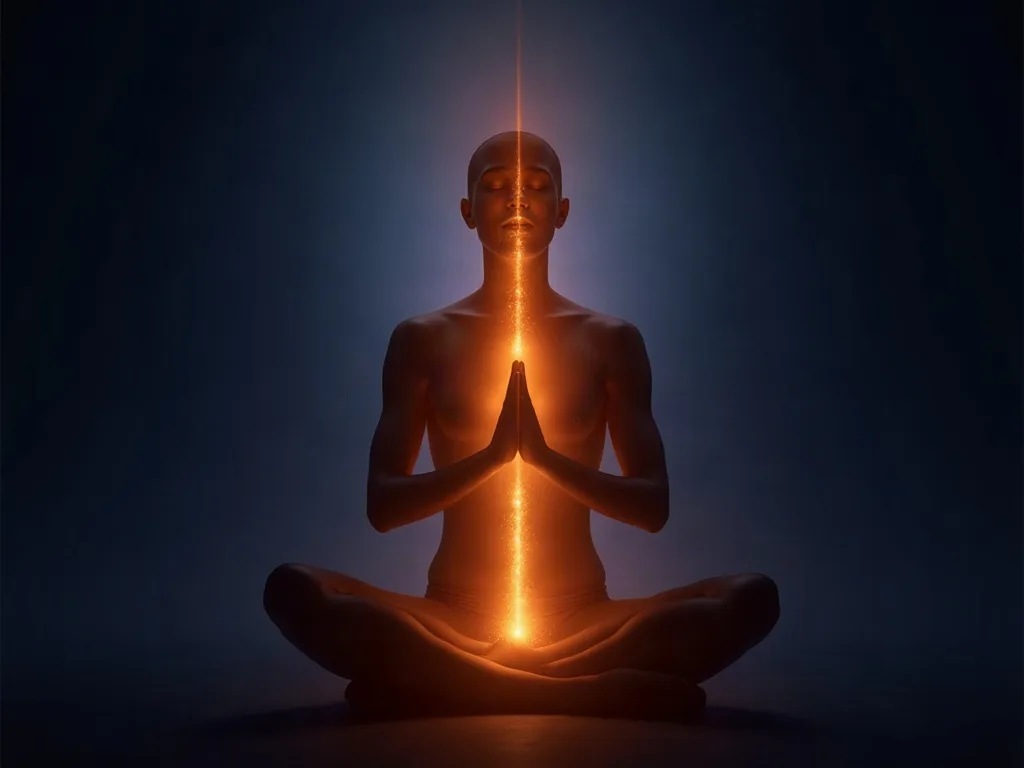
Tantric practice, which emerged around the first millennium CE, also reveres Agni but frames him differently. Tantric texts describe Agni as the embodiment of inner spiritual heat, the kundalini fire that rises through the subtle body during meditation and spiritual practice. In this framework, the external fire is a reflection of the internal fire of consciousness. When a Tantric practitioner visualizes flames in meditation, they are contacting Agni not as an external deity but as an inner principle of transformation.
The Hatha Yoga Pradipika, a medieval manual on yoga, describes inner heat practices and the "fire of yoga." This is Agni reimagined not as a god you propitiate but as a force you cultivate within. Yet the basic principle remains: Agni is the transformer, the purifier, the consciousness that burns away limitation.
Cremation, Death, and Agni's Deepest Work
The most solemn encounter with Agni in Hindu life occurs at death. When a Hindu dies, the body is carried to the cremation ground, placed on a wooden pyre, and burned. This practice, called Antyesti (the final sacrifice), returns the body to its constituent elements. The eldest son or close relative often lights the pyre. The act of kindling that final fire is not merely practical; it is a sacred responsibility and a last service to the deceased.
Agni at the cremation ground is Agni at his most profound. He is not celebrating or nurturing here; he is completing a cycle. The body, bound to the earth for a lifetime, is released through his flames back into universal consciousness. The Rig Veda addresses this explicitly in funeral hymns: "Agni, carry this soul to the realm of the fathers. Grant it safe passage." The fire god becomes a psychopomp, a guide between worlds.
This is not morbid in Hindu cosmology. Death is transformation, not termination. Agni's work at the pyre is sacred work, continuation of his eternal function: reducing the gross to the subtle, burning away the material so that the essence can rise. The smoke carries the consciousness upward just as the smoke of daily offerings carries prayers to the gods. The same fire, the same process, now applied to the most significant moment of embodied existence.
For this reason, Agni is both feared and deeply revered in Hindu understanding. He is the great equalizer. No wealth, no beauty, no status survives his flames. All bodies feed him equally. This equality before Agni is part of what makes him spiritually indispensable. He cannot be bribed or flattered. He cannot be fooled. He simply does his cosmic work: transform, purify, complete.
Agni in Comparative Mythology
Fire gods appear across human cultures, suggesting something fundamental about how consciousness perceives fire. Yet each tradition shapes the fire god according to its values and spiritual framework.
Prometheus in Greek mythology is fundamentally a transgressor. He steals fire for humanity against the will of Zeus. His defiance, and the punishment that follows, frames fire as a gift won through rebellion. Agni, by contrast, is obedience itself. He is the fire that fulfills cosmic law, not violates it. The Hindu fire god serves; the Greek fire god rebels.
In Mesoamerica, Xiuhtecuhtli, the Aztec fire god, embodies both creation and destruction. He is associated with the sun and with the renewal of time at each ceremonial cycle. This resonates with Agni in his role as transformer and cosmic maintainer, yet Xiuhtecuhtli carries more of the weight of calendrical time and solar astronomy. Agni is less about the outer cycles of time and more about the inner transformations that occur through ritual and consciousness.
Norse mythology presents Muspelheim, the realm of fire, as a cosmological zone, with the fire giant Surtr guarding it. Fire here is primal force, dangerous, destined to destroy the world at Ragnarok. It is less personified than Agni, more elemental. The Norse sensibility treats fire with greater ambivalence. Agni, while powerful and destructive, is fundamentally integrated into the cosmos and into human life. He can be spoken to, reasoned with, honored through proper action.
This difference reflects deeper shifts in spiritual orientation. Hindu thought emphasizes continuity, cyclicality, and integration of all forces into a unified cosmos. Fire is not foreign to order; it is the instrument through which order is maintained and renewed. Agni embodies this integration more fully than fire deities in traditions that frame fire as more transgressive or eschatological.
Festivals and Seasonal Worship of Agni
While Agni is honored year-round, certain times intensify his worship. Diwali, the festival of lights celebrated in autumn across the Hindu world, is suffused with Agni worship. Oil lamps are kindled in homes and temples, symbolizing the triumph of light over darkness, consciousness over ignorance. Agni in his gentler, more luminous aspect shines in every room.
Holi, the spring festival of colors, also invokes Agni. A ritual bonfire is lit the night before Holi, and devotees gather to sing and circumambulate the flames. This fire purifies the community and the land as spring arrives. Holi fire is Agni at the threshold of renewal, clearing away winter's heaviness.
New moon nights (Amavasya) are sacred to Agni in many traditions. The darkness of the new moon is offset by ritual fires. Agni is called upon to restore light and balance. During these observances, households kindle fires and perform simple offerings. The practice maintains an ongoing relationship with the god of fire throughout the year.
Agni Today: Continuity and Change
In contemporary Hindu practice, Agni god of fire remains central, though the forms of his worship have adapted to modern life. Urban Hindus who cannot light household fires may kindle oil lamps instead. Some perform simplified fire rituals. Others maintain the connection through meditation on inner heat or through study of ancient texts.
Vedic fire rituals continue, though now often performed for specific intentions: the birth of a child, the inauguration of a new home, peace in the world. Specialist priests trained in the Vedic tradition kindle fires according to ancient procedures, chanting in Sanskrit. These rituals are expensive and require significant preparation, so they remain accessible mainly to those with resources and time. Yet they persist, linking contemporary Hindus to practices thousands of years old.
The cremation ritual, however, remains nearly universal among Hindus. Even as modernization transforms almost every other aspect of life, the act of committing the body to fire remains central to Hindu death practice. This continuity speaks to Agni's enduring power. He is not a deity whose worship has been replaced by newer gods or newer frameworks. He is elemental, nearly inseparable from Hindu identity itself.
In diaspora communities, Hindus light symbolic fires for major rituals or perform Agnihotra in adapted forms. The practice adapts but does not disappear. Agni, as the principle of transformation, proves capable of transforming himself while remaining fundamentally recognizable.
Scholarly Debates Around Agni's Nature
Academic study of Agni reveals ongoing questions about his status in the Hindu pantheon. Early scholars noted that Agni appears more frequently in the Rigveda than any other god, mentioned by name in roughly 200 of the 1,028 hymns. This frequency led some scholars to propose that Agni might have been the supreme deity in an earlier stratum of Vedic religion, later superseded by Indra and other gods.
Contemporary scholars tend toward a different reading: Agni's prominence in the Rigveda reflects his functional centrality to sacrifice, not necessarily a hierarchy of power. Because Agni was the essential mechanism through which all ritual functioned, he had to be invoked and honored with particular care. This suggests a religious framework where function and power are distinct categories. Agni is functionally supreme because all ritual depends on him, yet this need not mean he held supreme ontological status.
Another scholarly debate concerns Agni's relationship to identity and individuation. Some texts suggest Agni is not one god but many, present in multiple manifestations. The philosophical implication troubles scholars: is Agni a singular divine being with multiple expressions, or are there genuinely many fire gods who happen to share a name and basic function? Hindu philosophy would likely accommodate both readings, understanding them as complementary perspectives on a unified reality. Western categories of singular versus plural prove less useful here.
Agni's Inner and Outer Dimensions
One of Agni's most striking features is his operation on both material and spiritual levels simultaneously. The same word (Agni) refers to the visible fire in the hearth and to an inner principle of transformation in consciousness. This is not metaphorical substitution or poetic fancy; it reflects a Hindu cosmology where the inner and outer are expressions of a single reality.
The Upanishads, philosophical texts that emerged from the Vedic tradition, explore this inner dimension extensively. They describe the fire within the body as Agni, the principle of digestion and transformation. Food is offered to Agni within the belly, where it is broken down and transformed into nourishment and energy. This process mirrors the larger cosmic sacrifice: Agni consuming offerings and transforming them into higher forms.
Modern practitioners of yoga and meditation work with this principle directly. Inner heat is cultivated through breathing practices, visualization, and bodily discipline. The practitioner learns to sense Agni as a rising warmth or light along the spinal axis. This is not imagination or symbol; practitioners report genuine physical sensations. Whether these are literal heat or the body's response to focused attention remains debated, but the experiences are real and reproducible.
This bridges the material and the metaphysical in a way that avoids both crude literalism and empty spiritualism. Agni is fully real as fire, fully real as inner principle. The two are not opponents but manifestations of a single actuality.
Frequently asked questions about Agni, the Hindu god of fire?
Frequently asked questions
Why is Agni mentioned first in the Rigveda if he is not the supreme deity?
Agni opens the Rigveda because he is the indispensable functional center of Vedic religion. All sacrifice flows through him. The first hymn addresses him as the household priest and messenger between mortals and gods. This placement reflects his role, not necessarily a hierarchy of cosmic power. Later texts introduce or emphasize other gods like Brahma or Vishnu, but Agni never loses his foundational position.
Is Agni the same as the sun god Surya in Hindu mythology?
No, they are distinct gods, though both embody light and energy. Surya is the sun itself, associated with the visible solar orb and its cycles. Agni is fire in all its forms: the household hearth, lightning, the digestive fire in the body, the transformative principle in ritual. The sun is one manifestation of Agni's power, but Agni encompasses far more. That said, Hindu philosophy recognizes deep connections between all illuminating principles.
Why do Hindus cremate the dead instead of burying them?
Cremation reflects the Hindu understanding of death as transformation and return to elemental origins. The body, bound to earth through life, is released through fire. Agni at the cremation ground completes the sacrifice begun at birth. The fire returns the gross material form to its subtle essence, believed to continue in another realm or form. This practice embodies the Hindu principle that nothing is truly destroyed, only transformed.
How is Agni different from fire gods in other cultures?
Agni is integrated into a cosmology of sacrifice and transformation. He is obedient to cosmic law, not rebellious like Prometheus. He is functional and relational, present in every ritual and every transformation. Other fire deities emphasize destruction, rebellion, or eschatological power. Agni, by contrast, is the fire that maintains the cosmos through its proper functions and allows all beings to transform and ascend.
Can I practice Agni worship without being born Hindu?
Yes. The fire ritual (Agnihotra) can be learned and practiced by anyone willing to approach it with respect and seriousness. Many contemporary practitioners from various backgrounds have adopted simplified fire practices and meditation on Agni. The key is sincerity and proper understanding. Agni responds to those who honor the fire and invoke it correctly, regardless of birth tradition.
Agni's Unfinished Story in Modernity
Agni carries a particular burden in the contemporary world. As industrial society has reduced fire to an engineering problem (controlled burning, electrical heating, gas ignition), the sacred dimension of fire has dimmed for most people. Yet it has not vanished.
Environmental crisis and the limits of industrial logic have prompted new attention to fire in its traditional contexts. Some Hindu communities have deepened their commitment to Agni worship as an act of cultural preservation. Others have discovered that ritual fires, properly conducted, embody a different relationship to the material world than industrial fire does. The ritual fire transforms intention into action, connects community, and honors cosmic forces beyond human control. Industrial fire is merely a tool, stripped of consciousness.
Agni in the 21st century represents a choice. His story is unfinished precisely because every devotee, every community, every practitioner adds a new chapter through how they kindle, honor, and work with fire. The cosmic principle remains unchanged; Agni is still transformation, still purification, still the bridge between mortal and divine. But the forms through which he manifests continue to evolve, adapting to contemporary existence while remaining rooted in thousands of years of unbroken practice.
Free 25-page sample
Want the whole story?
Take the first 25 pages free. If it pulls you in, the full edition is yours as an instant PDF download, with a paperback on Amazon for selected titles.

Mythology
The World Mythology Book: The Gods, Heroes and Myths of Every Culture
The Gods, Heroes and Myths of Every Culture, in One Volume
The whole of world mythology in a single volume: Greek, Norse, Egyptian, Japanese, Hindu, Celtic, Slavic, Mesoamerican and African myths gathered side by side, each drawn from the primary sources.