

Anuket: Goddess of the Nile's Bounty and Sacred Flow
Anuket embodied the Nile's nurturing power in Egyptian belief. From her shrine at Elephantine to the rituals of harvest, discover how this graceful goddess shaped Egypt's relationship with its life-giving river and what her symbols reveal about ancient devotion.
Contents
At the First Cataract of the Nile, where the river's waters churned and frothed over rocky shallows, the ancient Egyptians heard the voice of a goddess. Anuket goddess of the Nile embodied not merely the river itself, but its nurturing presence, its sudden floods, and the fertile gift it left behind on the valley's banks. Her name meant "the one who is clothed" or "the embracer," and she was imagined wrapping the land in abundance as the inundation swept northward each year. Unlike the male gods who commanded thunder or ruled the underworld, Anuket moved through water with grace, blessing the fields and sustaining the kingship that depended on the river's rhythm.
She appears in the oldest Egyptian texts, woven into rituals and prayers that priests chanted before the Nile rose. Yet for centuries, Anuket remained shadowed in modern scholarship, overshadowed by louder deities. This article restores her to view: her mythology, her worship at Elephantine Island, her role in festival and kingship, and her lasting presence in the symbolic life of ancient Egypt.
Origins and Names: The Embracer of the Waters
The goddess's roots stretch deep into Egypt's First Dynasty and before. Her name, Anquet or Anuqet in hieroglyphic transliteration, carried meanings tied to embracing, encircling, and clothing. The "one who clothed" or "the clasper" suggested her action as the inundation wrapped around the banks, bringing life to the parched earth. Some scholars propose a Nubian origin for Anuket, tracing her cult back to the southern reaches of the Nile where she was especially venerated at Elephantine, the southernmost major temple city in pharaonic Egypt.
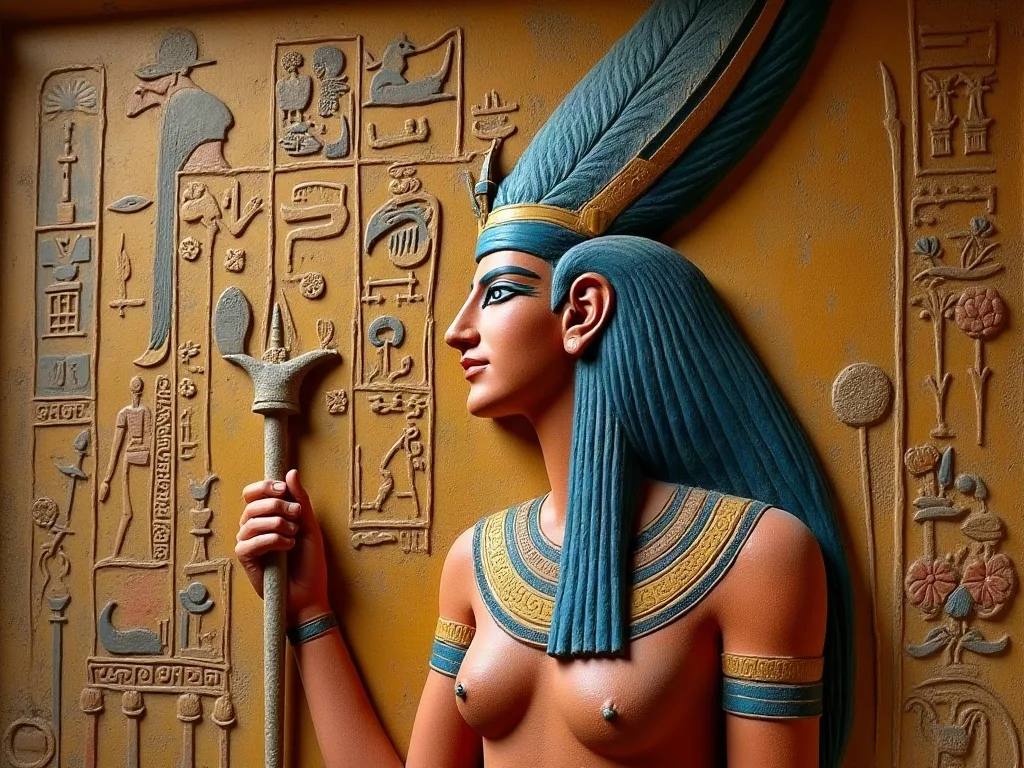
The hieroglyphic sign for her name often appeared near symbols for water and fertility. On temple walls, scribes wrote her as a figure crowned with ostrich feathers, sometimes holding a papyrus scepter or wearing a plumed headdress that marked her divine status. Her association with the feather itself carried profound meaning: in Egyptian cosmology, the feather of Ma'at (truth and cosmic order) was weighed against the heart of the dead in judgment. That Anuket bore feathers suggested her role as a keeper of balance and rightness in the natural world.
In the Ptolemaic period (after 332 BCE, when Greek rule came to Egypt), she was sometimes syncretized with Greek goddesses, but her core identity remained distinctly Egyptian. The Nile itself, in its flowing abundance, was her truest form.
The Sacred Triad of Elephantine: Anuket's Divine Family
Anuket was never worshipped in isolation. At Elephantine Island, where the First Cataract made the river's power visible and audible, she stood within a divine family: Khnum, the ram-headed creator god who fashioned souls on his potter's wheel; Satet (or Satet), an older hunting and flood goddess; and Anuket herself, often positioned as Khnum's daughter or consort.
This triad revealed the Egyptians' understanding of the river's components. Khnum represented the generative, creative force that formed life. Satet embodied the swift, fierce inundation itself, the dancer of chaos that brought danger as well as blessing. Anuket, by contrast, personified the river's benevolence, the waters as they settled and nurtured. Together, they held the complete cycle: creation, flood, and sustenance.
The temple at Elephantine, reconstructed many times across dynastic Egypt, was Anuket's primary sanctuary. Pilgrims journeyed there, especially during the inundation season, to leave offerings and prayers. The temple records, preserved on papyri, show that priestesses served Anuket alongside male priests, unusual in many cults but fitting for a goddess so tied to water and the cyclical renewal that women embodied in Egyptian thought.
Mythology and Divine Relationships
Unlike male gods such as Ra or Osiris, Anuket had no grand epic cycle attributed to her in surviving texts. The Egyptians did not record a birth story or a dramatic conflict involving her. Instead, her mythology was embedded in the seasonal and ritual calendar.
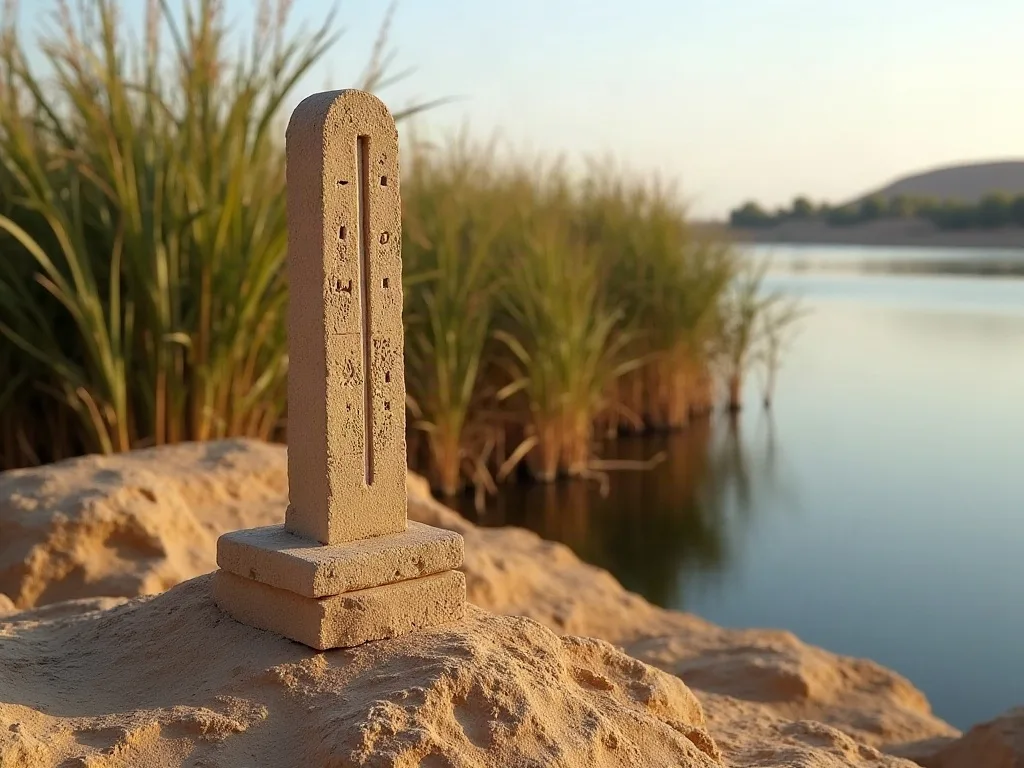
The inundation itself was her story. Each year, as the waters rose in July or August, Egyptians understood Anuket as moving northward, embracing the land, bringing the black silt that renewed the fields. Farmers watched the nilometer (a stone-marked column that measured the river's height) and prayed to Anuket for the perfect flood, not too low (which meant famine) and not too high (which brought destruction). Her mythology was practical, intimately tied to human survival.
In some texts, Anuket appeared as a guardian or guide for souls traveling through the Duat, the underworld. This role grew from her association with water, which represented both life and the crossing between worlds. The Pyramid Texts, inscribed on royal tomb walls from the Old Kingdom onward, occasionally invoked Anuket to protect the pharaoh's journey after death.
She also held a role in the coronation and renewal of kings. The pharaoh was imagined as the son or husband of various goddesses, each representing an aspect of Egypt. Anuket represented his tie to the Nile, the ultimate source of his power and legitimacy. A pharaoh who failed to bring the inundation was a pharaoh who had lost divine favor.
Symbols and Iconography: Reading the Sacred Attributes
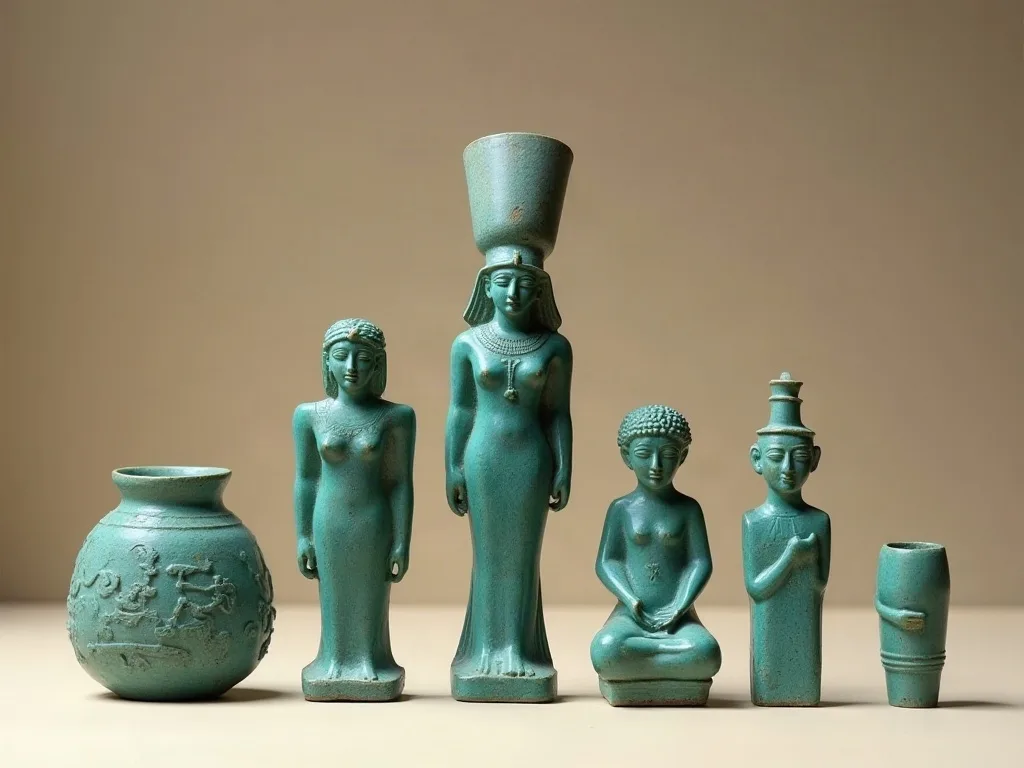
On temple reliefs and papyri, Anuket appears with a specific visual language that every educated Egyptian could read at a glance.
Her crown, the plumed headdress, bore two tall ostrich feathers flanking a sun disk or a simple rounded crown. This feathered crown marked her as divine and linked her to the goddess Satet, whose image she sometimes mirrored. The feathers also evoked the concept of lightness, ascent, and the breath of life.
She wore a close-fitting linen dress, often depicted with a narrow waist and pleated skirt, the typical garb of an elite Egyptian woman. This clothing emphasized her role as both divine and intimate, not a distant abstraction but a presence in daily life.
In her hands, she often held a papyrus scepter, the papyrus crown, which doubled as a symbol of Lower Egypt's greenness and fertility. Sometimes she carried the ankh, the looped cross that signified eternal life. Both objects reinforced her gift: she did not just bless the fields; she ensured continuity and renewal.
Anuket's animal form was the gazelle, a creature of grace and swiftness. The gazelle embodied the Nubian steppes and the desert margins that bordered the Nile valley. In this form, she represented the untamed forces that the inundation temporarily tamed.
Gold and lapis lazuli were her sacred materials. Votive figurines of Anuket, carved from faience (glazed ceramic) or stone, have been found at Elephantine and elsewhere, showing that ordinary pilgrims could afford to leave small images of her in temples.
Worship, Ritual, and the Nilometer Ceremony
The festival calendar centered Anuket's observance on the beginning of the inundation, typically marked in late summer. At this time, priests at Elephantine performed rituals designed to honor her and secure her blessing for the coming flood.
One of the most significant ceremonies involved the nilometer. This simple structure, a stairway or column marked with cubits (ancient Egyptian units of length), allowed observers to track the river's rise day by day. When the waters reached the level that promised a beneficial flood, the priests declared the moment sacred. They poured libations (ritual liquid offerings, usually water or wine) into the Nile while chanting prayers to Anuket. These ceremonies were not merely symbolic; they were acts of communication with the divine force that sustained Egypt.
Anuket's priestesses, called Hekayu (magicians or wise women), held considerable authority. They interpreted signs and omens related to the river and advised pharaohs on ritual timing. In some periods, the "Divine Wife" or consort of certain gods was identified with Anuket, a title of immense political power.
Ordinary people made vows and offerings to Anuket when traveling by river or facing drought. Fishermen prayed to her for safe passage through the Cataract's dangerous rapids. Families who depended on irrigation channels blessed them in her name.
Anuket in Kingship and Royal Ideology
The pharaoh was not simply a human ruler but a divine principle made flesh. His legitimacy depended on his relationship with the gods and his ability to maintain Ma'at, cosmic order. The Nile was Egypt; and Anuket was the Nile's benevolence. Thus, every pharaoh had to stand in proper relationship with her.
In royal inscriptions, a successful inundation was attributed to the pharaoh's piety and righteousness. Conversely, a failed flood signaled divine displeasure. This placed enormous pressure on the monarchy but also gave kings a narrative framework: they did not fail; they had merely incurred the gods' wrath, which the next ritual or offering might reverse.
Anuket appeared in royal coronation texts, blessing the new king's ascension. Temple reliefs showing the pharaoh making offerings to Anuket were standard iconographic programs, declarations of the king's devotion and the realm's fertility.
Cross-Cultural Echoes: Anuket and Other River Goddesses
Anuket's role as a river goddess connects her to wider patterns in ancient religions. The Nile itself was sacred in ways that rivers in Mesopotamia, the Indus Valley, and later Greco-Roman worlds were not. Yet each civilization developed goddesses or deities tied to water and fertility.
The Nubian goddess Taweret (Taueret), a hippopotamus deity, shared some characteristics with Anuket, particularly protection and fertility, though Taweret was more directly associated with childbirth and the vulnerable period after birth. The two coexisted in the Egyptian pantheon without conflict, each holding her own domain.
In later Ptolemaic Egypt, Anuket was sometimes conflated with the Greek goddess Anahita, a Persian deity of waters and cosmic order. This syncretism shows how Anuket's essence, embodied grace, life-giving flow, and protection, transcended cultural boundaries and remained intelligible to foreign peoples who also depended on water.
The Hindu goddess Ganga, personification of the Ganges River, shares Anuket's fundamental role as a river made divine, a direct channel between the human and transcendent worlds. Both goddesses embody the idea that water is not merely matter but spirit, that the river's flow is consciousness itself.
Anuket's Decline and Rediscovery
As Christianity spread through Egypt in the 4th and 5th centuries CE, temples closed and priestly traditions were abandoned. Anuket's shrines fell silent. For more than a thousand years, she became known only through fragmentary papyri and temple inscriptions, a name in scholarly footnotes.
Modern Egyptology has recovered her voice. The excavations at Elephantine, particularly those led by German and Swiss missions from the 20th century onward, revealed the temple's architecture, ritual objects, and inscribed dedications to Anuket. These discoveries reestablished her importance in the Egyptian pantheon and showed how deeply she was woven into daily religious life, not as a peripheral figure but as a central force.
Contemporary scholarship has also begun to recognize Anuket's role in the religious lives of women. Priestesses, pilgrims, and mothers made offerings to her for fertility, safe childbirth, and the security of their families. She was a goddess for the people, not merely for kings and temples, and the evidence for her widespread worship continues to surface.
Anuket in Art and Artifacts: What Remains
Museums across the world hold objects devoted to Anuket. The British Museum, the Louvre, and the Egyptian Museum in Cairo possess votive figurines, amulets, and temple reliefs bearing her image. These artifacts tell a story of devotion and craft that spans dynasties.
One of the most striking examples is a limestone stela (stone slab) from the Ptolemaic period, now in the Cairo Museum, showing a worshipper presenting offerings to Anuket. Her form is serene, her feathered crown tall and precise, and the inscription identifies her clearly in both hieroglyphic and Greek scripts. This dual language reflects the late period of Egyptian civilization, when two cultures coexisted and blended.
Faience figurines of Anuket, often no more than a few centimeters tall, were mass-produced at Elephantine and exported downriver. Pilgrims tucked them into their homes or left them in temples as permanent prayers. The fact that artisans took the time and expense to make these small images suggests a goddess beloved by ordinary people, not a remote abstraction.
Amulets bearing Anuket's image or name have been found in graves, sewn into linen wrappings alongside mummies. These talismans were believed to protect the deceased on their journey through the Duat and to ensure their resurrection. The amulet was a bridge between the living and the dead, between this world and the next, and Anuket, as a guardian of crossing, was an apt choice for that role.
The Nile in Modern Egypt: Anuket's Legacy
Today, the Nile remains Egypt's lifeline, as essential as it was five thousand years ago. Though the ancient temples are ruins and the gods are no longer worshipped in formal rituals, Anuket's presence lingers in cultural memory and in the landscape itself.
The modern Aswan High Dam, built in the 1960s and 70s, fundamentally altered the Nile's rhythm. No longer does the river flood predictably each year; the dam's control has brought both stability and loss. Some scholars have argued that this rupture with the ancient inundation cycle represents a break in the Egyptians' spiritual contract with the Nile and with Anuket herself. The nilometer at Elephantine, once a center of ritual observation, now stands as a historical monument, its function obsolete.
Yet Anuket's symbolic power endures. Egyptian poets, artists, and intellectuals have returned to her image in modern works, reclaiming her as a symbol of Egypt's ancient wisdom and its unbreakable connection to the river. In this way, a goddess forgotten by formal religion has found new life in cultural identity and artistic expression.
Frequently asked questions about Anuket, goddess of the Nile?
Frequently asked questions
Was Anuket worshipped throughout all of Egypt or mainly in the south?
Anuket's primary cult center was at Elephantine Island in Upper Egypt (the Nile's southernmost region), but her worship spread downriver to other temples and among ordinary Egyptians who made offerings at household shrines. The nilometer ceremonies at Elephantine were the most elaborate rituals, but every region that depended on the inundation honored her in some form, making her a national goddess despite her southern roots.
How did Anuket differ from Satet, the other flood goddess?
Satet embodied the fierce, chaotic power of the inundation itself, the wild flood that could destroy as well as create. Anuket, by contrast, represented the river's nurturing, settled aspect, the waters that brought abundance and life. Together, they held the full cycle: danger and blessing, chaos and order. Anuket was the mother who embraced; Satet was the force that brought her forth.
Did Anuket have any direct role in the afterlife, or was she only connected to the living world?
The Pyramid Texts reference Anuket as a guide and protector for deceased souls traveling through the Duat. Her association with water, which represented both life and the boundary between worlds, made her a fitting guardian at the threshold of death and resurrection. Some tomb reliefs show Anuket pouring water over the mummy or standing at the portal to the afterlife.
Were there male priests of Anuket, or did women exclusively serve her?
Both men and women served Anuket as priests and priestesses. Temple records from Elephantine show a mixed priesthood. However, the role of priestess held particular significance in Anuket's cult, reflecting the goddess's connection to feminine generative power and water. High priestesses of Anuket held considerable authority and sometimes bore the title "Divine Wife," a position of political and spiritual influence.
What happened to Anuket's worship after Egypt was Christianized?
Like all pagan Egyptian gods, Anuket's temples closed as Christianity spread in the 4th and 5th centuries CE. Her name and image vanished from public ritual. However, some aspects of her symbolism may have been absorbed into Christian Marian devotion, particularly the themes of nurturing, motherhood, and the protecting embrace. For over a thousand years, Anuket was known only through ancient texts until modern archaeologists rediscovered her through excavations at Elephantine and other temple sites.
Is there any connection between Anuket and the modern concept of environmentalism or water conservation?
Modern Egyptians and international scholars have drawn on Anuket's image as a symbol of the sacred bond between human civilization and the river, particularly in the context of water scarcity and climate change. While Anuket herself was not a conservationist in the modern sense, her mythology emphasizes balance, respect, and gratitude for the Nile's gift, values that resonate with contemporary environmental thought.
The Eternal Flow: Anuket's Enduring Mystery
Anuket remains one of ancient Egypt's most elegant and least sensationalized deities. She had no cosmic battles to her name, no revenge tales or elaborate seductions. She simply was: the river's grace, the inundation's blessing, the goddess who clothed the land. In an age when many gods are remembered for their drama, Anuket's quiet constancy is itself remarkable.
The Nile still flows northward as it has for millions of years, indifferent to human belief. Yet for the Egyptians who lived along its banks, the river was never merely water and silt. It was consciousness, intention, and divine presence embodied. Anuket was that presence given a name, a face, and a voice in prayer. To call her goddess of the Nile is almost to minimize her: she was the Nile itself, loved, feared, and thanked by a civilization that understood, in its bones, that water is life and divinity flows together.
In the thousands of votive offerings left at Elephantine, in the words carved into temple walls, in the memory of rituals performed at the nilometer's edge, Anuket endures. She is a reminder that the sacred is not always loud, and the most essential forces are often the quietest.
Free 25-page sample
Want the whole story?
Take the first 25 pages free. If it pulls you in, the full edition is yours as an instant PDF download, with a paperback on Amazon for selected titles.

Mythology
The World Mythology Book: The Gods, Heroes and Myths of Every Culture
The Gods, Heroes and Myths of Every Culture, in One Volume
The whole of world mythology in a single volume: Greek, Norse, Egyptian, Japanese, Hindu, Celtic, Slavic, Mesoamerican and African myths gathered side by side, each drawn from the primary sources.