

Artemis, Goddess of the Hunt: Archer, Moon, and Guardian of the Wild
Silver bow raised, hounds at her heels, Artemis ruled the wilderness long before cities had walls. Here is the full story of the Olympian huntress: her birth, her powers, her myths, and her enduring presence.
Contents
The arrow leaves the string before the deer hears the bowstring sing. Deep in the Arcadian hills, where oak roots crack the limestone and river mist hangs at dawn, a figure moves without disturbing a single branch. Her hounds know not to bark. The forest itself goes quiet.
This is Artemis, goddess of the hunt, and she has been moving through these mountains since before the Greeks gave her a name. She is the silver light that makes a night forest navigable. She is the sudden death that keeps herds from overpopulating a valley. She is the cry a woman gives in the extremity of childbirth. To flatten her into a single attribute is to misread her entirely.
The Birth of Artemis: A Goddess Born in Struggle
The standard Olympian genealogy places Artemis as the daughter of Zeus and the Titaness Leto. But that genealogy conceals a drama.
Hera, furious at Zeus's affair with Leto, forbade every land on earth from offering the Titaness a place to give birth. Leto wandered, pregnant and refused, until the floating island of Delos accepted her - because it was not yet "fixed" earth and thus fell outside Hera's injunction. According to the Homeric Hymn to Artemis (Hymn 27) and the longer Homeric Hymn to Apollo (Hymn 3), Artemis was born first, and then immediately helped her mother through the long labor of delivering her twin brother Apollo. The newborn girl became, in that moment, a goddess of midwifery before she had drawn three breaths.
Pindar and Callimachus both tell of the infant Artemis climbing onto Zeus's knee and making a list of demands: a silver bow, a quiver of arrows, a short tunic for running, the mountains as her domain, sixty ocean-nymphs for companions, and permanent chastity. Zeus, charmed, granted every wish. The scene is not frivolous. It encodes something structurally important: Artemis chose the periphery. She did not want the palace, the court, the walled city that her brother Apollo would illuminate. She wanted the eschatos, the outermost edges of the human world, where cultivation ends and wilderness begins.

Symbols, Attributes, and Sacred Animals
The symbols associated with the Artemis goddess of the hunt form a coherent ecology rather than a random collection of icons.
- The silver bow and quiver: Apollo carries a golden bow that sends plague. Artemis carries a silver one that sends swift, "gentle" death, the kind that comes without prolonged suffering. Homer uses the phrase hapta bele - "gentle arrows" - to describe the deaths Artemis inflicts on women, contrasting them with violent or disease-ridden ends.
- The crescent moon: The lunar association intensified through the classical and Hellenistic periods, partly as Artemis merged conceptually with Selene, the Moon Titaness. By the Roman era, her Latin counterpart Diana was almost entirely lunar. In earlier Greek cult, however, the moon was secondary to the wilderness.
- Cypress trees: Sacred to her at multiple sanctuaries. Tall, upright, dark - they marked the boundary between the living world and the underworld in Greek landscape perception.
- The stag: Her sacred animal, the same creature she most often hunted. The paradox is deliberate: the huntress protects what she pursues. Herds that lose their weakest members to predation grow stronger. Artemis embodies the rule that limits abundance.
- The bear: At Brauron, girls between five and ten years old served Artemis as arktoi (bears) before they were eligible for marriage. The ritual likely descends from a very old bear cult. A bear killed near the sanctuary was the mythological trigger: the goddess demanded the ritual service as recompense.
Her sacred plants included the amaranth and the walnut tree. Her cult objects frequently included torches, associating her with illuminating darkness. In iconography she wears a short chiton (knee-length tunic), a quiver slung at her shoulder, and she is nearly always depicted in motion: running, drawing the bow, or calling her hounds.
The Myth of Actaeon: What Happens When Someone Looks
Of all the myths involving Artemis, the story of Actaeon is the one that reveals her nature most starkly.
Actaeon was a skilled Theban hunter, grandson of Cadmus, trained by the centaur Chiron. One afternoon, hot and thirsty after a morning's hunt, he pushed through a thicket and stumbled upon a grotto where Artemis was bathing with her nymphs. The goddess, startled and enraged at being seen naked, had no weapon at hand. So she did something more permanent: she splashed water over Actaeon's head, and he transformed into a stag.
His own hounds did not recognize him. They tore him apart.
Ovid, in Metamorphoses Book III, frames the tragedy around the question of guilt: was Actaeon at fault? The consensus Ovid reports is that fate, not transgression, killed him - he found the grotto by accident. But the older Greek tradition is less interested in moral accounting. What matters is the structure: a human male saw the goddess unguarded. The natural world reclaimed him. His identity as a hunter collapsed into his identity as prey. Artemis did not punish him for impiety in the modern sense; she enforced the boundary between mortal and divine. The hunt has laws, and the hunter is not exempt from them.

Niobe and the Defense of Leto: Artemis as Protector
If the Actaeon myth shows Artemis defending her own boundaries, the Niobe myth shows her defending her family.
Niobe was the queen of Thebes, proud of her fourteen children (seven sons, seven daughters), who made the critical error of boasting she was more blessed than Leto, who had only two. Leto reported the insult to her children. Apollo and Artemis descended to Thebes and, in the space of an afternoon, killed all fourteen of Niobe's children with arrows - Apollo took the sons, Artemis took the daughters. Niobe wept until she turned to stone, and water still seeps from the rock.
Homer treats the story briefly in the Iliad (Book 24), using it as a grim argument for allowing grief to coexist with eating. Ovid returns to it at length in Metamorphoses Book VI. What interests mythographers is the precision of the twins' action: each took the gender that matched their own. The massacre was not random cruelty but patterned, symmetrical. Artemis killed the daughters because daughters were her domain: girls before marriage, girls becoming women, women in the raw biological crises of childbirth. She who protected them also held their lives.
Orion: The One the Goddess Grieved
The relationship between Artemis and Orion breaks the standard pattern. He was the only mortal companion she was ever said to have loved.
The traditions disagree sharply on how Orion died. In one version (favored by Aratus and implied in Hesiod's Astronomy), Artemis herself killed him, either tricked by Apollo, who pointed to a distant figure on the sea and challenged her to hit it, or acting in retribution for Orion's attempt to assault one of her nymphs. In another strand, a scorpion sent by Gaia (or by Artemis herself) delivered the killing sting. After his death, Artemis placed Orion among the stars - an honor she granted no one else. The constellation still bears his name, still chases the Pleiades across the winter sky, still pursued by Scorpius, the scorpion of the rival tradition.
The grief attached to this myth is unusual for a deity as severe as Artemis. It suggests the Greeks understood her not as cold but as purposefully self-contained: she had drawn a boundary around her own vulnerability, and Orion crossed it, with consequences for both.
Artemis at Ephesus: The Great Mother Nobody Expected
One of the most striking complications in studying Artemis is Ephesus.
The Temple of Artemis at Ephesus was one of the Seven Wonders of the Ancient World, and the deity worshipped there barely resembles the silver-bowed virgin of Attic vase painting. The Ephesian Artemis (called Artemis Ephesia) was covered in rows of egg-shaped protrusions that scholars have debated for centuries: breasts? bull testicles offered in sacrifice? date clusters? The most current consensus leans toward sacrificial bull scrota, symbols of fertility and abundance rather than lactation. Her cult image stood rigid, hieratic, arms extended - more Anatolian Great Mother than Greek huntress.
This is not coincidence or confusion. It is history. Ephesus was an ancient Anatolian city, and its goddess predated Greek colonization. When the Greeks arrived, they did not import Artemis - they identified their Artemis with the local deity they found. The result is a composite that reveals how "Greek" religion was never a sealed system: it was a living negotiation with every tradition it touched.
The Acts of the Apostles (19:24-41) records silversmiths in Ephesus rioting against the apostle Paul because his preaching threatened their trade in Artemis figurines. As late as the first century CE, the cult was economically enormous.

Artemis and Her Nymphs: The Politics of Female Space
Artemis traveled always with a band of nymphs who had sworn the same chastity she maintained. This was not merely decorative myth-dressing. It described a real female social space: the oikos (household) was male-governed, marriage was male-arranged, but the wilderness and the hunt provided a zone where women moved on their own authority.
The nymph Callisto broke this compact. Zeus disguised himself (in some versions as Artemis herself, which makes the violation more vicious) and seduced or assaulted her. When her pregnancy became visible, Artemis expelled her from the band. In the versions where Zeus transformed Callisto into a bear before Hera could punish her, and her son Arcas nearly killed her without recognizing her, Zeus placed them both in the sky as Ursa Major and Ursa Minor, the Great and Little Bears.
The Callisto myth encodes both the fragility and the purpose of the space Artemis maintained. She could not protect Callisto from Zeus - no Olympian female could resist the king of the gods - but the expulsion was not cruelty. It was the acknowledgment of a rupture. The sacred circle had been violated from the outside, not from within.
The myth of Iphigenia complicates this further. When Agamemnon killed a deer sacred to Artemis before the Greek fleet sailed for Troy, the goddess stilled the winds at Aulis. The price she demanded was Agamemnon's daughter Iphigenia, to be sacrificed on the altar. At the last moment, in one version (Euripides' Iphigenia at Aulis and its sequel Iphigenia among the Taurians), Artemis substituted a deer and carried Iphigenia to the Tauric peninsula as her priestess. The girl who should have been a sacrifice became, instead, a servant of the wilderness.
Artemis Across Traditions: Diana, Devi, and the Mistress of Beasts
The "Mistress of Animals" type - a goddess who controls wild creatures, stands between the human and non-human worlds, and is associated with lunar cycles - appears across cultures in ways that invite comparison.
Diana, her Roman equivalent, absorbed the Greek mythology almost wholesale but arrived at it from a different direction. Her oldest Roman cult was at Aricia, in the sacred grove of Nemi on the shores of Lake Albano. The priest of Diana Nemorensis held office by a singular rule: he kept his position until a stronger challenger killed him. James Frazer opened The Golden Bough with this image, arguing it pointed to an ancient sacrificial king tradition. Whether Frazer's broader theory holds, the Nemi cult is historically documented and strikingly different from the Olympian Artemis traditions.
In Hindu mythology, Durga occupies related symbolic territory: a fierce, autonomous goddess associated with wild spaces, animals, and the correction of cosmic imbalance. She is not a virgin hunter, but her independence from male authority and her sovereignty over the threshold between order and chaos echo structural features of Artemis. Similarly, the Celtic Cernunnos and the Norse hunting traditions around Skadi (who hunted alone on skis in the mountains after her marriage to Njord failed) suggest the archetypal resonance of the solitary hunter-deity is not Greek in origin but much older.
The Minoan "Goddess of the Hunt" depicted on Bronze Age seals from Crete may represent the oldest local ancestor of the figure the classical Greeks named Artemis. No continuous myth tradition connects them, but the iconographic continuity - woman, bow, animals flanking her - is hard to dismiss.
Artemis in Classical Art and Literature: A Canon of Her Own
The literary tradition on Artemis goddess of the hunt is rich and internally contradictory, which is exactly what a real deity's mythology looks like.
Homer treats her as a relatively minor figure in the Iliad (Book 21), where she is literally slapped by Hera during the battle of the gods and retreats weeping. That portrait jars against the severe, untouchable figure of Callimachus' third-century BCE Hymn to Artemis, where she argues with craftsmen, tests her bow on trees and then on unjust men, and moves through the poem with the confidence of someone who has never been uncertain. Euripides' plays, particularly Hippolytus, show a goddess who cannot intervene directly to save her devotee from Aphrodite's anger - another tragic limit.
In sculpture, the most famous image is the "Artemis of Versailles" (now in the Louvre), a Roman copy of a Hellenistic original showing her in mid-stride, reaching back for an arrow, a deer at her side. The posture captures the quality of perpetual motion the myth insists upon: she is never still, never domestic, never arrived.
Pausanias, in his second-century CE Description of Greece, catalogues dozens of Artemis cult sites and local variants, reminding us that classical Athens did not define the goddess for the whole Greek world. In Sparta she was worshipped as Artemis Orthia, at whose altar boys were flogged until they bled, a ritual that Plutarch himself found disturbing but documented carefully.
Frequently asked questions about Artemis, goddess of the hunt
Frequently asked questions
What is Artemis the goddess of, exactly?
Artemis was goddess of the hunt, wild animals, forests, and the moon (in later tradition). She also governed childbirth and transitions between girlhood and womanhood. Her domain was the boundary between civilization and wilderness, and she presided over both the survival and the death that that boundary produces.
Why was Artemis a virgin goddess?
Her virginity was not a moral statement about sexuality but a statement about sovereignty. By swearing chastity, Artemis remained outside the structures of marriage and household authority that governed most women in Greek society. Her virginal status meant she answered to no husband, no domestic oikos, no male relative after her father Zeus. It was a condition of her autonomy, not a reward for abstinence.
What is the difference between Artemis and Diana?
Artemis is the Greek figure; Diana is her Roman counterpart. The Romans adopted the Greek mythology largely intact, but Diana had an independent pre-Roman cult at Nemi (the sacred grove of Aricia), where her priesthood was governed by ritual combat. Diana also became more fully lunar in Roman religion, a trait that sharpened under the influence of Augustan poets. The theological core, an autonomous hunter-goddess of the wild, is shared.
What primary sources describe Artemis?
The key primary sources are: the Homeric Hymns 9 and 27 (short hymns dedicated to her), Homeric Hymn 3 (to Apollo, which covers the birth at Delos), Hesiod's Theogony (genealogy), Callimachus' Hymn to Artemis (third century BCE, the most detailed single treatment), Euripides' Hippolytus and Iphigenia plays, Ovid's Metamorphoses Books III and VI (Actaeon and Niobe), and Pausanias' Description of Greece (cult sites).
What is the myth of Artemis and Actaeon?
Actaeon, a Theban hunter, accidentally witnessed Artemis bathing in a forest grotto. The goddess, having no weapon ready, transformed him into a stag. His own hunting hounds then chased him down and killed him. Ovid in Metamorphoses Book III raises the question of whether Actaeon deserved his fate, given that the encounter was accidental. The older Greek tradition focuses less on guilt and more on the inviolability of divine space.
Was Artemis associated with the moon?
In early Greek religion, Artemis was primarily a goddess of the hunt and wilderness, distinct from Selene, the Titaness who drove the moon's chariot. The lunar identification strengthened through the Hellenistic period as Greek religious thought became more syncretic, merging Artemis, Selene, and Hecate into a triple moon goddess. By the time Roman religion identified her as Diana, the lunar aspect had become central.
What the Artemis Myths Reveal About Greek Ideas of the Wild
The Greek imagination needed Artemis to exist because civilization needs a border to define itself. Every city in the ancient Aegean world was surrounded by territory it did not fully control: mountains, forests, coastlines where the polis ran out. Artemis governed that outer ring. She was not hostile to cities, but she was not of them.
This is why her myths keep returning to thresholds. The deer at the edge of the field. The girl on the threshold of marriage, who stopped at Brauron to become a bear for a season before she could become a wife. The hunter who steps one thicket too far. The army that cannot sail until the goddess receives her due. Artemis goddess of the hunt is the deity you propitiate when you are about to cross from one state of being into another, when you are about to enter territory you do not entirely understand.
That function has not become obsolete. Contemporary ecology - the science of predator-prey relationships, of keystone species, of the role apex predators play in regulating ecosystems - describes exactly the mechanism Artemis embodied. Remove the hunter from the landscape, and the landscape unravels. The deer overrun the valley. The forest canopy disappears. The rivers silt. Ancient Greek religion, encoded in the figure of a silver-bowed goddess who keeps her hounds fed and her forests intact, had already grasped this.
She is still there, in every national park sign warning hikers not to feed the bears, in every wildlife corridor project that carves animal pathways through suburban sprawl. The hunt has laws. Even now, we are still learning what they are.
Read the full book
Want the whole story?
The complete edition is an instant PDF download here, with a paperback on Amazon for selected titles.
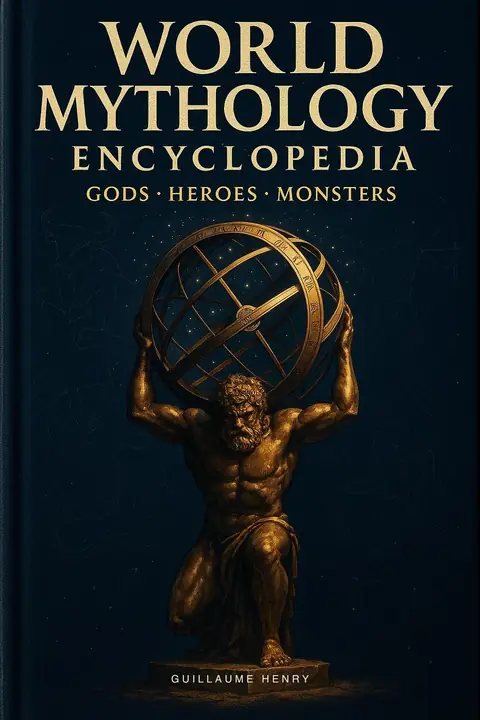
Mythology
The World Mythology Book: The Gods, Heroes and Myths of Every Culture
The Gods, Heroes and Myths of Every Culture, in One Volume
The whole of world mythology in a single volume: Greek, Norse, Egyptian, Japanese, Hindu, Celtic, Slavic, Mesoamerican and African myths gathered side by side, each drawn from the primary sources.