
Atum: The First God of Egyptian Creation and the Self-Birthed Creator
Atum emerged from the primordial chaos as the first god in Egyptian mythology, birthing himself and all creation through an act of will. Discover how this self-created deity shaped reality from nothingness and why pharaohs claimed his divine bloodline for 3,000 years.
Contents
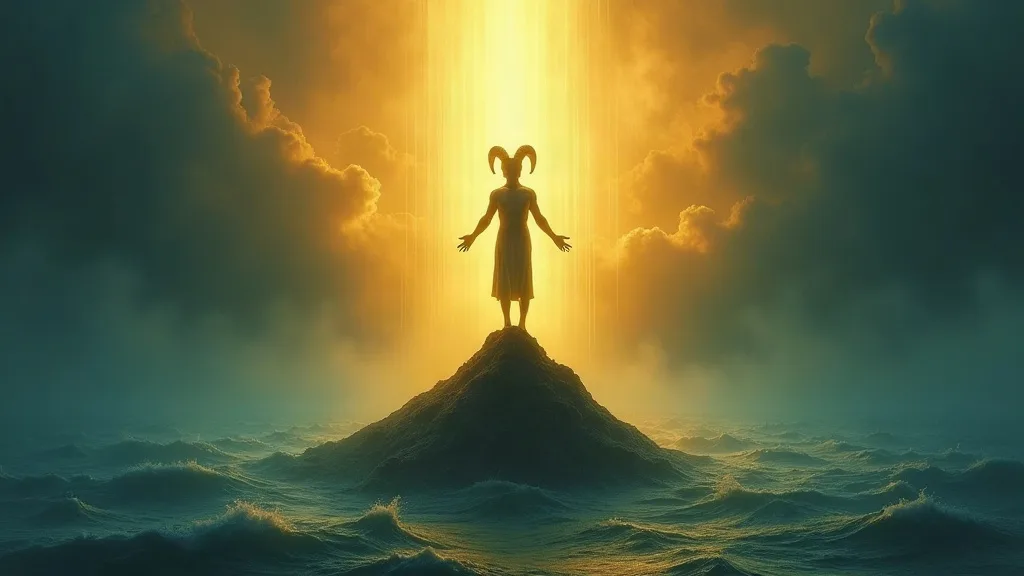
In the beginning, there was nothing. No sky. No earth. No time. Just Nun, the infinite ocean of chaos that existed before existence itself. Then Atum woke. Or perhaps he chose to be. The ancient Egyptian creation texts called the Pyramid Texts, carved into royal tombs around 2400 BC, describe how Atum the first god emerged from this formless void, pulled himself together, and through an act of pure will, gave shape to everything that would follow.
This was not creation by command. Atum did not speak the world into being. Instead, he became the world. He sneezed, or he masturbated, or he simply decided to exist. The ancient Egyptians recorded multiple versions of his self-creation, and each one tells us something different about how they understood the difference between chaos and order, between the possible and the actual.
For over three thousand years, Atum stood at the apex of Egyptian religious life. Pharaohs traced their descent from him. Temples rose in his honor. His image evolved across dynasties: sometimes a man with the head of a ram; sometimes a ball of light; sometimes an old man, weary from carrying the sun day after day. But his essential role never changed. Atum was the first, the generator, the one who made himself so that everything else could follow.
The Primordial Ocean and the Emergence of Atum
The Egyptians imagined creation not as an explosion or a spoken word, but as a gradual awakening from non-being. The Pyramid Texts, humanity's oldest religious writings, preserved in the tombs of Old Kingdom pharaohs (Dynasty 5 and 6, circa 2400-2300 BC), describe the moment before time: Nun, the primordial waters, endless and empty.
In this ocean, consciousness stirred. Something emerged. That something was Atum, whose name may derive from the verb atum, meaning "to complete" or "to fill." He was, in a sense, the completion of the void: the first act of definition, the first "I am."
The earliest creation accounts depict Atum standing on the Benben, a primordial mound that rose from Nun. This mound was less a mountain than a moment of solidification, a point where potential became actual. In some versions, Atum created the mound himself. In others, it was already there, waiting. Either way, Atum stood upon it, alone and complete, the first and only being in existence.
How did Atum bring forth the next generation of gods? The Pyramid Texts describe his act in language that is simultaneously biological and cosmological. He sneezed forth Shu, the god of dry air and space; a sneeze is involuntary, sudden, splitting one being into two. He spat out Tefnut, the goddess of moisture. Other accounts are more explicit: Atum masturbated, his seed falling to earth, and from this act Geb, the earth god, and Nut, the sky goddess, came into being. The ancient Egyptians recorded these versions without embarrassment. To them, reproduction was not shameful; it was the model for all creation.
What matters is that Atum the first god did not create through external will or command. He created through his own substance, through parts of himself. Every god who followed was, in some sense, made from him. This is why the Egyptians considered all creation to be divine: the earth, the sky, the air between them, all were literally Atum's children.
The Ennead: Atum's Divine Family Tree
Once Atum had created Shu and Tefnut, creation accelerated. Shu and Tefnut embraced, and from their union came Geb (earth) and Nut (sky). Geb and Nut also embraced, and from them sprang four more gods: Osiris, Isis, Set, and Nephthys. These nine deities together formed the Ennead, the sacred group of nine gods that governed Egyptian reality.
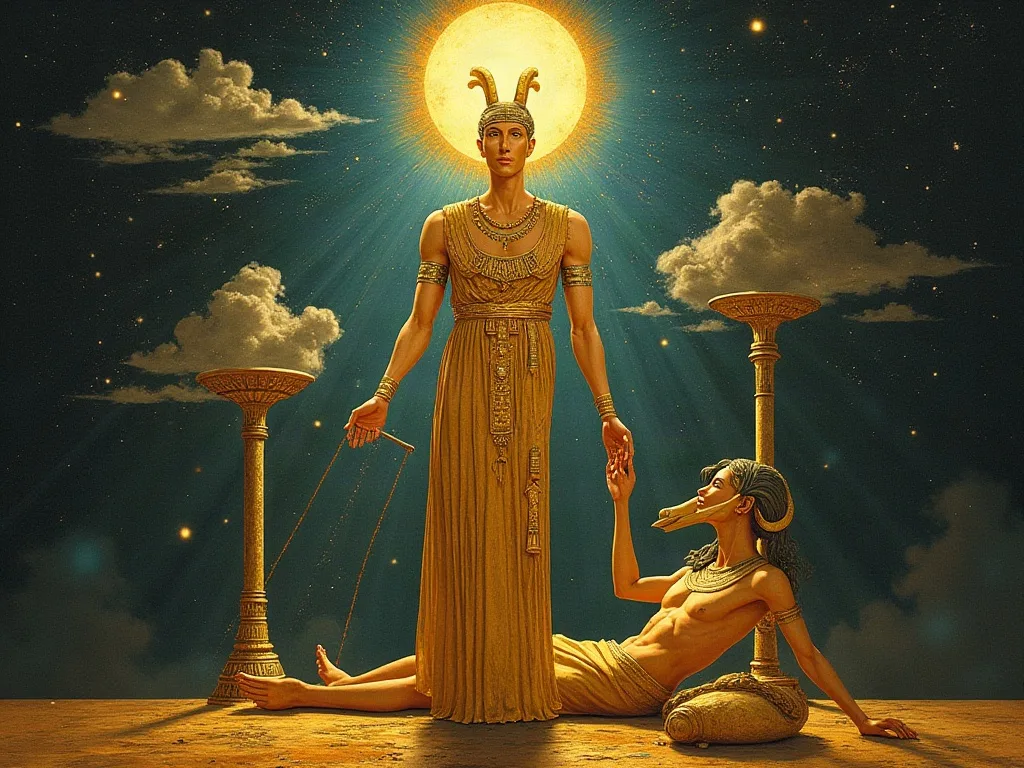
In the Heliopolitan tradition (named after the city of Heliopolis, where Atum was worshipped as supreme), Atum sat at the top of this hierarchy. He was not merely the oldest; he was the source. Every other god, every power in the cosmos, traced its existence back to him. Even Ra, the sun god who would eventually eclipse Atum in popularity, was often identified as an extension of Atum: they merged in the combined form Atum-Ra, the creator-sun, ruling the sky by day and the underworld by night.
The Coffin Texts, funerary spells from the Middle Kingdom (circa 1980 BC), make this relationship explicit. Atum says: "I breathed out Shu, I spat out Tefnut. From being one, I became three. My names increased." The self-perpetuating language is crucial. Atum does not create other gods and retire. He continues to exist, continues to sustain creation through his ongoing presence and energy.
The Egyptians represented this divine genealogy not as a linear narrative but as a visual pattern. Tomb walls and papyri showed Geb, the earth, reclining horizontally at the bottom; Nut, the sky, arched over him on top; and Shu, the air between them, holding them apart with his outstretched arms. This image, preserved in countless tombs and temples, made the act of creation permanent and visible. Every time an Egyptian looked at the sky and felt the earth beneath their feet, they were seeing Atum's children, and through them, the ongoing reality that Atum had initiated.
Atum's Forms and Names: Ram-Headed Creator to Setting Sun
Atum was not represented in a single fixed form. Across Egyptian history, his image shifted to reflect different aspects of his power and different theological interpretations. Understanding these forms helps us see how a single divine figure could encompass vastly different roles.
In his earliest representations, particularly in the Old Kingdom, Atum appeared as a man, often wearing the royal regalia of a pharaoh: the false beard, the uraeus (sacred serpent), the atef crown. This emphasized his role as the archetypal king, the first ruler, the model against which all earthly pharaohs measured themselves. When a pharaoh claimed, "I am the son of Atum," he was asserting his own legitimacy and divine origin.
Later, especially in the New Kingdom (1550-1070 BC), Atum appeared with the head of a ram. The ram (ba in Egyptian) was associated with male virility and power; this form emphasized Atum's role as the generative force, the one who literally created life through his own body. The curled horns of the ram also resembled the umbilical cord, evoking both birth and the primal connection between creator and created.
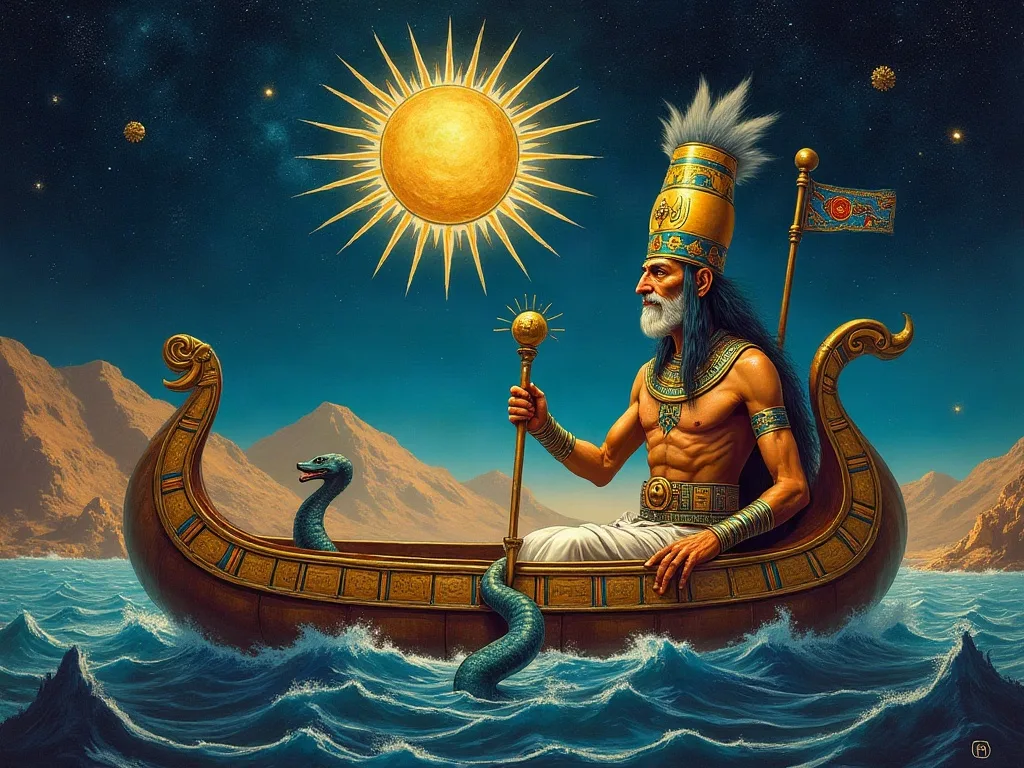
As Atum merged with Ra, the sun god, his image transformed again. He became the sun disk itself, a golden ball traversing the sky each day. This solar form reflected a later theological development: the identification of Atum with the life-giving heat and light of the sun. When the Egyptians said Atum sailed across the sky in the solar barque (a sacred boat), they were describing the passage of the sun and connecting it to Atum's original act of becoming.
By evening, as the sun sank toward the western horizon, Atum took yet another form. He became Atum the old man, bent and tired from his day's labor. This evening form was not a diminishment but a reflection of cyclical time. Atum did not cease to exist at sunset. He traveled through the underworld, through the Duat, encountering demons and dangers, before being reborn each dawn. This nightly journey and resurrection made Atum a prototype for Osiris, whose own death and rebirth followed a similar pattern.
The name Atum itself carried multiple layers of meaning. It could mean "the complete one," suggesting wholeness and self-sufficiency. It could derive from atom, meaning "father," making Atum "the father" par excellence. Different priestly schools at different temples offered competing etymologies, each one revealing a different theological emphasis. This multiplicity of meanings was not considered a problem; it was seen as proof of Atum's infinite nature. A god who could be understood in only one way was too limited to be truly divine.
The Benben Stone and the Architecture of Creation
One of the most sacred objects in Egyptian theology was the Benben stone, a pyramidal stone kept in the temple of Atum at Heliopolis. This stone was never lost or moved in modern times (it was likely destroyed or hidden during the Islamic period), but its theological significance was so great that it appeared in countless texts and images.
The Benben was said to be the place where Atum first stood, the primordial mound that emerged from Nun. Some texts suggest the Benben was a meteorite, a stone fallen from the stars, and thus a literal piece of heaven brought to earth. The Egyptians would have recognized iron meteorites as rare and precious objects, making the Benben a physical anchor for their cosmology. Here was an actual stone, venerated in an actual temple, that could be touched and seen. Creation was not purely metaphysical; it had a material reality that pilgrims could experience.
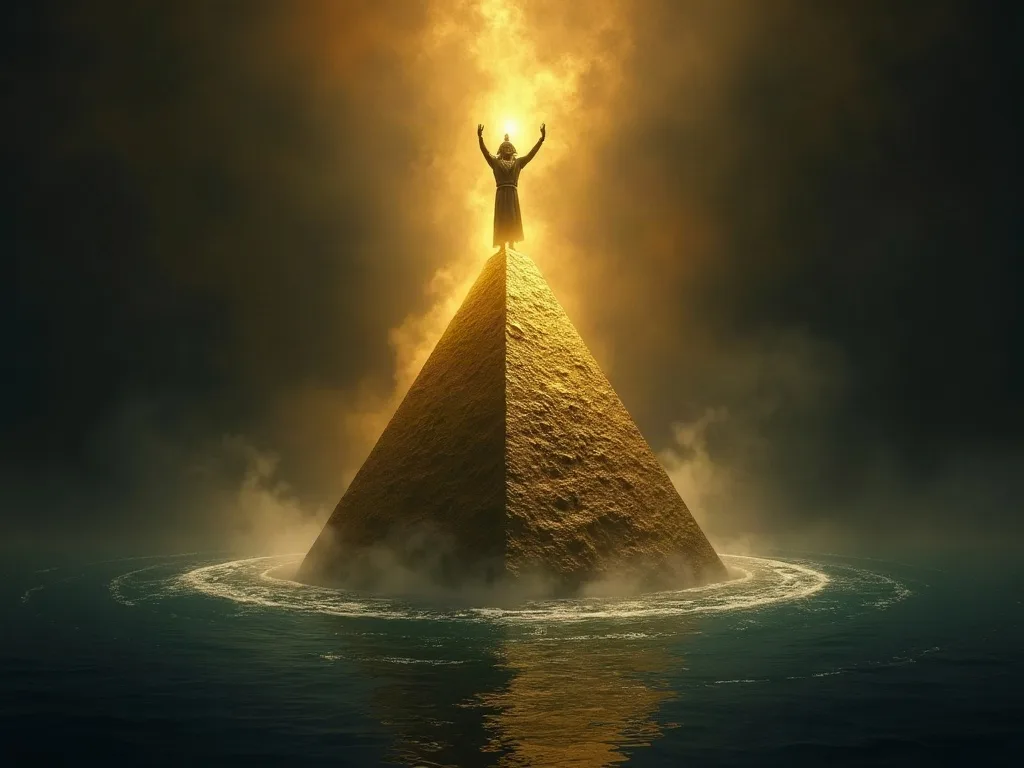
The shape of the Benben was reflected in the pyramids themselves. The pyramids, especially the Great Pyramid at Giza, were designed with a pyramidal apex that echoed the shape of the Benben. When a pharaoh was buried in a pyramid, he was placed within a sacred geometry that linked him to Atum and to the first moment of creation. The pyramid was a cosmic engine, a machine for resurrection and eternal life, modeled on the original act of becoming that Atum had performed in the primordial age.
Later, when temple architecture evolved, Egyptian builders created obelisks: tall, needle-like structures with pyramidal tops. Obelisks were erected as monuments to the sun, and they too reflected the shape of the Benben. Every obelisk was a replica of that first mound, a reminder that creation was still ongoing, that the generative power of Atum was not a one-time event but a continuous force sustaining the world.
Atum's Journey Through the Underworld and the Cycle of Rebirth
One of the most profound developments in Egyptian theology was the understanding that Atum the first god did not remain static in his role. Like all living things, Atum moved through cycles of birth, death, and rebirth.
Each night, after ruling the sky as Ra, Atum entered the Duat, the Egyptian underworld. This was not a descent into defeat but a necessary journey through chaos. The Book of the Dead, a collection of spells and instructions for the afterlife compiled over centuries but first recorded in the New Kingdom, describes Atum's nightly voyage. He travels in his solar barque, a sacred boat, past demons and hostile forces. He encounters Apophis, a serpent of chaos who seeks to destroy the sun and return the world to Nun.
Atum does not simply sail past these dangers. He engages them. He speaks. He transforms. At one point in the Book of the Dead, Atum recites his own names, and this recitation of his identity becomes a protective spell. The god's self-knowledge is his power. By knowing who he is, by asserting his identity, Atum defends creation against the forces that would undo it.
This nightly journey makes clear that creation is not a finished product. It is a daily achievement. Every dawn, when Atum emerges from the Duat and the sun rises, creation is renewed. The Egyptians who recited these texts understood that they too were part of this cycle. By identifying with Atum, by using the spells of the Book of the Dead, they could ensure their own resurrection and eternal life.
The pharaoh, especially, was understood to follow Atum's path. When a pharaoh died, he did not cease to exist. He entered the underworld like Atum, faced its perils, and would be reborn. The texts placed in pharaonic tombs were instructions for this underworld journey, rituals by which a dead king could become one with Atum and achieve immortality.
Atum in the Temple and in Daily Life
The worship of Atum was centered at Heliopolis, a major religious city located in Lower Egypt (near modern Cairo). The temple of Atum at Heliopolis was one of the oldest and most prestigious religious institutions in Egypt. Pharaohs from the earliest dynasties to the latest made offerings there. Priests trained in the mysteries of creation served as custodians of Atum's cult.
Yet Atum was not merely a temple god, an abstraction for priests and scholars. He appeared in spells recited by ordinary people, in amulets worn for protection, in the names that Egyptians gave their children. A man might be named "Atum-hotep" (Atum is pleased) or a woman "Atum-aa" (great Atum), embedding the god's name and blessing into their very identity.
In the New Kingdom, as temples became more elaborate and theological texts more sophisticated, the relationship between Atum, Ra, and Amun (another major deity) became a complex theological problem. How could Atum be the first god if Amun was also supreme? Egyptian theologians solved this not by abolishing Atum but by merging him with other gods. Atum-Ra was one deity. Later, Amun-Ra dominated, and Atum moved toward the background, though never disappearing entirely.
What remained constant was Atum's role as creator. In the cosmological texts that adorned tomb walls and temple pylons, Atum always stood at the beginning. He was the answer to the question: "What was there before anything else?" And the answer was: Atum, who made himself, who chose to exist, and in doing so, brought everything else into being.
The Theological Legacy of Atum: Creation as Self-Will
The figure of Atum the first god embodied a particular answer to the fundamental question of creation. The Egyptians did not imagine a creator god who stood outside creation, imposing order on matter from without. Instead, they imagined a god who created by becoming, by subdividing himself, by generating the world from his own substance.
This had profound implications for how the Egyptians understood their own place in the cosmos. If everything came from Atum, then divinity was woven into the fabric of reality itself. The pharaoh was not merely a servant of the gods; he was Atum's descendant, his living heir. The Nile, which flooded each year and made agriculture possible, was not just a river; it was associated with Shu and the life-giving forces unleashed at creation. The human soul, or ba, was understood to be a spark of the divine, an emanation of the original creative force.
Moreover, the Egyptians saw in Atum's self-creation a model for human agency. If Atum could choose to exist, could will himself into being, then humans too had the power to shape their reality through intention, spell, and ritual. The Book of the Dead gave Egyptians the words to recite and the knowledge to possess so that they could accomplish their own resurrection, following the pattern that Atum had set.
The influence of Atum extended beyond Egypt itself. When Greek writers and philosophers encountered Egyptian religion, they interpreted Atum through the lens of their own cosmology. They saw in him echoes of Kronos, the Titan who preceded the Olympians, or of Chaos, the primordial void from which all things emerged. Later, Jewish and Christian theologians, writing in Egypt, found in Atum's self-sufficiency and creative power parallels to their own understanding of God as self-existent and uncaused.
Atum and the Problem of Chaos: Order Constantly Defended
One aspect of Atum that modern readers often miss is his ongoing struggle against chaos. The Egyptians did not believe that Atum's act of creation was a one-time event after which reality could be taken for granted. Instead, they understood creation as a fragile achievement, constantly threatened by the forces of disorder.
The serpent Apophis, mentioned in the underworld journey texts, was not a minor demon. Apophis embodied the return to Nun, the undoing of creation, the regression to non-being. Each night, when Atum traveled through the underworld, he faced Apophis anew. The sun might not rise. The world might collapse back into chaos. These were real dangers, not metaphorical ones, in Egyptian cosmology.
This gave Egyptian religion an urgency that is sometimes lost in modern retellings. The spells in the Book of the Dead, the offerings made in temples, the rituals performed by pharaohs and priests: all of these were not celebrations of creation but defenses of it. By reciting the right words, by performing the right actions, Egyptians participated in Atum's eternal struggle to maintain order against chaos.
This is why Atum was never portrayed as remote or inactive. He was not a watchmaker god who wound up the universe and let it run. He was a warrior god in the oldest sense: the one who defeated chaos daily, who maintained the boundaries between being and non-being, between the possible and the impossible. The Egyptians who worshipped Atum, who invoked his name and recited his deeds, saw themselves as allies in this cosmic struggle.
Atum's Transformation and Later Decline in Popularity
By the Late Period of Egyptian history (664-332 BC), Atum had faded from the forefront of religious practice, though he was never forgotten. The rise of Amun, especially during the New Kingdom, meant that other gods claimed the roles and attributes that Atum had held. Amun-Ra became the supreme deity, and the theology of Amun's self-creation and generative power partly eclipsed Atum's.
Yet even in the Late Period, priests at Heliopolis maintained the cult of Atum. The temple continued to receive offerings. The Benben stone remained the holiest of objects. And when the Greeks conquered Egypt under Alexander the Great, and later when Rome took control, foreign rulers made offerings to Atum, recognizing his continued significance. The Ptolemaic and Roman rulers of Egypt understood that the legitimacy of their rule depended on honoring the ancient gods, and Atum, as the first god, could not be neglected.
When the Romans built the temple of Dendera, they depicted Atum alongside Hathor, Ra, and other gods in the sacred cartography of creation. When Coptic Christianity emerged in Egypt and eventually displaced the old religion, the very language of creation in the Christian tradition echoed concepts developed by Atum's priests. The theological vocabulary of self-existence, of the creator who is perfect and complete, of creation as an act of divine will: these ideas, refined and debated by Egyptian theologians, influenced how later religions understood God.
Frequently asked questions about Atum the first god
Frequently asked questions
How did Atum create himself if he did not exist beforehand?
The Pyramid Texts suggest that Atum existed in a state of potential within Nun, the primordial chaos. His act of creation was an act of consciousness, of will. He woke, he became aware, he decided to be. This is not unlike modern physics: the universe existed in potential form before the Big Bang; the Big Bang was the moment this potential became actual. For the Egyptians, Atum's self-creation was the transition from potential to actual.
Did the ancient Egyptians always worship Atum as the supreme god?
No. Atum's prominence was strongest in the Old Kingdom (2686-2181 BC) and during the Middle Kingdom. By the New Kingdom, Ra and especially Amun-Ra had become more prominent in popular worship. However, Atum never lost his theological significance. Priests and scholars continued to recognize him as the creator and the source of all gods, even when other deities received more temples and offerings.
What is the connection between Atum and the sun?
Atum was initially the creator god, independent of the sun. However, over time, theologians merged Atum with Ra, the sun god, creating Atum-Ra. This merger reflected the observation that the sun is a source of life and energy, and therefore a fitting symbol for the creator god. In this merged form, Atum travels across the sky each day as the sun, and through the underworld each night, constantly renewing creation.
Is Atum mentioned in the Bible or in Greek mythology?
Atum is not mentioned by name in the Hebrew Bible, but Egyptian creation theology influenced later Jewish and Christian thought, particularly through the Hellenistic Jewish tradition of Alexandria. The Neoplatonic philosophers, who flourished in Alexandria during the late Roman period, explicitly compared Atum to the One, the transcendent source of all being in their system. In Greek mythology proper, Atum is closest in function to Kronos or Chaos, though the Greeks had their own distinct cosmology.
What happened to Atum's cult after Egypt was conquered by Greeks and Romans?
Atum's cult persisted throughout the Ptolemaic and Roman periods. Rulers made offerings to maintain their legitimacy. The temple at Heliopolis continued to function. When Christianity emerged in Egypt, Atum's theology, particularly concepts of the self-existent creator and the emanation of divinity, influenced Christian theological vocabulary, even as the worship of Atum itself gradually ceased.
How did ordinary Egyptians invoke or honor Atum in their daily lives?
Ordinary Egyptians invoked Atum in prayers, amulets, and spells. His name appeared in personal names and in curses. During rituals performed by priests, Egyptians would participate in spells that identified them with Atum or invoked his creative power for healing or protection. The recitation of Atum's names and deeds was believed to have magical efficacy, connecting the speaker to the cosmic forces of creation and order.
Atum's Shadow: The Question of What Remains Unknowable
The enduring power of Atum the first god lies partly in what the Egyptians left unsaid. They did not attempt to fully explain the mystery of creation. Instead, they acknowledged the limit of knowledge and then offered a practical path forward through ritual and invocation.
The Pyramid Texts include a passage where Atum declares: "I did not copulate with a female; I sneezed, and there came into being [the gods]." This language is deliberately absurd, deliberately impossible. No male can sneeze and produce offspring. The impossibility is the point. The Egyptians were saying: creation is not governed by ordinary biology. It transcends the categories we use to understand normal reproduction and generation.
Similarly, the question of where Nun came from, what created the primordial ocean, is never answered in Egyptian texts. Atum emerges from Nun, but Nun is simply presupposed as the original state of things. This is not a failure of Egyptian theology but a recognition that there are horizons to human knowledge. The Egyptians were willing to push the question of origin back one step (to Nun), but they did not pretend to push it back infinitely.
This intellectual humility combined with practical theology is what made Atum endure. Over three thousand years, the god's specific attributes changed, his theological relationship to other deities shifted, and the intensity of his worship waxed and waned. But the fundamental insight remained: that creation is an act of will, that order must constantly be defended against chaos, and that understanding this cosmic pattern gives humans a way to participate in the perpetuation of reality itself.
Free 25-page sample
Want the whole story?
Take the first 25 pages free. If it pulls you in, the full edition is yours as an instant PDF download, with a paperback on Amazon for selected titles.

Mythology
The World Mythology Book: The Gods, Heroes and Myths of Every Culture
The Gods, Heroes and Myths of Every Culture, in One Volume
The whole of world mythology in a single volume: Greek, Norse, Egyptian, Japanese, Hindu, Celtic, Slavic, Mesoamerican and African myths gathered side by side, each drawn from the primary sources.