
The Caduceus vs The Rod of Asclepius: Two Healing Symbols, One Ancient Confusion
Two staffs, one serpent each, both tied to medicine and trade. The caduceus belongs to Hermes; the rod of Asclepius to healing. Yet hospitals worldwide wear the wrong one. Learn where each comes from, why they're different, and which symbol actually means what.
Contents
Walk into most hospitals in America and you will see a staff with two snakes wrapped around it, wings sprouting from the top. It feels right. Healing. Medical. But stop a Greek scholar or a classicist, and they'll tell you something that might surprise you: that symbol is not the rod of Asclepius at all. It's the caduceus, the herald's staff of Hermes. For two thousand years, the caduceus and the rod of Asclepius have been confused, swapped, and grafted onto medicine. This confusion isn't accidental. It's a knot of history, misreading, and the way symbols drift across cultures and centuries.
Understanding the difference matters. Not because pedantry demands it, but because each staff tells a completely different story about power, communication, commerce, and healing. One is about negotiation and crossing boundaries; the other is about the singular authority of a physician over sickness and death. Getting them straight opens up a window into how the ancient Greeks thought about medicine, divine authority, and the boundary between mortal and immortal.
The Rod of Asclepius: Medicine's True Symbol
Asclepius, the Greek god of medicine and healing, was born the son of Apollo, god of light, prophecy, and healing arts. But unlike his father, Asclepius was not born a god. He was mortal, a man so skilled in the craft of medicine that he eventually crossed the line that separates healer from deity. The Iliad, Homer's epic of the Trojan War, calls Asclepius "the blameless physician," trained by the wise centaur Chiron in the art of surgery and herbs.
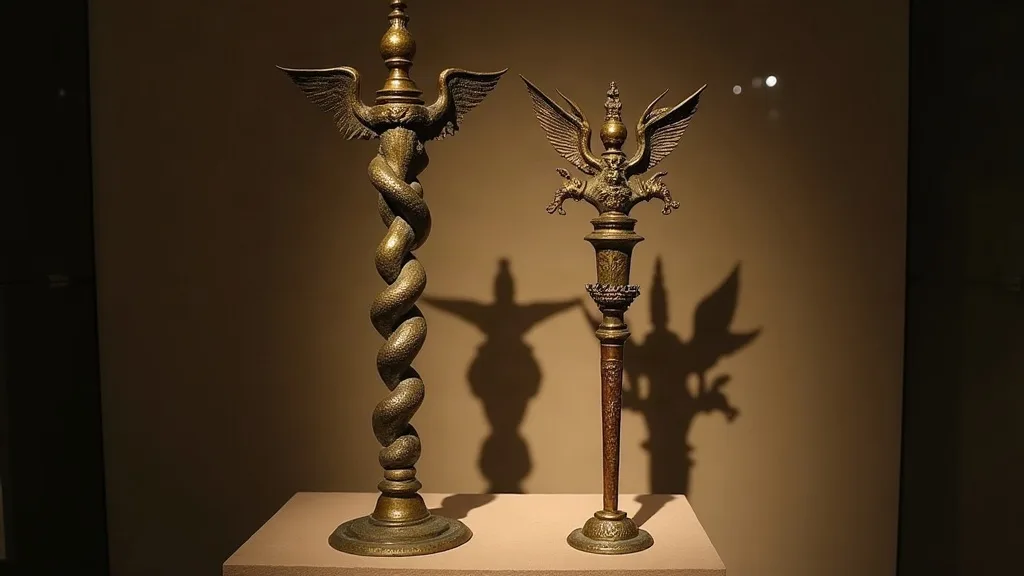
The rod Asclepius carries in myth is called the asklepieion, or more commonly, the rod of Asclepius. It is simple: a single wooden staff, roughly human-height, with a single serpent coiled around it. No wings. No elaborate ornament. Just the staff and the snake.

The serpent is the core meaning here. In ancient Greece, the snake was an ambiguous creature. It was dangerous, cold-blooded, associated with death and venom. But it was also regenerative. A snake sheds its skin and emerges new, whole, unmarked. Asclepius did not carry the serpent as a threat. He carried it as a healer's tool. The venom that could kill could also cure; the creature that symbolized danger embodied restoration.
The story goes that Asclepius learned the secret of raising the dead by watching a serpent revive another serpent killed in combat. Some versions say Athena gave him the venom of the Gorgon Medusa, that blood capable of healing or destroying depending on intent. What matters is this: the rod of Asclepius is a symbol of the physician's authority over sickness, death, and renewal. It represents restoration without negotiation, authority without diplomacy.
Asclepius became so skilled that he could raise mortals from the dead. Zeus, king of the gods, saw this as hubris, an overstepping of divine law. The boundary between life and death was not meant to be crossed by human hands, no matter how skilled. Zeus struck Asclepius down with a thunderbolt. But even in death, Asclepius did not fade. He was placed among the stars as a constellation, Ophiuchus, the serpent bearer, immortalized in the heavens. His rod became medicine's emblem across the Mediterranean and beyond.
The rod of Asclepius appears on coins, in temple inscriptions, and on the seals of physicians throughout the Greek and Roman world. It is democratic in a way: any healer, any physician who learned Asclepius's craft could invoke it. It is also singular and focused. It says one thing, clearly: healing.
The Caduceus: Hermes' Staff of Commerce and Boundaries
Hermes, in contrast, was born a god. He was the messenger of the Olympian gods, the god of commerce, thieves, travelers, and eloquence. His role was to move between worlds, to negotiate between realms, to traverse the boundary between the living and the dead. The caduceus is his defining attribute.
The caduceus is more elaborate than the rod of Asclepius. It consists of a staff or wand, usually with wings sprouting from the top, and two serpents intertwined around the shaft, often mirror-images of each other, writhing in opposite directions. Some versions show the serpents' heads meeting at the tip.

The two serpents on the caduceus are not regenerative symbols in the same way. They represent something else: balance, opposition held in tension, the meeting of opposites. The caduceus is about negotiation. The two snakes mirror each other; they coil around a central axis without resolving. The wings at the top of the staff suggest speed, travel, the ability to move quickly between spaces. This is Hermes' primary function: to carry messages, to move goods across borders, to mediate disputes.
In myth, the caduceus was a gift from Apollo to Hermes when the two gods were young. Hermes had stolen Apollo's cattle on the very day of his birth; Apollo was furious. To make peace, Hermes traded a magical lyre for forgiveness, and Apollo gave Hermes the caduceus as a symbol of his office as herald. With the caduceus in hand, Hermes could move safely between the gods and mortals, between the living and the dead. It granted him safe passage and neutrality. When he led the souls of the dead to the underworld, the caduceus was his passport.
The caduceus appears on merchants' guild seals, on coins of commerce, and on the insignia of heralds and diplomats. It is versatile. It is about connection, flow, and crossing barriers. It is not about authority over a single domain; it is about freedom of movement across domains. Where the rod of Asclepius says "I heal," the caduceus says "I go between."
Why They Got Confused
The confusion between the caduceus and the rod of Asclepius did not begin in ancient times. The Greeks and Romans knew the difference perfectly well. They are distinct symbols serving distinct gods with distinct purposes. The confusion is largely a modern phenomenon, and it has roots in several overlapping causes.
First, both symbols involve a staff and a serpent. To the casual observer in the Renaissance or Victorian era, both look vaguely similar. When engravers and artists reproduced these symbols without deep classical training, details blurred. A single serpent becomes two, or wings get added where they don't belong.
Second, heraldic and medical traditions began to mix. By the Middle Ages and Renaissance, the caduceus had become a general symbol of authority and power, used not just by heralds but by all kinds of officeholders. Medicine, being a skilled profession worthy of prestige, adopted symbols of authority. The more elaborate caduceus seemed more impressive, more official, than a simple rod with a single snake.
Third, there was a deliberate rebranding in the 19th century. The U.S. Army Medical Corps, founded in 1818, was looking for a symbol. Someone suggested the caduceus, possibly because Hermes was also a god of boundaries and crossings, and the medical corps moved between health and sickness, life and death. The U.S. Public Health Service adopted it in the 20th century. Once American medical institutions used it, the symbol spread globally. Where America went, the world followed. Today, the caduceus is ubiquitous in hospitals, on doctors' websites, in medical insignia. It feels right because it is everywhere.
The Serpent Across Cultures
Both symbols use the serpent, but the serpent's meaning is not universal, even within the Greek world. In Mesopotamia, the serpent is regeneration and wisdom, the creature that guards the secret of immortality in the Epic of Gilgamesh. In Egypt, the cobra (the uraeus) is the sacred protector, the instrument of royal power and divine will. In India, the serpent is Kundalini, the cosmic energy coiled at the base of the spine, waiting to be awakened through spiritual practice.
The Greek serpent is more ambivalent. It is Medusa's blood, Typhon's serpentine body, the Python that Apollo slew at Delphi. It is both poison and cure. The fact that both the caduceus and the rod of Asclepius use the serpent reflects this duality. But in Asclepius's rod, the serpent's regenerative power is emphasized. In Hermes' caduceus, the serpent is one half of a balanced pair, emphasizing communication and coexistence rather than renewal.
Hermes, as the god of boundaries, appears in many traditions as a figure who moves between worlds. The Hindu Brahmin is similarly a boundary-crosser between the mortal and divine realms. The Trickster figure in Native American traditions moves between chaos and order. All of these roles share something with Hermes: they thrive in the space between clearly defined categories. The caduceus, then, is not just a medical symbol; it is a symbol of threshold-crossing itself.
Medical Authority in Ancient Greece
The confusion of the caduceus with medicine may seem accidental, but it speaks to something deeper about how the ancients thought about healing. In ancient Greece, medicine was not a unified profession. Healers ranged from the formally trained surgeon-physician to the folk healer, the midwife, the herbalist. Asclepius himself was not strictly one or the other; he was a mythological ideal that represented all forms of healing knowledge.
Temples dedicated to Asclepius, called Asclepieia, were centers of healing. Patients would come, undergo rituals of purification, sleep in the temple, and await healing dreams in which Asclepius would appear and cure them. This was part medicine, part religion, part psychology. The physician's rod, Asclepius's rod, was a symbol of this holistic approach to wellness.
Hermes, by contrast, was not a healer in the strict sense. But he was a god of transitions and crossings. As medicine involves crossing from sickness to health, it is easy to see how Hermes could have come to be associated with medicine indirectly. But this association was never primary in ancient sources. It is a later invention, a convenience born of visual similarity and professional desire for prestige.
The Rod of Asclepius in Modern Tattoos and Symbolism
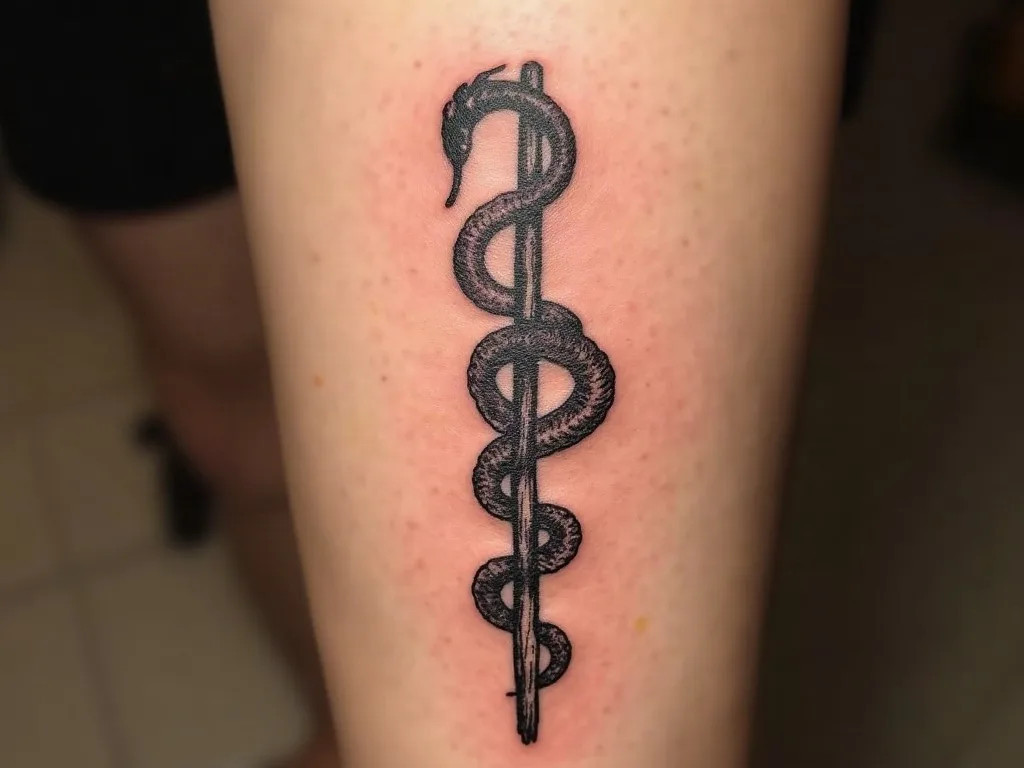
Today, if you see a tattoo of a staff with a single serpent, it is usually meant to honor medicine, healing, or medical tradition. These tattoos often appear on healthcare workers, physicians, nurses, and those with a personal history of overcoming illness. The rod of Asclepius, in this context, is a personal emblem of recovery and respect for the healing arts.
The symbolism is well-chosen, even if many wearers don't know the full history. The rod of Asclepius does represent medicine. It says clearly: "I am committed to healing, to the restoration of health and wholeness." For someone who has survived illness or dedicated their life to medicine, that meaning resonates. It is honest and direct.
There is also a quieter aesthetic at play. The rod of Asclepius is simpler, more elegant, than the caduceus with its wings and double snakes. As a tattoo, it is cleaner, easier to render, more striking in silhouette.
The Caduceus in Tattoos and Corporate Symbolism
The caduceus, meanwhile, has become a symbol of professional authority and prestige. It appears on the logos of hospitals, medical schools, pharmaceutical companies, and health insurance organizations. As a tattoo, it is rarer, but it does appear, often worn by those in positions of authority within healthcare systems, by paramedics, or by those fascinated by classical symbolism.
The irony is delicious: the symbol of Hermes, the god of thieves and tricksters, has become the symbol of institutional medical authority. Hermes was not a law-giver; he was a boundary-crosser, a dealer in exchanges, the patron of merchants and those who moved goods illicitly. Yet his staff has become the emblem of the most regulated, professionalized, and institutional of all professions.
This tells us something about symbolism itself. Symbols drift. They are reinterpreted, forgotten, reinvented. The caduceus did not become a medical symbol through some inevitable process of cultural logic. It became one through a chain of choices, accidents, and institutional adoption. Once the choice was made, it stuck. Thousands of medical facilities now use it daily. It has become the visual language of modern medicine, even if it is technically the wrong symbol.
Why Does This Confusion Matter?
The difference between the caduceus and the rod of Asclepius is not merely pedantic. It reflects two different models of how medicine works, how authority operates, and how we think about healing.
The rod of Asclepius embodies a model of healing based on singular expertise and renewal. It suggests that the physician has authority over sickness and death, that medicine is about transformation and restoration. It is individualistic; Asclepius is one god, one healer, with one rod and one serpent. His authority is personal, earned through skill and knowledge.
The caduceus embodies a model based on negotiation, exchange, and boundary-crossing. Hermes does not impose; he facilitates. He negotiates between parties. The two serpents suggest balance, an ongoing adjustment rather than a final resolution. The wings suggest speed and movement, the ability to adapt and flow.
If modern medicine had adopted the rod of Asclepius as its true symbol, the message would be clear: physicians are healers with singular expertise over disease. Cure is the goal. Death is the enemy to be overcome.
If modern medicine had adopted the caduceus more deliberately and knowingly, the message would be different: medicine is about communication, the exchange of information, the negotiation between body and treatment, illness and health. Healing is a process of balance and adaptation, not singular triumph.
What actually happened is a third thing: medicine took the caduceus, the wrong symbol, almost by accident. This has not destroyed modern medicine. But it has meant that the visual language of healing does not quite match the reality. The rod of Asclepius would have been more honest.
Cross-Cultural Echoes of the Healing Staff
The staff or rod as a symbol of healing and divine power appears across cultures and epochs. In Hinduism, the serpent goddess Manasa is often depicted with serpents, representing healing and protection. In Egyptian mythology, the was scepter, topped with an animal head, represents divine power and control. The serpent of Asclepius is not unique; it is part of a wider human vocabulary of using staffs and snakes to represent authority over life, death, and transformation.
In Christian tradition, Moses carries a staff that becomes a serpent, miracles spring from it, and it is used to strike water and bring forth plagues. The staff is a tool of divine communication and authority. When Jesus tells his disciples to "be wise as serpents," he is invoking an ancient symbolic language that pre-dates Christianity by centuries. The serpent in these traditions is never purely evil; it is wisdom, regeneration, and hidden knowledge.
The Modern Medical Symbol: A Symbol in Motion
The fact that the caduceus dominates modern medicine tells us that symbols are not fixed or final. They are tools of communication that evolve as institutions, cultures, and practices change. The caduceus was not "wrong" to be adopted by medicine; it became right through use and repetition.
But the confusion also matters because it obscures history. When a healthcare worker wears a symbol without knowing its origin, they are participating in a chain of meaning without fully understanding the chain. This is not a moral failing. It is simply how symbols work in everyday life. Most people do not know the etymology of the words they speak or the deep history of the icons they wear.
Yet there is something to be gained by learning where symbols come from. When you know that the caduceus is Hermes' staff, the god of thieves and tricksters, you see modern medicine in a slightly different light. You see it not as a fixed truth handed down from the ancients, but as an institution that has borrowed and reinterpreted symbols to suit its own needs. This knowledge does not diminish medicine; it humanizes it. It shows that even our most authoritative institutions are, in some sense, engaged in creative play with meaning.
The rod of Asclepius, meanwhile, waits in the background, the truer symbol, rarely adopted but never entirely forgotten. It appears on the insignia of some medical organizations that pride themselves on historical accuracy or classical learning. It appears in tattoos chosen by those who do their research. It is the symbol for those who want to invoke the specific history of Greek medicine and the specific god who presides over healing.
Frequently asked questions about the caduceus and the rod of Asclepius
Frequently asked questions
Why do hospitals use the caduceus instead of the rod of Asclepius if they're not the same thing?
The U.S. Army Medical Corps adopted the caduceus in the 1800s, possibly because Hermes' role as a boundary-crosser seemed to fit medicine's work between health and sickness. Once American institutions used it, the symbol spread globally. It became the medical symbol through institutional adoption, not through historical accuracy. Many medical organizations today use it without knowing the distinction.
What is the main visual difference between the two symbols?
The rod of Asclepius has a single serpent coiled around a plain wooden staff with no wings. The caduceus has two serpents intertwined around the shaft, often with wings sprouting from the top. This one visual detail carries the entire history of their confusion.
Are the serpents on both symbols meant to represent the same thing?
No. On the rod of Asclepius, the single serpent represents regeneration and renewal through healing; snakes shed their skin and emerge whole. On the caduceus, the two serpents represent balance, negotiation, and the coexistence of opposites. The two serpents don't resolve into one; they remain in tension, symbolizing Hermes' role as a mediator between competing forces.
Did the ancient Greeks confuse these two symbols?
No. Ancient Greeks knew the difference perfectly well. Asclepius was a god of healing; Hermes was a messenger and god of commerce. Their symbols were distinct and served distinct purposes. The confusion is largely a modern phenomenon born of visual similarity and the institutional choices of 19th and 20th century medicine.
If I get a tattoo of a staff with a serpent, which symbol should I choose?
If you want to honor medicine and healing specifically, the rod of Asclepius (single serpent, no wings) is more historically accurate. If you want to invoke the idea of communication, negotiation, or boundary-crossing, the caduceus (two serpents, often with wings) is the choice. Both are legitimate; the choice depends on what meaning you want to carry.
What was Asclepius' fate in mythology?
Asclepius became so skilled at medicine that he began to raise the dead, overstepping the boundary between mortal and immortal that Zeus had set. Zeus struck him down with a thunderbolt. But Asclepius was honored even in death; he was placed in the sky as the constellation Ophiuchus, the serpent-bearer, immortalizing both his skill and his transgression.
The Symbol That Almost Was
The story of the caduceus vs the rod of Asclepius is ultimately about how cultures remember, forget, and reinterpret the symbols they inherit. The rod of Asclepius was the original emblem of medicine in the Greek world. It carried the full weight of Asclepius's story: the physician who learned the secrets of renewal, who crossed the boundary between life and death, and who was punished for it. It is a profound symbol, one that acknowledges both the power of medicine and its limits.
The caduceus, by contrast, is Hermes' staff, the tool of a trickster god who moves between worlds, negotiates between parties, and operates in the spaces where fixed categories break down. It is no less powerful a symbol, but it is different. It speaks to negotiation, flow, and adaptation rather than singular expertise and restoration.
That modern medicine adopted the caduceus almost by accident tells us something about how institutions work. We do not always choose our symbols deliberately. Sometimes we inherit them, adapt them, and gradually, through repetition and institutional authority, they become naturalized. The wrong symbol becomes the right one simply because everyone uses it. This is not a failure of reason; it is simply how culture works.
Yet there remains value in knowing the difference, in recovering the original meanings, in understanding why each symbol matters. When you see the caduceus on a hospital's logo and remember that it is actually Hermes' staff, you gain a double knowledge: you see the symbol as it is, and you see it as it was meant to be. You see medicine not as a fixed truth handed down from antiquity, but as a living practice that has borrowed and reinterpreted the symbolic resources available to it. And you see the rod of Asclepius waiting in the background, the truer emblem, the symbol that still speaks the original language of Greek healing.
Free 25-page sample
Want the whole story?
Take the first 25 pages free. If it pulls you in, the full edition is yours as an instant PDF download, with a paperback on Amazon for selected titles.

Mythology
The World Mythology Book: The Gods, Heroes and Myths of Every Culture
The Gods, Heroes and Myths of Every Culture, in One Volume
The whole of world mythology in a single volume: Greek, Norse, Egyptian, Japanese, Hindu, Celtic, Slavic, Mesoamerican and African myths gathered side by side, each drawn from the primary sources.