

Celtic Knots: Meanings, Origins, and Sacred Geometry Across Cultures
Celtic knots weave ancient spiritual meaning into geometric design: symbols of eternity, protection, and interconnection from the Iron Age to modern practice. Discover what each pattern represents and why they still captivate today.
Contents
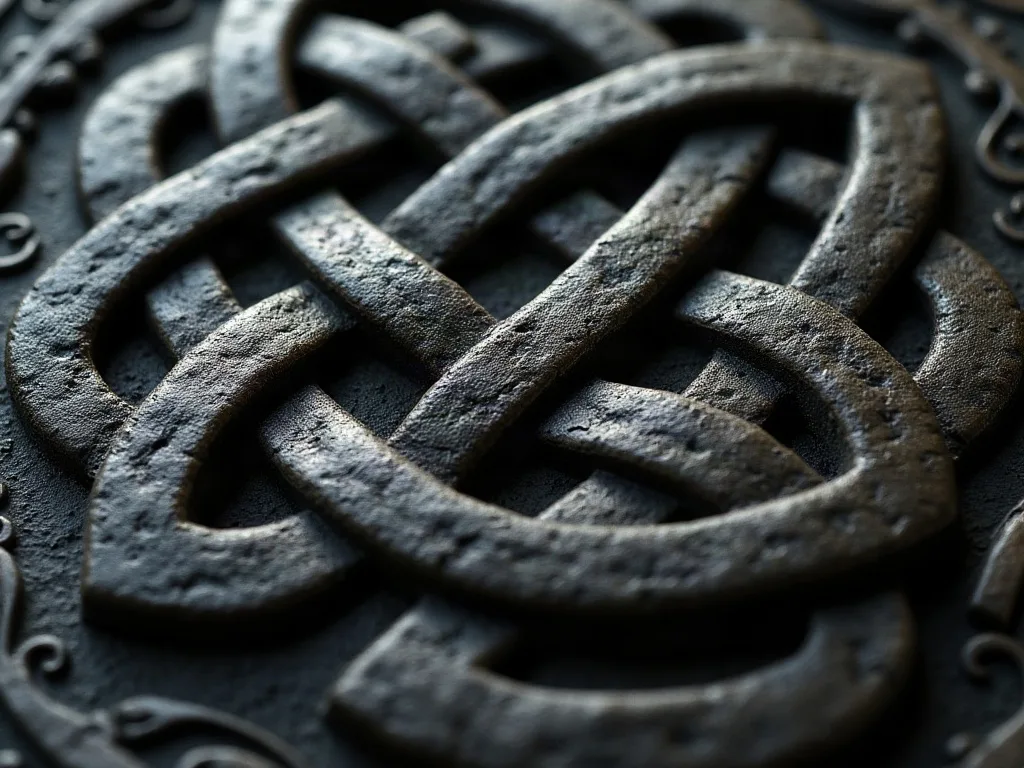
A single unbroken line curves over and under itself, looping endlessly. No beginning, no end. A Celtic knot sits in stone, on vellum, etched into a warrior's arm. For over two thousand years, these patterns have carried weight beyond decoration. They speak to something the Celts understood about existence itself: that all things connect, that nothing truly dies, that meaning flows in cycles.
The appeal of Celtic knots is deceptively simple. A person sees one, feels drawn to it, and wants to know what it means. The answer is never straightforward. The knots predate the written records of Celtic people by centuries. They survived invasion, Christianization, and the near-extinction of Celtic languages. Today they appear on everything from tattoos to wedding rings to home décor. But their actual meanings, their origins, their purpose: these remain layered, contested, and deeply human.
Origins in Iron Age Craft and Mystery
The Celts did not invent geometric patterns. The Mediterranean civilizations, Mesopotamia, Egypt: all worked with repeating lines and interlocking shapes. But the Celts took something different from geometry. They made it restless.
Around the 5th century BCE, Celtic artisans across what is now Ireland, Scotland, Wales, and mainland Europe began experimenting with intricate linear designs. Archaeology shows these patterns first on metalwork: bronze brooches, sword hilts, cauldrons. The technique was laborious. Each line required precision. A mistake could not be erased. This was meditation made visible.
But the knots we recognize today emerged much later. The majority of Celtic knots as we know them come from the period after Christianity arrived in Ireland, roughly 500-800 CE. The monks and artists who illuminated manuscripts like the Book of Kells (created around 800 CE) and the Lindisfarne Gospels (created around 700 CE in Northumbria) used interlocking patterns as decoration and spiritual practice. They filled pages with knots, spirals, and beast designs. Each pattern required the hand to move with intention, the eye to follow one line's journey.

This timing is crucial. The knots we treasure today are not purely pre-Christian relics. They are a hybrid: Celtic geometric tradition filtered through Christian monastic discipline and illumination practice. The monks preserved and refined what pagan artisans had begun.
The question of whether the knots had conscious symbolic meaning in the Iron Age remains open. We have no written accounts from the Celts themselves explaining the designs. The Celts left few written records before Roman conquest and Christian conversion. What we know comes from outsiders: Roman historians like Caesar and Tacitus, later Irish monks who recorded older oral traditions, and archaeological context.
The Unbroken Line: Symbol of Eternity
Every Celtic knot shares one physical property: the line never breaks. The design is continuous. This fact alone generates meaning.
In Celtic spirituality, continuity matters profoundly. Life flows into death flows into rebirth. Seasons turn. The wheel turns. Nothing is truly lost because nothing truly ends. An unbroken line becomes a visual prayer for this truth. The eye follows the knot's path, travels the entire design without lifting, and returns to where it began. The journey confirms the principle: everything connects.
This interpretation gains weight from Celtic cosmology. The Celts believed in an Otherworld (sometimes called the Sidhe, pronounced "shee"), a realm that exists alongside the material world but operates by different rules. The boundaries between this world and the Otherworld are permeable. The dead do not depart; they transform. Time moves differently there. A person might spend what feels like a day in the Otherworld and return to find years have passed.
The unbroken knot mirrors this belief. It suggests that divisions are illusions. The line passes under and over itself, suggesting that apparent separations are navigable, that surfaces and depths are part of one whole.
Common Knot Patterns and Their Meanings
Over centuries, certain knot patterns became recognizable and were given names. Each carries associations, though these meanings are more contemporary interpretation than historical certainty.
The Trinity Knot (Triquetra)
The Trinity Knot appears on the pages of the Book of Kells and on standing crosses throughout Ireland. Three interlocking loops form a shape with threefold symmetry. Each loop connects to the other two; remove one and all three collapse.
The number three held sacred significance for the Celts. The triple goddess appears in Irish mythology: Brigid as maiden, mother, and crone; the Morrigan and her sisters. Three was the number of completeness, of power. After Christianization, the Trinity Knot was reinterpreted as a symbol of Christian Trinity (Father, Son, Holy Spirit), which allowed the ancient pattern to persist and flourish in a new religious context.
Modern usage associates the Trinity Knot with family bonds, spiritual unity, and protection. It appears frequently on engagement rings and in tattoos meant to signify unbreakable family ties.
The Spiral
The spiral is older than the knot itself. It appears on Neolithic passage tombs in Ireland, like Newgrange (built around 3200 BCE), where spirals are carved into the stone at the entrance. Newgrange predates the Celts by over two thousand years, yet the spiral persisted in Celtic art and carried forward into manuscript illumination.
The spiral suggests growth, expansion, and the cycles of the sun and moon. A spiral that contracts toward a center suggests the inward journey, meditation, descent into the underworld. A spiral that expands outward suggests emergence, enlightenment, ascent. Many scholars interpret the spiral as a representation of spiritual evolution: the journey inward to find truth, then outward to share it.
The Quatrefoil and Four-Fold Knot
A knot with four equal sections or lobes connects to Celtic reverence for the number four: four seasons, four directions, four elements (earth, water, fire, air, though Celtic tradition varies). The four-fold knot appears on stone crosses and manuscripts as a symbol of balance, wholeness, and cosmic harmony.
In later tradition, the four-fold design is associated with grounding, stability, and the balance of physical and spiritual life. It speaks to the Celtic understanding that the sacred and the material are not opposed but woven together.
The Labyrinth
Some Celtic knot designs contain labyrinthine passages that lead deeper into themselves without obvious exit. These patterns carry associations with journey, mystery, and the need for guidance through spiritual confusion. Walking a labyrinth (or tracing it with the finger) becomes a meditative practice that quiets the analytical mind and opens perception to intuition.
The labyrinth appears not only in Celtic art but across many traditions: Greek myth contains the Labyrinth of Daedalus that housed the Minotaur, medieval Christian cathedrals incorporated labyrinths in their floors as pilgrimage paths, and Hindu and Buddhist mandalas often include labyrinthine elements. The Celtic version tends toward aesthetic intricacy, rewarding close attention and patience.

From Manuscript to Modern Tattoo: The Knots in Diaspora
The Celtic knots existed in obscurity for centuries after the medieval period. Then, in the 18th and 19th centuries, as Romanticism swept Europe and people began to celebrate indigenous and folk traditions, Celtic art experienced revival.
Scholars and antiquarians published books on Celtic design. Artists studying the illuminated manuscripts discovered the Book of Kells and other treasures. The Arts and Crafts movement of the late 1800s, led by figures like William Morris, looked back to pre-industrial artisanal traditions and found in Celtic knots a model of meaningful, handmade beauty that industrialization seemed to have erased.
This revival accelerated in the 20th century. Irish independence movements, Welsh cultural renaissance, Scottish clan identity: all found in Celtic symbols a visual language of heritage and continuity. A person could wear a knot and signal belonging to a cultural lineage. The knots became nationalist, romantic, and commercial all at once.
Today, the Celtic knot is one of the most tattooed designs in the world. A person chooses a Celtic knot tattoo for many reasons: ancestry, spiritual belief, aesthetic preference, or simply because the pattern appeals. The tattoo artist, often working from modern design books rather than primary manuscript sources, renders the knot in ink. The placement matters. A Celtic knot on the ankle or wrist or over the heart carries different symbolic weight.
The meanings assigned to modern Celtic knot tattoos often reflect contemporary spirituality rather than historical practice. A knot is interpreted as protection, as love eternal, as connection to the earth, as defiance of fate. Each reading is valid within the person's own context. The knot has become a canvas onto which the wearer projects meaning.
The Knots in Christian Conversion
The story of Celtic knots is inseparable from the story of Christian conversion in Ireland and Britain. When missionaries arrived in the 5th and 6th centuries, they faced a choice: suppress local culture or absorb it.
The strategy that emerged was synthesis. Christian iconography merged with Celtic artistic traditions. The High Cross became the dominant monument in Irish Christianity: a cross (Christian symbol) placed atop a circle (pre-Christian solar symbol), decorated with Celtic knot patterns. The result is neither purely Christian nor purely Celtic, but a living statement that the old and new could coexist.
The monks who illuminated the great manuscripts like the Book of Kells and the Book of Durrow (created around 680 CE) were trained in Celtic artistic tradition but working within a Christian framework. They illustrated the Gospel with knots, spirals, and abstract patterns that might seem secular to modern eyes but carried deep spiritual purpose. Each knot was prayer made visible. The labor of creating them was monastic devotion.
This synthesis allowed Celtic spiritual concepts to survive. The idea of the Otherworld, the threefold goddess, the sacred geometry of circles and spirals: these pre-Christian elements persisted because they found space within Christian art. The knots were the vehicle.
Celtic Knots Across Cultures: A Comparative View
The appeal of Celtic knots crosses cultural boundaries. Modern practitioners in Germany, Australia, Japan, and the United States engage with these patterns despite having no ancestral connection to Celtic peoples. What accounts for this universality?
One factor is pure aesthetics. The knots are visually complex, mathematically elegant, and endlessly reproducible. A pattern that works in stone works equally in ink, fabric, metalwork, or digital design. The mathematical properties of interlocking lines fascinate people regardless of cultural context.
But there is something deeper. Many cultures independently developed similar patterns. Islamic geometric design shares the interlocking principle with Celtic knots, though the mathematical base differs. Norse interlace patterns, visible on Viking age artifacts and preserved in the Jörmungandr (the World Serpent who bites its own tail), express a similar vision of endless cycles. Hindu mandalas and Native American geometric designs also emphasize the interconnection of all elements through abstract pattern.
The Celtic knot resonates because it taps into something universal: the human need to find pattern and meaning in existence, to believe that nothing is wasted or lost, that all things circle back and connect. Different cultures discover these truths independently and express them through design.
The Scholar's Hesitation: What We Really Know
It is important to pause here and acknowledge uncertainty. Much of what is claimed about Celtic knot meanings comes from modern interpretation, not historical documentation.
The Celts did not leave written explanations of their designs. The monks who preserved and developed the knots left few theological statements about them. Modern scholars like Peter Harbison (who studies Irish High Crosses), Susanne Ebbinghaus (who researches manuscript illumination), and others work with what artifacts remain: the stones, the manuscripts, the patterns themselves. They make educated interpretations based on comparative religion, archaeology, and surviving oral traditions recorded centuries after the pagan period.
This does not make the meanings false. It makes them collaborative. Modern readers bring interpretation to ancient patterns. The original Celtic artisans brought their own meanings, now lost to time. The medieval monks reinterpreted them through Christian theology. Each era adds layers.
A person who chooses a Celtic knot today is participating in this tradition of interpretation. The knot is a Rorschach test: it shows back what the viewer brings. The unbroken line reflects the viewer's own need to believe in continuity. The interlocking loops mirror the viewer's sense of connection. The pattern persists because it remains open to meaning.
Knots in the Wider Celtic Sacred Landscape
Celtic art was not exclusively geometric. Beside the knots sat spirals, animal designs, and abstract patterns that resist easy categorization. The Lindisfarne Gospels, for instance, contains a full-page design of interlocking snakes and birds that rivals any knot in complexity. The Durham Gospels features similar beast designs.
These other patterns carried meanings too, though equally obscured by time. The spiral might represent the sun; it might represent spiritual growth; it might simply represent the artist's meditative journey through creation. The animal designs (birds with interlocked necks, serpents forming knots) draw on Celtic totemism, the belief that certain animals embodied spiritual powers. A warrior might seek the qualities of the raven, the strength of the boar, the wisdom of the salmon.
The knots were part of a larger visual language. To understand a knot fully, one must understand the entire tradition in which it sits. And that tradition is ultimately alien to modern consciousness. The Celts did not think as we think. They perceived time, divinity, and the natural world through frameworks we can study but never fully inhabit.
This should humble any confident interpretation of Celtic meaning. But it should not silence curiosity. The knots endure because they merit attention. They are beautiful, yes, but also because they carry weight even in their obscurity. A pattern that survived invasions, language death, and cultural erasure must mean something. The challenge is to honor both the historical unknowing and the contemporary hunger for meaning.
Frequently asked questions about Celtic knots meanings and origins?
Frequently asked questions
Are Celtic knots actually ancient, or did monks invent them?
Both. The Celts used interlocking geometric patterns on metalwork as early as 500 BCE, but the complex knots we recognize today were refined by Christian monks in manuscript illumination around 500-800 CE. The knots are a continuation of Celtic tradition, not an invention, but their most recognizable forms come from the medieval period.
What is the most historically authentic Celtic knot meaning?
The unbroken line is the most consistent meaning across sources. The continuous pattern without beginning or end reflects Celtic beliefs in cyclical time and the permeability of boundaries between life and death. Beyond this, specific meanings for individual patterns (like the Trinity Knot = family) are more modern interpretation than historical certainty.
Why do Celtic knots appear so often in Christian manuscripts if they are pagan?
Christian missionaries and monks in Ireland and Britain chose synthesis over suppression. They incorporated Celtic artistic traditions into Christian practice, allowing ancient symbols to persist within new religious contexts. This strategy helped Christianity take root while preserving cultural continuity. The knots became bridges between old and new belief systems.
Do Celtic knot tattoos have specific spiritual properties, or are they just decoration?
Historically, tattoos were not the primary vehicle for Celtic knot meaning; stone carvings and manuscript illumination were. Modern Celtic knot tattoos carry meaning the wearer assigns them: protection, belonging, spiritual continuity, ancestral connection. The significance is real and personal to the individual, though not derived from ancient Celtic practice.
Are there Celtic knots specific to Scotland, Ireland, Wales, and other regions?
Regional variations exist. Irish High Crosses feature certain patterns; Scottish and Pictish stones show distinct interlace styles. The Lindisfarne Gospels (Northumbrian) has designs that differ from the Book of Kells (Irish). However, these are variations within a shared aesthetic language rather than entirely separate systems. All emphasize the unbroken line and interlocking geometry.
How do Celtic knots relate to other cultural geometric patterns like Islamic tiles or Norse interlace?
Many cultures independently developed interlocking patterns as a way to express ideas of interconnection, eternity, and cosmic order. Islamic geometric design, Norse interlace, Hindu mandalas, and Celtic knots all tap into universal human needs to find pattern and meaning. The specific mathematical bases differ, but the underlying philosophy is similar across cultures.
The Knot's Persistence in a Changing World
The Celtic knot has outlasted the Celtic languages, the Celtic political systems, and most of the original Celtic religions. This is remarkable. Most symbols die when their cultural context does. They become fossils, referenced in museums, forgotten by daily life.
The Celtic knot did not die. Instead, it transformed. It became democratic. A person with no Celtic heritage can wear a Celtic knot. A Catholic priest can bless a couple exchanging Celtic knot rings. A tattoo artist in Tokyo can render a Trinity Knot with the same precision as a medieval monk.
This democratization troubles some cultural gatekeepers. They argue that Celtic knots belong to Celtic peoples, that appropriating them erases the actual history and ongoing struggles of Celtic communities. This concern has merit. But the knots themselves seem to have chosen a different path. They have become, in a sense, everybody's.
Perhaps this is fitting. The knot's core meaning is about connection, about the idea that all things are woven together. When a person of any background engages with a Celtic knot, they participate in that truth. They acknowledge that nothing is isolated, that patterns matter, that careful attention to what we inherit and how we carry it forward is a form of spiritual practice.
The knot continues to spiral outward, finding new hands, new skin, new interpretations. The line remains unbroken.
Free 25-page sample
Want the whole story?
Take the first 25 pages free. If it pulls you in, the full edition is yours as an instant PDF download, with a paperback on Amazon for selected titles.

Mythology
The World Mythology Book: The Gods, Heroes and Myths of Every Culture
The Gods, Heroes and Myths of Every Culture, in One Volume
The whole of world mythology in a single volume: Greek, Norse, Egyptian, Japanese, Hindu, Celtic, Slavic, Mesoamerican and African myths gathered side by side, each drawn from the primary sources.