
The Creation of the World in Greek Mythology: Chaos, Titans, and the Birth of the Cosmos
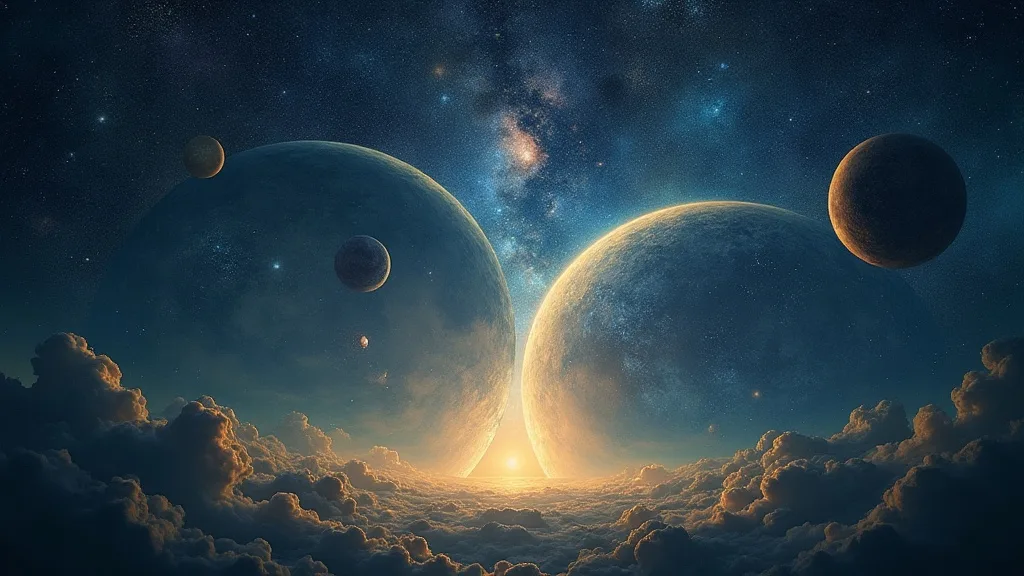
Before Zeus, before the Olympians, before even the sky had a name, there was Chaos. The Greek creation story moves from void to cosmos in a sequence of births, wars, and cosmic ordering that shaped Western imagination for three thousand years.
Contents
The darkness before time had no shape. No ground to stand on. No sky to look up at. Greek poets called it Chaos, a word that did not mean disorder but rather a raw, yawning gap, an open mouth swallowing nothing. From inside that void, the first beings willed themselves into existence without parents, without cause, without explanation. That moment, arguably the most consequential rupture in all of ancient literature, set in motion a chain of births and wars that would not settle until the creation of the world in Greek mythology reached its familiar form: a layered cosmos ruled by twelve Olympians, with mortals clinging to the middle ground between sky and underworld.
Hesiod, a Greek poet writing sometime around 700 BC, gave the Western world its fullest account of this cosmic origin. His poem the Theogony, whose title means literally "the birth of the gods," stitches together hundreds of years of older oral tradition into a single grand sequence. It is not a tidy story. It is recursive, violent, and breathtaking: gods eating their children, children dismembering their fathers, the sea hardening into islands. Reading it feels less like theology and more like watching a geological event in slow motion.
The Theogony was not alone. Hesiod's other major poem, Works and Days, adds the human dimension, explaining how people arrived in the cosmos and what their relationship to the gods was supposed to be. Later, Ovid's Metamorphoses, written in Latin around 8 AD, reframed the Greek creation story for Roman readers, opening with its own majestic account of formless matter shaped by an unnamed divine force. Together, these texts form the literary bedrock beneath the Greek creation myth, and every detail that follows draws from one or more of them.
What Came Before Everything: The First Beings Out of Chaos
Chaos did not create the first gods. It simply existed, and they emerged from it, the way a sound emerges from silence. Hesiod names four primordial beings who appeared at or near the very beginning.
Gaia (Earth) came first after Chaos itself, solid and wide, the foundation on which everything else would stand. Then Tartarus appeared, the deep abyss that sits far beneath the roots of the earth, darker than anywhere above it. Then Eros, the force of attraction and desire, arrived, not yet a cute winged child but something older, the compulsion that makes separate things want to join. Without Eros, Hesiod implies, nothing else would ever combine. Nothing would reproduce. The cosmos would stay a collection of isolated presences.
From Chaos came two more: Erebus (the darkness underneath the earth) and Nyx (Night). These two coupled together, and from them came Aether (the bright upper air, the sky gods breathe) and Hemera (Day). Light and day were born directly from darkness and night. The pattern repeats through the entire Theogony: opposites generating each other, absence calling its opposite into being.
Gaia then acted alone. Without a partner, she produced Uranus (the starry sky), who arched above her and covered her completely. She also made Ourea (the mountains) and Pontus (the sea). These were not divine personalities yet. They were the landscape itself, conscious and generative but not yet shaped into characters with wills and grudges. That would come next.

The Titans: The First Ruling Generation
Gaia and Uranus became the first great couple, and their children were the Titans, twelve in number according to Hesiod. The names matter, because each carries the seed of what comes later.
The twelve were: Oceanus, Coeus, Crius, Hyperion, Iapetus, Theia, Rhea, Themis, Mnemosyne, Phoebe, Tethys, and Cronus. Hyperion and Theia produced the luminaries: Helios (the Sun), Selene (the Moon), and Eos (the Dawn). Mnemosyne, whose name means Memory, would later give birth to the nine Muses. Oceanus, the river that ancient Greeks believed encircled the entire flat earth, partnered with Tethys to produce all the world's rivers and three thousand sea-nymphs.
But the child who broke everything was Cronus, the youngest and most ambitious of the Titans.
Uranus, the sky-father, had a problem with his children. According to Hesiod, he hated them the moment they were born, and he pushed them back inside Gaia rather than allow them into the world. The ones he feared most were not the Titans but an older group: the three Cyclopes (Brontes, Steropes, Arges, masters of thunder and lightning) and the three Hecatoncheires, the hundred-handed giants of enormous strength. Uranus stuffed them all into Gaia's body, and Gaia groaned with the weight of it.
She fashioned a sickle of grey flint and held it out to her Titan children. Only Cronus took it. He waited until Uranus came to lie over Gaia at night, reached up, and castrated his own father. The blood that fell to earth became the Erinyes (the Furies, avengers of blood crimes), the Giants, and the Meliai (ash-tree nymphs). The severed flesh fell into the sea. Around it, white foam gathered. From that foam, Aphrodite rose, already adult, already beautiful, already possessed of that power Eros had carried since the first moments of existence. She stepped ashore at Cyprus, and where her feet touched the grass, flowers grew.
Uranus, bleeding and deposed, cursed his children as he rose away. He called them Titanes, a word he turned into a taunt meaning "those who strain" or "the overreachers." He promised vengeance would come.
Cronus and the Age of the Titans
Cronus became the new ruler of the cosmos. He freed his Titan siblings from Gaia but left the Cyclopes and the Hecatoncheires locked away in Tartarus, afraid of their power. He took his sister Rhea as his consort, and together they ruled during what Hesiod called an age of gold, a time when people (in some versions of the story) lived without suffering, aging, or hard labor.
But Cronus carried his father's curse like a stone in the chest. An oracle, either from Uranus himself or from Gaia, told him that one of his own children would overthrow him exactly as he had overthrown Uranus. So he did what tyrants do when they fear the future: he swallowed his children whole. Hestia, Demeter, Hera, Hades, and Poseidon all disappeared down his throat the moment Rhea delivered them.
Rhea grieved. When the sixth child was due, she went to Crete, gave birth secretly, and wrapped a stone in swaddling clothes. She handed the stone to Cronus. He swallowed it without looking. The real child was hidden in a cave on Mount Ida, tended by the goat-nymph Amaltheia, while the Kouretes (young warrior-dancers) clashed their spears against their shields outside to drown the infant's crying.
That child was Zeus.
The Rise of Zeus and the War of the Titans
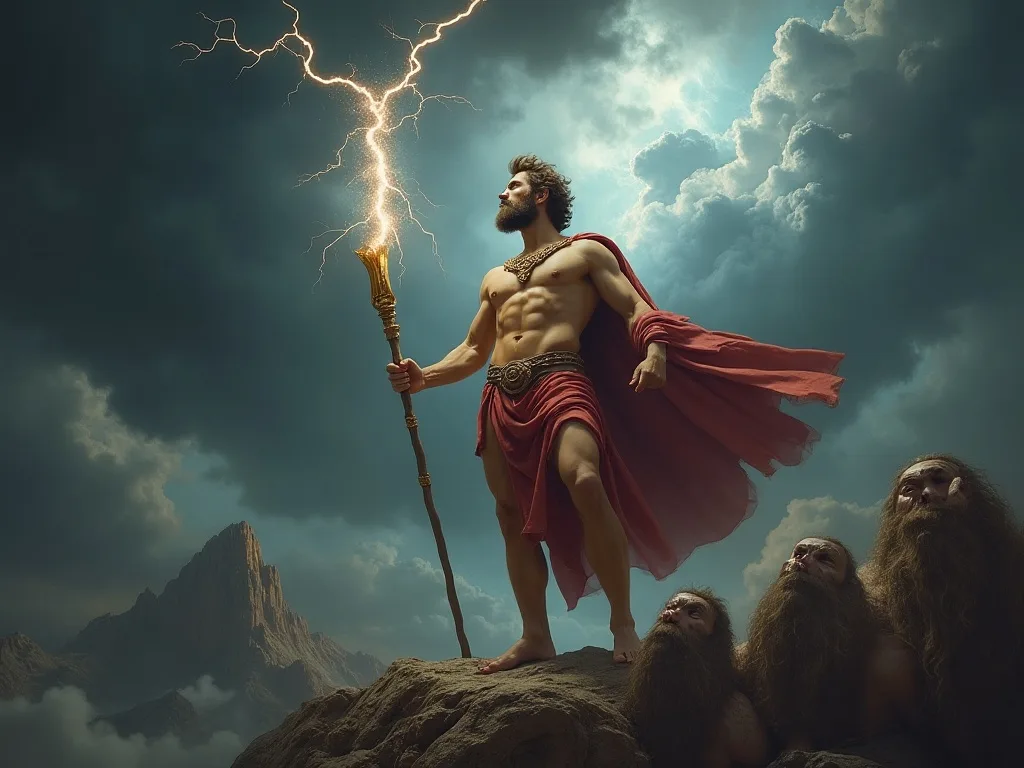
Zeus grew quickly, as gods do. When he reached maturity, the Titaness Metis (whose name means Cunning Thought) gave him an emetic potion. He brought it to Cronus disguised as a cupbearer. Cronus drank, and vomited first the stone, then the five gods he had swallowed. They came out fully grown and furious. The stone was placed at Delphi, where it remained an object of veneration for centuries.
The war that followed lasted ten years. It was the Titanomachy, the battle between the new Olympian gods and the older Titan generation. The Olympians held Olympus. The Titans held Mount Othrys. Neither side could break the other.
Zeus made the decisive move by going to Tartarus and freeing the Cyclopes and the Hecatoncheires, the very prisoners Cronus had kept locked away. The Cyclopes, grateful, gave each of the three ruling brothers a weapon. To Zeus they gave the thunderbolt. To Poseidon the trident. To Hades a helmet of invisibility. The Hecatoncheires hurled boulders by the hundred, burying the Titans under storms of rock.
The Titans broke. Cronus and most of his siblings were driven into Tartarus and sealed there behind bronze gates, with the Hecatoncheires set as guards. Atlas, who had led the Titans in battle, received a particular punishment: he was condemned to stand at the western edge of the world and hold up the sky on his shoulders forever.
Zeus took the sky. Poseidon took the sea. Hades took the underworld. The earth and Olympus remained shared territory. The new order was not born in peace. It was won in blood and fire, and the scars of it ran through everything that followed.
The myth of Prometheus stands as a direct consequence of this settlement: a Titan who sided with Zeus during the war but later defied him by giving fire to humanity, triggering another round of divine punishment that defines the Greek understanding of the human condition.
A Second War: The Giants and the Gigantomachy
The Titans were imprisoned, but the earth was not done fighting. Gaia, grieving the defeat of her Titan children, gave birth to the Giants, enormous beings who rose against the Olympians in the Gigantomachy. Ancient Greek art, particularly the magnificent Pergamon Altar frieze carved around 180 BC, shows this battle in breathtaking detail: gods and giants locked together, snakes writhing at giant feet, Athena dragging a winged giant by the hair.
The Giants could not be killed by gods alone. An oracle said a mortal hero had to deliver the final blow in each case. Zeus summoned Heracles (Hercules in Latin), his own half-mortal son, to fight alongside the Olympians. One by one the Giants fell. Gaia tried to find a herb that would make them immortal; Zeus stopped the Sun, Moon, and Dawn from rising so she could not find it in the dark, then plucked it himself before light returned.
Gaia was not finished even then. She bore one last monstrous child: Typhon, the most terrible creature the earth ever produced. Hesiod describes him as a great serpentine being with a hundred heads, each head speaking in the voice of a different animal. Even the Olympians fled. Only Zeus stood his ground, and the battle between them shook the sky and the sea. Zeus eventually pinned Typhon under the volcanic island of Sicily, and the mountain that sits there, Etna, still vents his fire.
With Typhon defeated, the cosmos settled. No more primordial rebellions. The structure of the universe was now fixed: sky above, earth in the middle, the sea around the edges, the underworld below, Olympus as the seat of power, and Tartarus as the ultimate prison at the bottom of everything.
The Creation of Human Beings
The gods were now in place, but the earth was empty of people. Greek mythology offers several competing accounts of how humans arrived, and none of them agree entirely. That tension is part of the tradition, not a flaw in it.
The oldest and strangest version appears in Hesiod's Works and Days. He describes five ages of humanity, each made from a different material and each degenerating from the one before.
The Golden Race was made during the reign of Cronus. They lived without toil, without aging, without grief. They died as if falling asleep, and after death became benevolent spirits watching over the living.
The Silver Race came next, made by the Olympians. They were childlike for a hundred years and foolish when they grew up. They refused to worship the gods. Zeus destroyed them, and they became the spirits of the underworld.
The Bronze Race was harder, violent, obsessed with war. They killed each other completely, fell into Hades nameless, and left nothing behind.
Then came the Race of Heroes, the only age that breaks the pattern of decline. These were the great men of myth: the warriors of Thebes, the heroes of the Trojan War. When they died, Zeus gave some of them eternal life on the Islands of the Blessed at the edge of the world.
Hesiod's own time was the Iron Race. Toil. Grief. Injustice. A brief window of good mixed with bad, and then the sure promise that things would get worse. Hesiod writes from inside that age, and his bitterness is real.
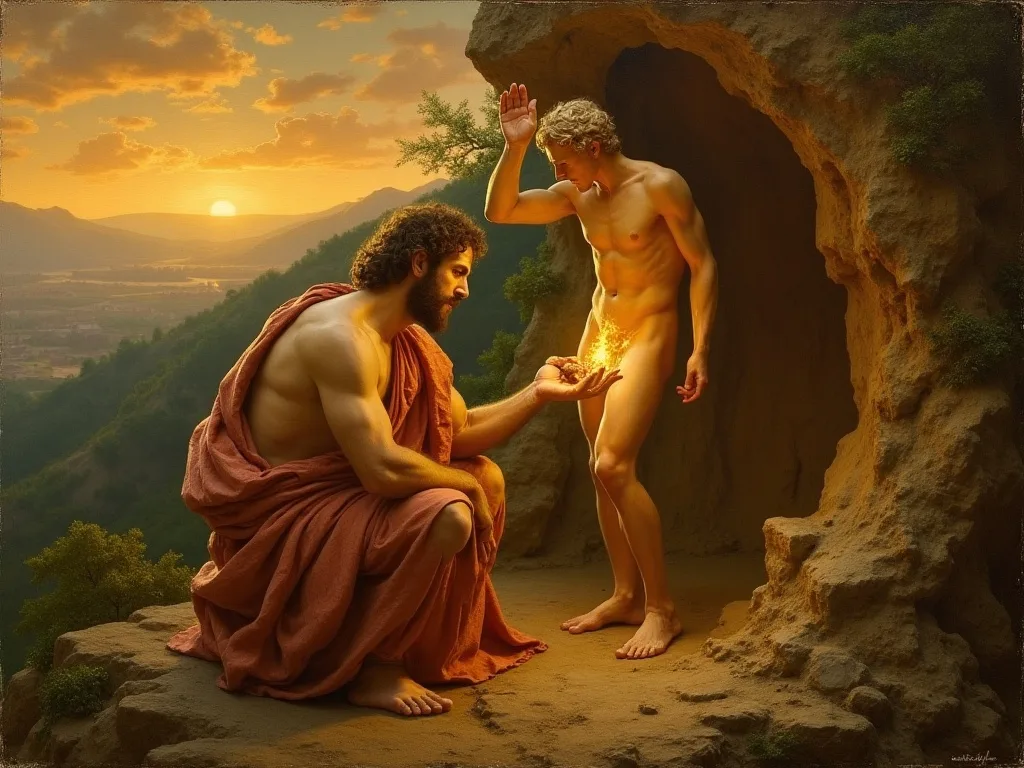
The separate story of Prometheus runs alongside these ages. Prometheus, a Titan who sided with Zeus, shaped the first humans from clay. He gave them fire, stolen from Olympus, when Zeus refused to share it. Zeus punished him with eternal torment on a rock and punished humanity in turn by sending Pandora, the first woman, carrying a jar (mistranslated for centuries as a box) full of sickness, labor, and misery. At the bottom of the jar, the only thing that did not escape: Elpis, Hope.
The Shape of the Greek Cosmos
Understanding the creation of the world in Greek mythology means understanding the structure the Greeks believed it had at the end of all this creation.
The Greek cosmos was not infinite space. It was layered and bounded.
- Olympus sat at the top, a real mountain in northern Greece but also a divine palace above the clouds, where the twelve Olympians held council.
- The Earth occupied the middle level, a flat disc (in early cosmology) or a sphere (in later philosophical thought) encircled by the great river Oceanus.
- The Underworld (the realm of Hades) sat below the earth, reached by rivers: Styx (by which gods swore oaths), Lethe (the river of forgetting), Phlegethon (fire), Acheron (woe), and Cocytus (lamentation).
- Tartarus lay beneath the underworld itself, three times as far below Hades as the sky was above the earth. A bronze anvil dropped from the sky would fall for nine days before hitting earth; it would fall another nine days before hitting Tartarus. It was prison, punishment, and cosmic foundation at once.
The journey from the Underworld and its geography to the Olympian heights was the spatial expression of the hierarchy created during the Titanomachy: those who won the war lived in light; those who lost were buried in darkness.
Greek Cosmogony Compared to Other Ancient Traditions
The Greek creation story did not exist in a vacuum. The ancient Mediterranean was a world of trading ports, travelling poets, and borrowed ideas, and the fingerprints of other traditions show up clearly in Hesiod.
The Enuma Elish, the Babylonian creation epic that scholars date to roughly 1100 BC in its written form but much earlier in oral form, begins with the mixing of salt water (Tiamat) and fresh water (Apsu) before any gods exist. Gods are born from their union. The younger gods become noisy, the older gods try to destroy them, and the youngest and most powerful god (Marduk) kills the primordial mother and makes the sky and earth from her body. The structure, young powerful god defeating a monstrous elder and reorganizing the cosmos, maps almost exactly onto Zeus defeating Typhon.
The Hittite myth of Kumarbi (from around 1400 BC) tells of a sky god castrated by his son, who swallows the sky god's genitals and becomes pregnant with terrible beings. Scholars including Martin West, in his 1997 study The East Face of Helicon, documented these parallels in careful detail, arguing that the Near Eastern storm-god tradition traveled west through Phoenician and Syrian intermediaries into the Greek world.
Norse cosmogony, far to the north, shares a striking parallel: the cosmos begins from nothing (the void Ginnungagap), and the first creative act involves the dismemberment of a primordial being (the giant Ymir) whose body becomes the earth, whose blood becomes the sea, whose bones become mountains. The Greek version scatters this dismemberment motive across several episodes: Uranus castrated, his blood becoming new life, Typhon dismembering and reassembling Zeus in some variants.
Hindu cosmology in the Rigveda opens the Nasadiya Sukta (the Hymn of Creation, around 1200 BC) with words that almost echo Hesiod's Chaos: "There was neither non-existence nor existence then. There was neither the realm of space nor the sky beyond." Both traditions reach for the same impossible image: the moment before anything existed, including the gods who would later claim to have made everything.
These parallels do not diminish the Greek story. They place it inside a much older conversation about how the cosmos came to be, a conversation that humanity has been having from one end of the ancient world to the other.
How Greek Creation Myths Shaped Western Thought
The influence of Greek world creation mythology on Western civilization is structural, not decorative. It is not that later writers quoted Hesiod. It is that his framework, a cosmos with a beginning, an ordered hierarchy, and an account of why things are imperfect, seeped into philosophy, theology, and science for the next two and a half thousand years.
Plato, writing in the 4th century BC, created his own cosmological dialogue, the Timaeus, in which a divine craftsman called the Demiurge shapes the physical world from pre-existing chaotic matter by looking at eternal ideal forms and impressing them on matter. This is not Hesiod's cosmos, but it grows from the same soil: an ordered world requiring an ordering agent, chaos preceding structure, reason subduing matter.
Early Christian theologians like Origen and Augustine read the Greek cosmological tradition alongside Genesis, finding points of contact and friction. The idea of creation from chaos (rather than creation from nothing) deeply influenced early theological debates about the nature of God and matter.
In Renaissance Europe, Hesiod's Theogony was printed and translated and read by poets, painters, and scientists. Milton's Paradise Lost (1667) draws on the image of a void before creation, Chaos as a character, and the fall of proud angels in terms that echo the Titanomachy. Botticelli's Birth of Venus (painted around 1484-1486) translates the foam-born Aphrodite into oil paint with a fidelity that Hesiod himself might have recognized.
The Romantic poets returned to the Titans as symbols of noble rebellion. Shelley's Prometheus Unbound (1820) reimagines the Titan not as a thief punished justly but as the heroic champion of humanity against a tyrannical Zeus. The question the Greek creation story never fully settled, whether the cosmos Zeus built is truly just or merely powerful, kept Western literature asking it for three millennia.
Frequently Asked Questions About the Creation of the World in Greek Mythology
Frequently asked questions
What is the very first thing that existed in Greek mythology?
According to Hesiod's Theogony, the very first thing was Chaos, a primordial void or gap rather than a chaotic mess. From Chaos emerged Gaia (Earth), Tartarus (the abyss), and Eros (desire). These beings arose spontaneously, without parents or creator, making the Greek account distinct from traditions where a single god creates everything from nothing.
Who created humans in Greek mythology?
The most widespread tradition credits Prometheus, a Titan, with shaping the first humans from clay. Hesiod's Works and Days describes five successive races of humanity (Golden, Silver, Bronze, Heroic, and Iron) created by the Olympian gods in sequence. These two accounts are usually read as complementary: Prometheus provided the physical form, while the successive races reflect humanity's moral and spiritual history.
What was the Titanomachy and why does it matter for the creation story?
The Titanomachy was the ten-year war between Zeus and the Olympian gods on one side, and the elder Titans led by Cronus on the other. It matters because it decided the structure of the cosmos: Zeus won the sky, Poseidon the sea, Hades the underworld. The cosmos as Greeks knew it, its rulers, its laws, its hierarchy, was the direct result of this war, not a gift from a single creator god but the outcome of a violent political settlement among divine generations.
Is there more than one Greek creation story?
Yes. Hesiod's Theogony is the main source, but the Orphic cosmogonies (texts attributed to the legendary poet Orpheus, probably written between the 6th and 4th centuries BC) describe creation quite differently, with a cosmic egg hatching the primordial god Phanes at the beginning. Plato's Timaeus offers a philosophical creation account where a Demiurge shapes the world rationally. These traditions coexisted and sometimes contradicted each other, which the Greeks generally treated as acceptable: competing myths were seen as different lenses on truths too large for any single story.
How does Greek cosmogony compare to the Genesis creation story?
Both begin with formless void and move toward an ordered world, but the mechanisms differ sharply. In Genesis, a single all-powerful God creates by speech ("Let there be light"). In Hesiod, no single creator exists: beings emerge, reproduce, struggle, and win or lose power. The Greek cosmos is the aftermath of family conflict rather than the act of a sovereign will. Early Christian writers, particularly the Greek-speaking theologians of Alexandria, spent considerable effort reconciling these two frameworks, which shaped much of Western theology.
What happened to the Titans after they lost the Titanomachy?
Most Titans were imprisoned in Tartarus, the deepest pit of the underworld, guarded by the Hecatoncheires. Atlas received the separate punishment of holding up the sky at the western edge of the world. A few Titans who had sided with Zeus (most notably Prometheus and Themis) were spared and remained in the world. In some later traditions, Cronus was eventually released and given rule over the Islands of the Blessed, where heroic humans spent eternity.
The Unresolved Question at the Heart of Greek Creation
The Greek creation story ends with Zeus victorious and the cosmos in order. But Hesiod never lets that triumph feel entirely clean. Uranus cursed his children. Cronus cursed his. The oracle that warned Cronus about his own son came true. And the same oracle told Zeus that his son by the Titaness Metis would surpass him. Zeus swallowed Metis, literally ate Wisdom to keep it inside himself, and from his own skull Athena was born, fully armored. He stopped the cycle. He was, perhaps, the first ruler in Greek myth to outwit rather than simply outlast the doom his own father passed to him.
But the pattern of overthrow still haunts the tradition. Ancient readers knew it. Aeschylus, the 5th century BC playwright, wrote a trilogy about Prometheus in which the Titan claimed to know something about Zeus's future that could destroy him. Only two of the three plays survive, so we cannot know exactly how Aeschylus resolved it. The silence is deliberate, a gap left open inside the story.
That gap is where the creation of the world in Greek mythology does its most interesting philosophical work. It insists that order is not eternal, that every ruler inherits the curse of the ruler before them, that the cosmos is not finished being made. The Greek universe is not a completed gift. It is a precarious settlement, held in place by force and cunning, always carrying the memory of how violently it was won.
For a civilization that built democracy, tragedy, and philosophy in the same century, that was probably the only honest way to tell the story of how everything began.
Free 25-page sample
Want the whole story?
Take the first 25 pages free. If it pulls you in, the full edition is yours as an instant PDF download, with a paperback on Amazon for selected titles.

Mythology
The World Mythology Book: The Gods, Heroes and Myths of Every Culture
The Gods, Heroes and Myths of Every Culture, in One Volume
The whole of world mythology in a single volume: Greek, Norse, Egyptian, Japanese, Hindu, Celtic, Slavic, Mesoamerican and African myths gathered side by side, each drawn from the primary sources.