
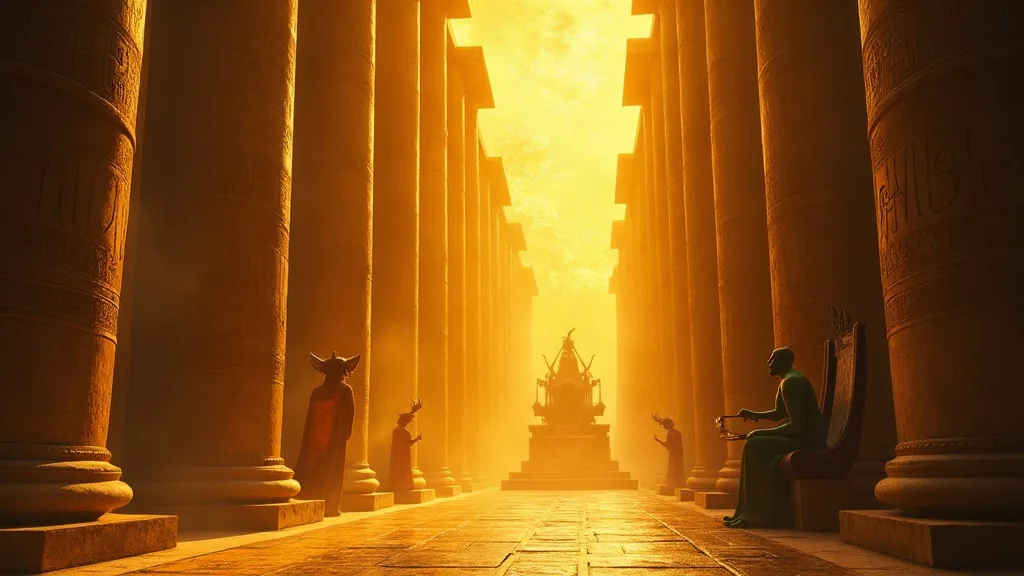
Death Gods Across Cultures: Anubis, Thanatos, Yama, and the Keepers of the Final Threshold
From Egypt's jackal-headed Anubis to Greece's quiet Thanatos and India's stern Yama, death gods across cultures share uncanny patterns. What do they reveal about us?
Contents
The soul leaves the body. Every human civilization, across every continent and century, has asked the same question next: where does it go, and who is waiting?
The answers differ wildly in their imagery. One tradition pictures a jackal-headed god weighing a heart against a feather. Another conjures a winged youth so gentle he could pass for sleep. A third imagines a green-skinned king seated on a water buffalo, holding a noose and a staff, judging the dead by a register written before they were born. Yet beneath those striking differences, the figures share an architecture. They are gatekeepers, not destroyers. They measure, they escort, they decide. They are, almost universally, figures of cosmic law rather than cosmic cruelty.
This article holds those figures side by side and reads them against each other, drawing on the Coffin Texts and the Book of the Dead from Egypt, the Hesiodic tradition from Greece, the Rigveda and the Mahabharata from India, the Popol Vuh from Mesoamerica, Norse Eddic poetry, and several other traditions. The goal is not to flatten differences but to trace the real structural parallels that keep emerging, unbidden, across cultures that had no documented contact with each other.
Anubis: the Jackal Who Holds the Scales
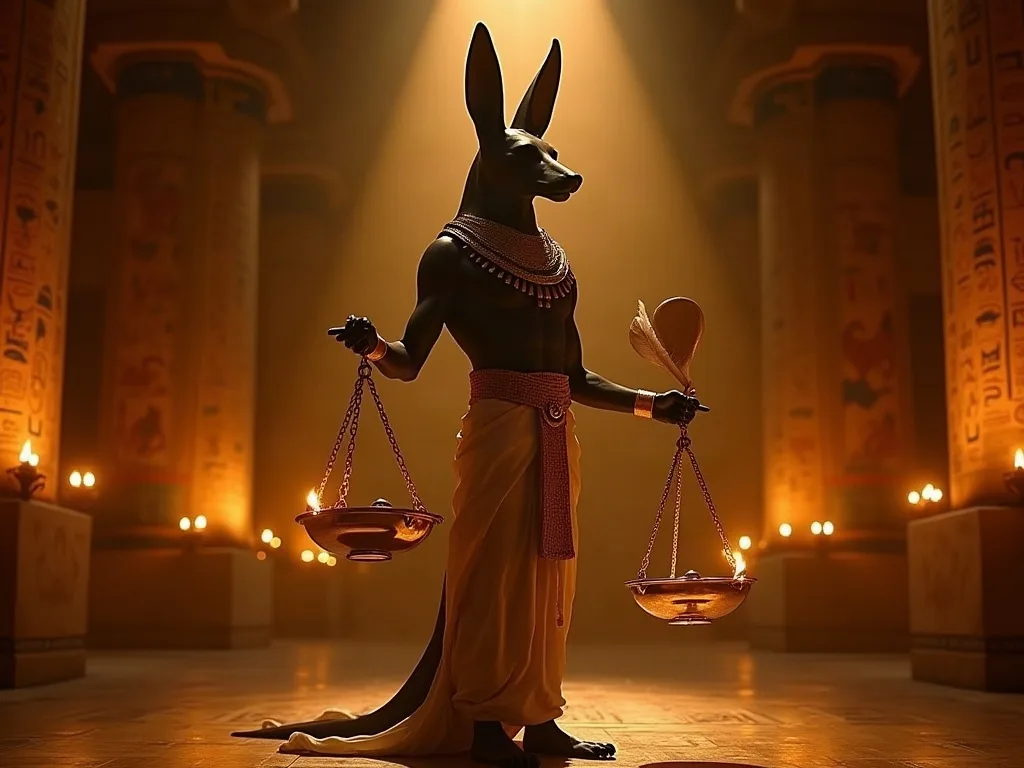
Anubis is the oldest named death deity whose cult can be traced with certainty. His earliest appearances come from the Pyramid Texts, a collection of mortuary spells carved inside Fifth and Sixth Dynasty pyramids at Saqqara, dating to roughly 2400-2300 BC. At that point he was already the god of embalming, the guardian of tombs, and the lord of the necropolis. His Egyptianname was Inpu, but the Greeks who encountered his cult rendered it as Anubis, and that name stuck.
The jackal association is precise and practical. Jackals haunted Egyptian cemeteries, drawn by shallow graves in the desert sand. Egyptian theology had a habit of folding threatening forces into protective ones: the animal that desecrated tombs became the animal that guarded them. Anubis wears the black coat, but in mythology he is the protector of the dead, not their predator.
His central role is the Weighing of the Heart, described in detail in the Book of the Dead, the New Kingdom papyrus compilation assembled from around 1550 BC onward. The deceased's heart is placed on one pan of a golden scale. On the other pan rests the feather of Ma'at, the Egyptian concept of cosmic order, truth, and balance. Anubis holds the plumb line. If the heart is heavy with wrongdoing, it sinks; the monster Ammit, part lion, part hippopotamus, part crocodile, devours it, ending the soul's existence permanently. If the heart balances with the feather, the soul passes into the Field of Reeds, the Egyptian afterlife.
Notice what this makes Anubis: not a punisher, but a weigher. He holds the instrument, he reads the result, but the heart condemns or redeems itself. He also guides the dead through the Duat, the Egyptian underworld, protecting them against the hostile entities that populate that liminal space. Spells in the Book of the Dead invoke him as a protector: "Anubis, who is upon his mountain, lord of the sacred land."
His mythology also carries a striking narrative thread. According to the Contendings of Horus and Set and several related papyri, Anubis is the son of Osiris (lord of the dead, judge of the afterlife) and Nephthys (goddess of death and lamentation). His parentage places him at the seam between two divine registers: the living world of the Ennead and the dead world of the underworld. He belongs to both, which is precisely why he can operate between them. He is a liminal deity in the most literal sense.
Thanatos: the God Who Looks Like Sleep
Greece gave death two faces. Thanatos, whose name simply means "death" in ancient Greek, is not a ruler but a personification. Hesiod, writing around 700 BC in the Theogony, places him among the children of Nyx (Night) and lists his twin brother as Hypnos (Sleep). That twinning is one of the most psychologically acute images in all Greek mythology: death and sleep are brothers, nearly identical, one merely more permanent than the other.
Hesiod describes Thanatos and Hypnos living together in the underworld, never seeing the sun. Homer, in the Iliad, Book XVI, sends the twins on a mission: Zeus asks them to carry the body of the slain Trojan hero Sarpedon from the battlefield to Lycia, his homeland, for proper burial. The image is one of tenderness, not terror. Death and Sleep cradle a body and carry it home.
This is not the skeleton with a scythe. That image, familiar from medieval European art, is a much later construction. The earliest Greek iconography shows Thanatos as a winged youth, often bearded, sometimes carrying an inverted torch (a symbol of a life extinguished). On the Euphronios Krater, a red-figure Athenian vase dating to around 515 BC and now split between the Metropolitan Museum of Art and the Archaeological Museum of Cerveteri, the Sarpedon scene is painted with extraordinary care: Thanatos and Hypnos are almost mirror images, one on each side of the body, their wings symmetrical, their faces calm.
Thanatos had a limited cult. Unlike Hades, who ruled the underworld and received prayers and propitiatory offerings, Thanatos was not worshipped in any sustained way. He is mythology's quiet agent, a function more than a figure. Yet his relative passivity tells its own story. Greek theology located moral judgment in Hades and his judges, Minos, Rhadamanthus, and Aeacus, while Thanatos simply collected the dead. He was not moral architecture; he was transit.
One myth complicates this gentleness. Sisyphus, the clever king, managed to chain Thanatos so that no human could die. The gods intervened, released him, and punished Sisyphus for his presumption. The story reveals what Thanatos really represents in Greek thought: not cruelty, but necessity. The world cannot function if death stops working.
Yama: the First Man Who Became the First Dead
Yama is the death god with perhaps the deepest textual history of any figure in this comparison. He appears in the Rigveda, the oldest surviving layer of Sanskrit literature, composed roughly between 1500 and 1200 BC, which makes his textual record older than almost any other named deity in this article.
In Vedic mythology, Yama is not originally a god. He is the first mortal human to die, the one who "chose death" and thereby opened the path for all other humans to follow. The Rigveda describes a realm he rules beyond death, a paradise of light and music where ancestors feast. He is joined in ruling this realm by Yami, his twin sister, with whom he has a tense and poignant dialogue preserved in Rigveda 10.10: Yami urges union, Yama refuses on moral grounds, insisting that the cosmic order (Rta, the Vedic precursor to Dharma) forbids it. His refusal establishes him as a figure of law even before he becomes a judge.
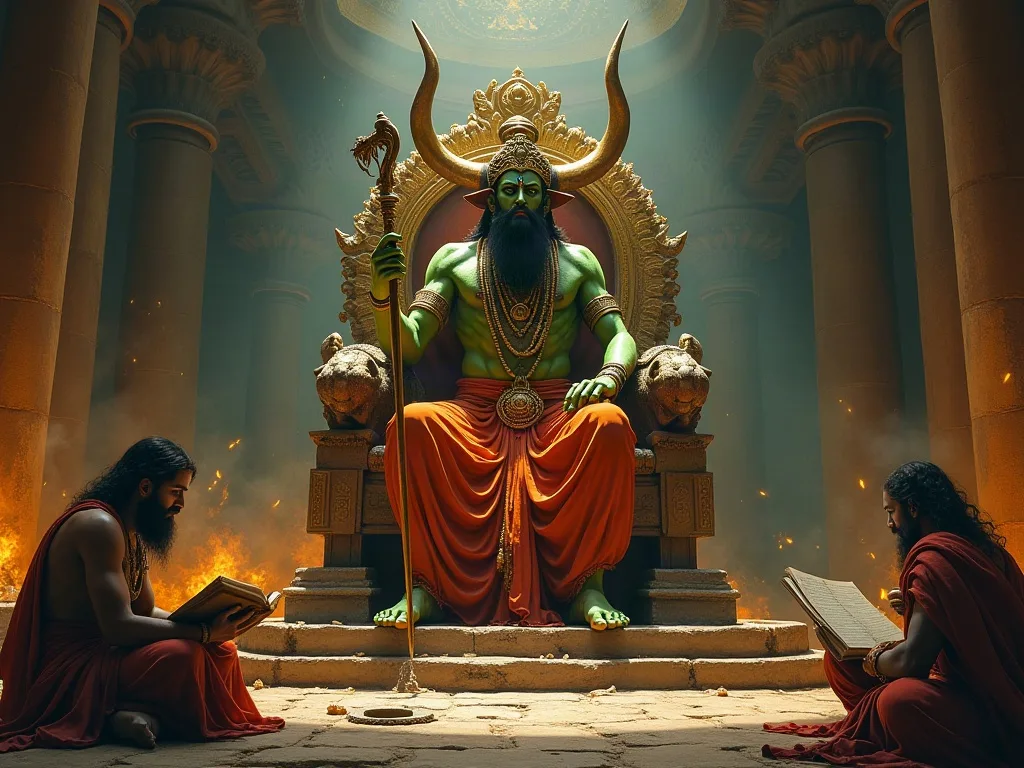
By the time of the Mahabharata (composed in layers between roughly 400 BC and 400 AD) and the Puranas, Yama has evolved substantially. He is now Dharmaraja, the King of Dharma, the Lord of Righteousness. He sits on his throne in Yamaloka, his realm, with his scribe Chitragupta beside him. Chitragupta maintains the cosmic ledger, recording every act of every soul. When a soul arrives, Chitragupta reads the account and Yama pronounces judgment. The soul then travels to the appropriate afterlife: a heavenly realm, a purgatorial realm, or one of the many narakas (hells) for temporary purification.
Yama carries a danda (staff) and a pasha (noose). His messenger Yamaduta (the Yama-messenger, often depicted as a crow or a dark figure) collects souls. His mount is a water buffalo, an animal associated with death across several Asian traditions. His skin is green or dark blue in Puranic iconography, marking him as a liminal being who exists between the world of the living and the world of the dead.
The Katha Upanishad, a philosophical text from roughly 600-400 BC, gives Yama his most extraordinary literary moment. The young boy Nachiketa arrives in Yama's realm and waits three days without food because Yama is absent. When Yama returns and learns a brahmin boy has waited unfed, he offers Nachiketa three boons as recompense. Nachiketa uses his third boon to ask the question that no human is supposed to ask: "What happens after death?" Yama tries to deflect, offers wealth, kingdoms, pleasures. Nachiketa refuses everything and insists on the answer. Yama ultimately teaches him the nature of the Atman (the individual soul) and Brahman (the universal consciousness), one of the earliest and most beautiful articulations of Hindu philosophy. Yama, the god of death, becomes the teacher of liberation from death. The structural irony is deliberate and profound.
Yama's lineage also connects him to the sun: his father is Surya (the sun god) and his mother is Saranyu. Across Indo-European mythology, the connection between solar deities and death gods is a recurring thread, possibly because the sun both rises and sets, both gives life and retreats from it.
Osiris, Hades, and the Rulers Who Judge
Before continuing with further comparative figures, it helps to distinguish between two types of death deity that appear in nearly every tradition. The first type is the escort: the being who collects and guides souls. Anubis and Thanatos belong here, and so do the Yamaduta and the Norse Valkyries. The second type is the ruler-judge: the sovereign of the underworld who pronounces verdicts on the dead.
Osiris is the supreme example of the ruler-judge in Egyptian theology. Unlike Anubis, who manages the physical transition and the scales, Osiris presides over the final verdict. He sits at the far end of the Hall of Two Truths, wearing the white crown of Upper Egypt, holding the crook and flail. His own biography gives him authority over death: he was murdered by his brother Set, resurrected through the efforts of his wife Isis and the embalming skill of Anubis, and then became eternal king of the dead. He died, came back, and chose to remain in the underworld. His resurrection is not escape from death but mastery of it.
Hades in Greek mythology fills the same structural role. He rules the underworld, dispenses judgment through his three judges, and keeps the dead from returning. His name may derive from a Proto-Greek root meaning "the unseen one." He is neither evil nor cruel in Greek primary sources; the Iliad and Odyssey treat him as simply the inevitable lord of a domain no one wishes to visit. His attribute is the helmet of invisibility, which reinforces his nature: death makes you disappear from the world of the living.
Both Osiris and Hades share a critical feature: they themselves have a mythological biography that involves dying or descending. Osiris was literally killed. Hades descended into the underworld after the Titans were defeated and the cosmos was divided by lot among the three brothers, Zeus, Poseidon, and Hades. The death god who has personal experience of death is a pattern worth noting. Yama, too, is the first being to experience death. This biographical link between the death deity and the act of dying may be theology's way of saying: only the one who has been through it can govern it.
Osiris and the Egyptian afterlife form one of the most elaborately documented mythological systems in history, and the contrast with Hades' more austere Greek underworld rewards close comparison.
Mictlantecuhtli and the Aztec Nine Levels
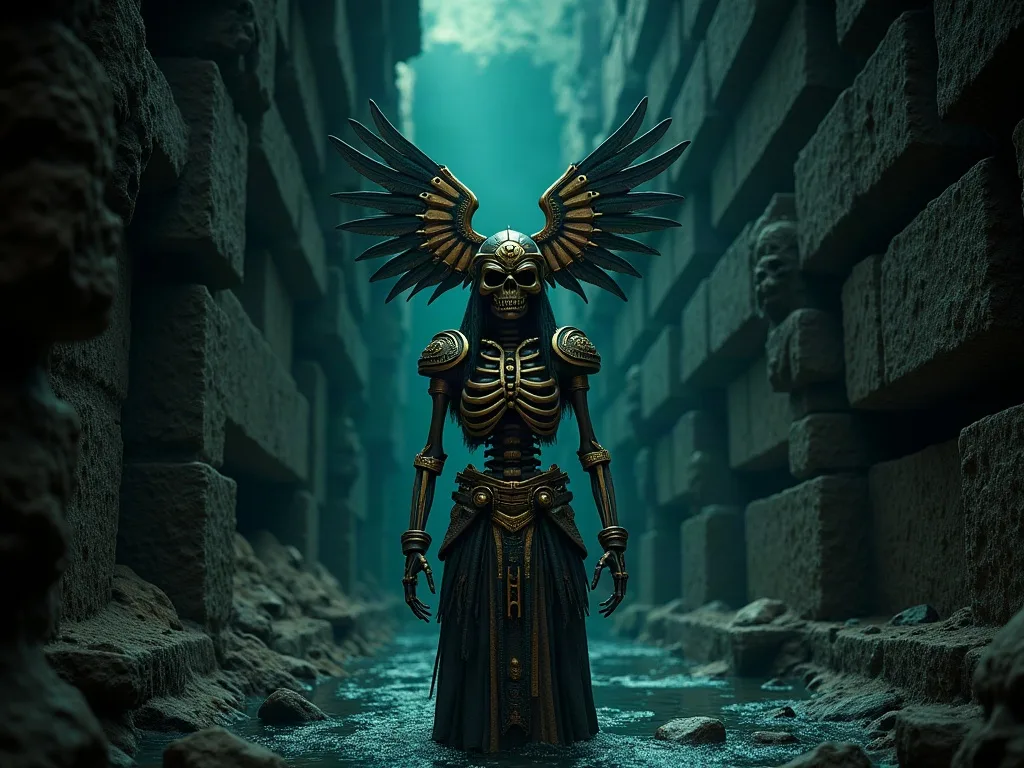
Mictlantecuhtli, whose name in Nahuatl (the language of the Aztec people) means "Lord of Mictlan," rules the Aztec land of the dead alongside his wife Mictecacihuatl. His domain, Mictlan, is not a judgment hall but a destination: the land of the dead is the ninth and lowest level of a nine-layer underworld, and reaching it requires a journey of four years through a series of obstacles. Rivers, wind-blasting deserts, mountains that crash against each other: the dead navigate all of these, aided by objects and provisions buried with them.
Mictlantecuhtli himself is depicted as a skeleton, often with blood-spotted clothing, wearing a skull mask and a headdress of owl feathers. The Codex Borgia, a pre-Columbian Aztec ritual manuscript, shows him in elaborate ritual poses associated with the calendar cycle and with sacrificial death. He did not judge: the manner of a person's death determined their afterlife destination in Aztec cosmology, not the moral weight of their deeds. Those who drowned, were struck by lightning, or died in childbirth went to paradises associated with rain or the sun. The majority of the dead went to Mictlan.
This is a meaningful divergence from the Egyptian, Greek, and Indian models. Aztec death theology was less interested in individual moral accounting and more interested in how death fitted into the cycles of cosmic renewal. Blood sacrifice fed the sun; drought, war, and death were the engines that kept the cosmos alive. Mictlantecuhtli is therefore less a judge and more a collector: he accumulates the dead the way the earth accumulates fallen leaves, a necessary part of the cycle.
The Popol Vuh, the Maya creation text written down in the early 16th century from an oral tradition far older, features the Lords of Xibalba (the Maya underworld) as antagonists rather than neutral judges. The Hero Twins, Hunahpu and Xbalanque, trick and defeat the Lords of Xibalba, exposing them as fraudulent. This gives Mesoamerican death mythology a confrontational dimension rarely seen in Egyptian or Hindu accounts: here, the dead can outwit death. The lesson is not submission but wit.
Hel, Ereshkigal, and Female Rulers of the Dead
Not all death gods are male. Two of the most powerful underworld sovereigns in world mythology are women, and their stories complicate any easy theory about what death deities represent.
Hel appears in Old Norse texts, particularly in the Prose Edda compiled by Snorri Sturluson around 1220 AD, drawing on older Eddic poetry. She is the daughter of Loki and the giantess Angrboda, and her siblings are the wolf Fenrir and the world-serpent Jormungandr. Odin cast her down into Niflheim, the realm of mist and cold, and charged her with ruling over those who die of illness, old age, and all deaths not taken in battle. Her appearance, half living flesh and half dead or bluish pallor, marks her as someone who spans the boundary between life and death. Her hall is called Eljudnir ("Damp with Sleet"), her knife is Famine, her plate is Hunger. Snorri's names for her attributes are deliberately grim.
Hel is largely passive in Norse mythology: she receives the dead and keeps them. When Baldr is killed and the gods send a messenger to negotiate his return, Hel agrees only if every being in the nine worlds will weep for him. The giantess Thokk (widely believed to be Loki in disguise) refuses, and Baldr stays. Hel does not gloat; she simply enforces the rule. She is impartial in the way a natural law is impartial.
Ereshkigal, the Sumerian queen of the great below, is a far more emotionally complex figure. The Descent of Inanna, one of the oldest written myths surviving from around 1900-1600 BC in its Old Babylonian versions, tells how Ereshkigal's sister Inanna descends through the seven gates into the underworld. At each gate a garment or ornament is stripped from Inanna: she arrives naked before Ereshkigal, who kills her. The gods send envoys to retrieve her; Ereshkigal is found in grief, moaning with pain. The envoys mirror her grief, expressing sympathy, and she relents. Inanna is restored.
Ereshkigal's grief is startling in a death deity. Scholars have interpreted it variously: as the loneliness of the underworld, as the pain of the divine feminine who does not get to live in the upper world, as the mourning that is structurally inseparable from ruling over the dead. Her complexity sets her apart from more schematic figures like Mictlantecuhtli or Thanatos. She feels.
The Structural Parallels: What Death Gods Share
Holding all these figures together, several consistent patterns emerge, and they are worth naming precisely.
First, the escort function. Virtually every tradition produces at least one being whose job is to guide or carry the dead from the moment of death to the realm of judgment or rest. Anubis guides through the Duat. The Greek psychopomp Hermes leads souls to the river Styx. Yamaduta collect souls for Yama's court. The Valkyries escort the battle-slain to Valhalla. This escort function implies something subtle: dying is not instantaneous in mythological thought. It is a journey, and journeys require guides.
Second, the judgment mechanism. The most sophisticated death-deity systems include some form of moral accounting. Egypt uses the scales. India uses Chitragupta's ledger. Greece uses three judges drawing on a soul's biographical record. The mechanism differs, but the principle is identical: the afterlife destination is not random. Something about how you lived matters. This is arguably mythology's attempt to install cosmic justice where human institutions fail.
Third, the connection to law. Yama is Dharmaraja. Osiris sits with the crook and flail of kingly authority. Hades runs his realm by impartial rules. Even Mictlantecuhtli operates within the predictable logic of the Aztec calendar. Death gods are almost never chaotic. They are among the most rule-bound figures in their respective pantheons, which makes philosophical sense: the finality of death, as a concept, demands regularity. An unpredictable death god would make the cosmos unintelligible.
Fourth, the liminal biography. As noted above, many primary death deities have personally crossed the threshold. Osiris was murdered and resurrected. Yama was the first mortal to die. The Norse god Odin hung on the world tree Yggdrasil for nine days in a self-sacrificial death before receiving the runes. This biographical experience of death grants the deity authority over it. You cannot govern a country you have never visited.
Fifth, and most striking, the avoidance of cruelty. Across traditions that developed entirely independently of each other, from Vedic India to Bronze Age Egypt to pre-Columbian Mesoamerica, the primary death deity is almost never bloodthirsty or sadistic. They collect, they judge, they preside. The cruelty, when it exists, belongs to underworld executioners and torturers, not to the sovereign figures themselves. The king of death is, in an odd way, often the most orderly figure in the entire pantheon.
Death Gods and the Indo-European Thread
Several scholars, notably Georges Dumézil in his comparative work on Indo-European mythology published throughout the mid-20th century, have argued for a common ancestral death-deity figure behind the Greek, Roman, Indian, and Norse traditions. The evidence is suggestive.
Yama (Sanskrit), Yima (Avestan, from Zoroastrian Iranian tradition), and the Norse Ymir share an etymology: all derive from a Proto-Indo-European root yem- meaning "twin." This twin motif matches Yama's pairing with Yami, and Thanatos's pairing with Hypnos. The twin structure may reflect a very old theological idea: that death is always paired with its near-equivalent, whether that pair is life, sleep, or a female counterpart.
In the Avestan Gathas, the Zoroastrian sacred hymns attributed to the prophet Zarathustra and dating possibly to around 1000-600 BC, Yima is the first king, first man, and ruler of a paradise. He later loses that paradise through moral failure. His decline mirrors the transformation of Yama from paradisiacal king in the early Vedas to underworld judge in the later Puranas: both figures begin as blessed leaders and end as rulers of the dead. This parallel arc, across two traditions that share a common ancestor, is not coincidence.
The Roman Orcus and the Etruscan Charun offer additional nodes in this network. Orcus, whose name may share a root with Horkos (oath) in Greek, was the Roman punisher of broken oaths in the underworld: another law-enforcing death deity. Charun, the blue-skinned Etruscan ferryman figure, predates Greek Charon and shows the antiquity of the ferryman motif across ancient Italy.
The Norse underworld and the Vedic Yamaloka share more structural features than their geographical distance would suggest, and the Indo-European hypothesis is a compelling explanation for why.
When the Living Enter the Kingdom of the Dead
One of mythology's most reliable plot structures is the katabasis: the living hero's descent into the underworld. Orpheus descends for Eurydice, charming even Hades and Persephone with his lyre. Heracles descends to capture Cerberus, the three-headed dog who guards the underworld's gates. Aeneas descends guided by the Sibyl, meets his father's shade, and receives a vision of Rome's future. Gilgamesh seeks Utnapishtim beyond the waters of death.
Each katabasis story tests the death god's rules. What usually happens is revealing: the rules hold. Orpheus wins Eurydice back on the condition he does not look back. He looks back. She is lost. The condition was arbitrary-seeming, but it was real. Hades, in that myth, is not the villain; Orpheus's own nature defeats him. The underworld's rules are as firm as physics.
This suggests that death deities in mythology serve a conservative function. They maintain order. They resist the hero's desire to cheat death not out of malice but because the cosmos requires it. Sisyphus chains Thanatos and the world breaks. Inanna descends and the earth goes barren. The death god's authority is structural, not personal.
Nachiketa's visit to Yama works differently because Nachiketa does not try to bring anyone back. He asks for knowledge. And Yama gives it. The distinction between demanding life and asking for understanding is the crux of the Katha Upanishad: the death god withholds only one thing, the reversal of death. Everything else, including the deepest philosophical truth in the tradition, he can and does give.
The myth of Orpheus and Eurydice distills the Greek attitude toward death's permanence into one unbearable backward glance.
Common Misconceptions About Death Gods Across Cultures
Popular culture has not been kind to these figures. Hades has been recast as a villain in multiple modern adaptations, despite having almost no villainous behavior in primary sources. Anubis is sometimes described as the god of death when he is more precisely the god of embalming and the guide of souls: Osiris holds the actual sovereignty. Yama is occasionally described as equivalent to Satan, a comparison that collapses a profound judge-figure into a Christian theological framework he does not fit.
These distortions tend to project a Christian binary of God/Devil onto traditions that do not organize the cosmos that way. In Egyptian, Greek, and Hindu thought, the underworld ruler is not the enemy of the good; he is the administrator of cosmic justice. Death is not punishment. It is transition. And the deity who manages that transition is, by definition, one of the most important and morally serious figures in the pantheon.
The death god's authority also has nothing to do with how people die. Mictlantecuhtli is the partial exception in Aztec thought, where manner of death routes the soul, but even there, the destination of Mictlan is not a punishment: it is simply where most people go. The underworld, in most pre-Christian mythological systems, is not hell. It is the other side of life.
Frequently asked questions about death gods across cultures
Frequently asked questions
Is Anubis the Egyptian god of death or the god of the underworld?
Anubis is more precisely the god of embalming, mummification, and the protection of the dead during their journey through the Duat (the Egyptian underworld). He oversees the Weighing of the Heart ceremony, but the sovereign ruler of the Egyptian underworld and the judge of the dead is Osiris. The two figures work in concert: Anubis manages the physical and ritual transition, Osiris presides over the verdict.
What is the connection between Yama in Hinduism and Yama in Buddhism?
Buddhism adopted Yama from the Vedic-Hindu tradition when it spread from India. In Theravada and Mahayana Buddhist texts, Yama retains his role as judge of the dead, but the theological context shifts: he operates within a cosmology of karma and rebirth rather than a permanent afterlife. In some East Asian Buddhist traditions, particularly Chinese, Yama becomes one of ten hell-kings who each govern a different purgatorial realm. Tibetan Buddhist iconography gives him an especially vivid form as a terrifying protector deity holding the Wheel of Life.
Why do so many death gods in different cultures have a twin or a near-identical companion?
The twin motif appears in Proto-Indo-European mythology (Yama and Yami, Thanatos and Hypnos), and it may reflect a deep theological intuition: death and its nearest counterpart, whether sleep, life, or the female principle, are inseparable. Scholars like Calvert Watkins and Martin West have traced the twin pair back to a reconstructed Proto-Indo-European ancestor figure. Outside that linguistic family, the pairing of death deities with a consort or companion (Mictlantecuhtli with Mictecacihuatl, Osiris with Isis) appears independently in Mesoamerican and Egyptian traditions, suggesting the paired structure may arise from the human intuition that something as vast as death needs a complementary principle to make sense.
Did ancient Greeks fear Thanatos the way modern people fear death?
Primary sources suggest that Thanatos himself was not an object of dread. He was too abstract and too gentle to inspire the kind of fear attached to, for example, the Furies or the monsters of the underworld. The Greeks feared a bad death (dying unmourned, unburied, without passage across the Styx) far more than they feared Thanatos personally. It was Hades' realm, with its erasure of identity and its shadowy existence for the shades of the dead, that colored Greek anxiety about mortality. Thanatos was simply the mechanism, as neutral as gravity.
Are there death gods outside the Indo-European and Egyptian traditions with similar structures?
Yes. The Yoruba tradition of West Africa features Oya, the orisha who governs the transition between life and death, storms, and the marketplace: a liminal force presiding over endings and transformations. Japanese mythology includes Izanami, who became the queen of Yomi (the underworld) after dying in childbirth, and whose story parallels Ereshkigal's in several respects. The Aztec Mictlantecuhtli and the Maya Lords of Xibalba represent fully independent traditions. The structural convergence toward a law-bound, judgment-dispensing death sovereign appears to arise independently across multiple continents, which is one reason scholars take it seriously as a deep feature of human religious imagination.
What Death Gods Reveal About the Living
The most consistent thing about death gods across cultures is that they are not primarily about death. They are about the question that death makes urgent: does what you do in life matter?
A society that believed in a moral afterlife accounting, whether Egyptian, Indian, or Greek, was making a philosophical claim. Justice, the claim runs, is not confined to what human courts can manage. There is a cosmic ledger, and it is kept by someone who cannot be bribed, cannot be deceived, and has seen everything. Chitragupta's register does not miss a single deed. Anubis's scales cannot be cheated. Hades' judges draw on the full biography of the soul, heard without the advocacy of powerful lawyers.
Yama as Dharmaraja, Osiris with the crook and flail, Hades with his impartial judges: each figure is a projection of the human longing for genuine justice. They comfort not because they are gentle but because they are fair.
There is also something worth noting in how many traditions give the death god a sympathetic biography. Osiris was murdered. Ereshkigal is lonely and grieving. Hel is born to parents who frighten even the Aesir and is cast down into cold darkness by Odin. Yama is the first being to face something no one had faced before. These are not triumphant figures. They are, in many ways, figures of profound loneliness, tasked with the job no one else can do, sitting at the threshold between everything the living know and everything they do not.
The myths we tell about death say less about death than about what we need to believe about life. And what humans seem to need, across twelve thousand years and every culture we can read, is that the threshold is held by someone paying attention, that the scales are real, and that the weight of a single life, measured against a single feather, actually counts for something.
Free 25-page sample
Want the whole story?
Take the first 25 pages free. If it pulls you in, the full edition is yours as an instant PDF download, with a paperback on Amazon for selected titles.

Mythology
The World Mythology Book: The Gods, Heroes and Myths of Every Culture
The Gods, Heroes and Myths of Every Culture, in One Volume
The whole of world mythology in a single volume: Greek, Norse, Egyptian, Japanese, Hindu, Celtic, Slavic, Mesoamerican and African myths gathered side by side, each drawn from the primary sources.