

Demeter: Goddess of the Harvest, Grief, and the Turning of the Seasons
Demeter fed the ancient world and broke it when her daughter was taken. Meet the goddess whose grief invented winter and whose rites shook the foundations of Greek religion.
Contents
The grain was already standing in the fields of the Rarian plain when the world stopped growing. A mother had searched for nine days without eating, without bathing, a torch in each hand, calling a name the rocks refused to answer. When she finally learned the truth, she did not weep quietly. She pulled the harvest back into the earth and waited.
That is the mythological bedrock of Greek agriculture, of seasonal death and return, of the most secret and most widely attended religious ceremony in the ancient Mediterranean. Demeter, goddess of the harvest, is not merely a pleasant symbol of autumn abundance. She is the figure who proved that even the Olympian order could be brought to its knees by a mother's refusal.
Her story runs through Homer's Hymn to Demeter, through Hesiod's Theogony and Works and Days, through the fragmentary testimonies of initiates who returned from Eleusis changed and silent. It is one of the oldest, most emotionally raw narratives in Greek religion, and it still lands.
Demeter's Place in the Greek Cosmos: Titan Blood and Olympian Power
Demeter belongs to the second generation of Olympians. Her parents are the Titans Cronus and Rhea, which places her among the original six children swallowed by their father and later disgorged when Zeus forced Cronus to vomit them up. Her siblings are Zeus, Hera, Poseidon, Hades, and Hestia. That family list alone signals her structural importance: she is not a minor deity invented to explain a local harvest custom. She sits at the very core of cosmic order.
Her name resists clean etymology. The second element, -meter, is unmistakably the Greek word for "mother." The first element, De-, has been read as a variant of Ge (Earth) and also connected to a pre-Greek word for grain or spelt. "Grain Mother" is the most widely accepted reading, though "Earth Mother" also has scholarly defenders. Either reading anchors her to the same ancient layer of agricultural religion found across the ancient Near East, in Mesopotamian grain goddesses like Nisaba, and in later Roman Ceres.
Hesiod places her among the Olympians in the Theogony and describes her union with her brother Zeus as the origin of Persephone (also called Kore, "the Maiden"). That child becomes the hinge on which the entire cosmos turns.

The Abduction of Persephone: How Winter Entered the World
The Homeric Hymn to Demeter opens at speed. Persephone is in a meadow with the daughters of Oceanus, picking flowers: roses, crocuses, hyacinths, irises, and one flower placed by Gaia herself as a lure: the narcissus, blooming with a hundred heads, smelling so intoxicating that "all the wide heaven above and all the earth and the salt swell of the sea" laughed with delight. When Persephone reaches for it, the earth opens and Hades rises in his chariot of immortal horses.
She screamed. Only Hecate heard, listening from her cave. Only Helios, the sun, saw it happen from the sky. Demeter heard her daughter's cry, but when she arrived, the meadow was empty.
What follows in the hymn is one of antiquity's most vivid portraits of maternal grief. Demeter searches for nine days. She holds torches in both hands. She neither eats ambrosia nor drinks nectar, refusing the sustenance of the gods. She does not bathe. On the tenth day, Hecate finds her and together they go to Helios, who finally tells Demeter the truth: Zeus had arranged the abduction. Hades took Persephone with the father's blessing.
The rage that follows is quiet but total. Demeter abandons Olympus. She disguises herself as an old woman and walks among mortals. She ends up in Eleusis, hired as a nurse to the son of the local king, Metaneira. In a remarkable episode, she begins secretly burning the child Demophoon in a fire each night to make him immortal, until Metaneira witnesses it and screams in horror, breaking the ritual. Demeter drops the child, resumes her divine form, and reveals herself. She demands a temple be built. Then she sits inside it and withdraws her gifts from the world entirely.
Nothing grows. Animals starve. Humans face extinction. Zeus sends Iris, then every individual Olympian in turn, to beg Demeter to relent. She refuses them all. Finally, Zeus sends Hermes down to the underworld with a single instruction: bring Persephone back. Hades agrees, but before she leaves, he gives her pomegranate seeds to eat. The number varies by source: three seeds in some versions, six in others, four in later Roman retellings. In the logic of Greek myth, eating the food of the dead binds one to the underworld. Persephone is now caught between two worlds.
The compromise reached by Zeus and Demeter sets the structure of the year: Persephone spends part of each year below (the sources disagree on whether it is one third or one half), and during that time, Demeter again withdraws warmth and growth from the earth. When Persephone returns, the crops rise. The myth is not a simple allegory for seasons. It is a story about power, consent, loss, and negotiation, told through the only force that could make the king of the gods blink: a mother's refusal to feed the world.

Demeter's Symbols, Sacred Animals, and Attributes
The visual language surrounding Demeter in Greek vase painting, sculpture, and coinage is consistent and unmistakable:
- Wheat stalks and grain: The most primary symbol. She is frequently shown holding a sheaf of wheat or wearing a crown of grain. The harvest itself is her living signature.
- The torch: Carried during her nine-day search for Persephone. Torches appear in almost every artistic representation of her grief, and initiates at Eleusis carried torches during nocturnal rites.
- The poppy: Associated with both sleep and with the unconscious fertility of the earth. Poppy heads appear alongside wheat in her iconography.
- The cornucopia (horn of plenty): Especially in Hellenistic and Roman period art, she is depicted with an overflowing horn, though this attribute belongs equally to the Roman Ceres.
- The serpent: Chthonic, connected to her role as a deity who mediates between the living earth and the underworld. In the Eleusinian mysteries, serpents played a ceremonial role.
- The pig: The sacrificial animal most closely associated with her cult. The Thesmophoria festival, one of the largest women-only religious festivals in the Greek world, involved throwing pigs into underground pits.
- The crane and the gecko: Minor animal associations attested in various local cults.
Her most iconic visual form in classical sculpture shows a mature, dignified woman, neither young nor old, holding grain and a torch simultaneously. The Cnidian Demeter, a marble head now in the British Museum dating to around 350 BCE, captures that quality: grief and authority coexisting in the same face.
Demeter's Family Tree: Connections that Shaped the Pantheon
Understanding Demeter fully requires following the threads of her family outward. Her relationships produced figures who defined Greek myth at every scale.
Parents: Cronus and Rhea (the Titans who preceded the Olympian order).
Siblings: Zeus, Poseidon, Hades, Hera, Hestia. The first three brothers divided the cosmos between them: sky, sea, underworld. Demeter received no cosmic realm. She received the earth's surface and everything that grows from it.
Children:
- Persephone, by Zeus: Queen of the underworld, the pivot of the most important myth Demeter carries.
- Plutus, by the mortal Iasion in a thrice-plowed field in Crete (Theogony, 969-974): The god of agricultural wealth. Hesiod records this union with striking directness. Zeus kills Iasion with a thunderbolt afterward.
- Despoina ("the Mistress"), by Poseidon in some Arcadian traditions: A goddess whose real name was kept secret, worshipped in a mystery cult at Thelpusa.
- Arion, the divine horse, also by Poseidon in the Arcadian tradition preserved by Pausanias: Poseidon pursued Demeter while she searched for Persephone; she hid by transforming into a mare, but he became a stallion.
Grandchildren through Persephone: In Orphic texts, Persephone mothers Dionysus (as Zagreus) by Zeus, linking Demeter's lineage to the god of ecstatic religion and making the Eleusinian and Dionysiac mysteries adjacent.
The family structure reveals something important: Demeter sits at the intersection of the Olympian sky order (her brother Zeus, her daughter married into the underworld) and the older, chthonic layer of Greek religion (serpents, underground pits, secret names, mystery rites). She is a bridge figure.
The Eleusinian Mysteries: The Most Sacred Rites in Ancient Greece
No other figure in Greek religion anchors a cultic institution as significant as Demeter anchors the Eleusinian Mysteries. These were held at Eleusis, a town roughly 22 kilometers northwest of Athens, every year for nearly two thousand years, from at least the 15th century BCE to the closing of the sanctuary by the Christian emperor Theodosius I in 392 CE.
The Mysteries were structured in two stages. The Lesser Mysteries were held in early spring in Athens and served as preparation and purification. The Greater Mysteries took place in autumn, over roughly nine days mirroring Demeter's search, and included a procession from Athens to Eleusis along the Sacred Way, night-long rites inside the Telesterion (the great hall of initiation), and an experience the initiates were forbidden, under penalty of death, to describe.
We know the outer frame. Initiates bathed in the sea. They fasted. They drank the kykeon, a barley-water mixture flavored with mint that echoes the drink Demeter accepts in the hymn when she breaks her own fast at Eleusis. The centerpiece, the dromena (things enacted), legomena (things spoken), and deiknymena (things revealed), remains genuinely unknown. Ancient writers who attended the rites, including Plutarch, Pindar, and Cicero, spoke of them as transformative, as dissolving the fear of death. Pindar wrote that those who had seen the Mysteries knew "the end of life, and its Zeus-given beginning."
The philosopher Plato almost certainly drew on the Mysteries when constructing his account of the soul's journey after death in the Phaedo and the Republic. The scholar Walter Burkert argued in Homo Necans (1972) and later in Ancient Mystery Cults (1987) that the Eleusinian rites centered on Persephone's return as a lived, experiential enactment, not merely a story told. The initiate did not just hear about descent and return. They enacted it.
What can be said with confidence: the Mysteries held together Athenian civic religion, the mythology of Demeter and Persephone, and a personal promise of blessed afterlife for the initiated. Attendance crossed all social boundaries. Slaves could be initiated. Women had full access. The experience was open to any Greek speaker who had not committed murder. At its height, thousands attended each year.

Demeter Across Cultures: Grain Goddesses from Eleusis to Mesoamerica
The pattern Demeter embodies, a mother goddess whose grief at loss drives the cycle of fertility and death, is not unique to Greece. It belongs to a much older stratum of human religious thought tied to agricultural dependence.
The Mesopotamian goddess Inanna/Ishtar descends to the underworld and the world above withers in her absence. Her return restores fertility. The structural parallel with Persephone's story is close enough that some scholars, including Thorkild Jacobsen in The Treasures of Darkness (1976), argued for direct transmission along ancient trade routes. Others favor independent parallel development driven by shared agricultural logic.
In Hindu mythology, the goddess Prithvi (Earth Mother) and the broader concept of Shakti as the generative force of the cosmos carry similar weight, though the Hindu tradition generally integrates rather than separates the destructive and creative aspects of the same divine female figure.
In the Aztec tradition, Chicomecoatl ("Seven Serpent") was the goddess of corn and sustenance, shown holding ears of maize the way Demeter holds wheat, governing the same existential hinge between abundance and famine. The Mesoamerican corn myths recorded in the Popol Vuh restate the theme at full scale: the death of the Maize God and his resurrection by his twin sons drives the cycle of planting and harvest.
The Norse tradition maps the pattern differently. Freyr, a male deity, governs abundance, and his sacrifice is what maintains the earth's generosity. But his sister Freya, goddess of love and seidr magic, carries some of Demeter's emotional intensity, especially her role as a mother figure whose loss reshapes the world.
What these cross-cultural echoes suggest is not that all grain goddesses derive from one source, but that agricultural societies facing the same annual crisis, the terrifying disappearance of life into the ground, independently generated myths that placed a maternal, grieving, powerful female figure at the center of the explanation. Demeter is the Greek crystallization of that universal anxiety.
Demeter in Cult Practice: Thesmophoria, Threshing Floors, and Local Sanctuaries
Beyond Eleusis, Demeter received worship throughout the Greek-speaking world in forms that varied sharply by region.
The Thesmophoria was among the most widespread festivals in Greece, celebrated in dozens of cities across three days in late autumn, just before the winter sowing. It was restricted exclusively to married citizen women. The ritual sequence involved:
- Carrying sacred objects, including the remains of pigs thrown into underground pits the previous year, up to a hilltop sanctuary.
- A day of fasting and mourning called Nesteia, named for Demeter's own fast during the search.
- A day of celebration, Kalligeneia ("beautiful birth"), at which women prayed for good harvests and healthy children.
The festival's agricultural and civic dimensions interlocked: the pit-pigs, mixed with seed grain and earth from the sanctuaries, were believed to fertilize the fields when returned to the soil. The women's lament mirrored Demeter's own. The logic was participatory: by embodying the goddess's grief and then her joy, the community enacted the agricultural cycle rather than merely praying for it.
Local sanctuaries reveal a Demeter more varied than the grain-mother stereotype suggests. At Thelpusa and Phigalia in Arcadia, she was worshipped in cave sanctuaries, sometimes depicted horse-headed, reflecting the myth of Poseidon's pursuit. These Arcadian traditions recorded by Pausanias (Description of Greece, Book 8) show a Demeter explicitly chthonic, connected to earth's dark interior rather than its sunny surface.
At Syracuse in Sicily, where Greek colonists had settled grain-growing territory of extraordinary richness, her cult took on particular intensity. Cicero, in his Verrine Orations, describes the Syracuse sanctuary as one of the holiest sites in the Mediterranean. Sicily's volcanic-enriched soil made it the breadbasket of the ancient Mediterranean, and Demeter was the theological explanation for that abundance.
Demeter's Reception from Antiquity to the 21st Century
The story did not end when the Eleusinian sanctuary closed in 392 CE.
Roman poets, particularly Ovid in the Metamorphoses (Books 5 and 6) and the Fasti, retold the abduction myth at length under the name Ceres. Ovid's version emphasizes Ceres's maternal rage with psychological sharpness that reads almost modern. The Roman grain dole, the annona, was administered partly through religious infrastructure tied to Ceres, which meant Demeter's theological framework literally underwrote Roman urban food supply.
In the Renaissance, Demeter/Ceres became a standard personification of Summer and Abundance in allegorical painting. But the myth's emotional core, the grieving mother, the absent daughter, the negotiated return, remained active in literary and operatic traditions. Gluck's opera Orfeo ed Euridice (1762) inverts the myth: it is Orpheus who descends to rescue a lost beloved, and his partial success reads as a darker retelling of what Demeter accomplished.
The 20th century recovered the mythological depth of the Demeter-Persephone story through several angles. Carl Jung and his colleague Carl Kerenyi published Essays on a Science of Mythology (1949), reading Demeter and Persephone as an archetypal mother-daughter dyad, a single psychic figure split across generations. Adrienne Rich, in her 1976 book Of Woman Born, returned to Demeter as a figure of maternal power that patriarchal structures had systematically suppressed.
In contemporary fiction, the myth pulses through countless retellings. Natalie Haynes' A Thousand Ships (2019) restores female perspectives to Greek myth, part of a wave of writing that treats Demeter's rage as the story's moral center rather than its inconvenient obstacle. Rick Riordan's Percy Jackson series introduces Demeter to a generation of younger readers as Persephone's fiercely protective mother, domestically scaled but mythologically accurate in emotional terms. The graphic novel Lore Olympus by Rachel Smythe became a New York Times bestseller precisely because the Demeter-Persephone relationship drives its emotional arc.
The myth holds because its core situation is not exotic. A parent searches for a lost child. A child is caught between the world they came from and the one they entered. The earth itself holds its breath.
Frequently Asked Questions about Demeter, Goddess of the Harvest
Frequently asked questions
What is Demeter the goddess of, exactly?
Demeter governs grain, agriculture, the fertility of the earth, the law of the harvest, and the sacred rites surrounding the dead. Ancient sources also associate her with the institution of law and civilization itself: Diodorus Siculus credits her with teaching humans to sow grain, which made fixed settlement and society possible. She is not simply a nature spirit but a deity whose domain encompasses everything human life depends on growing from soil.
Why did Demeter cause winter to exist?
According to the Homeric Hymn to Demeter, she withdrew her gifts from the earth after learning that Zeus had arranged for Hades to abduct her daughter Persephone. Nothing would grow until Persephone returned. When the compromise was reached, Demeter agreed to restore fertility for the months Persephone spends above ground, but withholds it during the months Persephone must return to the underworld. The myth explains seasonal barrenness not as natural physics but as an ongoing act of controlled grief.
What were the Eleusinian Mysteries and why did they matter?
The Eleusinian Mysteries were annual initiation rites held at Eleusis, tied to the myth of Demeter and Persephone. They ran for roughly two thousand years, from the Mycenaean period to 392 CE. The rites promised initiates a blessed afterlife, and attendance crossed all social divisions. Their specific content was kept secret under severe penalties, and the core ritual experience remains unknown to scholars. Ancient testimony from Pindar, Cicero, and others suggests the rites transformed the initiate's relationship to death itself.
How is Demeter different from Gaia and Rhea?
All three are female deities connected to the earth, which causes frequent confusion. Gaia is the primordial earth itself, a cosmological entity predating the Olympians. Rhea is a Titan, the mother of the Olympians including Demeter, associated with the mountain wilderness. Demeter operates specifically on the cultivated earth: plowed fields, grain crops, the social institution of agriculture. She is civilization's earth, not the wild or the primordial one. The three represent different temporal and functional layers of Greek theology.
What is the kykeon that Demeter drinks at Eleusis?
In the Homeric Hymn to Demeter, the goddess finally breaks her fast at Eleusis by drinking a kykeon: a mixture of barley, water, and pennyroyal mint. Initiates at the Greater Mysteries also drank a kykeon as part of the ritual sequence, consciously re-enacting Demeter's own gesture of ending grief. The ethnobotanist Gordon Wasson and classicist Albert Hofmann proposed in The Road to Eleusis (1978) that the barley used in the kykeon may have been infected with ergot, a fungus producing compounds related to LSD. This hypothesis remains debated but has not been definitively disproven.
What is the connection between Demeter and the Roman goddess Ceres?
Ceres is the direct Roman equivalent of Demeter, adopted into the Roman pantheon by the early Republic. Her name gives us the word "cereal." The mythological narrative is essentially the same: Ceres loses her daughter Proserpina to Pluto and the earth ceases to produce. However, the Roman cult of Ceres had a distinct political dimension absent in the Greek tradition: she was closely associated with the plebeian class and with the civic institution of the grain supply (annona). Ovid's Fasti and Metamorphoses are the primary literary sources for the Roman version.
The Unresolved Question: What Did Initiates Actually Experience at Eleusis?
Scholarship on the Eleusinian Mysteries has never fully closed this question, and the debate has intensified rather than settled as new disciplines weigh in.
The classical scholar Karl Kerenyi argued in Eleusis: Archetypal Image of Mother and Daughter (1967) that the central revelation of the Mysteries was agricultural and existential simultaneously: the showing of a single ear of grain in silence, symbolizing both the seed's death in the earth and its return as new life, was the deiknymena, the thing revealed. If he is correct, the Mysteries were an enactment of what grain itself demonstrates every season, but experienced as personal truth rather than agricultural observation.
Wasson, Hofmann, and Ruck's ergot-entheogen hypothesis from 1978 added a pharmacological layer. If the kykeon contained psychoactive compounds, the initiates' experience of death and rebirth was not metaphorical but neurologically induced. This would explain both the rites' power and the absolute prohibition on disclosure: describing a drug-induced visionary state to the uninitiated would sound either trivial or insane.
More recent scholarship, including that of Yulia Ustinova in Caves and the Ancient Greek Mind (2009), situates the Eleusinian experience within a broader Greek practice of sensory deprivation, darkness, and altered consciousness as religious technology. The Telesterion, the hall of initiation, could hold thousands of people in darkness. Sound, smell, the collective kykeon, and the darkness itself may have been the technology, without requiring ergot.
What all these readings share is a recognition that the Mysteries were not simply dramatic retellings of a myth. They were an engineered confrontation with mortality, using Demeter's story as the framework. The goddess who withdrew the harvest and then agreed to its return was the template for something the initiates enacted in their own nervous systems, whatever mechanism produced that enactment.
The sanctuary at Eleusis can still be visited. The Telesterion's foundations remain. The Sacred Way is partly traceable on the ground. Standing there, even now, it is not difficult to feel what the myth was doing: framing the terror of winter, of death, of loss, inside a story where the grief had a cause, the cause had an answer, and the answer came back every spring.
Read the full book
Want the whole story?
The complete edition is an instant PDF download here, with a paperback on Amazon for selected titles.
Mythology
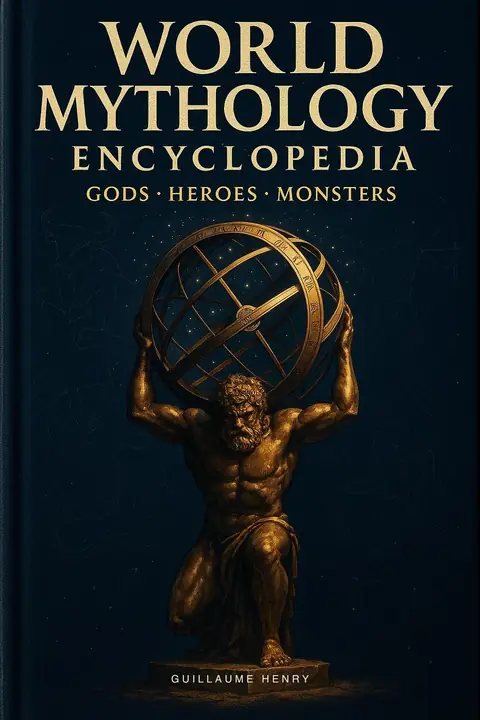
The World Mythology Book: The Gods, Heroes and Myths of Every Culture
The Gods, Heroes and Myths of Every Culture, in One Volume
The whole of world mythology in a single volume: Greek, Norse, Egyptian, Japanese, Hindu, Celtic, Slavic, Mesoamerican and African myths gathered side by side, each drawn from the primary sources.