Aztec
Aztec cosmology, gods, and ritual calendar explained through Nahuatl sources. From the Five Suns to Tenochtitlan's founding myth.
Browse Aztec
The Aztec mythology preserved in the Florentine Codex and the Codex Chimalpopoca is not a collection of fairy tales. It is a working cosmology built to explain why the sun rises, why maize grows, and why human blood must be offered to prevent the collapse of time itself. The gods do not rule from a distant heaven. They are engines of cosmic process, locked in cycles of creation and destruction that began long before the founding of Tenochtitlan and will continue long after.
The Spanish friars who recorded these traditions in the sixteenth century were hunting for idolatry. They found a theology as systematic as their own.
What is Aztec mythology?
Aztec mythology refers to the cosmological and ritual traditions of the Mexica people who ruled central Mexico from Tenochtitlan between the fourteenth and sixteenth centuries. The term "Aztec" is a modern convenience. The people called themselves Mexica, and their sacred narratives drew on older Toltec, Teotihuacan, and pan-Mesoamerican traditions stretching back over a millennium.
The mythology survives primarily through colonial-era sources: the Florentine Codex compiled by Bernardino de Sahagún with Nahua informants between 1545 and 1590, the Codex Chimalpopoca written in Nahuatl around the mid-sixteenth century, and pre-Columbian pictorial manuscripts like the Codex Borgia and Codex Borbonicus. These texts present a cosmos structured by duality, sacrifice, and calendrical precision. The gods are not immortal in the Greek sense. They die, transform, and require nourishment.
Time is cyclical. The universe has been created and destroyed four times already. We live in the fifth iteration, and it too will end.
The Five Suns: Aztec creation and cosmic cycles
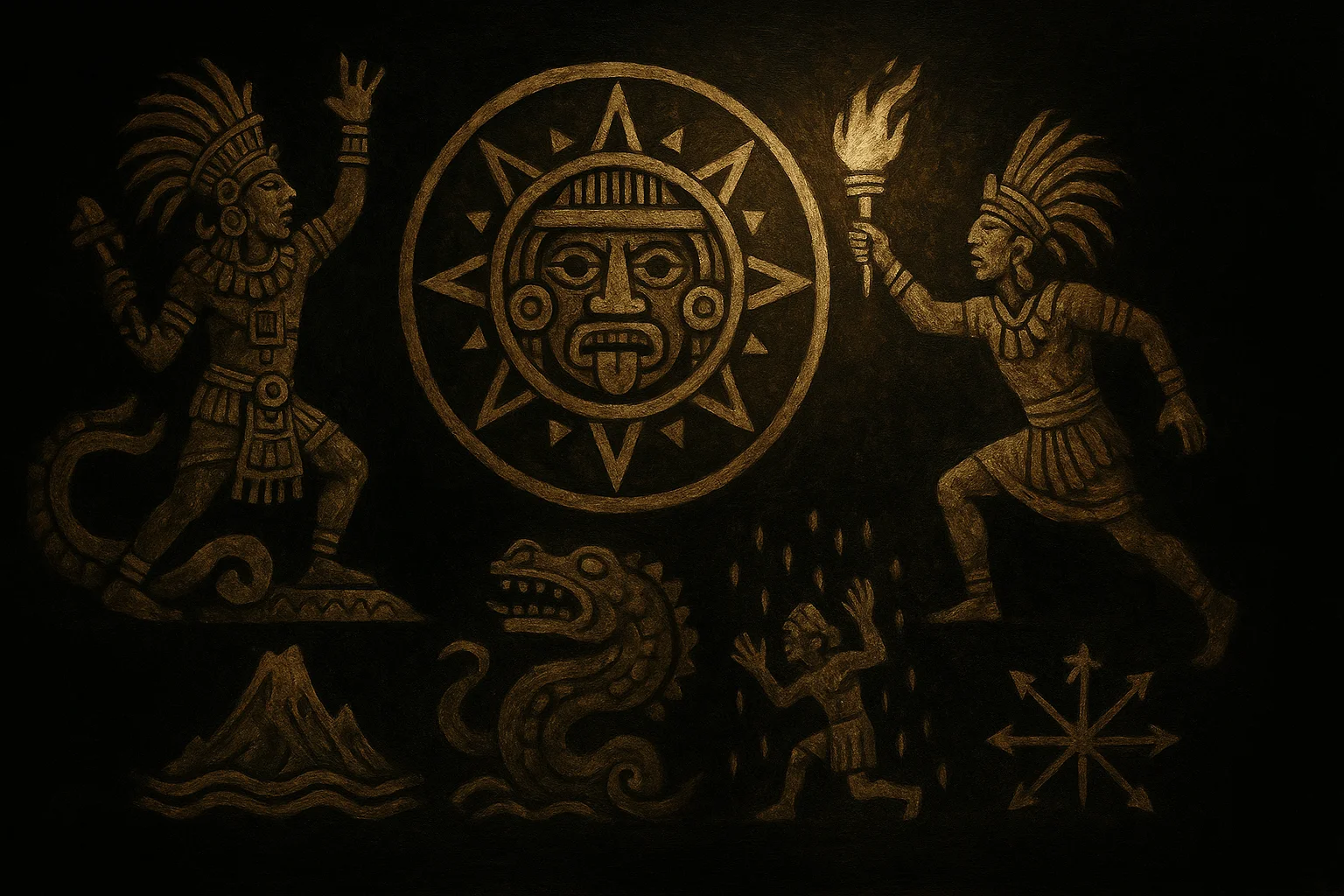
The doctrine of the Five Suns structures Aztec cosmology. Each Sun is an age of the world, presided over by a different deity and populated by a distinct form of humanity. Each ends in catastrophe. The Leyenda de los Soles in the Codex Chimalpopoca provides the most complete account, though details vary across sources.
The First Four Suns
The First Sun, Nahui Ocelotl (Four Jaguar), was ruled by Tezcatlipoca. Its people ate only acorns. Quetzalcoatl struck Tezcatlipoca down with a staff, and jaguars devoured the world's inhabitants. The Second Sun, Nahui Ehecatl (Four Wind), belonged to Quetzalcoatl. Tezcatlipoca took revenge, transforming the people into monkeys and scattering them with hurricanes. The Third Sun, Nahui Quiahuitl (Four Rain), was governed by Tlaloc. Quetzalcoatl sent a rain of fire, and the survivors became turkeys and dogs. The Fourth Sun, Nahui Atl (Four Water), belonged to Chalchiuhtlicue. A great flood destroyed it, and the people turned into fish.
These destructions are not punishments. They are structural failures, cosmic experiments that collapse under their own contradictions.
The Fifth Sun and the sacrifice at Teotihuacan
The Fifth Sun, Nahui Ollin (Four Movement), is the present age. Its creation required a sacrifice at Teotihuacan, the ancient city already in ruins when the Mexica arrived. The gods gathered in darkness. Two volunteered to become the sun: the wealthy Tecuciztecatl and the humble, sickly Nanahuatzin. A great fire was built. Tecuciztecatl hesitated four times at the flames. Nanahuatzin threw himself in without pause and became the sun. Shamed, Tecuciztecatl followed and became the moon. A rabbit was thrown in his face to dim his light.
But the sun did not move. The Florentine Codex records that the gods then sacrificed themselves, their blood setting the sun in motion. This is the theological root of Aztec sacrifice: the cosmos itself was born from divine self-offering, and it must be continually fed to prevent the sun from stopping in the sky. The Fifth Sun will end in earthquakes, as the name Four Movement suggests.
The Aztec pantheon: gods of a warrior empire
The Aztec pantheon is large, fluid, and organised by function rather than genealogy. Gods have multiple aspects, names, and roles depending on ritual context. Many predate the Mexica and were adopted from conquered or neighbouring peoples.
Huitzilopochtli and the founding of Tenochtitlan
Huitzilopochtli, the hummingbird god of war and the sun, is the patron deity of the Mexica. His birth is recorded in the Florentine Codex. His mother, Coatlicue, was sweeping the temple at Coatepec when a ball of feathers fell from the sky and impregnated her. Her daughter Coyolxauhqui and her four hundred sons, the Centzon Huitznahua, were enraged and plotted to kill her. Huitzilopochtli emerged fully armed from Coatlicue's womb, dismembered Coyolxauhqui, and hurled her body down the mountain. Her severed head became the moon.
This myth was ritually re-enacted at the Templo Mayor in Tenochtitlan. The temple's southern staircase represented Coatepec. Sacrificial victims were cast down it, their bodies echoing Coyolxauhqui's fall. Huitzilopochtli's shrine stood at the summit.
Quetzalcoatl, Tezcatlipoca, and the duality of creation
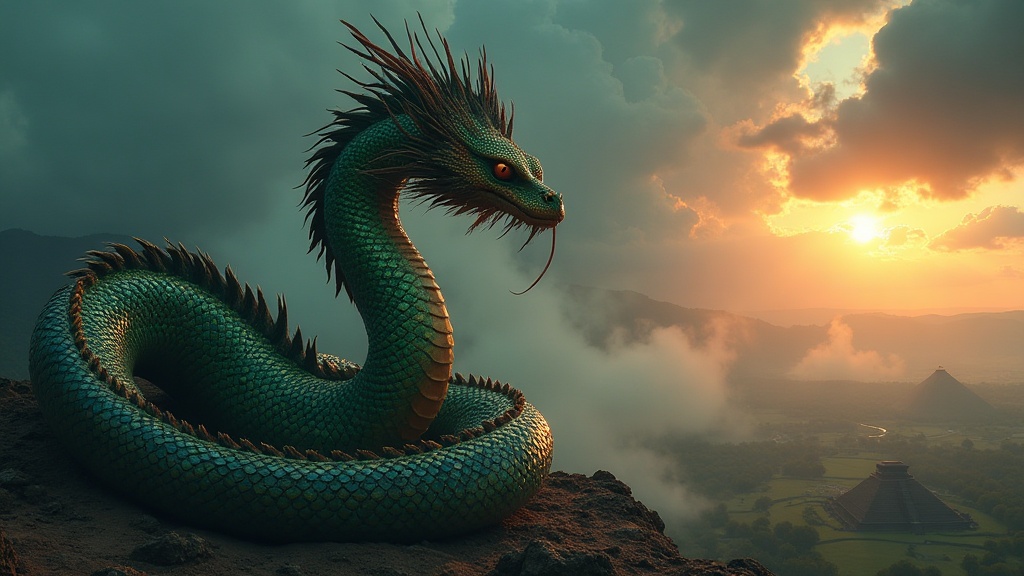
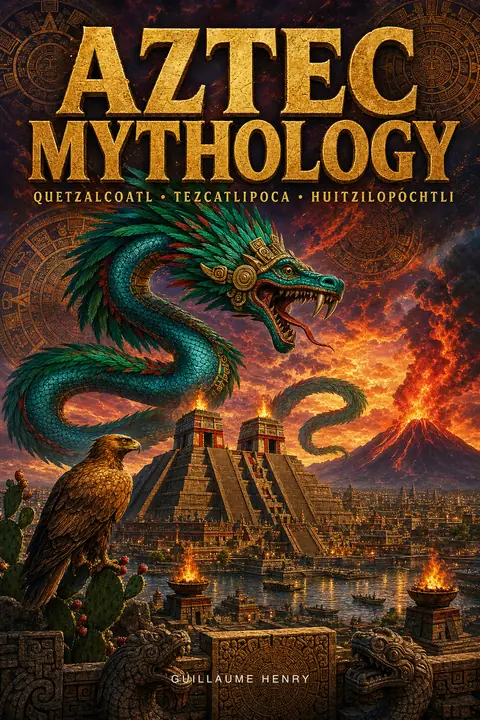
Quetzalcoatl, the feathered serpent, and Tezcatlipoca, the smoking mirror, are the twin engines of creation and destruction. They are not enemies in a moral sense but complementary forces. In the Historia de los Mexicanos por sus Pinturas, they create the earth by tearing apart the primordial crocodile Cipactli. Quetzalcoatl descends to Mictlan to retrieve the bones of the previous humanity, grinds them with his blood, and fashions the people of the Fifth Sun.
Tezcatlipoca is the god of night, sorcery, and destiny. His smoking obsidian mirror reveals hidden truths. He is capricious, granting kingship and withdrawing it. Quetzalcoatl is associated with wind, learning, and the planet Venus. In some traditions, he is the priest-king of Tollan who was tricked by Tezcatlipoca into drunkenness and incest, then fled eastward on a raft of serpents, promising to return. This myth later became entangled with the arrival of Cortés, though the historical evidence for Moctezuma mistaking the conquistador for a returning god is thin.
Quetzalcoatl
Creator god, bringer of maize and culture, associated with Venus and the wind. Sacrifices butterflies and snakes. Represents order and knowledge.
Tezcatlipoca
God of fate and sorcery, associated with the night sky and jaguars. Demands human hearts. Represents chaos and transformation.
Tlaloc, Chalchiuhtlicue, and the water gods
Tlaloc, the rain god, is one of the oldest deities in Mesoamerica, predating the Mexica by centuries. His goggled eyes and fanged mouth appear in Teotihuacan murals. He controls rain, lightning, and agricultural fertility. His paradise, Tlalocan, receives those who die by drowning, lightning, or water-related disease. Tlaloc's consort, Chalchiuhtlicue, governs rivers, lakes, and springs. She is also a mother goddess, protector of childbirth and newborns.
The Templo Mayor in Tenochtitlan had twin shrines: Huitzilopochtli's to the south, Tlaloc's to the north. This architectural duality reflects the Mexica worldview: war and water, sun and rain, sustaining the empire in tandem.
The ritual calendar and the mechanics of time
Aztec time is not linear. It is a mesh of two interlocking calendars, each with its own logic and ritual demands.
The tonalpohualli: 260 days and the sacred count
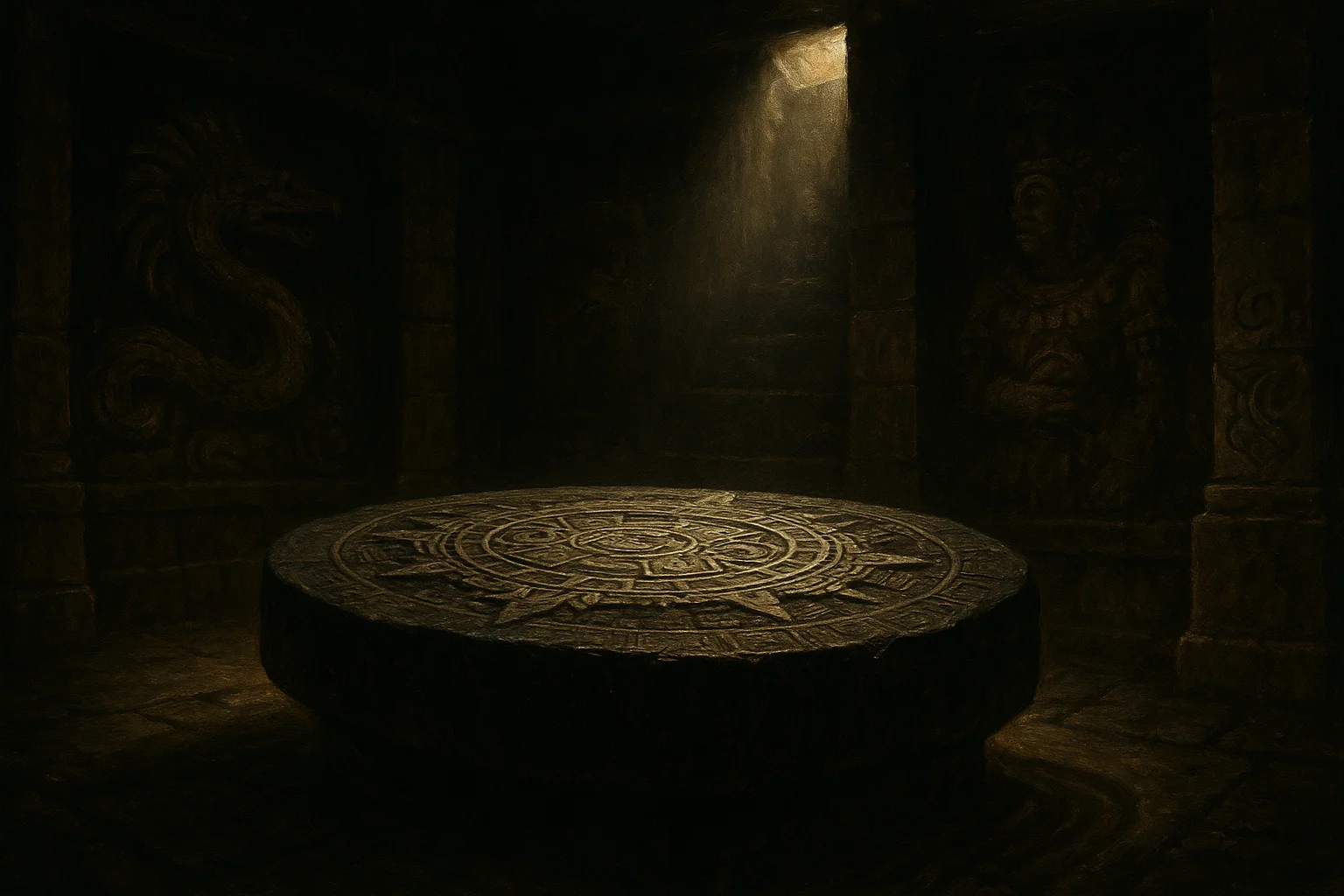
The tonalpohualli is a 260-day divinatory calendar composed of twenty day signs combined with the numbers one through thirteen. Each day has a name (Crocodile, Wind, House, Lizard, Serpent, Death, Deer, Rabbit, Water, Dog, Monkey, Grass, Reed, Jaguar, Eagle, Vulture, Movement, Flint, Rain, Flower) and a number. The combination determines the day's fortune and the fate of children born on it.
The Codex Borbonicus illustrates the tonalpohualli in full. Each day is ruled by a deity. Some days are favourable for planting, others for war, others for nothing at all. The 260-day cycle may derive from the human gestation period or the agricultural calendar of the Maya highlands. No one is certain.
The xiuhpohualli and the New Fire ceremony
The xiuhpohualli is a 365-day solar calendar divided into eighteen months of twenty days each, plus five unlucky days called nemontemi. The two calendars, tonalpohualli and xiuhpohualli, synchronise every 52 years in a cycle called the xiuhmolpilli, or calendar round. At the end of each 52-year period, the Mexica performed the New Fire ceremony. All fires in the empire were extinguished. Priests climbed Huixachtlan and watched the Pleiades cross the zenith. If the stars continued their course, a new fire was kindled on the chest of a sacrificial victim. Runners carried the flame to every temple and hearth. The world had been granted another 52 years.
Diego Durán describes the terror of the nemontemi days in his Historia de las Indias de Nueva España. Pregnant women were locked indoors lest they turn into beasts. Children were kept awake lest they become mice. The universe was fragile.
Human sacrifice and the theology of debt
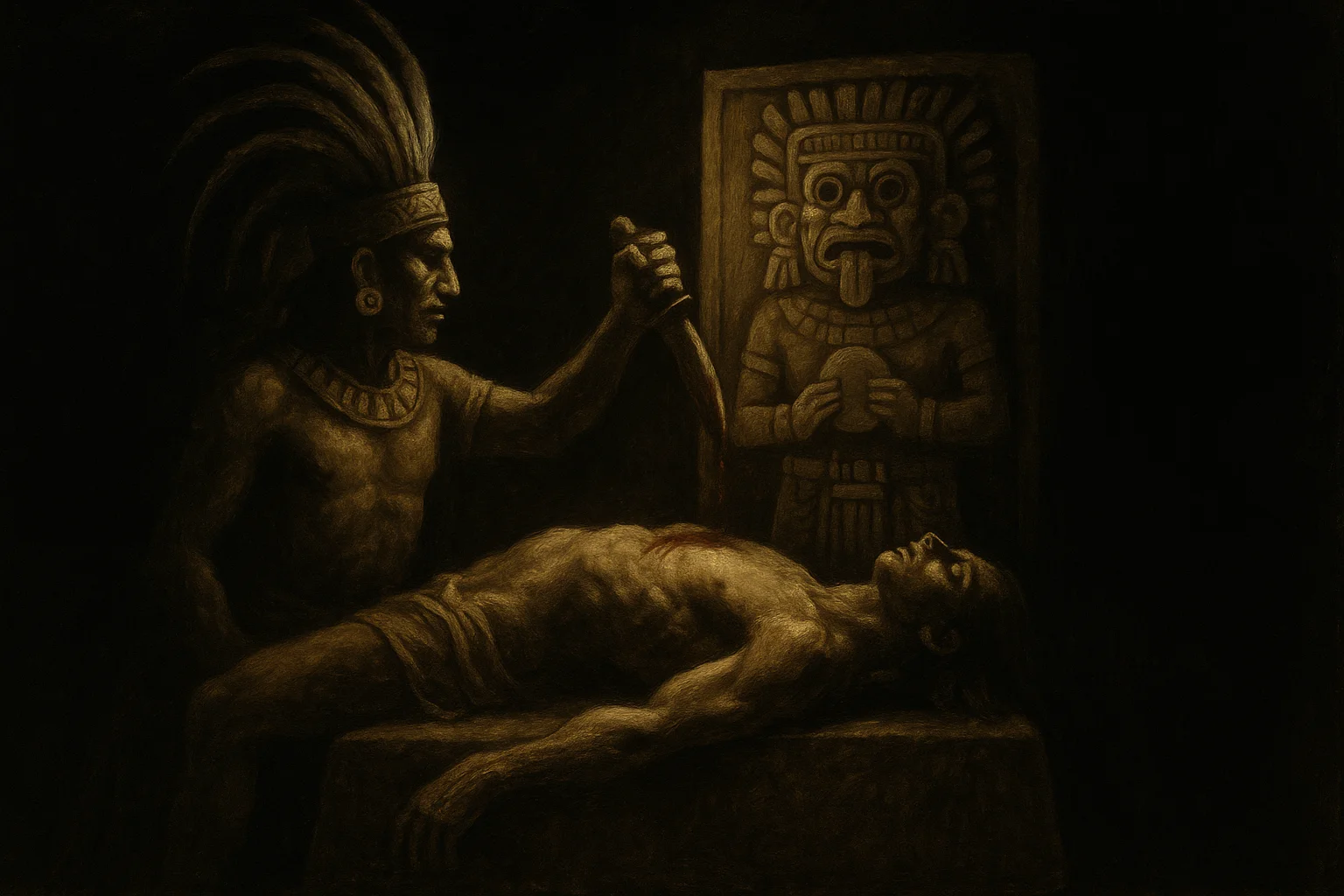
Human sacrifice in Aztec mythology is not cruelty. It is reciprocity. The gods sacrificed themselves to create the Fifth Sun. Humanity owes a blood debt, and the sun will not rise without payment. The Nahuatl term for sacrifice, nextlaoaliztli, means "the act of paying a debt."
The Florentine Codex records multiple forms of sacrifice: heart extraction, decapitation, drowning, arrow sacrifice, gladiatorial combat, flaying. Each method corresponds to a specific deity and ritual context. Victims were often captives taken in war, though children were sacrificed to Tlaloc, and the ixiptla, a person who embodied a god for a year before being sacrificed, was treated with reverence.
"Our lord, the lord of the near, of the nigh, thinketh what he will, determineth, amuseth himself. As he wisheth, so will he will. In the center of the palm of his hand he hath us; at his will he rolleth us about." Florentine Codex, Book VI
The scale of sacrifice is debated. Spanish sources claim tens of thousands were killed at the dedication of the Templo Mayor in 1487. Modern scholars treat these numbers with scepticism, noting that the Spanish had political reasons to exaggerate Aztec brutality. Archaeological evidence confirms sacrifice was widespread but does not support the highest colonial estimates.
The theology remains. The cosmos is sustained by offering. To withhold blood is to risk the end of the world, a concept that links Aztec practice to broader apocalypse myths across cultures.
Mictlan and the Aztec underworld
Mictlan, the land of the dead, lies in the north and is ruled by Mictlantecuhtli and his consort Mictecacihuatl. It is not a place of punishment or reward. It is a destination determined by the manner of death, not the quality of life. Warriors who died in battle and women who died in childbirth went to the sun's paradise. Those who drowned or were struck by lightning went to Tlalocan. Everyone else went to Mictlan.
The journey takes four years and nine levels. The dead cross a river with the help of a dog, pass between clashing mountains, traverse a mountain of obsidian knives, endure icy winds, and finally dissolve into nothingness. The Florentine Codex describes offerings left for the dead: food, water, and a jade bead placed in the mouth to serve as the heart in the afterlife.
This structure of underworld journeys mirrors the layered cosmology of the living world. The universe has thirteen heavens above and nine levels below. Humans occupy the middle.
Sources and the problem of colonial filters
Every major source on Aztec mythology was written after the Spanish conquest. The Florentine Codex, our most detailed source, was compiled by Sahagún with the explicit goal of understanding indigenous religion in order to eradicate it. The Nahuatl testimonies were filtered through Christian categories and translated into Spanish by friars who saw demons where the Mexica saw gods.
Pre-Columbian codices like the Codex Borgia and Codex Borbonicus survive, but they are pictorial and require interpretation. The Codex Chimalpopoca was written in Nahuatl by indigenous scribes but decades after the fall of Tenochtitlan, when memory and politics had already begun to reshape the tradition.
We do not have an unmediated Aztec voice. What we have is a conversation between Nahua elders and Spanish friars, recorded in a language under siege. The mythology is real, but the frame is colonial. Scholars like Miguel León-Portilla and Alfredo López Austin have worked to recover indigenous perspectives by reading the Nahuatl texts against the Spanish glosses, but uncertainty remains.
The gods are still there. The filters are visible.
Frequently asked questions
What are the Five Suns in Aztec mythology?
The Five Suns are successive world ages, each ruled by a different god and destroyed by a specific catastrophe: jaguars, wind, fire, flood, and earthquakes. We live in the Fifth Sun, Nahui Ollin, which began with the gods' self-sacrifice at Teotihuacan. Each Sun had a distinct humanity and staple food, and each ended when cosmic balance failed.
Why did the Aztecs practice human sacrifice?
The gods sacrificed themselves to create the Fifth Sun, and the sun requires blood to continue moving across the sky. Sacrifice is payment of a cosmic debt, not appeasement of wrath. The Nahuatl term nextlaoaliztli means debt payment. Without it, the universe collapses.
Who are the most important gods in the Aztec pantheon?
Huitzilopochtli, the Mexica war god, and Tlaloc, the ancient rain deity, shared the Templo Mayor's summit. Quetzalcoatl and Tezcatlipoca are the dual creators, locked in cycles of conflict and cooperation. Mictlantecuhtli rules the underworld, and Chalchiuhtlicue governs water and childbirth. Importance varies by ritual context.
What is the Aztec ritual calendar and how does it work?
Two calendars interlock: the 260-day tonalpohualli, a divinatory cycle of twenty day signs and thirteen numbers, and the 365-day xiuhpohualli, a solar calendar of eighteen months. They synchronise every 52 years in the calendar round, marked by the New Fire ceremony. Each day has a ruling deity and fortune.
What happens to the dead in Aztec belief?
Destination depends on manner of death, not moral conduct. Warriors and women who died in childbirth went to the sun's paradise. Drowning or lightning victims went to Tlalocan. Most others journeyed through Mictlan's nine levels over four years, crossing rivers and mountains before dissolving into the underworld.
How reliable are Spanish colonial sources on Aztec mythology?
All major sources were written after the conquest, often by friars seeking to convert or condemn. The Florentine Codex preserves Nahuatl testimonies but filters them through Christian theology. Pre-Columbian pictorial codices survive but require interpretation. We have no unmediated Aztec voice, only a colonial conversation with indigenous memory.