
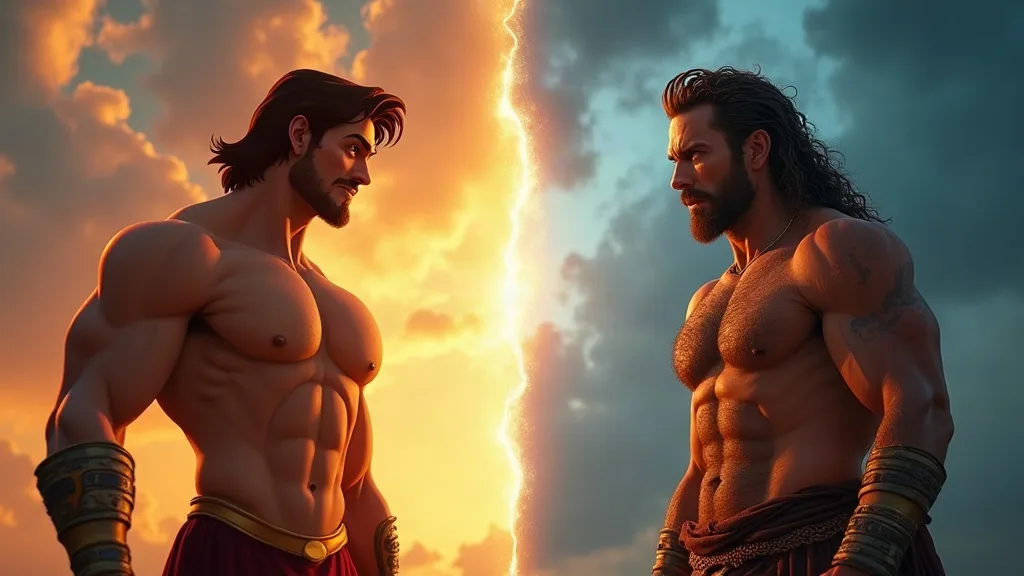
Disney's Hercules vs the Real Heracles: How Modern Animation Rewrote Ancient Greece
Disney's 1997 Hercules is a feel-good hero's journey. The ancient Heracles is something far stranger: a semi-divine bastard hounded by a goddess, forced into slavery, driven mad. See where the film nailed the source and where it invented an entirely new myth.
Contents
In Disney's 1997 "Hercules," a baby boy is kidnapped from his godly parents and raised by a kind peasant couple. He's clumsy, he's a social outcast, and he just wants to find where he belongs. By the end of the film, he realizes his true worth, defeats the villain, and earns a place among the gods. It's a story about identity and self-acceptance. It's a story about home.
The Heracles of Greek myth would not recognize himself in this film. The ancient Heracles was born of infidelity. He was hunted by divine rage before he could walk. He killed a man in a fit of madness. He spent years enslaved, wrestling monsters with his bare hands, and his final reward was not apotheosis but a funeral pyre that consumed him alive. Yet both are Heracles. Both are about a man caught between two worlds. What changed is not the story itself, but what we want that story to mean.
The Hero's Birth: Legitimacy vs Bastardry
Disney opens with grandeur: the baby Hercules is born in the palace of Mount Olympus, genuinely loved and wanted by both Zeus and Hera. The film even shows Hera blessing the child. Then Hades, out of spite, has the baby stolen and turned mortal as part of a scheme to overthrow the gods. The premise is clean. The boy was never meant to be in danger; he was made mortal as punishment.
In the ancient myths, recorded most fully in Hesiod's Theogony (a Greek poem from around 700 BC that charts the gods' origins and genealogies) and later elaborated in Ovid's Metamorphoses, the story is messier. Heracles was born of Zeus's infidelity. Zeus seduced Alcmene, the wife of the mortal king Amphitryon, by disguising himself as Amphitryon and lying with her on the same night the real Amphitryon was returning from war. Alcmene became pregnant with twins: Heracles (the bastard child of Zeus) and Iphicles (the legitimate son of Amphitryon). The two boys were born on the same night, in the same chamber. From birth, they shared a mother but lived in a state of painful ambiguity.
Hera, Zeus's true wife, was enraged. Not at Heracles himself, but at the evidence of Zeus's infidelity. She took that rage out on the boy. Within hours of his birth, Hera sent two serpents to strangle him in his cradle. The infant Heracles, barely able to grip anything else, seized both snakes by their throats and crushed them. He was less than a day old.
This is the ancient version's brutal honesty: the child did not deserve the goddess's hatred, yet he suffered it anyway. His only crime was existing as the product of his father's lust. No one kidnapped him. No spell made him mortal. He was supposed to be semi-divine, and that made him a target. He was born into a conflict between his divine father and his divine stepmother that he could never escape.
Growing Up Mortal: The Struggle for Belonging
Disney's Hercules grows up in a small village, raised by Phil (a satyr, a woodland creature with human torso and goat legs) and a kindly older couple, Amphitryon and Alcmene. He's bullied by other children, destroys property accidentally, and dreams of being accepted. When he discovers he's a god's son, he gets trained and eventually proves himself worthy. It's a narrative of overcoming your perceived limitations.
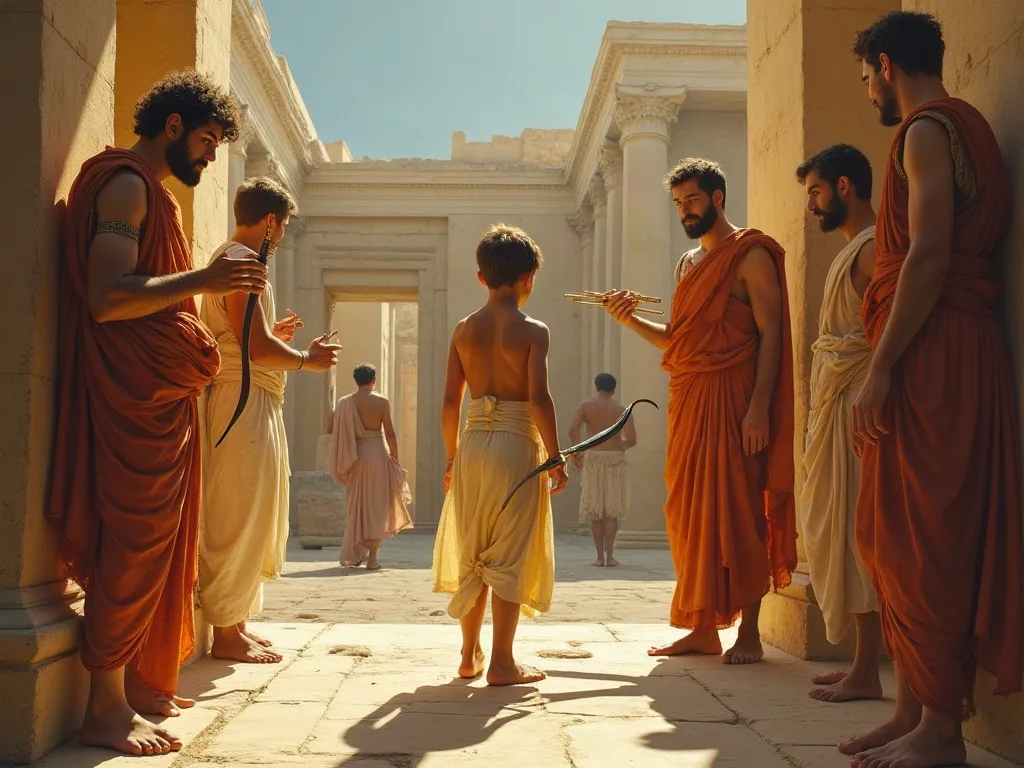
The ancient Heracles grew up in Thebes (a real Greek city), aware from childhood that he was different, but not isolated by shame. He was trained in multiple disciplines: music from Linus (who taught him to play the lyre), wrestling from Jason of Thessaly, and archery from Philomeles. The historical writer Pausanias (who lived in the 2nd century AD and recorded many Greek myths and local traditions) notes that Heracles was also trained in chariot warfare. He was not bumbling or awkward. He was systematically schooled in the skills of a hero.
But the ancient texts hint at a psychological tension. Heracles was extraordinarily strong from infancy, and strength without purpose is dangerous. One early myth, recorded in several ancient sources, tells of the young Heracles being taught music by the bard Linus. Heracles grew frustrated or angry at a correction Linus made, grabbed his lyre, and beat Linus to death with it. The first human death caused by Heracles was not a heroic deed but a moment of rage. Even in adolescence, his divine strength and mortal circumstances made him volatile.
Disney's Phil acknowledges Hercules' awkwardness by training him; the ancient Heracles had to learn that his strength could kill. There's a difference. One is a coming-of-age story about discovering your gifts. The other is a tragedy about learning to live with a weapon inside your own body.
The Twelve Labors: Slavery, Not Glory
This is where the films diverge most starkly. In the Disney film, Hercules performs a series of heroic tasks (fighting the Hydra, capturing Cerberus) to prove himself worthy of godhood and to win the heart of his love interest, Meg. The labors are quests. They have purpose. They lead somewhere.
In the ancient myths, the Twelve Labors were not Heracles' quest. They were his punishment.
Here's what happened in the classical sources: After his training, Heracles fell in love with a mortal woman named Megara and married her. They had children. But Hera, never forgetting her rage, reached into Heracles' mind and drove him insane. In a fit of madness, Heracles murdered Megara and their children with his own hands. Later accounts say he killed not just his family but his cousin Iphitus as well, throwing him from a city wall.
When Heracles regained his senses and realized what he had done, he was devastated. He consulted the Oracle at Delphi (a priestess who spoke for the god Apollo and was consulted by Greeks for prophecies) and was told that the only way to expiate his crime was to serve Eurystheus, a mortal king, and complete whatever tasks Eurystheus commanded.
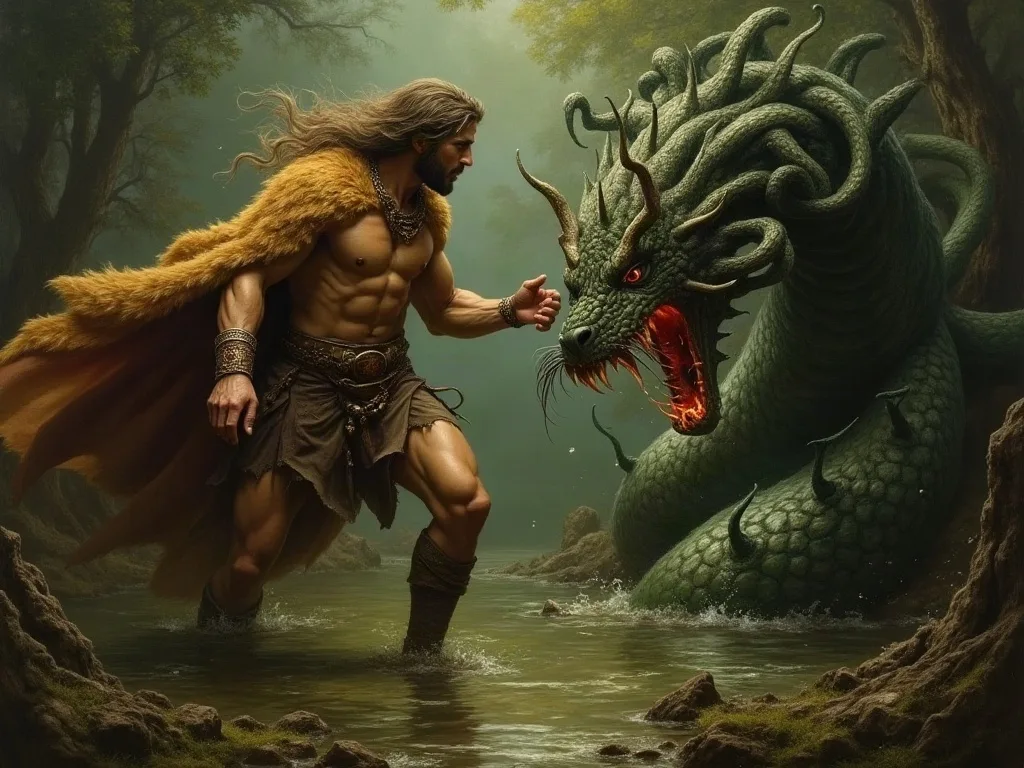
The Twelve Labors were, therefore, not a path to glory but a debt to be paid. Heracles was enslaved by his own guilt and by divine decree. He had to kill the Nemean Lion (whose hide was impervious to all weapons, so he strangled it), slay the Hydra (a many-headed serpent that grew two heads for each one cut off), capture the Golden Hind of Artemis (a sacred deer that he had to steal without harming it), obtain the girdle of Hippolyta (the queen of the Amazons), obtain the sandalwood apples from the nymphs in the far west, and capture Cerberus (the three-headed guard dog of the underworld). Each labor was designed to seem impossible. Each one was a humiliation for a demigod to endure.
Disney's Labors
Part of Hercules' journey to prove himself and become a true hero. Designed to inspire crowds and earn him fame. A path to romantic and divine reward. Defeat Hades and reclaim your place in heaven.
Mythic Labors
Punishment for murdering his wife and children while driven mad by a goddess. Enslavement to a mortal king who despised him. Tasks designed to humble and exhaust a demigod. No reward but the absence of further suffering.
In the film, Hercules' public victories transform him from outcast to celebrity. In the myths, Heracles' labors were a private atonement. Few people beyond Eurystheus witnessed most of them. The labors were not about becoming someone; they were about surviving long enough to become someone worth saving.
Meg, Megara, and the Question of Love
Disney's Megara is a human woman with a complex past. She had a bargain with Hades; she gave up her soul to save her lover, and he abandoned her anyway. She's cynical, world-weary, and afraid of love until Hercules wins her trust. Their relationship is the emotional core of the film.
The ancient Megara exists in the mythic sources but is almost a footnote. We know her name. We know she died at Heracles' hands during his madness. We know little else. Her personality is absent. Her voice is absent. She exists as the motivation for Heracles' guilt and penance, not as a character in her own right.
But there was another famous woman in Heracles' life: Iole (also spelled Iola), the daughter of a king named Eurytus. Heracles fell in love with Iole and defeated Eurytus in an archery contest to earn her hand. But Eurytus, distrusting Heracles, refused to give up Iole. Later, Heracles' companion Philoctetes (who would later become famous in the Trojan War) was struck by one of Heracles' poisoned arrows by accident and was abandoned on an island. Finally, Heracles sacked the city of Oechalia, killed Eurytus, and took Iole by force as his prize. Iole later bore Heracles a son.
The ancient myth is ugly: conquest, forced marriage, the casual destruction of a king's household. Disney's film inverts this: Meg is not conquered; she is cherished. She is not a prize; she is a person with her own agency and story. In modernizing the myth, Disney did not just simplify; it humanized. Whether that's a betrayal or an improvement depends on your view of what myths are supposed to do.
The Death of a Hero: Apotheosis vs. Immolation
Disney ends on triumph. Hercules sacrifices his immortality to save Meg, and because he acts out of pure love, he becomes a true god after all. He ascends to Mount Olympus with Meg, and the final scene shows them surrounded by all the other Olympians in a celebration of his homecoming. It's a fairy-tale ending: the outcast becomes fully accepted. The hero comes home.
The ancient Heracles' death is unremittingly tragic. Near the end of his life, Heracles took another wife, Deianira. A centaur named Nessus, who had tried to abduct Deianira, tricked her into giving her husband a "love potion" that was actually a shirt soaked in the centaur's own poisoned blood. When Heracles put on the shirt, the poison seared his flesh. The pain was so intense that he could not bear to live. He built a funeral pyre on Mount Oeta (a real mountain in northern Greece), lay down, and asked his companion Philoctetes to light the fire.
As the flames consumed him, one of several ancient sources says, a cloud descended and lifted him to Mount Olympus. He was made a god, not through love or sacrifice or self-discovery, but through suffering so extreme that death was relief. Even his ascension to godhood was conditional: it came after his suffering, not as its resolution, and it erased the man he had been in mortal life. The apotheosis was a kind of death.
Some later sources, written after Heracles had been venerated as a god in various Greek cities, made his afterlife more peaceful. But the original texture is one of agony, endurance, and a body so destroyed that transcendence became the only escape.
Why Disney Changed Everything: The Modern Hero's Journey
Every adaptation rewrites. The question is why Disney chose these changes. The answer lies in the story Disney wanted to tell: not a tragedy of impossible guilt and unrelenting punishment, but a coming-of-age narrative about self-acceptance and the power of love to redeem you.
Disney's Hercules is structured around Joseph Campbell's concept of the "Hero's Journey," a narrative arc in which an ordinary person is called to adventure, faces trials, and returns transformed. Campbell's framework, popularized in his 1949 book "The Hero with a Thousand Faces," has become the template for modern blockbuster storytelling. To fit that template, the ancient myth had to be stripped of its psychological weight: no infanticide attempts, no madness, no dead family, no enslavement, no wife burned alive as collateral damage.
But something valuable is lost in translation. The ancient Heracles speaks to a different emotional truth: that you can do everything right and still suffer, that strength is as much a curse as a blessing, that heroism is not about being special but about enduring despite everything. The ancient myth says suffering can change you into a god. Disney's myth says love can change you into a hero.
These are not the same thing. And both are true, in their own ways.
How Pop Culture Keeps Heracles Alive
The contrast between Disney and the ancient myths has spawned decades of reinterpretations. The 2014 video game "Smite," a multiplayer online battle arena game, casts Heracles as a warrior in a supernatural arena, stripping away psychology for combat spectacle. The "Assassin's Creed Odyssey" (2018) video game includes Heracles as a robed sage whose strength has made him supernatural and isolated. The mythology podcast "Lore" by Aaron Mahnke has covered Heracles' actual labors in vivid detail, contrasting them with modern heroism tropes.
And yet Disney's version persists as the dominant pop-culture image. That itself is instructive. It tells us what modern audiences want from a hero: not perfection or invulnerability, but belonging. Not conquest but acceptance. Not survival but homecoming.
The ancient Heracles might envy that. He never got to come home. But he blazed a trail so bright that we're still following it, even if we've redrawn the map.

Frequently asked questions about Disney's Hercules and the real Heracles myth?
Frequently asked questions
Did the ancient Heracles actually perform the Twelve Labors?
The Twelve Labors are real components of Greek mythology, recorded in sources like Ovid's "Metamorphoses" and described in detail by later Greek writers like Apollodorus. However, they were not a quest Heracles chose; they were penance imposed on him by the god Apollo's oracle after he murdered his family while driven mad by the goddess Hera. The labors were a punishment, not a path to glory.
Was Heracles actually a god in ancient Greek mythology?
Heracles was semi-divine: his father was Zeus, his mother was the mortal woman Alcmene. In ancient Greek religion, Heracles was also venerated as a god in various cities and had temples dedicated to him. But in the heroic myths, he lived and suffered as a man. His ascension to full godhood happened only at his death, after he was consumed by poison on a funeral pyre.
Who was Megara in ancient Greek myth, and did she matter as much as she does in the Disney film?
Megara was a mortal woman Heracles married, but she appears in the myths only briefly. Heracles killed her (along with their children) during a fit of madness sent by Hera. Her death is the catalyst for Heracles' guilt and his subsequent penance of the Twelve Labors. Disney's version gave her a full character arc and agency; the ancient sources treat her primarily as the victim whose death drives the plot.
Why did Hera hate Heracles so much if he wasn't her son?
Hera's rage was not directed at Heracles personally but at what he represented: proof that her husband Zeus had been unfaithful. In punishing Heracles, she was punishing the child born from Zeus's infidelity. It's a pattern in Greek mythology: divine jealousy and wounded pride are often visited upon innocent mortals or demigods, because they cannot directly harm other gods.
Is the Disney version completely inaccurate to the myth?
Not inaccurate so much as different. Disney kept the core elements: a semi-divine hero, labors involving monsters, a journey toward acceptance, and characters like Pegasus and Philoctetes. But it removed the tragedy, the madness, the murder of his family, the enslavement, and the agonizing death. It's a faithful adaptation, a deliberate creative reinterpretation, rather than a betrayal, though it tells a story the ancient myth never told.
Which version should I read or watch first?
Start with Disney's "Hercules" if you want an accessible, emotionally satisfying hero's journey that's genuinely entertaining. Then read Ovid's "Metamorphoses" or a summary of the ancient myths in a book like Edith Hamilton's "Mythology" to see the weight and complexity underneath. The contrast is the point: it shows how the same character can carry very different meanings in different eras.
The Myth That Refuses to Die
Every generation gets the Heracles it needs. The ancient Greeks needed a hero who endured suffering with dignity. The Renaissance needed a symbol of human strength and reason. The Victorians needed a moral exemplar of duty. Disney needed a story about finding where you belong. The video game industry needs a warrior archetype.
None of these versions erases the others. They coexist, overlap, and argue with each other. You can watch Disney's "Hercules" and find it shallow. You can read the ancient myths and find them brutal. Both reactions are valid. Both point toward something real in the story.
What's remarkable is that the ancient Heracles, born from divine infidelity and hunted before he could walk, speaking no line of dialogue in most of the myths that bear his name, has become one of the most recognizable figures in Western culture. A man defined by his suffering has become a symbol of achievement. A hero forced into slavery has inspired countless stories of freedom and self-determination. A bastard child whose birth was a scandal has become a picture of belonging and home.
If that's not the deepest transformation myth can perform, it's hard to imagine what would be.
Free 25-page sample
Want the whole story?
Take the first 25 pages free. If it pulls you in, the full edition is yours as an instant PDF download, with a paperback on Amazon for selected titles.

Mythology
The World Mythology Book: The Gods, Heroes and Myths of Every Culture
The Gods, Heroes and Myths of Every Culture, in One Volume
The whole of world mythology in a single volume: Greek, Norse, Egyptian, Japanese, Hindu, Celtic, Slavic, Mesoamerican and African myths gathered side by side, each drawn from the primary sources.