
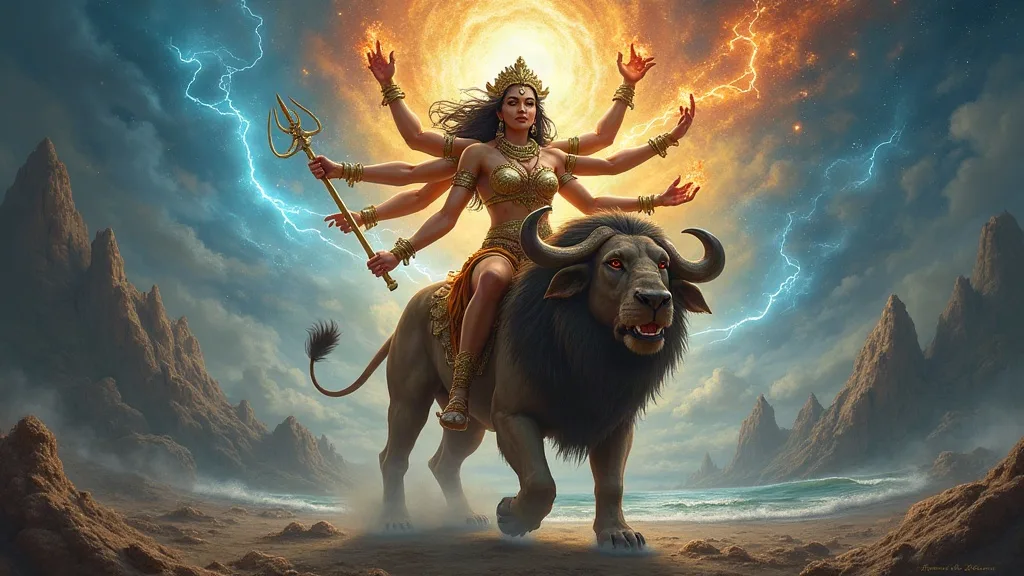
Durga the Invincible Warrior Goddess: Hindu Mythology's Greatest Protector
Durga defeats the buffalo demon in a battle that spans the cosmos. Learn how this warrior goddess emerged from the collective power of all Hindu deities and became the supreme protector against chaos and evil.
Contents
In the moment before creation fractures, all the gods stand facing annihilation. A demon named Mahishasura has become so powerful that no single deity can defeat him. The Brahma Sutras, ancient texts that codify Hindu philosophy, describe how the gods' combined rage and brilliance condense into a single, radiant form: a goddess with ten arms, riding a lion, her eyes blazing with cosmic fury. This is Durga the invincible warrior goddess, and her emergence marks the turning point when order reclaims the world from chaos.
Durga is not born from a single god. She crystallizes from the fury of Brahma the creator, Vishnu the preserver, Shiva the destroyer, and all the minor deities combined. Each god gives her a weapon: Shiva's trident, Vishnu's discus, Indra's thunderbolt, Yama's staff. She is simultaneously all of them and none of them, a force unto herself. Her story, told across the Devi Mahatmya (a 700-verse scripture embedded in the Markandeya Purana written between the 5th and 8th centuries CE), is the core text that explains Hindu philosophy's most radical claim: that the ultimate creative and destructive power of the universe is feminine.
From Durga flows every other goddess in the Hindu pantheon. Kali is her fury unleashed. Lakshmi is her grace. Saraswati is her wisdom. But Durga herself stands apart, embodying the warrior principle that protects righteousness when persuasion fails.
The Myth of Mahishasura: Why the Gods Needed a Goddess
The demon Mahishasura begins like all demons in Hindu mythology: ambitious and clever. He gains a boon from Brahma that makes him nearly undefeatable. The catch (there is always a catch) is that no man, god, or beast born of man can kill him. What Brahma's words do not cover is precisely what matters most.
Mahishasura's power metastasizes. He conquers heaven. He defeats the Adityas (the gods of light), throws Indra from his throne, and dominates every realm. The gods, stripped of their authority, gather on the slopes of the Himalayas in desperation. It is here that the Devi Mahatmya says they perform a cosmic ritual, their combined energies streaming upward like flames converging into a bonfire.
From that brilliance steps Durga, fully armed. She is beautiful and terrible. She carries a curved sword, a shield, a bow and arrows, a noose, an elephant goad, a conch shell, and a discus. Each weapon is consciousness taking form. Her lion, Vahana, is not a mount but her own animal nature, the predatory instinct that knows when mercy ends and war begins.
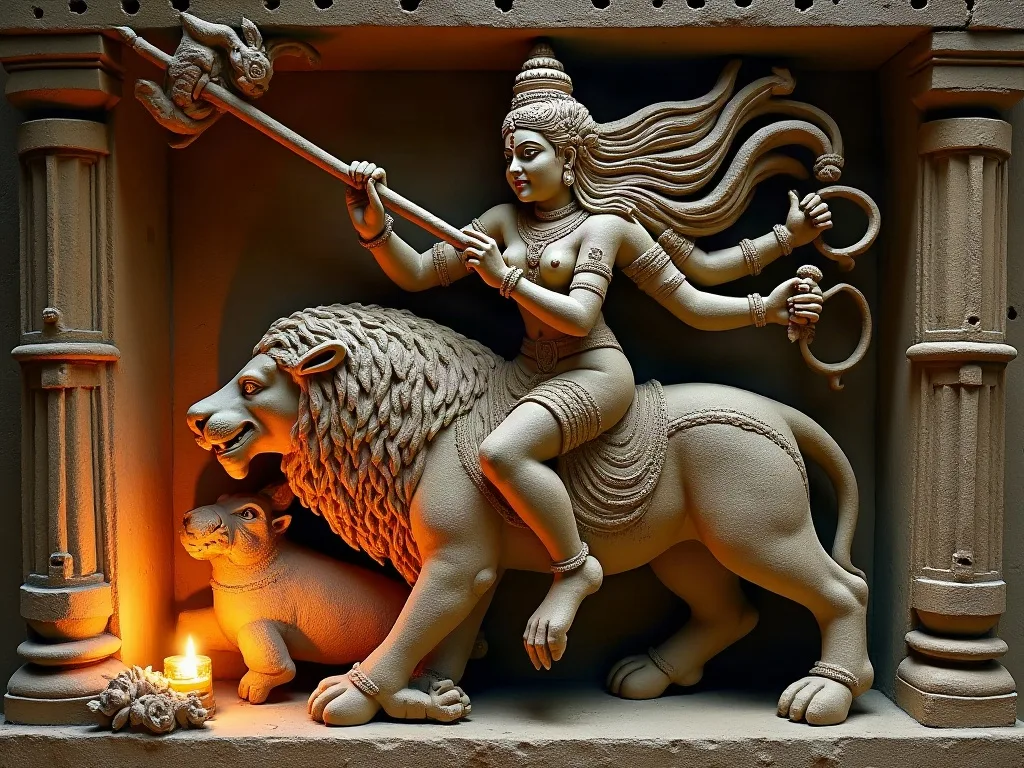
Durga descends to the mortal plane and confronts Mahishasura on the battlefield. The demon, arrogant, believes he can overpower her through sheer rage. He shifts his form again and again: from buffalo to lion to elephant to serpent. Each time, Durga matches him. The battle rages for nine days. Mountains crumble. Oceans churn. Stars scatter across the sky like sparks from a forge.
On the ninth day, as Mahishasura attempts one final transformation, Durga pierces him with her trident. The demon falls. His blood does not pollute the earth; it nourishes it. The cosmos exhales. Order returns.
The Ten Forms: Durga Beyond the Buffalo
Durga the invincible warrior goddess is not monolithic. She appears across Hindu texts and regional traditions in ten distinct forms, each addressing a different cosmic threat and human need.
The first nine correspond to the nine nights of Navaratri, the festival celebrating her victory:
Shailaputri (Daughter of the Mountain) appears first, embodying the strength of earth itself. She rides a bull and carries a trident and lotus. She represents the foundation: without her, nothing stands.
Brahmacharini (the Ascetic) is wisdom refined through meditation. She holds a prayer bead in one hand and a water pot in the other. She is the goddess who practices austerity, showing that power and discipline intertwine.
Chandraghanta (Bell-shaped Moon) radiates golden light. Her forehead bears a crescent moon in the shape of a bell. She is the warrior prepared for battle, her bell a warning that echoes through all worlds.
Koosmanda (Born from Cosmic Energy) is laughter and abundance. She sits on a lion throne and holds a bowl of honey. She reminds worshippers that joy and fierceness are not opposites but partners.
Skandamata (Mother of Skanda) cradles the war god Murugan in her lap while riding a lion. This form reveals that Durga is not only destroyer but nurturer, a mother whose love for her children fuels her protection.
Katyayani (Born to Destroy Tyranny) is the warrior in her purest form. She rides a lion, her expression stern, her weapons at the ready. This is the form that defeats Mahishasura.
Kaalratri (The Night That Destroys Time) is darkness incarnate, her skin black as midnight, her hair unbound. She carries a curved sword and a noose. This form addresses fears directly: she teaches that darkness and death are not evil but necessary transitions.
Mahagauri (The Extremely White Goddess) emerges from Kaalratri's fierceness as pure calm. She is pale, serene, her lion gentle beneath her. She shows that after every battle comes healing.
Siddhidatri (The Bestower of Perfection) grants spiritual attainment. She sits not on a lion but on a lotus, surrounded by the nine celestial perfections. She is the endpoint: the moment when struggle becomes wisdom.
The tenth form, Shivaratri or sometimes Bhairavi, is Durga as Shiva's eternal consort, the feminine principle that balances masculine creation. She appears in regional variations and certain temple traditions, completing the cycle.
Regional Faces: Bengal, South India, and the Goddesses Who Share Her Throne
Durga's worship transforms across the subcontinent. In Bengal, she becomes the focal point of the most visceral of Hindu festivals, Durga Puja. Each autumn, millions construct elaborate temporary temples called pandals. The goddess is sculpted in clay, her ten arms spread wide, her lion rearing beneath her, Mahishasura's severed head at her feet. For five days, the entire region pulses with music, theater, and collective prayer. The clay goddess is then immersed in the river: a reminder that all forms are temporary, even the divine made visible.
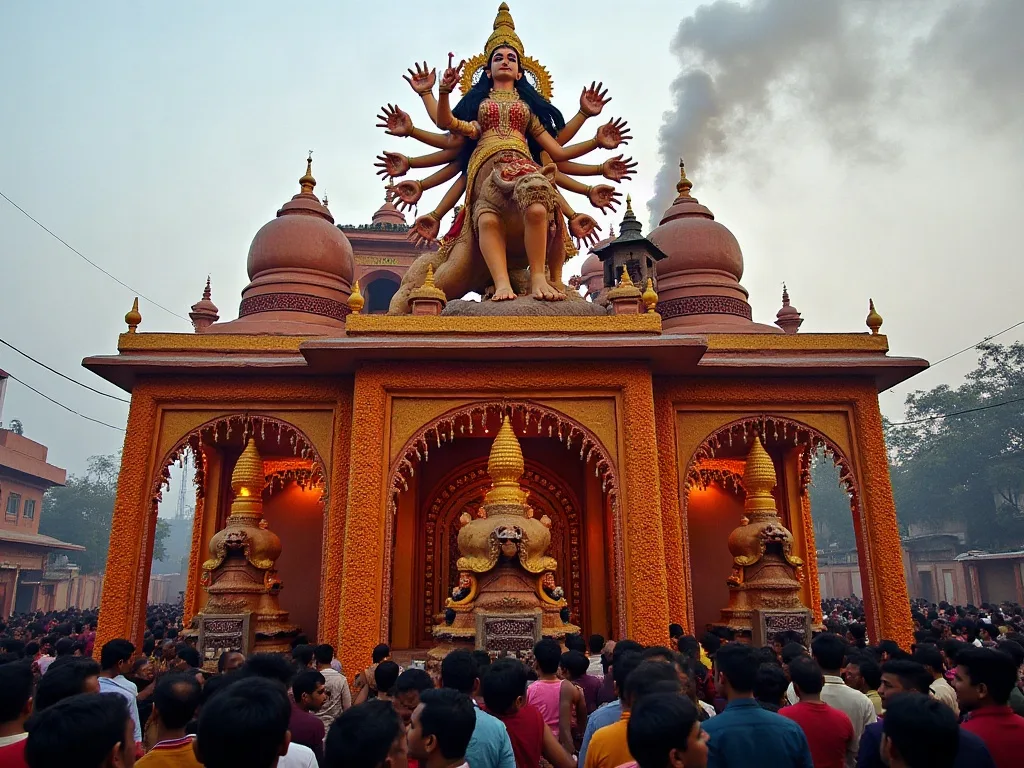
In Tamil Nadu and Karnataka, Durga merges with Shakti, the feminine principle of cosmic energy. She becomes Mariamman, the goddess of rain and agricultural fertility, worshipped by farmers who understand that the same force that defeats demons also brings monsoons that save harvests. In Himachal Pradesh, she is Kullu Devi, the protective deity of a region, her worship woven into local landscape and ancestry.
In Kerala, Durga's story overlaps with that of Kali, her most fearsome aspect. Kali is Durga's untamed fury, the dark energy that devours evil and ego alike. If Durga is the warrior controlled, Kali is the warrior uncontained. Yet both are aspects of the same cosmic principle: the feminine will that refuses subjugation.
The Devi Mahatmya explicitly names other demons Durga defeats beyond Mahishasura: Shumbha and Nishumbha, two brothers who attempted to dominate all worlds. These battles occupy nearly as much scriptural space as Mahishasura's defeat, yet receive less popular attention in the West. Each demon represents a different kind of threat: Shumbha is pride, Nishumbha is deception. Durga defeats them not through raw power alone but through strategy, transformation, and an understanding that evil rarely announces itself simply.
The Iconography of Power: Why Every Symbol Matters
Every detail of Durga's appearance in Hindu art and temple sculpture communicates theology. She is never depicted passively. Even in stillness, she is coiled.
Her ten arms are not mere abundance. They represent the ten directions of space, the ten senses, the totality of action. When a worshipper approaches a Durga statue and traces the path of each arm with their eyes, they are meditating on the idea that the divine addresses the whole world at once, that protection radiates in every direction.
Her lion (or sometimes tiger) is Vahana, the vehicle that carries her meaning. Vahana does not mean slave. The relationship between goddess and beast is reciprocal: she grants the lion sovereignty over the forest; the lion gives her mobility and primal grace. In South Indian interpretations, the tiger emphasizes Durga's connection to the wild, to the untamed creativity that civilization tries to suppress.
Her weapons are not arbitrary. The trident (trishul) comes from Shiva and represents the three aspects of time: past, present, future. The discus (chakra) from Vishnu spins like the wheel of karma, cutting through illusion. The bow and arrows grant precision; the noose and goad grant control. The conch (shankha) produces the sound that awakens consciousness. Together, they are a complete philosophy: awareness, action, discipline, and the courage to act.
Her blue or golden complexion (this varies by region) radiates divine light. In sculptures, her skin often appears luminous, as if lit from within. This light is cit, consciousness itself, the ultimate reality that Hindu philosophy calls Brahman.
Her expression is crucial. She never smiles sweetly. Her gaze is fierce, her brow slightly furrowed. This is not anger; this is complete attention. This is the look of a mother protecting her child, a teacher confronting a student's delusion, a healer cauterizing a wound.
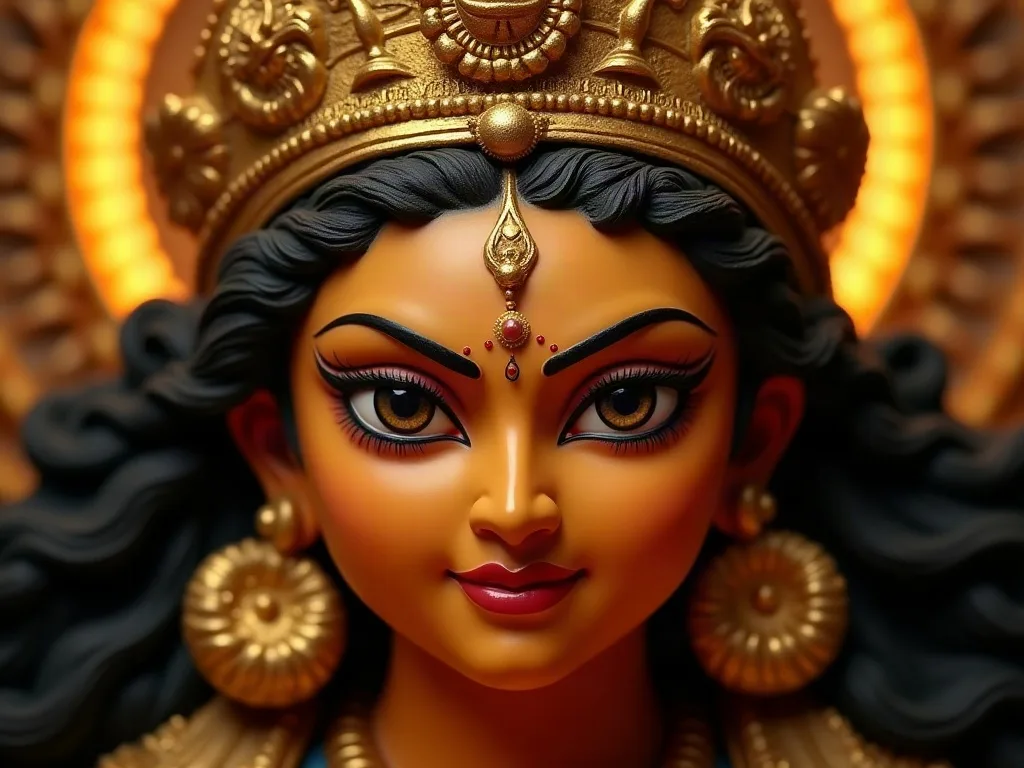
In many traditions, Durga wears a crown (mukut) adorned with symbols from multiple traditions. Sometimes it bears the sun and moon, reminding viewers that she transcends day and night. Sometimes it bears serpents, linking her to the primal energies of nature and to Shiva, the god who wears snakes as ornaments.
The Devi Mahatmya: The Scripture That Made Durga Supreme
The Devi Mahatmya is extraordinary in Hindu tradition for one reason: it places the goddess, not the god, at the center of cosmic drama. Written sometime between the 5th and 8th centuries CE (scholars still debate the exact dating), this 700-verse text was embedded into the Markandeya Purana, a larger chronicle of Hindu mythology that traces the cycles of creation and destruction across vast epochs.
What makes the Devi Mahatmya radical for its time is not merely that it celebrates a goddess. Many Hindu texts do this. What makes it unique is that it claims the goddess contains all other deities. The text opens with Brahma and Vishnu arguing about whose power surpasses the other. They become so absorbed in their debate that they fail to notice the goddess Mahamaya (Great Illusion) standing before them. When they finally perceive her, they realize that their entire dispute occurs within her consciousness. She is not a creation of the other gods; they are expressions of her power.
This theological position, once marginal, became central to Tantric Hinduism and shaped how millions understand divinity today. The goddess is not a supplement to the male gods; she is the source from which all power flows.
The Devi Mahatmya names the battles explicitly. It describes Durga's fight against Mahishasura (and identifies her as Katyayani in that form). It tells of her defeating Shumbha and Nishumbha, demons whose pride nearly exceeds Mahishasura's. It describes lesser demons: Chanda and Munda, whose destruction by Kali (Durga's wrathful form) causes such devastation that the battlefield becomes unrecognizable. The text spares no detail: the slaughter is total, necessary, and purifying.
After each victory, the text reports how the gods praise Durga with hymns that occupy dozens of verses. These are not mere flattery. They are theology in verse form, each hymn naming an attribute of the goddess and what it means for the cosmos.
Why Durga Defeats Every Demon: The Dharma Principle
A question haunts every reader of Hindu mythology: if Durga (or any deity) is divine and all-powerful, why don't demons simply vanish? Why the elaborate battles?
The answer lies in the concept of dharma, or righteous order. In Hindu philosophy, the universe is not ruled by arbitrary divine will. It operates by principle. Evil cannot be erased by fiat; it must be defeated according to the rules of that evil's own nature. A demon who gains power through austerity and receives a boon cannot be killed by stealth or through breaking their oath. They must be confronted and defeated in open battle.
This is why every demon's downfall includes a moment where they believe they are winning. Mahishasura nearly overcomes Durga several times. Shumbha and Nishumbha think victory is at hand. This is not suspense; it is theology. The demons are defeated not because they were always weaker but because they were defeated according to the terms of their own cosmic power.
Another layer: the demons are not merely evil. They are often depicted as proud, ambitious, and skilled. Mahishasura is no fool; he is a strategist. Shumbha is eloquent and charismatic. By making the demons formidable, the texts argue that good must be equally strong, equally intelligent, equally willing to fight. This is not a world where virtue automatically wins; it is a world where virtue must be defended actively.
Durga embodies this principle. She is not superior to the demons by nature; she defeats them by virtue, courage, and the support of all the other deities. Her victory is not predetermined; it is earned.
Durga Beyond the Puranas: Her Role in Tantra and Shakti Worship
Beginning around the 8th century CE, Hindu practice underwent a gradual shift. Tantra, a philosophical and practical tradition that emphasizes direct experience of divinity through ritual, yoga, and meditation, elevated the goddess to explicit centrality. Where earlier texts sometimes presented the goddess as an aspect of a male god's power, Tantric texts often inverted this relationship: the god becomes the stage on which the goddess dances.
In Tantric cosmology, Shakti (the feminine principle of creative energy) is not subordinate to Shiva (the masculine principle of consciousness). Rather, Shiva is static and unrealized until Shakti animates him. Durga, in this framework, is the ultimate Shakti, the power that makes creation possible.
This shift had practical consequences. Tantric temples began to honor the goddess independently. Rituals centered on her worship. Yogic practices focused on awakening the goddess energy (Kundalini) within the practitioner's body. By the medieval period, goddess-worshipping sects had become major branches of Hinduism, particularly in Bengal, South India, and the Himalayan foothills.
The ritual calendar also crystallized around Durga. Navaratri (the nine nights of Durga's victory) became the most important festival in many regions, overshadowing even Diwali in some communities. Each night is dedicated to a different form of Durga, and the communal celebration involves feasting, fasting, dance, theater, and the construction of temporary temples. This is not merely religious observance; it is the lived experience of the myth, the community enacting and internalizing Durga's victory year after year.
Durga in Modern Hinduism and Global Practice
In contemporary Hindu practice, Durga remains deeply embedded in daily life. She appears in home altars, in major temples, and in the rhythm of the festival year. Her image is ubiquitous during Navaratri: on posters, in storefronts, projected onto buildings during Durga Puja in Bengal. Millions of Indians grow up with her as a constant presence.
Yet her worship has also transformed. Feminist scholars and Hindu theologians have reclaimed Durga as a figure who challenges patriarchal interpretations of religion. If the ultimate creative power is feminine, they argue, then male authority cannot be absolute. Durga becomes a symbol of feminine agency and power outside male-defined structures.
Simultaneously, Durga has entered global consciousness through diaspora communities and Western interest in Hindu philosophy. Books on the goddess, interpretations of her iconography, and yoga classes that invoke her energy now reach audiences far beyond India. Some of these interpretations domesticate her, stripping her of her warrior nature to present her as a gentle mother goddess. Others, drawing on the Devi Mahatmya directly, emphasize her fierceness and her refusal to tolerate injustice.
This diversity of interpretation is not corruption of the original; it is the natural consequence of a living tradition. The myths evolve as they are told. Durga in a 21st-century yoga studio in New York is not the same Durga worshipped in a village temple in Tamil Nadu, yet both are authentic expressions of the tradition's core principle: that the ultimate creative and protective power of the universe is dynamic, feminine, and absolutely fierce when defense becomes necessary.
Frequently asked questions about Durga the invincible warrior goddess?
Frequently asked questions
Why is Durga depicted riding a lion instead of a horse?
The lion (or tiger in South Indian traditions) is not merely transport but a symbol of sovereignty and primal power. In Hindu symbolism, the lion represents the king of beasts, untamed nature, and the predatory aspect of protection. By riding the lion, Durga demonstrates her mastery over raw instinct and her command over the forces of nature. The relationship is reciprocal: she grants the lion transcendent purpose; the lion gives her connection to the animal energies that civilization attempts to suppress.
How does Durga relate to other Hindu goddesses like Kali and Lakshmi?
Durga is the unified source from which other goddesses emerge. Kali represents Durga's fury unleashed, the energy that devours obstacles and illusion without restraint. Lakshmi represents her grace and abundance, the ease that follows victory. Saraswati represents her wisdom. Rather than competing figures, they are facets of a single cosmic principle: Shakti, the feminine power that sustains all existence. Many temples honor all three within the same sacred space.
Is the Devi Mahatmya the oldest source for Durga's story?
The Devi Mahatmya (5th-8th century CE) is the most authoritative scripture specifically devoted to Durga, but references to goddess-worship and to divine feminine power appear in earlier texts. The Vedas (composed 1500-1200 BCE) allude to goddesses like Ushas (Dawn) and Vach (Speech). However, the explicit theology claiming the goddess as the ultimate creative power crystallizes in the Devi Mahatmya. This text transformed regional goddess-worship into a coherent philosophical system.
What is the significance of the nine nights (Navaratri) in Durga worship?
The nine nights commemorate the nine days of Durga's battle with Mahishasura, culminating in his defeat on the tenth day (Dasami). Each night is dedicated to a different form of Durga, allowing worshippers to meditate on different aspects of her power and protection. The extended duration emphasizes that the struggle between order and chaos is not instantaneous but requires sustained effort, strategy, and the full commitment of all one's faculties.
Why does Durga emerge from the combined power of all gods rather than being created by a single deity?
This theological detail is crucial to Hindu philosophy. It argues that no single principle can defeat chaos; all aspects of existence (creation, preservation, destruction, knowledge, power) must unite. The fact that Durga is composite teaches that the ultimate power is not personal ego but the alignment of all forces toward a common good. It also elevates the goddess above any male god, since she contains them all while remaining distinct.
Durga's Victory and the Problem of Eternal Recurrence
The Devi Mahatmya does not end with Mahishasura's defeat. It immediately introduces new demons. Shumbha and Nishumbha, two brothers jealous of Durga's power, attack the heavens. The battles recommence. This pattern repeats throughout Hindu cosmology: victory and renewal, order and chaos, forever cycling.
This is not pessimism. It is realism. The text teaches that evil is not a one-time aberration to be corrected but an eternal force that must be perpetually resisted. Durga's battles are not historical events that occurred once; they are eternal archetypes, patterns that repeat whenever order faces dissolution.
For the worshipper, this means Durga is never obsolete. She is not a figure to be remembered but a living principle to be invoked whenever protection is needed, whenever injustice threatens, whenever the warrior spirit must be awakened within. The festival, repeated each year, rehearses the victory and reminds the community that the work of maintaining dharma is never finished.
Durga the invincible warrior goddess represents something profound in Hindu thought: the conviction that the universe's ultimate principle is not distant or passive but actively engaged in the defense of righteousness. She rides the lion. She wields ten weapons. She faces demons alone. And each time her victory comes, the cosmos breathes easier, knowing that someone powerful enough and fierce enough stands ready to protect what matters.
Free 25-page sample
Want the whole story?
Take the first 25 pages free. If it pulls you in, the full edition is yours as an instant PDF download, with a paperback on Amazon for selected titles.

Mythology
The World Mythology Book: The Gods, Heroes and Myths of Every Culture
The Gods, Heroes and Myths of Every Culture, in One Volume
The whole of world mythology in a single volume: Greek, Norse, Egyptian, Japanese, Hindu, Celtic, Slavic, Mesoamerican and African myths gathered side by side, each drawn from the primary sources.