

Egyptian Creation Myths: Heliopolis, Memphis, and Hermopolis Cosmologies
Three sacred cities held three visions of how the world began. Heliopolis gave Egypt a sun god who willed existence into being; Memphis offered a creator god who thought reality into form; Hermopolis imagined chaos itself giving birth to order. Explore the cosmologies that shaped Egyptian belief for three thousand years.
Contents
Three cities in ancient Egypt held competing visions of creation, each sacred, each plausible, each woven into the fabric of Egyptian religion for over three millennia. A merchant in Heliopolis bowed to a sun god who emerged from chaos and willed himself into being. A priest in Memphis whispered that creation sprang from the mind of a cosmic artisan, thought made flesh. And in Hermopolis, learned scribes taught that eight primordial deities, the Ogdoad, labored in darkness before light itself was born. No single story dominated. Instead, Egyptians held all three truths, layered them, harmonized them, let them coexist in the way myths do in living religions. To understand Egyptian creation is to step into a cosmos of deliberate multiplicity, where contradiction was not a flaw but a feature.
The story of Egyptian creation begins not in light but in water. Before gods, before earth, before sky, there was Nun, the infinite ocean of chaos, dark and featureless and eternally potent. Nun was not evil; Nun simply was, a pregnant nothingness from which all order would emerge. Every Egyptian cosmology begins here, in Nun, the eternal return. And from Nun, through will or thought or magic or the labor of eight beings, the first solid ground rose. On that mound, the Bennu bird sang. The sun appeared. Time began.
The Heliopolis Creation: Atum Emerges Alone
Heliopolis, the Greek name for the Egyptian city of Iunu, was the seat of the greatest sun cult in Egypt. Here, priests taught that creation began with Atum, a god who stood alone on the primordial mound and willed himself into existence through an act so intimate and powerful that it shocked later Greco-Roman writers. Atum sneezed, or he masturbated, or he simply spoke his own name into being. The sources vary because the act itself was sacred mystery, language folding back on itself. The point was radical: Atum required no partner, no cosmic forge, no committee of deities. He simply was, and then he chose to be more.
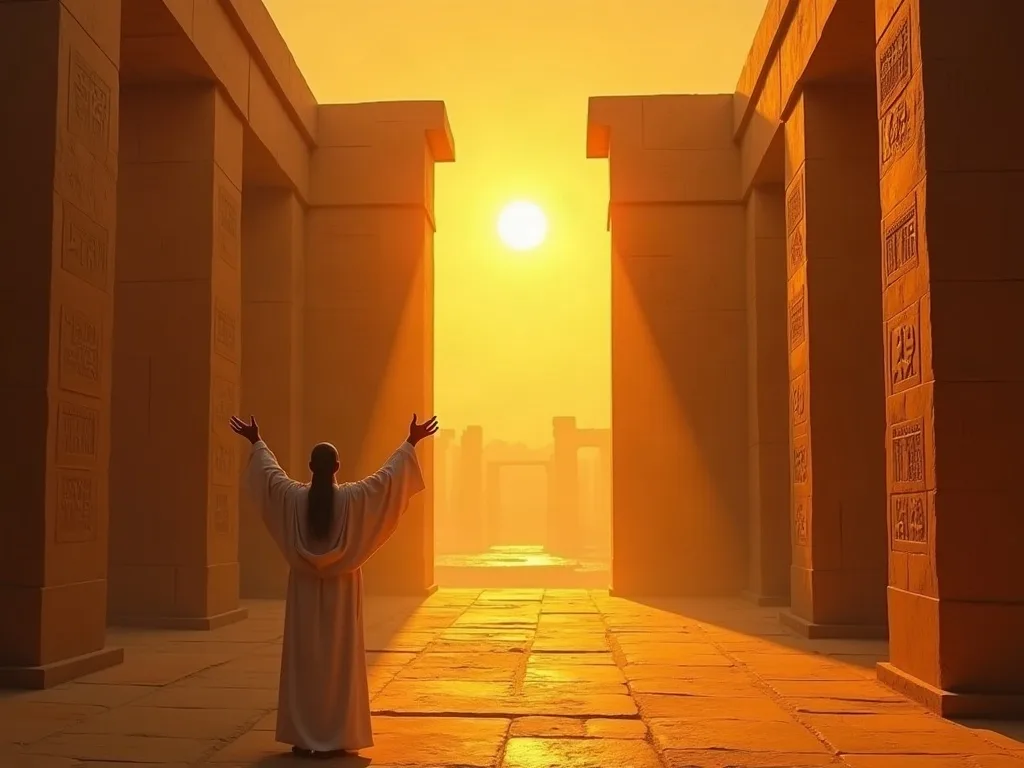
From Atum's solitary act emerged Shu, the god of air and dryness, and Tefnut, the goddess of moisture. Atum embraced them, and the Heliopolitan genealogy cascaded outward. Shu and Tefnut coupled to produce Geb, the earth, and Nut, the sky. Geb lay beneath; Nut arched above, her star-studded body spanning from horizon to horizon. Shu, the air, held them apart, creating the space in which life could move and breathe. Geb and Nut then bore Osiris, Isis, Set, and Nephthys, the gods who would people the Egyptian cosmos and whose stories would echo through every temple and tomb.
The Heliopolitan system was orderly, genealogical, dynastic. It mirrored the succession of pharaohs. Atum gave way to Shu; Shu to Geb; Geb to Osiris. Each generation received the cosmos from its father. This lineage mattered deeply to Egyptian kingship. The pharaoh claimed descent from this unbroken chain. To rule Egypt was to embody the order that Atum had willed into being.
Yet Heliopolis's story carried tension. Atum grew old. Every day, he sailed his solar barque across the sky as Ra, the sun in its diurnal glory, but every night he sailed beneath the earth through the Duat, the underworld, passing through twelve gates of darkness, constantly threatened by Apophis, a serpent of chaos who sought to devour him and return the cosmos to Nun. Each dawn, Ra defeated Apophis anew. Creation was not a one-time event but a daily necessity, a cosmic battle renewed at every sunrise.
The Memphis Cosmology: Ptah Thinks the World Into Being
Memphis, the great capital of the Old Kingdom, had its own creation narrative centered on Ptah, a god who embodied the craftsman, the architect, the consciousness that shapes matter into form. Where Atum willed himself, Ptah thought the cosmos. His was a theology of mind over matter, of intellect as the supreme creative force.
The Memphis creation story survives primarily in the Shabaka Stone, a granite slab from the 25th Dynasty (around 700 BCE) that purports to preserve ancient doctrine. The text claims that Ptah existed before all other gods, that he created them through the power of heka, the Egyptian word for magic or enacted will. More radically, Ptah created them not through physical action but through his ib (heart) and his ren (name). In Egyptian thought, the heart was the seat of intellect, will, and memory. The name was the essence. To speak a name was to bring something into being.
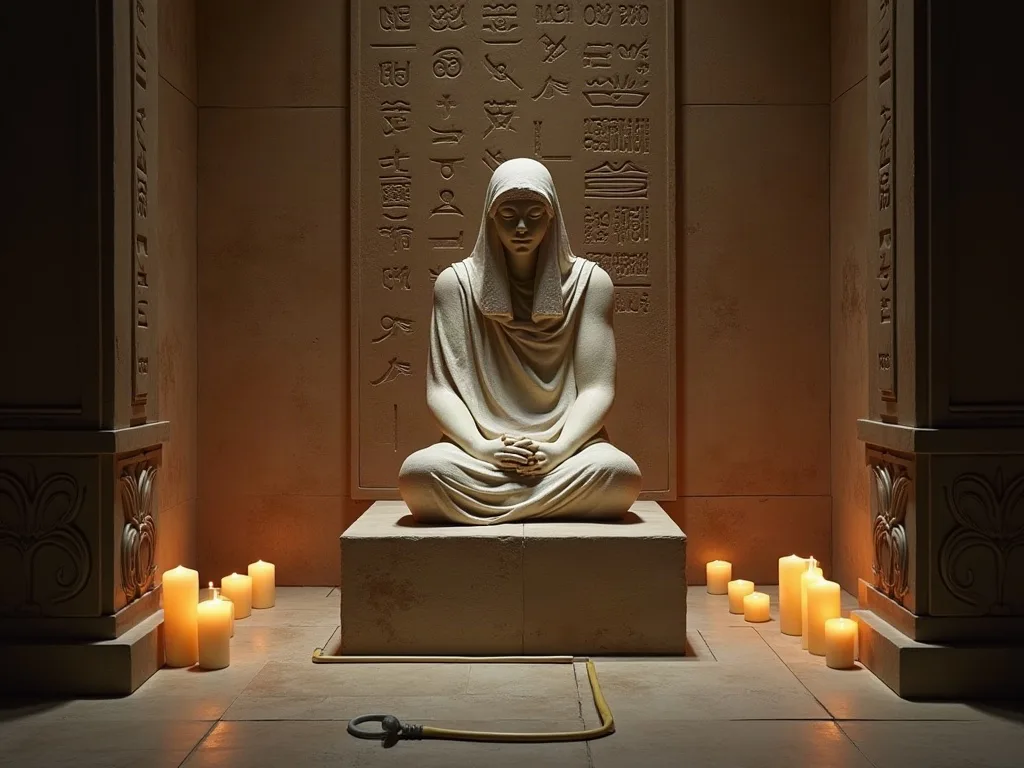
Ptah, the text tells us, first thought Atum into existence, then watched as Atum performed his cosmological act. Ptah then conceived of all other deities in his heart. He spoke their names. They took form. The physical world emerged from divine thought made manifest. Ptah spoke the word, and order solidified. He was the demiurge, but more: he was the principle that thought precedes and supersedes action.
This doctrine elevated Memphis intellectually. While Heliopolis offered a narrative of emergence and succession, Memphis offered a philosophy of creation. Ptah was often depicted as wrapped in a shroud, inert and still, his power concentrated in thought rather than motion. His high priests, the Hem-netjer, claimed to hold secrets of cosmic creation accessible only through initiatory knowledge. Ptah's theology was esoteric, reserved for those who could contemplate abstraction.
The Memphis cosmology also incorporated the Heliopolitan gods but repositioned them within Ptah's framework. Ptah created Atum; Atum created the Enneiad (the nine-fold company of Heliopolitan deities). The two systems were not contradictory but hierarchical. Ptah stood above and before; Heliopolis described what happened after thought took shape.
The Hermopolis Cosmology: The Ogdoad's Cosmic Labor
In Hermopolis, the city that the Greeks named after Hermes (the Egyptians called it Khemenu, the "City of Eight"), priests taught a more archaic and mysterious creation: the emergence of order from eight primordial powers, the Ogdoad. These eight deities represented forces and principles, not distinct personalities with narratives. They worked in pairs, male and female, embodying complementary cosmic tensions.
The Ogdoad consisted of four couples:
- Nun and Naunet: the primordial waters and their feminine counterpart.
- Amun and Amunet: the hidden, the formless, the unknowable and its feminine principle.
- Huh and Hauhet: infinity, endlessness, that which has no limit.
- Kuk and Kauket: darkness, the primeval darkness before light.
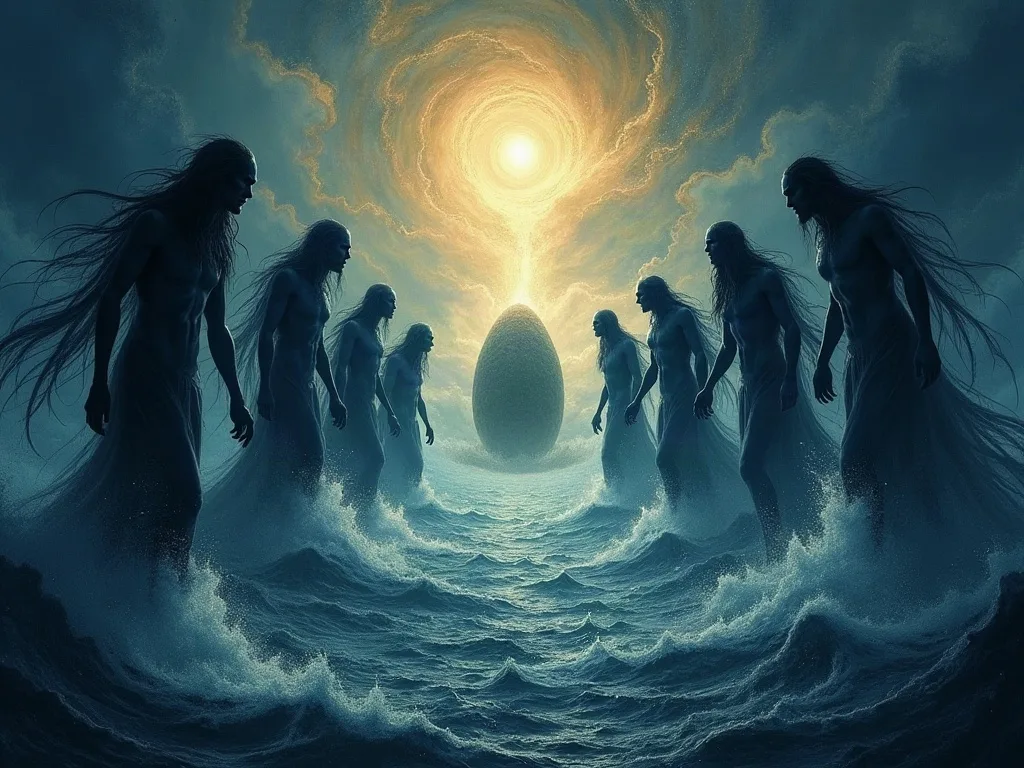
These eight deities did not act like Atum or Ptah. Instead, they existed in a state of potential, locked in chaos, until something stirred them. According to some versions, they labored together to create a cosmic egg or a mound of earth. The egg hatched, or the mound rose, and from it emerged Khepri, the scarab god, or the Bennu bird, or light itself. The Hermopolitan cosmology was less a narrative of will or intellect and more a meditation on how potential becomes actual, how chaos holds within itself the seeds of order.
Hermopolis theology emphasized the role of the Ogdoad as eternal forces. Unlike Atum, who became Ra, or Ptah, who remained still and transcendent, the Ogdoad continued to exist in the background, supporting the cosmos from beneath. Later, as Amun rose to prominence (particularly during the New Kingdom), he was identified as the hidden essence of creation, the force of will within the eight. Amun-Ra emerged as a syncretic deity that tried to reconcile the Hermopolitan and Heliopolitan cosmologies: Amun was the hidden potential (Hermopolis), and Ra was its manifestation in light (Heliopolis).
The Hermopolitan system was less hierarchical than philosophical. It asked not "Who rules?" but "What principles govern becoming?" It spoke to the Egyptian understanding of chaos not as enemy but as pregnant potential, as the necessary background against which order could emerge and be recognized.
Syncretism and Coexistence: How Egyptians Held Multiple Truths
A fundamental insight for understanding Egyptian mythology is this: the three cosmologies were not competing orthodoxies locked in theological combat. They coexisted. An educated Egyptian could hold all three simultaneously, understanding each as true in its own context, each as a lens into the nature of creation.
This coexistence reflected the structure of Egyptian religious practice itself. Heliopolis theology dominated the solar cult and shaped pharaonic ideology. Memphis theology influenced priestly knowledge and the metaphysics taught to initiates. Hermopolis theology persisted in older cults and in the mystical texts that explored the nature of primordial chaos. A priest might recite Atum's emergence in the morning, teach Ptah's thought-creation to a student in the afternoon, and contemplate the Ogdoad's labors in esoteric ritual at night.
The most famous synthesis appeared in the theology of Amun, particularly as developed during the New Kingdom (1550-1070 BCE). Amun, originally a local Hermopolitan wind god, rose to prominence as Thebes became Egypt's political center. Amun absorbed attributes of Atum, Ptah, and the Ogdoad. He was the hidden force that lay behind visible creation, the principle of becoming itself. When merged with Ra, Amun-Ra represented the totality of creation: the hidden potential (Amun) made manifest in light and time (Ra). A hymn to Amun-Ra could draw on all three cosmological traditions without contradiction, because the traditions themselves described different aspects of a single cosmic truth.
This theological flexibility was not weakness or confusion. It was sophistication. Egyptian priests understood that creation could be apprehended from multiple angles, that divinity was larger than any single myth. A religion that could hold Heliopolis, Memphis, and Hermopolis together without fracturing was a religion that had learned to think cosmically.
Creation and the Cosmos After: Maat, the Duat, and Eternal Renewal
Once creation was underway, the cosmos required constant maintenance. The Egyptians called this principle Maat, often rendered as "truth," "justice," or "cosmic order." Maat was not abstract. She was a goddess with a feather, the feather against which the heart was weighed in the afterlife. She embodied the idea that the universe depended on moral and cosmic equilibrium.
Every day brought threats to Maat. Chaos did not disappear after creation; it surrounded the cosmos like an ocean, forever pressing inward. The sun god Ra sailed through the sky each day and the underworld each night because the cosmos required divine labor to remain stable. The pharaoh performed rituals to sustain Maat. Priests sang hymns to reinforce divine vigilance. The entire civilization was, in a sense, a machine devoted to keeping order intact against the return of chaos.
The underworld, the Duat, occupied a peculiar space in Egyptian cosmology. It was not creation's opposite but its shadow side, the realm where the sun traveled at night, where the dead journeyed, where chaos seethed in managed form. The Duat was necessary. It was the price of creation, the chaos that had to be held at bay. The pharaohs and the wealthy were buried with spell-books (what we call the Pyramid Texts and the Book of the Dead) that contained the knowledge they would need to navigate the Duat and ensure their resurrection.
Creation, then, was not a distant past event. It was an ongoing process. Every sunset brought a small death; every sunrise brought a small rebirth. The Nile's annual flood was seen as a return to the conditions of creation, Nun's waters overflowing the banks, bringing fertility and the promise of renewal. Egyptians did not see time as linear progress but as cyclical return, eternal renewal through cosmic vigilance and ritual observance.
The Bennu Bird and the Symbol of Cosmic Renewal
Across all three cosmologies, a bird appears: the Bennu, a heron-like creature associated with the morning sun, with resurrection, with the fulfillment of cosmic cycles. In some texts, the Bennu is the form the sun takes at the moment of creation. In others, it represents the ba (soul) of Osiris, the principle of life renewed after death. The Bennu sang the first song of creation. Its cry brought light and order into being.
The Bennu was also connected to the Phoenix of Greco-Roman tradition, a bird that consumes itself in flame and rises anew. The Bennu did not burn, but it embodied the same principle: the eternal return, the cycle that cannot be broken. In temple reliefs and papyri, the Bennu stands on the primordial mound, witnessing creation, or it nests in the sacred Persea tree, the tree of heaven. Every time the sun rises, the Bennu sings. Every time the Nile floods, the Bennu is reborn.
The Bennu became a symbol of hope and certainty in Egyptian belief. No matter how dark the Duat, no matter how fierce Apophis, the Bennu would sing again. The sun would rise. Order would be restored. This image, repeated in temples and tombs, reassured the living and accompanied the dead.
Heliopolis and the Solar Cult: Theology and Governance
Heliopolis's cosmology was not merely intellectual; it shaped how Egyptians understood power. The pharaoh was the earthly embodiment of Horus, son of Osiris and Isis, and through him, the heir of Ra. The Heliopolitan genealogy placed the pharaoh at the apex of a divine succession. To become pharaoh was to take one's place in the chain of being that stretched from Atum to Ra to Osiris to the reigning king.
The Temple of Ra at Heliopolis was one of Egypt's most important religious sites, though little survives today. Ancient writers described its Benben stone, a pyramidal capstone believed to be the original mound on which Atum stood. Only the pharaoh and his highest priests could approach the Benben. It was the holiest object in the Heliopolitan cult, the tangible proof that creation had occurred, that order had conquered chaos. Kings made pilgrimages to Heliopolis to renew their divine mandate. In the Old Kingdom, the very form of the pyramid reflected Heliopolitan theology: its apex reached toward the sun and the heavens where Atum and Ra dwelled. Pyramids were mountains of creation, stone made to touch the gods.
The Heliopolitan system also produced some of Egypt's most important myths: the stories of Osiris and Isis, of Horus and Set, of the great conflict over the throne of Egypt. These were not separate from creation but its consequences. Once Atum brought forth Shu and Tefnut, and they brought forth Geb and Nut, the stage was set for dynasty, succession, conflict, and resolution. Creation was not an isolated event but the opening scene of an ongoing cosmic drama.
Memphis Theology and the Preservation of Knowledge
Memphis stood as Egypt's capital for much of the Old and Middle Kingdoms, and its theological influence persisted even as political power shifted. Ptah's priests cultivated an intellectual tradition focused on the transmission of esoteric knowledge. The doctrine of creation through thought and speech influenced later Hermetic philosophy and, some scholars argue, early Jewish and Christian cosmology. The idea that reality springs from divine speech, that "In the beginning was the Word," echoes concepts that may have their roots in Memphis theology, though tracing such influences is fraught with uncertainty.
What is clear is that Ptah's priesthood positioned Memphis as the intellectual heart of Egyptian civilization. A priest of Ptah was expected to understand the abstract principles underlying creation, to be learned in the mathematics and geometry that governed temple construction, to know the magical formulas that maintained cosmic order. The Memphis priesthood survived even when political power moved away, because knowledge, once inscribed, proved more durable than kings.
The Ogdoad's Persistence in Esoteric Tradition
Hermopolis remained less politically prominent than Heliopolis or Memphis, yet its cosmology proved remarkably resilient. The Ogdoad's association with primordial chaos and hidden potential resonated with Egyptian magicians and mystics. In later periods, Hermopolis became a center of secret learning, a place where initiates studied the deeper nature of creation. The Hermopolitan texts, preserved in various forms, influenced Greek thought when Egypt came under Ptolemaic rule (305-30 BCE). Hermes Trismegistus, the syncretic deity invented by the Greco-Egyptian synthesis, was identified with Thoth, the god of wisdom, and positioned as the heir of Hermopolis's secrets.
The eight deities of the Ogdoad never had elaborate mythologies attached to them. They were not characters in a story but philosophical principles, archetypal forces. This abstraction made them enduring. Amun, originally one of the Ogdoad, could be reinterpreted and elevated without contradicting the original doctrine. Amun the hidden potential became Amun the king of gods, Amun-Ra the synthesis of all creation. The Ogdoad's flexibility allowed it to persist while other theologies shifted.
Frequently asked questions about Egyptian creation myths?
Frequently asked questions
How did ordinary Egyptians understand creation if there were three different versions?
Most Egyptians did not engage with these cosmologies as philosophical systems. They knew that the sun rose because Ra sailed across the sky; they saw the Nile flood and recognized it as creation's renewal; they brought offerings to their local god. Formal creation theology was the province of priests, scribes, and the educated elite. The general population absorbed these ideas through temple reliefs, festivals, hymns, and stories passed down orally. They did not need to choose between Heliopolis, Memphis, and Hermopolis; they simply accepted that creation was more mysterious than any single account could capture.
Why was Amun-Ra considered the ultimate synthesis of the three cosmologies?
Amun, originally a minor wind god in Hermopolis, rose to prominence as Thebes became Egypt's political and religious center during the New Kingdom. Priests recognized that Amun embodied the hidden, formless potential of the Ogdoad (Hermopolis), while Ra represented the manifest light and time of Heliopolis. By merging them, theologians created a deity that reconciled all three systems: Amun as the unknowable source (Hermopolis), Ra as the manifest god (Heliopolis), and implicitly, Ptah's thought as the mechanism by which potential became actual (Memphis). Amun-Ra was not a new god but a theological solution to the problem of multiplicity.
Did Egyptians believe Apophis would ever succeed in destroying Ra?
No. The daily defeat of Apophis was not an uncertain outcome but a certainty renewed each dawn. The myth expressed an Egyptian conviction that chaos was always present and always must be resisted, but that order, maintained through divine will and human ritual, would ultimately prevail. The entire Egyptian civilization was organized around this principle: vigilance against chaos, the constant reaffirmation of order. In the last age of the world, some texts suggested, Apophis might succeed and the cosmos might return to Nun, but that apocalypse was distant, and even then, it would be followed by a new creation. Time was cyclical.
What connection exists between Egyptian creation myths and later Western philosophy and religion?
Several streams of influence have been proposed by scholars, though all require caution. The idea that creation springs from divine speech or thought appears in Memphis theology and resonates with the Logos concept in early Christianity and Greek philosophy. The notion of an unknowable, formless creative principle (Amun, the hidden one) parallels later mystical and philosophical traditions. When Egypt fell under Greek rule and then Roman rule, Egyptian priests themselves began to synthesize their myths with Greek thought, creating figures like Hermes Trismegistus. However, proving direct literary influence is difficult; similar ideas may emerge independently in different cultures confronting the same fundamental questions about existence.
How did the annual Nile flood relate to Egyptian creation theology?
The Nile's flood was understood as a return to primordial conditions. The waters of Nun overflowed the banks, erasing the boundaries between civilization and chaos. This was not chaotic destruction but necessary renewal. The flood brought fertile silt that replenished the fields. In religious terms, it was a smaller version of creation: chaos receded, new land emerged, and order was reestablished. The festival of Inundation celebrated this renewal. Egyptians saw the flood not as a threat but as proof that creation was ongoing, that Maat could be restored, that life would continue. A year without flood was catastrophic, a sign that the gods had withdrawn their favor and the cosmos was failing.
The Afterlife as Continuation of Creation Theology
Egyptian ideas about the afterlife were inseparable from their creation myths. The dead had to navigate the Duat, the underworld realm that mirrored the chaos from which the cosmos had emerged. The Book of the Dead, a collection of spells and instructions compiled for the deceased, provided a map of the underworld and the knowledge required to pass through its dangers and reach the Field of Reeds (Aaru), a blessed realm mirroring the living world.
The journey through the Duat was a re-enactment of cosmic creation in miniature. The dead followed the path of Ra, encountering demons and divine guardians, passing through gates, and finally standing before the Hall of Two Truths, where their heart was weighed against the feather of Maat. If the heart was heavier than the feather (meaning the person had lived unjustly), it was devoured by Ammit, a hybrid creature part crocodile, part lion, part hippopotamus. If the heart balanced the feather, the deceased was declared "true of voice" and allowed to dwell eternally in the Field of Reeds, performing the tasks of the gods and living as they lived.
This was not punishment and reward in the later monotheistic sense. It was cosmic order extended into the afterlife. Maat had to be maintained even beyond death. The dead who had lived justly contributed to the cosmos's equilibrium. The dead who had lived unjustly were denied eternal existence, annihilated, returned to nonexistence. In a real sense, the afterlife was the continuation of creation: the endless work of maintaining order against chaos, the eternal necessity of moral and cosmic vigilance.
The pharaohs, especially, were prepared for the afterlife through elaborate rituals and the construction of great tombs. The pharaoh's journey through the Duat was the nation's journey. If the pharaoh was successfully revived in the afterlife, the kingdom was assured continuity and divine favor. The tomb was a microcosm of the cosmos, its walls inscribed with spells and images meant to protect the king and guide him through dangers. Pyramids and later royal tombs were, in a sense, repositories of creation theology, physical monuments to the principle that order must be maintained through ritual and knowledge.
The Egyptians saw life and death, creation and dissolution, as phases of a single eternal cycle. To be born was to emerge from chaos into order, to live as an Egyptian was to maintain that order through right action and correct ritual, and to die was to enter the realm where that maintenance became a spiritual practice. The three cosmologies of Heliopolis, Memphis, and Hermopolis thus provided not just an account of how the world began but a framework for understanding every phase of existence: creation, maintenance, death, and the eternal renewal that followed.
Free 25-page sample
Want the whole story?
Take the first 25 pages free. If it pulls you in, the full edition is yours as an instant PDF download, with a paperback on Amazon for selected titles.

Mythology
The World Mythology Book: The Gods, Heroes and Myths of Every Culture
The Gods, Heroes and Myths of Every Culture, in One Volume
The whole of world mythology in a single volume: Greek, Norse, Egyptian, Japanese, Hindu, Celtic, Slavic, Mesoamerican and African myths gathered side by side, each drawn from the primary sources.