
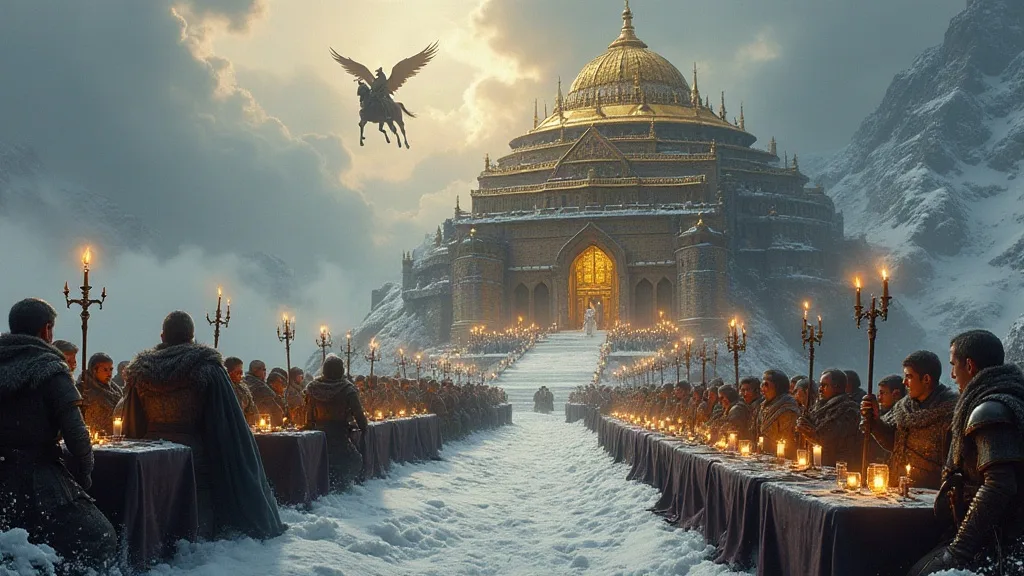
The Einherjar Warriors of Valhalla: Death, Honor, and the Halls of the Glorious Slain
In Norse mythology, the Einherjar are the honored dead chosen by the Valkyries to feast and fight in Valhalla, Odin's golden hall. Discover how fallen warriors earn eternal glory, why battle matters in the afterlife, and what separates a hero's death from a coward's fate.
Contents
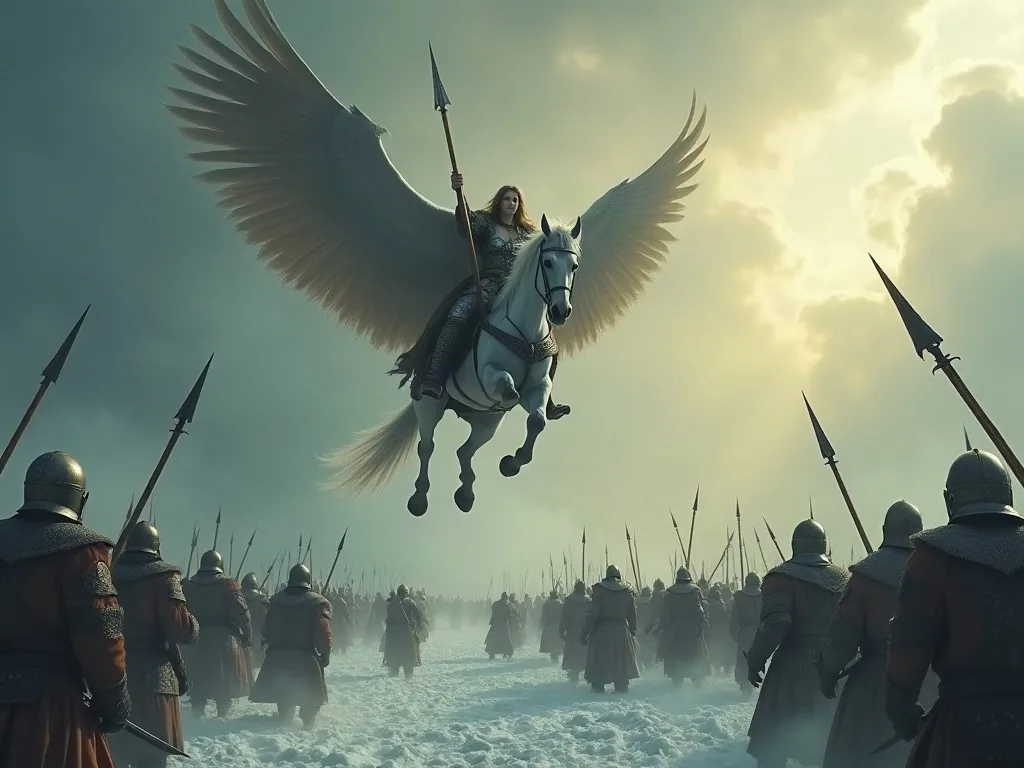
A warrior falls in battle, his shield shattered, his sword buried deep in an enemy's chest. As blood darkens the snow, a figure descends from the grey sky on a horse wreathed in flame. She is a Valkyrie, one of Odin's choosers of the slain, and she points to this fallen fighter with a knowing smile. In that moment, his death becomes transformation. He rises not as a ghost wandering the mist, but as one of the Einherjar, the honored dead who will feast and fight forever in the golden halls of Valhalla.
This is the heart of Norse warrior culture: the belief that a noble death in combat opens a door to eternal purpose. The Einherjar are not mere shades or happy ghosts. They are soldiers of the cosmos, armed and ready, because their battle is not over. It has only changed shape. Every day in Valhalla they fight; every night they feast on endless meat and mead. They know what mortal warriors know: that the real test comes not in the comfort of the hall, but in the clash of iron and the test of courage when all seems lost.
The mythology of the Einherjar reveals something profound about how the Norse imagined meaning itself. For them, a good death was not the end of a good life. It was an entrance into a life where honor and struggle take on cosmic weight. To understand the Einherjar is to see how an ancient warrior culture wrote its values into eternity.
Who Are the Einherjar? The Chosen Dead of Odin
The word Einherjar comes from Old Norse einherjar, meaning "lone fighters" or "single warriors" (from ein, one, and herr, warrior). But the name holds deeper weight: each Einherjar stands as an individual chosen by will and courage, not by accident of birth or wealth. They are the warriors Odin himself selects for his hall.
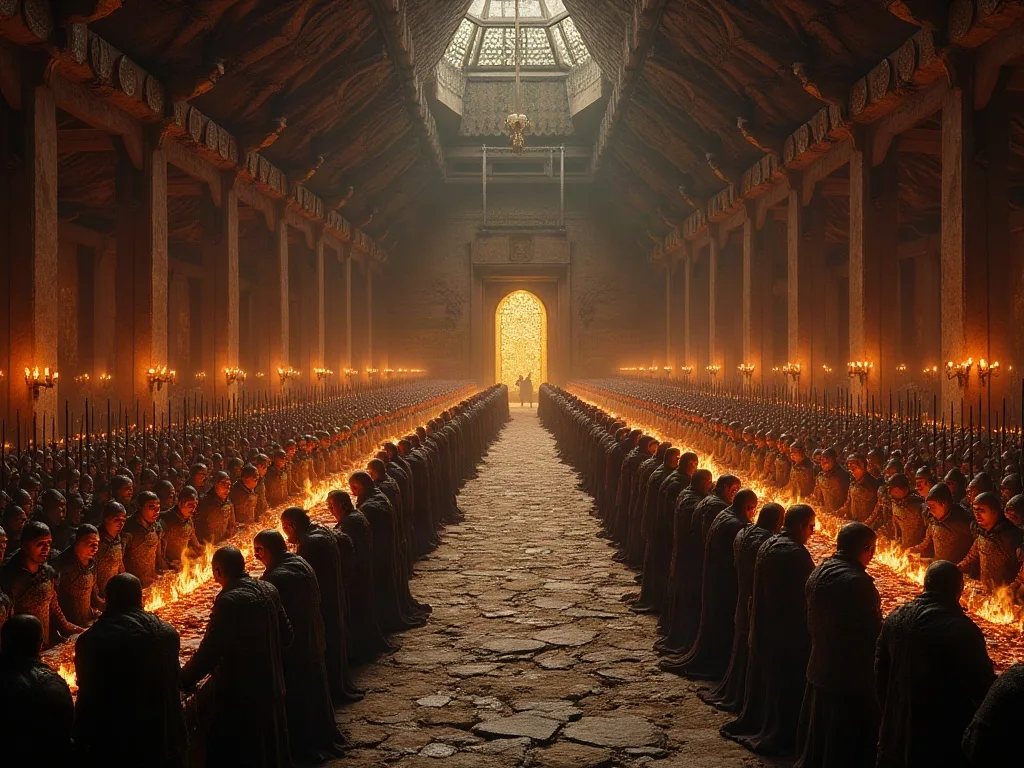
The Poetic Edda, a collection of Old Norse poems preserved in manuscript around 1270 CE but likely composed centuries earlier, describes Valhalla itself in vivid detail. The Grímnismál, a poem where Odin disguises himself and speaks the secrets of the cosmos, tells us that Valhalla has 540 doors. Through each door, 800 warriors march at once when the final battle comes. The hall's roof is covered in shields. Its rafters are spears. Benches are laid with armor, and chainmail hangs on its walls. The imagery is unmistakable: this is a place built entirely for war.
Who gets chosen? The Prose Edda, written in the 13th century by Snorri Sturluson to preserve older wisdom, explains that the Valkyries do the choosing. These are Odin's handmaidens, warrior-women who ride through battles on horseback, deciding the fates of fighters. When a warrior fights with honor and falls in a way that shows courage, a Valkyrie marks him. Some sources suggest they look for the manner of death: the warrior who dies facing his enemy, not running; the one whose last act shows defiance or compassion; the fighter whose death serves a purpose larger than survival.
Not all dead go to Valhalla. Warriors who die of sickness or old age, the Norse believed, travel instead to Hel's realm, a grey land beneath the earth. Hel herself is a half-living, half-dead figure, daughter of Loki, and her domain is far less glorious than Odin's hall. This is why the Norse prized honorable death in battle. It was not morbid fatalism. It was a choice: to live in a way that made one worthy of the Einherjar.
The Einherjar exist in a state of perpetual preparation. They are not idle feasters. Each day, they arm themselves and ride out to a great plain called Idavoll, where they fight each other in ritual combat. Warriors face off, testing skill and courage. Some fall, blood staining the earth. But then magic works: at day's end, all the fallen rise again, whole and unharmed. They return to the hall to feast on the flesh of Sæhrímnir, a boar that dies each day and is reborn each night. They drink mead that flows from the udders of the goat Heidrún, which stands on Valhalla's roof eating the leaves of Yggdrasil, the world tree.
This cycle is not punishment or reward in the simple sense. It is purpose. The Einherjar train for Ragnarök, the end of all things, when the boundaries of the world will break and gods and giants will fight their final battle. When that moment comes, Odin will need every warrior at his side. The Einherjar are not indulging in pleasure. They are becoming the last defense of the cosmos.
The Valkyries: Odin's Choosers and the Mechanics of Selection
Odin did not invent the afterlife alone. He depends on the Valkyries (Old Norse: valkyrjur, from valr, the slain, and kjósa, to choose) to carry out his will on the battlefield. These are not gentle angels. The Poetic Edda names them one by one: Göndul, Geirskögul, Randgríðr, and others. Each has her own name, personality, and legend.
The Valkyries appear in the sagas and Eddas as fierce, capable warriors themselves. Some are daughters of Odin. Others are of unknown parentage, simply born from the cosmic order. They ride horses that move through air and over sea as easily as over land. Some horses have flaming manes. Some can cross the rainbow bridge Bifrost. The Valkyries are armed with spears and wear helmets and armor. When they descend on a battlefield, blood and chaos swirl around them.
Their role is deeply practical. They observe fighters as they clash. They watch not just for skill but for the nature of the death. A warrior who dies with a war cry on his lips, who fights to the last even when defeat seems certain, who shows loyalty to his comrades or honor to his enemy, catches their eye. The sagas sometimes describe Valkyries appearing directly to warriors, pointing at them in the moment of death with a kind of grim approval. To be chosen by a Valkyrie is to have your death recognized as worthy.
Yet the Valkyries also have their own story. The Völundarkviða, a poem from the Poetic Edda, tells of the Valkyrie Svádilfari and of how Valkyries sometimes leave Valhalla to walk among humans, becoming lovers, wives, and mothers. Some sources suggest Valkyries can fall from grace or choose to leave Odin's service. This adds complexity: they are not mere servants but agents with their own will, selecting the Einherjar not by mechanical rule but by judgment.
One of the most striking features of Valkyrie mythology is that they make choices. They do not follow a checklist. In the saga of Völsunga and in Njál's Saga, Valkyries intervene in earthly battles based on oaths, betrayals, and the moral weight of a warrior's cause. A warrior might fight bravely but for an unjust cause, and the Valkyries might pass him by. Another might fall almost by accident, but if he lived with honor and kept his word, they might mark him. The mechanism of selection is tied to Norse values: courage, loyalty, honesty, and a willingness to face fate.
Valhalla: The Architecture of Eternal Purpose
The Grímnismál gives us the only extended description of Valhalla we have from the ancient sources. It is a building of immense size, standing in Odin's realm Asgard. The name itself, Valhöll in Old Norse, means "hall of the slain." It exists not in heaven in a Christian sense, but in the mythic geography of the Nine Realms, accessible to those who die with honor.
The 540 doors are the most famous detail. The Prose Edda clarifies their purpose: when Ragnarök comes and the giants march on Asgard, the Einherjar will march out of these doors, 800 from each one, to fight at Odin's side against the forces of destruction. The entire architecture of Valhalla is military. Every detail serves the coming war.
The halls are vast. Warriors sit at long tables running the length of the hall. Above them, the roof is covered with shields laid flat like shingles. The rafters, visible in the high darkness, are made of spears. Sæhrímnir, the boar, stands in the courtyard. The cook Andhrímnir slaughters it each evening, boils it in the great pot Eldhrímnir, and serves it to the Einherjar. No matter how many warriors eat, the boar is always sufficient. Some sources say Sæhrímnir's flesh tastes different to each warrior, offering whatever flavor most satisfies him.
The mead flows without end. Heidrún, a goat as large as a horse, stands on Valhalla's roof eating leaves from Yggdrasil. From her udders flows an endless stream of mead, stronger and more intoxicating than any brewed in the mortal world. No warrior ever goes thirsty. No feast ever ends.
This description might sound like hedonism to modern ears, but that misses the point entirely. The Norse did not fear pleasure; they feared meaninglessness. What would make an afterlife worth having was not softness but purpose. In Valhalla, every night's feast is a restoration that allows the next day's combat. The food and drink are fuel. The hall itself is a barracks.
Some details of Valhalla appear only in later saga sources and may reflect Christian influence or medieval embellishment. But the core picture remains consistent: it is a place of action, not passive reward. Warriors who spend eternity in idleness would not have appealed to the Norse imagination. Such an afterlife would have seemed like a curse.
The Daily Cycle: Combat, Resurrection, and Perpetual Honor
The rhythm of life in Valhalla forms a kind of eternal reenactment of the warrior's purpose. Each morning, the Einherjar arm themselves. They take up their weapons and armor, just as they did in life. Then they ride or march out to the plain of Idavoll, where they face each other in organized combat.
The battles are not bloodless tournaments. Warriors genuinely fight. They draw blood. They fall. But here is the crucial difference from mortal combat: the fallen rise again at day's end, completely healed. A warrior who takes a spear through the chest in the morning fights again in the afternoon. One who loses an arm in the first hour has it again by sunset.
This daily resurrection serves multiple purposes in the mythology. First, it makes the Einherjar immortal in the deepest sense: they cannot die, so they can perfect their skills without fear. A warrior might take centuries to master a new technique, knowing that every mistake and every failure is temporary. Second, it emphasizes that their struggle has no end because its purpose is training for a battle even greater than any individual fight. Every combat in Valhalla is practice for Ragnarök.
Third, and perhaps most important, the daily resurrection removes any sense of tragedy or waste from death in Valhalla. The Norse understood that death was real; it was not soft or gentle. But they believed that a death faced with courage and honor transcended mere loss. In Valhalla, death loses its finality. The Einherjar die and live again, proving that honor and courage are stronger than death itself.
The sagas sometimes hint at a kind of hierarchy among the Einherjar. Odin's favored heroes, warriors of legendary skill or whose deeds were remarkable, receive special honors. Kings and champions might sit at Odin's own table. But the basic truth is democratic in its way: any warrior who died well, regardless of birth or wealth, could become Einherjar. This reflects something deep in Norse society: martial skill and courage were the measure of a person's worth.
Legendary Einherjar: The Named Dead
While the Eddas do not provide a comprehensive roster of the Einherjar, the sagas name specific warriors believed to dwell in Valhalla. These become legendary figures, their deeds so remarkable that later generations could imagine them continuing to fight in Odin's hall.
Sigmund, the great hero of the Völsunga Saga, falls in battle and is said to go to Valhalla. He is one of the ancestral heroes of the Norse peoples, a king who defied fate itself and lived a life of such magnitude that his death on the battlefield seems inevitable and fitting. His son Sigurd, the dragon-slayer, is sometimes said to have joined the Einherjar, though versions of his story vary.
Ragnar Lothbrok, the legendary viking king, is central to his own sagas. Though his historicity is debated, his legend tells of a man who died in a snake pit, supposedly sent there by his enemies. Some versions of his saga suggest he too became Einherjar, his final defiance worthy of Odin's hall.
The reality is that many warriors across Norse history were believed or claimed to have become Einherjar. Chieftains and kings could strengthen their authority by suggesting that their ancestors now fought in Valhalla, watching over their descendants. The Einherjar became a way to connect the living world to the cosmic order.
What matters for understanding the Einherjar warriors of Valhalla is not the specific names, but what they represented. They were proof that courage and honor did not end with death. They were the best version of what a warrior could become. They lived in a state that most mortals could only imagine: eternal purpose, eternal strength, eternal community.
The Einherjar and Norse Warrior Values
To understand the Einherjar is to understand what the Norse valued most deeply. They were not a culture that prized comfort or leisure. They lived in a harsh climate, faced constant threats, and depended on martial skill for survival. Their mythology reflects this reality.
The Einherjar embody several core Norse values. First is courage in the face of death. A warrior who fights knowing he might die is common. But a warrior who fights knowing death is certain, and does not falter, shows true courage. The Norse did not believe in conquering death; they believed in meeting it nobly.
Second is loyalty and honor. The sagas repeatedly show that warriors value keeping their word above safety. A man who betrays his oath is worse than a man who dies fighting for a just cause. The Valkyries choose based partly on whether a warrior maintained his honor and kept faith with his companions and his lord.
Third is skill and mastery. The Einherjar do not simply exist in Valhalla; they train. They test themselves daily against worthy opponents. The Norse respected craft and expertise, whether in battle, speech, or craft. A warrior who perfects his technique shows respect for his role in the cosmos.
Fourth is community and feasting. The Einherjar do not eat or drink alone. They gather in the hall together. Feasting is not selfish indulgence but a social act that binds the community. When a warrior sits at a table with others, sharing food and mead, he becomes part of something larger than himself.
These values were not unique to the Norse, but the way they imagined the Einherjar shows how seriously they took them. A good afterlife was not escape from hardship. It was continuation of the struggle, alongside the best of one's people, in service of a cosmic purpose.
From Pagan Belief to Christian Reinterpretation
When Christianity spread through Scandinavia in the 10th and 11th centuries, the image of the Einherjar underwent transformation. Christian missionaries and kings who converted to the new faith saw in Valhalla a pagan rival to Christian heaven. Some attempts were made to suppress the old beliefs entirely.
Yet the Einherjar proved resilient. The sagas, many written down after Christianization, preserved the old stories. Snorri Sturluson, who compiled the Prose Edda in the 13th century, was himself a Christian, yet he recorded the mythology of the Einherjar with care and detail. This suggests a complex process: Christian Norse could acknowledge the old stories without fully endorsing their theology.
Some medieval Norse thinkers tried to harmonize the two traditions. They suggested that the Einherjar were a kind of Norse version of the saints or the elect in heaven. Others saw the old pagan afterlife as a distraction from the true faith. But the sheer power of the mythology ensured survival. The image of the Einherjar as eternal warriors, training for the end of all things, became woven into Norse identity itself.
This survival also speaks to something universal in human mythology. Nearly every warrior culture has imagined an afterlife for its heroes that continues their purpose. The Einherjar tap into a deep human need to believe that courage and honor matter, not just in life but beyond death. This is why the mythology endures.
The Einherjar in Modern Culture and Imagination
The figure of the Einherjar has returned to prominence in modern times, particularly in fantasy literature, games, and popular culture. They appear in Marvel's Thor films, in video games set in Norse worlds, and in novels that reimagine Viking society.
This modern return is not entirely new. Richard Wagner's Ring Cycle opera (1876) drew heavily on Norse mythology, including depictions of Valhalla and the Valkyries. Though Wagner's vision was filtered through 19th-century Romanticism and later appropriated in deeply troubling ways, it introduced millions to the Einherjar as a concept.
Contemporary uses of Einherjar imagery are mixed. Some are reverent, attempting to capture the original meaning: warriors who embodied virtue and fought for something beyond themselves. Others strip away context, reducing the Einherjar to mere tough soldiers or invincible warriors. Still others misuse the imagery entirely, particularly in far-right movements that have tried to co-opt Norse mythology for hateful purposes. This appropriation has no basis in the source material, which emphasizes honor, loyalty, and community, not supremacy or aggression.
The genuine Einherjar mythology offers something richer and more complex than simple warrior glorification. It asks serious questions: What makes a life worth living? What makes a death worth dying? How do we find purpose in a cosmos that is vast and often indifferent? The Norse answer was: through courage, community, and the willingness to face fate with open eyes. Whether one believes this answer or not, the question itself is worth taking seriously.
Contrasts with Other Warrior Afterlives
The Einherjar warriors of Valhalla are not unique in world mythology. Many cultures imagined afterlives for their warriors, but the Norse vision has distinctive features.
Einherjar (Norse)
Earn entry through honorable death in battle and virtuous conduct. Continue training and fighting daily. Afterlife mirrors and extends earthly life. Purpose is preparation for Ragnarök, not rest or judgment. Eternal activity and community feasting. Resurrection is daily and complete.
Christian Paradise
Earn entry through faith and moral living. Rest in the presence of God. Afterlife transcends earthly existence. Purpose is communion with the divine. Eternal peace and spiritual perfection. No resurrection needed; souls continue forever.
The Islamic concept of jannah (paradise) for the faithful includes gardens and rewards, but also eternal spiritual presence before God. The Hindu concept of moksha, liberation from the cycle of rebirth, is not an afterlife but an escape from the cycle itself. The ancient Greek Elysium was a place of peaceful rest for the blessed, but it lacked the military purpose of Valhalla.
The Einherjar differ most sharply from afterlives that promise rest or transcendence from earthly concerns. The Norse did not imagine a heaven where warriors would stop fighting or forget their purpose. Instead, they imagined an afterlife that intensified and purified their earthly role. The Einherjar continue to be warriors because being a warrior, to the Norse mind, was itself the highest form of human purpose.
Ragnarök and the Einherjar's Final Purpose
The Einherjar are not an end in themselves. Every detail of their existence points toward a larger event: Ragnarök, the twilight of the gods, when the cosmos itself will die and be reborn.
According to the Völva's Prophecy (Völuspá), one of the Poetic Edda's most visionary poems, Ragnarök will begin with Fimbulwinter, three winters of unending cold and snow. The sun will lose its warmth. Families will turn against each other. All bonds will break. Then the boundaries of the world will shatter. The serpent Jörmungandr, son of Loki, will thrash in the ocean and cause a flood. The fire giant Surtr will march from his realm with a sword that burns brighter than the sun. The wolf Fenrir, who has been bound since ancient times, will break free and devour Odin himself.
At this moment, when the gods are fighting their final battle, the Einherjar will march out of Valhalla's 540 doors. Odin will not fight alone. He will have an army of the best warriors who ever lived. They will fight not to win in the final sense (Odin knows he will fall), but to show that honor and courage persist even when defeat is certain. They will die again, permanently this time, but their presence matters.
This detail reveals the true function of the Einherjar in Norse thought. They are not reward for the dead. They are preparation for the end of all things. The afterlife is not a destination but a training ground. Every warrior who becomes Einherjar is consciously choosing to fight in a battle that cannot be won, because the fighting itself is the point.
This gives the Einherjar a peculiar kind of nobility. They are not promised victory. They are not guaranteed happiness. They are offered something more profound: a role in the cosmic story, a place in the final struggle, and the certainty that their courage will be seen and remembered. To the Norse, this was worth everything.
Frequently asked questions about the Einherjar warriors of Valhalla
Frequently asked questions
Did the Norse really believe the Einherjar were real?
Yes, within their cosmology. The Norse understood their mythology as true history and reality, not metaphor. Archaeological evidence shows Viking warriors were often buried with weapons and armor, suggesting they believed these items would be needed in the afterlife. The Einherjar were not symbols but expected residents of an actual place. Whether this reflects literal belief or sacred story is harder to determine, but the mythology was taken as seriously as any faith tradition takes its teachings.
Could women become Einherjar, or just men?
The primary sources (the Eddas and sagas) focus on male warriors, and Norse society was patriarchal. However, female warriors did exist in Norse culture, and some sagas describe women who fought in battle. Whether they could become Einherjar is unclear, but the logic of the myth would allow it: if a woman died honorably in combat, a Valkyrie might choose her. The mythology was more flexible than popular culture often suggests.
How is Valhalla different from the Christian heaven?
Valhalla is a place in the Norse cosmos that can be accessed through honorable death, not salvation or faith. It is not eternal peace but eternal activity and combat. There is no judgment by a god deciding your worthiness; the Valkyries choose based on how you died and lived. Valhalla is also not the only afterlife in Norse mythology: the dishonorable dead go to Hel's realm. Christian heaven is one place for all the saved, regardless of their earthly occupation or virtue.
Did dying in battle guarantee entry to Valhalla?
Not necessarily. A warrior could die in battle but in a dishonorable way: running from the enemy, betraying his companions, or dying because of cowardice rather than courage. The Valkyries chose based on the manner and meaning of the death, not simply its occurrence. This shows the Einherjar were not a mechanical reward but a recognition of lived values.
What happened to the Einherjar after Ragnarök?
The Völuspá describes what comes after the final battle: the earth rises again from the sea, green and fertile. The sun has a daughter who rides the sky. A new world is born. But the Eddas do not clearly state what happens to the Einherjar specifically. Some sources suggest certain figures survive or are reborn into the new world. Others suggest the afterlife itself ends. This ambiguity reflects how the mythology was passed down orally; different tellers added their own endings.
Are the Valkyries the same as the Einherjar?
No. The Valkyries are divine beings who serve Odin and choose which warriors become Einherjar. The Einherjar are the chosen dead. The Valkyries can also live on earth, take mortal lovers, and have their own stories. In some sources, Valkyries are part-divine and part-mortal, existing between worlds. The Einherjar, once chosen, exist in Valhalla unless they leave to visit the mortal world.
The Enduring Power of the Warrior's Myth
The Einherjar warriors of Valhalla represent something ancient and human: the desire to believe that courage and sacrifice mean something. They are not unique to Norse culture. Nearly every warrior society has imagined that the best of its warriors continue after death. What makes the Einherjar distinctive is the specificity of their vision: not rest but purpose, not escape from struggle but its continuation, not judgment but recognition of the manner in which one lived.
Reading the Eddas and sagas, one feels the Norse taking their own mythology seriously, not as comforting fantasy but as a statement about how the world works and what matters in it. A warrior who reads about the Einherjar knows that his culture sees his life as part of something larger. His death, if it comes with courage, will not be the end of his story but a transformation into something eternal.
This does not mean the Norse were uniquely violent or that their mythology is a guide to modern life. But it means their way of imagining courage and community remains powerful. In a world where many ask "what is my life for?", the Einherjar offer an answer: to face what comes with open eyes, to stand with others who do the same, and to trust that this matters even if victory is impossible. Whether one believes this or not, the vision has endured for over a thousand years and continues to move people in the present. That itself is a kind of proof that some truths persist.
Free 25-page sample
Want the whole story?
Take the first 25 pages free. If it pulls you in, the full edition is yours as an instant PDF download, with a paperback on Amazon for selected titles.

Mythology
The World Mythology Book: The Gods, Heroes and Myths of Every Culture
The Gods, Heroes and Myths of Every Culture, in One Volume
The whole of world mythology in a single volume: Greek, Norse, Egyptian, Japanese, Hindu, Celtic, Slavic, Mesoamerican and African myths gathered side by side, each drawn from the primary sources.