
Geb: The Earth God Who Holds Creation in His Body
Geb was the Egyptian god of the earth itself, whose body formed the soil, mountains, and all physical land. Discover how ancient Egyptians imagined their world literally resting on a god's form, and why Geb mattered to pharaohs, priests, and farmers alike.
Contents
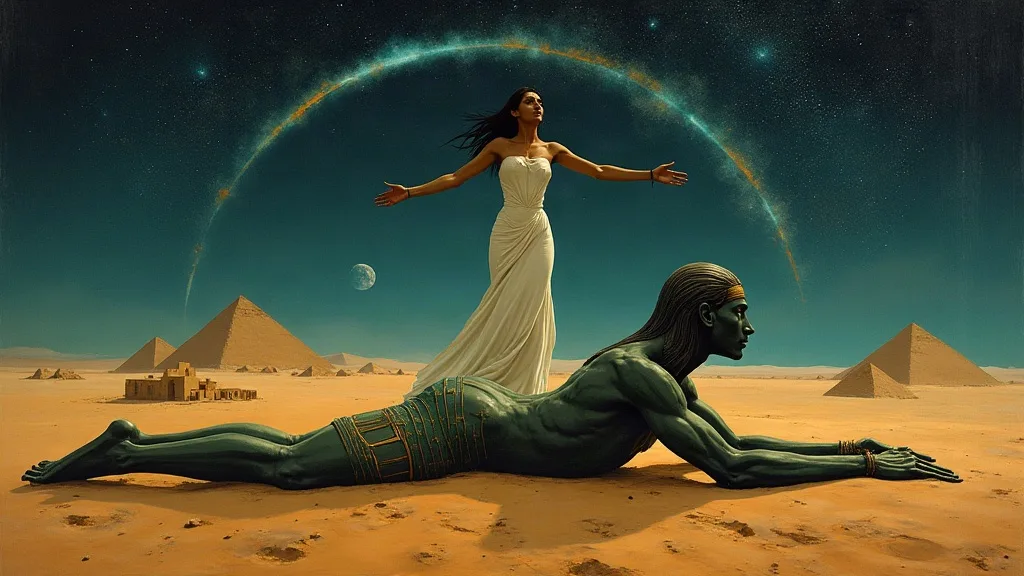
Geb lies beneath every footstep in Egyptian mythology. His name means "the earth," and the Egyptians imagined him not as a distant cosmic force but as a god whose actual body is the land. His skin is the soil. His bones are the mountains. His groan is the earthquake. For thousands of years, from the first Pyramid Texts around 2400 BC to the late temples of Ptolemaic Egypt, workers, priests, and pharaohs touched Geb's earth and addressed a god they believed was physically beneath them.
This is not metaphor. The ancient Egyptians described it plainly: Geb lies on his back, his body forming the ground itself, while his daughter Nut arches above him as the sky. Between them stands their son Shu, god of air, holding them apart. To understand Geb is to understand how Egyptians experienced the world. The earth was not dead matter. It was alive. It was a god.
Origins of Geb in the Primordial Creation
The story of Geb begins in the chaos before creation. In the Heliopolis creation account, preserved in the Pyramid Texts and later in the Coffin Texts, there was only Atum, the self-created god who emerged from the primordial waters called the Nun. Atum stood alone and began creating by an act of will. He sneezed (or in some versions, ejaculated). From this act came two children: Shu, god of air and dryness, and Tefnut, goddess of moisture and order.
These two embraced, and from their union came Geb and his twin sister Nut, goddess of the sky. The Egyptians imagined Geb as male and Nut as female from the moment of their birth. They clung together so tightly that Shu had to physically separate them, lifting Nut high above Geb to create space for creation itself.
This separation is the foundation of the Egyptian cosmos. Without Shu pushing them apart, there would be no room for human life, no horizon, no sun's path across the sky. Geb became the immobile base, stretching horizontally. Nut became the vault above, her body covered in stars. Their eternal separation, maintained by Shu, made the universe possible.
The Pyramid Texts preserve the moment plainly: "Geb lies beneath, Nut above; Shu stands between them, holding the sky away from the earth." This was not mythology to recite for entertainment. It was the literal architecture of reality.
The Physical Form of Geb
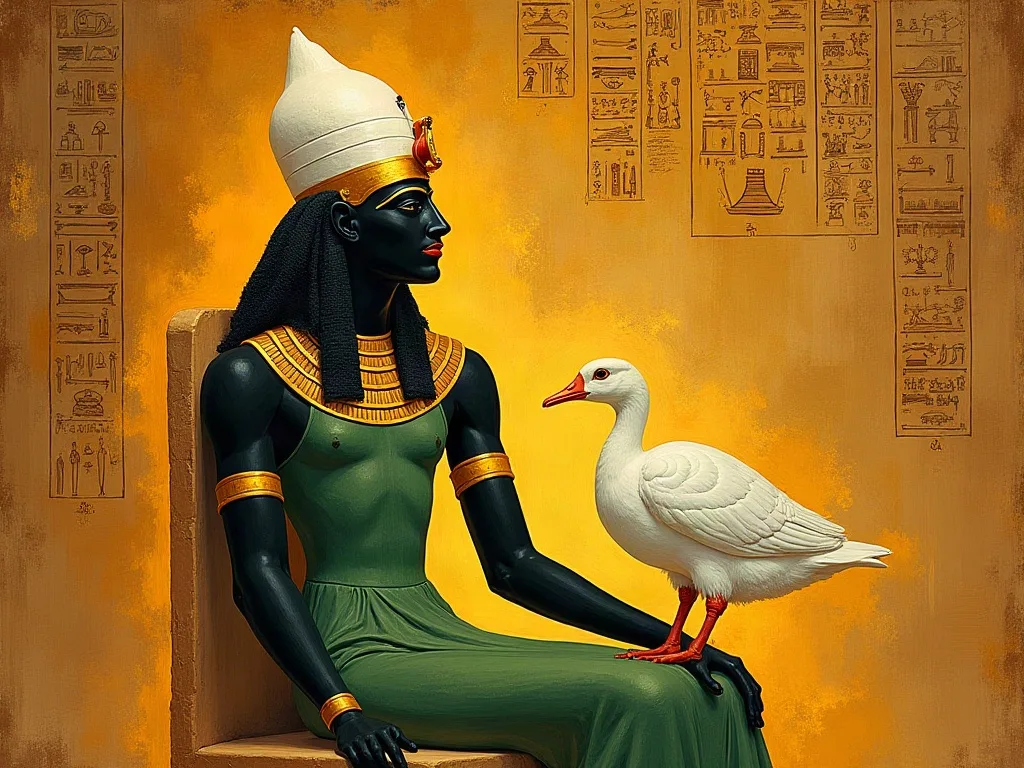
In Egyptian art, Geb appears as a man with green or black skin, often with a white crown on his head or a goose on his head (the word for goose, neb, sounds similar to Geb's name). His body is drawn in a reclining position, sometimes arching with his back forming the landscape itself. Hills, trees, and sometimes pharaohs appear on his back. His phallus sometimes stands erect, symbolizing fertility and the life that springs from the earth.
The green and black coloring was deliberate. Green represented vegetation, the life that Geb nourished. Black represented the fertile black mud of the Nile flood, the silt that made Egypt's agriculture possible. Ancient Egyptians had no word for "nature" as something separate from the divine. When they looked at good farmland, they saw Geb's body made fertile.
Occasionally Geb wears a collar or is adorned like a human dignitary, reflecting his role as a king among gods. His movements were thought to cause earthquakes. The Egyptians had a verb, wgen, meaning "to quake" or "to be agitated," which came directly from the concept of Geb stirring in his rest.
Geb's Family and Divine Relationships
Geb sat at the center of Egyptian divine genealogy. His parents were Shu and Tefnut. His siblings, in a cosmological sense, included the air that held him and his twin, Nut. His children were the most important gods in the Egyptian calendar: Osiris, Isis, Set, and Nephthys.
The relationship between Geb and his daughter Nut was paradoxical. They were separated at creation's beginning, yet their relationship remained intimate in Egyptian thought. Some texts describe Geb's constant desire to unite with Nut, a union prevented only by Shu's tireless intervention. This desire reflected an observable truth: the earth always pulls downward, the sky always pulls upward, and air fills the space between them.
With Osiris, his son, Geb had a turbulent relationship. When Osiris was murdered by Set (Geb's other son), the texts say that Geb wept. His grief was imagined as geological: tremors in the earth, subsidence in the soil. Yet Geb also had authority over Osiris. In the afterlife, Osiris became "the son of Geb," and Geb's authority extended even to the underworld, where he was sometimes invoked as a judge of the dead.
His son Set, god of chaos and the desert, stood in perpetual tension with Geb. Set was born from Geb and Nut, yet Set rejected the earth, preferring the sterile desert. This made Set a kind of renegade son, and Geb's attempts to mediate between Set and Osiris were a recurring theme in myth and ritual.
The Role of Geb in Daily and Cosmic Functions
Geb the earth god was not merely a mythological character. He had active, practical roles in Egyptian religious life.
First, Geb was a guarantor of stability. Pharaohs were said to rule "upon the back of Geb," meaning their authority rested on the physical earth and on Geb's consent. Royal coronation inscriptions sometimes included a statement that Geb had confirmed the pharaoh's rule. This grounded political power in a natural, cosmic order.
Second, Geb was the keeper of all underground treasures. Minerals, gems, metals, and fossil fuels were understood to belong to Geb. Mining was not simple extraction; it was a negotiation with a god. Before digging, miners or officials would make offerings to Geb, asking permission and promising proper respect.
Third, Geb was a fertility god beyond mere crop growth. Sexual fertility, animal fertility, and the fertility of ideas all fell within his domain. Pregnant women would invoke Geb. Farmers would appeal to Geb before sowing. Warriors would call on Geb for strength and endurance.
Finally, Geb was imagined as a healer. His association with the earth meant an association with herbs, with clay used in medicine, and with the regenerative power of rest (sleeping on Geb's body, so to speak, was healing). Several medical papyri invoke Geb in formulas for treating illness.
Geb and the Nile: The Life of Egypt
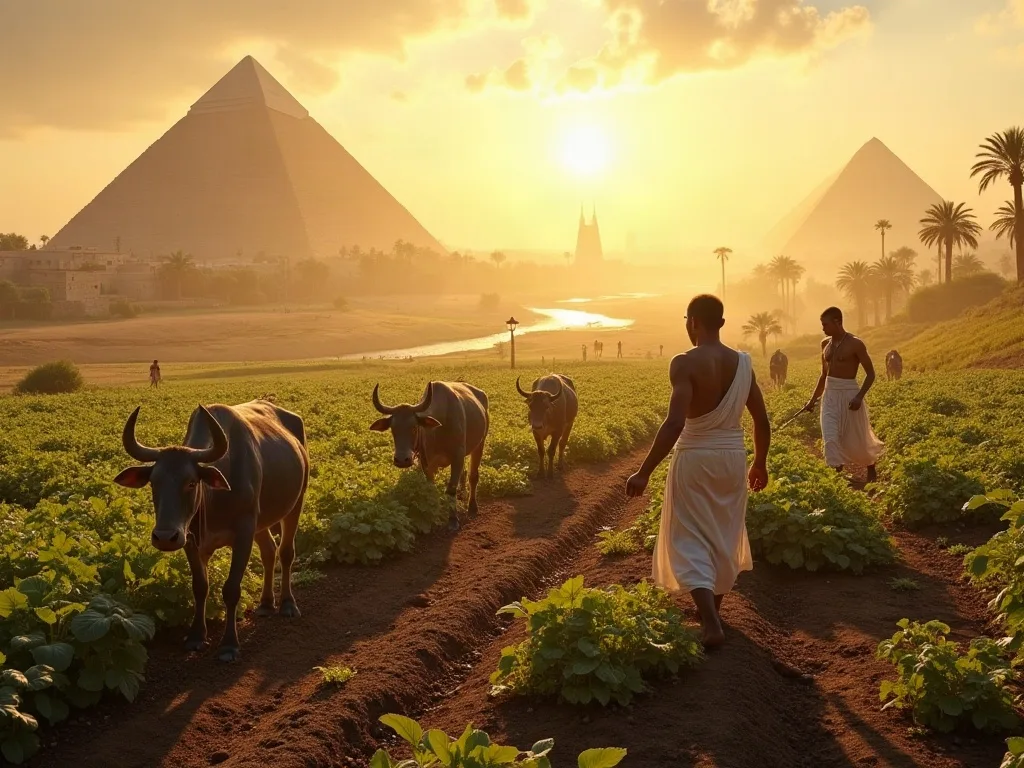
The Nile was the lifeblood of Egypt, and Geb was understood as the Nile's channel and supporter. The flooding of the Nile, which made Egyptian agriculture possible, was imagined partly as Geb's offering. The black mud deposited by floods was literally Geb's body given to farmers.
When the Nile failed to flood, the crisis was interpreted religiously as Geb's disturbance, a sign that cosmic order was breaking down. The Nile's height was measured in nilometers, structures on the banks that recorded the flood level. These were sometimes called "the measures of Geb."
Geb's role extended to the islands and flood plain as well. The Nile Delta, formed by silt accumulation over millennia, was sometimes personified as Geb's creative work. The land that emerged from the primordial waters of the Nun was continuously re-emerging from the Nile's waters, just as it had emerged in the mythological creation.
Geb in the Afterlife and the Judgment of the Dead
The underworld was called the Duat, and much of it was understood as Geb's domain. Osiris, the god of the afterlife and resurrection, was Geb's son, and some sources claim that Osiris ruled the Duat only with Geb's authority beneath him.
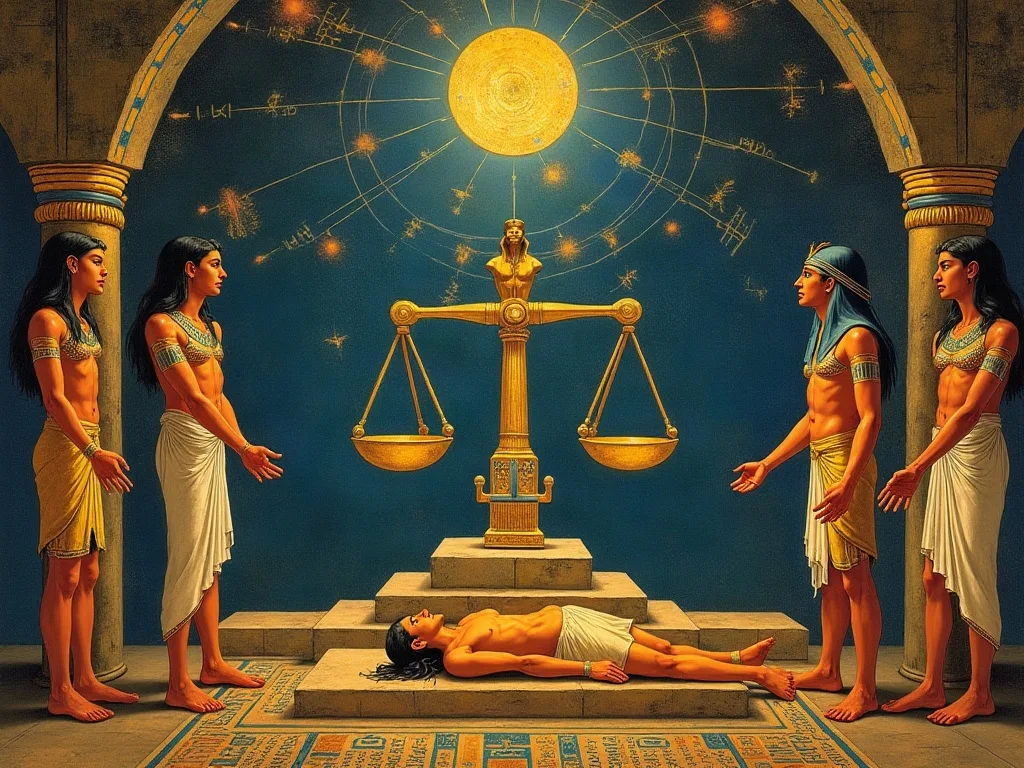
In the Book of the Dead, the deceased hoped to know Geb's names and to have Geb's approval. One text states: "I know Geb, I know his names." Knowing a god's names gave power over that god, or at least familiarity and access. Geb was sometimes invoked as a judge in the Weighing of the Heart ceremony, where the soul's sins were measured against the feather of truth. Geb's judgment could determine whether the soul found peace or was condemned to dissolution.
The deceased were also buried in Geb. They lay in tombs in Geb's body, awaiting resurrection. The afterlife was not imagined as floating away from Geb but as sinking deeper into him, into a fertile layer where death and rebirth merged. Geb was thus both the place of death and the promise of renewal.
In some late texts, Geb appears as the father figure who vouches for the deceased in the afterlife, much as a living father might vouch for a son. The identity "son of Geb" appears frequently in inscriptions and funerary literature, affirming a bond between the living and dead and the earth god who held them both.
Geb's Worship and Cult Practice
Unlike Ra, the sun god whose worship dominated temple priesthoods, or Amun, whose power grew through state sponsorship, Geb had no major temple dedicated solely to him. This reflects his ubiquity. He needed no house because he was the house. Every sacred precinct stood on his back.
Yet Geb was invoked constantly. Rituals involving the earth, foundation-laying ceremonies for temples and tombs, and agricultural blessings all called on Geb. The pharaoh would touch the earth and speak to Geb before making major decisions. Miners would pour libations to Geb before digging. Farmers would mark the seasons by calling on Geb.
Geb's animal was the goose, and geese were sometimes sacrificed in his honor, though this was less common than with other gods. His sacred tree was sometimes the sycamore fig, a tree deeply rooted in the earth. His colors were green (fertility and vegetation) and black (the Nile mud).
In the Greco-Roman period, when Egypt came under foreign rule and Greek names replaced Egyptian ones, Geb was sometimes identified with Kronos, the Titan god of harvest and time, because both had associations with agricultural fertility and an ancient, primal role in creation.
Geb and Other Earth Deities Across Cultures
The figure of Geb as an earth deity has parallels in other ancient mythologies, though Geb's conception was uniquely Egyptian. In Greek mythology, Gaia was the primordial earth goddess, whose body also formed the land, but Gaia was female and pre-dated the Olympian gods. Geb predated the creation of order but was embedded in Heliopolis' orderly cosmos from the start.
In Mesopotamian tradition, Ki or Ninhursag represented the earth, but again with different mythological roles and relationships. In Hindu cosmology, Prithvi, the earth goddess, plays a similar foundational role but with distinct narrative contexts and worship practices.
What made Geb unique was the Egyptian insistence that he was literally, physically the earth. Not a symbol. Not a metaphor. His body had weight, extent, and surface. You could walk on Geb and feel his presence. This grounded the divine in the immediate, sensory experience of landscape.
Geb and the Conflict of Osiris and Set
One of the most dramatic roles Geb played was mediator in the conflict between his sons Osiris and Set. When Set murdered Osiris and threw his body into the Nile, Geb was called to judge the dispute. The Contendings of Horus and Set, a later narrative text, portrays Geb as the elder judge who hears both sides.
Geb's judgment was complicated by family loyalty and the cosmic principles at stake. Set represented chaos and the desert; Osiris represented order and fertility. Geb, as the earth itself, contained both principles. His role in the judgment was to weigh the claims and ultimately endorse Horus, Osiris's son, as the rightful heir.
This story appears in fragmentary form in the Pyramid Texts and Coffin Texts, and in fuller narrative in much later demotic texts. Regardless of the version, Geb's authority over inheritance and succession was absolute. He could not be overruled; he could only be persuaded.
Geb in Hieroglyphic Writing and Iconography
The Egyptian hieroglyph for Geb is straightforward: a reclining figure, sometimes green, sometimes black. The glyph itself became a word for earth and soil. Scribes writing about soil, agriculture, or the ground would use Geb's name or image.
His most common epithets were "the Great Cackler" (referring to the sound of geese, his sacred animal), "Father of the Gods," and "He Whose Body Is the Earth." On temple walls and tomb paintings, Geb often appears in scenes of creation, lying horizontally while other gods stand or sit around him. His presence grounds the composition literally, making him the base on which the entire scene rests.
In the New Kingdom (roughly 1550-1070 BC), when Egyptian art became more elaborate, Geb sometimes appears wearing a pharaoh's regalia or a god's crown, signaling his authority. By the Late Period (664-332 BC), his image had become more standardized, appearing in papyri and tomb inscriptions with consistent features.
Modern Understanding and Scholarly Interpretation
Egyptologists have long recognized that Geb represents more than a personified earth. He embodies Egyptian spatial and temporal consciousness. To the ancient Egyptians, space was not empty. It was filled with sacred presence. Every place was a place of a god. Geb was the god of place itself, the principle of ground and location.
Some scholars have noted that Geb's role as a guarantor of pharaonic authority reflects real political needs. By claiming Geb's approval, a pharaoh rooted his rule in something that could not be challenged: the earth itself. This was a profound rhetorical move, one that grounded political power in the natural world.
The separation of Geb and Nut by Shu also reflects Egyptian observation of the horizon. The air creates a perceived space between earth and sky. To the Egyptian eye, space itself is a god (Shu) holding two bodies apart. This was not ignorance; it was a way of organizing sensory experience into mythological form.
Recent work on Egyptian cosmology has emphasized that the Heliopolis creation myth, with Geb at its center, was not the only creation story in Egypt. Different temples promoted different cosmologies. Yet Geb appears consistently across all of them, suggesting that his role was foundational to Egyptian religious thought regardless of local variation.
The Decline of Geb's Worship in Late Antiquity
As Egypt came under Greek rule after Alexander's conquest in 332 BC, and later under Roman rule, traditional Egyptian religion persisted but transformed. New gods emerged, old gods merged with Greek equivalents, and the texture of worship changed.
Geb's worship did not disappear, but it became absorbed into broader cosmological frameworks. In Greco-Roman Egypt, Geb might be identified with Kronos or Gaia, depending on context. As Christianity spread in the early centuries AD, Geb and the entire Egyptian pantheon gradually faded from active worship, though they never entirely vanished from memory or from popular folk belief.
By the end of the 4th century AD, when pagan temples were closed throughout the Roman Empire, Geb had ceased to be a god with priests and rituals. He survived in texts, in hieroglyphic inscriptions on temple walls and in papyri, preserved in the silence of ancient stone.
Geb's Legacy in Modern Culture and Scholarship
Today, Geb appears in popular culture, from fantasy novels to video games, usually portrayed as an earth-elemental god or a source of seismic power. These modern retellings capture something true: Geb's association with the earth's creative and destructive forces.
Academic study of Geb has deepened over the past century as Egyptologists have recovered more texts, more temple inscriptions, and more artifacts. The discovery and translation of the Pyramid Texts in the late 19th century revealed Geb's antiquity and importance. Later finds, including tomb paintings and coffin texts, filled in details of his worship and mythology.
What emerges is a picture of a god who was perhaps less celebrated in temple cults than other gods, but more fundamental to Egyptian cosmology and daily religious experience. Geb was the ground beneath every prayer, the premise of every ritual, the body on which every life was lived.
Frequently Asked Questions About Geb
Frequently asked questions
How did the ancient Egyptians know Geb's names?
The Pyramid Texts and Coffin Texts preserve a list of Geb's secret names, including "Great Cackler," "Father of the Gods," and "He Whose Body Is the Earth." Knowing a god's true names gave power over that god or at least magical access. Priests and the deceased were taught these names as part of their religious training so they could invoke Geb with authority.
Did Geb have a wife other than Nut?
Nut was Geb's twin sister and cosmic counterpart, not strictly a wife in human terms, though they are depicted as lovers eternally separated by Shu. In some later texts, Geb is paired with other goddesses like Seb or less commonly with lesser earth deities, but Nut remained his primary divine partner throughout Egyptian history.
Why did Egyptians imagine the earth as a god's body?
This reflects how Egyptians experienced the world. To them, everything alive had a divine essence. The ground they walked on, the crops they grew, and the Nile that sustained them were all alive in a sacred sense. Representing earth as Geb's body was a way of affirming that the ground itself was divine and alive, worthy of respect and reverence.
What is the difference between Geb and Osiris?
Geb is the earth itself, the physical ground and principle of soil fertility. Osiris is Geb's son, the god of agriculture, resurrection, and the afterlife. Osiris rules the Duat (underworld), while Geb is the domain in which the Duat sits. Geb is static and foundational; Osiris is active, dying, and rising again. Geb's realm is the present moment and the physical world. Osiris's realm is the cycles of death and rebirth.
How did ancient Egyptians physically pray to Geb?
Geb had no major temple, so prayers to Geb often took place directly on the earth. A person might touch the ground, kneel, or pour liquid offerings onto the soil while calling Geb's name. In ceremonies, priests would strike the ground to awaken Geb or to symbolically affirm the pharaoh's connection to Geb's authority. Every act of planting, building, or excavating could become a ritual conversation with Geb.
Did Geb appear in texts outside the Pyramid Texts?
Yes. Geb appears in the Coffin Texts (Middle Kingdom), the Book of the Dead (New Kingdom), temple reliefs, king lists, and astronomical ceilings. He also appears in later demotic texts from the Greco-Roman period. His role shifts slightly across these sources, but he remains consistent as the earth and as a fundamental cosmic principle throughout Egyptian recorded history.
Geb's Eternal Lie: The Persistence of the Earth
What makes Geb remarkable is his absolute stillness. While other gods act, travel, fight, and transform, Geb lies on his back, supporting creation. His role is to be present, to hold firm, to offer his body as the foundation of all things.
In Egyptian thought, this was not a diminished role. To be the ground of being, to be the answer to every child's question "what am I standing on?", this was supreme. Geb did not need to perform miracles or perform cosmic tasks. His existence was the miracle. His body was the task.
When modern readers encounter Geb in ancient texts, they often see a distant, abstract god. But for an Egyptian farmer pressing seeds into black soil, for a pharaoh touching the earth before his coronation, for a miner entering Geb's depths seeking gemstones, Geb was the most intimate god imaginable. He was beneath every footstep, closer than breath, the ground of all being. His silence was not emptiness. It was the sound of creation supporting itself.
Free 25-page sample
Want the whole story?
Take the first 25 pages free. If it pulls you in, the full edition is yours as an instant PDF download, with a paperback on Amazon for selected titles.

Mythology
The World Mythology Book: The Gods, Heroes and Myths of Every Culture
The Gods, Heroes and Myths of Every Culture, in One Volume
The whole of world mythology in a single volume: Greek, Norse, Egyptian, Japanese, Hindu, Celtic, Slavic, Mesoamerican and African myths gathered side by side, each drawn from the primary sources.