

The Gorgons: Three Sisters at the Edge of the World
Stheno, Euryale, and Medusa: the Gorgon sisters who turned flesh to stone and haunted the Greek imagination from Hesiod to Hollywood. A deep study of their origins, symbolism, and every myth they inhabit.
Contents
The sailor who reached the western edge of the known world was supposed to feel it before he saw it. A chill, an odd stillness in the water, as if the sea itself held its breath. Ancient Greek storytellers placed the Gorgons three sisters precisely there, at the rim of the habitable earth, beyond the sunset, in a land shared with their kin the Hesperides and the sleeping Titan Atlas. You didn't travel there. You were sent.
Perseus was sent. That is the oldest structural truth about the Gorgon myth: no hero visits them out of curiosity. The encounter is forced, shaped by impossible demands from jealous kings or scheming gods, and only one of the three sisters is mortal enough to be killed. The other two, Stheno and Euryale, are eternal, and they scream when their sister falls. Their cry across the ocean is one of the most acoustically vivid images in all of archaic Greek poetry.
What kind of creature generates that much dread, that much sound, and that much protective power all at once? The answer runs deeper than snakes for hair.
Origins of the Gorgons in Greek Cosmology
Hesiod's Theogony, composed around 700 BCE, gives the Gorgons their first systematic genealogy. They are daughters of Phorcys and Ceto, two primordial sea deities whose very names mean "grey one" and "sea monster." Their family tree is a catalogue of beautiful horror: sisters of the Graeae (the three "grey women" who share one eye and one tooth), cousins to Echidna (half woman, half serpent, mother of most Greek monsters), and kin to the Hesperides at the world's western boundary.
The three Gorgons bear distinct names, each weighted with meaning. Stheno translates to "the mighty" or "the forceful." Euryale means "the wide-roaming" or "the far-springer," a name that implies vast, untethered movement across sea or sky. Medusa carries the most debated etymology, generally rendered as "the guardian" or "the queen," from the verb medô, to rule or protect. That last meaning matters enormously: the creature whose gaze destroys was, before that, a ruler and a protector.
Hesiod notes that Stheno and Euryale are immortal, while Medusa alone is subject to death. He gives no explanation. This asymmetry is ancient, structural, and perhaps deliberate: the two outer sisters exist to frame the central one, to make her mortality poignant and her death consequential.
The Theogony also preserves a detail often overlooked in retellings: Medusa lay with Poseidon in a soft meadow among spring flowers. From her severed neck, when Perseus strikes, spring two children: Chrysaor ("he of the golden sword") and the winged horse Pegasus. The violence of decapitation is simultaneously a birth. The Gorgon's death is generative, not merely terminal.

What the Gorgons Actually Looked Like: Archaic vs. Classical Art
The oldest visual Gorgon bears almost no resemblance to the haunted beauty that Renaissance painters handed to Caravaggio and Cellini. On the mid-seventh-century BCE Eleusis amphora (one of the earliest known depictions), the Gorgon is frontally positioned, wide-faced, with a protruding tongue, boar's tusks, and a belt of writhing snakes. The face is explicitly mask-like: symmetric, confrontational, designed to make eye contact with the viewer regardless of the angle.
This oldest type is called the Gorgoneion, the Gorgon face as apotropaic symbol, and it predates the narrative myth of Perseus by centuries in the archaeological record. The face came first. The story came later, perhaps as an etiological explanation for why such a face existed and why it worked.
By the fifth century BCE, Classical sculpture begins to soften the image. The Gorgons of the Temple of Artemis at Corfu (circa 580 BCE) still show full-frontal grotesque features, but by the Parthenon frieze, Medusa's face has grown more humanoid, more sorrowful. Hellenistic art completes the transformation: Medusa becomes beautiful, her horror internalized rather than worn on the surface.
The physical attributes that persist across all periods are worth cataloguing:
- Serpents: wound around the waist, nested in the hair, or worn as a belt
- Tusks: sometimes boar-like, sometimes equine, projecting below the lips
- Wings: golden in some accounts, bronze feathers in others
- Hands and feet: sometimes described as bronze
- A gaze that petrifies: attributed explicitly to Medusa in most sources, but occasionally extended to all three
The wings link the Gorgons to other winged female terrors in Greek cosmology, including the Harpies and the Erinyes. The serpents link them to chthonic, underworld power. The bronze body-parts suggest something forged rather than born, artificial in its invulnerability.
The Perseus Myth: Every Stage, Every Source
The killing of Medusa is the most elaborated Gorgon narrative, and it is worth tracking across sources because the versions diverge significantly.
Pindar (fifth century BCE) is the earliest source to tell the Perseus story in detail. In Pythian Ode 12, he focuses on what happened after the beheading: Athena, watching the Gorgon sisters shriek over Medusa's body, invented the aulos (double flute) to replicate that wailing sound, transforming grief into music. This is not a footnote to the myth. It is Pindar's entire point: the Gorgon's death generates art.
Apollodorus (first or second century CE, Bibliotheca) gives the fullest narrative sequence. Perseus, son of Zeus and Danae, is challenged by the Argive king Polydectes to bring back Medusa's head. He receives aid from Athena and Hermes: a reflective shield (or, in some versions, a polished bronze sword), winged sandals, a kibisis (a special bag for the head), and the cap of Hades which confers invisibility. He visits the Graeae, the Gorgons' sisters, steals their single shared eye to extort information about where to find the nymphs who hold his equipment.
He then travels to the Gorgons' lair, approaches while they sleep, locates Medusa by her reflection in the shield, and strikes. Stheno and Euryale wake to their sister's blood and pursue Perseus across the sky. He escapes because Hades' cap makes him invisible.
Ovid's Metamorphoses (8 CE) adds layers. He gives Medusa a past: once a beautiful woman with magnificent hair, she was raped by Poseidon inside Athena's temple. Athena, furious at the desecration of her sacred space, punished Medusa by transforming her hair into serpents. This version shifts moral weight dramatically. The monster was made, not born.
Ovid also records Perseus' return journey, during which drops of Medusa's blood fall into the Libyan desert and generate venomous serpents, and during which Perseus encounters the Titan Atlas, turns him to stone with the head, thereby creating the Atlas mountains of North Africa. He rescues Andromeda from the sea monster Cetus along the way, using the head again as a weapon.
The head's ultimate fate: Perseus gives it to Athena, who places it on her aegis, the divine shield or breastplate that thereafter becomes the most powerful protective symbol in the Greek pantheon.

Stheno and Euryale: The Immortal Two
Most retellings treat Stheno and Euryale as scenery, present only to make Medusa's mortality legible by contrast. This misreads the original sources.
Stheno is, by Apollodorus, the most murderous of the three sisters. She killed more men than Medusa and Euryale combined, a detail so casually inserted that it reads almost like a correction of the popular record. Her name's meaning, "the forceful," carries physical connotations; she is the warrior-sister, the one defined by action rather than beauty or range.
Euryale appears occasionally in post-Hesiodic tradition as the mother of Orion, the great hunter, fathering him with Poseidon. This tradition is preserved in some scholiast notes and referenced in later mythographic sources, though it competes with other Orion genealogies. If authentic, it makes Euryale not merely a peripheral monster but the matriarch of one of the sky's most recognizable constellations.
The wail of Stheno and Euryale after Medusa's death is described by Pindar as the direct inspiration for the aulos. Athena, hearing their grief, shaped the double pipe to reproduce the sound of mourning sisters. Music, in this version of Greek mythology, is born from Gorgon grief. That is not a small detail.
Their immortality also creates a narrative problem that Greek myth never fully resolves: the two surviving Gorgons simply continue to exist. They are never killed, never transformed, never reintegrated into the cosmic order. They remain at the world's edge. That open-ended persistence is unusual; most Greek monsters have death stories. The Gorgon sisters' immortality is a structural remainder, a mythological loose end that may reflect the apotropaic symbol's function: the Gorgoneion was supposed to remain active, watching, never resolved.
The Gorgoneion: When the Monster Becomes the Shield
The Gorgon face worn as protection is one of the most durable religious images in the ancient Mediterranean, and it operates on a logic that Greek myth makes explicit: the terror that destroys from outside can be harnessed to destroy whatever threatens from further outside.
Athena wears the Gorgoneion on her aegis across hundreds of vase paintings. Alexander the Great, according to Plutarch, wore it on his breastplate at the Battle of Issus. City gates in Athens bore the face. Drinking vessels, coins, mosaic floors, and public fountains all carry the image. The Roman legions stamped it on armor. It traveled to North Africa, the Iberian peninsula, and as far east as Gandharan Buddhist art, where the face occasionally appears on guardian figures, absorbed into a different but structurally parallel apotropaic tradition.
The logic of the Gorgoneion connects the Greek tradition to a broader human pattern. Kali, the Hindu goddess of destruction, performs a formally similar function: her terrifying face and extended tongue echo the archaic Gorgon's visual grammar, and she too is worn as protection against evil by devotees. The Aztec deity Coatlicue carries serpents and skulls in a configuration that scholars of comparative religion have compared to the Gorgon complex. These are not borrowings; they reflect a shared human instinct about how to represent the outer limit of the frightening.
Medusa in Ovid and the Question of Victimhood
Ovid's innovation deserves sustained attention because it does something structurally unusual in ancient myth: it creates a monster with a sympathetic backstory.
The pre-Ovidian Medusa is frightening, functional, and morally neutral. She is what she is, by birth, as part of the cosmic furniture. Ovid's Medusa, in Metamorphoses Book 4, was beautiful. She was violated in a sacred space. She was then punished for the violation by the goddess whose temple was desecrated. The punishment, in modern ethical terms, falls on the wrong person.
Ancient readers do not appear to have experienced this as the contradiction modern readers feel. Athena's anger at Medusa for "allowing" the desecration of her temple is consistent with ancient Greek understandings of pollution (miasma): the body that bears violence also bears ritual contamination, regardless of consent. This is not to endorse that framework but to read Ovid's text accurately.
What Ovid does accomplish is a narratively rich ambiguity: Perseus kills a creature who was, arguably, more victim than monster. The hero's triumph carries a shadow. The head he carries is beautiful even in death. Caravaggio's 1596-98 Medusa (now in the Uffizi) captures this precisely: the severed head screams, the serpents rear, and the face is exquisitely rendered. The painting makes the viewer complicit in the horror rather than comfortable with the heroism.
This Ovidian reading created the interpretive line that runs through feminist scholarship on the myth. In 1975, the French theorist Hélène Cixous wrote "The Laugh of the Medusa," explicitly using the Gorgon as a symbol of female power reclaimed from patriarchal violence. Her point was not separable from the Ovidian version: you can only laugh with Medusa if she was, first, made unjustly monstrous.

Cross-Mythological Parallels: Gorgon Logic Beyond Greece
The Gorgon sisters operate within a recognizable mythological grammar that appears, independently, across several traditions.
In Mesopotamian mythology, Humbaba, the guardian of the Cedar Forest in the Epic of Gilgamesh, has a face constructed from intestines arranged in a spiral, a face that radiates a paralyzing aura called melammu (divine radiance-as-terror). Gilgamesh cannot look at it directly. The parallel with the Gorgon's petrifying gaze is structural: both are threshold guardians whose primary weapon is vision, or rather the fear of being seen.
In Japanese tradition, the face of Hannya, the demon mask of a jealous woman in Noh theater, performs a related function: it is worn to embody destructive female rage and is simultaneously terrifying and pitiable. The ambivalence between monster and victim in the Hannya mask echoes the Ovidian Medusa almost exactly, through a completely independent cultural channel.
Norse mythology offers Hel, ruler of the dead realm Niflheim, whose body is half living-flesh and half corpse, a visual binary that operates like the Gorgon's bronze-and-flesh combination: mortal materials arranged to signal the threshold between worlds.
The deeper pattern seems to be this: cultures that need to represent the absolute boundary of the safe world tend to generate a female figure with a horrifying face whose gaze or proximity brings transformation (death, stone, madness). The Gorgon is Greece's most articulate version of that archetype, but she is not alone.
The Gorgons in Later Art and Modern Reception
The Gorgon's life after antiquity is long and surprisingly varied.
Dante places Medusa in the Inferno (Canto 9), where the Furies threaten to summon her to petrify the pilgrim's reason. Virgil covers Dante's eyes to prevent him seeing her. The Gorgon, in Dante's moral cosmology, is the stone of intellectual despair: what petrifies you is not death but the loss of the capacity to think. This is a genuinely creative theological interpretation, not a simple borrowing.
In the visual arts: Antonio Canova's unfinished Perseus with the Head of Medusa (1801, Vatican Museums) treats the hero triumphantly; the head hangs, its power neutralized. Compare this to Luciano Garbati's 2008 sculpture Medusa with the Head of Perseus, where Medusa stands victorious, Perseus' head in her hand, a direct inversion commissioned by the post-Ovidian feminist interpretation. Garbati's statue stood in New York's Collect Pond Park opposite the courthouse during the Harvey Weinstein trial in 2020, which tells you precisely how alive this myth remains.
Film has done variable things with the Gorgons. The 1981 Clash of the Titans Ray Harryhausen sequence, in which Perseus stalks a sleeping Medusa through a ruined temple while her tail coils and her eyes glow, remains one of the most atmospherically faithful sequences in mythological cinema, capturing the dread and the stillness. The 2010 remake replaces atmosphere with combat spectacle, losing the myth's essential quality: the Gorgon is not meant to be fought, only evaded and reflected.
In contemporary fiction, Rick Riordan's Percy Jackson series reframes Medusa as a woman unjustly transformed (borrowing Ovid's reading) and makes her explicitly sympathetic before she becomes antagonistic. The novels introduce millions of young readers to the myth via its most ethically complex version.
Madeline Miller's Circe (2018), though focused on the witch, places the Gorgon world within a broader meditation on monstrous women and divine power, asking which characteristics Greek tradition called monstrous and why. The Gorgon question runs beneath much of that novel's surface.
The Snakes, the Wings, and the Threshold: Reading the Gorgon Symbol
The specific physical features of the Gorgons carry precise symbolic weight that archaic Greek audiences would have parsed without needing an explanation.
Serpents in Greek cosmology signal chthonic power, connection to the earth's deep strata, and regenerative force (snakes shed skin and are "reborn"). They also signal Dionysian energy: the god's maenads wore living snakes, Asclepius carried a serpent staff, the Oracle at Delphi breathed vapors from a chthonic crack. A head crowned with snakes is not simply grotesque; it signals a being whose power flows from below the Olympian order.
Wings mark the Gorgons as liminal, between earth and sky, comparable to the Harpies. Flight in Greek myth is almost always a marker of the non-human. The Gorgons' wings are gold or bronze, not feathered like birds; they are forged, divine-material wings, which reinforces the sense that these are beings built at a cosmic forge rather than born in a normal biological sense.
The petrifying gaze operates as a precise inversion of the Greek philosophical concept of vision. Ancient Greek optics, following Empedocles and later Plato, often theorized vision as an emanation from the eye, a ray projected outward that encounters the world and reports back. The Gorgon's gaze is vision weaponized: the ray goes out and comes back as stone. The viewer and the viewed are both destroyed in the encounter. Perseus' reflective shield corrects this by interposing a mediating surface, turning the Gorgon's own projected ray back on itself.
The Gorgon is, in this reading, a figure for the unmediated confrontation with the absolute, with death, with the divine unfiltered. You cannot face it directly. You can only approach it via reflection, via art, via the indirect angle. Athena's gift of the polished shield is a gift of mediation, and the fact that she receives the head afterward and wears it suggests that the goddess herself represents that same power of controlled, mediated engagement with what would otherwise be fatal.
Frequently Asked Questions about the Gorgon Sisters
Frequently asked questions
Who were the three Gorgon sisters and what were their names?
The three sisters were Stheno ("the mighty"), Euryale ("the wide-roaming"), and Medusa ("the guardian" or "the queen"). All three were daughters of the primordial sea deities Phorcys and Ceto, as recorded in Hesiod's Theogony (circa 700 BCE). Stheno and Euryale were immortal; Medusa alone could be killed, a distinction Hesiod states without explanation. Apollodorus later recorded that Stheno killed more men than both sisters combined, though Medusa became the most mythologically prominent of the three.
Was Medusa always a monster, or was she transformed?
In Hesiod's account, Medusa was born a Gorgon; monstrousness was her original nature. Ovid's Metamorphoses (8 CE) introduced the transformation narrative: Medusa was once a beautiful woman who was violated by Poseidon in Athena's temple, and Athena punished her by turning her hair to snakes. These are two distinct and incompatible mythological versions, and both have been active in Western culture simultaneously since the Roman period. Ovid's version dominates modern retellings; Hesiod's is older and was likely more widespread in archaic Greek culture.
What happened to Stheno and Euryale after Medusa was killed?
According to Apollodorus, Stheno and Euryale pursued Perseus after he beheaded their sister, but could not catch him because the cap of Hades made him invisible. After that pursuit, the two immortal sisters disappear from the major mythological narratives. Greek myth never provides them with death stories or transformations; they simply remain at the western edge of the world, unresolved. Some scholiast traditions record Euryale as the mother of Orion the hunter (fathered by Poseidon), which would make her the matriarch of one of the most recognizable figures in Greek mythology.
What is a Gorgoneion and how was it used?
A Gorgoneion is the Gorgon face rendered as a standalone apotropaic symbol, used to ward off evil. Archaeological evidence places the Gorgoneion on temple pediments, shields, drinking vessels, coins, armor, and public architecture across the ancient Mediterranean from at least the seventh century BCE. Athena wore it on her aegis; Alexander the Great reportedly bore it on his breastplate. The Gorgoneion appears before the Perseus narrative in the archaeological record, which suggests the protective face is mythologically older than the story built around it. Similar apotropaic face-symbols appear independently in Mesopotamian, East Asian, and pre-Columbian traditions.
Why did Perseus use a reflective shield rather than looking at Medusa directly?
Ancient Greek optical theory (articulated by Empedocles and referenced in Plato) often modeled vision as an emanation from the eye, a ray projected outward. The Gorgon's petrifying gaze was understood as that ray turned lethal: direct contact destroyed both parties. A polished reflective surface interposes a layer of mediation, bouncing the Gorgon's own visual ray back without allowing it to reach Perseus' eyes. Philosophically, the shield represents the possibility of indirect knowledge: you can study the lethal and the absolute only through its reflection. Scholars including Jean-Pierre Vernant have read this as a founding metaphor for Greek representations of death and the divine.
How has the Medusa myth been used in feminist theory?
Hélène Cixous's 1975 essay "The Laugh of the Medusa" is the pivotal text. Cixous argued that patriarchal culture renders women monstrous to prevent them from acting; looking at Medusa directly, she proposed, reveals that the monster is a fiction constructed by men afraid of female power. She urged women to write from that exposed, "monstrous" position. The essay builds explicitly on Ovid's version (Medusa as unjust victim) rather than Hesiod's (Medusa as born monster). Since then, Medusa has functioned in feminist discourse as a symbol of unjust demonization, reclaimed power, and the political dimensions of who gets to name what is monstrous.
The Gorgon at the Edge of Vision: A Question Greek Myth Never Closed
The two sisters who survive are never hunted down. The head that ends up on Athena's breastplate continues to petrify enemies through every war the goddess enters. The blood that falls from Medusa's neck in Ovid generates a desert full of serpents, which then generate further myths. The Gorgons three sisters do not resolve neatly because the thing they represent, the lethal outer limit of what the human gaze can safely encounter, does not resolve.
Scholars including Jean-Pierre Vernant (Mortals and Immortals, 1991) have argued that the Greek encounter with Medusa is specifically an encounter with death-as-image: you cannot look at a corpse too long, cannot stare at the sun, cannot face the Gorgon. All three are forms of the same prohibition on the unmediated absolute. The mirror that Perseus uses is, in this reading, the same instrument as art: a way to approach the unviewable at a safe diagonal.
That reading gives the Gorgon sisters a dignity beyond their role as obstacles. They are not failures of the Greek imagination, crude early monsters to be refined by later, more sophisticated myth. They are the system's honest acknowledgment that some things at the edge of understanding require a reflective surface, a shield, a translation, before the human eye can hold them without being broken.
The open question in Gorgon scholarship remains the relationship between the apotropaic symbol and the narrative. Did the face come first and the story later, as the archaeological sequence suggests? If so, the Gorgon's origin may not be in storytelling at all, but in a very old, very human practice: painting a face of maximum terror on the threshold of everything precious, to say to whatever is outside: this is what lives here. Look away.
That face still appears. On motorcycle helmets, heavy metal albums, video game boss-screens, and the prows of fishing boats in modern Greece. Stheno and Euryale are still out there somewhere, still screaming. The sound has not stopped. We just started calling it music.
Read the full book
Want the whole story?
The complete edition is an instant PDF download here, with a paperback on Amazon for selected titles.
Mythology
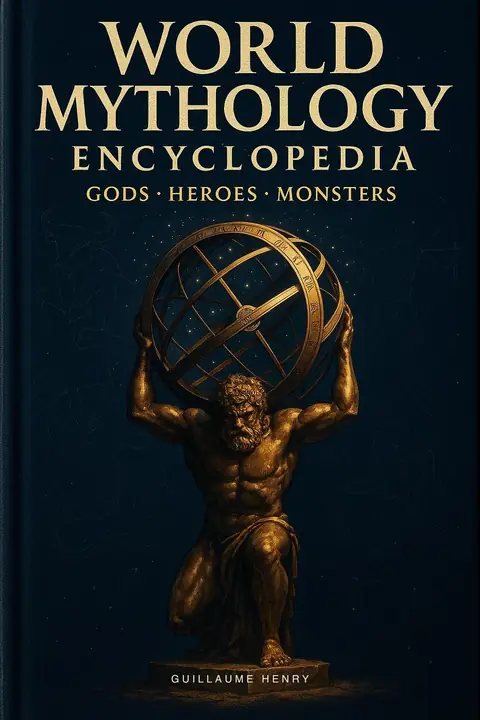
The World Mythology Book: The Gods, Heroes and Myths of Every Culture
The Gods, Heroes and Myths of Every Culture, in One Volume
The whole of world mythology in a single volume: Greek, Norse, Egyptian, Japanese, Hindu, Celtic, Slavic, Mesoamerican and African myths gathered side by side, each drawn from the primary sources.