
The Greek Key Meander Pattern: Labyrinth Logic and the Eternal Return Across Cultures
The Greek key meander pattern is far more than decoration. Born from the myth of Daedalus' labyrinth, this infinite geometric loop carries meaning across tattoos, temples, and cultures: order emerging from chaos, the journey inward, the path that returns home.
Contents
On the potter's wheel of ancient Athens, an artist traces a line. It goes forward, then sharply turns. Forward again, then back. Never crossing itself, yet never ending. This is the Greek key meander pattern, and it hides a story about being lost and finding your way home.
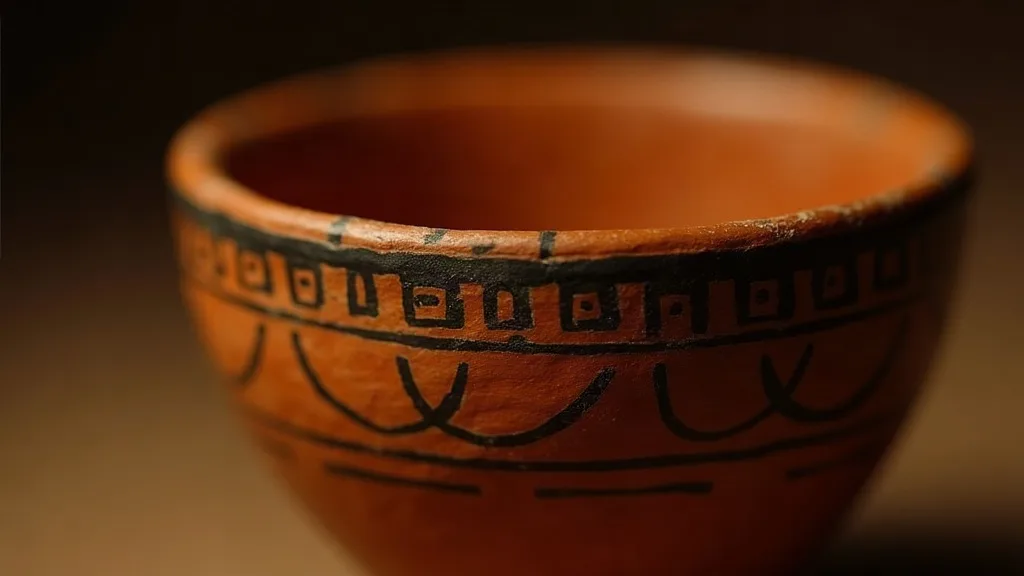
The meander appears on black-figure pottery around 500 BCE, but its meaning reaches back further, to labyrinths carved into stone and myths whispered in the dark. For the Greeks, this simple looping line was not mere ornament. It was philosophy drawn with a steady hand: a visual proof that the most confusing path can still have order, that chaos and design are neighbors separated by a single turning point.
The Labyrinth Myth: Theseus, Ariadne, and the Line That Saves
In Crete, the king Minos kept a secret. Beneath his palace lived the Minotaur, a creature half-man, half-bull, born of a curse. To contain it, he hired Daedalus, the craftsman-god of ingenuity, to build a prison from which no one could escape. Daedalus built the labyrinth: a building so twisted and intricate that anyone who entered would wander until they died, unable to find the exit.
Athens, humbled by Minos, sent tributes: young men and women, condemned to become the Minotaur's meal. The hero Theseus chose to go willingly, intending to kill the beast and free Athens from this debt. But a labyrinth is designed to defeat courage. Strength means nothing when every corridor looks the same.
Then Ariadne, Minos' daughter, fell in love with Theseus. She gave him a ball of red thread and whispered instructions: tie it at the entrance, unwind it as you go, follow it back after the kill. This thread was not mystical. It was practical geometry: a physical record of the path, proof that chaos could be tamed by simply marking your steps. Theseus followed the thread into the dark, slew the Minotaur, and walked back out. The thread was his salvation because it was his memory made tangible.
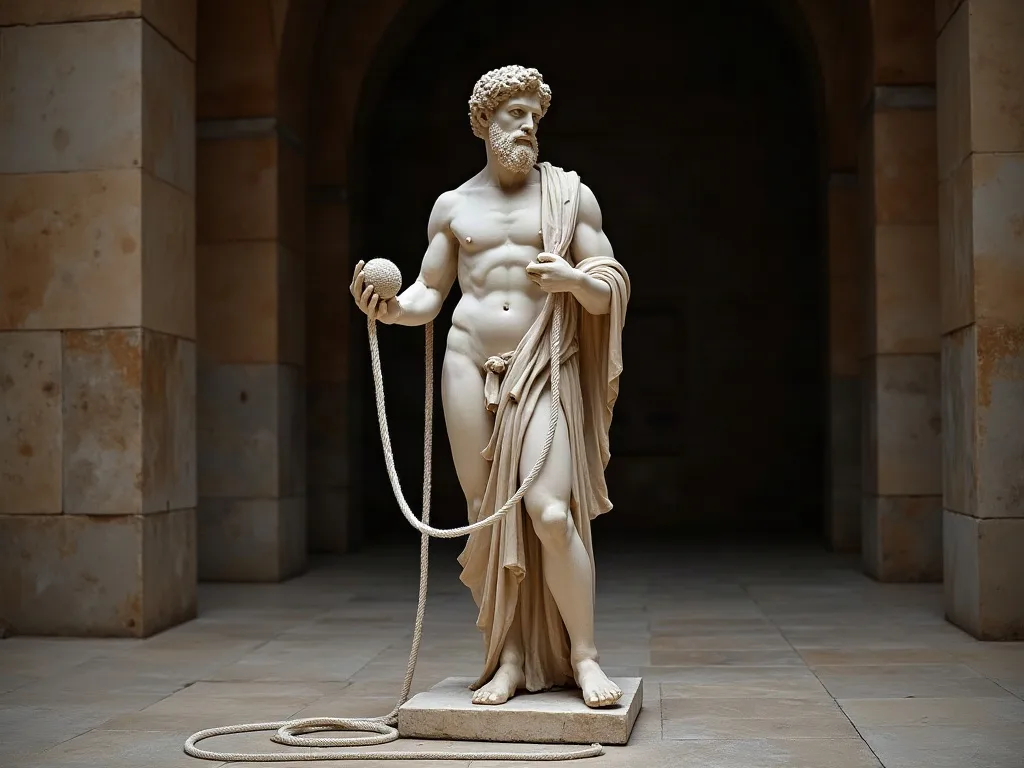
The Greeks understood this metaphor immediately. Getting lost is natural. Finding your way out depends on leaving a trail, on creating pattern where none existed. The meander became that trail: a line that proves you can wander infinitely and still return to where you began.
The Geometry of Return: Why the Meander Never Ends
Look closely at a Greek key meander pattern. It is a closed loop constructed from right angles only. No curves. No diagonal escapes. Yet if you trace it with your finger, you notice something: the line turns inward and outward with mechanical precision. For every step forward, there is a step back. For every expansion, a contraction.
This is not random decoration. It is a visual statement about cyclical time.
Greek potters and architects understood the power of a line that never crosses itself. In mathematics, we call this a simple closed curve. To the ancients, it was something deeper: proof that you could move in complex patterns and still return home. The meander appears on the borders of cups, on walls, on tombs. It frames images of gods and heroes because it embodies a truth about existence: the journey is spiral, not linear. You may think you are going forward, but the path loops back on itself.
The pattern also appears in nature. The rivers of Greece meander. The intestines coil. Snakes spiral. By rendering these natural coils in geometric form, the meander becomes a bridge between the chaotic living world and the ordered world of human making. It suggests that underneath apparent disorder, there is geometry. Underneath the Minotaur's labyrinth, there is a plan.
The Meander in Greek Art and Architecture
By the 5th century BCE, the Greek key meander pattern had become the dominant border ornament in Greek pottery. Black-figure vases, red-figure vases, marble friezes: the meander was everywhere. It framed the rim of a drinking cup, the base of a statue, the edge of a courtyard. It was so common that modern scholars sometimes dismiss it as mere convention, a decorative filler that meant nothing.
This is a mistake.
The meander was placed where it was for a reason. On the rim of a cup, it surrounded the drinker's lips, transforming each sip into a miniature labyrinth journey: in, around, back out. On the base of a statue, it anchored the god or hero to a path of return, suggesting that even the immortals move in cycles. On the border of a painted scene, it contained the narrative within a frame of infinite turning, suggesting that these myths loop eternally.
The architects of the Parthenon used meanders on the entablature. The builders of Minoan palaces (centuries before the classical period) carved meanders into stone. The pattern appears in Mycenaean pottery, suggesting the symbol had already traveled deep into Greek consciousness before anyone wrote down the story of Theseus.

This geometric persistence matters. Unlike a symbol that relies on a single myth, the meander worked because it tapped into something universal about how humans experience space. We are creatures who get lost. We are creatures who find our way home. The meander acknowledges both truths at once.
The Meander Across Cultures: A Symbol Older Than Greece
Here lies a secret that changes how we read the meander: the ancient Greeks did not invent it.
Similar spiral and meander patterns appear in Neolithic pottery from across Europe and Asia, thousands of years before the first Greek city-states formed. The spiral appears in Minoan art (Crete, c. 1700 BCE), in Chinese ceramics (c. 2000 BCE), in Irish Neolithic stone (c. 3200 BCE). The specific form of the Greek key meander, with its right angles and looping repetition, is characteristically Greek. But the impulse to create infinite, non-crossing geometric patterns is older than any single culture.
This suggests that the meander taps into something primal: the human need to create a path that returns, to prove that chaos can be ordered, to transform the experience of being lost into something beautiful and meaningful.
In Celtic art, spirals and interlocking patterns dominate. The Book of Kells, created by Irish monks around 800 CE, features spirals and loops that never cross themselves, suggesting a continuity of meaning from pre-Christian European symbol-making. The Celtic spiral was said to represent journey, renewal, and the eternal cycle. The form differs from the Greek meander, but the underlying idea is identical: a line that proves order and return.
In Islamic art, geometric meanders appear in tilework and calligraphy. Here, the pattern carries theological weight: the infinite path, never broken, represents the infinite nature of God, the eternal pattern beneath creation. The similarity to Greek meanders is striking, suggesting that when cultures developed geometric abstraction, they arrived independently at the same symbolic logic.
In Chinese and Japanese art, meanders and spirals appear in jade carvings, textiles, and architectural details. The pattern was woven into robes and carved onto ritual objects. Again, the visual form differs, but the core meaning persists: a path that is ordered, continuous, and eternal.
Greek Meander
Right angles only; perfect geometric precision; borders frames and rims; derived from labyrinth myth; dominates pottery and architectural ornament; represents cyclical return and hidden order.
Celtic Spiral
Flowing curves; spirals often triple or double; dominates entire design surfaces; associated with journey and renewal; appears in stone carvings and manuscripts; represents the eternal cycle and spiritual progression.
Why the Meander Remains Powerful: Tattoo, Meaning, and Personal Journey
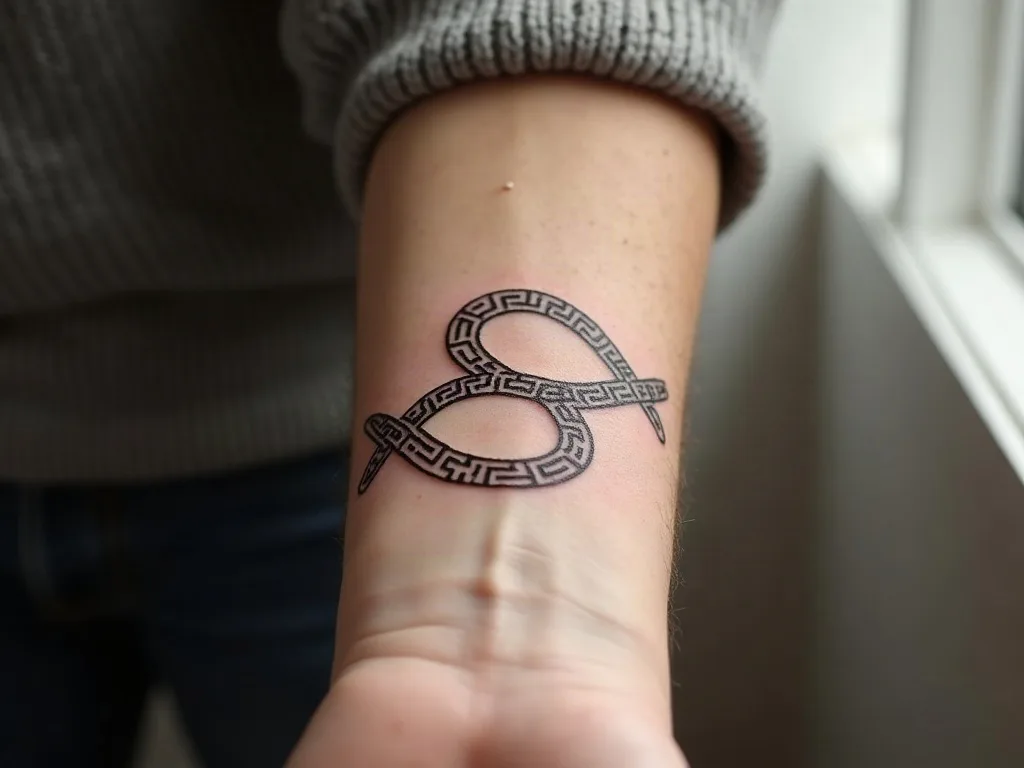
Walk into a tattoo parlor today and ask for a Greek key meander. The artist will likely ask: "What does it mean to you?" This question reveals something profound. The meander is old enough to carry historical weight, simple enough to personalize, and geometric enough to feel eternal.
Modern wearers of meander tattoos cite several meanings:
-
The labyrinth as life journey: Each turn represents a decision, a challenge, a moment of doubt. The pattern shows that you move through chaos and return stronger.
-
Eternal return and cyclical time: The meander never ends. It suggests that life moves in circles, seasons return, and death is not an ending but a turning point in an infinite loop.
-
Connection to Greek heritage: The meander carries direct lineage to classical Athens. For people with Greek ancestry or deep love of classical culture, the tattoo is a living connection to that world.
-
The unbroken path: Many describe the meander as a symbol of perseverance. No matter how much the path turns, it never breaks. This resonates with modern ideas of resilience and finding your way through adversity.
-
Order within chaos: The geometric precision of the meander appeals to people who see beauty in mathematical structure, in finding pattern where others see only confusion.
The tattoo context reveals something the ancient potters understood instinctively: symbols work because they are ambiguous enough to hold multiple truths at once. The meander is simultaneously a myth, a pattern, a philosophy, and a decoration. It works as a tattoo because it works on all these levels.
The Meander and the Labyrinth: Daedalus's Legacy in Art and Thought
Daedalus was more than a myth. He was a personification of human ingenuity, the craftsman who could solve any problem through intelligence and precision. He built the labyrinth, yes, but he also built wings from feathers and wax so his son Icarus could fly. He created the first wooden statue that seemed alive. He represented the human capacity to impose order on nature.
The meander is Daedalus's gift to art. It is a pattern that any human can draw with a ruler and compass. It requires no special talent, only patience and precision. Yet once drawn, it becomes profound: a meditation on return, on cyclical time, on the hidden geometry of the world. The pattern is democratic. A potter in ancient Athens could create it. A monk in medieval Ireland could carve it. A person getting a tattoo today can wear it.
This may be why the meander outlasted so many other ancient symbols. Symbols tied to specific gods or specific myths can fade when belief systems change. But the meander was always more fundamental. It was about space, time, and the return journey. It worked for pagan Greeks, Christian monks, Islamic artisans, and modern individuals seeking personal meaning. It is a symbol that asks only one thing: do you understand that the path loops back?
Meander Variations: The Infinite Forms of a Simple Idea
Artists across centuries realized they could modify the basic meander without losing its power. Some key variations:
-
Double meander: Two parallel lines that follow the same path, never crossing. This suggests duality, companionship, or the idea of moving forward together.
-
Spiral meander: The right angles soften into curves, creating spirals within the larger pattern. This bridges the geometric Greek form with the flowing Celtic aesthetic.
-
Nested meander: Smaller meanders fit inside larger ones, creating fractal-like depth. This suggests that the same pattern repeats at every scale, from the cosmos down to the smallest detail.
-
Meander filling: Rather than a border, the entire field is filled with interlocking meander patterns, creating a visual paradox: infinite movement within a contained frame.
Each variation preserves the core logic: a line that turns back on itself, that never breaks, that creates order from apparent chaos. The flexibility of the form is part of its power. It can be adapted to any culture's aesthetic while maintaining its essential meaning.
The Meander in Scholarly Debate: Symbol or Decoration?
Academic art historians have long debated the meander's significance. For much of the 20th century, scholars treated it as ornamental filler, a convention that potters repeated without thinking. This view has shifted. Contemporary classicists like Nanno Marinatos and others argue that the meander was deeply intentional, that its placement and prominence on Greek objects was deliberate, and that it carried symbolic and cosmological meaning.
The debate hinges on a central question: did the ancient Greeks read meaning into every decorative element, or were some things purely aesthetic? The answer, likely, is both. Some meanders were routine convention. Others were placed with intention, chosen because they carried the weight of myth and meaning.
What matters for modern readers is this: the meander works as a symbol because it encoded something true about human experience. Whether every ancient potter consciously thought about the labyrinth myth or not, the pattern itself is inseparable from that myth. And that mythic weight is what gives the meander its enduring power.
Frequently asked questions about the Greek key meander pattern
Frequently asked questions
Does the Greek key meander pattern have a specific starting point, or is it truly infinite?
Technically, any meander can be drawn as a closed loop with a defined beginning and end, but the aesthetic power comes from the fact that it appears infinite. You can trace it continuously around a circle without lifting your stylus. This apparent infinity is the point: it mirrors how the mythic labyrinth seems endless, and how life's cycles feel eternal. In practice, potters drew meanders with clear endpoints where the pattern met a corner or frame, but visually, the effect is of continuation without end.
Why right angles and not curves? Couldn't the meander be drawn with flowing lines instead?
The right-angle form is distinctly Greek. Curves appear in Celtic spirals and other cultures' geometric ornaments. The Greek choice of right angles reflects their broader aesthetic: think of the Parthenon's perfect straight lines, the precision of their mathematics, the grid of their city plans. The meander, with its strict geometry, says: "Order is mathematical. Chaos can be tamed through geometry." This philosophical stance is inseparable from why the Greeks loved the meander so much.
Is the meander pattern connected to other Greek symbols like the labyrinth or the spiral?
Yes, deeply. The labyrinth is the mythic story; the meander is the geometric expression of that story. Both represent the same idea: a path that turns back on itself. The spiral, common in pre-Greek cultures, shares the idea of cyclical movement but uses curves instead of angles. The meander is essentially the Greek geometric version of the spiral. All three symbols point to the same underlying human experience: movement through cycles, return, and the discovery of order within apparent chaos.
Why do people get meander tattoos today if most don't know the mythological backstory?
Because symbols that carry deep meaning are felt before they're consciously understood. Someone might see a meander tattoo and be drawn to it without knowing why. The geometric perfection appeals to the eye. The loop-back quality suggests resilience and return. The viewer may not think of Theseus or Ariadne, but they sense that this is a pattern with weight. Once they learn the myth, the tattoo becomes richer. This is how symbols survive: they work intuitively first, intellectually second. By the time you learn the story, you're already attached to the shape.
Did the ancient Greeks invent the meander, or did they borrow it from other cultures?
The meander as an ornamental motif is distinctly Greek, appearing in its characteristic right-angled form on Greek pottery from around the 6th century BCE onward. However, the impulse to create spirals and interlocking geometric patterns is universal and very old. Minoan Crete (c. 1700 BCE), which predates classical Greece, used spirals extensively. Celtic cultures, Chinese cultures, and others all created similar non-crossing patterns independently. What the Greeks did was formalize the meander with right angles and make it a dominant element of their aesthetic. They gave the universal symbol a specific, recognizable form.
The Meander in Modernity: When an Ancient Symbol Finds New Meaning
The meander disappeared from high art during the medieval period in Europe, replaced by Christian iconography and Islamic patterns. But it never truly vanished. It resurfaced in neoclassical design during the 18th and 19th centuries, when European artists became obsessed with Greek forms. Interior designers used meander borders on wallpaper and carpets. Architects applied them to building cornices. It was a conscious revival of classical taste.
In the 20th and 21st centuries, the meander has had a second life, unmoored from explicit classical learning. It appears in tattoo parlors, in contemporary graphic design, in jewelry, in fashion. Most people wearing or using the meander today do not know its mythological root. Yet the symbol continues to resonate. This suggests that the meander's power is not simply historical nostalgia. It is rooted in something primal: the human need to understand the path, to find order in turning, to believe that the journey loops back home.
There is an unresolved scholarly conversation here. Does a symbol retain its meaning when its origin story is forgotten? Or does meaning live in the symbol itself, independent of history? The meander offers a compelling case study. Even separated from Theseus and Ariadne, the meander still communicates. It still promises. It still suggests that chaos can be rendered as geometry, that return is possible, that the path, however twisted, is still a path.
This is the meander's secret. It is old enough to carry the weight of myth. It is simple enough that anyone can draw it. And it is universal enough that it speaks across cultures and centuries without losing power. The ancient potter who drew it on a cup, the medieval monk who carved it in stone, the modern person who wears it on their skin: they are all tracing the same line, following the same thread back home.
Free 25-page sample
Want the whole story?
Take the first 25 pages free. If it pulls you in, the full edition is yours as an instant PDF download, with a paperback on Amazon for selected titles.

Mythology
The World Mythology Book: The Gods, Heroes and Myths of Every Culture
The Gods, Heroes and Myths of Every Culture, in One Volume
The whole of world mythology in a single volume: Greek, Norse, Egyptian, Japanese, Hindu, Celtic, Slavic, Mesoamerican and African myths gathered side by side, each drawn from the primary sources.