

The Hamsa Hand Across Cultures: Protection, Blessing, and Sacred Geometry
The hamsa hand is an ancient symbol of protection and blessing that spans the Middle East, North Africa, South Asia, and the Mediterranean. Discover its roots in multiple traditions, from Islamic and Jewish faith to Arab, Berber, and Hindu practice, and why this five-fingered amulet remains one of the world's most recognizable sacred signs.
Contents
An open palm faces outward on a cord around your neck, a pendant on a wall, a tattoo on your wrist. Five fingers spread wide. Sometimes an eye sits in the center. This is the hamsa hand, one of the oldest and most traveled symbols in human culture. It appears on amulets in Morocco and Mumbai, blessing jewelry in Tel Aviv and Istanbul, protective charms in Palestinian villages and Indian homes.
The symbol crosses borders that religions and empires drew. It survives in traditions that otherwise have little in common, modified and reinterpreted by each culture that adopted it, yet unmistakably itself. The hamsa is proof that some symbols speak a language older than any single faith.
The name itself comes from the Arabic word hamsa, meaning "five". In Hebrew, the same symbol is called chamsa. In Farsi and Urdu, it carries variations of the same root. That linguistic unity across vastly different cultures hints at something profound: not every culture invented this sign independently. Instead, it traveled, was adopted, was blessed by different hands and different stories, and refused to belong to only one tradition.
The Hamsa's Ancient Roots and Original Meaning
The hamsa doesn't spring from a single moment in time. Its lineage reaches back to the ancient Mediterranean and Middle East, where the open hand was already a gesture of warding off evil, blessing, and divine protection.
Archaeological evidence suggests that the hand as a protective symbol appeared in Mesopotamia and ancient Egypt. The Egyptians used the open hand to signify blessing and divine power. The gesture of the raised palm conveyed "stop, be safe, be blessed", meanings that felt almost instinctive. When danger approached, an open hand raised outward meant "shield yourself" or "I grant protection." When a god blessed a pharaoh, the blessing hand was shown palm outward.
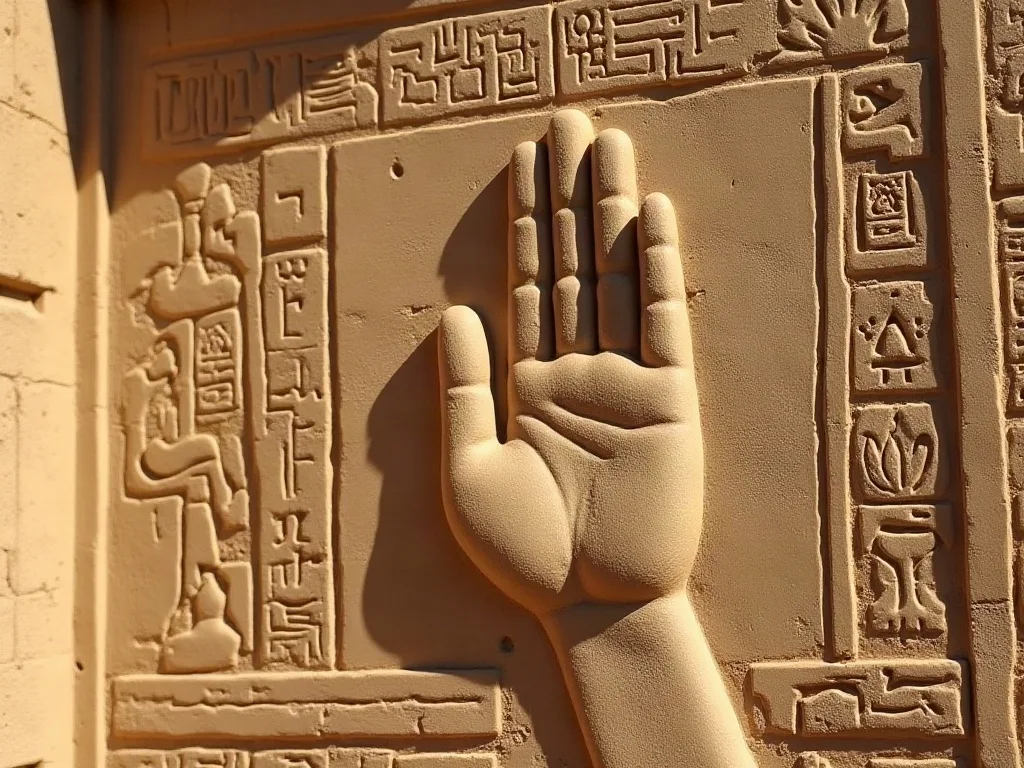
By the 1st century CE, what we now recognize as the hamsa hand had crystallized in the Mediterranean and North African regions. The Phoenicians, who traded across the entire eastern Mediterranean, likely carried both the gesture and its spiritual meaning across their networks. Jewish communities in the Levant and North Africa incorporated it into their protective practices. Arab traders, traveling inland and westward across North Africa, adopted and adapted it. The symbol embedded itself so deeply that by the medieval period, it appeared in almost every tradition that had contact with the Mediterranean trade routes or with Islamic and Jewish cultures.
The original meaning was remarkably consistent: protection from harm, the evil eye, and spiritual danger. The open palm said "stop" to malevolent forces. The five fingers represented divine completion and wholeness. And in many traditions, the right hand specifically carried extra significance, the right hand was the hand of power, blessing, and righteousness in Semitic cultures.
The Hamsa in Islamic Tradition and Arab Culture
In Islamic practice, the hamsa hand became known as the hand of Fatima, the daughter of the Prophet Muhammad. The association runs deep in popular Islamic belief, though Islamic scholars have debated the theological propriety of using any object or sign as a talisman rather than relying solely on God.

The story goes that Fatima represented compassion, wisdom, and protection in the Prophet's household. Islamic tradition honors her as one of the most virtuous women in faith history, and naming the symbol after her reflects that reverence. The five fingers of the hamsa came to symbolize the five pillars of Islam (declaration of faith, prayer, almsgiving, fasting, and pilgrimage), giving the symbol a specifically Islamic theological dimension it had not carried before.
In Arab and North African Muslim culture, the hamsa became ubiquitous as a home blessing. Women would paint it on doorways, embroider it on textiles, and wear it as an amulet against the evil eye. The evil eye, the belief that an envious or malevolent gaze can cause harm, was not unique to Islamic cultures, but it took particular weight in Arabic-speaking societies. The hamsa offered visual protection: a warding-off sign that announced the home and its inhabitants were under divine safeguard.
Arab Jews and Arab Christians living in the same regions adopted the same symbol with the same purpose. The hamsa became a cultural artifact that transcended religious boundaries, used by neighbors who shared geography and vocabulary more than theology.
The Hamsa in Jewish Faith and Practice
Jewish communities, particularly in the Levant, North Africa, and later in Israel, embraced the hamsa with their own interpretations. The Hebrew name chamsa took on its own spiritual weight.
For Jewish practitioners, the hamsa connected to the concept of blessing and protection derived from biblical tradition. The gesture of the upraised hand appeared throughout Hebrew scripture as a sign of blessing, Moses raising his hands to part the sea, Aaron's raised hand blessing the people. The hamsa became a physical echo of these moments of divine intervention and safekeeping.
The numerical symbolism also resonated: five fingers, but also the five books of Torah (Genesis through Deuteronomy). Some Jewish amuletic traditions associated the five fingers with the names of God or with divine attributes. Wearing or displaying the hamsa was a way of invoking those protections into one's home and life.
By the medieval period, Jewish communities across North Africa, the Middle East, and the Mediterranean used the hamsa as a standard protective amulet. Jewish women wore it as jewelry, often in silver. Jewish homes displayed it above doorways or in windows. It appeared on wedding gifts and birth blessings. The hamsa integrated so thoroughly into Jewish folk practice that it became almost inseparable from Jewish identity in these regions, even though its roots predated any single religious tradition.
The Hamsa in Berber and North African Traditions
The Berber peoples of North Africa, indigenous inhabitants of the region long before Arab conquest, developed their own relationship to the hamsa, one that is sometimes distinct from the Arab or Islamic interpretation, though heavily influenced by centuries of cultural exchange.
In Berber culture, the hamsa appears in textiles, jewelry, and home decoration across Morocco, Algeria, and Tunisia. Some Berber traditions associate the five fingers with the five senses or with the five members of the family, emphasizing protection and unity. The symbol integrates with Berber geometric patterns and designs in a way that feels native to Berber aesthetic, even if the symbol itself arrived with other cultures.
Berber women traditionally crafted elaborate hamsa amulets from silver, often inscribed with geometric patterns or Berber script. These pieces were worn at significant life moments, marriages, births, times of illness or danger. The hamsa became part of the visual language of Berber identity, working alongside other symbols and practices to create a coherent system of spiritual protection and blessing.
What is notable about the Berber hamsa is that it coexists with distinctly Berber protective symbols without contradiction. The symbol was adopted and localized but never replaced indigenous practices. This pattern repeats across every culture that received the hamsa: it was added to, not substituted for, existing protective traditions.
The Hamsa in Hindu and South Asian Practice
In South Asia, particularly in India, the hamsa appears in Hindu and broader Indian spiritual practice, though it arrived later than in the Mediterranean and Middle Eastern traditions and took on distinct characteristics.
The hamsa integrated into Indian folk practice as a protective amulet, often worn as jewelry or displayed in homes. Some Hindu practitioners connected the five fingers to the five elements (earth, water, fire, air, and ether), making the hamsa a symbol of cosmic balance and wholeness. Others linked it to the five senses or the five aspects of the divine (Pancha Brahma, the five aspects of Brahman).
In Indian practice, the hamsa sometimes appears with the eye in the center more prominently than in other traditions. This eye connects to the Hindu concept of divine sight and protection, the eye of Shiva, for instance, which sees all and protects all. The eye in the center of the palm transforms the hamsa from a simple protective hand into a symbol of divine awareness and blessing.
The hamsa exists alongside other Indian protective symbols without displacement. The Om symbol, the lotus, the peacock eye, and geometric yantras all coexist with the hamsa in Hindu protective practice. The hamsa was absorbed into an already rich symbolic vocabulary rather than replacing it.
The Central Eye: The Evil Eye Within Protection
One of the most striking variations of the hamsa across cultures is the addition of an eye at the center of the palm. This transformation is particularly visible in Jewish and Mediterranean traditions, though it appears in other regions as well.
The eye in the center of the hamsa serves a paradoxical function: it uses the very symbol of harm, the evil eye, as part of the protective mechanism. By incorporating the eye into the hamsa, the amulet becomes doubly protective: the hand wards off, and the eye watches for danger. Some interpretations suggest that the eye returns the evil eye back to its sender, neutralizing it through reflection.
The evil eye belief is ancient and cross-cultural. It appears in Mediterranean Greek tradition (the Greek mati), in Islamic cultures, in Jewish folk belief, and across North Africa and South Asia. The notion that an envious or malevolent gaze can cause harm is rooted in observable human psychology, envy is real, and its social effects can be damaging, and the hamsa with its central eye offers a visual counter to that threat.
The eye also connects to divine protection in several traditions. In Jewish amuletic practice, the eye can represent the eye of God watching over the household. In Islamic tradition, it echoes the concept of divine sight (ilm, God's perfect knowledge). In Hindu tradition, the eye recalls Shiva's third eye or the all-seeing divine awareness. The eye in the center of the hamsa is protection layered: human hand, divine sight, and reflected malevolence all working together.
Tattoo Symbolism and Modern Practice
In contemporary practice, the hamsa hand has become one of the world's most recognizable tattoo symbols, particularly among people seeking protection, spiritual connection, or cultural identity.
The hamsa tattoo typically appears on the forearm, wrist, back of the hand, or upper back. Some people choose it purely for its aesthetic beauty, the geometric clarity of five fingers spread is visually striking. Others choose it for explicit protection: a permanent amulet drawn on the skin rather than worn around the neck.
The meaning in modern tattoo culture often shifts with the wearer's intention. For Jewish individuals, the hamsa tattoo can represent connection to heritage and faith. For Arab or North African people, it signifies cultural roots. For people from Hindu backgrounds, it may invoke the five elements and spiritual balance. For people without specific religious or cultural ties to the symbol, the hamsa tattoo often simply represents a desire for protection and blessing, a universal sentiment that the symbol seems to invite.
Notably, many contemporary wearers combine the hamsa tattoo with other symbols. A hamsa with a Star of David emphasizes Jewish identity. A hamsa with a crescent and star leans toward Islamic or Arab identity. A hamsa with an Om or lotus invokes Hindu or broader South Asian spirituality. The hamsa's neutrality, or its capacity to work alongside other symbols, makes it adaptable across intentions and identities.
The color of a modern hamsa tattoo also carries meaning. Blue is the most common, specifically the shade of blue used in hamsa amulets across Mediterranean and Middle Eastern traditions. Blue was believed to repel the evil eye in these regions, and the color retains that association. Some people opt for red, black, gold, or white, each carrying different cultural and spiritual associations.
Evil Eye Within
When a hamsa features a central eye (particularly a blue eye), it becomes a double protection: the hand wards off, and the eye watches for and reflects malevolent intent. This version emphasizes divine sight and active defense. It is especially common in Jewish, Islamic, and Mediterranean Arab amulets.
Open Palm Alone
A hamsa with an open palm and no eye is simpler, more geometric, more abstract. It emphasizes the hand as blessing and the five fingers as cosmic wholeness. This version is more common in Hindu practice and in contemporary Western spiritual use, where the simplicity appeals as a universal protection symbol.
The Hamsa in Jewish Tradition and Modern Israel
The hamsa holds particular significance in modern Israel, where it appears as a symbol of both Jewish identity and cross-cultural coexistence. Israeli Jews, many of whom have roots in Arab or North African countries, grew up with the hamsa as part of their childhood experience, mothers wearing it, homes displaying it.
After 1948 and the founding of Israel, the hamsa became a symbol of Jewish heritage and connection to the Mediterranean and Middle Eastern world. Jewish Israelis wear and display it as a marker of belonging to the region, not as outsiders but as people whose ancestors lived there for millennia. For Mizrahi Jews (those with roots in Arab lands), the hamsa is especially charged with the memory of ancestral homes and cultural identity.
Concurrently, Israeli Arabs and Palestinians also wear and display the hamsa as a symbol of Palestinian cultural heritage and protection. The hamsa belongs to them too, rooted in centuries of Levantine and Arab practice. This creates an interesting cultural moment: both Israeli Jews and Israeli Arabs and Palestinians claim the hamsa as theirs, and both claims are legitimate. The symbol predates modern political boundaries and belongs to the shared history of the region.
The Hamsa Across the Mediterranean and Christian Practice
Christian communities in the Mediterranean also incorporated the hamsa into their practice, particularly in Greece, Cyprus, and parts of southern Italy where Muslim and Christian cultures coexisted for centuries.
In Greek Christian folk practice, the hamsa appeared as a protective amulet, often called the hand of protection or the hand of blessing. It coexisted with other Christian symbols, the cross, icons of saints, without theological conflict. The hamsa was understood as a protective tool, not as a religious statement about theology or faith.
This pattern, the hamsa as a cultural and protective tool that works alongside rather than instead of a tradition's core religious symbols, repeats across every culture that received it. Christian Greeks wore the hamsa. Muslim Arabs wore it. Jewish communities wore it. Hindu practitioners incorporated it. Each tradition kept its own prayers, its own gods, its own religious practices, and added the hamsa as an extra layer of protection.
This speaks to something important about how symbols actually travel and function in human life. The hamsa wasn't forced onto other cultures by conquest or missionary work. It spread because it worked, because the gesture of an open hand saying "stop harm, be blessed" felt true to people across traditions, and because the symbol was flexible enough to absorb local meaning while retaining its core function.
Scholarly Debates and Regional Variations
Scholars of material culture and religion have debated the precise origins and transmission routes of the hamsa, and these debates reveal how symbols travel and change.
One school argues that the hamsa's origins lie in ancient Mesopotamian protective gestures and symbols, particularly the raised hand as a sign of blessing and warding. From Mesopotamia, the symbol would have traveled westward with trade networks and cultural contact, arriving in Egypt and the Mediterranean. This model emphasizes continuity and ancient precedent.
Another school emphasizes the specific association with Fatima in Islamic and Arab tradition as a moment of crystallization and meaning-making. In this view, while the hand gesture is ancient, the particular symbolic form we now call the hamsa solidified through Islamic adoption and naming. The symbol predates Islam, but the hamsa as we know it, the specific geometric form, the association with five, the particular apotropaic function, took its current shape through Islamic practice.
Regional variations support both views. The Moroccan hamsa has specific geometric qualities that reflect Berber aesthetic. The Jewish hamsa sometimes incorporated Hebrew letters or mystical symbols (kabbalistic designs). The Indian hamsa often appears with the eye more prominently than Middle Eastern versions. These variations suggest that while a core symbol was adopted, each region adapted it to local visual and spiritual language.
What scholars largely agree on is that by the medieval period, the hamsa was established across the Mediterranean, North Africa, the Middle East, and parts of South Asia as a standard protective amulet, used by multiple religious communities without exclusive ownership by any single faith.
Why the Hamsa Persists: Universal Protection Across Time
The hamsa has endured for millennia across cultures, religions, and empires. This persistence is worth examining.
Part of the reason is practical: the hamsa is visually simple and immediately legible. Five fingers spread is a form that anyone can recognize, draw, carve, embroider. It doesn't require complex artistry or specialized knowledge to reproduce. A child can draw a hamsa. This simplicity made it reproducible across media and skill levels, which meant it could spread easily.
Part of the reason is psychological and spiritual: the hamsa addresses a universal human need. Every culture has concepts of blessing and protection. Every tradition has practices to ward off harm, envy, and malevolent force. The hamsa offered a visual symbol for these universal impulses. It said "I am protected" in a way that people across different faiths could immediately understand.
Part of the reason is adaptability: the hamsa has proven flexible enough to absorb local meaning while retaining its core function. It is literally and figuratively a blank hand, open, ready to receive new interpretations without losing its essential gesture of protection. It could be the hand of Fatima or the hand of God, the five elements or the five pillars, the eye watching for danger or the eye of divine sight. These meanings don't contradict each other; they layer onto the symbol without erasing what came before.
This flexibility is rare among symbols. Many symbols are jealously guarded by single traditions and lose power if adopted by others. The hamsa seems to gain power through adoption, becoming richer and more resonant with each new tradition that embraced it.
The Hamsa in Contemporary Global Practice
Today, the hamsa is experiencing a resurgence of global interest, particularly among people seeking spiritual meaning, protection, or cultural connection in an increasingly secular, fragmented world.
Contemporary spiritual practitioners who don't identify with any traditional religion often choose the hamsa as a protection symbol. The hamsa works in this context because it carries no exclusive religious baggage and speaks to something pre-religious or trans-religious: the basic human desire for safety and blessing.
Meanwhile, people from traditions with deep historical connections to the hamsa, Jews, Arabs, Muslims, Hindu practitioners, often experience renewed interest in the symbol as a connection to heritage. The hamsa tattoo, the hamsa pendant, the hamsa wall hanging become ways of saying "this heritage is part of me" and "this ancient practice connects me to my ancestors."
Fashion and design have also played a role in the hamsa's contemporary popularity. The symbol appears on clothing, jewelry, home décor, and accessories marketed globally. Sometimes this commercialization strips the symbol of spiritual meaning, it becomes merely decorative. But the fact that it became marketable at all speaks to how widely recognized and aesthetically resonant the hamsa has become.
What is striking about the hamsa's modern life is that it coexists peacefully across all these contexts. A hamsa tattoo can mean something completely different on the wrist of a Jewish Israeli, a Muslim Egyptian, a Hindu woman from India, and a secular American spiritual seeker. All these meanings are legitimate. All these people are using an ancient symbol to express their own truth about protection, blessing, and spiritual belonging.
Frequently asked questions about the hamsa hand across cultures?
Frequently asked questions
What is the difference between a hamsa and a hand of Fatima?
The terms are often used interchangeably, but technically the hand of Fatima is a specific Islamic and Arab version of the hamsa, named after Fatima, the daughter of Prophet Muhammad. Fatima represents compassion and protection in Islamic tradition. The hamsa is the broader symbol that predates and extends beyond Islamic practice, appearing in Jewish, Christian, Berber, Hindu, and other traditions. All hands of Fatima are hamsas, but not all hamsas are specifically identified as hands of Fatima.
Why is the hamsa associated with the evil eye?
The evil eye is an ancient belief across Mediterranean, Middle Eastern, and North African cultures that an envious or malevolent gaze can cause harm. The hamsa functions as a ward against this belief: an open palm facing outward says "stop, be blessed, be protected." Some versions include a central eye, which paradoxically uses the symbol of harm (the eye) as part of the protection, either by watching for danger or reflecting it back to its source. The connection expresses a universal human anxiety about harm and malevolent intent.
Can non-Muslims wear a hamsa with the hand of Fatima meaning?
Yes. While the hand of Fatima carries specific Islamic significance, the hamsa has been adopted across religions and cultures for centuries. Jewish communities, Christian communities, Hindu practitioners, and secular spiritual seekers all use hamsa amulets and tattoos. The symbol has historically transcended religious boundaries, and contemporary practice continues this tradition. That said, understanding the cultural and spiritual roots of the symbol, including its significance to Islam and Arab culture, is a respectful way to wear it.
What do the five fingers of the hamsa represent?
The meaning of the five fingers varies across traditions. In Islamic practice, they can represent the five pillars of Islam. In Jewish tradition, some interpret them as the five books of Torah or five divine attributes. In Hindu practice, they often represent the five elements (earth, water, fire, air, ether) or the five senses. In broader protective practice, the five fingers simply represent completeness and wholeness, a full, open hand signifying blessing and protection. The number five itself carried significance across ancient Mediterranean and Middle Eastern cultures as a number of wholeness and power.
Is it disrespectful to get a hamsa tattoo if it's not part of my heritage?
The hamsa has historically been a cross-cultural symbol adopted by people across religions and traditions, so wearing it doesn't require exclusive cultural ownership. That said, approaching it with respect and understanding, knowing its roots, understanding that it carries meaning to many people, is important. Getting a hamsa tattoo because you understand and value what it represents is different from wearing it as a trendy symbol with no awareness of its significance. If you're drawn to the hamsa for genuine reasons, seeking protection, spiritual connection, appreciation for the symbol's history, a hamsa tattoo is a legitimate choice.
How has the hamsa's meaning changed over time?
The core meaning of the hamsa, protection, blessing, warding off harm, has remained consistent across millennia and cultures. What has changed is the theological and spiritual framework surrounding it. Early Mediterranean and Mesopotamian versions emphasized the hand as a protective gesture. Islamic adoption named it after Fatima and connected it to Islamic values. Jewish practice incorporated it into mystical and folk tradition. Hindu practice connected it to the five elements and divine sight. Modern secular practice often uses it as a universal protection symbol without specific religious meaning. The symbol's flexibility and capacity to absorb local meaning while retaining its core function explains its remarkable persistence.
The Hamsa as a Bridge Across Cultures and Faiths
The hamsa hand persists because it speaks to something human that transcends any single culture or religion. In a world of borders, religions, and identities, the hamsa exists in the space between them. It belongs to Islam and to Judaism, to Arab culture and to Berber heritage, to Hinduism and to secular spirituality. It is owned by all these traditions and by none exclusively.
This is rare. Most symbols are marked by their origins and carry the weight of single traditions. But the hamsa, perhaps because it is so ancient and so simple, has managed to become genuinely cross-cultural. It is a symbol that multiple peoples can claim as theirs, and all those claims are historically and spiritually valid.
For contemporary wearers and practitioners, the hamsa offers something equally valuable: a symbol that works across traditions. You can wear a hamsa and honor your own faith while acknowledging that people of other faiths, and people with no faith, wear and understand the same symbol. The hamsa, in this sense, is a quiet statement about human unity and shared spiritual need. We all seek protection. We all want blessing. We all fear harm. These needs are older than any religion or empire.
The hamsa hand, spread wide and open, says simply: be safe, be blessed, be whole. And across thousands of years and dozens of cultures, people have listened.
Free 25-page sample
Want the whole story?
Take the first 25 pages free. If it pulls you in, the full edition is yours as an instant PDF download, with a paperback on Amazon for selected titles.

Mythology
The World Mythology Book: The Gods, Heroes and Myths of Every Culture
The Gods, Heroes and Myths of Every Culture, in One Volume
The whole of world mythology in a single volume: Greek, Norse, Egyptian, Japanese, Hindu, Celtic, Slavic, Mesoamerican and African myths gathered side by side, each drawn from the primary sources.