

Hathor: Goddess of Love, Music, and the Cosmic Feminine in Ancient Egypt
Hathor embodied the feminine divine across love, music, dance, and motherhood in ancient Egypt. Discover how this golden-horned goddess shaped royal power, ritual life, and the Nile's rebirth cycle, from temple worship to her fearsome hidden face.
Contents
Hathor descended in a pillar of turquoise light to greet the souls of the dead. At least, that's how the ancients imagined her: not as pure love, but as something far stranger. She was the eye that gazed from heaven, the mirror in which pharaohs saw their divine right, the jazz notes of the sistrum that made crowds sway, and the terrible eye of vengeance when she became Sekhmet, raging lioness of plague. To know Hathor, goddess of love and music, is to understand that Egypt's deities were never simple; they held contradictions the way a river holds islands.
Her name meant "House of Horus," embedding her identity into motherhood from the start. But she was far more than a mother. In temple reliefs, she appeared with a broad face, gentle smile, and cow's horns cradling a solar disk. In everyday homes, women carved her image onto mirrors and cosmetic vessels. Singers invoked her before performances. Yet in the temples of Thebes, priests whispered of her descent into rage, when she hunted humanity on the deserts and drank blood from pools. This was not contradiction but completeness: she held the full spectrum of the feminine, from nurture to wrath.
Origins and the Cosmological Role of Hathor
The question of where Hathor came from opens onto a landscape of competing myths, all equally true in Egypt's theological imagination. The Pyramid Texts, carved into royal tombs around 2400 BC, name her as the daughter of Ra, the sun god, born from his eye. Some texts say she emerged as a golden cow when Ra wept; his tears became her form, alive and shining. Others describe her as the sky itself: the vault above the earth, across which Ra sailed each day. In still other accounts, she was Atum's daughter, born alongside Shu and Tefnut, the principles of air and moisture, in the first act of creation. Every story held truth because Hathor contained them all.
By the New Kingdom (1550-1070 BC), when temples grew massive and theology crystallized into writing, priests had settled on a unified portrait. Hathor was the Eye of Ra: the instrument through which the sun god witnessed the world below and wielded cosmic justice. When Ra sailed each night through the underworld in his barque, Hathor watched over him. When he emerged at dawn, she rejoiced. This role made her inseparable from the daily cycle of rebirth, the eternal guarantee that chaos would not triumph. To Egyptians who lived by the inundation and the seasons, this reassurance was not metaphor but the deepest promise the gods could make.
The Goddess of Love, Beauty, and Desire
Walk into any temple where Hathor held dominion, and you would find walls painted with scenes of lovers embracing, musicians playing, dancers twirling under garlands of flowers. Her sanctuaries were places where sexual desire was sacred, not shameful. The Egyptians spoke of nefer, often translated as "beautiful," but really meaning "harmonious, flourishing, capable of bearing life." Hathor embodied nefer absolutely. She was the force that drew couples together, that made children possible, that blessed harvest and fertility fields. Yet she was never reduced to nature or instinct; she was intellectual and deliberate. She chose who would prosper. She granted abundance according to her will.
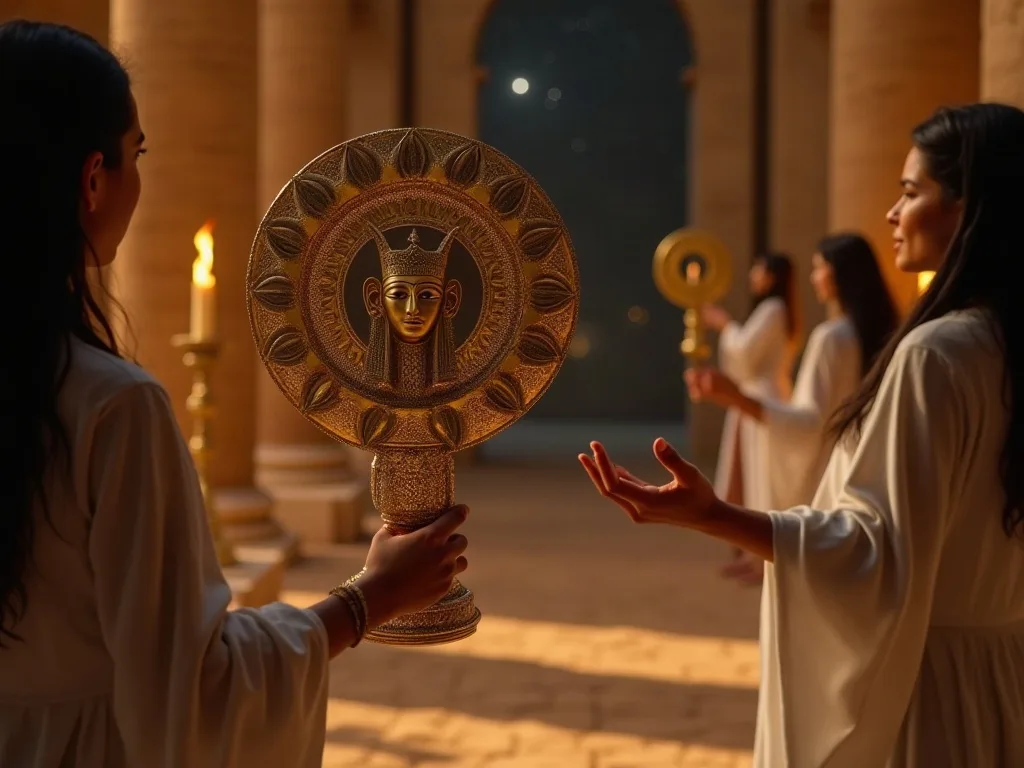
In the temple of Dendera, built over centuries and renovated as late as the Ptolemaic era (305-30 BC), Hathor presided as the primary deity. Travelers who climbed the stone ramps in summer heat entered a sanctuary painted with scenes of her dancing with the pharaoh, her face radiant. On the walls, musicians played the sistrum (a rattle strung with metal disks), a instrument forever associated with her worship. Egyptians believed that when the sistrum sounded, its ringing vibrations mimicked the trembling of the cosmos itself, the rattling of creation held in divine hands. Women performed these rituals, wielding the sistrum with bodies and voices to draw down blessing.
Hathor appeared also as the protector of women in childbirth. She stood in the moment of greatest danger, when a woman's life balanced on a knife's edge. Amulets bearing her image or the sistrum were placed around mothers' necks. Midwives invoked her name. When a child emerged alive, it was Hathor's favor. When women died in labor, her withdrawal was devastating. She was not gentle in the conventional sense; she held power over life and death as clearly as any god.
The Eye of Ra and the Mythology of Divine Wrath
The mythology that defined Hathor most vividly was not gentle at all. In a cycle of myths preserved in various temple texts and demotic stories from Ptolemaic times, Ra grew old and distant from his creation. Humanity began to mock him. The god decided to punish them. From his eye, he sent forth a terrible daughter: Sekhmet, the lioness, the drinker of blood. She ravaged the earth so completely that Ra feared all humanity would be destroyed, including those who still worshipped him. To save creation, Ra ordered priests to brew a vat of beer mixed with pomegranate juice (turned red to resemble blood) and leave it on the desert.
Sekhmet, exhausted and bloodthirsty, came upon the pool. She drank deeply, mistaking it for actual blood. The beer intoxicated her. She fell asleep, and when she woke, her rage had lifted. She became gentle again. In some versions of the tale, this gentler form was Hathor. In others, Hathor and Sekhmet were distinct beings sharing a deep kinship, aspects of the same cosmic power at different temperatures. The line between them was not a boundary but a spectrum.
This mythology reveals something essential: Hathor was not the goddess of love in the modern, sentimental sense. She was the goddess of desire, fertility, creative chaos, and the power that destroyed as easily as it gave life. She was what the universe felt like when it moved. When priests named her "Eye of Ra," they were saying that she was the god's instrument of perception and judgment, the wrath that fell upon enemies, the mercy that came after. She contained opposites not by balancing them but by being them completely.
Hathor as Divine Mother and Nurse
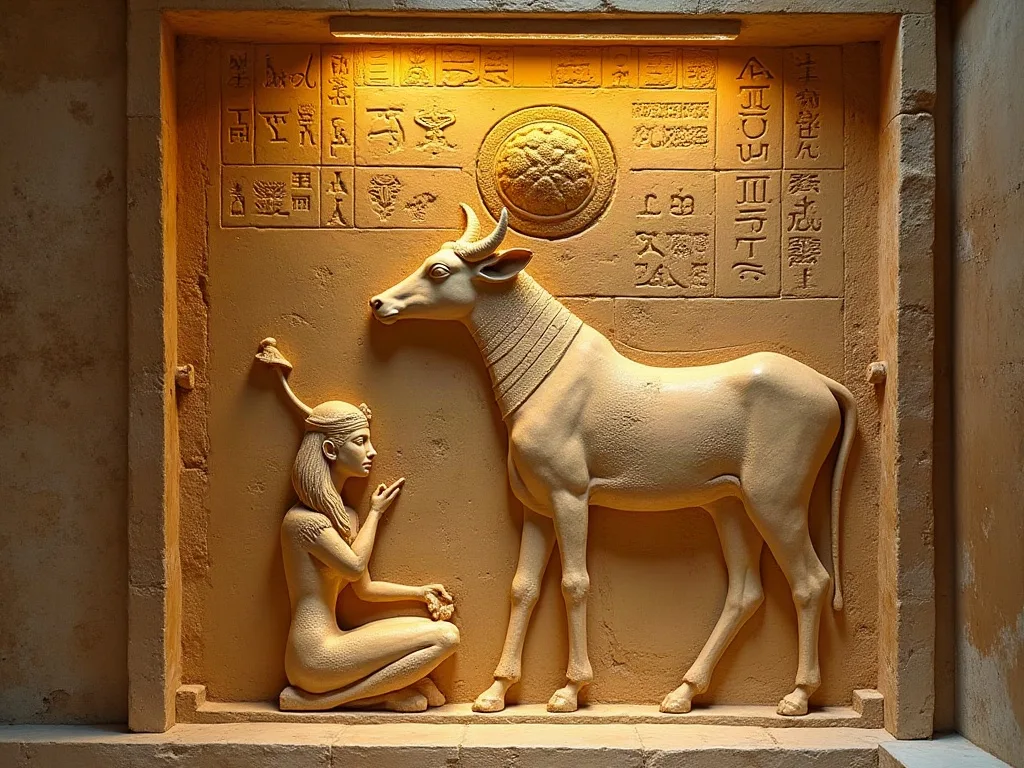
Throughout Egypt's religious history, Hathor nursed pharaohs at her breast, and this image appeared constantly in reliefs and temple texts. She was not the mother of any one king but the symbolic mother of the realm itself. When a pharaoh was crowned, he was ritually reborn as her son, drawing milk from her breast to gain the legitimacy and power to rule. This was not fantasy; it was political theology. By depicting themselves as Hathor's children, pharaohs claimed a connection to cosmic order that justified their rule over the Nile's resources and the labor of their people.
Artwork from Karnak shows Hathor cradling young Amenhotep III, her cow horns sheltering him, her face serene. The image communicated a simple truth: this boy is divine. He belongs to the gods. He will not age like ordinary men; he will merge with them. In the temple of Luxor, Amenhotep III appears being led to Hathor's sanctuary by Sekhmet, and she nurses him while Mut, another great mother-goddess, watches. Multiple goddesses shared this role because the principle of divine motherhood was larger than any single deity. Yet Hathor's presence was always primary, her bovine gentleness the ultimate reassurance.
The cow itself carried profound symbolic weight. Unlike many ancient cultures, where cattle were primarily labor and food, Egypt revered the cow as a creature of profound mildness and nurturing power. Cows produced milk and sustained herds; they were embodiments of peaceful abundance. When Hathor took bovine form, she was emphasizing her connection to natural generative power, to the quiet strength of motherhood that held civilization together.
Worship, Ritual, and the Festival of Drunkenness
The worship of Hathor was joyous in ways that distinguished it from the worship of other major deities. While Osiris drew solemnity and Ra commanded awe, Hathor attracted celebration. The "Festival of Drunkenness," held annually in her honor, was a raucous affair. The mythology behind it drew on the story of her near-destruction of humanity: once she had been pacified with intoxication, the festival reenacted that salvation. Worshippers brewed beer, drank themselves into ecstatic states, and danced with abandon. The point was not merely indulgence; it was a controlled access to divine consciousness, a temporary loosening of the rational mind's grip. In that looseness, worshippers believed, they touched something real about the universe: that it moved to rhythms beyond words, that ecstasy was a form of prayer.
The temple of Dendera, dedicated chiefly to Hathor, remains the best window into her cultic life. Pilgrims came from across Egypt to seek her blessing. Mothers came to pray for safe childbirth. Musicians came to be initiated into her mysteries. Traders came to ask for abundance. The temple stood on a platform overlooking the Nile, and at sunrise, when Ra's barque appeared on the horizon, priests processed with Hathor's golden statue to greet the sun. They sang; they rattled the sistrum; they believed that in that moment, the cosmos renewed itself.
Priestesses played a distinctive role in Hathor's worship. They were not merely devotional; they were performers, musicians, dancers. The title "God's Wife," held by women of high status, was associated especially with Hathor and Amun. These women participated in state rituals, sang ritual hymns, and wielded real political influence. To serve Hathor was to access a sphere of power that the masculine priesthoods of other deities did not grant.
Hathor and the Afterlife
For souls entering the Duat, the Egyptian underworld, Hathor was a guide and protector. In the Book of the Dead, spells invoked her to aid the deceased's journey. She appeared as part of the tribunal where a soul's heart was weighed against the feather of Ma'at, goddess of truth and justice. If the deceased had lived wrongly, their heart would be heavy, outweighing the feather. If they had lived in harmony with cosmic order, the heart would be light. Hathor sometimes stood with the other divine judges; sometimes she appeared to the deceased as a sycamore tree, offering shelter and water after their ordeal.
The sycamore was a common motif in Egyptian afterlife literature. Its wide, cool canopy provided respite from the desert heat. When Hathor manifested as a sycamore, she was offering comfort, rest, the promise that the journey would end not in dissolution but in a kind of paradise. The deceased could eat of her fruit, drink from her wells, and remain forever in a place of abundance. This was not heavenly in the Christian sense; it was the extension of a good earthly life into eternity, a continuation of pleasure and security.
Hathor's Many Faces: Local Forms and Syncretism
Hathor appeared under different names and attributes depending on geography and era. In the oasis town of Dendera, she was paramount. In Upper Egypt, she shared authority with Sekhmet. In Memphis, she merged with the attributes of other goddesses. Along the Sinai desert, she was the protector of miners who extracted turquoise, a stone sacred to her. In Nubia, she was worshipped as Anuket, another love and fertility goddess, her attributes merging across cultures and millennia.
The Greeks, arriving in Egypt after Alexander's conquest, recognized in Hathor qualities reminiscent of their own Aphrodite. Ptolemaic temples began to syncretize the two, and Hathor acquired some of the characteristics of Greek aestheticism. Yet she remained distinctly Egyptian: rooted in Nile theology, in pharaonic legitimacy, in the cosmic cycle that had structured worship for thousands of years. By the time Rome dominated the Mediterranean, Hathor had become a figure venerated across the Greco-Roman world, her image on amulets carried by merchants and soldiers, her festivals observed by communities far from Egypt.
The Symbolism of the Sistrum and Music
The sistrum was not merely an instrument but a theological object. Made of wood, metal, and sometimes precious materials, it consisted of a handle and a frame strung with metal disks that clattered when shaken. When priestesses performed in temples or during public festivals, they held the sistrum as if it were a cosmic engine, its rattle and jingle mimicking the vibration of creation. Some Egyptian texts suggest that the sound of the sistrum literally held the universe in place; without the music, chaos would encroach.
This metaphor grew from a deeper insight: that rhythm, pattern, and harmony (the principles underlying music) were also the principles underlying cosmic order. Ma'at, goddess of truth and justice, maintained order through these same principles. Hathor, through music, was an instrument of Ma'at, a keeper of the harmony that prevented the Nile from running backwards, the sun from failing to rise. When a woman picked up a sistrum and shook it, she was not simply making noise; she was participating in the gods' work of maintaining reality.
Hathor was closely associated with other musicians and music-makers. Bes, a dwarf-god, often danced at her side. The god Thoth, associated with writing and wisdom, sometimes played the harp when she danced. These relationships placed Hathor at the center of a cosmic arts scene, a realm where creation, expression, and order overlapped. Musicians who invoked her name before performances believed they were calling down divine inspiration, that their skill came not from practice alone but from her blessing.
Frequently asked questions about Hathor, goddess of love and music
Frequently asked questions
How did Hathor relate to Sekhmet, and were they the same goddess?
In mythology, Hathor and Sekhmet are sometimes portrayed as distinct beings, sometimes as two aspects of the same cosmic force. Both were daughters of Ra, both embodied his eye, but Sekhmet represented the fierce, destructive expression while Hathor represented the nurturing, creative one. The famous myth of Sekhmet's rampage shows her transforming into a gentler form after her rage was satiated, and some texts identify this gentler form with Hathor. They were not interchangeable, but they occupied related positions in theology, like two poles of a spectrum.
Why was Hathor associated with both love and severe punishment?
Ancient Egyptian theology did not separate these concepts as modern thinking does. For Egyptians, love and desire were creative forces tied to fertility and abundance, but also to chaos and unpredictability. A goddess who embodied the feminine divine had to contain both the nurturing and the destructive potential. Hathor's capacity to shift from gentleness to wrath reflected the ancients' understanding that the same force that created life could take it away, that desire and violence were not opposites but manifestations of the same fundamental power.
What role did priestesses play in Hathor's worship?
Priestesses held extraordinary status in Hathor's cult. They were not merely attendants but performers and theologians. They danced, sang, and played the sistrum in temple rituals, and their bodies became instruments through which Hathor communicated with the world. The title "God's Wife of Amun," though associated with multiple deities, held special significance for women serving Hathor. These priestesses wielded real political and spiritual authority, unusual for women in other priestly hierarchies of ancient Egypt.
How did Hathor's worship change from the Old Kingdom to the Ptolemaic era?
In the Old Kingdom (around 2700-2200 BC), Hathor appeared primarily in royal funerary texts and as a protector of the pharaoh. By the New Kingdom (1550-1070 BC), her temples had grown into major pilgrimage sites, and her worship had become more public and participatory, with festivals involving music, dancing, and beer. Under the Ptolemies (305-30 BC), Greek influence introduced new iconography and myths, but Hathor remained fundamentally rooted in Egyptian theology, never losing her connection to the Nile, fertility, and kingship.
What was the Festival of Drunkenness, and what did it mean religiously?
Held annually in honor of Hathor, the Festival of Drunkenness reenacted the mythological moment when she was pacified with intoxicated beer after her rampage as Sekhmet. Worshippers brewed beer, drank extensively, and danced in ecstatic celebration. Rather than mere indulgence, this ritual was understood as a form of religious practice: a controlled access to altered consciousness, a way of touching the divine mind. The festival expressed the belief that Hathor's blessing came through joy, music, and the loosening of everyday rational constraints.
Hathor's Legacy and Transformation in Modernity
Hathor did not vanish when Coptic Christianity arrived in Egypt in the first centuries CE. Many of her qualities transferred to the Virgin Mary in Christian theology and art. The image of Mary nursing Jesus echoed the image of Hathor nursing pharaohs. Mary's gentleness and protective power over childbirth inherited the space that Hathor had held. Even today, in Coptic iconography, there are echoes of the ancient mother-goddess: the flowing hair, the serene expression, the gesture of nurture.
In the modern world, Hathor has become a symbol for contemporary paganism, goddess spirituality, and feminist reclamations of the divine feminine. Online communities invoke her name in rituals; authors write novels featuring her; musicians compose songs in her honor. This revival is not a return to ancient practice but a dialogue with it. Modern worshippers, reading translations of ancient hymns, discovering her story through Egyptology, have decided that Hathor speaks to their own spiritual needs: the need to honor the divine in feminine form, to reconnect sexuality and spirituality, to recover music and dance as sacred practice. Whether an ancient Egyptian priest would recognize this modern Hathor is uncertain. What is clear is that her story, once carved into temple walls and sung in the festivals of the Nile, has proven resilient enough to speak across millennia, adapting and persisting in the ongoing human conversation with the sacred.
The goddess whose name meant "House of Horus," who held both love and wrath, whose music allegedly kept the cosmos from collapse, has become an archetype that transcends her historical moment. She represents the possibility of the divine feminine as multivalent, powerful, and irreducible to sentiment. In that sense, Hathor remains alive, not in belief systems demanding worship, but in the enduring human need to imagine and celebrate the sacred in all its contradictory abundance.
Free 25-page sample
Want the whole story?
Take the first 25 pages free. If it pulls you in, the full edition is yours as an instant PDF download, with a paperback on Amazon for selected titles.

Mythology
The World Mythology Book: The Gods, Heroes and Myths of Every Culture
The Gods, Heroes and Myths of Every Culture, in One Volume
The whole of world mythology in a single volume: Greek, Norse, Egyptian, Japanese, Hindu, Celtic, Slavic, Mesoamerican and African myths gathered side by side, each drawn from the primary sources.