

Iris the Rainbow Messenger: Goddess, Symbol, and Bridge Between Worlds
Iris carried the will of the Olympians across sky and sea, her rainbow body stitching heaven to earth. Trace her origins, symbols, and enduring mythic power here.
Contents
The sea was still churning when the rainbow appeared. A shimmer of violet and gold dropped from the clouds over the Aegean and touched the water's surface, and the nymph who rode it did not pause. She had a message from Hera. The recipient would not argue.
Iris the rainbow messenger is one of Greek mythology's most quietly indispensable figures. She does not slay monsters or fall in love with mortals or found cities. She runs. She is the living filament between the will of the Olympians and the world below, the divine postal service with wings on her sandals and a golden pitcher of water from the Styx in her hand. Ancient poets called on her in every great scene of celestial diplomacy, yet she remains underexplored beside the louder Olympians. That oversight misreads the myth. Iris is not a supporting character. She is the connective tissue of the Greek cosmos.
Her presence threads through Homer's Iliad, Hesiod's Theogony, the Homeric Hymns, and Virgil's Aeneid. Each appearance reveals something different: the obedient herald, the cosmic enforcer, the goddess who holds an oath of the gods in her palm. Read together, these texts build a portrait of a deity whose power lies not in weapons or domains but in motion itself.
The Family of Iris: Titans, Winds, and Harpy Sisters
Iris was born of a Titan father and an Oceanid mother. Hesiod names her parents as Thaumas ("Wonder") and Electra, one of the three thousand daughters of the Ocean Titan. Thaumas was himself a sea god, a son of Pontus (the primordial sea) and Gaia (the earth), which gives Iris a genealogy rooted in the oldest strata of Greek cosmology, predating the Olympians by several divine generations.
Her siblings are equally elemental. From the same parents came the Harpyiai, the "Snatchers": Aello ("Storm-swift") and Ocypete ("Swift-wing"), the winged storm-spirits who carried off the dead and tormented Phineus in the Argonaut cycle. The family of Thaumas is a family of atmospheric forces, all speed and sudden sky-change. The rainbow, the whirlwind, the snatching gust: Iris fits perfectly in that lineage.
She is sometimes listed as the wife of Zephyrus, the west wind, and mother of Pothos, one of the winged spirits of longing. Whether or not later mythographers invented this match to explain why the rainbow often chases the west wind, it reinforces her nature as a figure of the sky's transitional states, neither storm nor calm, but the dazzling bridge between them.
Iris stands apart from her sibling Hermes in an important way. Hermes became the primary messenger of Zeus, running errands across every domain. Iris served Hera above all. In Homer's Iliad, she is Hera's instrument; in Virgil's Aeneid, Juno (Hera's Roman equivalent) dispatches her to cut the soul-thread of dying Dido. The two messengers occupied different lanes of divine communication, and the difference is not trivial. Hermes crosses boundaries to aid mortals. Iris crosses boundaries to enforce the will of the queen of heaven.

Iris in Homer: Wings Over the Battlefield
Homer's Iliad is the richest single source for Iris in action. She appears at least seven times across the epic, always in motion, always urgent. In Book 2, she disguises herself as the Trojan herald Polites and warns Priam's son Hector that the Greek fleet is deploying. In Book 3, she finds Helen at the loom and breathes homesickness into her so that she climbs the walls to watch Paris fight Menelaus. In Book 11, she carries Zeus's message ordering Hera and Athena to stay out of the fighting.
What Homer conveys is that Iris does not merely deliver words. She transforms the emotional atmosphere of every scene she enters. When she appears to Helen with longing for Menelaus already stirring in her chest, or when she materializes beside the resting Achilles to tell him that Patroclus's body is in danger, she brings not just information but the divine pressure that makes mortals act. Her arrivals feel less like announcements and more like weather changes.
In Book 23, she dives into the sea to summon the wind-gods Boreas and Zephyrus to fan Patroclus's funeral pyre. The winds are feasting at the house of Zephyrus when she arrives. Homer describes her standing at the threshold, refusing to sit, refusing food, because her mission is too urgent. The winds leap up and scatter across the sea in a tumult; the pyre blazes. Even among the elemental powers, Iris commands respect through sheer purposefulness.
Homer uses a recurring epithet for her: podas okea, "swift-footed", the same epithet applied to Achilles. The parallel is deliberate. Speed is the supreme heroic and divine virtue in the Iliad, and Iris shares it fully with the greatest warrior in the Greek camp.
The Golden Pitcher: Iris and the Oath of the Styx
Hesiod's Theogony reveals a cosmic function of Iris that Homer never fully unpacks. When the Olympians needed to swear an unbreakable oath, they called on the water of the Styx, the underworld river. But the Styx does not flow above ground, and the gods needed a reliable carrier for its water. That carrier was Iris.
Hesiod describes the ritual in detail. Iris would fly down to the underworld with her golden jug, fill it with the cold black water of the Styx, and carry it back to Olympus. The oath-taker would pour a libation from the jug while swearing. If any god then broke the oath, they fell breathless, voiceless, and prostrate for a full year. After recovering, they were banned from all feasts and councils of the gods for nine more years, and only in the tenth year could they rejoin divine society.
This is extraordinary power for a messenger. Iris did not judge the oath or punish its breach. She simply held the instrument of cosmic accountability. But in a universe where the worst thing an immortal could do was lie under oath, the goddess who carried the Styx water occupied a structural position close to the roots of divine law itself.
The Styx connection also explains why Iris has access to every zone of the cosmos without restriction. Most divine figures inhabit a specific domain: Poseidon rules the sea, Hades the underworld, Zeus the sky. Iris passes through all of them freely, because the sacred water she carries is recognized everywhere as something that predates the Olympian settlement of cosmic territories.

Wings, Wand, and Rainbow: Reading Her Symbols
Ancient vase painters and sculptors gave Iris a consistent visual signature. She appears as a young woman, usually running or hovering mid-flight, with large feathered wings extending from her shoulders or sometimes from her sandals. She carries a kerykeion (herald's staff) in some depictions, though that attribute belongs more securely to Hermes; more distinctively, she is shown holding a pitcher or oinochoe, and occasionally a caduceus-like staff.
The rainbow itself is her body as much as her attribute. The Greek word iris means "rainbow" in ordinary usage, and the link is total. When sunlight struck rain at the right angle over the Aegean or the Aegean coast, ancient Greeks did not see a meteorological accident. They saw the goddess in transit, her body catching the light between heaven and earth. Aristotle later attempted a natural explanation of the rainbow in his Meteorologica, but the mythological reading co-existed with the scientific one for centuries.
Her wings deserve attention. Hesiod describes them as golden (chrysopteros), catching the light at the same angle as the rainbow she personifies. Gold recurs throughout her iconography: the golden pitcher, the golden wings, the shining trail she leaves across the sky. In Greek aesthetics, gold signified permanence, divinity, and the quality of never-fading, which sits oddly but honestly against Iris's role as a transient being who appears and disappears. The permanent one who comes and goes: that tension is at the heart of what she represents.
Iris (Greek)
- Primary employer: Hera (also Zeus in Homer)
- Domain: sky, sea, underworld crossings
- Symbols: golden wings, rainbow, pitcher of Styx water
- Mortal interactions: rare, always on divine business
- Nature: elemental, atmospheric, oath-keeper
- Speed epithet: podas okea (swift-footed), shared with Achilles
Hermes (Greek)
- Primary employer: Zeus
- Domain: boundaries, trade, thieves, travelers
- Symbols: caduceus, winged sandals, petasos hat
- Mortal interactions: frequent guide, trickster, psychopomp
- Nature: liminal trickster, patron of human activity
- Speed: implied by winged sandals, not foregrounded in epithets
Iris in the Aeneid: A Roman Adaptation
Virgil gave Iris one of her most dramatic scenes, and it is not Greek at all. In the Aeneid, Book 4, the queen Dido of Carthage lies dying. She has cursed Aeneas, stabbed herself on her own funeral pyre, and begun a slow death. But she lingers. Her life-thread has not been properly cut, and so she cannot fully die.
Juno sends Iris down to end it. Iris descends in a rainbow of a thousand colors, stands over Dido, and cuts a lock of her hair, which was the Roman ritual action that released the soul from the body. "I am ordered to perform this service for Juno," Iris says, "I cut this lock as an offering to Dis, and I release you from your body." She cuts the hair. Dido dies.
Virgil's Iris is colder than Homer's, more mechanical. She serves as a divine euthanasia agent, performing the technicality of death that Juno demands. But the rainbow remains: even at this grim moment, she arrives in color, a shimmer of light over a burning pyre. The visual contrast between her prismatic appearance and the brutality of the act she performs gives the scene its particular horror.
This Roman version of Iris influenced later conceptions of the goddess as a figure associated with transitions beyond death, not just between the realms of the living. Virgil's reading complements Hesiod's Styx connection: both locate her at the boundary between life and its absence.
Cross-Mythological Parallels: Rainbow Bridges Across the Ancient World
Iris is not the only rainbow deity in world mythology, and the parallels illuminate why the image recurs.
Bifrost in Norse cosmology is the most structurally similar: a burning rainbow bridge that connects Asgard to the nine worlds, guarded by Heimdall. Bifrost is infrastructure rather than deity, but it performs the same function as Iris: it is the visible connection between the divine plane and the mortal one, a path that the Aesir travel to reach human affairs. The bridge will shatter at Ragnarok, just as the old Olympian order eventually fragmented.
In Mesoamerican tradition, the rain deity Tlaloc is associated with the rainbow as a symbol of rain's aftermath and agricultural renewal, though no single rainbow deity matches Iris's messenger function exactly. The rainbow's agricultural meaning, marking the end of rain and the return of light, runs through many traditions from West Africa to the Pacific.
The Yoruba deity Oshumare (also spelled Oxumaré in Candomblé) is a serpent-rainbow figure who connects sky and earth, controls rain, and guards the threshold between states of being. The structural overlap with Iris is striking even without any historical contact between ancient Greece and West Africa: both are transitional beings who span visible extremes, both are associated with water and sky simultaneously.
The Hindu tradition offers Indra's bow (Indra-dhanus), the Sanskrit name for the rainbow, named after the thunder god Indra. The rainbow as Indra's weapon echoes the Greek association between rainbow and divine power, though the Hindu version is more martial than diplomatic.
What these parallels suggest is not borrowing but a convergent mythological logic. When ancient peoples looked at a rainbow, they saw something that demanded a divine explanation: an arc that appeared between rain and sun, connecting sky to earth, too perfectly formed to be accident. The messenger reading and the bridge reading were the most natural available interpretations, and cultures that never communicated with each other arrived at remarkably similar answers.

Iris in Art, Literature, and the Naming of Eyes
The goddess left her name on things both expected and unexpected.
In anatomy, the colored ring of the human eye is called the iris, named by ancient Greek physicians for the same reason the rainbow was: its range of colors, its circular form, its quality of being the part through which light passes to reach something deeper. The Hippocratic tradition used the word iris for the eye's colored membrane at least by the 5th century BCE. Every time an optometrist mentions iris pigmentation, a thread leads back to the goddess on her rainbow.
The flower genus Iris, which includes over 300 species, was named by Theophrastus (Aristotle's student) because the range of iris flower colors reminded him of the rainbow. The purple bearded iris that appears in European heraldry, the Japanese hanashobu, the yellow flag iris of riverbanks from Morocco to Japan: all carry her name. The fleur-de-lis of French royal heraldry is almost certainly a stylized iris flower, though debate continues about whether it represents a lily or a flag iris.
In Renaissance painting, Iris appears as an attendant figure in scenes of divine announcement, most notably in works depicting Hera dispatching messengers. Rubens painted her as a monumental winged woman in several works. Guercino and Reni each depicted her in ways that emphasized her atmospheric nature, giving her the feeling of a figure emerging from weather rather than standing on solid ground.
The name Iris became a given name throughout the Mediterranean world in antiquity and has persisted with unusual durability into the present day. It carries its mythological weight without requiring the bearer to explain it: the rainbow, everyone knows, is beautiful and brief.
Frequently Asked Questions About Iris the Rainbow Goddess
Frequently asked questions
What is Iris the goddess the messenger of?
Iris served primarily as the personal messenger of Hera, queen of the Olympian gods, though in Homer's Iliad Zeus also sends her to deliver commands. She was not a general-purpose herald like Hermes but a figure specifically tied to Hera's authority and to the communication between the divine, human, and underworld realms.
What are Iris's symbols in Greek mythology?
Her primary symbols are the rainbow (which she personifies), golden wings, and a golden pitcher or jug containing water from the Styx. In some vase paintings she carries a herald's staff. Ancient sculptors typically show her in flight, wings spread, often above a shoreline or cloud.
Is Iris the same as Hermes in Greek mythology?
No. Iris and Hermes are both divine messengers but they operated in separate spheres. Iris served Hera; Hermes served Zeus. Iris crossed all cosmic domains because she carried the sacred Styx water. Hermes was also a psychopomp, guide of souls, trickster, and patron of travelers and thieves, roles Iris never held. Homer depicts them as contemporaneous figures with different employers and different functions.
What were Iris's parents and siblings?
Her parents were Thaumas (a sea god, son of Pontus and Gaia) and Electra (an Oceanid, daughter of Oceanus and Tethys), according to Hesiod's Theogony. Her siblings were the Harpyiai, the storm-spirits Aello and Ocypete, making Iris part of a family of fast atmospheric forces rooted in the oldest generation of Greek cosmic beings.
Why is the human eye called an iris?
Ancient Greek physicians, working in the Hippocratic tradition, named the colored ring of the eye iris because its range of colors and its circular, light-admitting form reminded them of the rainbow. The term was in use by at least the 5th-4th centuries BCE and passed through Latin medical terminology into every modern European language.
Does Iris appear in the Trojan War myths?
Yes. In Homer's Iliad, Iris appears at least seven times during the Trojan War. She delivers Zeus's commands to various gods ordering them to withdraw from battle, summons the winds to fan Patroclus's funeral pyre, and most memorably visits Helen at the loom in Book 3, inspiring her with longing for Menelaus just before the duel between Paris and Menelaus begins.
The Quiet Power of the God Who Carries Words
There is a tendency to rank mythological figures by the size of their weapons. Iris had none. She carried a pitcher and a message. But consider what that combination controlled: the sacred oath that bound every Olympian, the channel through which divine decisions reached the human world, the link between the goddess who ruled heaven (Hera) and every mortal and immortal who needed to know what Hera had decided.
Modern readers sometimes mistake accessibility for weakness. Iris is accessible in myth because she is always moving between zones, always arriving, always departing. She does not hold court. She does not demand temples in the same quantity as Athena or Apollo. But the Iliad would be structurally incoherent without her: remove Iris and the gods cannot reach each other or the battlefield. The cosmic bureaucracy freezes.
What Iris represents, finally, is the idea that connection is power. In a mythology built around divided domains, rival immortals, and the constant friction between divine and mortal life, the figure who moves freely between all those domains carries a different kind of authority than the one who rules a single territory with an iron fist. Her rainbow body, visible to every sailor and farmer who looked up at the right moment after rain, was a daily reminder that the Olympians were watching, communicating, sending instructions through that curved band of color. The sky was not silent. It was a message in transit.
Her name persists in flowers, in eyes, in pharmaceutical brand names, in the cornea of every human being alive. That kind of afterlife, quiet and ubiquitous, suits a goddess who always preferred motion to monuments.
Read the full book
Want the whole story?
The complete edition is an instant PDF download here, with a paperback on Amazon for selected titles.
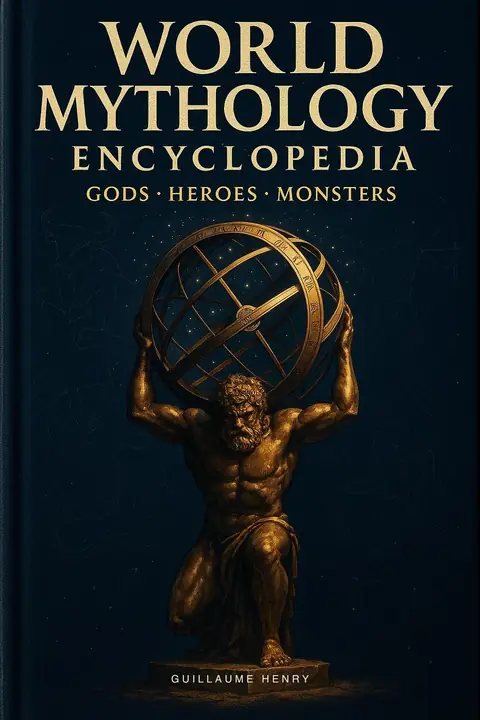
Mythology
The World Mythology Book: The Gods, Heroes and Myths of Every Culture
The Gods, Heroes and Myths of Every Culture, in One Volume
The whole of world mythology in a single volume: Greek, Norse, Egyptian, Japanese, Hindu, Celtic, Slavic, Mesoamerican and African myths gathered side by side, each drawn from the primary sources.