

Izanami: The Goddess of Creation and Death in Japanese Myth
Izanami stands at the heart of Japanese creation, the female kami who alongside Izanagi brought the islands into being. When death claims her, she becomes a harbinger of corruption and loss, reshaping how Japan understands the boundary between life and the grave.
Contents
Izanami does not begin as a corpse rotting in a cave. She begins in the chaos before the world.
In the Kojiki, Japan's oldest written record of myth (compiled around 712 CE), two kami stand on the Floating Bridge of Heaven. Izanami, the Female Who Invites, holds a jewelled spear next to her male counterpart, Izanagi. Together they stir the primordial ocean. As the spear lifts, brine drops fall and harden into the first islands of Japan. This is not metaphor. This is creation itself: birth through the union of male and female, the primal polarities encoded in Japanese cosmology from the very start.
For much of her existence, Izanami is generative. She gives birth to the islands. She bears children who become other kami: the sea, the mountains, fire itself. Yet the myth pivots. When she dies birthing the fire deity, Izanami descends to Yomi, the land of the dead, and her transformation becomes absolute. She rots. She becomes inhabited by maggots and decay. When Izanagi, desperate to retrieve her, breaks the taboo and peers into the darkness with his comb-turned-torch, he sees not his beautiful wife but a rotting corpse covered in filth and corruption. That sight breaks something. It establishes, once and for all, that death is pollution, separation, a one-way descent.
Izanami goddess of creation and death is not two beings. She is one being split by the boundary between before and after. Understand her, and you understand how Japan shaped its entire religious and social order around purity, taboo, and the terror of what lies beyond.
The Primordial Pair and the Birth of the Islands
The Kojiki opens not with words but with void. Nothing exists yet. No sky, no earth, no time. Then, in the void, a principle stirches itself into form: the Primordial Forces gather into two kami. Izanami and Izanagi. Female and male. Yin and yang, though those Chinese terms came later.
The text is sparse but vivid. The two kami descend the Floating Bridge of Heaven. Below them churns chaos. Izanagi takes the jewelled spear (in some versions, it is his spear; in others, hers; the text allows ambiguity, and this matters). They stir the ocean. The brine adheres to the spear. As it drips, the islands of Japan crystallize.
Then comes the question of procreation. Izanagi asks Izanami, "How is your body formed?" Izanami answers, "My body is fully grown except in one place." Izanagi says, "My body is fully grown except in one place. Suppose we join the parts of our bodies that are not fully grown." The language is delicate but unmistakable. Sexual union sanctifies creation.
They perform a ritual circumambulation around a pillar. Some versions say Izanami speaks first. Some say Izanagi. This reversal matters deeply to Japanese mythologists: whoever speaks first is considered the initiator. When Izanami speaks first, the offspring are imperfect (the island of Awaji is born malformed). When Izanagi speaks first in the second attempt, the islands are perfect. The hierarchy is built into the structure of speech itself.
What emerges from this union is not abstract. The kami give birth to the eight great islands of Japan: Honshu, Hokkaido, Kyushu, and five others. They are not metaphorical islands. They are the islands. The myth does not "represent" creation; it is the creation narrative that gave Japanese people their sense of terrestrial belonging. To recite the birth of the islands is to recite your own origin.
The Goddess Who Births the World
Izanami's generative power does not stop with geography. She continues to bear children. Her labor becomes labour. She births the kami of the sea, of the mountains, of the wind. Some of these children are gentle; others are terrible. She bears Ōkami no Muchi, the god of growing plants. She bears Kaze no Kami, the wind kami. She bears the fire deity, Kagu-Tsuchi.
The fire birth is the turning point. Giving birth to flame consumes her from within. Her vagina is burned by the child's divine heat. She is mortally wounded by the very act of creation. The Kojiki states it plainly: she dies of that wound.
This is not a sidelined narrative. This is the hinge. The myth tells us that generativity comes with a price. Creation costs. The goddess who brings forth life is destroyed by one of her own offspring. Fire, one of the most sacred elements in Japanese ritual (used to purify, to ward off pollution), is also the instrument of Izanami's death. The contradiction is intentional. It establishes a principle that runs through all of Japanese spirituality: the sacred and the profane, purity and pollution, life and death are not opposites. They are locked in each other.
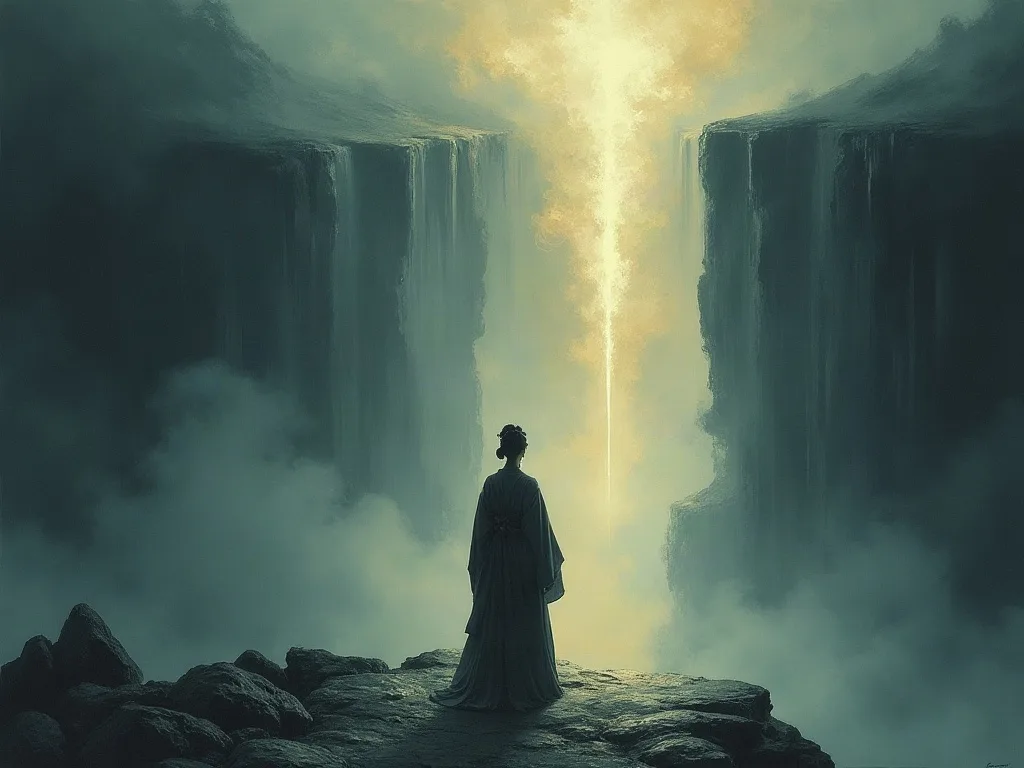
The Land of Yomi and the Corruption of Death
When Izanami dies, she does not ascend. She descends. The Kojiki calls her destination Yomi, sometimes translated as "the land of the dead" or "the underworld," though neither phrase captures the term's original sense. Yomi is not a place of judgment or reward. It is a place of concealment, darkness, and unmaking. It is where things go when they cease.
Izanagi, unable to accept her loss, descends after her. He finds her in the darkness. He tells her he cannot bear to lose her. He begs her to return to the world of light. Izanami agrees, but under one condition: she must first consult with the kami of Yomi to arrange her release. She enters a chamber. She tells Izanagi not to look at her while she confers.
Izanagi waits. The darkness presses. He cannot bear the silence. He takes out his comb and sets it on fire, creating a torch. He peers into the chamber.
What he sees unmakes him.
The Kojiki describes it: Izanami's corpse is covered in filth and corruption. Maggots writhe on her body. She is rank with decay. The description is brutally specific. She has begun to return to matter. She is coming undone.
Izanagi flees in horror. He runs up the slope of Yomi toward the world of light, pursued by the rotting form of his wife and by the Eight Thunder Kami (or sometimes eight spirits) that dwell in Yomi. Behind him, Izanami, still barely conscious of her own degradation, shouts that he has shamed her. She vows to kill 1,000 people each day. Izanagi responds that he will ensure 1,500 people are born each day. In this exchange, the rhythm of death and renewal is established. Neither will have dominion. Both are necessary.
Izanagi escapes. He seals the entrance to Yomi with a great boulder. Izanami remains trapped inside, queen of a realm she never chose, bound to a place where creation reverses into dissolution.
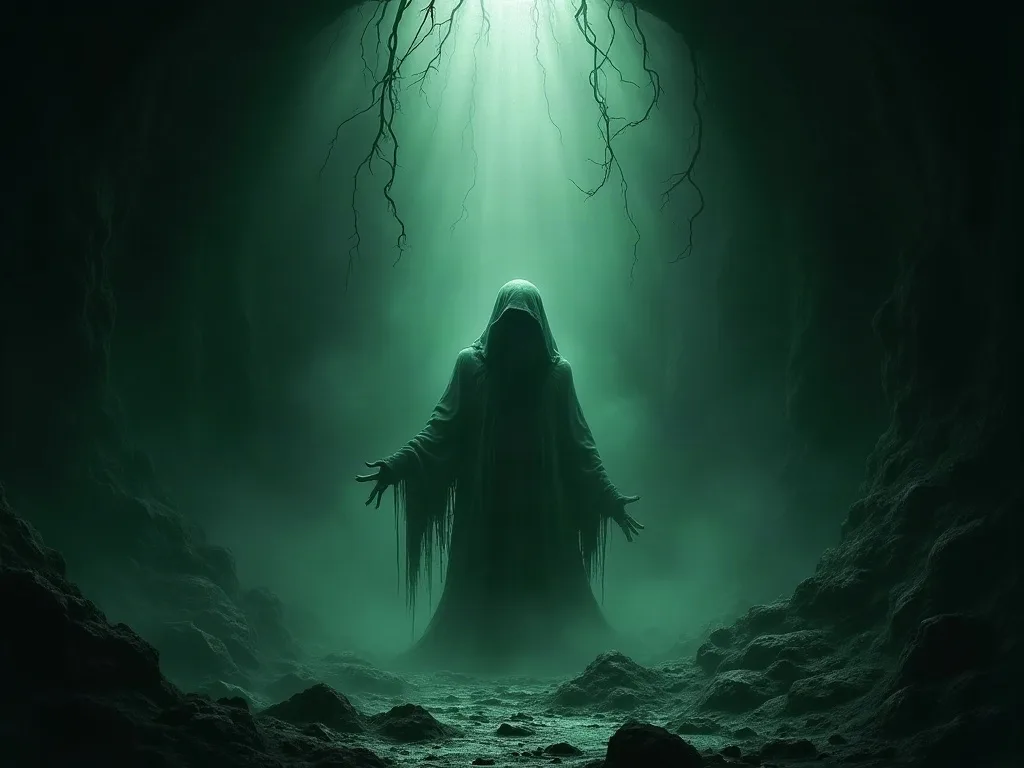
The Transformation from Creator to Pollutant
What happens to Izanami after that moment is as important as what came before. She does not disappear. She remains present in the Japanese imagination as a force, a boundary, a warning.
The sight of Izanami's corpse does something specific to Izanagi. It contaminates him. In the Kojiki, he feels unclean. He travels to a river to purify himself through ritual ablution. As he bathes, he washes away various pollutants. From his left eye emerges the sun goddess, Amaterasu. From his right eye emerges the moon god, Tsukuyomi. From his nose emerges Susanoo, the storm kami. The act of purification is itself generative. Izanagi births three of the most important kami in the pantheon by washing away the contamination of having seen death.
Izanami, meanwhile, remains in Yomi. She is transformed from the radiant, creative mother into something else: the embodiment of death-pollution, the kami who must be kept at a distance, the force that threatens to pull the living world back into chaos and decay.
This transformation is not symbolic. It is cosmological. In Shinto, Japan's indigenous spiritual system, purity and pollution are not moral categories. They are states of being. Pollution includes menstruation, birth, sickness, death, and anything associated with bodily boundary-breaking. Izanami, queen of the land of the dead, becomes the ultimate source of pollutant energy. To come into contact with death is to be touched by Izanami's realm. Shinto priests perform rituals to ward off such contact. Families avoid touching corpses without protective barriers. Graves are kept separate from living spaces. All of this flows from the moment Izanagi saw his wife's body begin to dissolve.

Izanami in Broader Japanese Spiritual Context
To understand Izanami is to grasp the entire framework of Shinto. The religion that emerged in Japan over centuries is inseparable from the myths of the Kojiki. Izanami is not a god you pray to for favor. She is a principle you observe respect for by maintaining distance. She is a boundary-keeper. She is a reminder that creation and destruction are linked.
This is visible in Japanese funerary practices. When death comes, the body is treated with extreme care but also with extreme precaution. Mourners undergo purification rituals. Salt is scattered. The deceased is separated from the living space. These practices are not superstition. They are a direct response to the myth. Izanami teaches that death is contagious, that the boundary between the living world and Yomi is fragile, that crossing it requires protection and ritual.
The myth also establishes gender dynamics that would influence Japanese society for millennia. Izanami's death in childbirth, her transformation into a pollutant, her immobility in Yomi while her husband escapes and births gods through his own body: these details encoded particular ideas about the female body as both creative and dangerous. Later Japanese medical and philosophical texts would repeat these associations. A woman in menstruation or childbirth was considered polluted. Childbirth was dangerous not only physically but spiritually. These were not unique to Japan, but the Kojiki gave them a cosmic authorization.
Kami and the Spectrum of Divine Beings
To speak of Izanami requires understanding what a kami is. The term is often translated as "god" or "spirit," but both are imprecise. A kami is a presence, a force, a being that exists at the boundary between the material and the unseen. Not all kami are good. Not all are powerful. Some are household kami (such as the kami of a cooking pot). Some are kami of places (a tree, a river, a rock). Some are kami of abstract concepts (growth, decay, beauty).
In the Kojiki and the Nihon Shoki (another foundational text compiled in 720 CE), the term refers to a vast hierarchy of beings. At the top are the primordial kami like Izanami and Izanagi. Lower in the hierarchy are countless other kami. There is no neat distinction between them. Amaterasu, the sun goddess and supreme deity of Shinto, is called a kami. So is the spirit of a specific shrine. The spectrum is continuous.
Izanami holds a special place because she is among the most ancient, most powerful, and most feared of all kami. She is not worshipped in shrines the way Amaterasu is. There are no major temples dedicated to her. This absence is itself meaningful. To honor Izanami is not to invite her presence; it is to acknowledge her power and maintain the boundary she represents.
Yokai, Yomotsu-Shikome, and the Blurred Line Between Worlds
Here is where Izanami connects to the broader landscape of Japanese supernatural beings. In Japanese folklore, beings called yokai populate the world: creatures that are neither fully kami nor fully animal, neither alive nor dead. They are mischievous, sometimes dangerous, often misunderstood. They haunt the edges of human society.
The eight spirits (or eight thunder kami) that pursued Izanagi out of Yomi hint at this spectrum. Sometimes called the Yomotsu-Shikome (the spirits or shamans of Yomi), these beings exist in the liminal space where Izanami now dwells. They are not quite kami of the upper world. They are not fully human ghosts. They are inhabitants of Yomi, servants of the dead, beings that belong to neither world.
This is where yokai originate in the Japanese imagination. They are beings that have slipped between worlds, that have touched death or decay without fully submitting to it. They retain a kind of agency, an ability to move through and between spaces. A yokai might be the spirit of a fox that has lived for centuries and absorbed too much spiritual power. It might be an object imbued with longing or malice. It might be the echo of a dead person who cannot fully depart.
Izanami, locked in Yomi, becomes the source of all yokai-ness. She is the principle of boundary-crossing, of the uncanny, of the not-quite-living that persists in the spaces of the Japanese landscape. When a traveler encounters a yokai in a mountain pass at twilight, they are, in a sense, brushing up against Izanami's domain. The yokai is an intermediary, a being caught in the same liminal space she now occupies.
Izanami in Medieval and Modern Japanese Culture
After the classical period, Izanami's myth entered Japanese literature, kabuki theater, and popular storytelling. She appears in Noh plays, where her story is often told from Izanagi's perspective: the husband's grief and the horror of discovering that his beloved has become something other. In these retellings, Izanami sometimes speaks from the darkness of Yomi, defending her transformation, explaining that she could not help her decay. Other times she is portrayed as vengeful, angry at being abandoned.
The Edo period (1603-1868) saw a flourishing of yokai illustration and folklore texts. Izanami loomed large in these collections as the ultimate source of death-pollution, the kami who remains at the root of all hauntings and supernatural disturbances. Artists drew her sometimes as a decomposing beauty, sometimes as a skeletal figure, sometimes as a being of pure shadow.
In modern times, Izanami has entered popular media. She appears in anime, manga, and video games. The anime series "Hanoka" references her myth. The visual novel "Umineko: When They Cry" uses Izanami and Izanagi's separation as a central metaphor for the boundary between life and death. Contemporary artists draw on her story to explore themes of loss, forbidden knowledge, and the cost of transgression.
What remains consistent is her role as a liminal figure. She is never fully redeemed or resolved. She remains in Yomi. The boundary between her world and ours remains sealed. Every time a modern Japanese person encounters a yokai in fiction, they are, perhaps unknowingly, engaging with an echo of Izanami's descent.
The Scholarly Question: Is Izanami Still a Kami?
Japanese and Western scholars have long debated what Izanami becomes after her death. Is she still a kami? The Kojiki does not explicitly say. It records that she is confined to Yomi, that she rots, that she is transformed by death and decay. The question of her ontological status remains deliberately ambiguous.
Some scholars argue that Izanami becomes a yuurei, a vengeful spirit or ghost. Unlike regular dead, who eventually achieve peaceful status in the ancestral realm, a yuurei is a dead person trapped by regret, anger, or incompleteness. Izanami's unfinished desire (to return to the world of light, to reclaim her husband) could mark her as such a being.
Others maintain that Izanami remains a kami, but of a different order: a kami of death itself, of boundaries, of the forces that work in Yomi. In this reading, she is not diminished but transformed. She rules a realm. She is powerful, even if that power is exercised through absence and separation.
The ambiguity is not a flaw in the source material. It is the source material's genius. By leaving Izanami's status unclear, the myth preserves the mystery that surrounds death in Japanese spiritual life. She cannot be fully classified or controlled. She persists in a state of productive uncertainty.
Izanami and the Cycle of Creation and Destruction
One more thread connects Izanami to broader patterns in Japanese and East Asian cosmology. Creation and destruction are not opposed in Japanese thought the way they often are in Western philosophy. They are partners in a dance. Life requires death. Order requires the acknowledgment of chaos. Purity requires the ritual acknowledgment of pollution.
Izanami embodies this principle perfectly. She is the creator who becomes the symbol of un-creation. She is the kami who must be forgotten in order to allow the living world to persist. Every purification ritual in Shinto is, in a sense, a re-enactment of Izanagi's escape from Yomi, a renewal of the boundary she represents.
In this sense, Izanami does not fade from Japanese spiritual life. She remains present precisely through her absence, through the rituals performed to keep her at a distance, through the fear and respect her memory commands. She is the ghost in the system, the principle against which all order is defined.
Frequently Asked Questions About Izanami, Goddess of Creation and Death
Frequently asked questions
Why did Izanami die from childbirth if she was a goddess?
The Kojiki explicitly states that Izanami was burned by the fire kami she gave birth to. The myth does not explain why a kami should be vulnerable to such an injury, and this ambiguity is deliberate. It suggests that even divine beings are subject to natural law, and that creation carries real cost. Izanami's death establishes that being is not eternal or automatic; even the creators must pass into Yomi.
Is Izanami still alive in Yomi, or is she truly dead?
The Kojiki describes her in a state of advanced decay, yet still conscious enough to pursue Izanagi and make agreements with him. She exists in a liminal state between life and death. Later interpretations sometimes call her a yuurei (vengeful spirit) or a kami of death itself. The text deliberately avoids complete clarity, reflecting the Japanese understanding that death is not a simple end but a transformation into a different mode of existence.
Does Izanami appear in any Shinto shrines or rituals today?
Unlike Amaterasu or other kami, Izanami is not widely worshipped at major shrines. However, her myth underlies nearly all Shinto purification practices. Rituals to protect the living from death-pollution, avoidance of places associated with the dead, and the use of salt and other purifying substances all stem from the Kojiki's account of Izanami's contamination and Izanagi's escape.
How does Izanami connect to yokai in Japanese folklore?
Yokai are supernatural beings that exist in liminal spaces between worlds. Izanami, queen of Yomi and the ultimate embodiment of boundary-crossing and death-pollution, is the archetype and source of yokai-ness in Japanese imagination. Encounters with yokai are, in a sense, echoes of proximity to Yomi and to the power Izanami represents.
What is the meaning of Izanami's name?
Izanami means "the Female Who Invites," while Izanagi means "the Male Who Invites." The names emphasize their roles as the pair that draws forth creation through their union. Some scholars connect the names to ritual invocation and the power of naming itself to bring things into being, a principle central to Japanese magical and spiritual practice.
Izanami's Unresolved Presence in Modern Japan
The Kojiki sealed Izanami in Yomi more than 1,300 years ago. Yet she has never truly left. Every time a Japanese person performs a purification ritual, maintains distance from the dead, or encounters a yokai in a story, they are engaging with her presence through her absence. She is the sealed door. She is what must not be looked upon. She is the price of creation.
Modern Japan has inherited this unresolved relationship. Horror films use Izanami's myth as a template for the return of the dead. Manga artists draw her decaying form with aesthetic precision. Musicians reference her journey to Yomi. Writers explore what she might say if given a voice beyond the Kojiki's account. In all of these acts, she is kept alive by being repeatedly sealed away.
The myth does not offer redemption or closure. Izanami does not escape Yomi. Izanagi does not retrieve her. The boundary remains. This refusal of resolution is perhaps Izanami's most profound gift to Japanese culture: the understanding that some separations are necessary, that some boundaries must hold, that the cost of creation is paid not once but continuously, through ritual, through memory, through the active maintenance of the line between life and death, purity and pollution, the world of light and the darkness of Yomi.
Free 25-page sample
Want the whole story?
Take the first 25 pages free. If it pulls you in, the full edition is yours as an instant PDF download, with a paperback on Amazon for selected titles.

Mythology
The World Mythology Book: The Gods, Heroes and Myths of Every Culture
The Gods, Heroes and Myths of Every Culture, in One Volume
The whole of world mythology in a single volume: Greek, Norse, Egyptian, Japanese, Hindu, Celtic, Slavic, Mesoamerican and African myths gathered side by side, each drawn from the primary sources.