
King Midas and the Golden Touch: The Complete Myth, Its Sources, and What It Still Teaches Us
King Midas asked a god for the power to turn everything he touched into gold. He got exactly what he wished for. The story of what happened next is one of Greek mythology's most human warnings.
Contents
A satyr was sleeping in the rose gardens of Phrygia. He was drunk, sprawled among the flowers, and the gardeners did not know what to do with him. So they bound him with garlands and brought him before their king.
The king's name was Midas. He recognized the creature immediately. This was Silenus, oldest and wisest of the satyrs, tutor and companion of the god Dionysus himself. Midas fed Silenus well, listened to his stories for ten days, and then escorted him safely back to Dionysus. The god, grateful and generous, offered Midas any wish he desired.
Midas did not hesitate. He asked that everything he touched be turned to gold.
The Wish That Worked Too Well
Ovid, writing his Metamorphoses around 8 AD, gives the most complete and vivid account. He describes Midas walking home from his meeting with Dionysus, testing the gift on everything he passes. He picks a twig from an oak tree. Gold. He picks up a stone. Gold. He touches a handful of earth. Gold. He reaches for a ripe ear of wheat. Gold. He plucks an apple from a branch, and the apple becomes a treasure from the orchards of the Hesperides, those mythical daughters of Evening who guarded a tree of golden fruit at the edge of the world.
Midas laughs. He summons his servants and calls for a feast to celebrate his fortune. Then he reaches for bread.
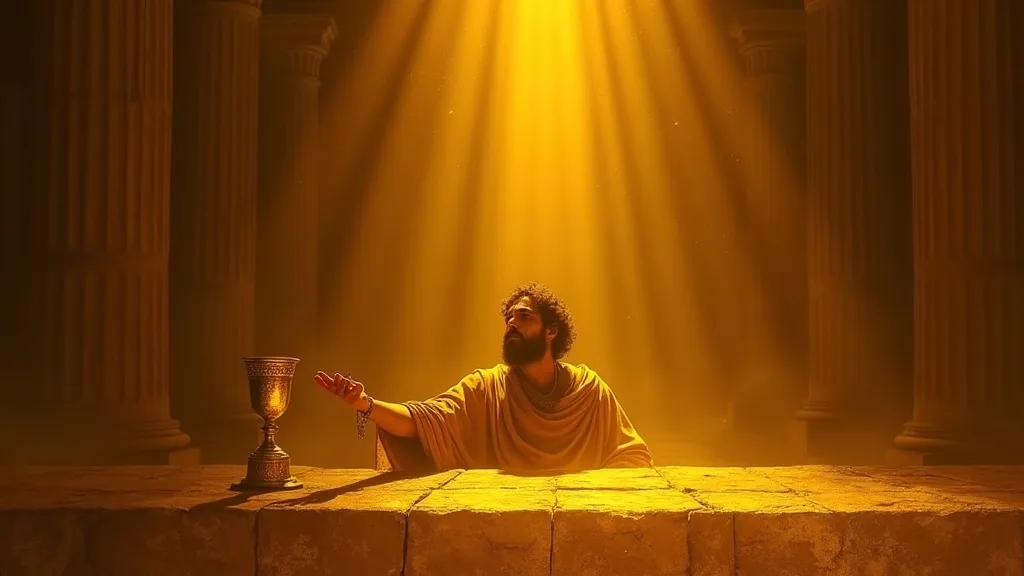
The bread turns rigid and cold under his fingers. He lifts a cup of wine. The liquid solidifies into a thread of gold as it touches his lips. He tries meat. He tries water. Every bite, every sip, every small comfort of a human life turns to metal the moment he grasps it. The king who wanted the most gold in the world now sits at a banquet table surrounded by treasure, and he is starving to death.

Ovid writes: "That curse he craved himself now choked him." The Latin is more brutal than any translation manages. The wish is fulfilling itself perfectly. That is the horror.
Midas does what desperate men do. He prays. He raises his arms to Dionysus and begs to be freed from what he himself asked for. Ovid says the god, showing more mercy than most of the Greek pantheon typically managed, heard him immediately and told him where to go.
The River Pactolus and the Washing of the Gift
Dionysus directed Midas to the headwaters of a river called the Pactolus, which flows through the ancient kingdom of Lydia in what is now western Turkey. He told Midas to wash both his head and his body in its waters, and the gift would leave him.
Midas went. He plunged himself into the river, and the golden touch passed out of him and into the riverbed. The Pactolus thereafter ran with flakes of gold washed from the sands. Ancient writers treated this as straightforward historical explanation: the Pactolus was genuinely famous in antiquity for its alluvial gold deposits. The river's gold made the Lydian kings extraordinarily wealthy. The Greek historian Herodotus, writing in the fifth century BC, mentions this wealth extensively when he describes Croesus, the Lydian king whose name became synonymous with riches. The myth of Midas and the Pactolus was, for ancient readers, an origin story for a real economic fact.
This connection to actual gold-bearing rivers is what mythologists call an aetiological myth, from the Greek aitia, meaning "cause." The story explains a feature of the landscape while carrying a moral charge. The Greeks layered these two purposes together so naturally that it is sometimes hard to tell where geography ends and parable begins.
Who Was the Historical Midas?
The mythological Midas and the historical Midas are two different figures that ancient storytellers blended together over centuries. Archaeologists and historians have confirmed that a king named Midas ruled Phrygia, the kingdom occupying the central Anatolian plateau, in the late eighth century BC. His throne name in the Phrygian language was Mita. He appears in Assyrian royal records as a rival and occasional ally of the Assyrian king Sargon II. He may be the first named individual in history to be mentioned in both Greek literary tradition and contemporary Near Eastern documents.
His capital was Gordium, the city famous for the Gordian Knot, another myth that would become attached to the Midas dynasty. Excavations at Gordium, carried out extensively by the University of Pennsylvania from the 1950s onward, uncovered a burial mound called Tumulus MM, which for decades was associated with Midas himself. Recent scholarship has revised the dating: the burial likely belongs to Midas's father or predecessor, around 740 BC. But the tomb's contents, which include wooden furniture of extraordinary craftsmanship and the largest collection of Iron Age bronze vessels ever found, confirm the kingdom's genuine wealth.
The historical Midas died around 695 BC, likely during a catastrophic invasion by the Cimmerians, a nomadic people who swept through Anatolia and reportedly drove the king to suicide. The myth swallowed the history and kept only the gold.

Silenus and the Older, Darker Story Inside the Myth
Before Ovid's polished version, there was an older layer. The Greek philosopher Aristotle, writing in the fourth century BC, preserved a fragment of a story about Silenus that is much stranger and more disturbing than anything Ovid includes.
In this version, Midas captures Silenus and asks him: what is the best thing for humans? What is the greatest good a person can attain?
Silenus laughs at him. Then he answers. He says: the very best thing is not to have been born at all. The second best thing is to die as soon as possible.
This answer belongs to a strand of Greek thought called pessimism, or sometimes philosophical nihilism, associated with thinkers who questioned whether human life had any inherent worth. Silenus is not being cruel. He is being, in his ancient, drunken, satyr way, honest. He has seen too much. He has walked alongside a god. He knows what human lives actually contain.
The philosopher Friedrich Nietzsche, writing his 1872 book The Birth of Tragedy, called this "the wisdom of Silenus" and built a significant part of his argument about Greek culture around it. For Nietzsche, the Greeks were not sunny optimists but clear-eyed people who stared at darkness and chose to create art and myth as their answer. The golden touch story sits right at the junction of these two impulses: the wish for gold is the human refusal to accept limits, and the starvation that follows is Silenus's wisdom made flesh.
Learn how Dionysus, the god who granted Midas his wish, shapes Greek mythology's darkest narratives
Midas and Apollo: The Second Myth, the Donkey Ears
The golden touch is the myth everyone knows. But Midas appears in a second major myth, and it is worth telling because it deepens the portrait considerably.
After the Pactolus washing, Midas gave up his love of wealth and moved to the countryside. He became a follower of Pan, the goat-legged god of wild places and music. One day, Pan challenged the god Apollo to a music contest. Pan played his pipes. Apollo played his lyre. A mountain deity named Tmolus served as judge and declared Apollo the winner.
Midas, standing nearby, disagreed. He said Pan was better.
Apollo heard him. The god turned to Midas, looked at his ears, and transformed them into donkey's ears, long and grey and bristling, as punishment for what Apollo considered a judgment of breathtaking stupidity and poor taste.
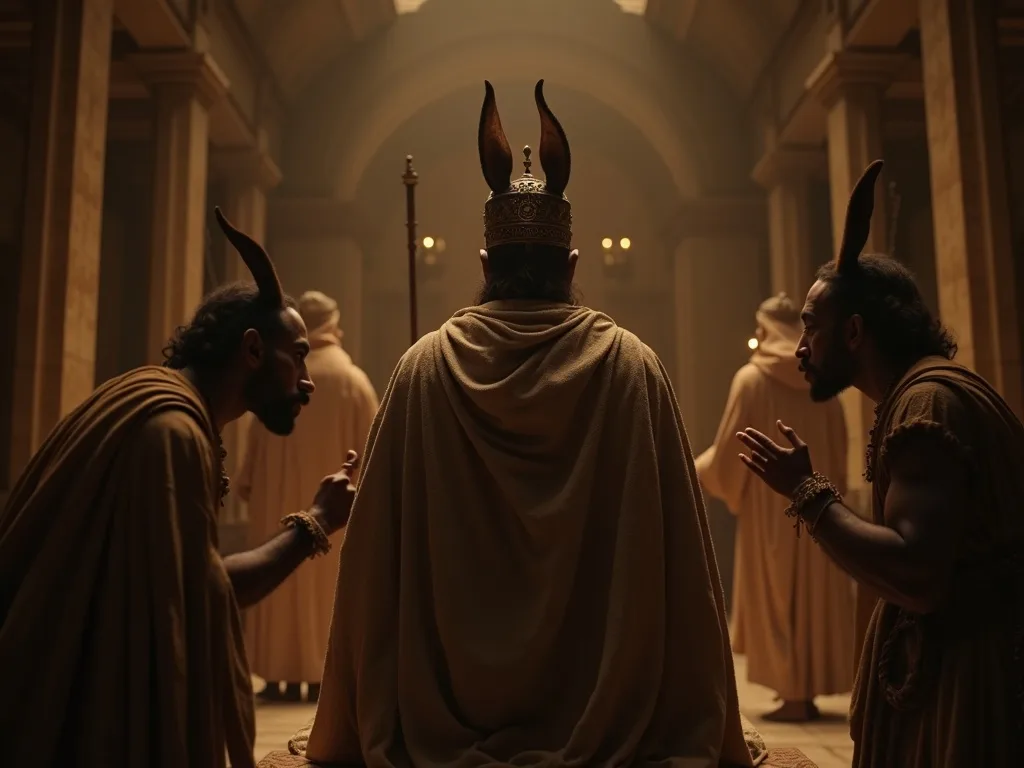
Midas tried to hide this. He wore a tall cap day and night. Only his barber knew the truth. The barber, unable to keep the secret, dug a hole in the ground and whispered it into the earth: "King Midas has donkey ears." Reeds grew up from the spot. When the wind blew through them, they whispered the secret back to anyone passing: "Midas has ass's ears. Midas has ass's ears."
The story is comic in tone, which makes it easy to miss how precise it is. The golden touch punished Midas for wanting too much. The donkey ears punished him for bad judgment, for backing the wrong aesthetic, for refusing to recognize excellence when it stood in front of him. Two wishes, or in this case, two failures of discernment. Both punishments are permanent until a god intervenes. Both involve the king's face: one at his mouth, one at his head. The body becomes the record of the soul's errors.
What the Golden Touch Actually Means: Three Readings
Scholars have read the King Midas and the golden touch myth in at least three major ways, and none of them cancels the others.
The moral reading is the oldest and most obvious. Greed destroys. The wish for infinite wealth leads to isolation and starvation because wealth without the ability to use it, without the texture of ordinary life, is worthless. This reading stretches from ancient Greek moralists through Roman Stoics through medieval Christian allegorists who loved the Midas story as a demonstration that earthly riches are empty. It survives intact in every children's picture book about Midas today.
The structural reading is more interesting. The classicist W.R. Johnson noted that the Midas myth follows a pattern that appears across Greek myth: the mortal who receives divine power cannot integrate it into human life. The same pattern governs Phaethon, who took the sun god's chariot and burned the earth, and Semele, who asked to see Zeus in his full divine form and was incinerated. The Greeks were suspicious of humans touching divine attributes directly. The myth says not that wealth is wrong, but that divine-scale power in human hands always finds the cruelest way to break.
The economic reading has gained traction in recent decades. The classicist Richard Seaford, in his 2004 book Money and the Early Greek Mind, argued that the Midas myth reflects Greek anxieties about the new money economy of the seventh and sixth centuries BC. Coinage was transforming Greek society when the myth took its literary shape: suddenly wealth could be abstracted, accumulated, detached from land and grain and livestock. The nightmare of Midas, who cannot eat his gold, is the nightmare of a society realizing that abstract wealth can replace concrete need right up to the moment it cannot. The myth worries about money the way later societies worried about industrialization or digital abstraction.
All three readings survive because the myth is genuinely all three things at once. Good myths contain multitudes.
The Golden Touch Across Cultures: Parallels and Echoes
The Greek version of this story is the most famous, but the anxiety it encodes appears in other traditions.
In the Sanskrit epic the Mahabharata, the god Kubera, lord of wealth, is both celebrated and portrayed as a figure of excess. His city Lanka (before the demon king Ravana seized it) was literally built of gold, and the stories around Kubera track the same tension: extraordinary wealth becomes its own prison.
In West African Akan oral tradition, particularly among the Asante people, gold is sacred but also deeply regulated. Mythological accounts of kings who accumulated gold beyond what ritual allowed feature similar motifs of isolation and supernatural punishment. Gold must circulate, must be used properly, or it curses its keeper.
Norse mythology offers the most direct parallel. The dragon Fafnir in the Völsunga Saga was once a dwarf. His greed for gold, specifically for the cursed hoard of Andvari, transformed him physically into a dragon, a creature who does nothing but lie on treasure and breathe poison. The cursed gold of Fafnir in Norse mythology follows the same structural logic as the golden touch: the wish fulfilled becomes a body that can no longer participate in human life.
The Japanese folktale tradition includes stories of kin no niwatori, golden chickens or objects that transform everything they touch, usually tied to warnings about disrupting natural cycles. The pattern is quieter in Japanese tradition but recognizable.
What these parallels suggest is that the golden touch myth answers a question all complex societies ask: when does wealth stop being a resource and start being a trap? Every culture that produces surplus generates a version of this story.
Timeline: Midas from Phrygia to Ovid
Understanding when different versions of the myth appeared helps clarify how the story grew.
- circa 740-695 BC : Historical King Mitas of Phrygia rules. Mentioned in Assyrian records. His kingdom at Gordium is wealthy and powerful.
- circa 695 BC : Cimmerian invasion destroys Phrygia. Historical Midas dies, possibly by suicide.
- 6th century BC : Herodotus mentions the Pactolus and Lydian gold. The myth of Midas begins circulating in oral and written form, absorbing the historical king.
- 4th century BC : Aristotle records the Silenus fragment, with the "it is best not to be born" answer. The philosophical layer of the myth is well established.
- circa 25 BC : Strabo, the Greek geographer, describes the Pactolus and its gold, treating the Midas myth as historical explanation.
- 8 AD : Ovid publishes the Metamorphoses, Books 11. His version of the golden touch and the donkey ears becomes the definitive Latin account and the primary source for medieval and modern readers.
- 1st-2nd century AD : Hyginus, in his Fabulae, provides a shorter Latin summary. The two myths of Midas are now fixed in the canonical retelling tradition.
- 1872 : Nietzsche's The Birth of Tragedy reinterprets the Silenus encounter as the key to understanding Greek culture's relationship with suffering.
- 2004 : Richard Seaford's Money and the Early Greek Mind proposes the economic reading.
Midas in Art, Literature, and Modern Culture
The image of a king reaching for food and finding only cold metal proved irresistible across centuries. Medieval illuminated manuscripts showed Midas at a banquet table surrounded by golden cups and plates, his face fixed in an expression caught between wonder and despair. This image appears in at least fourteen major manuscript traditions catalogued before 1400.
Nathaniel Hawthorne retold the myth in 1853 in his Tanglewood Tales and introduced the detail that Midas's daughter, a little girl who ran to embrace him, was turned to a golden statue. Hawthorne added this himself. It does not appear in Ovid. But it was so emotionally right, so precisely the kind of collateral damage greed produces, that it entered the popular imagination as if it had always been there. Most people who know the Midas story know Hawthorne's version.
The phrase "Midas touch" passed into business and financial journalism by the early twentieth century, typically as a compliment: "he has the Midas touch" means someone turns everything they attempt into profit. The irony is complete. The phrase praises exactly the thing the myth warns against. The warning became a badge of honor and the myth went on carrying its original meaning quietly underneath.
Economists use "Midas problem" as technical shorthand for the paradox of a good becoming worthless at the moment of total saturation, which is itself a neat demonstration of how mythological thinking and analytical thinking sometimes converge on the same truth from opposite directions.
See how Greek heroes across the tradition navigate divine gifts that cut both ways
Frequently Asked Questions About King Midas and the Golden Touch
Frequently asked questions
What is the original source for the King Midas golden touch myth?
The most complete ancient account is in Ovid's Metamorphoses, Book 11, written around 8 AD. Ovid drew on earlier Greek sources that no longer survive in full. The philosopher Aristotle, writing in the fourth century BC, preserves an older version of the Silenus encounter, and Herodotus mentions the gold-bearing Pactolus River in his Histories in the fifth century BC. None of the Greek originals survive as a unified text; Ovid's Latin version is what shaped the modern tradition.
Did King Midas really exist?
Yes, though the historical Midas is quite different from the mythological one. A king named Mitas ruled Phrygia in central Anatolia around 740-695 BC. He appears in Assyrian royal records and controlled the city of Gordium. Archaeologists have excavated large burial mounds at Gordium associated with the Midas dynasty. He died, probably by suicide, during the Cimmerian invasion around 695 BC. The myth of the golden touch was attached to this real king over the following centuries.
Why did Dionysus grant such a dangerous wish?
Ancient sources are consistent here: Dionysus warned Midas and gave him the chance to choose differently. Midas insisted. Within Greek theological thinking, this is important. The gods grant wishes, but they are not responsible for the human failure of imagination that makes a wish ruinous. Dionysus also showed unusual mercy afterward by releasing Midas from the curse when he begged. Most Greek gods in similar situations, Zeus especially, were far less forgiving.
Is the detail about Midas's daughter turning to gold original?
No. That detail appears in Nathaniel Hawthorne's 1853 retelling in Tanglewood Tales, written for children. In Ovid's original Latin, Midas hugs a child and she turns gold, but Ovid does not name her or develop her character. Hawthorne expanded the scene and gave the story its modern emotional center. His addition was so resonant that it is now often mistaken for the classical version.
What did the Pactolus River actually have to do with gold?
The Pactolus is a real river in western Turkey, flowing through what was ancient Lydia near the city of Sardis. It carried genuine alluvial gold deposits, likely from gold-bearing geological formations upstream. The Lydian kings, including the historically wealthy Croesus, derived real economic power from this source. The Greeks explained this geographical fact through the Midas myth: the gold in the river came from when Midas washed the divine gift out of his skin. Myth and economic history fused together completely.
What is the connection between Midas and the Gordian Knot?
Gordium, the capital of Midas's Phrygian kingdom, was also the site of the famous Gordian Knot. A prophecy said that whoever untied the knot would rule Asia. Alexander the Great famously cut it with his sword in 333 BC. The knot was attached to a wagon in the citadel of Gordium, associated with the founder of the Midas dynasty. The two myths, the golden touch and the Gordian Knot, share the same physical location and the same historical kingdom, though they belong to different generations and different story traditions.
The Myth That Keeps Earning Its Place
There is a reason "the Midas touch" entered a dozen languages as a living phrase. The myth got something right about how human desire works. Not desire for gold specifically, but the underlying structure: we wish for the absolute version of something good, we get it, and the absolute version destroys the thing we wanted it for. Midas wanted to be rich. He became so rich he could not eat. The wish was granted perfectly, and the perfection was the punishment.
The myth also got something right about human adaptability. Midas prays. He admits the error. He goes to the river. The gift washes out. Life resumes. The Greeks did not usually write myths in which the lesson stays abstract. They put it in a body, in a river, in a specific landscape that their audiences could visit and recognize. The Pactolus still exists. It still flows through Turkey. Its gold deposits, thinner now than in antiquity, still shimmer in the silt. A reader who goes there and bends down to look at the riverbed is doing something the ancient Greeks would have recognized: checking the myth against the world, and finding that the world confirms it.
That groundedness is what separates the Midas myth from a simple moral fable. It insists on being real. The king was real. The river is real. The gold was real. Only the transaction, the god, the wish, the sudden cold weight of treasure where bread should be, that part belongs to another order of truth. But it is the part that has not faded.
Explore how Greek mythology's most human stories compare across the full tradition
Free 25-page sample
Want the whole story?
Take the first 25 pages free. If it pulls you in, the full edition is yours as an instant PDF download, with a paperback on Amazon for selected titles.

Mythology
The World Mythology Book: The Gods, Heroes and Myths of Every Culture
The Gods, Heroes and Myths of Every Culture, in One Volume
The whole of world mythology in a single volume: Greek, Norse, Egyptian, Japanese, Hindu, Celtic, Slavic, Mesoamerican and African myths gathered side by side, each drawn from the primary sources.