

Krishna the Eighth Avatar: The Divine Cowherd and the Heart of Hindu Faith
Krishna is the eighth avatar of Vishnu, the Hindu god of preservation, born to restore dharma and free the world from tyranny. His life spans divine play and profound philosophy, from childhood pranks to his role as spiritual guide in the Bhagavad Gita.
Contents
On a moonlit night in the city of Mathura, a divine child was born in a prison cell. Guards slept. Doors swung open. Rain fell upward. The eighth avatar of Vishnu, the god of preservation, had arrived in human form. His name was Krishna.
The Hindu tradition knows Krishna through two radically different lenses. In one, he is the cowherd lover, dancing with the milkmaids of Vrindavan, his flute music so enchanting it draws all creatures into rapture. In the other, he is the warrior charioteer on the battlefield of Kurukshetra, explaining to his student Arjuna why he must fight his own cousins. Both are real. Both are sacred. Both reveal different aspects of the divine.
Krishna's story, told primarily in the Mahabharata (an epic Sanskrit poem written between the 5th century BC and 2nd century AD) and the Bhagavata Purana (a sacred text composed around 900 AD), stands as one of the richest narratives in world religion. He is not distant or transcendent alone; he is intimate, playful, and human in ways that made him the most beloved avatar across Hindu practice for two thousand years.
The Birth and the Curse
The story begins with a curse and a prophecy. King Kamsa of Mathura had just married his sister Devaki. At the wedding, a heavenly voice announced: "The eighth child born to Devaki will slay you." Kamsa, terrified, imprisoned Devaki and her husband Vasudeva. As each child was born, he killed them.
But when the eighth child arrived, something extraordinary happened. The Bhagavata Purana describes it: Vasudeva's chains fell off. The prison guards fell asleep. The locked doors opened on their own. Carrying the newborn Krishna across the Yamuna River, Vasudeva found shelter with a cowherd family in the village of Gokul. There, he exchanged his son for a newborn daughter born to Yashoda, the cowherd's wife. When Kamsa rushed to kill the eighth child, he found a girl who transformed into the goddess Durga. The curse was set in motion, but the child of prophecy was safe.
The Divine Child of Gokul and Vrindavan
Yashoda raised Krishna as her own. The Bhagavata Purana fills pages with his childhood pranks: stealing butter and eating it with the other children, breaking his mother's pots, climbing the fruit trees, running through the forest. These are not simply cute stories. In Hindu theology, every gesture Krishna made as a child is sacred play, or lila. His pranks reveal a truth: the divine is not bound by adult rules or morality. Krishna can steal butter because he is Krishna; he is not subject to ordinary law.
By age seven, Krishna began his cosmic work. When the demon Putana, disguised as a beautiful woman, came to poison him by offering him poisoned milk, Krishna drank it and killed her. When the serpent Kaliya polluted the Yamuna River with his venom, Krishna danced on its hood and subdued it, forcing the serpent to flee. These victories announced what the scriptures already knew: the cowherd child was Vishnu himself.
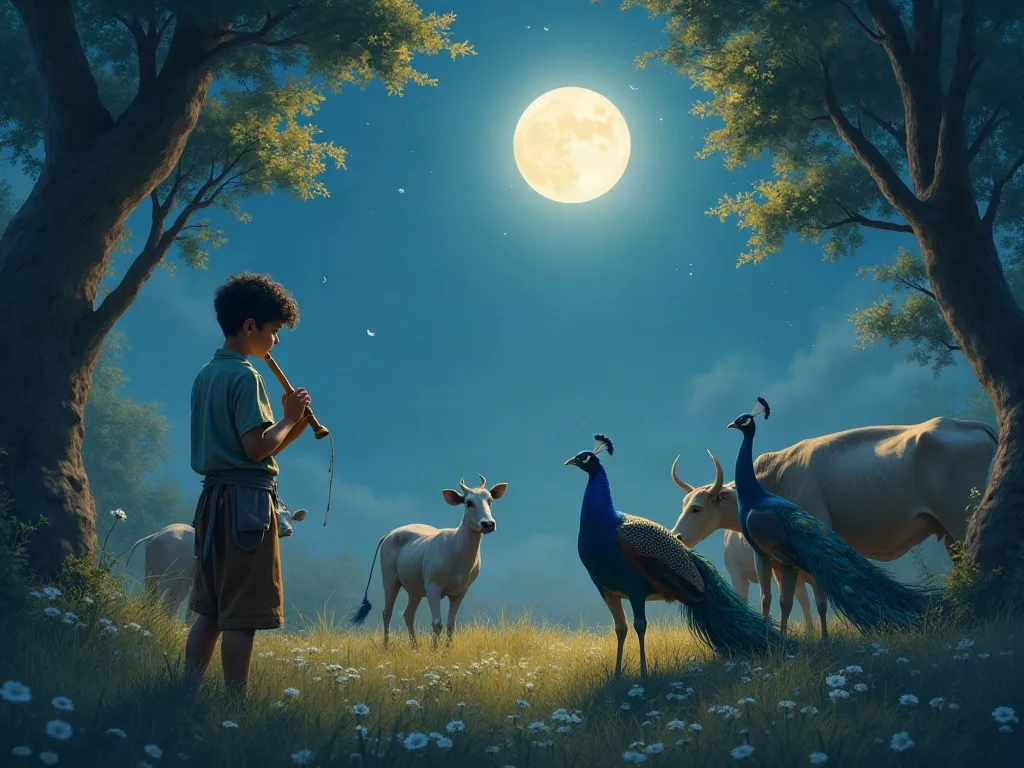
The most famous image of Krishna comes from these years: standing alone in the forest near Vrindavan with his flute. The Bhagavata Purana says that when Krishna played his flute, all creatures were drawn to him. The gopis, the cowherd girls, left their homes and families. The peacocks spread their feathers. The trees bent close. Even the river Yamuna flowed toward him. His music was the sound of the divine calling the soul back to itself.
One night, Krishna invited all the gopis to dance with him under the full moon. The Bhagavata Purana describes the rasa lila, the dance of divine love: Krishna multiplied himself so that each gopi believed he danced only with her. Each felt chosen, each felt beloved. For scholars and believers alike, this dance is interpreted in many ways: as the soul's longing for God, as the ecstatic union of the individual consciousness with the universal divine, or simply as the sweetest expression of love and play. In temples and homes across India, paintings and sculptures of this moment hang as the ultimate image of Krishna.
The gopis' devotion to Krishna, their bhakti or surrender, became a model for Hindu practice. If the gopis loved Krishna so fully, so unreservedly, then the path to salvation was not ritual or knowledge alone but love.
The Warrior on the Chariot
By age fifteen, Krishna left Vrindavan. The Mahabharata describes his next twenty years: he befriended Arjuna, the great archer, and later married his sister Subhadra. He became a diplomat and prince in his own right, ruling the city of Dwaraka. He fathered children. He accumulated power and wives, taking 16,108 of them according to some texts, marrying each one he rescued from danger or imprisonment.
But his most defining moment came on the battlefield of Kurukshetra. Two branches of the same royal family faced each other: the Pandavas, virtuous but sometimes uncertain, and the Kauravas, powerful but corrupt. Arjuna, the greatest warrior of the age, sat in his chariot with his hands trembling. His cousins, some of whom he loved, stood across from him. He turned to his charioteer, Krishna, and refused to fight.
"How can I kill my own family?" Arjuna asked. "What good is victory? What good is a kingdom?"
What followed is the Bhagavad Gita (literally "the Song of God"), eighteen chapters of dialogue between Krishna and Arjuna. It is not a command to violence. It is a profound meditation on duty, righteousness, and the nature of action itself.
Krishna taught Arjuna several truths. First, the soul is eternal; the body dies but the atman (soul) is reborn. So in one sense, no one truly dies in battle. Second, Arjuna's duty as a warrior (his dharma) is to fight. To abandon his duty out of attachment or fear is to violate the cosmic order. Third, and most radically, action done without attachment to its fruits is the highest form of wisdom. Do your duty completely, but do not cling to the outcome. This is karma yoga, the yoga of selfless action.
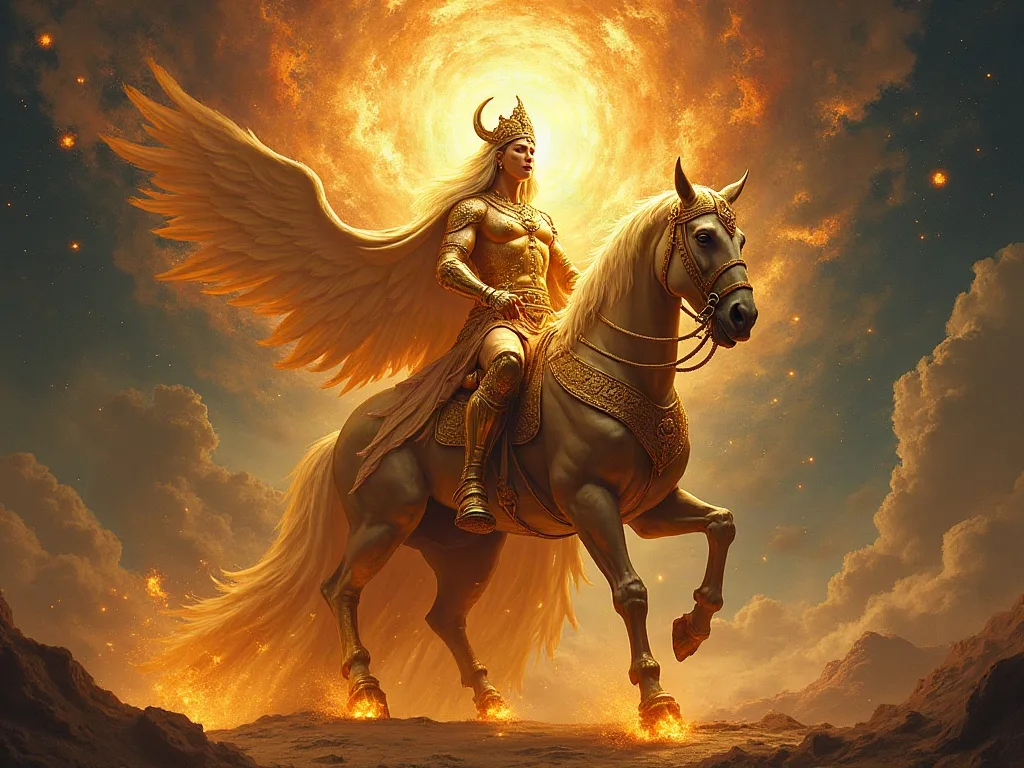
The Bhagavad Gita then expands into cosmology. Krishna reveals his divine form to Arjuna: a being with infinite faces and mouths, all three worlds reflected in his body, radiating the light of a thousand suns. It is terrifying and overwhelming. Arjuna falls at his feet. Then Krishna returns to his human form. He is both the intimate friend and the infinite divine; both are equally real. By war's end, Arjuna fights.
The Dark Stories and the Limitations
Hindu texts do not hide Krishna's moral ambiguities. He lies strategically. During the great war, he encourages the warrior Bhima to break the rules of honorable combat by striking below the waist. He orchestrates the death of the warrior Jayadratha by hiding the sun. He tricks his wife Draupadi into an impossible situation (the game of dice that starts the entire war). He kills the tyrant Kamsa with treachery.
This complexity has sparked centuries of debate among Hindu theologians. Some explain that Krishna, as God, is not bound by human morality; his acts transcend ordinary ethics. Others argue that he acts according to context, that true justice sometimes demands deception and violence. Still others suggest that these stories are not literal moral instruction but layers for deeper philosophical meditation.
The Puranas also tell darker tales. In some versions, the young Krishna kills the cowherd girl Radha through indifference. In others, he abandons the gopis of Vrindavan when he leaves for the city. These stories, troubling on the surface, are interpreted by scholars as tests of faith: they ask whether devotion to Krishna survives disappointment, loss, and apparent cruelty. They teach that love of the divine must be unconditional.
The Iconography and the Symbols
Across Hindu temples and homes, Krishna appears in several recognizable forms. Most commonly, he is shown with blue or dark skin, a reference to the word "Krishna" itself, which means "dark" or "black" in Sanskrit. He wears a yellow dhoti (skirt), and a peacock feather crowns his head. His flute rests in his hand or his mouth. Often, a cow stands nearby.
The blue skin has provoked much speculation. Some texts say he was born with blue skin because he drank poisoned milk as a child. Others say the blue represents his cosmic nature; in Hindu color symbolism, blue is the color of infinity and divinity. The peacock feather and flute connect him to nature, music, and beauty. The cow (the go) is sacred in Hinduism, and Krishna's association with cows links him to fertility, the earth, and nourishment.
The color yellow, often the dhoti and the cloth around his shoulders, represents auspiciousness and divinity in Hindu practice. His jewels, crowns, and ornaments mark him as royalty and divine power. When Krishna is shown with Radha, a cowherd girl who becomes his primary beloved, they are often depicted mirror images: Krishna blue, Radha fair-skinned, locked in eternal embrace or dance.
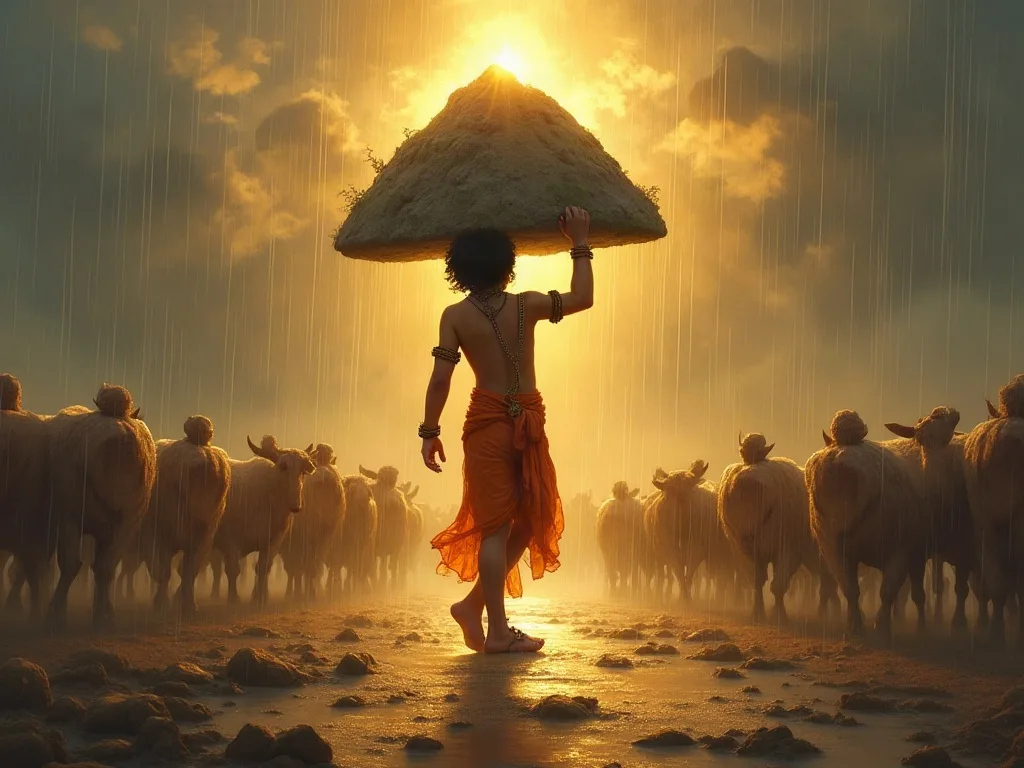
Another crucial image: Krishna lifting Mount Govardhana with one hand to shelter the people and cattle from a terrible storm sent by the god Indra. This moment, celebrated in sculptures and paintings, shows Krishna as protector and savior. The mountain became sacred; to this day, Hindu pilgrims worship Mount Govardhan in Uttar Pradesh.
The Bhakti Revolution and Regional Devotion
By the medieval period (roughly 1200-1800 AD), Krishna had become the focus of a revolutionary spiritual movement across India. The bhakti movement (from the Sanskrit root meaning "to share" or "to devote") taught that salvation was not the domain of Brahmin priests and elaborate ritual but accessible to anyone through love and surrender to God. And God's most accessible, most intimate form was Krishna.
The medieval poets of southern India wrote ecstatic verses about Krishna. Jayadeva, a 12th-century Sanskrit poet, composed the Gita Govinda, a poem of a thousand verses describing Krishna's love affair with the gopis, especially Radha. These were not academic works. They were sung, danced, performed in temples. The poem blurred the line between sacred text and love ballad, between theology and poetry.
In northern India, Vallabhacharya (1479-1531) founded a sect centered on Krishna worship. He taught that Krishna is the supreme reality and that total surrender to Krishna was the path to liberation. His followers, found primarily in Gujarat and Rajasthan, still practice his teachings today, understanding every moment of life as an offering to Krishna.
In eastern India, Chaitanya Mahaprabhu (1486-1534) created ecstatic forms of Krishna worship. He taught that chanting the names of Krishna, dancing, and singing in public were the highest spiritual practices. His followers, the Gaudiyas, spread Krishna devotion across Bengal and eventually around the world. The International Society for Krishna Consciousness, founded in New York in 1966, traces its spiritual lineage to Chaitanya.
Each region developed its own Krishna: the secret lover of the cowherd girls in Vrindavan theology, the supreme warrior and teacher in the Mahabharata, the cosmic principle in Advaita Vedanta philosophy, the passionate friend of Radha in the poetry of Jayadeva.
The Ten Avatars and Krishna's Place
Hindu theology teaches that Vishnu, the preserver, descends into the world whenever dharma (cosmic order) is threatened and adharma (chaos) grows too strong. These descents are called avatars (from the Sanskrit avatara, meaning "descent"). The classical list contains ten avatars:
- Matsya, the fish
- Kurma, the tortoise
- Varaha, the boar
- Narasimha, the half-man, half-lion
- Vamana, the dwarf
- Parashurama, Rama with the axe
- Rama, the perfect king
- Krishna
- Buddha (a controversial inclusion in some texts)
- Kalki, still to come
Each avatar is born in response to a specific crisis. The fish saved humanity from a world-destroying flood. The tortoise supported the cosmic mountain during the churning of the ocean. Each acts to restore balance. But among the ten, Krishna is unique: he is the most human, the most intimate, and perhaps the most philosophically complex.
Some Hindu theologians argue that Krishna is not merely an avatar but a fuller manifestation of Vishnu than the others. The Bhagavata Purana sometimes hints that Krishna is the source from which all avatars flow. Others teach that all ten avatars are simultaneous manifestations of the one divine principle. The philosophical richness lies in the multiplicity of interpretations.
The Death and the Eternal Return
The Mahabharata describes Krishna's death: an arrow strikes him by accident while he stands in the forest. Some versions say it was shot by a hunter who mistook him for a deer. Others say it was an act of cosmic justice, a wound inflicted on him just as he had inflicted wounds on others. Krishna falls. He smiles. He returns to Vaikuntha, Vishnu's heaven, his human form dissolving into the infinite.
But in Hindu practice, Krishna does not truly leave. Every eight years, the city of Mathura celebrates Janmashtami, Krishna's birthday, with parades, plays, songs, and all-night worship. In Vrindavan, pilgrims walk the lanes where the cowherd child once played. In temples across India and the world, Krishna's image receives flowers, incense, and devotional song. Chanting his names, Hare Krishna, Hare Krishna, is believed to invoke his presence and grace.
The philosophy of Krishna also lives on. The Bhagavad Gita, his central teaching, has become perhaps the most translated and quoted Hindu text in the world. Everyone from Swami Vivekananda to Mohandas Gandhi to modern philosophers has drawn wisdom from its verses. Its message resonates beyond India: the idea that we can find meaning by fulfilling our duty without attachment to results, that action itself is a form of prayer, that the divine dwells in every human heart.
Krishna in Art, Music, and the Modern World
For over two thousand years, Krishna has inspired artists across every medium. The Chola bronzes of southern India (10th-12th centuries) depict him in forms of exquisite grace and power. Medieval manuscripts from northern India show him stealing butter, dancing with the gopis, standing on the serpent's hood. Contemporary Indian cinema has built entire genres around his life; every few decades, a new Mahabharata adaptation and a new Krishna film capture audiences.
In music, Krishna's flute has been reimagined in every Indian classical style: hindustani and carnatic, folk and contemporary. The raga tradition, the melodic framework of Indian classical music, is said to have been revealed to the sage Narada by Krishna himself. Ragas like Bhairav and Bhimpalasi are considered expressions of his moods and his teachings.
In the modern era, Krishna crossed into Western culture through the International Society for Krishna Consciousness (ISKCON), founded by A.C. Bhaktivedanta Swami Prabhupada in 1966. The movement introduced the mantra "Hare Krishna, Hare Krishna, Hare Rama, Hare Rama, Rama Rama, Hare Hare" to Western audiences. It presented Krishna devotion as a universal path, not bound to any single culture or time. Today, millions of non-Indians worship Krishna in temples on five continents.
Scholars of comparative religion have drawn lines between Krishna and other mythological figures: the boundary-crossing trickster of many traditions, the divine lover, the cosmic teacher. Some see echoes of Krishna in the Greek Hermes (messenger, shapeshifter, friend to humans) or in the wounded-healer archetype found across world myths. These comparisons are illuminating but risk flattening Krishna's particular genius: he is the god who stands equally at ease playing with cowherd girls and explaining cosmology on a battlefield, the god who can be both utterly human and utterly divine in the same breath.
Frequently asked questions about Krishna the eighth avatar
Frequently asked questions
Why is Krishna depicted with blue or dark skin?
The name Krishna means "dark" or "black" in Sanskrit. Some Hindu texts explain the blue skin as arising from Krishna drinking poisoned milk as a child. In Hindu color symbolism, blue represents infinity and the cosmos; the dark color also distinguishes him from other avatars. The exact reason remains open to interpretation, but the blue has become his most recognizable marker across art, sculpture, and popular culture.
What is the Bhagavad Gita and why is it so important?
The Bhagavad Gita is an eighteen-chapter dialogue between Krishna and his student Arjuna on the battlefield of Kurukshetra. It teaches that righteous action, performed without attachment to results, is the highest spiritual practice. Often called the "Song of God," it has become Hinduism's central philosophical text and one of the most translated works in world literature. Many Hindus memorize passages and turn to it for life guidance.
Did Krishna actually live as a historical person?
Hindu tradition teaches Krishna as both historical and divine. Many scholars believe a historical figure inspired the Krishna legends, possibly a warrior-king who lived in northwest India sometime between 1500 and 500 BC. However, the mythological Krishna of the Mahabharata and Bhagavata Purana is presented as an avatar of Vishnu, the divine principle incarnate. Whether historical or purely mythological, his influence on Hindu philosophy and practice has been profound and continuous.
How does Krishna's moral ambiguity fit with Hindu ethics?
Krishna lies, deceives, and kills in the Hindu texts. Hindu theologians have wrestled with this for centuries. Some explain that as God, Krishna transcends human moral laws. Others argue that true dharma (righteousness) sometimes requires deception in service of a greater good. Still others see the ambiguities as invitations to deeper reflection: they test whether devotion to Krishna survives moral complexity, teaching that faith must be unconditional and that divine reality may exceed human categories of right and wrong.
What is the rasa lila and why is it sacred?
The rasa lila is the dance of divine love Krishna performed with the gopis under the full moon, described in the Bhagavata Purana. Krishna multiplied himself so each gopi believed he danced only with her. It symbolizes the soul's longing for God and the supreme form of love. In temples, the rasa lila is re-enacted through dance and drama (rasalila performances). It has inspired centuries of poetry, art, and devotional practice across India.
How do the different regional versions of Krishna differ?
Southern India emphasizes Krishna's childhood and his love for the gopis, drawing on the Bhagavata Purana. Northern India developed the poetry of Radha and Krishna's eternal love, especially through medieval figures like Jayadeva. Eastern India, through Chaitanya, stressed ecstatic chanting and public devotion. Western India created the Krishna theology of Vallabhacharya, emphasizing total surrender. Each region has shaped Krishna's worship and meaning to reflect local spiritual values, yet all recognize him as the same eighth avatar of Vishnu.
The Eternal Present: Krishna Beyond History
What makes Krishna remarkable in the landscape of world religion is not that he is ancient or distant. He is intimate. When a Hindu child chants the mantra "Hare Krishna," she is not speaking to a memory. She believes Krishna hears her. When a devotee leaves flowers at a Krishna temple, it is an act of present encounter, not commemoration.
The theology of Krishna also bridges the most difficult gap in religious experience: the gap between the transcendent and the intimate, between the God so vast that all worlds fit inside his body and the friend who stole butter and danced under the moon. Krishna is both. He contains both truths without diminishing either. That paradox, sustained through two millennia of devotion and philosophy, gives him a power that extends far beyond the Hindu world. He speaks to something universal: the human hunger to touch the divine in its most human form, and to recognize the divine in one's own heart.
The flute plays. The gopis listen. Arjuna trembles on the battlefield. The soul wakes to itself. These are not three different stories. They are one story, told in three keys, and the name of the story is Krishna.
Free 25-page sample
Want the whole story?
Take the first 25 pages free. If it pulls you in, the full edition is yours as an instant PDF download, with a paperback on Amazon for selected titles.

Mythology
The World Mythology Book: The Gods, Heroes and Myths of Every Culture
The Gods, Heroes and Myths of Every Culture, in One Volume
The whole of world mythology in a single volume: Greek, Norse, Egyptian, Japanese, Hindu, Celtic, Slavic, Mesoamerican and African myths gathered side by side, each drawn from the primary sources.