
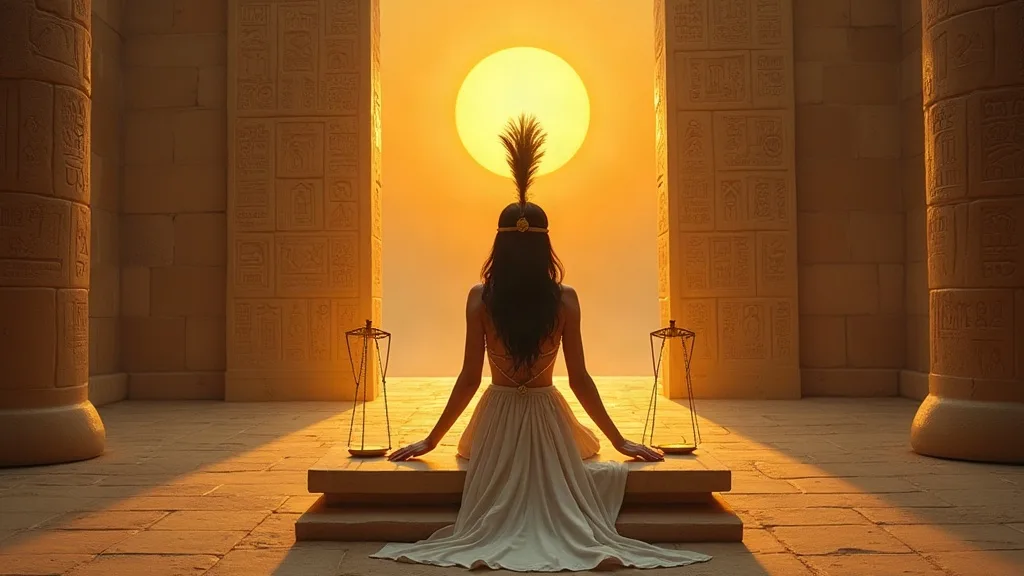
Maat: The Egyptian Goddess of Truth, Justice, and Cosmic Order
Maat embodied the principle that kept the cosmos from collapsing into chaos. Discover how ancient Egypt's most abstract yet crucial goddess shaped law, afterlife, and the very fabric of existence.
Contents
In the mythology of ancient Egypt, there exists a goddess without temples built for her alone, without a grand creation myth of her own, yet so essential that without her the sun would not rise, the Nile would not flood, and the dead would never reach the afterlife. Her name was Maat, and she was the embodiment of truth, justice, harmony, and the cosmic order that held all things in balance. She was not worshipped as an angry deity demanding sacrifice, but revered as the principle itself, the force that kept the universe from sliding into chaos and void.
The ancient Egyptians called the chaos before order isfet. Maat was the absolute antidote to it. Every pharaoh, every commoner, every god depended on her. She was not merely a goddess one prayed to in times of need. Rather, she was the law of existence, and to act in accordance with Maat was to act in accordance with the very heartbeat of reality. To violate her principles was to threaten not just society but the stability of the cosmos itself.
Origins and Nature of Maat
Maat first appears in the Pyramid Texts, the oldest religious writings of Egypt, inscribed on the walls of royal tombs around 2400 BCE. In these ancient inscriptions, she is already treated as an eternal principle rather than a deity who was born. Some accounts suggest she emerged from the breath of Ra, the sun god, during creation. Others describe her as self-existent, present at the moment the world was separated from the primordial waters of chaos called Nun.
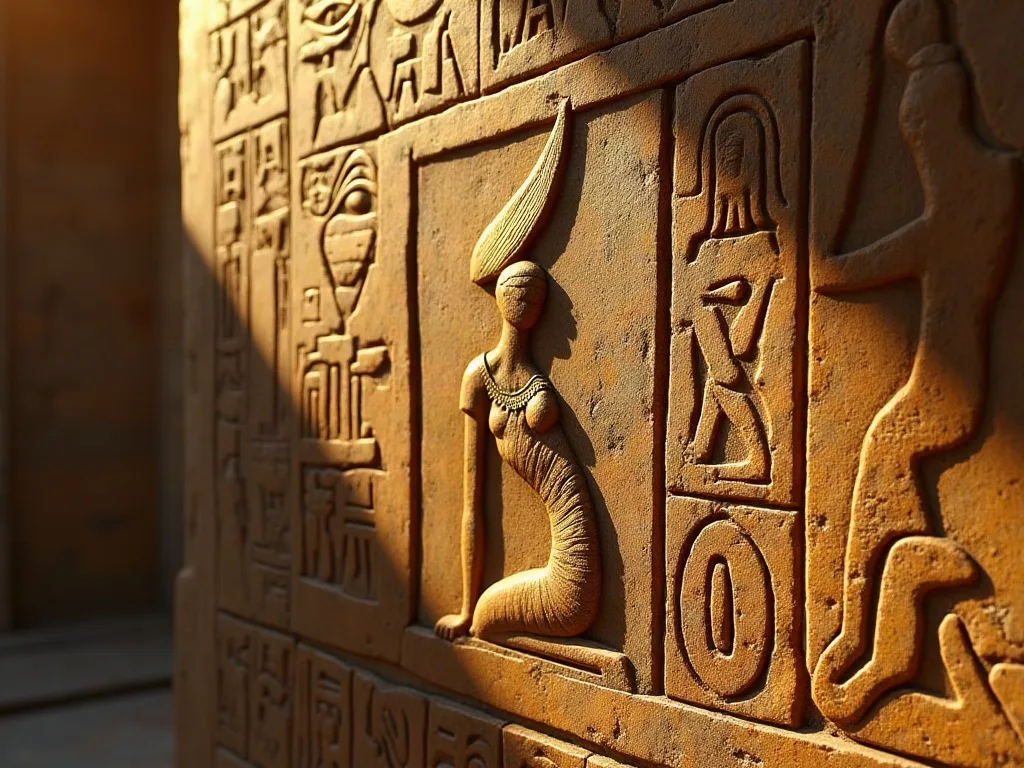
Her name, written in Egyptian hieroglyphics as three symbols (a seated woman, often with the feather of truth, and other glyphs representing order), translates directly as "truth" or "order." But the word carries deeper meanings untranslatable into English. Maat meant rightness, correctness, harmony, balance, and the proper functioning of all things. A pharaoh who ruled justly was said to "establish Maat." A transaction made honestly was done "in Maat." Even the physical laws governing how the sun moved across the sky and the Nile flooded each year were considered expressions of Maat's power.
Unlike many other Egyptian deities, Maat was less a personality with moods and desires and more a cosmic law made visible. Artists depicted her as a woman with a single feather on her head, sometimes with wings. The feather, light as air, was her symbol of truth: nothing false could hide beneath its weight. She was often shown holding an ankh, the symbol of eternal life, or seated on a throne, her posture serene and unshakeable.
Maat and the Creation of the World
Egyptian creation mythology assigns Maat a role of supreme importance from the very first moment. In one version, preserved in texts like the Coffin Texts and later temple inscriptions, Maat emerged from the primordial ocean when Atum, the self-created god, brought himself into being. As Atum separated the sky from the earth and organized the formless void, Maat stood beside him as the principle that made order possible.
Other texts describe how Maat sang the universe into being. Her voice, like a cosmic frequency, established the laws that would govern stars, seasons, and the behavior of living creatures. The sun, when it rose each morning, did so because of Maat. The Nile, when it flooded each summer, did so not by chance but because Maat maintained the cycles. Without her active, eternal presence, the cosmos would collapse back into isfet, the undifferentiated chaos from which it came.
The annual flood of the Nile was considered a direct expression of Maat's will. When the waters rose predictably and nourished the fields, Maat was in balance. When drought came, it was because Maat had been offended, and the order had been disrupted. This is why a pharaoh's primary duty was not merely to expand territory but to maintain Maat. A ruler who allowed injustice, who taxed unfairly, or who failed to perform religious rituals correctly was literally destabilizing the universe.
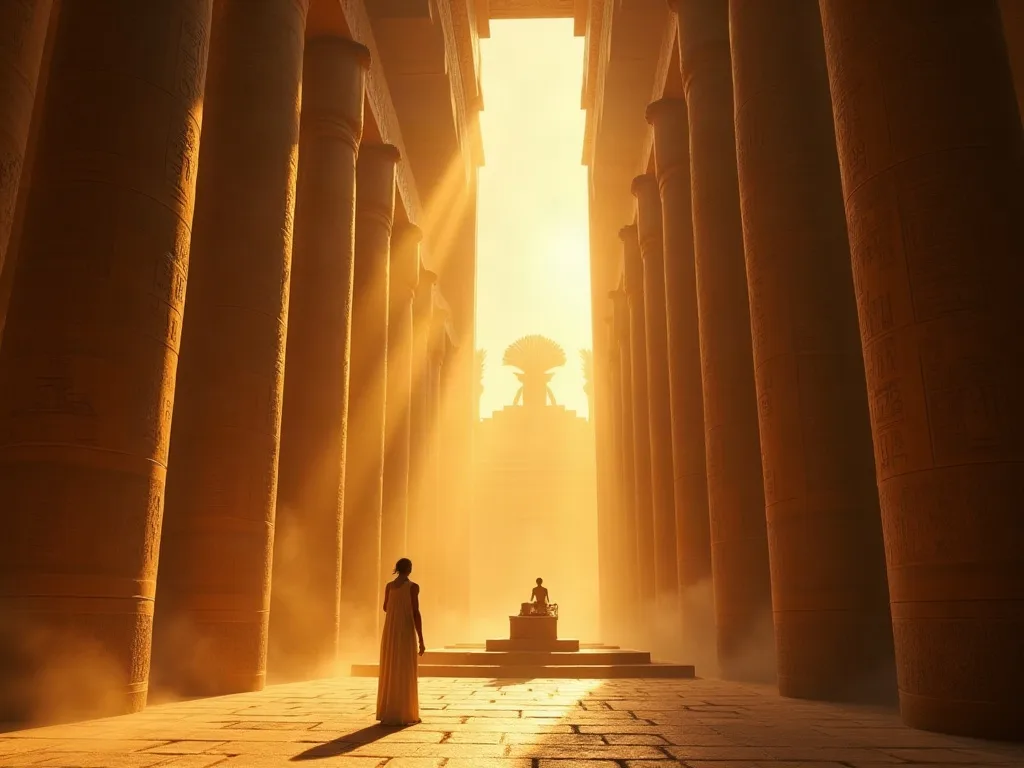
The Weighing of the Heart: Maat in the Afterlife
No single scene better captures Maat's power than the "Weighing of the Heart," a ritual that every Egyptian believed awaited them after death. This moment, depicted in countless papyrus scrolls and tomb paintings, was the ultimate judgment, and Maat herself presided over it.
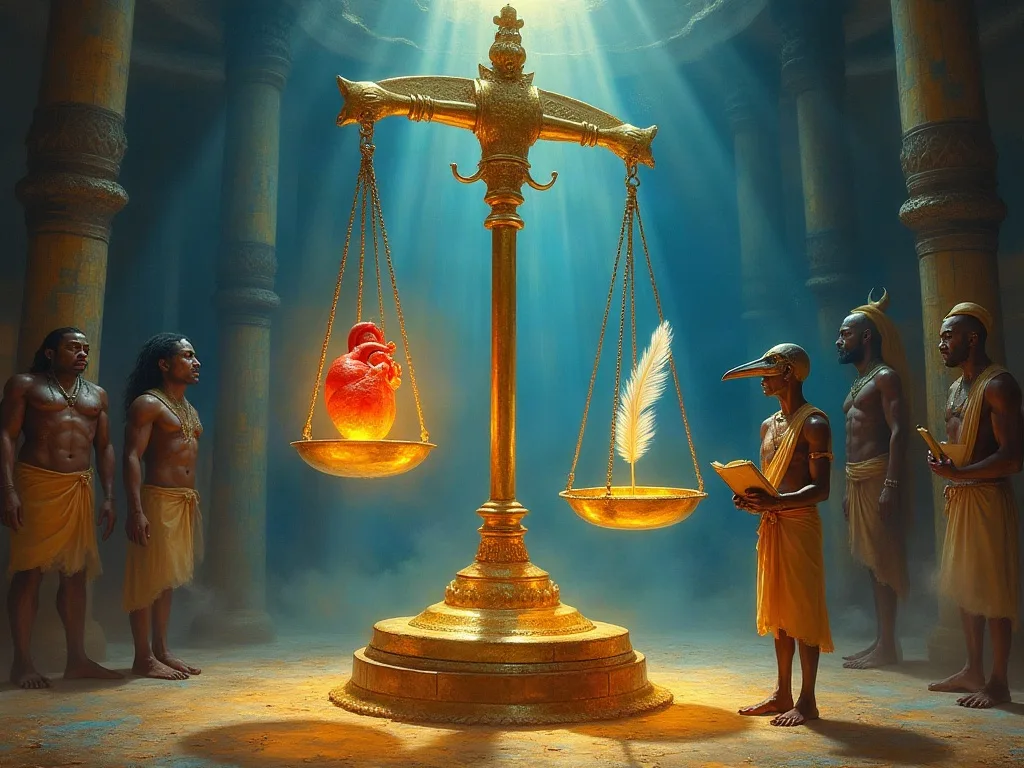
When a person died, they traveled through the Duat, the underworld. Eventually, they entered the Hall of Two Truths, a divine court where Osiris, god of the afterlife, sat in judgment. There, the deceased's heart (believed to be the seat of conscience and memory) was placed on one side of a great scale. On the other side lay a single feather of Maat, light as air, representing truth itself.
The divine ibis-headed god Thoth, god of wisdom and writing, operated the scales and recorded the verdict. Monsters and demons waited nearby. If the heart was heavy with lies, theft, cruelty, or betrayal, it would outweigh the feather. The heart would then be devoured by Ammit, a creature part crocodile, part lion, part hippopotamus. The person would cease to exist, denied the eternal life in the afterlife that every Egyptian hoped to achieve.
But if the deceased had lived in accordance with Maat, if they had been truthful, had treated others justly, had honored their family and the gods, and had performed their duties correctly, the heart and feather would balance perfectly. The person would then proceed into eternal blessing, joining the realm of the blessed dead in the Field of Reeds (Aaru).
This belief shaped Egyptian morality for over three thousand years. The fear of the scales was not the fear of divine punishment in the way later religions conceived it. Rather, it was the fear that one's truth would be revealed, that the accumulated weight of one's deeds would be exposed to the light. In a very real sense, Maat was not a tyrant. She was simply the law of consequences made manifest.
Worship and Ritual: Maintaining Maat
Maat had no major temples dedicated to her alone, yet she was honored in every temple in Egypt. Priests performing rituals began by pouring water on the ground as a symbolic offering to Maat, affirming their commitment to truth before approaching the god they came to worship. Every day, as the sun rose, the pharaoh (or a priest in his place) performed a ritual in which he would present an image of Maat, sometimes a small figurine or just a symbolic gesture, to the morning sun, thereby affirming that he would uphold order for another day.
Pharaonic Duty to Maat
A pharaoh's primary religious obligation was to maintain universal order by performing daily rituals, ensuring justice in laws, and preventing chaos. Failure to uphold Maat risked not just the nation but the cosmos itself.
Personal Duty to Maat
Ordinary Egyptians were expected to live truthfully, deal justly with neighbors, care for family, and perform their duties without greed or cruelty. At death, their heart would be weighed against Maat's feather to determine their eternal fate.
Maat also appeared in Egyptian law and administration. Judges in Egyptian courts were called "priests of Maat." When they delivered verdicts, they did so not as their personal opinion but as representatives of Maat's cosmic law. A contract between two merchants, a marriage agreement, a will: all were meant to be conducted in the presence of Maat, with each party swearing truthfully before her.
During the Ptolemaic period, when Greek rulers governed Egypt, Maat was sometimes syncretized with Greek concepts of order and law. Yet her essential character remained unchanged: she was the principle that kept reality from unraveling.
Maat and Other Deities
Maat did not stand alone in the pantheon. She had relationships with nearly every major god, though often in the role of counsel or guide rather than as a subordinate or rival. Ra, the sun god, relied on Maat to keep the cosmos orderly so his daily journey across the sky could proceed without disruption. Osiris, god of the afterlife and resurrection, could not judge the dead without her presence and authority. Thoth, the god of wisdom and record-keeper of all things, worked in concert with her, for wisdom without truth is merely clever deception.
She had a complex relationship with Sekhmet, the fierce lion-headed goddess of destruction and pestilence. While Sekhmet represented the untamed force of divine wrath, Maat represented the restraint necessary to prevent that wrath from consuming everything. Both were essential to the balance. A world with only Sekhmet's destructive power would collapse into chaos. A world that could never be cleansed of corruption through Sekhmet's force would also fall into disorder.
Interestingly, Maat was sometimes described as the daughter of Ra, though she was also described as existing before he did. This paradox reflects the Egyptian understanding that truth and order were not invented by anyone; they were woven into the fabric of existence itself.
Symbolic Representations and Hieroglyphics
The feather of Maat was her most iconic symbol, and it appears throughout Egyptian art and writing. The feather represents truth because, in Egyptian philosophy, truth is weightless and light. Lies, by contrast, weigh heavily on the soul. In hieroglyphic writing, the feather became a determinative, a visual clue added to the end of words related to truth, justice, or order.
Maat herself was often depicted wearing this feather as a headdress, sometimes a single ostrich feather, sometimes a double crown. Some representations show her with wings, suggesting her ability to move between the divine and human realms, carrying truth wherever she went. She was frequently portrayed as a slender woman in a simple white linen dress, her posture upright and dignified, her face serene.
In the Book of the Dead, the collection of spells and instructions meant to guide the deceased through the afterlife, Maat appears repeatedly. Spells often invoked her name to ensure safe passage. Coffins were sometimes inscribed with her image and prayers to her, the belief being that even in death, one remained under her jurisdiction.
Decline and Legacy: Maat Through the Ages
As Egyptian civilization waned and foreign powers increasingly dominated the Nile valley, the worship of Maat faded, though never entirely disappeared. During the Ptolemaic period, Greek and Egyptian religious traditions blended. Maat was sometimes identified with the Greek goddess Themis, who similarly embodied justice and divine law. When Rome conquered Egypt, Maat's principles found echo in Roman concepts of iustitia and pietas, though the direct cult largely disappeared.
Yet the idea of Maat did not vanish entirely. It lived on in the literature of later ages, in the moral frameworks of different religions, and in the universal human intuition that truth, justice, and order are not invented by humans but discovered, principles as real as gravity, waiting to be recognized and honored.
In modern scholarship and popular culture, Maat has experienced a revival of interest. Her role in Egyptian thought is now understood as far more sophisticated than earlier Egyptologists recognized. She was not simply a personification of abstract concepts but a dynamic cosmic force that held reality together through ceaseless action. Every sunrise, every successful harvest, every just verdict in a court of law was, in Egyptian belief, Maat at work.
The Philosophy Behind Maat: Order Versus Chaos
To understand Maat fully, one must grasp how the ancient Egyptians perceived the relationship between order and chaos. The world, in their view, was not naturally stable. Chaos, isfet, was always present, pressing at the edges of reality. Maat was not the absence of chaos but the active force holding it back. This required constant effort, constant vigilance, constant maintenance through ritual, law, and truthful action.
This concept gave Egyptian civilization a distinctive moral texture. Actions were judged not by whether they brought pleasure or even benefit to the individual, but whether they maintained or disrupted cosmic order. A lie that profited you still damaged Maat. A theft that went undetected still weighed on your heart at death. The gods were not capricious tyrants demanding obedience on a whim; they were custodians of a law deeper than any king's decree.
Scholars have noted parallels between Maat and similar concepts in other Indo-European and Near Eastern religions: the Vedic concept of rita in Hinduism, the Persian concept of asha in Zoroastrianism, and even echoes in the Greek concept of kosmos. Each represents an ancient understanding that the universe operates according to an eternal, impersonal law of order that humans ignore at their peril.
Frequently asked questions about Maat, the Egyptian goddess of truth and order
Frequently asked questions
Was Maat one of the most powerful goddesses in the Egyptian pantheon?
Maat was unique: she was not powerful in the way Ra or Osiris were powerful. She did not command armies or rule a realm. Instead, her power lay in her role as the cosmic law itself. Every god, including Ra, depended on her to keep the universe functioning. She was less a personality and more the principle that gave all other deities their authority.
Did ordinary Egyptians perform rituals to Maat, or was she only for pharaohs and priests?
Maat was relevant to everyone. While pharaohs performed formal rituals to maintain cosmic order, ordinary people honored her through truthful dealings, honest commerce, and just treatment of others. Most importantly, every Egyptian, rich or poor, faced judgment by Maat's feather in the afterlife. This belief influenced daily behavior far more than any temple cult.
How did the Weighing of the Heart actually work in Egyptian belief?
When a person died, they traveled through the underworld to the Hall of Two Truths. Their heart was placed on one side of a divine scale and balanced against Maat's feather on the other. Thoth, the god of wisdom, operated the scale and recorded the result. If the heart balanced with the feather, the person entered the afterlife. If it was heavier due to sin, it was devoured by the monster Ammit, and the person ceased to exist.
What was the relationship between Maat and the pharaoh?
The pharaoh was considered the earthly guardian of Maat. His primary religious duty was to perform rituals, uphold just laws, and prevent chaos. In return, the gods granted him authority to rule. A pharaoh who failed to maintain Maat risked losing divine favor, leading to drought, famine, or invasion. The pharaoh's legitimacy rested entirely on his commitment to Maat.
Why did Maat have no major temples of her own if she was so important?
Because Maat was not a personality one appealed to with prayers or sacrifices. She was the law itself. Rather than petition her like other gods, Egyptians honored her by living truthfully and performing their duties correctly. She was present in every temple, every court, every transaction. Her absence would be felt immediately as the collapse of order, but she was too fundamental to require a cult focused on her alone.
How did Maat influence Egyptian law and justice?
Egyptian judges were called "priests of Maat," and their verdicts were meant to reflect her eternal law, not personal preference or political pressure. Contracts and oaths were made "in the presence of Maat," meaning that any person swearing falsely was not just violating a legal agreement but disrupting cosmic order. This made truth a sacred matter, not merely a practical one.
Maat and Modern Understanding of Ancient Egyptian Thought
Contemporary Egyptology has come to recognize Maat as one of the most sophisticated philosophical concepts in the ancient world. She reveals that the ancient Egyptians were not merely superstitious people performing rituals by rote. Rather, they had developed a nuanced ethical and metaphysical system grounded in the observation that reality requires order to function and that maintaining order is everyone's responsibility.
The concept of Maat also challenges modern assumptions about ancient religion. She was not a god demanding worship for personal gratification. She was not vengeful or jealous. She was simply the law of consequences, the principle that the universe operates according to rules that humans cannot break without experiencing repercussions. This made Egyptian morality profoundly different from later systems based on divine reward and punishment administered by an angry god.
In contemporary Egypt, among some scholars and spiritual practitioners, there has been a modest revival of interest in Maat as a philosophical principle. Some see in her a precursor to modern concepts of justice, sustainability, and environmental balance. Whether approached as history, philosophy, or spiritual practice, Maat continues to speak across millennia, reminding us that truth and order are not luxuries but necessities, and that ignoring them has consequences that extend far beyond the individual.
Free 25-page sample
Want the whole story?
Take the first 25 pages free. If it pulls you in, the full edition is yours as an instant PDF download, with a paperback on Amazon for selected titles.

Mythology
The World Mythology Book: The Gods, Heroes and Myths of Every Culture
The Gods, Heroes and Myths of Every Culture, in One Volume
The whole of world mythology in a single volume: Greek, Norse, Egyptian, Japanese, Hindu, Celtic, Slavic, Mesoamerican and African myths gathered side by side, each drawn from the primary sources.