
The Real Mythology Behind Moana: Polynesian Gods, Ocean Wayfaring, and Disney's Source Material
Moana draws from centuries of Polynesian oral tradition. Discover which gods, myths, and wayfaring legends shaped Disney's film, and how ancient Oceanic storytelling inspired a modern masterpiece.
Contents
The Ocean Calls: Moana and the Living Tradition
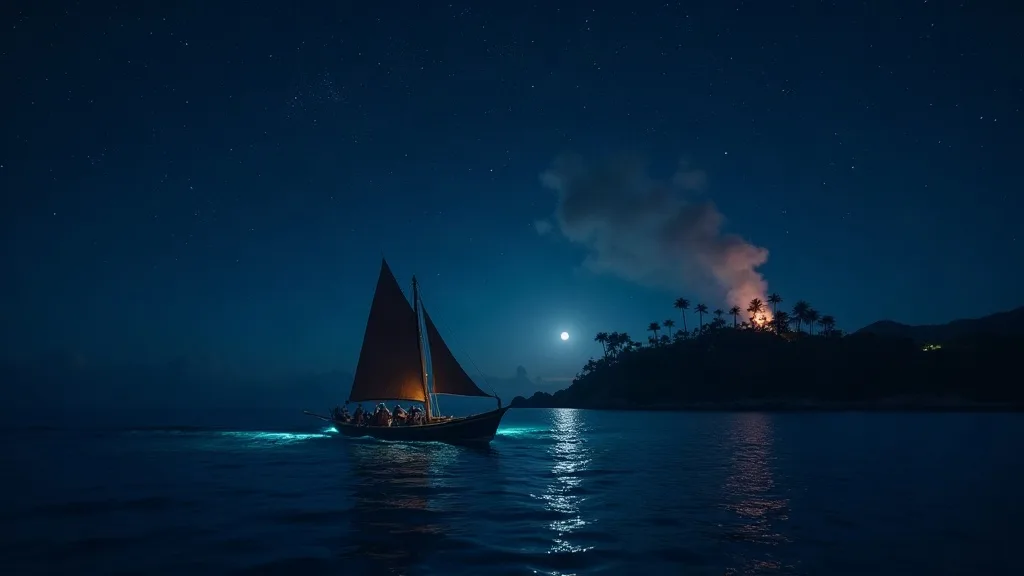
Moana sails out across the screen singing about an ocean that calls to her. That ocean was real. For 2,000 years, Polynesian navigators crossed an expanse of water larger than all the continents combined, finding islands no one else could locate. They navigated by stars, swells, and a knowledge so precise it makes modern science stop and listen. Disney's 2016 film pulls directly from that world: the gods who appear, the ocean itself as a character, the wayfinding at the heart of the story. These are not inventions. They are echoes of a mythology so alive it is still lived.
The film's core journey is rooted in a real historical phenomenon known as the Polynesian expansion or Lapita voyaging era (circa 1500-500 BCE). Polynesian peoples in seafaring outrigger canoes discovered and settled islands across the Pacific in one of humanity's greatest migrations. But Moana takes that history and merges it with the real mythology behind Moana: the gods who guided voyagers, the monsters they feared, the islands they found. To understand what Disney got right, and what it transformed, we need to step into the living myths of the Pacific.
Moana the Ancestor and the Real-World Wayfinders
In the film, Moana is a village chief's daughter who feels called to sail beyond the reef. The character is named after a Polynesian concept, but her story echoes something older: the role of women in maintaining oral tradition and the figure of the wayfinding navigator.
The real Moana (or Moʻokiʻi in Hawaiian) translates loosely to "ocean" or "large area of water." More importantly, the name carries weight across Polynesian cultures: it appears in genealogies (mo'o) and chant cycles that go back centuries. In Samoan, Tokelauan, and Hawaiian traditions, ocean-crossing stories feature both male and female navigators, though Hollywood's gender-flip was deliberate. Moana's role as a chosen leader who must sail mirrors the kapu (taboo) and mana (spiritual power) systems that governed who could lead and who could navigate.
The film's obsession with wayfinding as a lost and rediscovered art reflects a real history. By the time Europeans arrived in the 1700s, traditional Polynesian navigation had been suppressed in many island groups. Only in places like Micronesia (particularly among the Caroline Islands) did the stars-and-swells navigation method, called etak, survive unbroken. In the 1970s-1980s, scholars and Pacific Islander activists led a revival. Master navigator Mau Piailug of Satawal sailed a reconstructed double-hulled canoe, the Hokule'a, proving that ancient Polynesian navigation was real and precise. Moana's central theme, that the ocean spoke to the ancestors and the ancestors could listen, mirrors this very real cultural awakening.
Te Fiti and Te Kā: Goddesses of Creation and Chaos
The heart of Moana's mythology is Te Fiti, the mother island goddess who creates life and abundance, and Te Kā, her destructive mirror self. Disney created these figures, but they are woven from Polynesian theological threads.
In Hawaiian cosmology, Pele is the volcano goddess who embodies creation and destruction simultaneously. She builds and burns, gives and takes away. She appears in the Kumulipo, one of the oldest Hawaiian chants, as a force of natural power residing in the earth. Pele is not evil; she is primal, amoral in the way weather is amoral. She can nurture a fisherman's catch or consume his village. Te Kā channels this energy: a goddess of devastation who, in the film's logic, is wounded and angry rather than simply malignant.
Te Fiti's creation aspect draws from broader Polynesian creation myths. In the Samoan creation story, the primordial deities shaped the islands from the ocean. In Māori tradition, Papatūānuku, the earth mother, was separated from Ranginui (the sky father) by their children so that light could enter the world. These myths tell of feminine creative force bringing form from formlessness. Te Fiti's ability to restore Moana's island reflects this: she is the reversal of entropy, the return to abundance.
The film's most audacious move is making Te Kā and Te Fiti the same being, split by a curse. This echoes the Polynesian concept of mana imbalance: when spiritual power is corrupted or severed, it becomes destructive. Healing requires restoration, not defeat. Moana defeats Te Kā not through warfare but through acknowledgment and love, a narrative beat that feels very close to actual Polynesian conflict-resolution philosophy, which emphasizes ho'oponopono (Hawaiian restoration practice) and communal healing over individual triumph.

Maui the Demigod: The Trickster Reborn
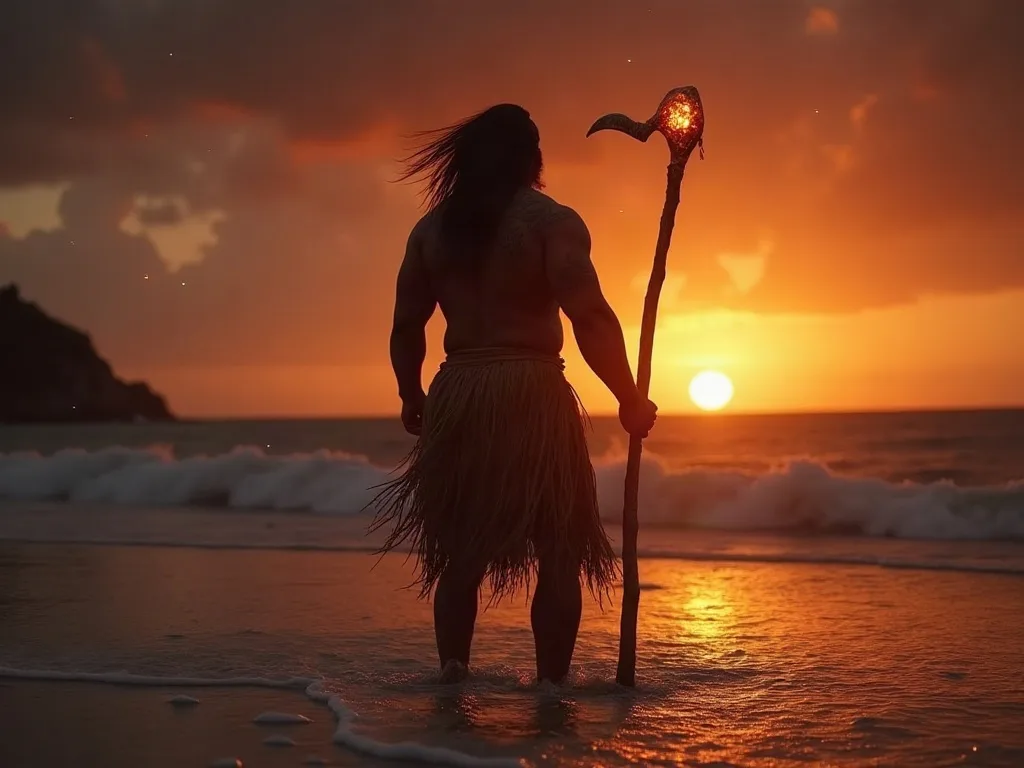
Moana gives us Maui as a barnacle-crusted demigod with a magic fishhook and a treasure-hoarding conscience. This character is the film's most direct lift from real mythology, and he barely needs adaptation because the original source material is already spectacular.
Maui (also spelled Māui in Māori) is a figure who appears across every major Polynesian tradition: Hawaiian, Samoan, Māori, Tongan, and more. He is the archetypal trickster, shape-shifter, and culture hero. In the Māori Kumulipo and broader Polynesian cycle, Maui is born from gods but must prove himself through wit and theft. He slows the sun by catching it in a rope snare so his mother has more daylight to work. He fishes up entire islands using a magical hook and the jaw of his grandmother. He descends to the underworld seeking immortality, only to fail (in most versions, he is killed when a goddess crushes him).
The film's Maui is largely faithful to source material, though with Hollywood softening. His magical fishhook, called Āmanaia or in some stories simply his bone hook, is real. In Polynesian oral tradition, Maui's hook is often the jawbone of an ancestor or a gift from the gods; it is never a simple tool but an object of mana, power. The film's version, given to him by an ocean goddess (a nod to Te Fiti's blessing), preserves this sacred quality.
Maui's narcissism and his redemptive arc through helping Moana also align with source material. He is not a hero in the Western sense; he is selfish, occasionally cowardly, but undeniably powerful and ultimately driven by a buried love for humanity. This moral ambiguity is actually very Polynesian. Unlike European heroes who are often straightforwardly good, Polynesian gods and demigods are complex: they do harmful things for personal gain or mischief, then help communities despite themselves.
One element the film invents: the "Te Fiti curse" that erases Maui from human memory. The original Maui myths do not include this, but it serves the film's emotional purpose and mirrors a real fear in Polynesian communities: that colonialism and cultural suppression would erase their stories. The curse is a metaphor for historical silencing.
Tamatoa the Crab: Greed and the Ocean's Guardians
The scene where Moana meets Tamatoa, a giant coconut crab obsessed with treasure, is pure Disney invention. But the crab's role as a guardian or obstacle figure has roots in Polynesian mythology, where the ocean itself is populated with entities both helpful and dangerous.
In many Polynesian traditions, the deep ocean is not human space. It belongs to gods and creatures with their own laws. Some are protectors; some are tests. In Hawaiian belief, certain creatures like the honu (turtle) or hihimanu (manta ray) can be aumakua, ancestral spirits that guide or protect. Others, like certain octopuses (he'e) or unidentified deep-sea creatures, are unpredictable, neither benevolent nor malicious but simply dangerous to the unwary.
Tamatoa's song, "Shiny," which celebrates his collection of human artifacts, carries an unintended thematic weight. Polynesian mythology is full of warnings about greed and about the seductive danger of foreign objects. The movie plays this for laughs, but in real Polynesian culture, an obsession with possession, especially of things from outside the community, is often a mark of spiritual imbalance. Tamatoa is less a folk figure and more a personification of a cautionary principle: materialism breaks harmony with the ocean.
Te Kā's Lava Transformation and Destruction Myths
Te Kā's role as a volcanic destroyer goddess is perhaps the most culturally resonant figure beyond Maui. She is not borrowed wholesale from one source but synthesized from destruction deities across Polynesian and broader Oceanic mythology.
Pele, again, is the model. In Hawaiian tradition, Pele's fires can be wrathful. When her lover Lohiʻau sleeps with another woman, Pele's jealous rage burns villages. But this is not retribution: Pele is acting according to her nature. She is fire, and fire consumes. The Kumulipo and chants like the Mele o Pele make clear that destruction and creation are not opposites in Polynesian theology; they are phases of the same cosmic cycle.
The film's choice to make Te Kā and Te Fiti the same being, separated by wound and time, inverts traditional volcano mythology slightly. Usually, Pele is one being capable of both states. But it works narratively because it raises the stakes: restoring balance is not about defeating an enemy but about healing a rift. This is deeply Polynesian in its restorative philosophy.
Other destruction figures add texture. In Tongan and some Samoan myths, Tagaloa (the sky god) can send tidal waves or storms to punish or test. In Māori mythology, Rūaumoko is the unborn child in Papatūānuku's womb who causes earthquakes. These myths present destruction as purposeful, linked to cosmic order, not random chaos. Te Kā's fury in the film, once reframed as Te Fiti's pain, channels this philosophy: destruction is the shadow of creation, and acknowledging that shadow can restore balance.
Te Vaka and the Ancestors: The Ghost Fleet
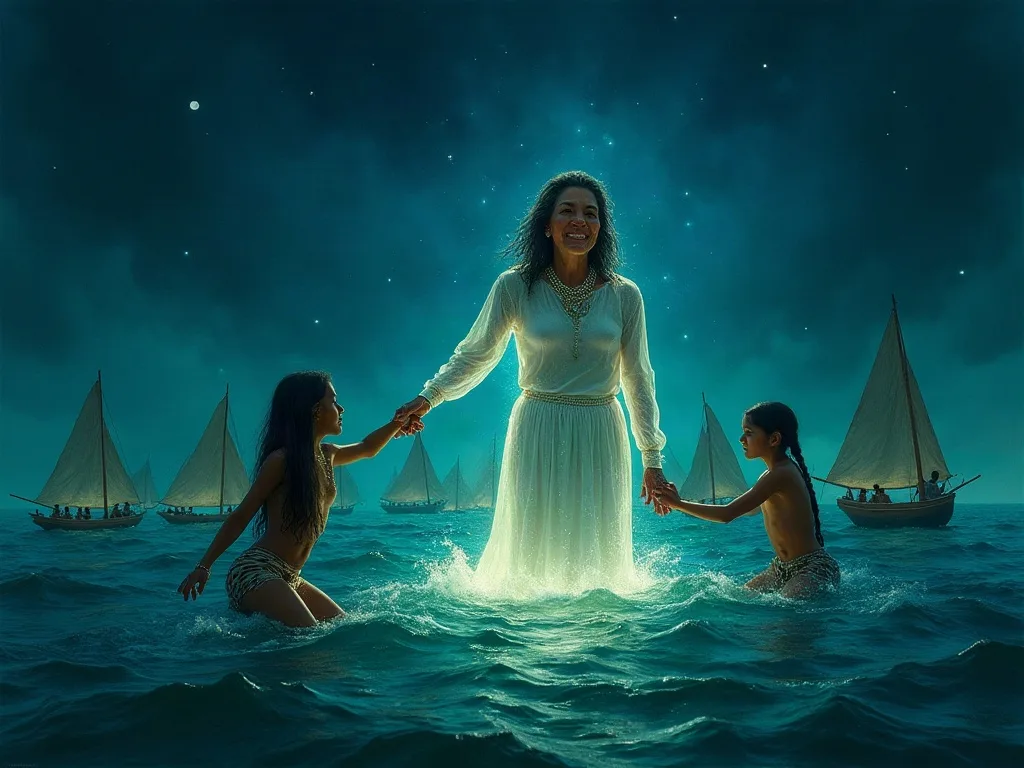
One of Moana's most visually stunning scenes is the arrival of ancestor spirits in their ghost canoes, the te vaka, to guide her toward her destiny. This scene is entirely Disney's invention, but it resonates with a real and profound aspect of Polynesian spirituality.
In Polynesian cultures, the boundary between living and dead is permeable. Ancestors (tupuna in Hawaiian and Samoan, tūpuna in Māori) are not gone; they are present as guardians and guides. This is not ancestor worship in the European sense but a lived relationship. Genealogies (whakapapa in Māori, mo'okūʻauhau in Hawaiian) are recited not as historical facts but as spiritual chains connecting the living to the dead to the gods themselves.
The ghost fleet scene, with ancestors paddling their canoes toward Moana, is Disney's visual expression of this constant spiritual presence. When Moana's grandmother tells her "the ocean chose you," she is invoking kaumaha (spiritual weight or choice in Hawaiian) or a similar concept of mana directing a person's life. The ancestors in their canoes are not rescuing her; they are validating what the ocean (and lineage) has already chosen.
This scene also echoes the real voyaging canoes of the Polynesian expansion. The double-hulled outrigger (vaka in Samoan and Tongan, waka in Māori) was the vessel that carried humans to unknown islands for over 1,000 years. In oral tradition, ancestors who died far from home were believed to sail on spiritual versions of these canoes, returning to guide their descendants. The film gives them material presence, but the theology is authentic.
Coconut Pirates and the Reef: Humor Meets Cultural Truth
The film's coconut pirates, the Kakamora, are invented for comedic effect. But they embody a real anxiety in Polynesian mythology: the unknown invader, the thing that comes from beyond the reef and disrupts order.
The reef itself is a crucial theological boundary in Polynesian thought. Inside the reef is tapu (sacred, protected) space; outside is the open ocean, where different rules apply. The Kakamora represent what happens when that boundary breaks down. They are not malevolent in themselves, just disruptive, which mirrors how many Polynesian myths treat foreign forces: not evil, but fundamentally atea (strange, other).
The coconut design of the Kakamora also echoes the importance of coconut in Polynesian mythology and life. The coconut palm provided food, fiber, and shelter; in chants and genealogies, it appears as a symbol of abundance and survival. Making the invaders coconut-shaped is perhaps a dark joke: the most basic resource turns hostile. It works as comedy while touching on a real cultural anxiety about resources and belonging.
Sina and the Moon: Female Power in Shadow
The film gives Moana's grandmother, who appears as a spirit guiding Moana near the end, an important role. She is not directly named after a mythological figure, but her function echoes the role of female ancestral spirits in Polynesian cosmology.
In Samoan tradition, there is a goddess named Sina who appears in several myths, often as a woman of power and knowledge. In one widespread story, Sina is the mother figure who offers wisdom or intervention at crucial moments. In Hawaiian tradition, Hina (the Hawaiian cognate of Sina) is the goddess of the moon and women's crafts, a figure of wisdom and renewal. She is often depicted as old, wise, and slightly removed from the action, but essentially a source of power and guidance.
Moana's grandmother, while not Sina directly, functions as this archetype: the elderly female figure whose knowledge and spiritual weight ground the younger hero's journey. This is very much in line with real Polynesian social structure, where elder women, especially grandmothers (kupuna wahine in Hawaiian), held significant spiritual and practical authority.
The Real Ocean: Moana's Greatest Achievement
If there is one element of Moana that is most mythologically true, it is the treatment of the ocean as a character, a living presence with intention.
In Polynesian mythology, the ocean is not a backdrop. It is Tawhirimatea in Māori (god of weather and seas), Tangora in Samoan, Kanalo in Hawaiian. These are not abstractions but personalities with will, moods, and the power to grant or withhold passage. When Polynesian wayfinders navigated by reading the ocean's swells, feeling the rhythm of waves, they were in dialogue with the ocean as an intelligent entity. This is not metaphorical in Polynesian epistemology; it is how the world actually works.
The film's choice to make the ocean actively guide Moana, reaching out and pulling her back when she fails, is not a poetic flourish. It is an expression of real Polynesian theology: the ocean is animate, responsive, and capable of choosing. In the Hokule'a voyages of the 1970s and beyond, modern Polynesian navigators speak of the ocean in exactly this way. They say things like "the ocean carried us" or "the swells chose our path." This is not mysticism; it is precision, a different epistemology from Cartesian objectivity.
Moana's central message, that the ocean calls and the ancestors listen, is the closest the film comes to expressing pure Polynesian worldview. The ocean is not conquered or crossed; it is engaged with, respected, negotiated with. You listen to it, and if you are chosen, it opens a path.
Moana in Polynesian Revival and Western Perception
Since its release, Moana has become something unexpected: a global touchstone for Polynesian culture. In communities across the Pacific, the film sparked conversations about wayfinding, language, and pride. But it also raised questions about representation and authenticity.
The most significant achievement of Moana is that it made Polynesian mythology visible to billions of people who had never encountered it before. For many non-Polynesian audiences, the gods, the ocean, the wayfinding were entirely new. This visibility matters because Polynesian culture has been historically marginalized, exoticized, and erased. Disney's film, for all its Westernizations, created space for the real tradition to resurface.
However, the film also reflects a fundamental Western assumption: that ancient myths are material for entertainment and adaptation rather than living belief systems still practiced by millions. The Polynesian gods and practices depicted in Moana are not museum pieces but living practices in Hawaiian, Samoan, Māori, and Tongan communities. When Moana recites genealogies, she channels the actual oli (chants) still used in Hawaiian protocol. When she navigates by stars, she honors the still-living practice of traditional wayfinding taught in programs across the Pacific.
The film's release coincided with a cultural moment in which Polynesian communities were reasserting their languages, their spiritual practices, and their intellectual sovereignty. Schools in Hawaii, for instance, were expanding Hawaiian-language immersion programs and ocean-voyaging curricula at the same time Moana was playing in theaters. The film did not create this movement, but it amplified it, giving it global visibility.
Storytelling Traditions and the Oral Canon
One final element worth noting: Moana's very structure echoes Polynesian narrative traditions.
Polynesian myths were preserved through oral recitation, often in verse or chant form. The oli or mele (chants) use rhythm, repetition, and formulaic language to ensure accurate transmission across generations. They embed genealogies, landscape descriptions, and spiritual teachings in poetic form. A master chanter (kaumakua or kahu oli) could recite a genealogy that took hours and traced a person's line back dozens of generations.
Moana, structured as a hero's journey punctuated by songs that advance plot and reveal character, mirrors this oral storytelling architecture. The songs are not merely entertainment; they are how culture is transmitted. Lin-Manuel Miranda's "How Far I'll Go" functions like an oli: it establishes Moana's spiritual identity and her mana, her personal power. "We Know the Way" is explicitly described in the film as an ancestral chant, performed by a deep male chorus that echoes the sound of traditional Polynesian canoe chants.
This is not accidental. The filmmakers consulted with Polynesian cultural advisors, and those advisors insisted that the emotional and narrative weight be carried partly through music and chant. The result is a film that, beneath its Disney gloss, respects the actual mechanism through which Polynesian mythology was preserved and is still practiced.
Frequently Asked Questions About The Real Mythology Behind Moana
Frequently asked questions
Is Moana based on a real Polynesian myth?
Not a single myth, but rather a synthesis of multiple Polynesian traditions woven together with invented elements. Maui is a real demigod who appears across Hawaiian, Samoan, Māori, and other Pacific cultures. Te Fiti and Te Kā are Disney creations, but they draw theology from Hawaiian volcano goddess Pele and broader Polynesian creation mythology. The wayfinding and canoe-voyaging core is historically real, reflecting the actual Polynesian expansion (1500-500 BCE) when navigators crossed thousands of miles of ocean using stars, swells, and celestial knowledge.
What is the real Maui myth?
Maui appears in Polynesian mythology across dozens of stories. The most famous: he fished up islands using a magical hook (often made from his grandmother's jawbone) and a rope; he slowed the sun by catching it in a snare to give his mother more daylight; he traveled to the underworld seeking immortality but was crushed by a goddess and died. He is a trickster culture-hero, selfish but ultimately beneficial to humanity. The historical Maui myths are far older than Moana (from oral traditions predating European contact) and exist in multiple versions across Hawaii, Samoa, Māori New Zealand, Tonga, and other islands.
Did Polynesian wayfinders really navigate by the stars and ocean swells?
Yes, absolutely. The Polynesian expansion across the Pacific was accomplished using sophisticated navigation techniques including star position, wave and swell patterns (a method called etak in Micronesia), bird behavior, and ocean currents. This knowledge was suppressed during the colonial period but was proven real and still-accurate in the 1970s when master navigator Mau Piailug of Satawal sailed a reconstructed double-hulled canoe, the Hokule'a, without modern instruments across thousands of miles. This navigator revival is still ongoing in Pacific Island communities, and the Hokule'a continues to sail.
Who is Te Fiti, and is she based on a real goddess?
Te Fiti is an original Disney creation, but her attributes draw from real Polynesian goddesses of creation and the earth. She most closely echoes Pele, the Hawaiian volcano goddess who appears in the Kumulipo and other Hawaiian chants, and Papatūānuku, the Māori earth mother. These real goddesses embody both creation and destruction; they are primal forces, neither purely good nor evil. Te Fiti's role as a creator who can also destroy, and who must be healed rather than defeated, reflects actual Polynesian theology where destruction and creation are linked phases of cosmic renewal.
What does the ocean represent in Moana mythology?
In Polynesian belief, the ocean is not a geographic obstacle but a living, intelligent entity with volition. In Hawaiian tradition, it is Kanalo; in Samoan, Tangora; in Māori, Tawhirimatea (also a storm god). The ocean chooses who can navigate it, sustains voyagers, and punishes the disrespectful. When Moana says the ocean chose her, she is invoking real Polynesian philosophy: you do not conquer or merely cross the ocean; you engage with it respectfully and listen for its guidance. Modern Polynesian navigators still speak of the ocean in these terms, describing voyages as collaborations with ocean, swells, and stars.
The Shadow of Colonialism and Cultural Resurrection
What Moana achieves, perhaps unintentionally, is a reflection of Polynesian culture's resilience through a story about restoration and memory.
For nearly 200 years, Polynesian traditions were actively suppressed. Languages were forbidden in schools. Voyaging was dismissed as impossible. Gods were declared false. Genealogies were erased from official record. By the late 20th century, many Polynesian communities were in genuine danger of losing their languages and spiritual practices. The Polynesian cultural renaissance of the 1970s onward, which included the Hokule'a voyages and language revitalization programs, was an act of deliberate recovery.
Moana, arriving in 2016, came during this resurrection. The film's plot, in which an ancient practice (wayfinding) is recovered and the spiritual connection to ancestors is restored, parallels what Polynesian communities were actively doing in real time. The film does not create this parallel; it reflects it. When Moana remembers her people were voyagers and chooses to sail, she enacts a cultural narrative that resonates because it is, literally, what real communities were doing: remembering who they were and reclaiming that identity.
The gods in Moana, from this angle, are not exotic entertainment. They are touchstones for a living spirituality that survived colonialism and is being actively practiced and taught across the Pacific. When a Hawaiian child watching the film hears their own language, recognizes their own gods, and feels their own ancestry validated on screen, Moana becomes something more than a fairy tale. It becomes a mirror of cultural continuity and pride.
This is also why criticism that Moana is inauthentic or appropriative, while understandable, misses something important. The film is a Western commercial product with real limitations and compromises. But it is also a moment when billions of people encountered Polynesian mythology with genuine respect, and when Polynesian voices (the film's cultural advisors, many of whom were descendants of the traditions being portrayed) had some say in how their gods were rendered. It is not perfect, but it is perhaps a model for how popular culture can engage with living traditions without flattening or diminishing them.
The story Moana tells about a young person who listens to her inner voice, honors her ancestors, and sails into the unknown is not uniquely Polynesian. But the way Moana tells it, through ocean-voyaging, through ancestor connection, through restoration rather than conquest, gives the universal human story a specifically Polynesian inflection. That inflection, live and breathing in Polynesian communities today, is the real mythology behind the film.
Free 25-page sample
Want the whole story?
Take the first 25 pages free. If it pulls you in, the full edition is yours as an instant PDF download, with a paperback on Amazon for selected titles.

Mythology
The World Mythology Book: The Gods, Heroes and Myths of Every Culture
The Gods, Heroes and Myths of Every Culture, in One Volume
The whole of world mythology in a single volume: Greek, Norse, Egyptian, Japanese, Hindu, Celtic, Slavic, Mesoamerican and African myths gathered side by side, each drawn from the primary sources.