
Momotaro the Peach Boy: The Folk Hero Who Bridges Kami and Yokai
Momotaro emerges from a magical peach to fight demons and find his place between worlds. This beloved folk hero embodies the tension between order and chaos at the heart of Japanese spirituality.
Contents
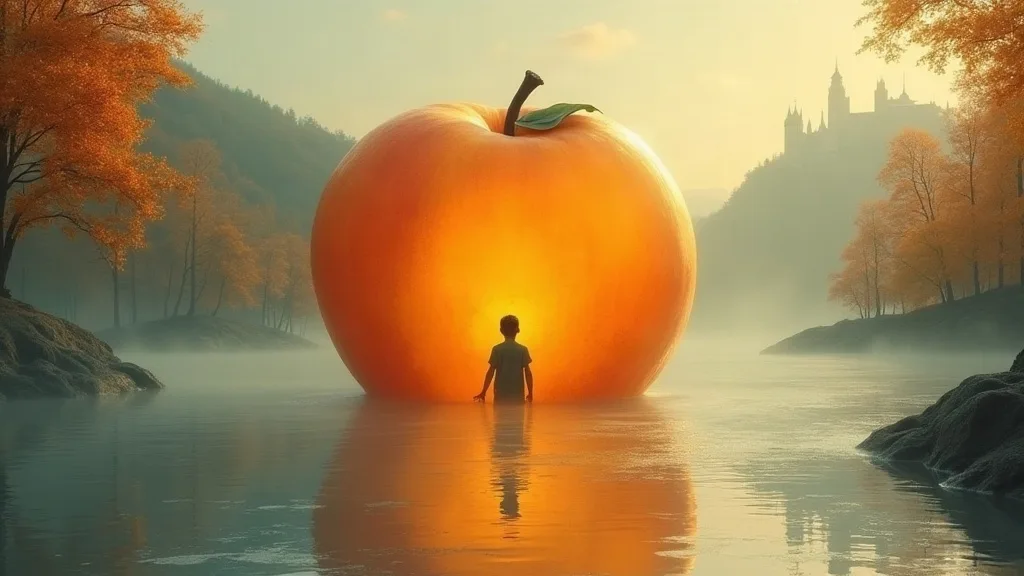
A peach splits open in a river. Inside, a boy. No parents. No birth. Just a child born whole from fruit, ready to march into legend.
Momotaro the peach boy stands at a crossroads in Japanese myth where the sacred and the monstrous collide. He is not a god in the Shinto pantheon (the kami), nor is he a supernatural creature born from chaos (a yokai). He is something stranger: a human who understood both worlds and walked between them with purpose. His story, recorded in folk traditions but never officially canonized, has shaped Japanese thought about heroism, duty, and the boundary between civilization and the wild for over a thousand years.
The tale survives in hundreds of regional variants, oral retellings, picture scrolls from the Edo period, and modern anime. Each version shifts the moral weight slightly. But the core remains: a boy born of impossible circumstance must confront the demons that threaten human order, and in doing so, discover what it means to belong to neither world fully but to serve both.
The Birth from the Peach: Origins in Oral Tradition
The peach itself holds deep meaning in East Asian lore. In Chinese mythology, it represents immortality. The Queen Mother of the West guards a peach garden where gods eat fruit to live forever. The peach appears also in Daoist alchemy as a symbol of completeness and renewal. Japanese folklore absorbed these echoes but transformed them.
The story of Momotaro first appears in reliable written form during the Edo period (1603-1868), recorded in collections like the Otogizoshi (wonder tales). Yet scholars argue the oral roots run deeper, possibly to medieval Shinto temple narratives. A priestess might have chanted the tale to explain why a particular shrine held power over demons. A grandmother told it to children at winter fires to illustrate courage.
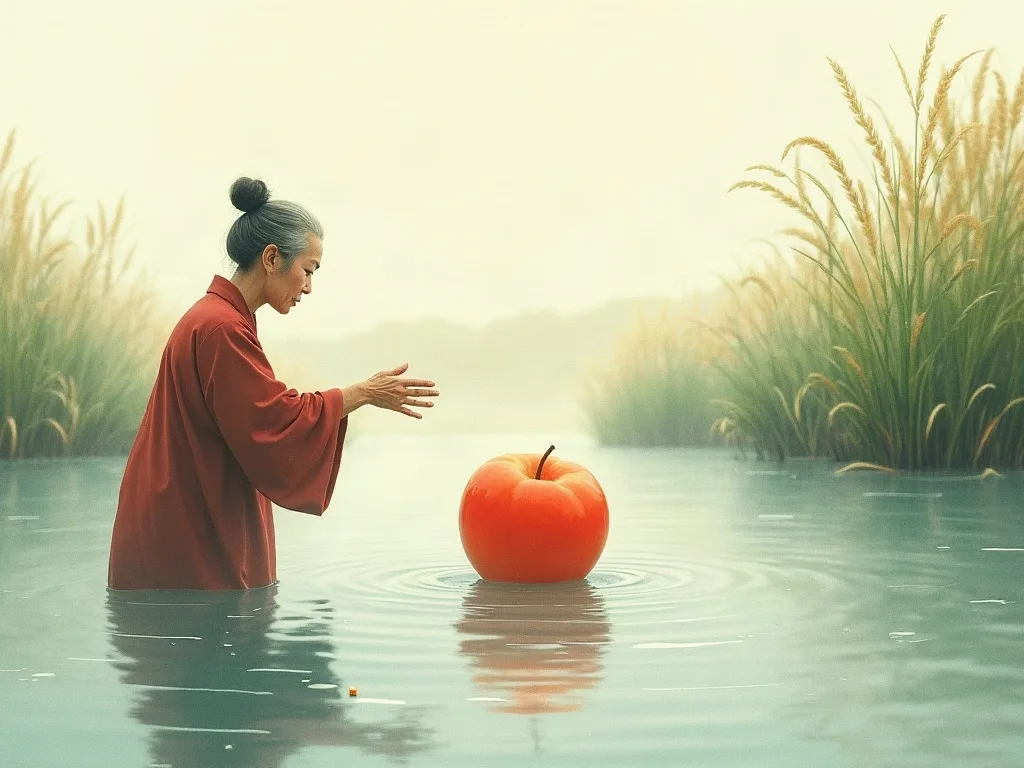
The opening unfolds with ritualistic simplicity. An old woman washes clothes in a river when a giant peach drifts toward her. Too large to be natural. Too perfect to ignore. She takes it home. When she and her husband cut it open, they find no pit, no flesh: only a healthy, fully formed boy. He speaks immediately, calling them mother and father. They weep. They name him Momotaro, which means simply "peach boy" or "peach son."
This birth bypasses all biological process. No nine months of pregnancy. No pain of labor. The peach is both womb and gift, arriving exactly when the old couple prayed for a child. In Shinto logic, this is not miraculous violation of nature but the kami answering directly. The peach becomes a vessel for divine will. The river becomes the road between the seen and unseen worlds, and Momotaro emerges as a being shaped by both.
Some versions add a detail: the couple finds the peach on the boy's day of birth. It is not coincidence but the kami's timing. Other tellings describe the boy as notably strong and quick to grow, maturing in months what would take years. He is marked from the start as other than ordinary.
Growing into Purpose: The Call to Adventure
Momotaro becomes the perfect son. Strong. Obedient. Wise beyond his years. He tends his parents' small holding, helps in the village, learns the way of humans without ever fully being one. Years pass. The boy becomes a young man.
Then, reports arrive: demons plague the land. Oni, they are called, the chaotic spirits or ogres that embody everything civilization rejects. These are not minor supernatural nuisances. The oni have grown bold. They raid villages, steal harvests, kidnap people. The local authorities cannot stop them. The kami shrines offer prayers. Nothing shifts.
Momotaro listens to these stories and feels a pull he cannot name. He knows, somehow, that this is why he was born. Not to tend fields forever, but to stand against the chaos that the kami themselves struggle to contain. He approaches his parents and tells them: he will go to Demon Island (Onigashima) and end the threat.
The parents resist. He is their only child, born of impossible grace. To lose him is to lose everything they prayed for. But they also recognize what he is: not fully theirs, but the world's. They release him.
Before he leaves, his mother gives him kibidango, small balls of millet and honey. These sweet dumplings are simple peasant food, yet in the story they become tokens of something deeper: the bonds of human domesticity, the mother's blessing, the flavor of home that even a peach-boy carries with him into the wild.
The Gathering of Companions: Humanity Among the Inhuman
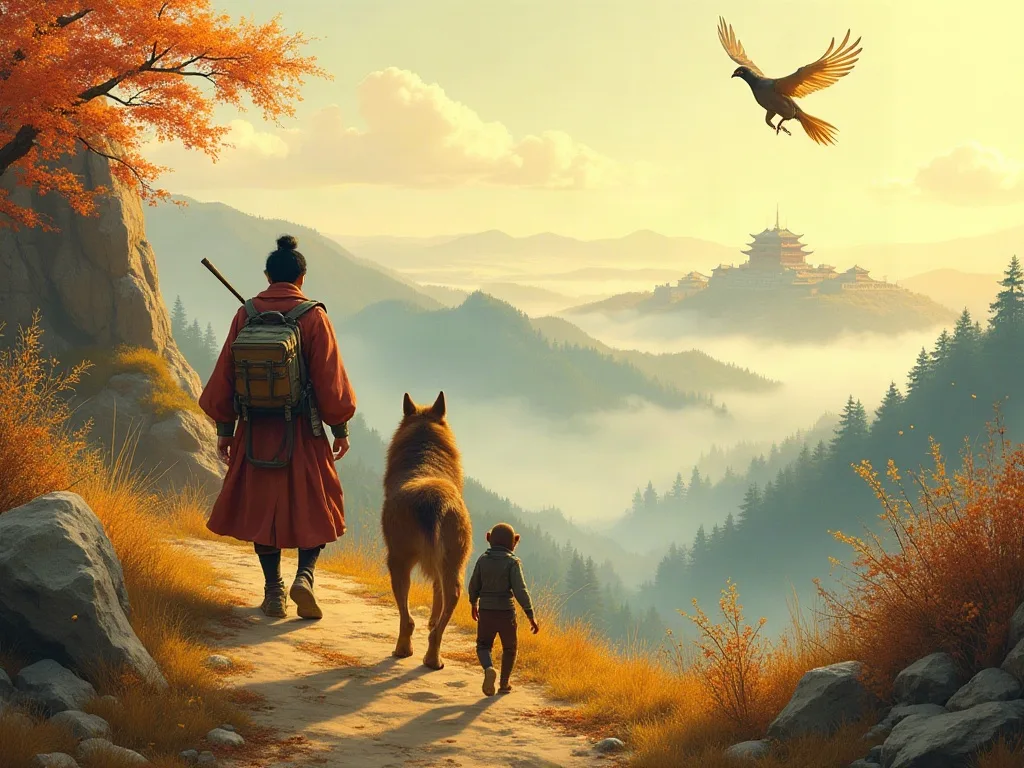
Momotaro walks alone toward Demon Island. On the road, he encounters animals. The first is a dog. The second, a monkey. The third, a pheasant. In some versions, these are merely animals. In others, they are kami in animal form, spirits testing his worthiness. In still others, they are yōjin, creatures of the borderland with enough consciousness to speak and reason.
Each animal smells the kibidango and approaches. Momotaro does not turn them away. Instead, he offers a dumpling and makes a compact: help me fight the oni, and you will eat well.
The three accept. They become his retinue. The dog brings strength and loyalty. The monkey brings cleverness and agility. The pheasant brings speed and aerial advantage. More significantly, they represent humanity extending its bonds outward. Momotaro does not conquer through isolation or superhuman power; he builds alliance across species, drawing even the animal world into the cause of human order.
This detail sits uneasily with some scholars. In classical Japanese thought, animals are mononoke or kichiku, creatures of lesser spiritual status. That a human hero would depend on them, trust them, and treat them as equals, suggests a story shaped by common folk rather than aristocratic courts. It is a peasant's logic: you work with what you have. You respect the creature who fights beside you.
The journey itself tests the group. They cross mountain passes. They endure hunger. The pheasant scouts ahead. The monkey handles the terrain. The dog's senses alert them to danger. Momotaro is no longer the individual hero; he is the center of a distributed band, strong because multiple.
The Confrontation at Demon Island: Order Against Chaos
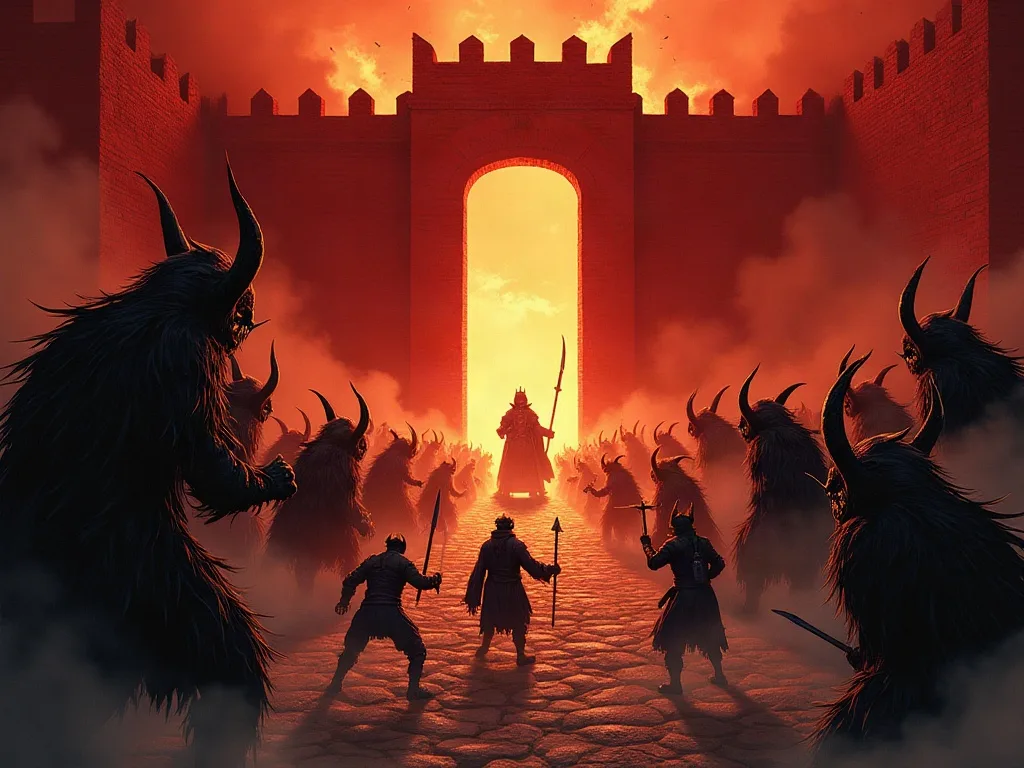
Demon Island appears as a fortress. The oni lair is described in classical texts as a structure of both Japanese and foreign design, a hybrid realm. In the Ōta Dōkan scroll paintings from the late 15th century, it appears as a castle with red walls, decorated with demon horns and trophies. Other illustrations show a cave. Some texts place it across the sea; others put it in a mountain interior. The geography is intentionally unstable because Demon Island exists partially outside normal space, in the liminal zone where kami and yōkai dwell.
The battle is brief in most tellings. Momotaro and his companions breach the walls. The oni within resist, but they are not invincible. The leader, the Demon King (the oni no taishō or Daimyo) faces Momotaro directly. There are accounts of combat, but the tone varies. Some versions make it a genuine duel. Others suggest the Demon King, seeing Momotaro backed by three loyal creatures, recognizes a force of order too coherent to resist and surrenders rather than die.
In the most psychologically subtle renderings, the Demon King capitulates because he sees in Momotaro something he lacks: the ability to bind different natures into a unified will. The oni are powerful but chaotic. They raid because they have no purpose beyond appetite. Momotaro has gathered order around a clear goal. This difference is the true victory.
The oni are not destroyed but subdued. Some versions say they are imprisoned. Others claim they are reformed, brought into human service or relocated to the fringes of the human world where they can do less harm. The tension here is real and unresolved in the folk tradition: can chaos be eliminated, or only managed? The answers vary by region and era, reflecting local anxieties about what lies beyond the rice field or the village boundary.
The Return and the Reckoning: Homecoming and Displacement
Momotaro returns laden with the treasure he seized from the demon lair: gold, jewels, sacred objects. He presents gifts to his companions. The dog receives honors. The monkey is praised. The pheasant is celebrated. He returns to his aged parents, who weep with joy. He gives them the wealth. He provides for their final years in comfort.
Yet something is broken. Momotaro is no longer the perfect son who tends the fields. He has crossed into the realm of the kami and yōkai. He has killed, or at least imprisoned, demons that most humans dare not even name. He belongs now to legend as much as to his village. Some tellings suggest he withdraws, taking a wife and raising children who inherit both his humanity and his extraordinary nature. Others imply he departs again, unable to live fully in the human world after knowing what lies beyond it.
This ambiguous ending is not a flaw in the narrative but its deepest truth. Momotaro solves the problem but cannot undo the crossing. He stands at the boundary between the ordinary and the mythic, never fully at rest on either side.
Kami, Yokai, and the Borders of Japanese Spirituality
To understand why Momotaro matters beyond children's literature, we must grasp the two concepts that frame his world: kami and yōkai.
The kami are the spirits of Shinto. They inhabit natural places: mountains, rivers, trees, stones. They are not gods in the Christian sense; they are presences that animate the world and respond to human respect and ritual. The great kami are named and worshipped at specific shrines. Amaterasu, the sun goddess, resides in Ise Shrine. Susanoo, the storm god, was honored throughout Japan. But countless lesser kami dwell everywhere, and humans interact with them through small offerings and awareness. The Kojiki (712 CE), Japan's oldest written mythology text, describes how the first kami emerged from primordial chaos and shaped the islands.
The yōkai are different. They are spirits of ambiguity, often arising from the long accumulation of history in a place. A tree that grows in a graveyard for two hundred years may become a yōkai. A samurai who dies with deep regret may haunt a bridge as a yōkai. Unlike kami, which respond to proper worship and remain stable, yōkai are unpredictable, sometimes helpful, sometimes destructive. They inhabit the margins: old temples, deep forests, the space between sleep and waking.
Momotaro was born not in a shrine but in a river, not from a prayer answered by an existing kami but from a peach. The peach could be read as a kami gift, but it is strange enough that some interpret it as partly yōkai-like, a being of liminality. When Momotaro confronts the oni, he is fighting creatures that embody yōkai chaos, the force that Shinto hierarchy seeks to contain.
The oni themselves are worth understanding. In classical Shinto cosmology, the oni are not demons in the Christian sense, nor are they purely evil. They are beings born of excess energy, of human desire that breaks containment, of natural forces that refuse the order imposed by ritual. To be oni is to be on the wrong side of the boundary that civilization draws. But the boundary itself is unstable. An oni can be reformed. A human can become an oni if he transgresses far enough. The oni in some tales are not intrinsically malevolent but simply yuugi, wild and lawless.
Momotaro's victory is therefore not a triumph of good over evil in a dualistic sense. It is the reassertion of the human world's boundaries against the pressure of the non-human. The fact that he accomplishes this through alliance with animals and through the power of human food (kibidango) suggests that the boundary is not impermeable but permeable, negotiable, held together by relationship rather than force.
Momotaro in Edo Visual Culture and Religious Narrative
During the Edo period (1603-1868), when Japan's cities grew and literacy spread, Momotaro became a subject of intense artistic interest. Picture scrolls (emakimono) and woodblock prints depicted every stage of the story. The Otogizoshi collections printed the tale in both full and abbreviated forms. Publishers realized that Momotaro sold: the story was familiar, the moral clear enough for families but rich enough to sustain aesthetic interest.
What is striking in these visual retellings is how often the demons are sympathetic. In some Edo prints, the Demon King looks more resigned than evil, a ruler defending his territory against invasion. The oni soldiers appear almost comical, their musculature exaggerated into caricature. This tonal shift is important: by the Edo period, Japan was unified and stable. The threat of actual demons was no longer immediate. Momotaro could be read not as a hero banishing genuine evil but as a story about the inevitable clash between order and whatever resists order. The sympathy extended to the oni reveals that Edo audiences understood the complexity.
Temples and shrines also adopted Momotaro narratives, seeing in him a reflection of their own role: maintaining boundaries, protecting communities from spiritual chaos. Some shrines claimed that local heroes or founders had been inspired by Momotaro, or that his story explained the shrine's origins. In this way, folk narrative fed back into religious practice. A story told at winter fires became part of priestly interpretation.
Momotaro and Yokai Ecology: The Broader Constellation
To fully grasp Momotaro, one must understand the broader ecology of Japanese yokai, the realm of spirits and creatures that populate Japanese folklore. The yokai are not organized in a hierarchy. They are a distributed network of beings that emerged from specific places, specific events, or specific emotional accumulations.
Some famous yokai include:
- Kitsune (fox spirits) that disguise themselves as humans and seduce or mislead travellers
- Tanuki (raccoon dogs) that shape-shift and play pranks but often help humans who show them respect
- Rokurokubi (creatures with elongating necks) that feed on human despair
- Yuki-onna (snow women) beautiful and deadly, embodying the cold beauty of winter
- Kappa (water sprites) that drown people but can be bargained with and sometimes become allies
Each yokai occupies an ecological niche. The kitsune thrives on the edges of civilization, in forests near villages. The kappa claims rivers and pools. The yuki-onna inhabits mountains during winter. The tanuki prefers groves and old temples. Together, these creatures map the landscape of Japan's natural world as perceived by the folk imagination. They are not descriptions of actual animals but expressions of what those places feel like, what they might do to a human who enters unprepared.
Momotaro moves through this ecology. He encounters kitsune-like animals that might be yokai or kami or merely themselves. He travels through kappa-haunted rivers without incident (his companions guide him safely). He breaches the territory of the oni, which is the most chaotic and liminal of all yokai realms. His triumph is possible partly because he understands the rules of yokai engagement: respect, exchange, clear intention. He does not burn the shrine or desecrate the sacred. He offers food. He accepts the aid of non-human allies. He honors the boundary he crosses.
Kami
Kami are spirits of Shinto, responding to proper ritual and worship. They are relatively stable, dwelling in specific sacred places (shrines, mountains, rivers). They are hierarchically organized, with great kami like Amaterasu at the top. They are not inherently good or evil but represent natural forces and human values. When treated with respect, they protect and bless.
Yokai
Yokai are creatures of ambiguity and liminality, often born from accumulated human emotion or long-dwelling in a place. They are unpredictable and multiple, with no central organization. They can be helpful or harmful depending on circumstance and how they are approached. They dwell in margins: old buildings, forests, the spaces between sleep and waking. They resist easy classification.
The Modern Afterlife: Anime, Animation, and Spiritual Echo
In contemporary Japan, Momotaro is inescapable. He appears in anime, manga, children's books, festival floats, and video games. Studio Ghibli has drawn from his archetype in films like "Princess Mononoke," which features a young woman navigating between human and animal/spirit worlds much as Momotaro does. The peach itself has become a Japanese cultural icon, associated with softness, sweetness, and innocent strength.
The 2010 anime "Momotaro Instant" depicted him as a modern urban hero, a theme that recurs in Japanese pop culture: the ordinary person (or person born of extraordinary circumstance) who must confront hidden supernatural realities. The story's template is powerful enough to contain multiple interpretations. In some retellings, Momotaro is a soldier protecting the nation (this reading was especially common during wartime). In others, he is an environmental hero defending nature against exploitation. In still others, he is a child's coming-of-age, the moment when innocence encounters responsibility.
What connects all these readings is the fundamental narrative: a being born outside normal human process must cross a boundary between worlds and return transformed but not destroyed. This template resonates because it mirrors the actual Japanese experience of modernity, a nation that repeatedly finds itself between tradition and innovation, Japanese and foreign, kami-world and material world.
Unresolved Tensions: What Momotaro Leaves Open
The story of Momotaro does not fully resolve what it raises. Several tensions remain deliberately unresolved in the folk tradition:
First, the question of whether Momotaro is human or kami or something else entirely. His peach-birth suggests divine intervention, yet he lives as a human, feels hunger, respects his parents. He is not a god but something that the system of kami and yokai cannot quite accommodate.
Second, the question of whether chaos can be eliminated or only managed. The demon island is subdued, not destroyed. The oni are imprisoned or reformed but not annihilated. Some versions suggest that Momotaro himself, having crossed into the demon realm, becomes partly demonized by the experience. He can never fully return.
Third, the moral status of the boundary he defends. Is the human world objectively good, or does Momotaro simply defend it because it is his world? Some versions hint that the oni were not entirely wrong, that the human world's order comes at a cost, that Momotaro is not a pure hero but a partisan in an eternal struggle.
These unresolved tensions are part of what makes Momotaro endure. A myth that answered all its own questions would calcify. Momotaro survives because each generation can read into it the tensions of their own time.
Frequently asked questions about Momotaro the peach boy
Frequently asked questions
What is the real origin of the Momotaro story?
Momotaro likely originated in folk oral traditions during Japan's medieval or early Edo period, though no single "original" source exists. The story first appears reliably in written form in the Otogizoshi collections (Edo period, 1603-1868). Regional variants circulated before and after, each adapted to local shrines or spiritual concerns. The peach-birth motif may reflect Chinese influence (where peaches symbolize immortality), but the demon-slaying structure is distinctly Japanese, echoing Shinto purification narratives found in the Kojiki.
Are Momotaro's animal companions yokai or ordinary animals?
This varies by telling. In some versions, they are ordinary animals who develop human speech and loyalty through the bond with Momotaro. In others, they are yokai or kami in animal form, testing Momotaro's worthiness. Some scholars read them as the personification of human virtues (the dog as loyalty, the monkey as cunning, the pheasant as swiftness). The deliberate ambiguity is intentional; it allows the story to work on multiple levels and reflect regional theology.
What are yokai, and how do they differ from the kami?
Kami are Shinto spirits that inhabit natural places and respond to ritual worship; they form a relatively stable hierarchy with named deities like Amaterasu at the top. Yokai are creatures of ambiguity born from human emotion or long dwelling in a place; they are unpredictable, often mischievous or dangerous, and dwell in marginal spaces like old temples or deep forests. Momotaro's story sits at the boundary between these two categories, with the oni representing the chaotic yokai force that human order (embodied by kami shrines and village communities) must contain.
Why does Momotaro's mother give him kibidango before his journey?
The kibidango are millet and honey dumplings, simple peasant food that represents human domesticity and maternal love. They function as both practical nourishment and spiritual talisman. In the story, Momotaro uses them to form bonds with his animal companions, extending the domestic sphere (the mother's blessing, the home's bonds) outward into the wild. This reflects a distinctly Japanese understanding of civilization: not as walls against nature but as relationships of respect that can extend even to animals and spirits.
Is Momotaro considered a deity or hero in Japanese religion today?
Momotaro is not formally enshrined as a deity in major Shinto shrines, but he is a cultural folk hero whose narrative has deeply influenced Japanese spirituality. Some smaller temples or regional shrines incorporate him into their origin myths or protective narratives. He is more significant in literature, visual art, and popular culture than in formal worship, but his enduring presence in Japanese storytelling suggests he occupies a quasi-sacred status in the collective imagination.
How has Momotaro been interpreted during different eras of Japanese history?
In medieval times, Momotaro may have been tied to specific shrine narratives about protecting communities from spiritual chaos. During the Edo period, he became a popular literary and artistic subject, often sympathetically depicting the demons as well as the hero. In wartime Japan, he was sometimes read as a nationalist hero defending his nation. In modern times, he appears in anime and manga as a template for navigating between worlds, often adapted to contemporary anxieties about tradition versus modernity. Each era reads into him the tensions of its own time.
The Peach-Boy as Mirror: What Momotaro Reveals About Japanese Spirituality
Momotaro's endurance across thirteen centuries of Japanese culture reveals something essential about how Japanese spirituality thinks about boundary and belonging. In Western traditions, the hero is often born of known parents, inherits a kingdom or a quest, and proves himself through trials that affirm his rightful place in the world. His journey is homecoming.
Momotaro inverts this. He has no biological parents. He is born fully formed from fruit, a gift from forces outside the human family. His quest is not to reclaim inheritance but to understand what he is and where he fits. When he returns victorious, he does not settle into the comfortable life he might have claimed. Instead, he stands at a threshold, transformed by crossing, no longer fully at ease in either world.
This pattern reflects something deep in Japanese thought, visible in the literature of Murasaki Shikibu (author of "The Tale of Genji") and in Buddhist philosophy adopted into Japanese culture. Identity is not fixed at birth. The person is always becoming. Relationships create reality; isolation destroys it. The boundary between self and other, human and animal, kami and yokai, is permeable and negotiable, held in place by attention and respect rather than by nature or law.
Momotaro walks that boundary his entire story. He is the template for how to do it with grace: with loyalty to those who raised you, with respect for the creatures you encounter, with clear purpose tempered by humility about what you do not understand. The demons he fights are not evil abstractions but beings whose chaotic energy genuinely threatens human order. Yet his victory does not erase them or transform him into something purely human. He becomes the guardian of the threshold itself.
This reading places Momotaro not as a simple children's tale but as a profound meditation on Japanese spirituality's central insight: that civilization and chaos, kami and yokai, human and animal, are not opposites but partners in an eternal dance. The art is in dancing well, in knowing when to bow and when to stand firm, in offering kibidango to the creatures you meet and expecting them to become your allies.
The peach will split open again in another river. Another impossible child will be born. The story will be told to new generations, and each will hear in it the tensions of their own time. This is how myths live: not by answering all questions but by remaining open enough to let each generation find itself reflected in the eternal pattern.
Free 25-page sample
Want the whole story?
Take the first 25 pages free. If it pulls you in, the full edition is yours as an instant PDF download, with a paperback on Amazon for selected titles.

Mythology
The World Mythology Book: The Gods, Heroes and Myths of Every Culture
The Gods, Heroes and Myths of Every Culture, in One Volume
The whole of world mythology in a single volume: Greek, Norse, Egyptian, Japanese, Hindu, Celtic, Slavic, Mesoamerican and African myths gathered side by side, each drawn from the primary sources.