
Mummification Process and Rituals: Egypt's Sacred Art of Preserving the Dead
Discover how ancient Egyptians transformed death into eternity through mummification: the sacred rituals, divine protectors, and 70-day preservation process that promised resurrection in the afterlife.
Contents
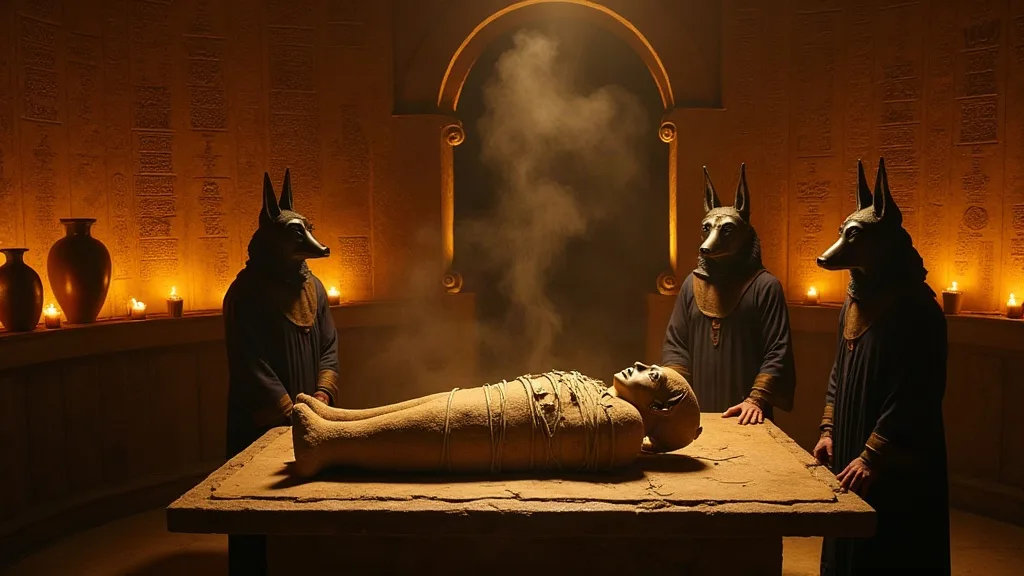
A body lies in darkness. Priests move in measured silence, chanting the names of gods. Natron salt fills the eye sockets, the mouth, every hollow space. Over seventy days, this corpse becomes something else: a vessel for the soul's journey into the Duat, the Egyptian underworld. This is not mere burial custom. This is resurrection technology, drawn from the myth of Osiris and enacted thousands of times across three thousand years.
The mummification process and rituals were Egypt's answer to mortality itself. Death was not an end but a threshold. To pass it safely, the body had to be preserved, the name had to be spoken, the proper spells had to be recited. Pharaoh and commoner alike trusted that flesh kept intact would house the soul forever. The practice reveals something profound about how Egyptians saw existence: not linear, not final, but cyclical and negotiable if you knew the right words and made the right offerings.
The Mythology Behind Mummification: Osiris and the First Mummy
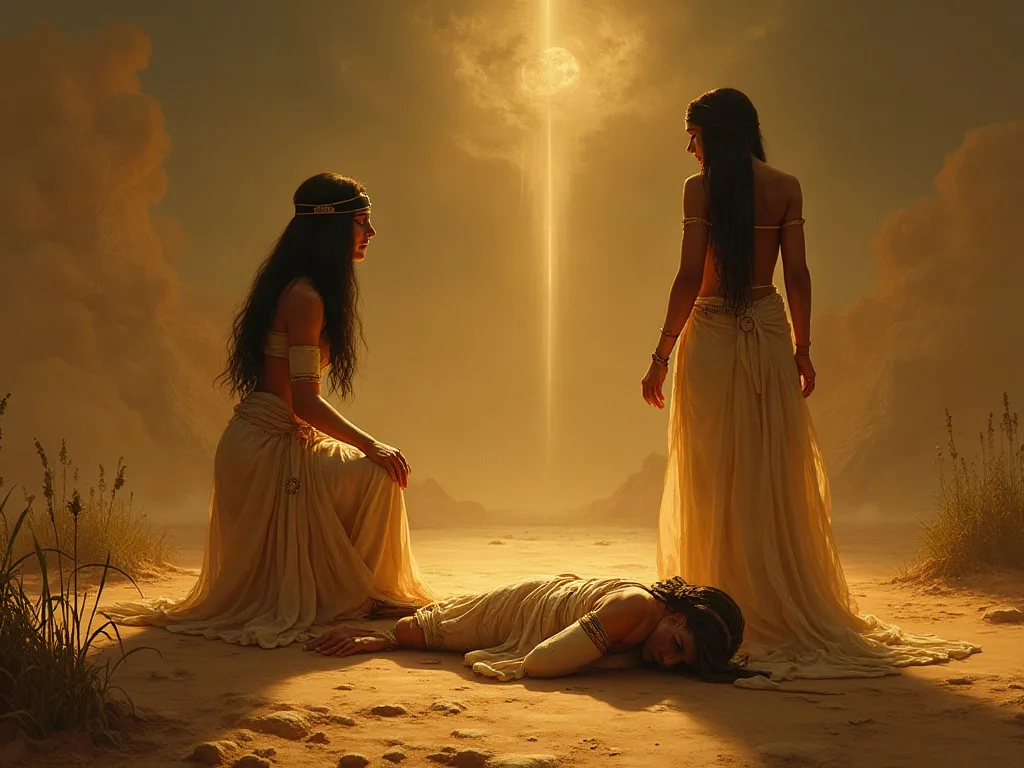
The story begins with death and treachery. Osiris, the green-skinned god of the Nile's flooding, grain, and resurrection, ruled Egypt justly alongside his wife Isis. His brother Set, jealous and brutal, murdered him in a fit of rage. The god's dismembered body was scattered across the landscape. Isis, desperate and devoted, searched the marshes and riverbanks, finding each piece with magical cunning. She and her sister Nephthys reassembled Osiris limb by limb and, crucially, they bound his body in linen wrappings. Using spells and sheer will, Isis restored him to wholeness and brought him back to consciousness, if not to life in the mortal world.
This myth, recorded in texts like the Pyramid Texts (funerary inscriptions carved into pyramid chambers around 2400 BC) and the Coffin Texts (spells painted on wooden coffin interiors from around 2100 BC), became the template for every mummification that followed. When priests wrapped a corpse, they were re-enacting Isis's desperate labor. When they recited the Opening of the Mouth ceremony (a ritual that restored the mummy's ability to eat, breathe, and speak in the afterlife), they were channeling the words Isis herself had spoken. The dead person, by undergoing this treatment, became Osiris. Not symbolically: the Egyptians believed the ritual transformation was literal.
The god Anubis, originally a jackal deity of deserts and death, became the patron of mummification after Osiris's resurrection. In some versions of the myth, it was Anubis who first wrapped Osiris's body. In others, Anubis was the illegitimate son of Osiris and Nephthys, born of that chaotic union. Regardless, Anubis became the god-who-knew-how-to-preserve, and the human priests who performed mummification wore his mask: a black jackal head, the color black itself signifying both death and the fertile soil of the Nile. The chief embalmer was called the "Head of Mysteries" and held priestly rank. When he donned the jackal mask, he was Anubis in the flesh, repeating the god's ancient work.
The Seventy-Day Preservation: Step by Step
The mummification process was not spontaneous or rushed. It followed a rigorous sequence, part practical chemistry and part sacred ritual. The timeline was deliberate: seventy days, mirroring the cosmic cycle in which the star Sirius (called Sothis or Sopdu by the Egyptians) disappeared from the night sky and reappeared, symbolizing rebirth.
Anubis's First Touch: Removal of Internal Organs
The embalmers began by extracting soft tissues, which would putrefy fastest and draw insects and decay. Using a long bronze hook, they pierced the diaphragm and pulled the lungs, stomach, intestines, and liver through the nostrils or through an incision in the left side of the abdomen. The brain was drawn out similarly through the nasal passages. The heart was left in place; Egyptians believed the heart was the seat of memory and consciousness, not the brain, so removing it would cripple the soul in the afterlife.
Each organ was treated with natron (a naturally occurring mineral salt, sodium carbonate mixed with sodium bicarbonate, harvested from dry lake beds in the Wadi Natrun) and placed in a stone canopic jar. Four jars, four gods. The stomach went to Imsety, the human-headed son of Horus. The intestines to Duamutef, the jackal-headed protector. The lungs to Kebehsenef, the falcon-headed guardian. The liver to Hapy, the ape-headed watcher. These were the Four Sons of Horus, and their names and images were inscribed on each jar's lid. By this act, the organs were not simply stored; they were placed under divine protection and would travel with the mummy into the afterlife.
The Natron Salt Bath
The entire body, now hollow, was covered in natron salt and left in a dry location, often a tent or purpose-built natron bed, for forty days. Natron worked through osmosis, drawing water out of the tissue. The salt was caustic enough to kill bacteria and insects but gentle enough not to damage the skin. During this phase, the body transformed. Flesh dessicated. The skin turned leathery and brown. What remained was something preserved, something permanent.
The Washing and Wrapping
After forty days in natron, the body was removed, any remaining salt was brushed away, and the mummy was washed with water from the Nile. The body cavities were packed with sawdust, sand, natron, and sometimes aromatic resins (myrrh, frankincense, cedar) to maintain shape and add fragrance. Fingers and toes were sometimes individually wrapped in small strips of linen. Then came the great wrapping: hundreds of yards of linen strips, torn from old garments or woven fresh for the purpose, wound around the body in overlapping layers. Between each layer, the embalmers brushed on a resinous adhesive (pine tar or bitumen), sealing everything. Amulets and charms were placed between the layers: a scarab over the heart, a djed pillar to represent Osiris's spine, an Eye of Horus (Wedjat eye) for protection. Each amulet had a specific magical purpose.
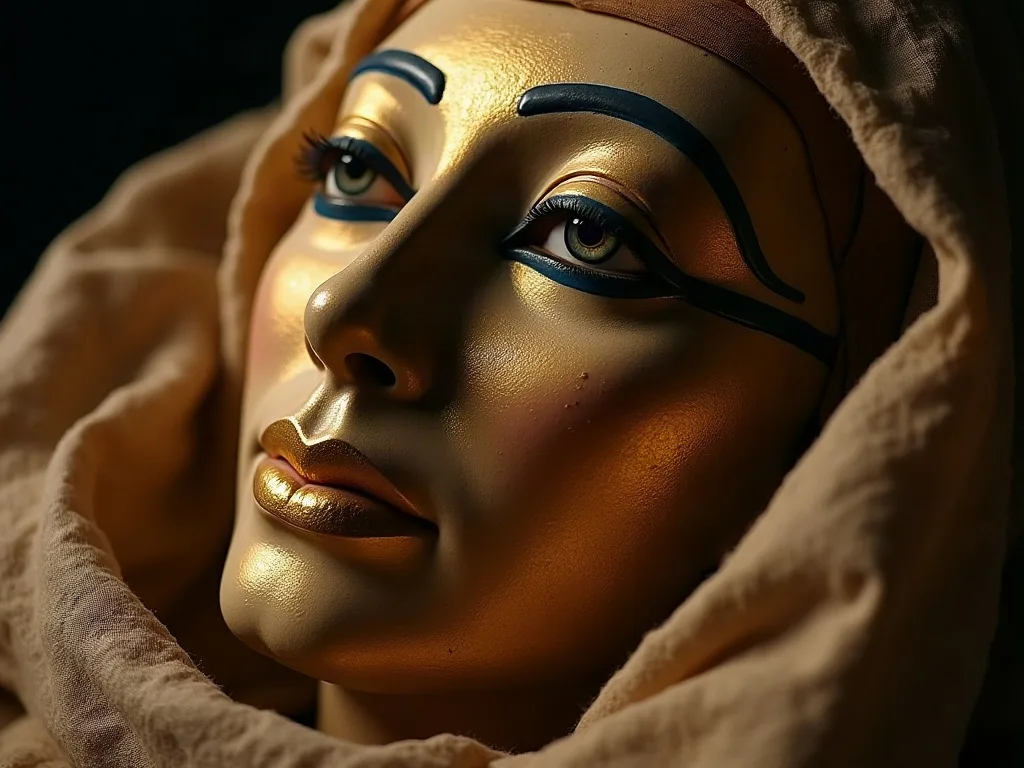
The face was treated with special care. A mask of plaster, linen, or wood was often fitted over the head, painted with the mummy's idealized features and sometimes inlaid with lapis lazuli eyes. This was not vanity; it was identity preservation. The mask ensured the soul would recognize its home.
Divine Guardians: Anubis, Thoth, and the Weighing of the Heart
The mummification process was never only about technique. Every step invoked deities whose names appear in the Coffin Texts and the Book of the Dead, a collection of spells and instructions for navigating the afterlife (the title comes from modern Egyptology; the Egyptians called it the "Book of Coming Forth by Day").
Anubis, as already noted, oversaw the preservation itself. But Thoth, the ibis-headed god of writing, magic, and the moon, was equally crucial. Thoth was said to have invented the spells that would allow the dead to recognize themselves, navigate the Duat's dangers, and present themselves before the divine tribunal. The Book of the Dead was, in effect, Thoth's instruction manual for the dead. A copy was often placed in the tomb, buried with the mummy, or its spells were painted on the coffin's interior walls. Thoth's role as the recorder of all things made him the scribe of eternity: he would write the dead person's name in the Book of Life if they passed judgment.
That judgment came at the Weighing of the Heart, a scene depicted in hundreds of tomb paintings. The dead person stood before Osiris himself, who sat enthroned in the Duat. The jackal-headed Anubis and the baboon-headed Thoth operated a great scale. On one side lay the deceased's heart. On the other, a single feather of Ma'at, the goddess of truth, justice, and cosmic order. If the heart was heavy with sin, it would outweigh the feather and be devoured by Ammit, the "Eater of the Dead," a hybrid creature with the head of a crocodile, the torso of a lion, and the hindquarters of a hippopotamus. The person would then cease to exist, denied the afterlife entirely. If the heart balanced the feather, the person was declared "justified" (maa kheru in Egyptian, "true of voice") and was allowed to enter the Field of Reeds, a paradise that mirrored earthly life: fields to tend, friends to greet, a home to live in. Crucially, the soul needed the preserved body to get there. A destroyed or desecrated mummy meant the death of the person forever.
Living Egypt
Pharaoh commands armies and builds monuments. A farmer works his fields by the Nile's banks. A woman tends her household. Trade and taxation flow. Conflict and ambition shape society.
The Field of Reeds (Aaru)
The pharaoh's soul continues to rule his domain. A farmer's ka (life force) tends fields that never fail. A woman's household never suffers loss. Work is meaningful but effortless. Pain, hunger, and decay do not exist.
The Opening of the Mouth: Animating the Dead
Days before the mummy was sealed in its tomb, the most sacred ritual of all took place: the Opening of the Mouth ceremony. This rite, documented in temple reliefs and tomb inscriptions from as early as the Old Kingdom (around 2686-2181 BC), was meant to restore the mummy's sensory and digestive functions in the afterlife.
A specially prepared implement called the pesh-kef, a curved copper or stone tool resembling an adze, was touched to the mummy's mouth, eyes, ears, and nostrils while priests recited magical formulas. The chief priest, masked as Anubis, spoke the words that would allow the mummy to eat, drink, hear the prayers spoken on its behalf, and see the beauty of the afterlife. Food offerings were presented: bread, beer, oxen, fowl, oil, and incense. These were ritual gifts, often consumed afterward by the priests, but the Egyptian belief was that the mummy's ka would consume the spiritual essence of the offering. The physical sustenance mattered less than the act of being fed and spoken to.
This ceremony was repeated in the tomb during subsequent visits by family members. The dead were not abandoned; they were fed, praised, and invoked regularly. The living maintained the dead through ongoing ritual, and the dead, in turn, could intercede on behalf of the living in the divine realm. It was a two-way covenant, sanctified by the preservation of the body.
Ma'at, the Cosmic Principle: Why Preservation Mattered
The preservation of the body was not sentimental. It was cosmological. The Egyptians understood the universe as governed by Ma'at, often depicted as a woman with an ostrich feather on her head. Ma'at was order, truth, justice, and the natural balance of all things. Her opposite was isfet (chaos, disorder, violence). Every mummification, every proper burial, every spoken prayer reinforced Ma'at. Every desecrated tomb, every stolen corpse, every name erased from a monument was an act of isfet, a blow against cosmic order itself.
This is why tomb robbing was not merely theft; it was cosmic transgression. When a tomb was violated and a mummy scattered or destroyed, the ancient Egyptians believed the victim's existence itself was erased, their chance at resurrection obliterated. Some pharaohs, notably Hatshepsut and Akhenaten, had their names chiseled away from monuments and temples by hostile successors. The Egyptians called this damnatio memoriae in Latin, the "condemnation of memory." It was the cruelest fate available to the living: the denial of immortality to the dead. Conversely, a well-preserved mummy in a sealed tomb, visited regularly with offerings and prayers, remained eternally present, eternally protected, eternally justified.

From Pharaohs to Commoners: Mummification Across the Classes
For millennia, mummification was the privilege of kings and the wealthy. A royal mummy, prepared in the royal necropolis of the Valley of the Kings, cost a fortune in materials, labor, and expertise. The pharaoh's tomb was equipped with furniture, chariots, weapons, clothing, cosmetics, and magical texts to ensure a comfortable and powerful afterlife. Tutankhamun's tomb, discovered nearly intact in 1922, contained over 5,000 objects. A pharaoh's mummy was the anchor of his eternal kingdom.
Wealthy nobles and high priests underwent similar preparation, though on a smaller scale. By the Middle Kingdom (around 2055-1650 BC), mummification had become more common among the literate classes. By the Late Period (664-332 BC), it had spread to merchants, scribes, and even some laborers. A poorer mummy might skip the canopic jars or use cheaper resins, but the core ritual remained: natron, wrapping, amulets, and the hope of resurrection.
Some of the most affecting mummies in modern museums belong to ordinary people. A weaver from Ptolemaic Egypt (305-30 BC). A priestess of Hathor. A child buried with a wooden doll and a clay horse. Each mummy testifies to the same faith: that with the right ritual, the right preservation, and the right magic, death could be negotiated. The soul could survive. The person could live forever.
Mummification's Echo in Later Faiths and Modern Understanding
The practice of mummification influenced and was influenced by neighboring cultures. The Nabataeans, who inhabited the Arabian Peninsula and parts of the Levant, adopted mummification techniques from Egypt. The Ptolemies, Greek rulers of Egypt after Alexander the Great's conquest (332 BC), brought Greek funerary practices into contact with Egyptian ritual. Some Hellenized tombs show a hybrid aesthetic: the mummy preserved in the Egyptian way, but housed in a sarcophagus with Greek sculptural style.
In early Christian Egypt, debate raged over whether mummification was compatible with resurrection theology. Some Christian communities preserved mummified saints, believing the intact body would rise again on the Day of Judgment. Others saw mummification as pagan superstition. By the late medieval period, the practice had largely ceased in the Islamic world, though respect for the dead remained paramount.
Modern scholars have used mummification to unlock ancient Egypt's history. Computed tomography and non-invasive imaging have revealed cause of death, disease patterns, diet, and even emotional relationships (DNA analysis has confirmed familial bonds inscribed on tomb walls). The Egyptians, in seeking to preserve bodies for eternity, inadvertently preserved a record of their own lives. In some cases, modern scientists have learned more from a three-thousand-year-old mummy than from written records.
Frequently asked questions about mummification and Egyptian death rituals
Frequently asked questions
Did all ancient Egyptians mummify their dead?
No. In the earliest dynastic periods (around 3100 BC), mummification was limited to royalty. By the New Kingdom (1550-1077 BC), it had become accessible to the wealthy and educated. Poorer Egyptians were buried in simple pit graves in the desert, where natural mummification sometimes occurred due to the dry climate and hot sand. The desire for mummification was universal, but the means were not. Even so, any Egyptian with resources strove for it, because the belief in resurrection was central to their view of a good death.
How long did a mummy actually last in the tomb?
Under optimal conditions, an Egyptian mummy could last thousands of years. Many mummies in museums today are over 3,000 years old and still retain skin, hair, and soft tissue. However, if a tomb was breached by water, robbers, insects, or fungi, decay accelerated. The sealed tombs of the Valley of the Kings preserved their contents far better than exposed burials. Climate also mattered: mummies in naturally dry regions lasted longer than those exposed to humidity. Some of the best-preserved mummies come from cold, arid high-altitude sites.
What happened to the canopic jars if a mummy was destroyed?
The Egyptians believed that if the body was destroyed but the canopic jars survived, the organs inside could still be reunited with the soul in the afterlife, restoring wholeness. Conversely, if the jars were shattered, the person's capacity for resurrection was severely damaged. This is why tomb robbers often targeted the jars: destroying them was a way to curse the dead and ensure they would not reach the afterlife. Some priestly tombs show evidence of canopic jars being carefully restored or reburied after desecration, suggesting that the living tried to repair this damage through ritual.
Was the brain really left to rot inside the skull?
During mummification, the brain was extracted and discarded (or, in some royal mummies, treated with natron and placed in a separate container). The Egyptians had no understanding of the brain's function; they believed consciousness and memory resided in the heart. Modern neurologists initially viewed this as a tragic loss of information, but the disposal of the brain actually helped prevent decay. A brain left in the skull would putrefy and cause internal liquefaction, damaging the mummy. By removing it, embalmers unknowingly improved preservation. Some scholars argue this practice shows empirical knowledge, even without anatomical understanding: they knew that certain removals made mummies last longer.
Could a mummy be made again if it was broken apart?
Theoretically, yes. The Egyptians believed that if scattered bones and fragments were reassembled and ritually restored, the soul could be reunited with them. This belief echoes the myth of Osiris, whose dismembered body was gathered by Isis and restored to wholeness. However, in practice, a badly damaged mummy was often considered beyond recovery, especially if the damage was deliberate (desecration by enemies). Families sometimes attempted to restore mummies of ancestors if pieces were found, but such restoration was laborious and incomplete. Many tombs show evidence of attempted repairs, suggesting that the living did not always accept a mummy's fate as final if they could intervene.
Why is natron salt such an effective preservative?
Natron (sodium carbonate and sodium bicarbonate) removes water from organic tissue through osmosis. Water is essential for bacterial growth and enzyme activity that causes decay. By desiccating the body, natron halts putrefaction. Additionally, natron is slightly alkaline, which inhibits microbial growth. The Egyptians sourced natron from the Wadi Natrun, a natural salt lake northwest of Cairo, where it crystallized in abundance. This geographic gift was crucial to mummification's feasibility; without easy access to natron, the practice would have been impossible on such a scale. Modern chemical analysis confirms that natron, when applied correctly, is as effective as modern refrigeration at halting decay, at least in the short term. Over centuries, the desiccated tissue remains stable.
The Duat and the Impossible Journey: Mummification as Insurance
The Book of the Dead, a collection of spells first compiled during the New Kingdom, describes the soul's passage through the Duat as a gauntlet of horrors. The deceased faced demons with names like "Eater of Shadows" and "Swallower of Filth." They had to cross lakes of fire, navigate halls where the walls themselves were hostile, and recite the secret names of gatekeepers at every threshold. Without the right spells, the soul would be lost or devoured.
A mummy, properly preserved and equipped with funerary texts, was insurance against these dangers. The mummy was the soul's home base, the anchor it could return to if threatened. If the soul was cornered by a demon in the Duat, it could retreat into the mummy's heart (which was left in the body). If it forgot a crucial spell, the spells painted on the coffin or buried with the body would remind it. The living, by maintaining the mummy with offerings and prayers, kept the soul's earthly support system active. As long as the mummy stood in the tomb, the dead person was not truly vulnerable.
This explains the terror the Egyptians felt at the prospect of mummy destruction. A destroyed mummy meant a soul cast adrift in the Duat with no home, no anchor, no hope of finding the Field of Reeds. Some pharaohs built multiple hidden tombs and had themselves mummified in secret locations precisely to guard against this fate. The mummy was not just the body; it was the essential survival tool for eternity.
Free 25-page sample
Want the whole story?
Take the first 25 pages free. If it pulls you in, the full edition is yours as an instant PDF download, with a paperback on Amazon for selected titles.

Mythology
The World Mythology Book: The Gods, Heroes and Myths of Every Culture
The Gods, Heroes and Myths of Every Culture, in One Volume
The whole of world mythology in a single volume: Greek, Norse, Egyptian, Japanese, Hindu, Celtic, Slavic, Mesoamerican and African myths gathered side by side, each drawn from the primary sources.