

The Nemean Lion: Origin, Myth, and the Monster That Made Hercules
Born of divine monsters and gifted with impenetrable skin, the Nemean Lion terrorized an entire region before Hercules strangled it bare-handed. Here is every layer of that myth.
Contents
The valley fell quiet first. Shepherds learned to recognize the silence before the roar, the way birds emptied the sky an hour before the lion came down from the hills. Villages around Nemea stopped sending men into the fields alone. Offerings piled up at the temple of Zeus nearby, prayers to a god who seemed, for once, slow to answer.
The Nemean Lion was not simply a large predator. Ancient sources described it as something outside the natural order: a beast with skin that turned aside iron and bronze as easily as cloth, a creature whose very existence posed a theological question. If the gods allowed this thing to live, what did that mean for the humans beneath it? The First Labor of Hercules would eventually answer that question, but the answer cost blood, broken fingers, and everything a man could give short of his life.
This article traces the lion from its divine parentage through its death, its transformation into a constellation, and its long afterlife in art, coinage, and the modern imagination. Every layer repays attention.
The Parentage of the Nemean Lion: Children of Typhon and Echidna
Greek cosmogony is densely populated with terrors, but the pair that generated the most consequential monsters were Typhon and Echidna. Hesiod, writing in the Theogony around 700 BCE, establishes Typhon as the last great challenger to Zeus, a creature of such overwhelming violence that even the Olympians fled to Egypt in animal form when he appeared. Echidna was his counterpart: half woman, half serpent, immortal, living in a cave below the earth.
Their offspring reads like a catalog of the Greek heroic program. The Lernaean Hydra, the multi-headed water serpent Heracles would face as his Second Labor, was their child. So was Cerberus, the three-headed hound of Hades. The Chimera, the Sphinx, the Colchian dragon, the Caucasian Eagle that tore at Prometheus every day. The Nemean Lion completes the roster of their most lethal productions.
Some sources, including the mythographer Apollodorus writing in the Bibliotheca, offer an alternative genealogy: the lion was the offspring of the moon goddess Selene and the monster Typhon, or alternatively of Orthus, the two-headed dog, and the Sphinx or Echidna herself. The Selene attribution carries a particular resonance, because it ties the lion's invulnerability to the otherworldly radiance of moonlight, something that cannot be touched or cut. Regardless of which line one accepts, every ancient source agrees on the creature's superhuman nature. It was not bred; it was generated.
The lion was placed in the hills around Nemea, in the northeastern Peloponnese, in the region of Argolis. The area was already sacred to Zeus, site of the Nemean Games (founded, tradition held, to mourn a young child named Opheltes, or alternatively in honor of Heracles's victory). The juxtaposition of sacred games and a killing ground was not accidental. Greek sacred sites regularly drew meaning from proximity to danger.

The Terror at Nemea: What the Lion Actually Did
Ancient sources are specific about the lion's activity in ways modern retellings tend to flatten. It did not merely kill livestock, though it did that too. Diodorus Siculus and Apollodorus both emphasize that the lion preyed on the human population of the surrounding countryside. The villages of Cleonae and Bembina are named in some traditions as communities that lost significant numbers of people.
The lion's skin was its defining characteristic. This detail is not decorative. In the ancient Greek conceptual universe, armor and hide belonged to the same semantic field: protection conferred by the divine or semi-divine. The aegis of Zeus, the hide of the Calydonian Boar, the scales of the Hydra, all these surfaces mark boundaries between the human and the monstrous. A skin that no weapon could penetrate meant that the lion existed in a category of being that ordinary heroic action could not address. You could not solve this problem with a better spear.
Apollodorus in the Bibliotheca (2.5.1) records that Eurystheus set this as the First Labor precisely because it seemed impossible. The king of Tiryns, who administered Heracles's labors on behalf of Hera's hatred, calculated that the hero would die on the first assignment. Hera herself, in many readings of the myth cycle, had arranged for the lion to exist in the first place: a standing weapon waiting for the moment Heracles arrived in the Peloponnese.
The local response to the lion had been collective paralysis. The region around Nemea had essentially been abandoned to the creature. No hero had successfully challenged it. Some traditions record earlier attempts by anonymous warriors whose weapons shattered or slid off the hide. This backstory matters: it establishes that Heracles was not solving a problem no one else had noticed, but a problem everyone had accepted as insoluble.
Heracles and the First Labor: How the Killing Was Done
Heracles arrived at Cleonae, a small city near Nemea, and lodged with a laborer named Molorchus. The detail of Molorchus appears in several sources including Callimachus and later in Virgil's Georgics (3.19), and it does significant narrative work. Molorchus was about to sacrifice his last ram, either to Zeus or to Heracles himself as a hero, and Heracles asked him to wait thirty days. If Heracles returned victorious, they would sacrifice to Zeus. If he did not return, Molorchus should sacrifice to Heracles as a dead hero. The thirty-day window humanizes the encounter. Heracles knew he might not come back.
He found the lion's lair, a cave with two entrances, in the hills. He tried his arrows first. They bounced off the hide without leaving a mark. He tried his sword. Same result. He tried his olive-wood club, which at least staggered the animal, driving it back into the cave. At this point, Heracles blocked one entrance, cornered the lion inside, and wrestled it with his bare hands, throttling it until it died.
The physical detail here is extraordinary. Greek vase painters returned to this moment obsessively for three centuries, from the late 7th century BCE well into the Hellenistic period. Some images show Heracles wrapping both arms around the lion's neck in a standing choke. Others show him on the ground, the lion on top of him, his legs locked around its body. Pindar in his Nemean Odes alludes to the labor obliquely but consistently treats it as the foundational act of the hero's career, the moment that revealed what he was.

After the kill, Heracles faced a secondary problem: how to skin an animal whose hide resisted every blade. Apollodorus records that Athena advised him, or that he figured it out himself, to use one of the lion's own claws. The hide, impenetrable from outside, could be cut from within. He stripped the pelt, wore it as a cloak from that point forward, and used the lion's gaping mouth as a helmet. He returned to Cleonae on the thirtieth day. He and Molorchus sacrificed to Zeus.
Eurystheus's reaction, recorded in Apollodorus with a dry matter-of-factness, was to hide inside a large bronze jar when he saw Heracles returning with the pelt over his shoulders. He issued all subsequent commands from a safe distance, via herald.
The Pelt as Symbol: What the Lion's Skin Meant
The transformation of the lion's hide into Heracles's permanent costume is one of the more sophisticated symbolic operations in Greek mythology. Consider what it accomplishes.
The invulnerability that once protected the monster now protects the hero. Heracles effectively absorbed the lion's defining property. He did not just defeat the creature; he became the creature, at least in terms of what the external world saw first. Every subsequent image of Heracles in Greek and Roman art identifies him instantly by the pelt: the lolling jaw framing the face, the heavy paws knotted at the chest, the shaggy bulk over his shoulders.
This visual grammar had political consequences. Alexander the Great wore a lion-scalp helmet on coins and in portrait sculpture, consciously echoing Heracles, from whom the Macedonian royal house claimed descent. The Ptolemaic dynasty in Egypt continued the iconographic tradition. Roman emperors from Commodus onward periodically posed as Heracles in lion costume, most notoriously Commodus himself, who had court artists produce statues showing him throttling the Nemean Lion in the guise of the god.
The pelt also appears in the myth cycles of other cultures in interestingly parallel ways. Indra, the Vedic king of the gods, wears the skin of Vritra, the cosmic serpent-dragon he slew, in some later retellings. The association of the hero with the hide of the slain monster recurs across Indo-European traditions. Whether this represents parallel symbolic logic or genuine shared inheritance is still debated, but the pattern is real.
The Lion Becomes a Star: Catasterism and Leo
The celestial afterlife of the Nemean Lion is one of the cleaner examples of Greek catasterism, the process by which mythologically significant beings were translated into constellations. Leo, the fifth sign of the zodiac and one of the oldest recognized constellations in the ancient world, was identified by Greek astronomers with the Nemean Lion.
The association is attested in Eratosthenes's Catasterismi (3rd century BCE), a systematic catalog of stellar myths. Eratosthenes writes that Zeus placed the lion among the stars to honor his son Heracles's first and greatest feat. The lion occupies the sky as a monument to both the monster's power and the hero's victory over it.
The constellation Leo was independently recognized by Mesopotamian astronomers centuries before the Greeks; Babylonian star lists from around 1200 BCE describe what they called UR.GU.LA, the Great Lion, in the same sky region. Whether the Greek myth of the Nemean Lion was partly shaped by this earlier stellar tradition, or whether the Greek name was simply applied to a pre-existing constellation, remains uncertain. What is clear is that the lion's position in the zodiac gave it an enduring astronomical presence that outlasted all political changes in the Mediterranean world.
The sun passes through Leo roughly from late July to late August, a period that in the ancient eastern Mediterranean corresponded to the hottest and most dangerous part of the year. Lions were most active and most dangerous during summer in the ancient Near East. The stellar timing reinforced the creature's symbolic weight.

The Nemean Lion in the Broader Monster Ecology of Greek Myth
Greek mythology is exceptionally systematic about its monsters. They do not appear randomly; they occupy specific landscapes, descend from specific parents, and exist in structural relation to the heroes who face them. Placing the Nemean Lion within this ecology clarifies what it meant.
The Twelve Labors of Heracles move through an implicit geography of danger, from the local (Nemea, Lerna, Arcadia) to the edges of the known world (the garden of the Hesperides, the realm of Geryon, the underworld itself). The Nemean Lion opens this sequence because it represents the most direct, most immediate form of the monstrous: a killing machine in a valley, close to home, resisting every ordinary solution. The later labors require cunning, divine assistance, cosmological knowledge. The first labor requires only the willingness to use your hands.
Compare this with the role of similar beasts in adjacent traditions. The Caledonian Boar in Celtic myth, the Erymanthian Boar in Heracles's own cycle, the boars and bulls in Mesopotamian royal hunting iconography: the hero who kills a large, dangerous animal is asserting dominion over nature on behalf of civilization. The Nemean Lion escalates this standard motif by making the animal supernaturally indestructible, shifting the register from physical courage to something more nearly divine.
The lion's placement at Nemea, site of a Zeus cult, also invites a theological reading. The animal that cannot be killed by human weapons occupies a sacred precinct. Heracles, son of Zeus, is the only figure capable of restoring order there. The labor is thus also a demonstration of the hero's unique status: born of a god, operating above the normal constraints of the human world.
The Sphinx, another child of Typhon and Echidna, offers a useful contrast. Where the Nemean Lion kills by brute physical force, the Sphinx kills by intellect, posing riddles whose answer is death. Oedipus defeats the Sphinx by answering the riddle; Heracles defeats the lion by strength that transcends the physical. The two strategies map onto the two dominant modes of Greek heroism: cleverness (Odysseus) versus force (Heracles). Both are required. Neither is sufficient alone.
Appearances Beyond the First Labor: The Lion Through the Myth Cycle
The Nemean Lion's pelt continued to appear throughout the Heraclean cycle long after the creature's death. Its presence in subsequent myths is worth cataloging.
-
The Gigantomachy: In the great war between the Olympians and the Giants, Heracles fought wearing the lion's pelt and carrying his club. Several Attic vase paintings depict this scene. The pelt functions as a visual signifier that the hero present is the real Heracles, not a mortal ally.
-
Heracles at the court of Omphale: Queen Omphale of Lydia, as punishment or game (sources differ), had Heracles dress in women's clothes while she wore his lion's pelt and carried his club. This transposition of the pelt to a female figure was a major subject of Hellenistic art. It plays on the skin's identification with masculine heroic power by temporarily redistributing it.
-
The apotheosis: When Heracles died on Mount Oeta, burned alive by the poisoned cloak of Nessus, he wore the lion's pelt to the end. At his deification, the pelt presumably transferred with him to Olympus. Several ancient vase paintings show the deified Heracles in the pelt, reclining at banquet among the gods.
-
Heracles in Etruria and Rome: Etruscan artists adopted Heracles (as Hercle) early, and the lion's pelt traveled with the iconography. Roman Hercules maintained it through every period of Roman art. The pelt appears on over three thousand surviving Greek and Roman objects, making it one of the most reproduced single motifs in ancient visual culture.
The Lion in Ancient Art: Vases, Coins, and Sculpture
The scene of Heracles wrestling the Nemean Lion is among the most extensively documented subjects in ancient Greek ceramic art. The Munich Antikensammlung alone holds more than forty vases depicting the combat. Scholars have traced the iconographic development across roughly three centuries.
The earliest images, dating to around 630-600 BCE, tend to show the two figures standing and grappling. By the mid-6th century, Attic black-figure painters began showing Heracles on one knee, the lion's neck locked in the crook of his arm, a composition that emphasizes the asymmetry: the man looks almost overwhelmed, but he is winning. Red-figure painters of the 5th century gave the scene more psychological depth, showing the hero's strained face, the lion's open mouth, the precise geometry of the chokehold.
Coin mints across the ancient world used the lion's head as currency iconography. Macedonian tetradrachms show Alexander wearing the lion-scalp. Coins from Tarentum, Croton, and Herakleia (a city explicitly named for the hero) featured the wrestling scene on their reverses. The Nemean Lion was not merely a story; it was a monetary unit.
The most famous sculptural treatment is the metope from the Temple of Zeus at Olympia (c. 460 BCE), now largely preserved in the Olympia Archaeological Museum. The composition shows Heracles standing with the dead lion draped over his shoulders, Athena beside him, and Hermes nearby. The scale and placement, in a religious building of the first importance, signals the canonical status the story had achieved by the classical period.
The Nemean Games: an Institutional Legacy
The athletic games held at Nemea every two years were part of the Panhellenic circuit alongside Olympia, Delphi (Pythian Games), and Corinth (Isthmian Games). Their mythological foundation was contested in antiquity: one tradition said Heracles founded them after defeating the lion; another said they predated him and were established to mourn the infant Opheltes (also called Archemorus), son of a local king, who died of a snake bite while his nurse showed soldiers a spring.
Both origin stories were in active circulation by the 5th century BCE and were not considered mutually exclusive. Pindar wrote four Nemean Odes celebrating victors at these games; his First Nemean Ode directly associates the games with Heracles and treats the lion combat as the guarantee of the site's sanctity. Winners at the Nemean Games received a wreath of fresh celery (selinon) rather than the olive or laurel of other games. The celery wreath was associated with mourning, again linking the games to Opheltes's death, a tension the site never fully resolved.
The games were suppressed and revived several times in antiquity. Modern archaeological excavations at ancient Nemea, led by Stephen Miller of UC Berkeley from 1974 onward, recovered the stadium, starting blocks, and the temple of Zeus. The Society for the Revival of the Nemean Games has held events at the ancient site since 1996, with athletes running barefoot as in antiquity.
The Nemean Lion in the Modern Imagination
The creature's grip on the modern imagination is substantial and cuts across media. A few specific examples reveal how the myth mutates under pressure.
In Disney's 1997 animated Hercules, the Nemean Lion appears briefly but is redesigned as a single monster among many, stripped of its specific invulnerability. The film's compression of the labors sacrifices most of the theological weight. By contrast, Rick Riordan's Percy Jackson novels restore more of the monster's distinctiveness; his reimagining of the Nemean Lion as a monster hunters pursue across modern America plays on the creature's indestructibility with reasonable fidelity to the source.
The video game Assassin's Creed: Odyssey (2018) includes the Nemean Lion as a Legendary Animal encounter, set in the correct geographic region (the Argolis area of the game's ancient Greece map). The hide becomes a craftable armor set. The logic of the myth, skin absorbed by the slayer, survives the translation intact.
In academic mythology, the Nemean Lion has attracted specific attention from scholars of religion and symbol. Walter Burkert in Structure and History in Greek Mythology and Ritual (1979) reads the Heracles labors as encoding a shamanistic initiatory sequence, with the lion combat as the initiand's encounter with the overwhelming animal spirit. Joseph Fontenrose in Python: A Study of Delphic Myth (1959) situates the lion within the combat myth archetype connecting Greek, Near Eastern, and Indo-European traditions. Neither reading exhausts the story, but both illuminate angles the casual retelling misses.
Frequently Asked Questions About the Nemean Lion
Frequently asked questions
Why couldn't Heracles use weapons against the Nemean Lion?
The lion's skin was impervious to all weapons made of iron, bronze, or any material crafted by human hands. This invulnerability is described explicitly in Apollodorus's Bibliotheca (2.5.1) and is the defining characteristic that makes it unlike any ordinary predator. It existed outside the category of things human technology could address, which is precisely why Heracles had to resort to bare-handed strangulation to kill it.
Who were the Nemean Lion's parents according to ancient sources?
The most common genealogy, given in Apollodorus and consistent with Hesiod's monster catalog, makes the lion a child of Typhon and Echidna, the same pair who produced the Hydra, Cerberus, and the Chimera. An alternative tradition attributes the lion's parentage to Typhon and the moon goddess Selene, which would explain the otherworldly quality of its invulnerability. A third variant makes the lion an offspring of Orthus (the two-headed dog) and Echidna. Ancient sources did not harmonize these accounts.
How did Heracles skin the Nemean Lion if its hide was impenetrable?
Athena (in some versions) or Heracles himself (in others) realized that the hide, though impervious to external attack, could be cut by the lion's own claws, which shared its supernatural sharpness. Heracles used one of the dead animal's front claws as a blade to strip the pelt. This detail appears in Apollodorus and is depicted in several Attic vase paintings showing Heracles holding a claw to the carcass.
What is the connection between the Nemean Lion and the constellation Leo?
Eratosthenes's Catasterismi records that Zeus placed the Nemean Lion among the stars as Leo, to commemorate his son Heracles's victory. Leo is one of the oldest named constellations in the ancient world, recognized by Babylonian astronomers as early as 1200 BCE under the name UR.GU.LA (the Great Lion). The sun's passage through Leo coincides with the hottest weeks of the Mediterranean summer, a period associated in agricultural societies with lion activity and the peak of seasonal danger.
Why was the Nemean Lion the First Labor of Heracles?
Ancient sources including Apollodorus describe Eurystheus choosing it first because it seemed guaranteed to kill Heracles on the initial assignment. Symbolically, its placement as the first labor also makes structural sense: it is the most geographically close to home (the Peloponnese), the most physically direct challenge (brute force against brute force), and the one that establishes the hero's defining visual identity. Every subsequent labor builds on what the first one proves: that Heracles operates above human categories.
Did the Nemean Lion appear in other myths beyond the First Labor?
The lion itself died in the First Labor, but its pelt remained active in myth for the rest of Heracles's life. It appears in accounts of the Gigantomachy, the episode with Queen Omphale of Lydia, and Heracles's death on Mount Oeta. It traveled with the iconography of Heracles into Etruscan (Hercle) and Roman (Hercules) religious culture, and was the basis for the lion-scalp helmet of Alexander the Great, who claimed Heraclean descent for the Macedonian royal line.
The Lion as a Threshold: What the Monster Marks in Myth and Time
Monsters in Greek mythology do not exist to be evil. They exist to mark boundaries. The Nemean Lion occupied a specific geographic and ritual threshold: the valley near a Zeusian sanctuary, between the cultivated world of Argolis and the raw hills beyond. Its indestructibility was not cruelty but taxonomy. It belonged to a layer of reality that human craft could not reach.
What Heracles accomplished by killing it was not merely the removal of a threat. He demonstrated that the human-divine threshold, too, is permeable. A son of Zeus, trained to the limits of mortal flesh, could cross into the space the monster occupied and come back wearing its skin. The hide transferred from monster to hero in the only direction a Greek myth would allow: downward through the food chain, upward through the moral hierarchy.
Scholars of comparative religion note that this structure replicates itself across mythologies with striking consistency. Indra's defeat of Vritra, Thor's battles with the Midgard Serpent, the Babylonian Marduk killing Tiamat and making the sky from her hide: in each case, the hero absorbs the defining substance of the defeated monster and reorganizes the world. The Nemean Lion's pelt is the Greek instance of a very old human intuition. You become what you can outlast.
The lion also marks a temporal threshold. Its death opens the Heraclean cycle properly: everything before it is backstory, everything after it is consequence. The star it became in Leo marks the boundary between spring's softening and summer's killing heat. The games at Nemea marked, for Greeks in the classical period, a pause between seasons in the athletic calendar. Thresholds accumulate around this animal even in death. Perhaps that was always the point.
Read the full book
Want the whole story?
The complete edition is an instant PDF download here, with a paperback on Amazon for selected titles.
Mythology
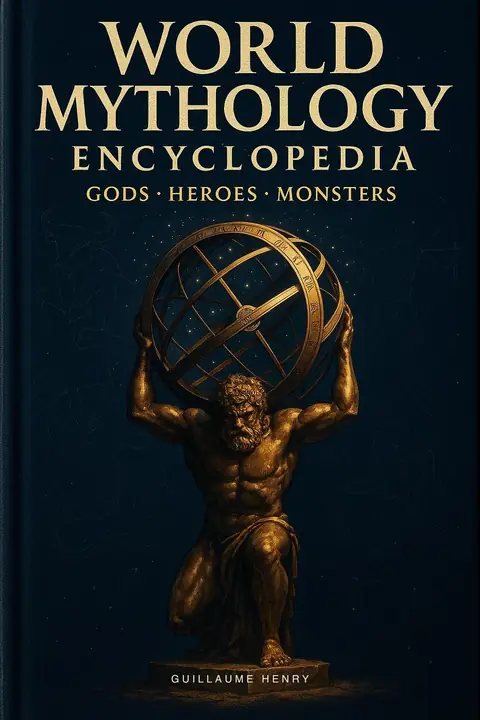
The World Mythology Book: The Gods, Heroes and Myths of Every Culture
The Gods, Heroes and Myths of Every Culture, in One Volume
The whole of world mythology in a single volume: Greek, Norse, Egyptian, Japanese, Hindu, Celtic, Slavic, Mesoamerican and African myths gathered side by side, each drawn from the primary sources.