
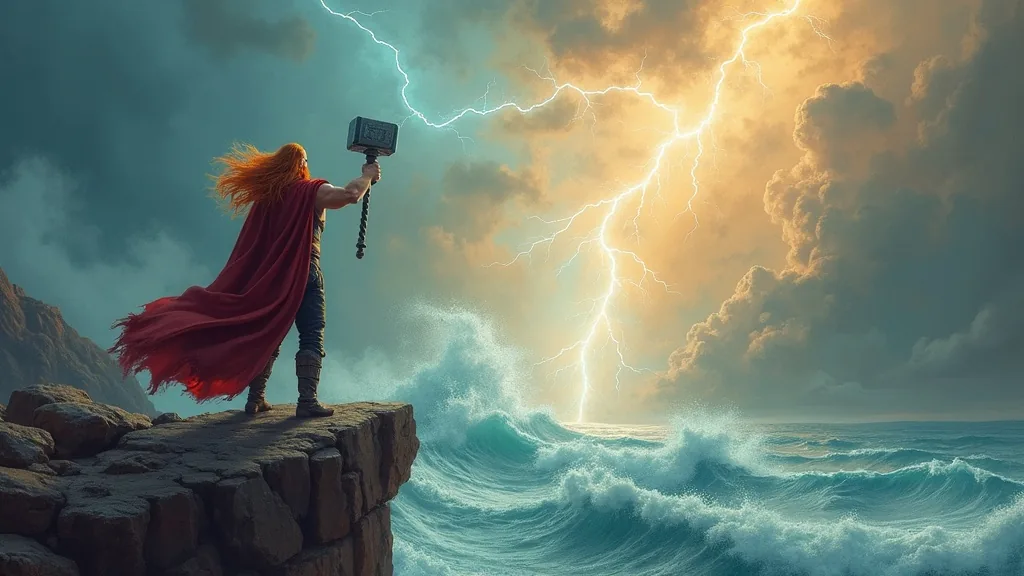
Thor, God of Thunder: Hammer, Storm, and the Sacred Defender of Worlds
Thor, the Norse god of thunder, stands as one of the most powerful and beloved figures in world mythology. Son of Odin, wielder of Mjolnir, and eternal guardian of Asgard and Midgard alike.
Contents
Thor, the god of thunder, occupies a singular place in Norse mythology and in the broader tapestry of world religion. He is at once a cosmic warrior and a farmer's patron, a destroyer of giants and a protector of ordinary men and women. His name resonates in the English word "Thursday" (from Old English Þūnresdæg, "Thor's day"), a quiet testament to how deeply his cult was woven into the fabric of Northern European life.
To understand Thor is to understand a people who lived under vast skies, who watched lightning split the horizon over the North Sea, and who needed a god powerful enough to hold chaos at bay.
Son of Odin, Son of the Earth
Thor's parentage is itself a statement of cosmological ambition. His father is Odin, the Allfather, sovereign of Asgard and master of wisdom and war. His mother, however, is not one of the Aesir but Jörð, the personification of the earth itself. The union of sky-father and earth-mother is an ancient Indo-European motif, and the Norse tradition places Thor precisely at that crossroads: a being born of heaven and earth, thunder emerging from the marriage of sky and soil.
He is the husband of Sif, the golden-haired goddess, and together they have a daughter, Þrúðr (Thrúd), whose name means "strength." Thor also fathered two sons, Magni and Móði (meaning "strength" and "courage"), with the giantess Járnsaxa. These names are not incidental. Thor's family is a living vocabulary of force, valor, and endurance.
Thor Among the Aesir
Within Asgard's divine hierarchy, Thor holds a position second only to Odin in raw power, though the two gods embody quite different qualities. Odin is cunning, sacrificial, and often morally ambiguous. Thor is direct, loyal, and ferociously generous. While Odin schemes, Thor acts. Old Norse sources, particularly the Prose Edda compiled by Snorri Sturluson around 1220 CE, describe Thor as the strongest of all gods and all men, a figure whose rage is productive rather than destructive, always aimed at the enemies of order.
Mjolnir: The Hammer That Holds the World Together
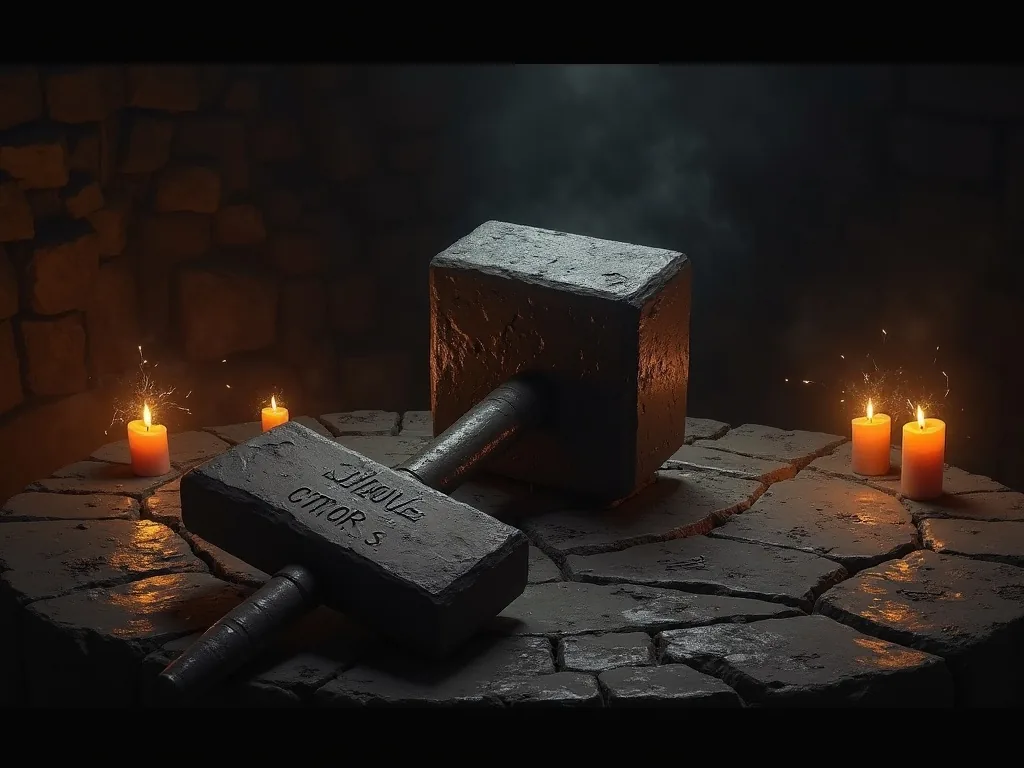
No single symbol in Norse mythology is more iconic than Mjolnir, Thor's hammer. Its name derives from a Proto-Germanic root related to the words for "grind" or "crush," and it is described in the Prose Edda as the greatest treasure of the Aesir. Mjolnir never misses its target, always returns to Thor's hand after being thrown, and can be shrunk small enough to be concealed beneath a cloak.
The hammer's origin is itself a marvelous story. Loki, in one of his more destructive moods, cut off the golden hair of Sif while she slept. Forced by Thor's fury to make amends, Loki traveled to Svartalfheim, the realm of the dwarves, and commissioned the finest craftsmen in existence. The dwarves Brokkr and Sindri forged Mjolnir in their furnace, a process nearly ruined when Loki (transformed into a fly) bit Brokkr on the eyelid, causing the handle to be made slightly shorter than intended. Despite this flaw, the gods judged Mjolnir the most valuable treasure of all. Its short handle required Thor to wear iron gauntlets (Járngreipr) to wield it properly, and a belt of strength (Megingjörð) that doubled his already prodigious power.
The Hammer as Sacred Sign
Mjolnir was not merely a weapon. Archaeological discoveries across Scandinavia and beyond have uncovered hundreds of small hammer-shaped amulets, worn by men and women as devotional objects from roughly the 8th through the 11th centuries CE. They were hung around the neck much as a cross might be worn today. Notably, some archaeological sites have yielded molds capable of producing both cross pendants and hammer pendants side by side, a vivid material record of the religious transition occurring as Norse paganism met Christianity.
The hammer was used to consecrate births, marriages, and funerals. In the Þrymskviða (Thrymskvida), one of the poems of the Poetic Edda, the giant Thrym demands Mjolnir be brought out to "hallow the bride" in what appears to be a genuine ritual formula, suggesting that real-world ceremonies invoked the hammer's sanctifying power.
The Giant-Slayer: Thor's Great Battles
Thor's defining mythological function is the defeat of giants, the jötnar, who represent the forces of primordial chaos pressing constantly against the ordered cosmos of gods and humans. His journeys into Jotunheim, the realm of the giants, form a cycle of stories as rich and varied as any in world mythology.
The Serpent at the End of the World
Thor's most consequential enemy is Jörmungandr, the Midgard Serpent, also called the World Serpent. The creature encircles the entirety of Midgard (the world of humans) by biting its own tail beneath the ocean. It is Thor's eternal nemesis and, ultimately, his killer.
The Hymiskviða tells of Thor and the giant Hymir going fishing, with Thor baiting his line with an ox's head and hauling Jörmungandr to the surface. The confrontation is visceral and terrifying; the serpent rises from the deep, and the two lock eyes across the churning water. Hymir, overcome with fear, cuts the fishing line before Thor can deliver the killing blow. The unfinished business will not be resolved until Ragnarök.
At Ragnarök, the apocalyptic end of the Norse cosmos, Thor and Jörmungandr will finally settle their account. Thor will kill the serpent with Mjolnir, but the creature's venom will prove lethal. Thor walks nine steps after the serpent's death before falling. Even the god of thunder cannot emerge unscathed from the end of the world.
Þrymskviða: The Theft of the Hammer
Among the most beloved Thor myths is the story of the stolen hammer. The giant Thrym hides Mjolnir and demands the goddess Freya as his bride in exchange for its return. Freya refuses, so Thor himself dresses as a bride, with Loki as his bridesmaid, and travels to Jotunheim. The scene is rich with dark comedy: Thor's enormous appetite and smoldering eyes nearly expose the disguise, but Loki spins increasingly elaborate excuses. When Mjolnir is brought out to bless the wedding, Thor seizes it and slaughters every giant in the hall. The myth is sometimes read as a commentary on the limits of disguise, the indestructibility of identity, and the ultimate futility of chaos trying to claim what belongs to order.
Utgarda-Loki and the Trials of Perception
In one of the most philosophically layered Thor myths, the god and his companions visit Útgarðr, a castle presided over by the giant king Útgarða-Loki. There, Thor fails at three challenges: he cannot drain a drinking horn, cannot lift a cat, and is wrestled to one knee by an old woman. The revelations that follow are stunning. The horn was connected to the ocean; the cat was Jörmungandr in disguise; and the old woman was Elli, the personification of old age, whom no one can truly defeat. Even Thor's apparent failures are extraordinary: he lowered the ocean's level, he moved the World Serpent, and he stood longer against old age than any being had. The myth teaches that even the mightiest are operating within cosmic constraints they cannot fully perceive.
Thor and Humanity: The People's God
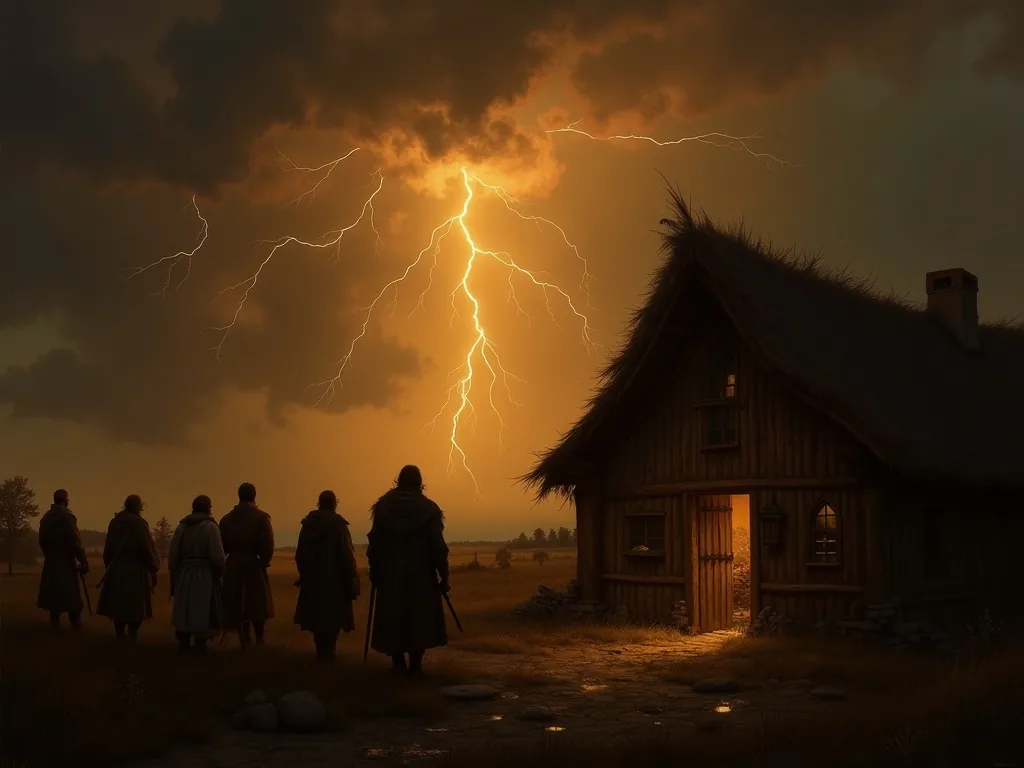
Where Odin was primarily the god of kings, warriors, poets, and the elite, Thor was the god of the common people. Farmers prayed to him for rain and fertile harvests. Sailors called on him to calm storms. His name appears in countless Scandinavian place names, from Thorsberg in Denmark to Þórsmörk (Thor's Forest) in Iceland, a valley still bearing his name today beneath the Eyjafjallajökull glacier.
The conversion of Scandinavia to Christianity was a drawn-out process lasting from roughly the late 9th century through the 12th century, and in many regions the resistance to Christianity was expressed explicitly as loyalty to Thor. Icelandic sagas describe men who "trusted in their own might and Thor" as a formula for paganism. The Christian missionary Olaf Haraldsson reportedly faced particular hostility from Thor-worshippers in Norway. At Uppsala in Sweden, one of the great pagan cult centers, a statue of Thor reportedly stood at the center of the temple's divine assembly, flanked by Odin and Freyr.
Worship and Ritual
Thor's worship appears to have involved sacrificial feasts (blót), the raising of sacred pillars carved with his likeness, and the swearing of oaths on hammer-shaped rings. Several runic inscriptions invoke Thor's protection, most famously with the formula Þór vígi ("May Thor hallow/consecrate"). His role as the hallower, the one who makes sacred space, mirrors the hammer's ceremonial uses and marks him as a god of boundaries as much as a god of battle.
Echoes Across Time: Thor's Legacy
Thor's mythological profile did not end with the Christianization of Scandinavia. The Norse diaspora carried his stories into the British Isles, where they merged with local traditions. The thunder-god archetype itself speaks to something universal in human experience: the need for a powerful, righteous protector willing to stand between civilization and the abyss.
In the 19th century, Romantic nationalism rediscovered the Norse gods as icons of Northern European cultural identity, inspiring Richard Wagner's operatic cycle Der Ring des Nibelungen (though Wagner drew more heavily on Germanic variants) and a vast literary tradition. Jacob Grimm's Deutsche Mythologie (1835) treated Thor, alongside Donar, his Germanic cognate, as evidence of a deep ancestral religion.
The 20th and 21st centuries brought Thor into global popular culture, from Marvel Comics' superhero adaptation (debuting in Journey into Mystery No. 83, 1962) to blockbuster cinema. These retellings, while departing substantially from the ancient sources, have introduced millions to the god's core attributes: the hammer, the storms, the unyielding protectiveness. Whatever the medium, the archetype persists because the need it addresses is perennial. People have always needed to believe that somewhere, above the storm, a force of cosmic loyalty stands ready to fight on their behalf.
Thor at Ragnarök: Death, Venom, and the Seeds of Renewal
The Norse mythological tradition does not allow its gods the comfort of immortality without condition. Ragnarök, the "fate of the gods" or "twilight of the gods," is the eschatological event that frames all of Norse cosmology. Every story of Thor's victories is shadowed by the foreknowledge of his final battle.
At Ragnarök, the Midgard Serpent will rise from the ocean as the world shakes apart. Thor and Jörmungandr will fight their final duel. Thor will kill the serpent, walk nine steps, and die from its venom. Yet Ragnarök is not simply an ending. The sources, particularly the Völuspá (the "Prophecy of the Seeress," one of the most extraordinary poems in Old Norse literature), describe a world that will rise again from the sea. Among the survivors are Thor's sons Magni and Móði, who will inherit Mjolnir. The hammer endures. The force it represents, the principle of protective, ordered strength, survives even the end of the world.
This cyclical eschatology ensures that Thor is never simply a god of the past. He is a god of renewal: the thunderstorm that breaks the drought, the power that clears the air so that life can begin again.
Free 25-page sample
Want the whole story?
Take the first 25 pages free. If it pulls you in, the full edition is yours as an instant PDF download, with a paperback on Amazon for selected titles.
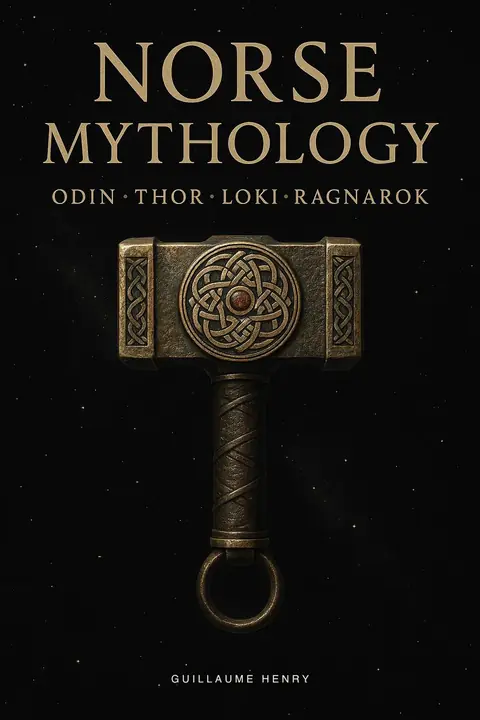
Norse
The Norse Mythology Book: Odin, Thor, Loki, Ragnarok and the Sagas of the Vikings
Odin, Thor, Loki, Ragnarok and the Sagas of the Vikings
The complete guide to Norse mythology drawn from the Eddas, the sagas, and the scholarship of those who read the source texts. Every god, every world, every myth.
More from Norse
All articles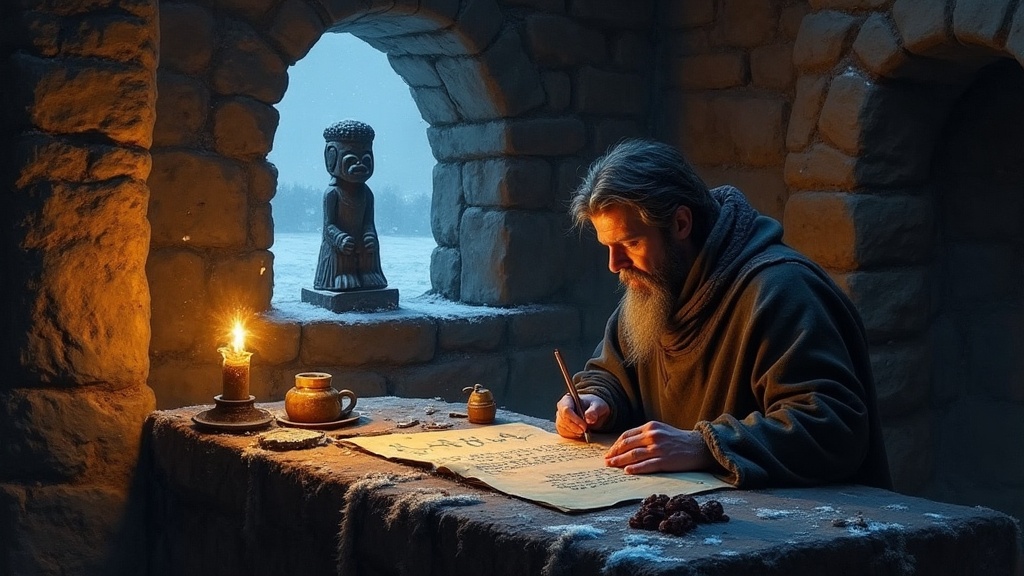
Norse
The Prose Edda and Poetic Edda: Primary Sources of Norse Myth
The Prose Edda and Poetic Edda are the two great written pillars of Norse mythology, preserved in medieval Iceland centuries after the gods had stopped receiving sacrifices. Without them, Odin, Yggdrasil, and Ragnarok would be shadows.
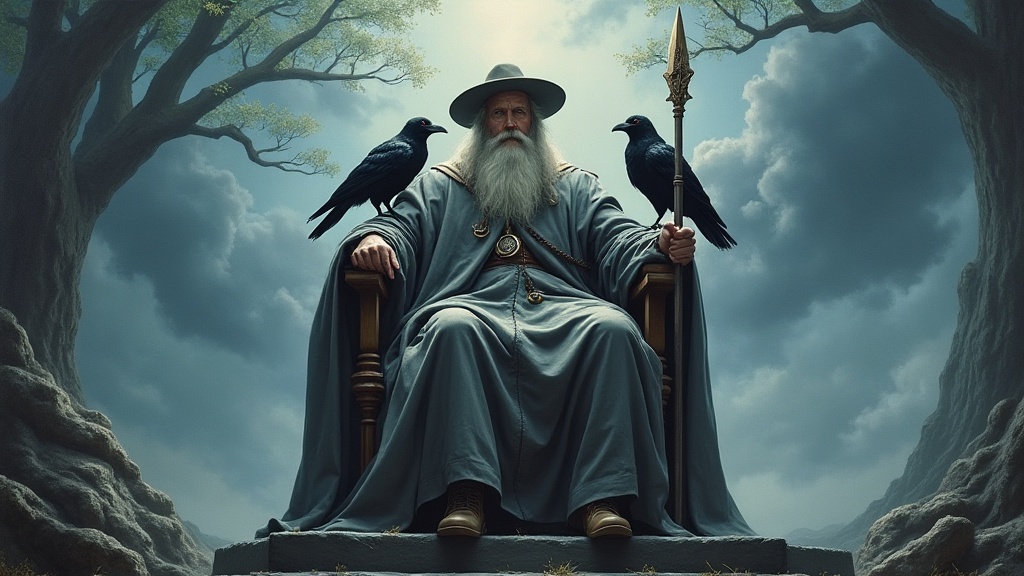
Norse
Odin: Allfather of Asgard
Odin stands at the center of Norse cosmology as ruler, wanderer, and keeper of forbidden wisdom. His contradictions make him the most haunting deity in the Germanic pantheon.
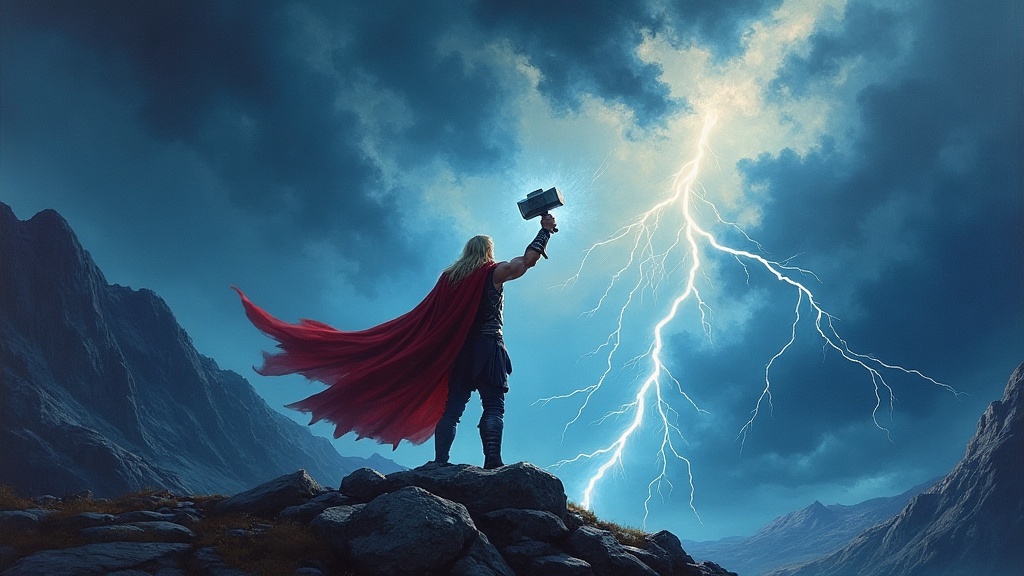
Norse
Mjolnir: The Sacred Symbol of Thor's Hammer
Mjolnir, the hammer of Thor, is one of the most potent symbols in Norse mythology, a weapon of divine thunder, a ward against chaos, and a mark of sacred covenant worn by Vikings for centuries.
Norse
Yggdrasil the World Tree: Axis of the Norse Cosmos
Yggdrasil the World Tree stands at the center of Norse cosmology, binding nine worlds in its roots and branches. Explore the myths, creatures, and sacred meanings woven into its eternal bark.