
Nephthys: The Egyptian Goddess of Mourning and the Hidden
Nephthys was the ancient Egyptian goddess of mourning, death's shadow, and the boundaries between worlds. Her cult shaped how Egyptians grieved and protected their dead from the chaos of the underworld.
Contents
The Woman at the Threshold
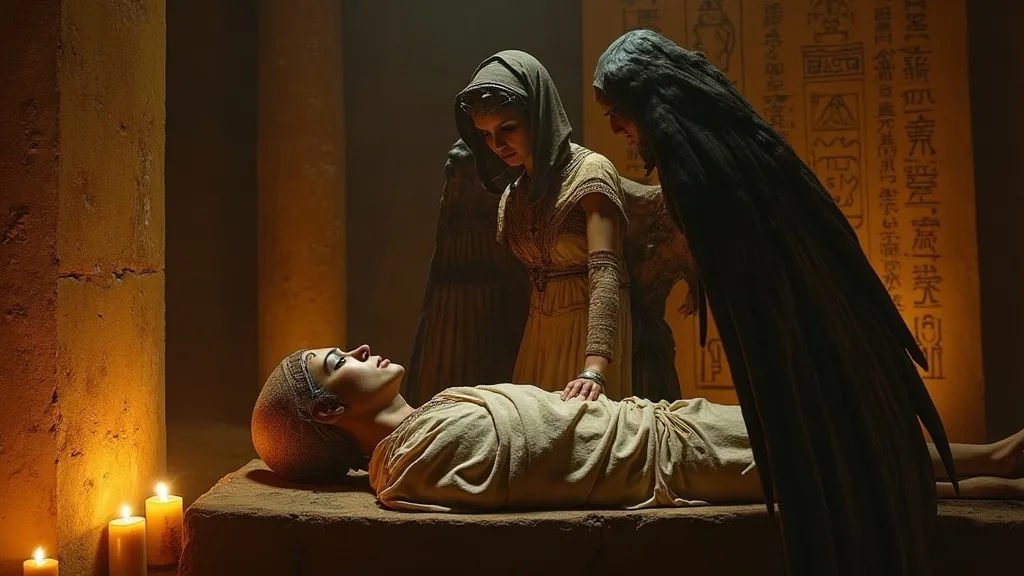
A woman in shadow stands at the edge of life. Her wings unfold across the chamber where a body rests, and the air grows heavy with purpose. This is Nephthys the mourning goddess, one of ancient Egypt's most misunderstood deities. Her name meant "the Lady of the House" in ancient Egyptian, yet she presided not over domestic life but over death, mourning, and the liminal spaces where the living and dead meet. Where her sister Isis embodied love and magical power, Nephthys represented the necessary darkness: the tears that fall, the secrets kept, the transformation that comes when life ends.
For over three thousand years, bereaved Egyptians called upon her. Not to resurrect the dead, not to deny loss, but to honor it. Nephthys appears in tomb inscriptions, funeral prayers, and the mystery rites of Abydos. Yet outside Egypt, her name has faded. The world remembers Isis, remembers Osiris, sometimes remembers Set. Nephthys waits in the margins. This article restores her to view.
Family and the Divine Genealogy
Nephthys emerged from Egypt's oldest creation account. In the Heliopolitan Ennead, the nine fundamental deities that shaped reality, she was the daughter of Geb (the earth) and Nut (the sky). Her siblings were Osiris, Isis, and Set. The papyri tell a crucial detail: her father was Geb, but her true husband was Set, the chaotic god of deserts and storms. This marriage was cold, joyless, a cosmic arrangement rather than a love match. Set was disorder made flesh; Nephthys stood beside him not in passion but in duty.
The irony was deliberate. Nephthys, goddess of boundaries and protection, was bound to the force most hostile to order. Their relationship produced one child: Anubis, the jackal-headed god of mummification and the dead. In some traditions, Anubis was the son of Nephthys and Osiris after Set killed him. The ambiguity was intentional. Anubis belonged to death itself, and his parentage reflected that liminal nature. Nephthys, whether wife or unwilling partner, remained the maternal presence at the threshold of death.
Nephthys and the Death of Osiris
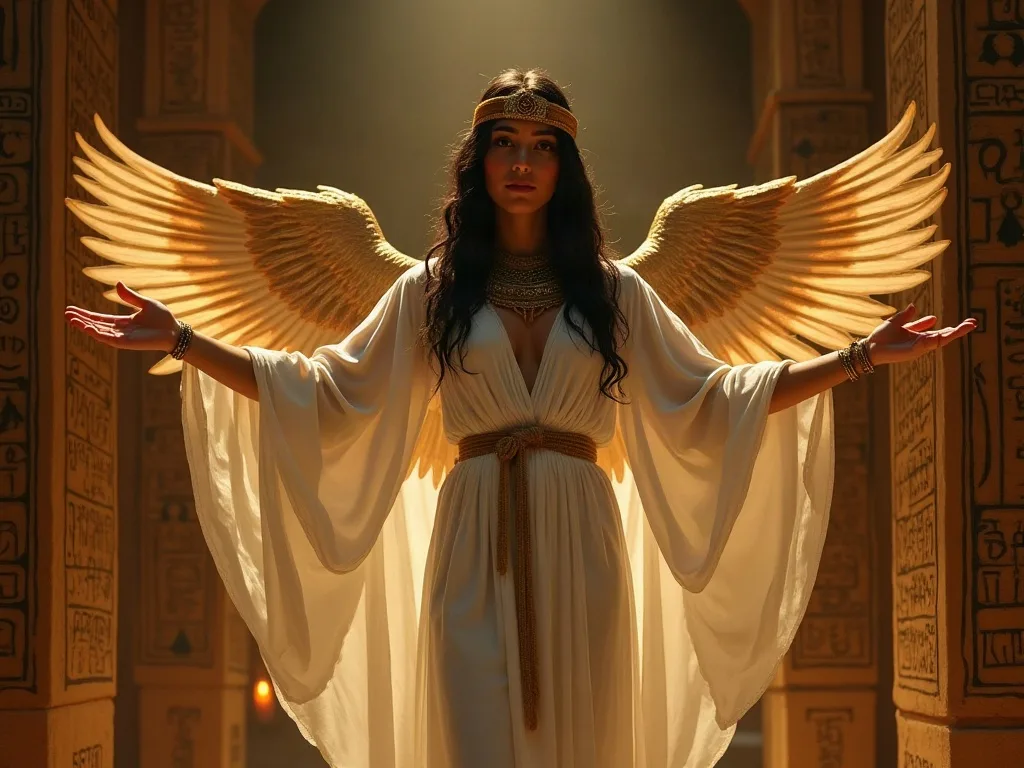
The defining myth of Nephthys the mourning goddess unfolds in the tragedy of Osiris. Her brother, the king of Egypt and god of the Nile's inundation, was murdered by Set. Set, consumed with jealousy over Osiris's rightful reign, tore him into fourteen pieces and scattered them across Egypt. Panic seized the divine and mortal worlds alike.
Isis acted first, using magic to restore Osiris's body. But Nephthys, often overlooked in retellings, played an equally vital role. She and Isis searched across Egypt together, gathering the scattered pieces of their brother's corpse. The Coffin Texts, funerary inscriptions from around 2000 BCE, describe their anguish and their labor. Nephthys, the quieter sister, never ceased searching. She found what Isis could not reach. Together they reassembled him.
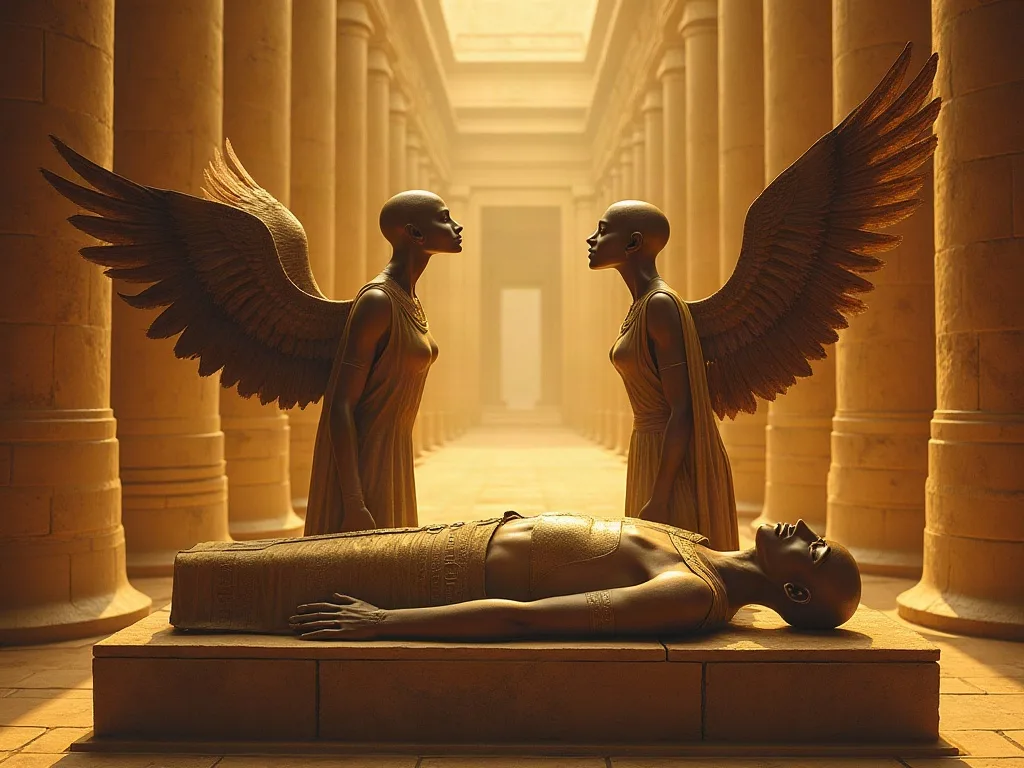
Then Nephthys did what only she could do: she stood guard. When Osiris was restored but still trapped between life and death, Nephthys assumed her role as protector of the dead. She guarded his tomb. She shielded him from Set's renewed attacks. In some papyri, she and Isis are depicted as birds with human heads, hovering over Osiris's corpse, their wings spread in eternal watchfulness. This image became iconic: the two sisters united in grief, transforming it into vigilant power.
Nephthys did not resurrect Osiris. That was Isis's domain. She did something more subtle and permanent: she honored the boundary between death and life by standing in it herself, refusing to let the dead be forgotten or destroyed.
The Hieroglyph and Names
In hieroglyphic script, Nephthys was written as Nfṯ-ḥw.t, sometimes simplified as a woman wearing the symbol of her name on her head: a rectangular basket or house-shape crowned with feathers. The name literally meant "the House's Lady," but Egyptians understood it deeper. Her "house" was the realm where the dead rested, the space between burial and eternity. She was the keeper of thresholds.
She had other titles too. "Foremost of the Wailing Women," the inscriptions called her. "She of the Boundary." "The One Who Finds What Is Lost." Each title revealed a facet. She was not a benign mourner but an active force who moved through loss and emerged transformed. In the Book of the Dead, a collection of spells and prayers for the afterlife, Nephthys is invoked to protect the deceased from chaos. Her power was not gentle; it was fierce and focused.
The Cult and the Priesthood
Nephthys the mourning goddess was worshipped in temples across Egypt, though her major shrines were less prominent than those of Isis or Osiris. At Abydos, the sacred city where Osiris was believed to be buried, Nephthys held a place of honor. During the annual festival of Osiris, which lasted several days and drew pilgrims from across the kingdom, Nephthys was invoked by professional mourners called the "Kites."
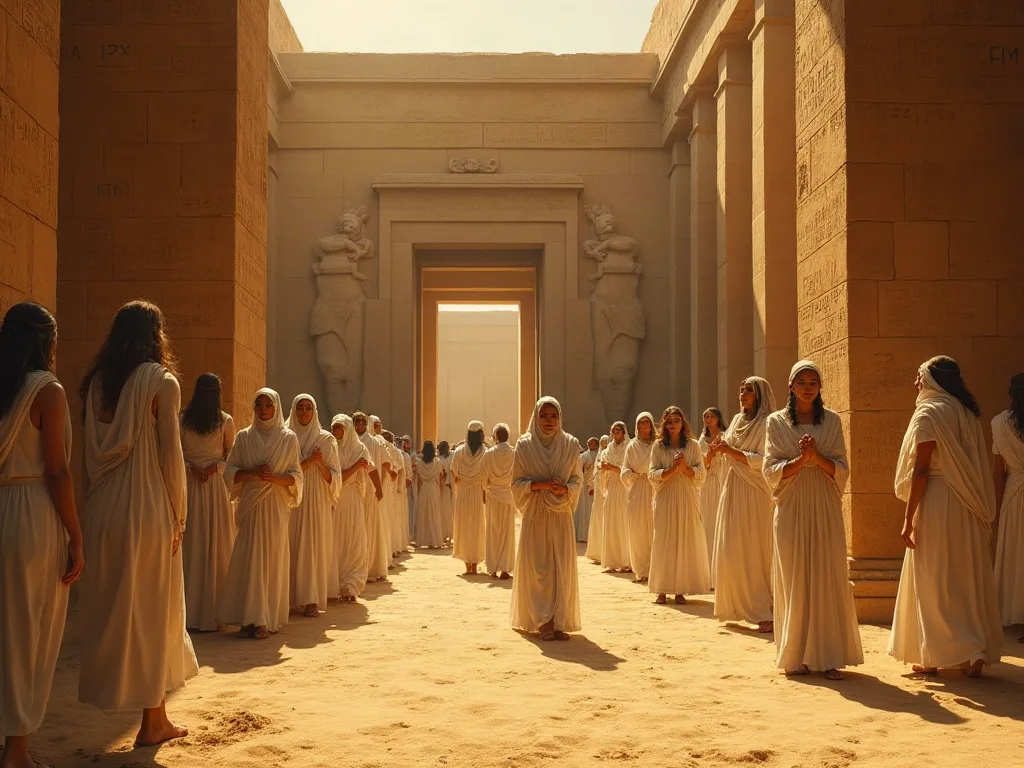
These kites were priestesses or hired women who enacted the roles of Isis and Nephthys. They sang ritual laments. They tore their garments and beat their breasts in prescribed patterns. They gave voice to grief in a way that channeled chaos into meaning. Modern scholars sometimes dismiss these rituals as mere theater, but Egyptians understood them as sacred work. By embodying the divine sisters' grief, the mourners participated in cosmic order. They made private loss into public, witnessed, transformed loss.
In tombs belonging to wealthy Egyptians, especially during the New Kingdom (1550-1070 BCE), Nephthys appears alongside Anubis. The tomb owner wanted her protection in the afterlife. On coffins and tomb walls, spells called upon her: "Nephthys, spread your wings over me and protect me." These were not requests for comfort but for survival. The dead would face trials, demons, the weight of judgment. Nephthys's vigil would shield them.
Nephthys and Anubis: Mother and Child
The relationship between Nephthys and Anubis deepens the theme of guardianship. Anubis, the jackal-headed god of embalming and mummification, was her son. As the child of death itself, Anubis inherited his mother's role as threshold-keeper but added the element of transformation. While Nephthys mourned and protected, Anubis actively worked to preserve the dead. He supervised the mummification process. He invented the sacred rites that would allow the body to survive eternity.
Nephthys taught her son that death was not failure. It was a passage that demanded craft, respect, and presence. The Egyptian mummifier, the sAw, was said to embody both Anubis and Nephthys: the knowledge of how to preserve the body (Anubis) and the spiritual gravity of what was being done (Nephthys). Statues of Anubis often showed him with his mother nearby, or wore the symbols of her protection. In funerary texts, the two are inseparable. To invoke Anubis was to honor Nephthys. To accept Anubis's guardianship was to trust Nephthys's vigil.
The Mourning Rites and the Transformation of Grief
What made Nephthys the mourning goddess unique was her teaching about grief itself. Egyptian funerary culture did not try to suppress tears or move quickly past sorrow. Instead, Nephthys's cult sanctified mourning as a spiritual practice. To mourn well was to honor the dead and protect order.
The lamentation was a central rite. Led by priestesses who took the names of Isis and Nephthys, the lamentation involved rhythmic wailing, poetic invocations, and the re-enactment of the search for Osiris. These were not hysterical outbursts but choreographed, meaningful expressions of loss. The mourners would sing of the dead person's virtues, the emptiness left behind, the hope for their safe passage to the afterlife. Nephthys, through the priestess, transformed raw grief into a container that could hold both pain and purpose.
In private homes, the family would also perform rituals of mourning. They would call upon Nephthys by name. They would leave offerings of bread, beer, incense, and flowers at the tomb. Over time, these acts became less about immediate pain and more about maintained connection. Nephthys's role evolved beyond the funeral into a permanent relationship: the family, like Nephthys herself, would stand eternal guard over the memory of the dead.
Nephthys and the Weighing of the Heart
In the Book of the Dead, the most elaborate ancient Egyptian text about the afterlife, Nephthys appears in one of the most critical scenes: the Hall of Two Truths, where the dead face judgment. The deceased's heart is weighed against the feather of Ma'at, the goddess of truth and cosmic order. Anubis presides over the scales. Osiris sits in judgment. And Nephthys stands by, watchful.
Her presence here is essential. She is not judging; she is witnessing. The dead person must account for their life, their actions, their truth. Nephthys's role is to ensure that this accounting is real, not falsified, not denied. She stands for the inescapable reality of death and its moral weight. In a text sometimes called the "Declaration of Innocence," the deceased swears an oath of truth before Nephthys and other gods. Her name on that oath was a binding force.
This reflects a deeper Egyptian understanding: Nephthys the mourning goddess was also a truth-keeper. Mourning, in the Egyptian worldview, required honesty. You could not mourn falsely. You could not claim love for someone you had harmed. Nephthys enforced this integrity. Her wings, spread over the dead, promised both protection and accountability.
Comparative Echoes Across Ancient Cultures
The figure of Nephthys echoes in mourning goddesses across ancient Mediterranean and Near Eastern traditions. Lilith in Jewish mysticism, Hecate in Greek tradition, and the banshees of Celtic myth all share some of Nephthys's attributes: they move at the boundaries of life and death, they wail and lament, they stand apart from ordinary society. Yet Nephthys is distinct. She is not demonized or feared. She is honored as performing essential sacred work.
In Mesopotamian tradition, the goddess Ereshkigal rules the underworld, but she rules it with distant authority. Nephthys is more intimate. She does not command from a throne but stands beside the dead as a companion in transition. The Sumerian Inanna descends to the underworld and returns; Nephthys accompanies those who do not return, ensuring they are not abandoned. Different mythologies, different temperaments, different solutions to the problem of death.
Nephthys in the Mystery Cults and Abydos
By the time of the New Kingdom, Nephthys had become central to the mystery rites at Abydos, the sacred necropolis where Osiris was said to be buried. These were not public festivals but initiated ceremonies, secrets kept by the priesthood and revealed only to those deemed worthy. Pilgrims would travel to Abydos to participate, to witness the sacred drama of Osiris's death and restoration.
Nephthys played a crucial role in these rites. She was not merely represented but embodied. A priestess wearing the regalia of Nephthys, her features painted to match the divine image, would move through the temple in ritualized procession. She would perform the search for Osiris. She would perform the mourning. For the initiated participant, watching this priestess was not watching an actress but witnessing a god made flesh, a divine action made present and real.
The mysteries taught that death was not an ending but a transition. Nephthys's presence, her constancy, her refusal to abandon the dead, offered assurance. If you could trust Nephthys, you could trust the process. Your loved ones, your own future self, would not be alone.
The Decline and the Modern Recovery
With the rise of Christianity and the fall of Egypt's native religious traditions, the worship of Nephthys ended around the 4th and 5th centuries CE. Her temples were abandoned or converted. Her names were forgotten outside scholarly circles. For over fifteen hundred years, Nephthys the mourning goddess was unknown to most of the world.
The modern recovery began with Egyptology in the 19th century. As scholars deciphered hieroglyphics and excavated tombs, Nephthys returned to view. Early Egyptologists, shaped by their own Victorian attitudes toward grief and emotion, sometimes misunderstood her. They saw her as secondary, a supporting player to Isis. Recent scholarship has corrected this. We now recognize her as a independent power, a complex theology unto herself.
Contemporary pagans and spiritual practitioners have also embraced Nephthys. In modern religious traditions that look back to ancient Egypt, she is invoked as a guide for grief work, as a presence during times of loss, as a reminder that sorrow has dignity and purpose. This is not reconstructionism; it is contemporary religion learning from the past. It reflects something true in the ancient cult: Nephthys speaks to a need that transcends centuries. Everyone grieves. Everyone needs to know that grief can be held, honored, and transformed.
Frequently Asked Questions About Nephthys
Frequently asked questions
Was Nephthys ever worshipped alone, or only alongside Isis?
Nephthys had independent temples and worship sites, though she is more often depicted with Isis in tomb art and ritual texts. At Abydos, she was central to the mystery rites of Osiris. However, she did not accumulate as large a popular cult following as Isis, who became increasingly prominent in the Greco-Roman world. Nephthys was more the concern of those directly involved with death rites: embalmers, tomb builders, professional mourners, and families preparing for the afterlife.
Why did Nephthys remain married to Set if he was evil?
In Egyptian theology, marriage was not primarily about love but about cosmic function and balance. Nephthys's bond with Set demonstrated that even chaos and disorder had a place in creation. By standing beside Set, even as an unwilling or cold wife, Nephthys showed that boundaries and protection existed even at the edges of chaos. Some scholars suggest the myth encoded social anxieties about maintaining order in a harsh world. Others interpret it as teaching that you could neither escape nor destroy disorder; you could only contain it through discipline and vigilance.
What was the relationship between Nephthys and the mummification process?
Nephthys did not perform mummification directly; that was her son Anubis's domain. However, she sanctified the practice through ritual and magical invocation. Mummifiers would call upon Nephthys to protect the dead person's body and spirit during the lengthy process of preservation. Spells from the Book of the Dead and the Pyramid Texts invoke her protection over the corpse as it was washed, dried, wrapped, and treated with oils and resins. She was the guardian presence that made the work sacred rather than merely practical.
Did Nephthys have any enemies or conflicts with other gods?
Nephthys's main tension was with her husband Set, though it was a cold marriage rather than an outright conflict. Set, as the god of chaos, represented everything Nephthys opposed through her role as boundary-keeper and mourning guide. Yet she did not fight him or diminish his power. Some texts suggest a deeper ambiguity: Nephthys may have had sympathy for Set, or at least a grudging acceptance of his nature. She stood apart from most divine conflicts, focused on her role as protector of the dead and honored guide of grief. Her power lay in her detachment from the political dramas of Olympus-style myths.
How do we know about Nephthys if she was less popular than Isis?
Our knowledge of Nephthys comes from the same sources as Isis: temple inscriptions, coffin texts, papyri, and tomb art. She appears consistently in funerary literature, which was abundant because every wealthy Egyptian prepared extensively for the afterlife. The Pyramid Texts, carved inside pyramids from around 2400 BCE onward, invoke Nephthys repeatedly. The Book of the Dead, compiled during the New Kingdom, includes numerous spells calling upon her. While she appears less often in popular religious texts than Isis, she is extensively documented in death-related literature, which preserves her story for us.
The Enduring Legacy of Nephthys the Mourning Goddess
Nephthys the mourning goddess teaches a lesson that modern culture often resists: that grief is sacred work, that loss needs witnessing and honor, that the dead require a permanent guard. She did not promise to make sorrow disappear. Instead, she offered presence, structure, ritual, and the assurance that one was not alone in darkness.
Contemporary culture tends to move through grief quickly, to "process it" and move on. Nephthys suggests an older way: to slow down, to allow the mourning to unfold, to invite community into the work of remembering. Her cult was not about denial of death but radical acceptance of it, met with dignity and care.
In the museums of Cairo, London, and New York, statues and papyri depicting Nephthys remain. In tombs in the Valley of the Kings, her image still guards the dead. And in the practices of contemporary spirituality and grief work, her influence lives on, sometimes named, sometimes unnamed. Wherever someone chooses to honor loss rather than escape it, wherever someone stands vigil for the forgotten, wherever ritual transforms chaos into meaning, Nephthys is present.
Free 25-page sample
Want the whole story?
Take the first 25 pages free. If it pulls you in, the full edition is yours as an instant PDF download, with a paperback on Amazon for selected titles.

Mythology
The World Mythology Book: The Gods, Heroes and Myths of Every Culture
The Gods, Heroes and Myths of Every Culture, in One Volume
The whole of world mythology in a single volume: Greek, Norse, Egyptian, Japanese, Hindu, Celtic, Slavic, Mesoamerican and African myths gathered side by side, each drawn from the primary sources.