

Nut the Sky Goddess: Egypt's Cosmic Mother and Boundary of Creation
Nut arches over creation itself, her star-studded body the boundary between order and chaos. Meet Egypt's supreme sky deity: her role in resurrection, her relationship to the sun god, and why she mattered to every ancient Egyptian who looked up.
Contents
Nut does not sit on a throne. She stretches across the cosmos, her body a living vault of stars, her belly the night sky, her limbs the four cardinal directions. Every dawn, the sun god Ra crosses her interior in his sacred boat, and every dusk he is swallowed by her mouth, only to be born again in the morning. She is not metaphor. To the ancient Egyptian, she was the literal structure of existence, the cosmic mother who held all life in her span.
Her name sounds simple in our ears: Nut. In Egyptian hieroglyphs, she appears as a woman arched backward or stretched overhead, her body painted deep blue or black and speckled with stars. Sometimes she wears the water sign, the sign of infinity itself. She is the opposite of everything fixed; she is movement, boundary, and the perpetual circulation of divine energy through the universe.
The Egyptians did not imagine creation as a single act of conquest or command. They saw it as an act of separation. Before time began, all things were water, a chaos called Nun. From this primordial ocean, the gods emerged. Shu, the god of air and dryness, held up Nut, and she became the sky. Beneath her stretched Geb, the earth god. Shu stood between them, holding them apart, and in that gap creation became possible. Nut and Geb had been lovers; now they were separated. Their separation was the price of order.
The Cosmic Body: Nut's Role in Egyptian Cosmology
Nut was not merely decoration. She was the fundamental structure that made the daily rebirth of the sun possible. Every pharaoh and every common person depended on her. Without her, without her body as the path and boundary, Ra could not travel, and without Ra's daily journey, the world would spiral back into chaos.
The Egyptians understood the night sky as her body. Her name itself may derive from a word meaning "the sky" or "the waters above." In temple ceilings and tomb walls, she appears stretched across the heavens, sometimes supported by Shu or by attendant deities. The stars in the Egyptian calendar were called the "Decans", and each represented a segment of Nut's body. To understand the stars was to understand the goddess herself.
Her role was intimate and absolute. When a dead pharaoh died, he did not simply vanish. He entered Nut's body and traveled with Ra through the night, battling the serpent of chaos called Apophis to ensure dawn came again. The pharaoh became part of the cosmic cycle, part of Nut's eternal function. Common people too expected this: they would be wrapped in linen painted with images of Nut, placed in tombs where ceiling paintings showed her arch, so they would be born again through her just as the sun was born again each morning.
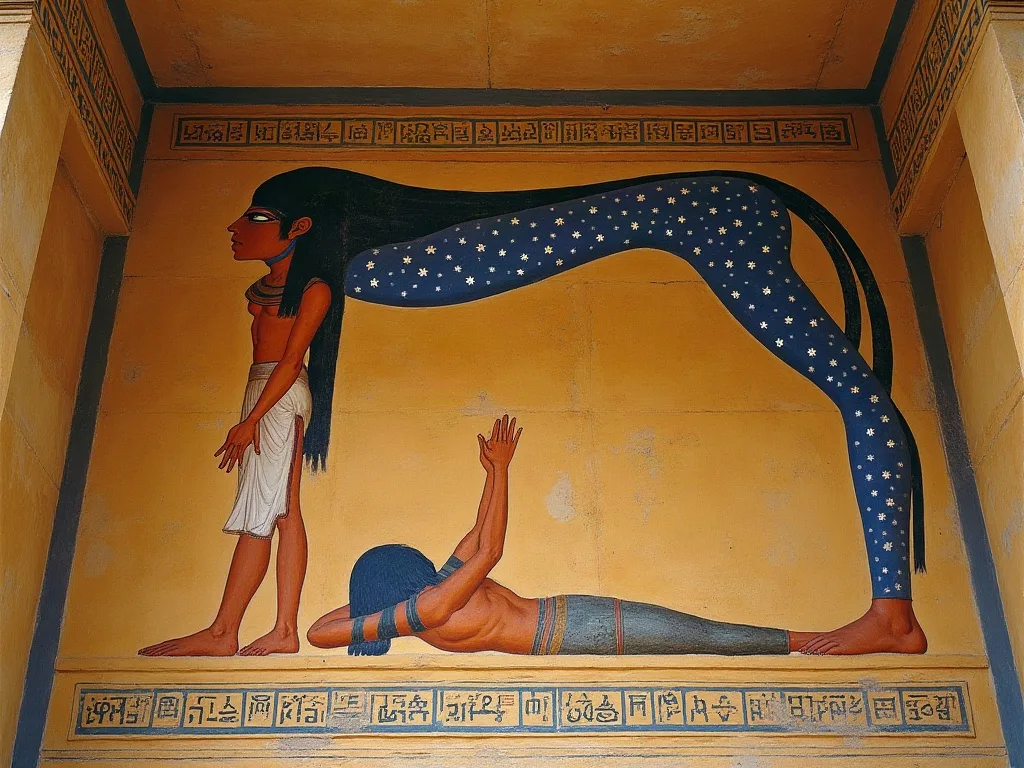
Nut's separation from Geb, her former partner, was not a myth of tragedy but of necessity. In some versions, they had been so intertwined that creation could not occur. Shu, the air god, was their son, and he forced them apart by positioning himself between them. This was cosmologically essential: without distance between earth and sky, nothing could grow, nothing could exist. The gap Shu created became the space where all life unfolded.
The Sun's Journey: Ra and Nut's Sacred Cycle
The most important part of Nut's mythology centers on her relationship with Ra, the sun god. Each day, Ra was born from her body at dawn. Each night, he died entering her mouth, traveling through her body as a deceased traveler, only to be reborn the next morning. This was not metaphorical for the Egyptians; this was literal cosmic fact, visible every single day.
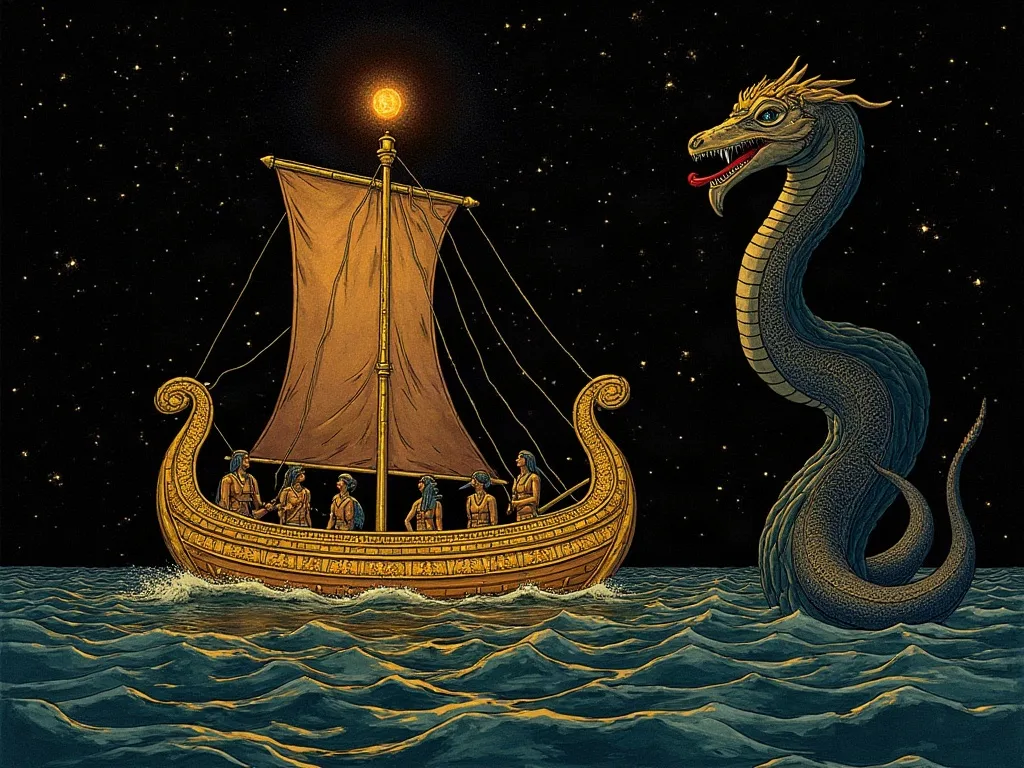
The sun's nightly journey through Nut's body was treacherous. Ra traveled in a boat called the Mandjet during the day, and at night he entered the Mesektet, a night barque, to make the passage through the Duat, the Egyptian underworld. Inside Nut, he faced Apophis, a colossal serpent of chaos and darkness who sought to prevent his rebirth. Ra, accompanied by other gods and sometimes by the pharaoh's spirit, would battle Apophis and defeat him, ensuring the sun would rise again.
This daily resurrection was the model for all Egyptian resurrection. The pharaoh, and eventually every person, hoped to follow Ra's path. To be born into Nut's body at death, to travel through the darkness, to emerge triumphant into the light: this was the promise of the afterlife. Without Nut, this cosmic rebirth was impossible. She was not a bystander to creation; she was its engine.
Some texts show Nut as protective of Ra as well. In the Book of the Dead, a collection of spells and instructions for the afterlife, Nut speaks to the deceased in a voice of comfort and assurance. She promises them that just as Ra is reborn each day, so too will they be reborn. Her body becomes a sanctuary, not a threat.
Birth of the Gods: Nut as Divine Mother
Beyond her cosmic function, Nut was also a mother. According to the Pyramid Texts, some of Egypt's oldest religious writings carved into tombs around 2400 BCE, Osiris, Isis, Set, and Nephthys were the children of Nut and Geb. She bore them not in a single birth but across four consecutive days. These four deities became central to Egyptian mythology and religion.
Osiris, born on the first day, became the god of the Nile's fertile floods and the afterlife, the judge of the dead. Isis, born on the second day, became a goddess of motherhood, magic, and loyalty. Set, born on the third day (or some texts say he tore his way out), became the god of chaos, the desert, and violent storms. Nephthys, born on the fourth day, became the protector of the dead and sister to Isis.
Why four consecutive days? Because the Egyptian calendar originally had only 360 days, and these four extra births took place outside normal time, in sacred time. This reflected a deeper truth: the gods operated in a different order than the human world. Nut's pregnancy and birth transcended the ordinary rules of existence, marking her as fundamentally different from human mothers, however much she loved her children.
Her relationship with her son Osiris became one of the most important in Egyptian mythology. When Osiris was murdered by his jealous brother Set, Nut could not reverse death, but she grieved deeply. The mythology of Osiris and his resurrection, which became the template for Egyptian afterlife belief, unfolded partly under her watch and within her cosmic domain.
Worship and Veneration: Nut in Temple and Tomb
Nut received worship across Egypt, though she was not as prominent in popular religious practice as gods like Osiris or Amun. Her veneration was more intellectual, more cosmological. She was worshiped primarily by scribes, priests, and the educated elite who understood the complexities of Egyptian theology.
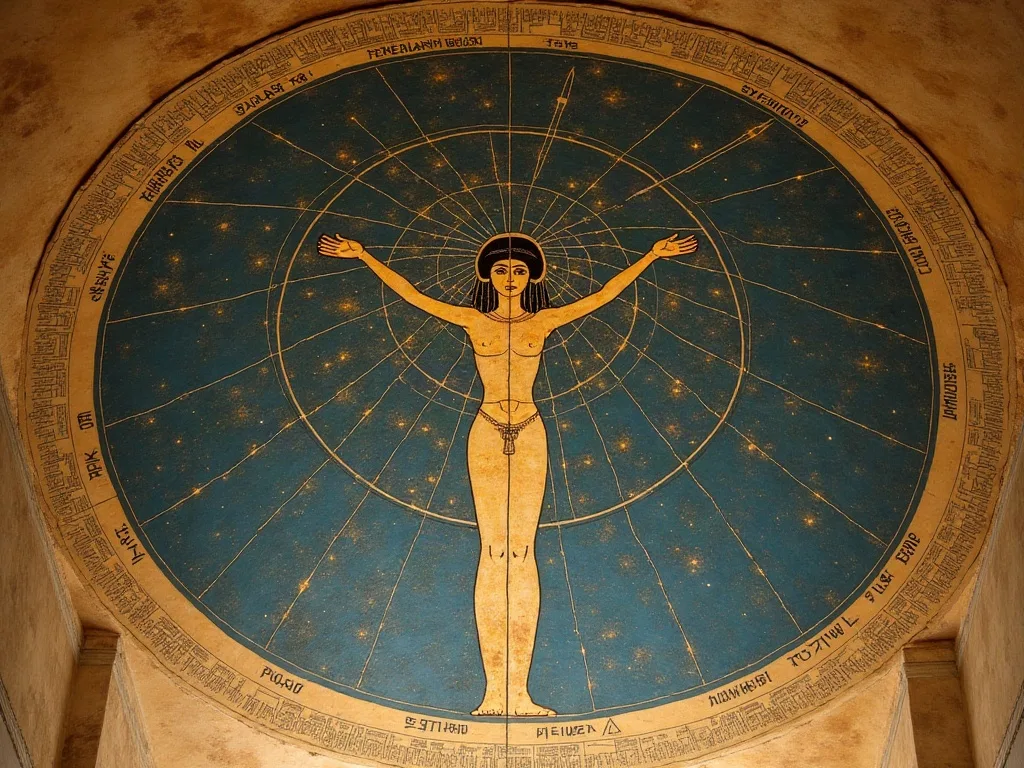
In temples, she appeared in astronomical ceilings. The most famous surviving example is in the Tomb of Senmut, a high official of the New Kingdom (around 1480 BCE), where the ceiling shows a detailed star map with Nut's figure arching overhead. Other temple and tomb ceilings similarly depicted her body as the night sky, complete with the paths of the sun and other celestial bodies.
Her primary temple was at Dendera, where she shared a sanctuary with Hathor and other deities. However, she was not one of the great state gods with enormous temples and vast priestly establishments. Her worship was more subtle, woven into the fabric of cosmic theology rather than dramatized in public festivals like those dedicated to Osiris or the inundation of the Nile.
Yet her presence was inescapable. Any Egyptian who looked up at the night sky saw her. Any deceased person placed in a tomb saw her image on the ceiling above them. She was the visual and spiritual backdrop to all existence. Spells and prayers invoked her protection and her promise of renewal. Amulets bore her image. Her name appeared in countless religious texts.
The Star Goddess: Nut's Astronomical Identity
The Egyptian understanding of Nut merged mythology with practical astronomy. She was not an abstract concept but the observable sky, mapped and measured. The Egyptians understood the movement of the stars, the cycles of the moon, and the path of the sun. They integrated all of this into their theology of Nut.
The Decans, the thirty-six stellar groups visible in the Egyptian sky, were understood as parts of Nut's body. The brightest star visible to Egyptian astronomers was Sirius, called Sothis or Sopdet in Egyptian, and it held immense significance. The rising of Sirius marked the beginning of the Egyptian new year and the season of the Nile flood. It was, in a sense, the moment of Nut's renewal, the moment when her cosmic cycle began again.
Some of the most complex Egyptian texts dealing with time, astronomy, and theology discuss Nut in explicitly cosmic terms. The Egyptians were not primitive in their understanding of the heavens; they were careful observers and record-keepers. Nut embodied their knowledge and their reverence for the ordered cosmos they observed.
Her identity as the star goddess also made her a protector of the pharaoh's journey after death. The pharaoh, like the sun, would follow a stellar path through the afterlife. Nut would guide him as she guided Ra. Spells in the Pyramid Texts speak of the pharaoh becoming a star in the sky, an indestructible soul that would endure forever like the stars in Nut's body.
Nut and Other Goddesses: Distinct Yet Connected
Nut was sometimes confused or merged with other Egyptian goddesses, particularly Hathor and Sekhmet, yet she remained distinct in essential ways. Hathor was often the sky goddess in Heliopolis, the theological center of northern Egypt. Yet Hathor embodied the nurturing, sensual side of the divine feminine, while Nut embodied the cosmic, structural, necessary side.
Similarly, Sekhmet, the fierce lioness goddess, represented the destructive power of the sun, while Nut represented the sun's cosmic path and rebirth. Sekhmet was Ra's fierce protector and the goddess of plague and healing; Nut was Ra's container, the space through which he traveled.
The boundaries between Egyptian deities were often porous. A goddess could have multiple names or identities depending on context or region. Yet Nut's fundamental role as the sky, as the boundary between chaos and order, remained consistent across Egypt and through Egyptian history.
The Afterlife Promise: Resurrection Through Nut's Body
For the ancient Egyptian, Nut's greatest promise was resurrection. The Book of the Dead, compiled over centuries but reaching its classical form by the New Kingdom, repeatedly assures the deceased that they will be born again, just as the sun is born again each day. This promise was rooted in Nut's body and function.
Funerary texts spoke directly to Nut, pleading with her to protect and nurture the deceased. The dead person would say, "I am born with Nut," aligning themselves with the sun's daily rebirth. Tomb paintings showed the deceased traveling through Nut's body, sometimes with Ra, sometimes with Osiris, always with the promise that they would emerge into new life.
The Egyptian afterlife was not a passive heaven. It was active, cyclical, and connected to the daily renewal of the cosmos. Every Egyptian wanted what the sun had: the certainty of return, the knowledge that death was not the end but a transformation within a larger cycle. And that cycle, that promise, that guarantee of return, all depended on Nut. She was not symbolic of renewal; she was the mechanism of renewal.
When a pharaoh died, he became Osiris, the dead king reborn. But he also took on solar aspects; he became one with Ra. Both paths led through Nut. The pharaoh's tomb was designed as a microcosm of Nut's body, the coffin placed beneath a ceiling showing her star-studded form. The living pharaoh ruled in the world of day; the dead pharaoh ruled in the world of Nut.
Regional Variations and Historical Development
Nut's mythology evolved over Egypt's three-thousand-year history. In the Old Kingdom (around 2686 to 2181 BCE), reflected in the Pyramid Texts, she appears as a protective mother and cosmic boundary. By the Middle Kingdom, her role became more explicitly tied to the daily resurrection of the sun and the pharaoh's afterlife journey.
In the New Kingdom (around 1550 to 1077 BCE), when the great temples of Luxor and Karnak were built, Nut became integrated into increasingly complex theological systems. She was merged with Hathor in some regions, understood as an aspect of Amun in others, yet her core identity remained: the sky, the boundary, the space through which the sun traveled.
Different Egyptian cities emphasized different aspects of Nut. In Memphis, the theological capital of the Old Kingdom, she was primarily the sky boundary. In Heliopolis, center of sun worship, her relationship to Ra took precedence. In Thebes (Luxor), during the New Kingdom, she became part of a more elaborate cosmological system involving Amun-Ra and the mysteries of hidden dimensions.
By the Greco-Roman period, when Ptolemaic Greeks ruled Egypt, Nut appeared in hybrid forms, sometimes identified with the Greek Rhea or other celestial goddesses. Yet among native Egyptians, her worship and imagery remained rooted in ancient theology.
Nut in Modern Interpretation and Scholarly Debate
Modern Egyptologists continue to debate aspects of Nut's mythology and significance. Some scholars emphasize her role as a protective mother figure, while others stress her function as a cosmic structural necessity. The richness of Egyptian theological texts allows for multiple interpretations.
One significant scholarly question concerns the nature of Nut's separation from Geb. Was this a tragic loss, a necessary sacrifice, or simply a neutral cosmological event? Egyptian texts treat it as necessary and correct, but the emotional weight varies. Some traditions emphasize Nut's longing for Geb, others focus on the beauty of the ordered cosmos their separation made possible.
Another debate involves the relationship between different sky goddesses in Egyptian theology. Why did Egypt have multiple sky or cosmic goddesses (Nut, Hathor, Sekhmet, Neith)? Some scholars see this as regional variation; others argue each goddess represented different aspects of the sky or different theological systems developing over time. Nut's role as specifically the boundary between chaos and order, as the literal structure of the cosmos, seems distinct even when other goddesses also claimed sky associations.
The astronomical sophistication of Egyptian Nut theology is increasingly recognized. Recent scholarship has demonstrated that Egyptian priests understood celestial mechanics in sophisticated ways, and Nut mythology encodes real astronomical knowledge alongside theological meaning.
Why Nut Still Matters: The Cosmic Mother Today
Nut's mythology speaks to something fundamental in human consciousness: the need to understand the cosmos as ordered, purposeful, and renewing. She represents the principle that death is not final, that endings contain the seeds of new beginnings, that the universe operates according to knowable laws that repeat.
Modern readers often approach Nut through the lens of feminist spirituality, celebrating her as a powerful female figure who contains all existence. Others study her to understand ancient Egyptian cosmology and astronomy. Still others find in her mythology a metaphor for psychological renewal, the daily resurrection we all hope for.
For the ancient Egyptian, these were not separate meanings. Nut was simultaneously literal sky, theological principle, astronomical map, and spiritual guide. She was the mother who promised that what dies will be born again, and that promise was written in the stars.
Frequently asked questions about Nut the sky goddess?
Frequently asked questions
What was Nut's relationship to Ra, and why did he travel through her body?
Ra was born from Nut's body each dawn and died entering her mouth each dusk, traveling through her interior during the night. This daily cycle symbolized the sun's journey and served as the model for all Egyptian resurrection. Without Nut's body as the cosmic path, Ra's renewal would be impossible, and creation would collapse into chaos. The journey was also dangerous: Ra had to battle the serpent Apophis inside Nut to ensure his rebirth.
Did the ancient Egyptians worship Nut as a major deity with temples and festivals?
Nut received veneration primarily from the educated elite, scribes, and priests rather than through large public temples or major festivals like Osiris received. Her worship was more theological and intellectual than populist. Yet her presence was inescapable: every tomb ceiling showed her, every funerary spell invoked her, and her role in the afterlife made her essential to everyone's hope for resurrection.
How did Nut give birth to Osiris, Isis, Set, and Nephthys across four days?
According to the Pyramid Texts, Nut bore these four deities on four consecutive days outside the normal Egyptian calendar, which originally had only 360 days. These births occurred in sacred time, not ordinary time, reflecting the gods' transcendence of human rules. This mythology explained why these four fundamental deities existed and linked them all to a common divine mother.
What did Nut's hieroglyph or symbol look like?
Nut appeared in hieroglyphic art as a woman with her body arched backward or stretched horizontally across the sky, often painted deep blue or black and covered with stars. Sometimes she wore the water sign (a wavy line) on her head, representing the waters above the sky. In some depictions, she was supported by Shu, the air god, standing between her and Geb, the earth god.
How did Nut differ from other Egyptian sky goddesses like Hathor?
While both could embody the sky, Nut represented the sky as a cosmic boundary and structure essential to creation, while Hathor embodied the nurturing, sensual, and protective aspects of the divine feminine. Nut's role was fundamentally structural: her separation from Geb by Shu made all existence possible. Hathor's functions were more aligned with love, fertility, and the sun's feminine aspects.
Why did tomb ceilings show Nut, and what was her role in the afterlife?
Tomb ceilings depicted Nut to ensure the deceased would recognize themselves as traveling through her body after death, just as the sun did nightly. The tomb itself became a microcosm of Nut, with the coffin placed beneath her star-covered form. This visual reminder assured the dead that they were following Ra's path toward resurrection, that their journey through darkness would end in rebirth.
Nut in Comparative Mythology: The Cosmic Mother Across Cultures
Nut belongs to a family of cosmic mother goddesses found across world mythologies. Gaia in Greek mythology, who gives birth to the Titans and Olympians, fulfills a similar generative role. The Vedic Aditi, the "infinite" mother of the gods in Hindu tradition, shares Nut's position as the primordial container of divinity. Even the Earth Mother in many indigenous cultures worldwide embodies the principle that creation itself comes from the body of a divine feminine being.
What distinguishes Nut is her specific role as the sky boundary rather than the earth itself. While many mythologies identify the mother goddess with the earth, Egypt elevated the sky to equivalent cosmic importance. Nut's separation from Geb by Shu represents a unique theological insight: that order requires distance, that boundaries make creation possible, and that the maternal body is not a passive cradle but an active cosmic force.
The Mesopotamian Tiamat, the primordial ocean goddess, shares with Nut a role in cosmological ordering, though in Mesopotamian myth, Tiamat is defeated and her body becomes the substance of creation, while Nut remains eternally active and protective. The comparison reveals how different cultures shaped cosmic mythology around their own values and landscapes: Egypt, a land of clear skies and the reliable flooding Nile, mythologized the sky as ordered and renewing. Mesopotamia, caught between two river valleys, saw creation as a victory over chaotic water.
These parallels suggest that Nut represents a universal human need to understand the cosmos as alive, mothering, and capable of renewal. That need transcends geography and historical period.
Free 25-page sample
Want the whole story?
Take the first 25 pages free. If it pulls you in, the full edition is yours as an instant PDF download, with a paperback on Amazon for selected titles.

Mythology
The World Mythology Book: The Gods, Heroes and Myths of Every Culture
The Gods, Heroes and Myths of Every Culture, in One Volume
The whole of world mythology in a single volume: Greek, Norse, Egyptian, Japanese, Hindu, Celtic, Slavic, Mesoamerican and African myths gathered side by side, each drawn from the primary sources.