
Oni: Japanese Demons of Fury, Form, and Fate
Oni are not mere monsters. Born from Buddhist underworld lore and Shinto chaos, these shape-shifting demons embody everything humans fear and desire. Discover what makes them Japan's most complex supernatural force, from ancient texts to modern anime.
Contents
A man stands at the boundary between two worlds. On one side, a shrine gate marks the safety of the human realm. On the other, mist thickens. A low horn sounds. The oni emerges from the fog, grotesque and magnificent: the body of a demon, the horns of a bull, the hide of rust and shadow. Its teeth are iron. Its laugh splits thunder.
This is not fiction. Japanese storytellers have described oni this way for over a thousand years, weaving them into the fabric of religious practice, folklore, and art. The oni is not a simple monster. It is a category of being that contains multitudes: demon and deity, punisher and protector, the chaos that destroys the world and the force that keeps it spinning. To understand oni is to step into the Japanese imagination at its most profound.
The word "oni" itself carries no single translation. "Demon" is too Christian. "Ogre" is too crude. "Spirit" is too vague. An oni is all of these and none of them. It is a being that can shift form, steal human children, punish sins, grant treasure, or seduce a noble into ruin. It lives in the margins: the mountain pass where no one travels, the red gate of the underworld, the gap between seasons, the space between what is seen and unseen.
Origins: From Buddhist Hell to Shinto Wildness
The oni was born in the collision of two great religions. When Buddhism arrived in Japan around the 6th century, it brought cosmology: the six realms of existence, the wheel of karma, and the hell realms where sinners paid for their deeds. That hell required guardians. Buddhist texts described them: demonic wardens with horns, clubs (called kanabo), and faces twisted with fury. These beings were not evil, merely agents of consequence. They executed the laws of karma.
But Japan already had its own unseen world. The Shinto tradition, native to the islands, peopled the landscape with kami: divine spirits that dwelled in mountains, rivers, trees, and storms. Some kami were benevolent. Others were wild, dangerous, capable of possession and madness. When Buddhism and Shinto merged over the centuries, the Buddhist demon and the Shinto wild spirit fused into something new: the oni.
The earliest literary mention appears in the Nihon Shoki (Chronicles of Japan), compiled in 720 CE. A passage describes a "demon-like creature" that the emperor Sutoku encountered. But the real codification came from the Heian period (794-1185), the golden age of Japanese court literature. In the court, nobles began to fear demons with intellectual precision. They collected stories. They debated the nature of possession. They developed rituals to defend against oni attack.
One of the most famous accounts is from the Konjaku Monogatarishu, a collection of tales compiled in the 12th century. It tells of an oni that haunted a bridge near Kyoto, attacking travelers at night. A warrior named Minamoto no Yorimitsu was asked to hunt it. He discovered the creature was gathering young women in a hidden mountain grotto, keeping them prisoner. When Minamoto confronted the oni and cut off its arm, it flew away as a bird. The story reveals a key truth: oni are not bound by single forms. They can shift, flee, hide in plain sight.
The Five Forms of Oni: Understanding Shape and Nature
Not all oni look alike. Japanese tradition recognizes that oni vary wildly in appearance, color, and intent. Some are towering brutes; others are beautiful and seductive. This variation is not random. It reflects the enormous range of what an oni can be.
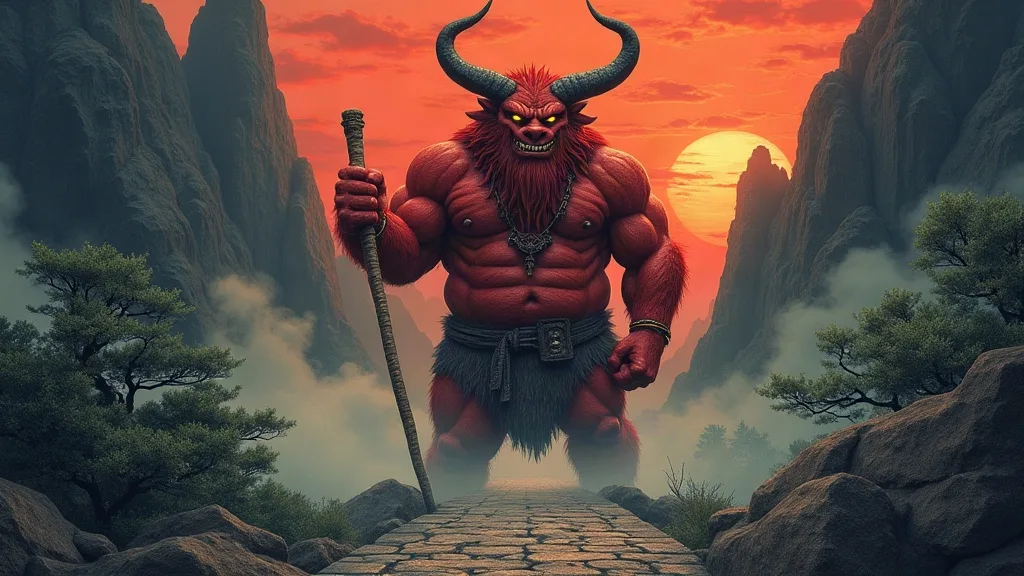
The red oni is the most iconic: crimson skin, sharp horns curving upward, muscles like carved stone. This oni is associated with rage, lust, and raw power. It smashes through barriers, devours what it wants, laughs at pain. In festivals, the red oni appears as the destroyer that must be driven back by onlookers throwing beans.
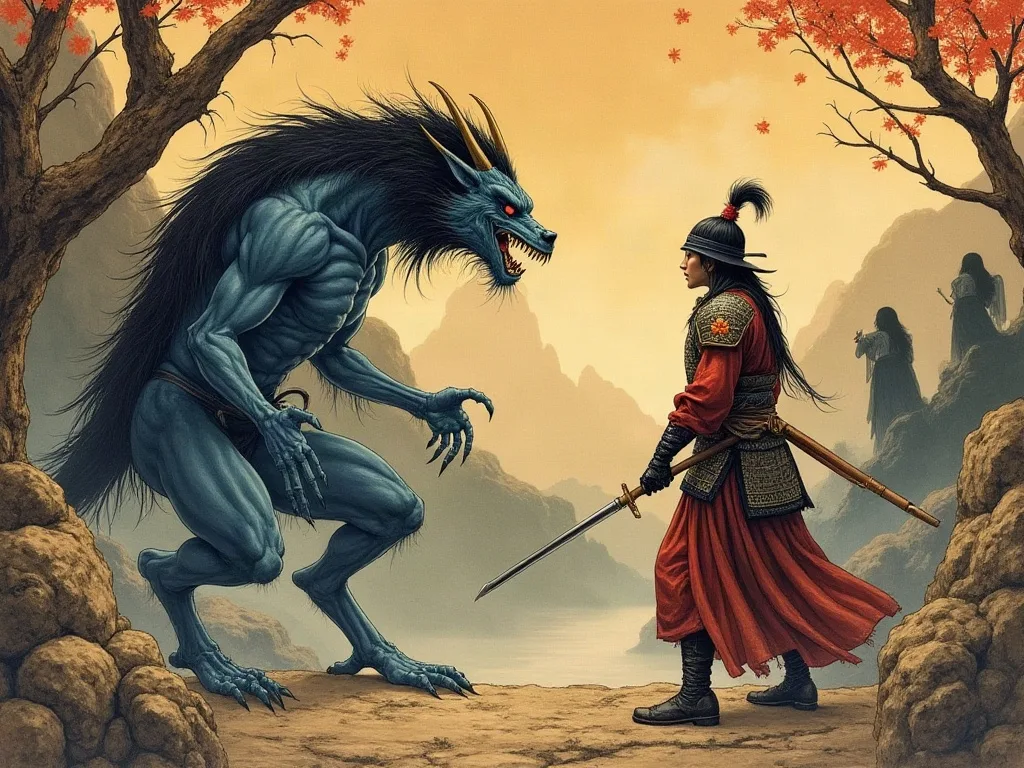
The blue oni is cooler and more intellectual. Its skin is deep indigo or black. It is associated with sadness, melancholy, and a kind of lonely cunning. Where the red oni attacks with force, the blue oni corrupts through despair. It whispers doubts. It saps courage. It was sometimes depicted as more tragic than evil: a being suffering in its own nature.
The gold oni and white oni are rarer and often benevolent. The gold oni is a keeper of treasure and abundance; it appears in shrines and protective contexts. The white oni sometimes acts as a messenger or kami-demon hybrid, occupying the borderland between sacred and profane.
Female oni (onnatachi or onibaba) operate differently from their male counterparts. They are seductresses, shapeshifters who take the form of beautiful women to lure men to their doom. The most famous is Ibaraki Doji, who was believed to haunt a mountain pass near Kyoto. In the tale, she appeared as a young woman and befriended a samurai, only to reveal her true form as an enormous oni when he rejected her advances. Like many female demons in world mythology, the onibaba represents the danger of desire itself.
Then there are the invisible oni, the ones you cannot see until it is too late. These beings operate through possession, illness, madness. A warrior returns from battle changed, speaking in a voice not his own. A woman bears a child with impossible strength. A scholar's mind shatters in a single night. These oni do not live in mountains or hells. They live in the spaces between intention and action, between health and sickness.
The Buddhist Hell and Oni Punishment
To truly understand the oni, you must grasp its role in Buddhist cosmology. Japanese Buddhism inherited the Indian concept of samsara, the wheel of rebirth, and the six realms that all sentient beings cycle through. The lowest realm is the infernal realm, divided into hot hells and cold hells, each designed for a specific form of suffering. Murderers, thieves, and the lustful each face appropriate torment.
The oni serves as the executioner and administrator of this justice. It is not sadistic; it is bureaucratic. A soul enters hell because its karma demands it. The oni's job is to ensure the debt is paid. In the Jataka tales (earlier Buddhist stories that greatly influenced Japan), demons in hell are described as neither particularly intelligent nor particularly malevolent. They are workers. They do their job. When a soul has finished its punishment, the oni lets it go, indifferent.
But this raises a darker question: what happens when an oni grows bored, or angry, or simply develops a taste for human flesh while guarding the boundary between worlds? Some Japanese texts suggest that powerful oni can escape their posts, climb up from the infernal realm into the human world, and wreak havoc. Others hint that an oni might be a human who lived such a life of sin that after death, instead of reincarnating, it was absorbed into demonhood itself. The line between being punished and becoming the punisher blurs.
Exorcists (onmyoji) developed elaborate rituals to protect people from oni. The most famous was Abe no Seimei, a legendary onmyoji of the Heian period who could see invisible spirits and command demons through the power of onmyo (yin-yang cosmology). Seimei could bind oni with talismans, drive them back with ritual words, or negotiate with them. He represents the human capacity to survive in a world full of supernatural threat, not through strength, but through knowledge and will.

The Shinto Bleed: Oni as Kami Gone Wild
Here is where the oni story grows more complex. In pure Buddhist contexts, oni are demons and nothing more. But in Japan, Buddhism and Shinto coexist. Many creatures worshipped as kami in one village are feared as oni in another. The boundary is permeable.
A kami is typically understood as a force of nature or a local spirit that deserves respect and offerings. But a kami that is angered, neglected, or has died a terrible death can "turn" and become oni-like. The kami of a mountain might be benevolent in spring and summer, bringing rain and fertility. But if a shrine built to honor it is destroyed, or pilgrims stop coming, the kami may grow lonely and volatile. It begins to cause illness and crop failure. Is it still a kami or has it become an oni? The answer depends on context.
This is why Japanese spirituality resists clean categories. A being might be simultaneously a kami (deserving of ritual respect), an oni (dangerous and destructive), and a Buddha-nature (capable of salvation). The Kojiki, Japan's oldest written mythology (compiled in 712 CE), does not use the word "oni," but it describes chaotic, destructive forces: Izanami, the primordial mother, becomes a rotting corpse in the underworld after giving birth to fire; her husband Izanagi flees in horror. That rot, that corruption, that violation of sacred boundaries: that is the essence of what would later be called oni-ness.
Some of the greatest kami began their existence as oni or as chaotic forces. Susanoo, the storm god and brother of the sun goddess Amaterasu, is described as destructive and uncontrollable. He rages, kills, and destroys. Yet he is also a culture-bringer who defeats monsters and wins respect. The line between demon and deity, in Shinto, is about alignment and acceptance, not inherent nature.
The Medieval Oni Wars: Demons in Samurai Narrative
By the Heian and Kamakura periods (9th to 13th centuries), oni had become central to Japanese martial narrative. Warriors hunted them. They collected stories of oni battles. The most celebrated tale involves Minamoto no Yorimitsu (also called Raiko), a legendary general of the 10th century. According to the Minamoto no Yorimitsu Oni Taiji Monogatari (Tales of Minamoto Yorimitsu's Demon-Slaying), Yorimitsu assembled a band of four warriors and hunted a particularly troublesome oni on Mount Oe, near Kyoto.
The oni on Mount Oe had been kidnapping young women and carrying them to a hidden palace in the mountain. Yorimitsu and his men tracked the creature to its lair, fought it, and drove it off. In some versions, Yorimitsu's lieutenant Watanabe no Tsuna grappled with the oni and tore off its arm. The demon fled, and Tsuna kept the arm as proof. When the oni's mother came later, disguised as an old woman, to retrieve it, Tsuna was too clever and refused to be tricked.
These stories were enormously popular because they served a social function: they showed that oni, while terrible, were not invincible. A disciplined, honorable warrior with magical support could face down a demon. This idea was deeply reassuring to a society where supernatural danger felt real and constant.
Oni in Ritual and Festival
To understand oni as a living force, not just a historical curiosity, one must look at how modern Japan still engages with them. The most widespread ritual is Setsubun (The Dividing of Seasons), celebrated on the eve of spring, around February 3rd. Families and temples perform a ceremony in which a person wearing an oni mask runs through a space while others throw beans and shout "Oni wa soto, fuku wa uchi!" (Out with demons, in with fortune!).
This is not performed with the intention of harming an actual oni. Rather, it is a ritual expulsion of bad luck, old negativity, and spiritual staleness. The oni represents not malice but everything that is past, stale, and threatening. By driving it out with noise and beans (which are believed to have purifying power in Shinto), the community refreshes itself. The oni, in this context, is necessary: you cannot have good fortune without something to cast out. The demon provides the contrast that makes blessing meaningful.
In some village festivals, the oni role is not feared but coveted. A man is chosen or volunteers to wear the oni mask and costume and charge through the streets, scaring and exciting onlookers. But this oni is not trying to harm anyone. It is playing a role in a sacred drama, helping to mark the passage of time and the renewal of community bonds. Some scholars suggest that this reflects an older, pre-Buddhist understanding of oni as a wild but necessary force, akin to the carnival figure in European tradition.
Temple exorcisms (kichosai) still exist, though less commonly than in centuries past. A priest, trained in rituals derived from Esoteric Buddhism and Shinto, will perform an elaborate ceremony to drive an unwanted spirit from a house. The spirit may or may not be identified as an oni, but the ritual acknowledges that the world contains beings that do not respect the boundaries of human comfort and property. The exorcist's role is to remind them of their proper place.

The Modern Oni: From Literature to Anime
The oni did not vanish with industrialization. It evolved. The Meiji Restoration (1868 onwards) brought Western ideas and skepticism, yet Japanese writers and artists continued to draw on oni imagery and narrative. The writer Lafcadio Hearn, an American who settled in Japan in 1890, collected and translated oni tales, introducing them to English readers. His work helped canonize certain oni stories and shape how the rest of the world understood Japanese demons.
In the 20th century, oni became a staple of Japanese literature, film, and eventually anime and manga. The oni appears as a tragic figure in modern retellings: a being that is powerful and feared, yet capable of love, sacrifice, and redemption. The film director Hayao Miyazaki drew on oni imagery in films like Princess Mononoke and Spirited Away, creating demons and spirits that are complex moral agents, neither simply good nor evil.
The anime and manga worlds have reconfigured the oni for contemporary storytelling. In Demon Slayer (Kimetsu no Yaiba), the most successful manga series of recent years, demons are creatures of the night that must be slain by warriors with special swords. Yet even here, the old truth persists: some demons retain human consciousness. Some of them were human once. Some of them suffer. Some of them question their nature and seek redemption. The structure of the oni tale remains intact: a being of power and chaos that forces humans to reckon with the boundaries of morality and survival.
What is striking is how the oni has become one of Japan's most portable cultural exports. Non-Japanese fans consume oni stories without necessarily understanding the Buddhist cosmology or Shinto context underneath. The oni works as symbol, as aesthetic, as narrative archetype. It is fearsome and seductive. It embodies transgression. It cannot be ignored. This is why it has proved so durable.
The Oni and Its Shadow: Fear, Desire, and the Threshold
The deepest truth about oni cannot be stated in a single fact. It emerges from studying how they are depicted across centuries and regions. The oni is a threshold guardian: it marks boundaries that humans both fear crossing and desperately wish to cross. A young man's desire to transgress his station, a woman's rage at being confined, a community's shadow side, the part of ourselves that is not civilized, not controlled, not safe.
In this way, the oni resembles other demonic figures across world mythologies. The Rakshasa of Hindu tradition is similarly both monster and being capable of loyalty and cunning. Lilith, in some Jewish traditions, is a demon born from chaos, both dangerous and alluring. The giants of Norse mythology represent the untamed power that existed before order was imposed. Yet each culture has shaped its demons differently, according to its deepest concerns.
In Japan, what worries the culture most is disorder, imbalance, and the violation of seasonal or social boundaries. The oni, therefore, is typically described as either too powerful (demanding ritual containment) or operating in wrong places at wrong times. The oni in the mountain pass in winter is a threat. The oni bound to the hell realm where it belongs is manageable. A demon loose in the human capital is catastrophe. This reflects Shinto and Buddhist concerns with purity, proper placement, and the maintenance of boundaries.
Yet the oni is also profoundly loved in Japanese culture. It appears in art, masks, festival dress, protective amulets. Children learn oni stories as part of their inheritance. Playwrights and artists have devoted centuries to depicting them. This is not the love one feels for a simple monster. It is the recognition that the oni, like all powerful figures in nature and psychology, cannot be ignored or fully controlled. You can only respect it, give it its due, and maintain the boundary.
Frequently asked questions about oni, Japanese demons
Frequently asked questions
Is an oni the same as a yokai?
No. A yokai is a broader category of supernatural creature that includes animals with magical abilities, shape-shifters, spirits of objects, and many other beings. An oni is a more specific type of yokai, one that is typically demonic, possesses intelligence and will, and often has a visible form including horns. All oni are yokai, but not all yokai are oni. A kitsune (fox spirit) is a yokai but usually not called an oni unless it has become particularly malevolent.
Are oni always evil?
Not always. While oni are dangerous and unpredictable, they are not inherently evil in the Buddhist or Christian sense. Some oni can be negotiated with, appeased, or even allied with. In Japanese tradition, a powerful oni that is properly respected and given offerings may protect a shrine or territory. The key difference is that an oni does not serve human morality; it follows its own nature and the laws of karma. It can bring harm, but it is not motivated by malice so much as by hunger, rage, or the working out of cosmic debt.
Where do oni come from?
Oni origins are mixed. Some are understood as demons who serve in Buddhist hell realms. Others are kami that have become twisted or corrupted. Some are human souls that, due to intense emotion or terrible deeds in life, have been transformed into demonic form after death. The most powerful oni in legend are sometimes said to have once been entirely human: a warrior consumed by rage, a woman driven to madness by betrayal, a scholar who pursued forbidden knowledge. This blurred boundary between human and demon is central to the Japanese understanding of oni.
What is a kanabo and why do oni carry them?
A kanabo is an iron-studded club, often depicted as oversized and impossibly heavy. It is the signature weapon of oni in Japanese art and legend. The kanabo likely derives from Hindu and Buddhist depictions of demonic weapons, but it became so associated with Japanese oni that it is now considered essential to oni iconography. The kanabo represents brute force and the oni's refusal to accept human rules of combat or order. Only a being of enormous strength could wield such a weapon.
What role do oni play in modern Japan?
Oni remain present in festivals, popular culture, and spiritual practice. Setsubun celebrates the driving out of demon-fortune, and the Setsubun ritual is still performed in millions of homes and temples each February. In contemporary anime, manga, and film, oni are featured prominently, often with more psychological depth than in older tales. They serve as figures of both fear and fascination, embodying chaos, power, and the untamed aspects of existence that civilization cannot fully suppress. The oni has become both a living religious concept and a rich symbol for storytellers worldwide.
How do oni relate to the Shinto kami?
The boundary between oni and kami is fluid. A kami is a Shinto divine spirit, typically associated with a place or natural force. An oni can be a corrupted kami, a kami operating outside its proper realm, or a being that occupies the space between Shinto and Buddhist cosmology. Over centuries, Buddhism and Shinto merged in Japan, and many figures came to be understood as both kami and demon depending on context and mood. This duality reflects the Japanese comfort with spiritual ambiguity and the idea that power and danger are not absolute categories but relational ones.
The Oni's Eternal Return: Why These Demons Still Matter
The oni has survived over a thousand years of cultural change, religious reformation, modernization, and globalization. It has survived because it answers a perennial human need: the need to personify chaos, desire, and the untamed aspects of nature and self. As long as humans experience rage, as long as seasons change and time passes, as long as we sense boundaries that we are drawn to violate, the oni will have currency.
What makes the oni distinctive is not that it is evil, but that it is neither fully human nor fully divine in the way that most gods are. It stands between categories. It refuses to be domesticated. It can be feared, respected, bound, negotiated with, even loved, but never truly controlled. In this, the oni reflects a wisdom that runs through both Buddhist and Shinto thought: that reality contains forces which human intention cannot fully master, and attempting to deny this is itself a source of suffering.
Modern creators continue to draw on oni because the archetype is so flexible. An oni can be a symbol of colonialism, environmental destruction, inner trauma, or passion. It can be a victim of circumstance or a genuine villain. It can be redeemed or eternally damned. The oni's lack of a fixed moral alignment makes it endlessly available for contemporary meaning-making. In this way, it shares something with the Trickster figures that appear across world traditions: shape-shifters that inhabit the margins and teach us through disruption.
Free 25-page sample
Want the whole story?
Take the first 25 pages free. If it pulls you in, the full edition is yours as an instant PDF download, with a paperback on Amazon for selected titles.

Mythology
The World Mythology Book: The Gods, Heroes and Myths of Every Culture
The Gods, Heroes and Myths of Every Culture, in One Volume
The whole of world mythology in a single volume: Greek, Norse, Egyptian, Japanese, Hindu, Celtic, Slavic, Mesoamerican and African myths gathered side by side, each drawn from the primary sources.