
Pandora's Box and the First Woman: The Complete Myth, Its Sources, and What It Really Means
Pandora was not a villain. She was the first mortal woman, shaped from clay by the gods, given every gift and one terrible prohibition. Here is the full story, with every ancient source laid bare.
Contents
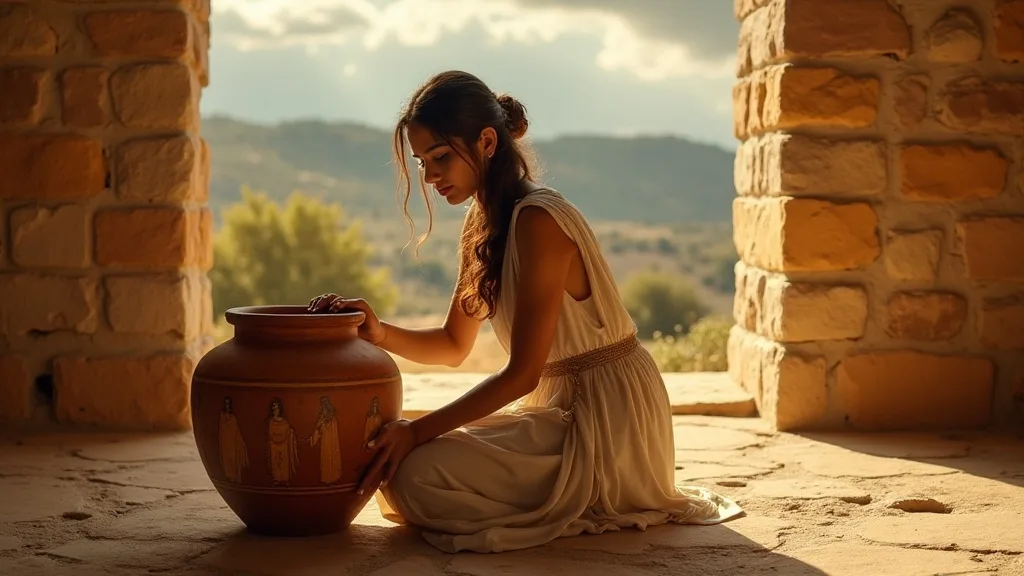
The jar sat on the floor of a new house. It was sealed with wax, heavy with whatever the gods had packed inside it, and nobody had ever opened it. Nobody except Pandora.
She had been alive for perhaps a week. She had never watched anything die. She did not yet know what sorrow looked like, or plague, or grief, because none of those things had ever happened on earth before. All she had was curiosity, which the gods had deliberately given her, along with a face like a goddess, a voice like running water, and a sealed jar she had been told to leave alone.
You already know how this ends. But the version you know may be missing most of the story. The Greeks who first told it had something stranger in mind than a simple warning about nosy women. The myth of Pandora's box and the first woman reaches into questions about why suffering exists, why hope survives, and whether the gods ever actually wanted humanity to be happy in the first place.
Hesiod Tells the Story First: Two Versions, One Poet
The oldest written sources for Pandora are both by Hesiod, a Greek poet writing around 700 BC in Boeotia, central Greece. He tells the story twice, in two different poems, and the two versions are not quite the same.
The first appears in the Theogony, a poem about the birth of the gods. Here Hesiod describes Pandora briefly: she is a creation of Hephaestus (the smith-god, shaped from earth and water), dressed and adorned by Athena (goddess of craft and wisdom), and given a "shameless mind and a thievish nature" by Hermes (the messenger god). She is called kalon kakon, a "beautiful evil," sent as punishment to men after Prometheus stole fire from the gods. The Theogony does not mention the jar at all. It describes Pandora as herself the container of evils: from her descend the "ruinous race of women," who drain men the way drones drain a beehive. The misogyny in this version is stark and deliberate. Hesiod is not trying to hide it.
The second version, in the Works and Days (roughly contemporary with the Theogony), is longer, richer, and includes the jar. It is the version almost everyone refers to when they say "Pandora's box."
The Full Story from the "Works and Days"
Before Pandora, there was fire. Or rather, there was not. Humans lived on earth, but they had no flame for warmth or cooking. Prometheus, the Titan, looked down from Olympus with something like affection for these cold creatures and made a choice that would ruin him: he climbed to the sun's chariot, lit a hollow fennel stalk from it, and carried fire back to humanity.
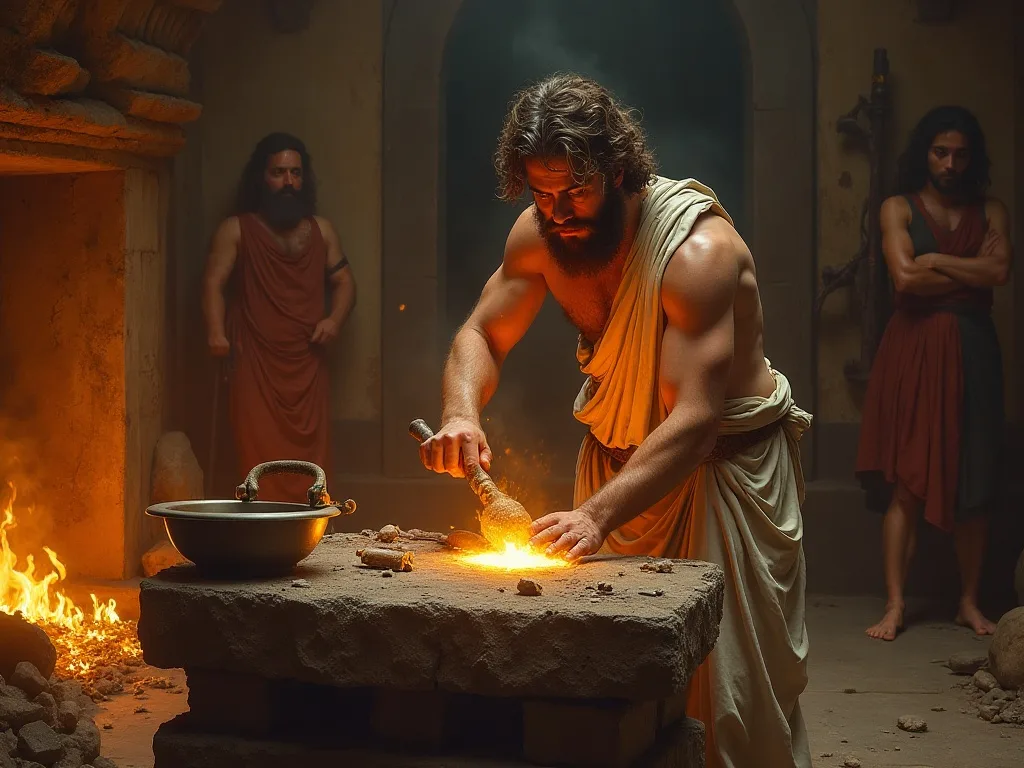
Zeus was furious. Not merely because a divine gift had been stolen, but because fire meant power: metallurgy, weapons, sacrifice conducted on human terms. Zeus had his smith Hephaestus build a response.
Hephaestus took earth and water and shaped them into the form of a modest young woman. Athena dressed her in silver robes and taught her weaving. Aphrodite poured charm and painful longing over her head. The Graces hung gold necklaces at her throat. The Seasons crowned her with spring flowers. Hermes last of all gave her a voice, a deceitful heart, and a name: Pandora, meaning "all-gifted" or, in some readings, "gift to all."
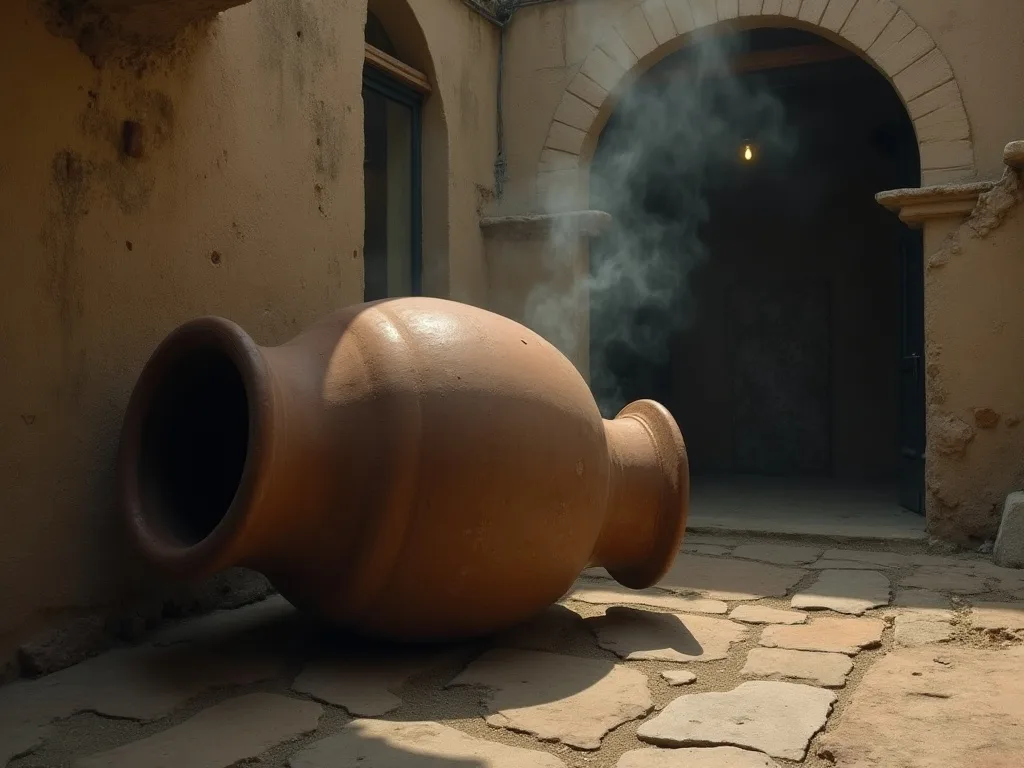
She was sent to earth with a jar. Hesiod calls it a pithos. Its contents: every disease, every sorrow, every form of labor and pain that had been absent from human life until that moment.
Epimetheus (whose name means "hindsight," as opposed to his brother Prometheus, whose name means "foresight") had been warned by Prometheus not to accept any gift from Zeus. He accepted her anyway. He saw her and, in the words Hesiod gives us, did not "understand" what he had done until the harm was done.
Pandora opened the jar. Hesiod does not say she was curious. He does not say she was told not to open it. He simply says she opened it, and everything flew out: the Spites, the diseases, the sorrows. They spread through the world "silently" because Zeus had taken away their voices. Only one thing stayed inside the jar, under the rim, unable to escape: Elpis, Hope.
Hesiod ends the passage without explaining why Hope was in the jar at all. That silence has kept philosophers and classicists busy for 2,700 years.
Who Put Hope in a Jar of Evils?
This is the question the myth refuses to answer cleanly. Three major interpretations have circulated since antiquity.
The first reading: Hope is a good thing, and it survived. The jar contained all the evils of the world; Hope alone stayed behind and was preserved for humanity. On this view, Zeus's revenge was cruel but not total. Some scholars, like M.L. West in his 1978 commentary on Works and Days, point out that Elpis in Greek often simply means "expectation" without the positive charge the English word "hope" carries. Expectation could be good or bad.
The second reading: Hope is a deception. The jar held evils, and Hope is the last and subtlest one. It stays inside the jar, always promising what may never arrive, keeping humans working and striving when they might otherwise lie down and rest. On this reading, Zeus's cruelty is total: he even gave us the illusion of rescue.
The third reading: Hope is the only thing humans still control. Everything else escaped and moves freely through the world. Hope alone stayed close, within the jar, which Pandora now guards. She did not release it; she sealed it back in. Humanity holds it at home, always available.
All three readings are philologically defensible. The Greek text supports each one. Hesiod may not have intended to resolve the ambiguity. The myth works precisely because it does not.
Prometheus, Epimetheus, and the Shape of the Punishment
The Pandora story cannot be read in isolation from the Prometheus myth. The two are braided together in Hesiod, and the logic of the punishment only makes sense if you see the whole picture.
Prometheus stole fire. Zeus punished Prometheus first: he was chained to a rock in the Caucasus mountains, and every day an eagle ate his liver; every night the liver grew back. An eternal recycling of suffering, calibrated to a body that could not die.
Then Zeus punished humanity for receiving the gift. He could have simply taken fire back. Instead he added to the human condition. Before Pandora, Hesiod says, humans lived on earth without toil, without disease, without aging. There was a kind of paradise, though Hesiod is vague about what people actually did in it. After the jar was opened, humans had fire and suffering simultaneously: the tool that makes civilization possible, and every cost that civilization brings.
Epimetheus is the hinge of the story. Prometheus told him explicitly: return any gift from Zeus, send it back unopened. Epimetheus waited until Prometheus was already chained to the rock, then accepted Pandora. His name meaning "he who understands after the fact" is the myth's own commentary on his decision. He is every person who knows the right choice in theory and makes the wrong one in practice.
The Other Pandora: An Earlier, Different Goddess
Hesiod's story is the canonical one, but it was not the only one. Several ancient sources hint at an older layer of myth in which Pandora was not a punishment at all.
Aristophanes, in the comedy The Birds (414 BC), refers to Pandora as an earth goddess who gave gifts upward toward the sky. The name Pandora ("all-gifted" or "giver of all") makes better sense in this context: she is the earth itself, abundant and generous.
A fragment from the lost play Pandora by Sophocles suggests she was honored in cult worship in parts of Greece. Some scholars, notably Dora Panofsky and Erwin Panofsky in their 1956 study Pandora's Box: The Changing Aspects of a Mythical Symbol, argue that Hesiod adapted an older earth-goddess tradition and reframed it as a punishment myth. The original Pandora may have been a figure of abundance, not a vehicle of suffering.
If that reconstruction is right, then the myth underwent a significant reversal somewhere between the Bronze Age and the archaic period. A goddess who gave gifts became a woman whose gift-giving ruined the world. What drove that reversal, nobody knows for certain. But it placed Pandora alongside a pattern found in other cultures: the first woman who changes everything.

Pandora and Eve: Parallel First Women
No cross-cultural comparison in Western mythology gets more attention than the parallel between Pandora and Eve, and few are more contested by scholars.
Both are the first woman of their respective traditions. Both bring hardship into a world that previously had none. Both are connected to a prohibited act involving a container of knowledge or consequence (a jar, a fruit). Both are sometimes blamed for the suffering of all who follow them.
Pandora (Greek)
Shaped from earth by Hephaestus at Zeus's command. Given beauty and deception as deliberate tools of punishment. Opens a jar she may or may not have been told to leave sealed. Releases suffering but retains Hope. Her act is Zeus's plan carried out, not a rebellion.
Eve (Hebrew)
Shaped from Adam's rib by God. Given life and companionship. Eats fruit from the Tree of Knowledge after being deceived by a serpent. Brings mortality, labor in childbirth, and exile from Eden. Her act is read in Genesis as disobedience, though later interpreters disagree sharply about guilt and agency.
The similarities are real, but the differences matter just as much. Eve acts out of deception and desire for wisdom; she is lied to by the serpent. Pandora in Hesiod seems to act without explicit prohibition: she simply opens the jar. Eve's act is a form of self-determination, however punished; Pandora is explicitly built to cause harm, a weapon disguised as a person. Zeus is not deceived; he is the architect.
Scholars like William Hansen and Jan Bremmer have been careful not to argue direct influence between the Genesis narrative and Hesiod. Both stories likely draw on older Near Eastern traditions about the origin of human suffering. The Sumerian and Akkadian literature of Mesopotamia contains similar motifs: primordial abundance, a rupture, the entry of toil and death into the world. The parallels suggest a shared cultural grammar, not a copying of one text from another.
The Five Ages and Where Pandora Fits
Hesiod places the Pandora story inside a larger account of human history: the myth of the Five Ages. Before the jar was opened, humanity lived in the Age of Gold: no work, no aging, no conflict, earth giving food freely. The opening of the jar marks the end of that age and the beginning of decline through the Silver Age, the Bronze Age, the Age of Heroes, and finally Hesiod's own time, the Iron Age, the worst of all, full of toil and injustice.
Pandora is therefore not just a story about one woman. She is a cosmological pivot, the moment when human history changed direction. This is why Hesiod returns to her twice and why scholars read her as performing a function similar to the Fall in Christian theology: a break between a primordial state and the human condition as it actually exists.
What is unusual in Hesiod, compared to the Christian version, is that Zeus plans the break deliberately. There is no serpent who acts outside divine will, no tragedy of free will misused. Zeus builds Pandora because he wants humans to suffer. His motivation is revenge, not justice. This makes the Greek version more unsettling in some ways, not less: the gods are not merely allowing evil, they are engineering it.
Pandora in Athens: The Parthenon and Civic Ritual
The myth had a real presence in Athenian civic life. On the base of the enormous statue of Athena inside the Parthenon, sculpted by Pheidias around 438 BC, there was a carved frieze depicting the birth of Pandora. She stood at the center, surrounded by gods attending her creation, exactly as Hesiod described.
This is significant. The Parthenon was the most sacred building in Athens. Its decorative program was chosen with care for what it communicated about Athenian values and identity. Placing the birth of Pandora on the base of Athena's statue put the myth at the heart of Athenian self-understanding. It also placed Athena, the city's patron, in the role of Pandora's creator: the goddess of wisdom and craft made the first woman beautiful and skilled.
The lost play Pandora by Sophocles, mentioned earlier, suggests the myth was staged for broad Athenian audiences. What dramatic angle Sophocles took with the story, whether sympathetic to Pandora or not, cannot be recovered from the surviving fragments. But the fact that three of the five canonical tragedians (Hesiod is not a tragedian, but Sophocles, Aeschylus, and Euripides all engaged with Prometheus-adjacent material) engaged with this cluster of myths suggests how central it was to Greek literary culture.
A Timeline of Pandora Across History
Understanding how Pandora's box and the first woman has moved through time helps make sense of why the myth looks so different in different periods:
- circa 700 BC: Hesiod composes the Theogony and Works and Days. The two earliest written Pandora narratives. The pithos (storage jar) is the vessel in the story.
- circa 438 BC: The Parthenon completed in Athens. The base of the Athena Parthenos statue shows Pandora's creation in relief sculpture.
- circa 414 BC: Aristophanes's The Birds references Pandora as an earth-goddess figure, suggesting alternative traditions existed alongside Hesiod's version.
- circa 4th century BC: Plato references Prometheus and the fire myth in the Protagoras, though he does not discuss the jar directly.
- 1st century BC - 1st century AD: Roman poets including Ovid integrate the Pandora narrative loosely into their accounts of the Ages of Man in the Metamorphoses, though Ovid does not name Pandora directly.
- 1508 AD: Erasmus of Rotterdam, writing in Latin, translates the Greek pithos as pyxis (a small box). The mistranslation spreads through Renaissance Europe.
- 1556 AD: The artist Jean Cousin the Elder paints Eva Prima Pandora, explicitly merging Pandora with Eve, the first direct artistic conflation of the two figures.
- 1956 AD: Dora and Erwin Panofsky publish Pandora's Box, the defining modern scholarly study of how the myth's imagery transformed across 2,500 years.
- 20th-21st century: Pandora becomes a common name in popular culture (the music streaming service, the jewelry brand), largely stripped of the myth's content.
What the Myth Was Actually Doing
Myths do not survive for millennia because they are pleasant stories. They survive because they answer questions that human beings keep asking. The Pandora myth, across all its versions, addresses at least three of them.
Why do we suffer? Because something happened at the beginning of human history that changed the terms of existence. The details vary (a jar, a fruit, a theft, a disobedient act), but the structure is the same across dozens of cultures: there was a rupture, and we live in the aftermath of it.
Why do we keep trying anyway? Because Hope stayed in the jar. Or because Hope is itself a kind of trap. The myth does not decide which, and that ambiguity may be the most honest thing about it.
What is the cost of civilization? Fire, in the Greek myth, is not a simple gift. It comes with everything in Pandora's jar. This is a remarkably sophisticated idea: that the tools which allow human culture to exist (metallurgy, cooking, agriculture, sacrifice) also require toil, disease, and mortality. There is no version of human life that has the tools without the costs. Prometheus gives the fire; Zeus sends the bill.
The myth is not primarily a warning about curious women. That reading, which dominated much of its post-ancient reception, is a narrow use of a much wider story. Hesiod's Pandora is a story about gods and humans, power and punishment, what was lost and what, against all probability, remained.
Frequently Asked Questions About Pandora's Box and the First Woman
Frequently asked questions
What did Pandora's jar actually contain according to the ancient Greeks?
Hesiod's Works and Days lists the contents as all the "Spites" that afflict humanity: disease, toil, old age, hard labor, and nameless sorrows. The Greek word he uses is kakoi, meaning evils or bad things. Hope (Elpis) was also inside the jar, though whether it counts as a good thing or the cruelest of the evils is a question the text deliberately leaves open. No ancient source gives a specific numbered list of evils; later traditions (especially Renaissance emblem books) began cataloguing individual vices, which is where ideas like "envy," "pride," and "greed" entered the popular image of the jar's contents.
Why is it called Pandora's 'box' if it was actually a jar?
The word "box" enters the story through a translation error by the Dutch humanist Erasmus in 1508. When he translated Hesiod's Greek into Latin for his collection Adagia, he rendered pithos (a large clay storage jar, often as tall as a person) as pyxis, a small decorative box. The image of a box was more visually dramatic in European art and literature, and it stuck. The original pithos was the same kind of vessel used to store grain, wine, olive oil, and occasionally to bury the dead. It was household technology, not a jewelry box.
Was Pandora told not to open the jar? Who gave her the jar?
Hesiod is ambiguous on both points. In the Works and Days, he says the jar accompanied Pandora when she was sent to Epimetheus, but he does not specify who gave it or whether anyone told her to leave it sealed. Some later ancient commentators assumed a prohibition existed. Others assumed that Pandora's "thievish" and "curious" nature, which Hermes had built into her, meant she opened it of her own character without needing a direct command. The clearest statement of a prohibition comes from much later retellings, not from Hesiod himself. The original story may intend that Pandora was simply built to do exactly what she did: the jar was the mechanism of Zeus's revenge, and she was the mechanism's trigger.
Is there a connection between Pandora and Eve in ancient sources?
Ancient Greek and Hebrew sources do not directly reference each other on this point. The parallel is structural, not textual. Both figures appear in traditions that were developing roughly in the same era (8th to 5th centuries BC) and that both likely draw on older Near Eastern literary models from Mesopotamia, including Sumerian and Akkadian stories about primordial abundance and its loss. The first explicit artistic merger of the two figures appears in the 1556 painting Eva Prima Pandora by Jean Cousin the Elder, where a nude woman holds both an apple and a jar. The scholarly consensus today, following scholars like M.L. West who traced Near Eastern parallels in his East Face of Helicon (1997), is that both traditions inherited a common grammar of "origin of suffering" mythology rather than one borrowing directly from the other.
What does the name Pandora actually mean?
The name combines two Greek words: pan (all) and dora (gifts). It can mean "she who has been given all gifts" (as in the Works and Days, where the gods pile attributes onto her) or "giver of all gifts" (as in older traditions where she may have been an earth-goddess who gave abundance upward). Hesiod uses the first meaning: she is all-gifted, every divine attribute poured into one body. The older earth-goddess reading, suggested by Aristophanes and some archaeological evidence from Greek cult sites, uses the second: she is the generous earth, giving all things. The name's double meaning may reflect the myth's transformation from an abundance goddess into a punishment figure.
Why does Hope remain in the jar? Is Hope good or bad in the myth?
This is the most genuinely unresolved question in the Pandora myth, and ancient sources offer no single answer. Three readings have existed since antiquity. First: Hope is good and stayed inside, preserved for humanity as Zeus's one mercy or as Pandora's act of conservation. Second: Hope is the final and subtlest evil, an illusion that keeps humans laboring without guarantee of reward. Third: Hope remains under human control, inside a jar that is now kept in the home, always available but not released into the wild like the other evils. The classicist M.L. West noted in his 1978 commentary that Elpis in Greek carries the neutral sense of "expectation" and can refer to bad outcomes as easily as good ones. Hesiod's silence on the meaning is probably deliberate, since the myth's power lies precisely in that unresolved tension.
Pandora After Hesiod: Modernity and the Myth's Unfinished Business
The Pandora story did not stop moving after the ancient world closed. Every era that touched it reshaped it for its own needs, and the reshapings reveal as much about those eras as they do about Hesiod.
The Renaissance took the story in two directions simultaneously. On one side, painters like Jean Cousin the Elder fused Pandora with Eve, producing an image of the "first woman" as a specifically female source of catastrophe. On the other, some humanist writers read Pandora with sympathy: she was curious, which was a virtue in Renaissance intellectual culture, and her curiosity enabled the discovery of what the world actually contained. The same action, depending on the frame, is wisdom or catastrophe.
The 19th century produced a more overtly sentimental Pandora. In many Victorian retellings, the emphasis fell on Hope remaining in the jar as comfort: the myth became a story about resilience, about how even in the worst circumstances something good survives. This is the version that reached 20th-century children's mythology books and remains the dominant popular reading today.
Feminist scholarship in the second half of the 20th century, from figures like Eva Keuls and Barbara Walker, challenged the misogynist frame directly. They pointed to the evidence for an older Pandora who was not a punishment at all, to the earth goddess traditions Aristophanes gestured at, and to the fact that in Hesiod's own telling the real agents of harm are Zeus and Hermes, not Pandora. She does what she was made to do. Blaming her is like blaming a key for what was behind the door.
The philosopher Friedrich Nietzsche took a different angle. He read the retention of Hope in the jar as Zeus's deepest cruelty. Nietzsche argued in Human, All Too Human (1878) that Hope is "the evil of evils" because it prolongs human torment; humans endure suffering because they believe it might end, and that belief is the most persistent trap of all. This reading takes Hesiod's ambiguity and resolves it in the darkest possible direction.
None of these readings is wrong, exactly. Each extracts something that is genuinely in the text. The myth is capacious enough to support all of them, which is part of what makes it a myth rather than a fable. A fable has one point. Pandora's story has kept multiplying its points for 27 centuries, and there is no sign it is finished.
The jar, whatever was in it, has never been fully sealed again. That may be the only thing about the story everyone agrees on.
Free 25-page sample
Want the whole story?
Take the first 25 pages free. If it pulls you in, the full edition is yours as an instant PDF download, with a paperback on Amazon for selected titles.

Mythology
The World Mythology Book: The Gods, Heroes and Myths of Every Culture
The Gods, Heroes and Myths of Every Culture, in One Volume
The whole of world mythology in a single volume: Greek, Norse, Egyptian, Japanese, Hindu, Celtic, Slavic, Mesoamerican and African myths gathered side by side, each drawn from the primary sources.