

Prometheus the Fire Bringer: Titan, Trickster, and the Cost of Defiance
Prometheus stole fire from the gods and handed civilization to a shivering humanity. The myth of the fire bringer is a story about knowledge, punishment, and what it costs to defy the divine order.
Contents
The eagle lands every morning before dawn. It tears into the liver with clinical patience, eating until nothing remains. Through the night, the organ grows back. The next morning, the eagle returns. Prometheus the fire bringer has been chained to his rock on Mount Caucasus for an unspecified eternity, and the torture is architecturally perfect: endless, self-renewing, without the mercy of death or the consolation of forgetting.
This is not a story about a minor offence. Prometheus did not simply take something that belonged to someone else. He broke the structural logic of the cosmos by deciding that mortal human beings deserved what the Olympians had reserved for themselves. Every furnace, every forge, every lamp lit against the dark is downstream of that single act of theft.
Hesiod tells the story twice, once in the Theogony (composed around 700 BCE) and again in Works and Days, and the two tellings are not quite the same. That inconsistency is part of the myth's vitality. Prometheus is large enough to hold contradictions: he is champion of humanity, patron of craftsmen, deceiver of Zeus, and the unwitting reason women exist. No single reading exhausts him.
Who Was Prometheus: Origins and Divine Lineage
The name Prometheus is ancient Greek for "forethought" - the ability to see consequences before they arrive. His brother Epimetheus carries the opposite meaning: "afterthought," the one who acts and then considers. Together they form a conceptual pair, two halves of human cognition split into mythological persons.
Prometheus was a Titan, child of the Titan Iapetus and the Oceanid Clymene (some sources name his mother as Asia, another Oceanid - Hesiod lists both versions). The Titans were the generation before the Olympians, divine beings who ruled before Zeus overthrew Kronos and reorganised the cosmos from his throne on Olympus. Prometheus was thus cousin to Zeus by genealogy, and simultaneously his structural subordinate.
His siblings matter. Epimetheus, already mentioned, received and opened the jar that Hesiod calls pithos (later tradition corrupted into "Pandora's box"). Atlas was sentenced to hold the sky on his shoulders. Menoetius was blasted into the underworld by Zeus's thunderbolt for his arrogance. The entire Iapetid line runs toward catastrophic confrontation with Olympian authority.
What separates Prometheus from his brothers is precisely his name: forethought. During the Titanomachy, the war between Titans and Olympians, he alone foresaw that Zeus would win. He sided with the Olympians, advising his mother and possibly other Titans to do the same (Pindar and Aeschylus both suggest this reading). He was thus never imprisoned in Tartarus alongside the other Titans. He worked within the Olympian order. Then he broke it from the inside.
The Great Deception at Mekone: Fire Theft Has a Prelude
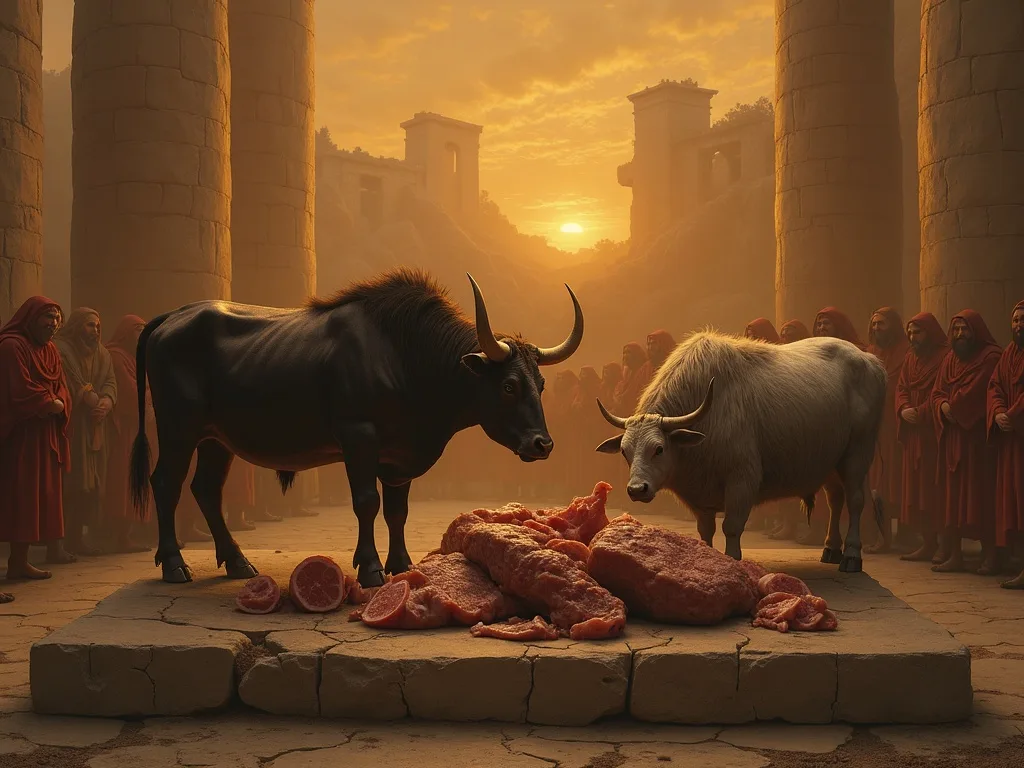
Most retellings skip directly to the fire theft, but Hesiod's Theogony (lines 535-616) opens with a prior offence that establishes the antagonism between Prometheus and Zeus. At Mekone, gods and mortals met to negotiate which portions of sacrificed animals each party would receive - a literal division of cosmic property.
Prometheus slaughtered a great ox and divided it into two portions. In one pile he placed the meat and rich offal, disguised beneath the stomach's unappealing lining. In the other he arranged the bare bones, artfully hidden under gleaming fat. He invited Zeus to choose. Zeus chose the bones and fat, and the Theogony offers a studied ambiguity: "But Zeus, who knows imperishable counsels, perceived and did not fail to recognise the trick." He chose the bones deliberately, knowing what Prometheus had done, so that he would have cause to punish mortals by withholding fire.
This scene explains something real about Greek religious practice: worshippers burned bones and fat on altars, kept the meat for themselves, and considered this a pious act. The myth retrojects the explanation. It also makes Zeus a complicated figure - not simply deceived, but choosing to be deceived so the narrative can proceed.
Prometheus had framed it as a gift to humanity. Zeus read it as an insult. The logic of divine honour required a response.
The Theft of Fire: What Hesiod Actually Says
Zeus's response was to withhold fire from mortals. In Works and Days (lines 42-105), Hesiod specifies that human beings were left without the means to cook food, smelt metal, or survive winter. The ash tree (melia) species kept fire hidden in their hollow branches, a detail scholars read as a memory of actual fire-making techniques using friction on dry wood.
Prometheus stole a glowing ember and carried it inside a hollow fennel stalk - the Greek narthex, a plant whose pithy interior can carry a slow-burning coal for hours without the outside catching flame. This is not metaphor. The method is botanically accurate: fennel stalks were used throughout the ancient Mediterranean for exactly this purpose. The myth is precise where it needs to be.
He brought fire back to mortals. Zeus reacted with what Hesiod describes as cholos - a specific kind of divine rage, closer to wounded pride than mere anger.
The punishment had two components. First, Hephaestus, the divine smith, fashioned a woman of clay: Pandora, the "all-gifted," adorned by every god with a different attribute. She was sent to Epimetheus, who accepted her despite Prometheus's explicit warning never to accept gifts from Zeus. She opened her jar. Disease, suffering, and hard labour poured into the world. Hope (Elpis) alone remained sealed inside.
Second, Prometheus himself was seized. Hephaestus chained him to a pillar or rock in the Caucasus Mountains. An eagle - in some tellings, a giant eagle born from Typhon and Echidna - fed on his liver daily. Heracles eventually killed the eagle and freed Prometheus, with Zeus's consent. Why did Zeus consent? Aeschylus provides the answer that Hesiod only implies.
Aeschylus and the Deeper Secret
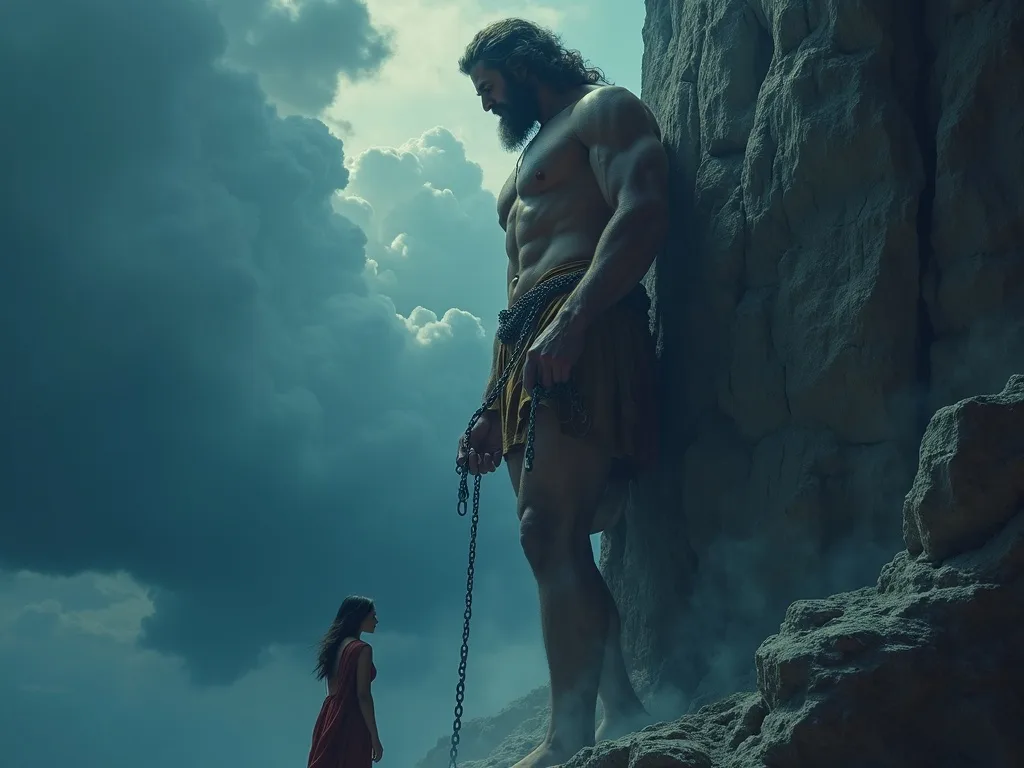
The tragic playwright Aeschylus (c. 525-456 BCE) transformed the myth into a trilogy. Only the first play, Prometheus Bound (Prometheus Desmotes), survives intact. The other two - Prometheus Unbound and Prometheus the Fire-Bringer - exist only in fragments and reconstructions. But what survives changes everything.
In Aeschylus's version, Prometheus possesses a secret that Zeus desperately needs. The Titan knows, through his gift of forethought, that if Zeus mates with the sea-nymph Thetis, their son will overthrow him, exactly as Zeus overthrew Kronos and Kronos had overthrown Uranus. Zeus is caught in the same generational trap that crushed his predecessors, and only Prometheus knows how to avoid it.
This secret is the real chain. Hephaestus's iron is secondary. Zeus cannot kill Prometheus - that would destroy the knowledge - and cannot release him without concession. The two are locked in a standoff that stretches across cosmic time.
The resolution in the lost plays appears to have involved Prometheus finally revealing the secret (Thetis was subsequently married to the mortal Peleus, producing Achilles rather than a god-destroyer) in exchange for his freedom. Zeus accepted. Both sides got what they needed. The myth shifts from pure punishment narrative to something more like a negotiated settlement between cosmic powers.
This version of Prometheus is genuinely heroic: he suffers not because he was foolish but because he holds out. His endurance is a form of leverage. Io, who visits him in chains in Prometheus Bound, hears a prophecy about her own descendants - a subtle thread connecting the fire theft to the lineage that will eventually produce Heracles, the liberator. Aeschylus makes the myth a vast genealogical engine.
The Symbolism of Fire: What Was Actually Stolen
Fire in Greek cosmology was not decorative. Pyr carried multiple registers of meaning.
On the practical level, fire meant the difference between raw and cooked, between beast and human. The scholar Marcel Detienne and anthropologist Jean-Pierre Vernant, in The Cuisine of Sacrifice Among the Greeks (1989), argued that the boundary between gods and mortals in Greek thought was expressed through sacrificial cooking. Gods received smoke, mortals received cooked meat. Fire was the medium of that distinction. To give fire to humans was to raise them partway out of animal existence.
On the technical level, fire meant metallurgy. Bronze weapons, iron ploughs, the entire material infrastructure of civilization passed through the forge. Prometheus appears in several late classical sources as the patron of tekhnai - the technical arts broadly, including weaving, navigation, and writing. Aeschylus's Prometheus makes this explicit: he claims credit for giving humans not just fire but every civilizational skill they possess.
On the symbolic level, fire is divine energy made portable. In multiple mythological traditions - and this is where the cross-cultural resonances become striking - fire theft sits at the boundary between sacred and profane, between divine monopoly and human capability. Agni, the Vedic fire god, mediates between humans and gods in a structurally similar role to the sacrificial fire Prometheus disrupts. The Norse trickster Loki engineers catastrophe through mischief that blurs cosmic boundaries. But Prometheus is unique in that his transgression is explicitly altruistic: he does it for others, not for himself.
Prometheus and Deucalion: The Flood Connection
Prometheus does not disappear after his chains. His lineage carries the myth forward. His son Deucalion married Pyrrha, daughter of Epimetheus and Pandora. When Zeus decided to destroy humanity with a great flood (kataklysmos), Prometheus warned Deucalion. Father and son share the gift of forethought. Deucalion built a chest (the Greek larnak, which translates as both "chest" and "coffin"), survived the flood, and landed on Mount Parnassus or Mount Othrys depending on the source.
The structural echo with Noah is conspicuous enough that early Christian writers - including Origen and Theophilus of Antioch - commented on it directly, attributing the resemblance to a shared ancestral memory or, in the Christian reading, to Greek borrowing from the Hebrew tradition. Comparative mythologists now see both as part of a much wider ancient Near Eastern flood narrative cluster, the Mesopotamian Atrahasis epic and the Epic of Gilgamesh sitting at the evident base.
Deucalion and Pyrrha repopulated the earth by throwing stones - "bones of their mother," interpreted as rocks of the earth goddess - over their shoulders. Each stone became a human being. The Greeks called this new race the laoi, possibly a folk-etymology connecting laas (stone) and laos (people). Prometheus's descendants are literally earthborn.
Prometheus Across Cultures: The Wider Pattern of the Stolen Fire
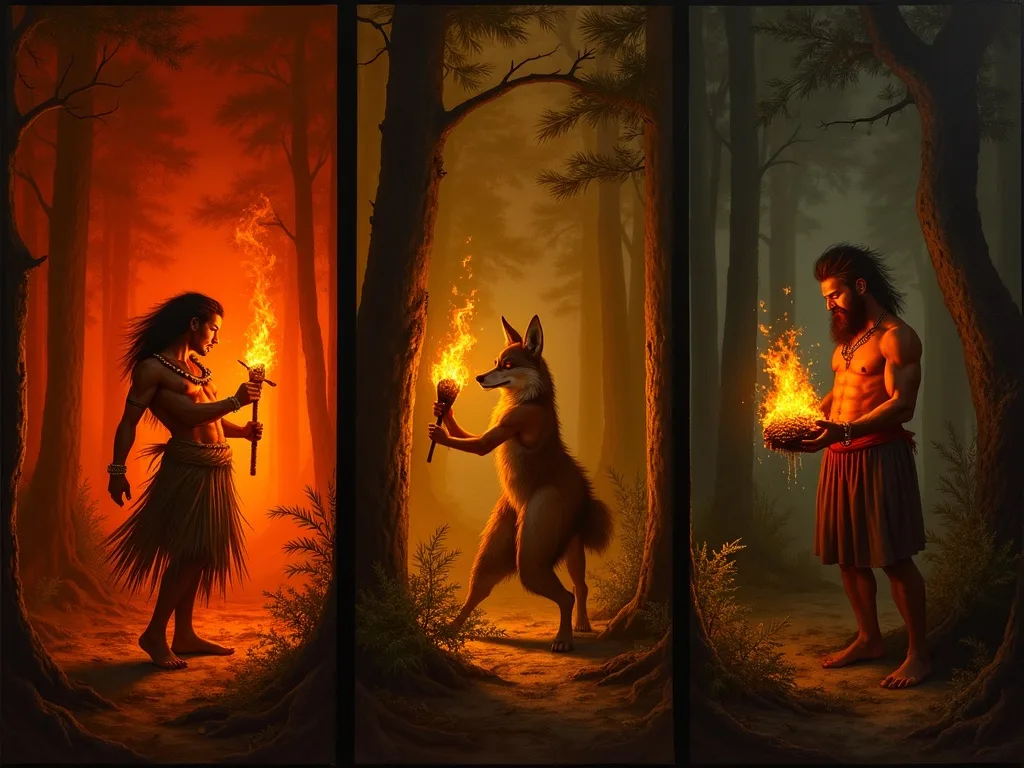
The motif of a culture hero who brings fire to humanity by stealing or tricking it away from a divine or supernatural source appears across at least four independent mythological traditions, a distribution so wide that folklorists classify it separately in the Aarne-Thompson-Uther index.
The Polynesian trickster Maui stole fire from his ancestress Mahuika by repeatedly extinguishing the flames she gave him and asking for more, until she threw the last ember at him in fury and he had to call rain to save himself. Fire escaped into trees, which is why wood makes fire when rubbed. The structural parallel with Prometheus is almost syllable-by-syllable: deception of a powerful figure, fire hidden in organic material, punishment attempted.
Among certain North American traditions, Coyote is the fire thief, stealing it from supernatural beings who guarded it jealously and passing it down the line of animal helpers until it reaches humans. The transmission-chain structure differs from the Greek version, but the underlying logic, that fire belongs to dangerous supernatural entities and must be taken rather than given, is identical.
In Vedic tradition, the god Matarisvan brought the hidden fire Agni to the Bhrigus, the priestly clan who first domesticated sacrificial flame. The Rigveda (1.143 and elsewhere) describes this as a gift rather than a theft, which reflects a different theological stance: Vedic religion tends to frame the relationship between gods and humans as cooperative rather than agonistic. But the fire-bringing hero function remains.
What this distribution suggests is not borrowing but convergence around a common human problem: fire is necessary, dangerous, and unexplained. Every tradition needs a story for how it was obtained.
Prometheus in Art and Iconography: Reading the Symbols
Greek vase painting from the sixth and fifth centuries BCE depicts Prometheus consistently in several key images. The chains are almost always present. The eagle or vulture (ancient sources vary) is shown feeding. In some red-figure vases, Heracles is present pulling back the bowstring - the liberation scene that closes the punishment arc.
The fennel stalk (narthex) appears on certain Athenian vases as an attribute: a long, dried stalk carried upright like a torch, which it functionally was. Some art historians, including LIMC (Lexicon Iconographicum Mythologiae Classicae) cataloguers, read certain ambiguous torch-bearer figures as Prometheus rather than generic fire-carriers.
A separate iconographic tradition shows Prometheus as craftsman-creator, modelling human figures from clay. This tradition is largely post-classical - it appears strongly in Hellenistic and Roman sources, and in Ovid's Metamorphoses (Book 1) it becomes canonical - but it has roots in earlier Greek speculation about human origins. The detail that the goddess Athena breathed life or soul (pneuma) into Prometheus's clay figures connects the myth to later theological arguments about the origin of the rational soul.
Roman sarcophagi from the second century CE show the full sequence: Prometheus modelling the human body, Athena supervising, the figure animated. These images were popular in funerary contexts because the scene raised implicit questions about where life came from and where it goes, questions Christianity would later inherit and reframe.
The Prometheus Myth and Its Scholarly Debates
Three serious disagreements run through Prometheus scholarship and are worth knowing directly.
First: was Prometheus originally a fire god? Walter Burkert and M.L. West both raised the question of whether Prometheus began as a local divinity of fire-making before Hesiod elevated him to cosmic Titan. The etymology of the name is contested: alongside "forethought," some scholars have proposed a connection to the Sanskrit pramantha, a fire-drill. If correct, the myth preserves a memory of a fire-deity associated with a specific technique. Most contemporary classicists accept the "forethought" etymology as primary but leave the fire-tool connection open.
Second: is Hesiod's Zeus tyrannical or just? The Theogony and Works and Days present a Zeus who withholds fire from mortals as collective punishment, which sits uncomfortably with the later tradition of Zeus as universal justice. Classicist Jenny Strauss Clay (Hesiod's Cosmos, 2003) argues that Hesiod's Zeus is operating within a coherent logic: the fire theft disrupts the proper cosmic order of exchange between mortals and immortals, and Zeus's anger is structurally legitimate even if uncomfortable. Other readers, including Norman O. Brown (Hesiod's Theogony, 1953), see a genuine ideological tension in Hesiod between an older theology of divine generosity and a newer, harder theology of divine sovereignty.
Third: what did Aeschylus's lost plays say? The reconstruction of Prometheus Unbound is ongoing. Fragments preserved in Cicero, Hyginus, and the Oxyrhynchus Papyri suggest that the released Prometheus eventually prophesied the Trojan War, predicted Alexander the Great's conquests (if the play was revised in the fourth century BCE), and was finally reconciled with Zeus through the mediation of Heracles. The exact terms of the reconciliation - and what Prometheus admitted or conceded - remain open questions.
Frequently Asked Questions about Prometheus the Fire Bringer
Frequently asked questions
What exactly did Prometheus steal, and why did it matter so much?
Prometheus stole fire - specifically, a burning coal carried inside a hollow fennel stalk - from the Olympian gods after Zeus withheld it from humanity as punishment for the Mekone deception. Fire mattered because it was the foundation of cooking, metallurgy, and warmth: the three material pillars of civilized life in Greek thought. Hesiod's Works and Days frames its absence as forcing humans to live like animals. Giving fire back raised humans to a different category of existence, which is precisely why Zeus considered it a cosmic violation.
Is Prometheus a god or a Titan, and does the difference matter?
Prometheus is a Titan by birth, son of Iapetus and Clymene. He is not an Olympian and holds no seat among the twelve gods. The distinction matters: Titans represented the older divine order that Zeus displaced. Prometheus's position is therefore structurally ambiguous. He fought with Zeus against the other Titans, making him an ally of the Olympian order, yet he defied that same order. This insider-outsider status gives the myth its particular tension. He is powerful enough to steal from gods, knowledgeable enough to threaten Zeus's throne with a secret, but not protected enough to escape punishment.
What is the connection between Prometheus and Pandora?
Pandora is Zeus's direct counter-move to the fire theft. Hesiod's Works and Days presents her creation by Hephaestus as the punishment intended for humanity, complementing Prometheus's personal punishment on the rock. She was sent to Epimetheus, Prometheus's brother, who accepted her against Prometheus's warnings. When she opened her jar (pithos), she released disease, suffering, and hard labour into the world. Hope alone remained. The myth links male and female as a matched pair of punishments: fire given, suffering sent in return. Prometheus and Pandora are structurally inseparable in Hesiod's telling.
How was Prometheus eventually freed, and why did Zeus allow it?
Heracles killed the eagle that tormented Prometheus and broke his chains, with Zeus's tacit consent. The deeper reason Zeus agreed comes from Aeschylus's Prometheus Bound: Prometheus possessed the secret that Thetis, if she married Zeus, would bear a son greater than his father. Zeus needed this secret to avoid the same generational overthrow that had destroyed Kronos and Uranus before him. Prometheus held out under torture until the terms were acceptable. Thetis was subsequently married to the mortal Peleus, and their son Achilles became a great hero rather than a god-destroyer. Prometheus's liberation was a diplomatic settlement as much as a rescue.
Which primary sources describe the myth, and do they agree?
The two oldest and most authoritative sources are Hesiod's Theogony (c. 700 BCE) and Works and Days (c. 700 BCE), which give the fire theft and Pandora story. Aeschylus's Prometheus Bound (c. 460 BCE) adds the political dimension and the secret about Thetis. Pindar mentions Prometheus briefly in several odes. Ovid's Metamorphoses (Book 1, c. 8 CE) introduces Prometheus as the creator who moulded humans from clay - a detail largely absent from the earliest Greek sources. The sources do not fully agree: Hesiod's Zeus chooses his deception knowingly, while Aeschylus's Zeus is more straightforwardly tyrannical. Each author reshaped the myth for different dramatic and theological purposes.
Why does Prometheus's liver regenerate every night?
The liver in ancient Greek medicine and religion (hepatoscopy was a major form of divination) was considered the seat of life, blood, and emotion rather than the heart or brain. Choosing the liver as the organ of perpetual punishment amplifies the cruelty: it is the most vital organ, the one most closely associated with the life force. Its nightly regeneration makes the punishment truly eternal rather than fatal - Prometheus cannot die from it, only endure it. Some scholars, including classicist Bernard Knox, read the detail as a deliberate inversion of the creative act: the organ that sustains life is consumed rather than generated.
From Shelley to Ridley Scott: Why Prometheus Never Stops Burning
The myth refused to stay in antiquity. It has been adopted, reimagined, and weaponised by each era that found in it a useful mirror.
The Romantic movement seized on Prometheus the fire bringer with particular intensity. Percy Bysshe Shelley's Prometheus Unbound (1820) rewrites Aeschylus deliberately: his Prometheus does not bargain with Zeus (Jupiter in Shelley's version). He wins by refusing to hate. Jupiter collapses under the weight of his own tyranny when Prometheus withdraws his curse. Shelley's reading is politically Romantic and theologically radical - it turns the myth into an argument against all hierarchical authority, divine and monarchical alike. Mary Shelley's Frankenstein (1818) carried the subtitle "The Modern Prometheus" from its first edition. Victor Frankenstein creates life, is punished by what he creates, and cannot undo the damage. The subtitle is not decorative: it is a structural argument. Creation without responsibility produces suffering, and the creator is chained to the consequences.
Karl Marx, in the preface to his doctoral dissertation (1841), named Prometheus "the foremost saint and martyr in the philosophical calendar." The political left across the nineteenth century used the myth to frame intellectual and scientific progress against religious or aristocratic authority that withheld knowledge from ordinary people.
The cinematic twentieth century produced its own variants. Ridley Scott's Prometheus (2012) returns to the literal fire: engineers who created humanity are found to have intended its destruction, and the ship that hunts them is named for the myth directly. The Alien franchise's Engineers are Promethean in the specific sense Aeschylus would have recognised: beings whose gifts to lesser creatures become the mechanism of their own punishment.
More recently, the myth frames ongoing arguments about artificial intelligence, genetic engineering, and nuclear technology. Every technology that dramatically reshapes human capacity and carries catastrophic risk gets called Promethean, and the label is not rhetorical flattery. It is a genuine structural observation: humanity keeps taking fire from places it probably shouldn't, and the eagle keeps landing.
What distinguishes Prometheus from other mythological figures who suffer is the quality of his defiance. He does not repent. He does not claim the punishment was undeserved. In Aeschylus's play, chained and bleeding, he says: "I gave fire to mortals. I do not regret it." That refusal to collapse under divine authority is why every generation that has felt the weight of a power it considers unjust has written its name in the Titan's rock.
Hephaestus forged the chains. Heracles broke them. The fire is still burning.
Read the full book
Want the whole story?
The complete edition is an instant PDF download here, with a paperback on Amazon for selected titles.
Mythology
The World Mythology Book: The Gods, Heroes and Myths of Every Culture
The Gods, Heroes and Myths of Every Culture, in One Volume
The whole of world mythology in a single volume: Greek, Norse, Egyptian, Japanese, Hindu, Celtic, Slavic, Mesoamerican and African myths gathered side by side, each drawn from the primary sources.