
Ra's Journey Through the Underworld: The Nightly Voyage of the Egyptian Sun God
Every night, the Egyptian sun god Ra descends into the Duat, a perilous realm of demons and darkness, emerging reborn at dawn. Discover the twelve hours of his voyage, the gods who guide him, and what ancient Egyptians believed about death, renewal, and the cosmic battle against chaos.
Contents
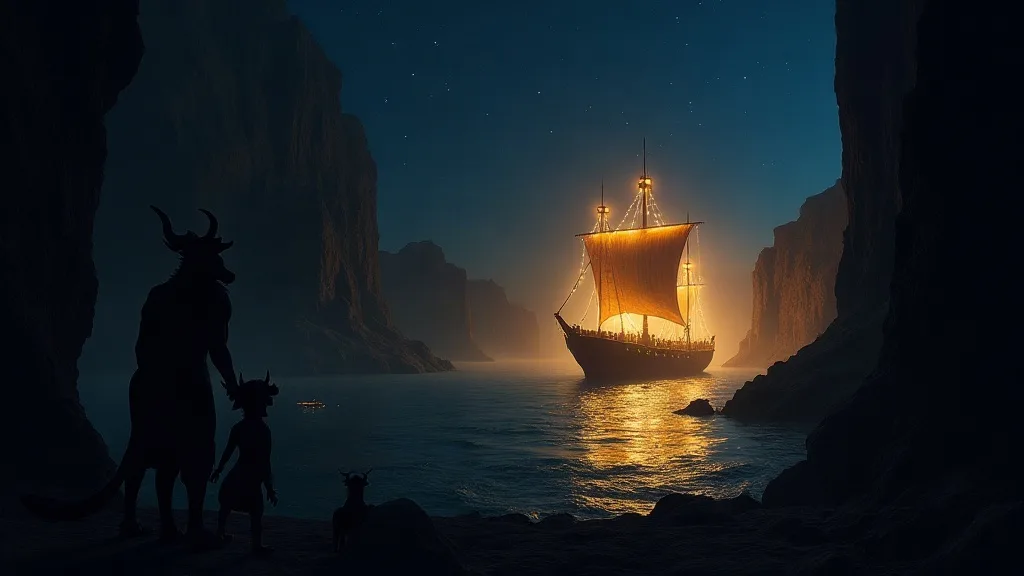
Each evening, as the sun dips below the western horizon, the ancient Egyptians believed something extraordinary happened. Ra, the most powerful of all gods, did not simply disappear. Instead, he entered a realm most mortals never saw alive: the Duat, the underworld. For twelve hours, he would navigate a landscape of shadows, demons, and spiritual trials. By dawn, he would be born anew, sailing across the sky again in his solar barque, or sacred boat. This nightly cycle was not myth for its own sake. It explained death and rebirth, showed how chaos could be overcome, and promised renewal to every Egyptian who died and hoped to follow Ra's path.
The journey was real to the ancient Egyptians in the way that matters most: it shaped how they saw mortality, kingship, and their place in the cosmos. Pharaohs inscribed the twelve hours of Ra's underworld voyage on the walls of their tombs. Common people carried amulets depicting him. Priests recited prayers to speed his passage. For over three thousand years, this story held Egyptian civilization together.
The Duat: Where Sun and Shadow Meet
The Duat (also spelled Dat or Duaat) was not a single place but a state between worlds. It lay beneath the earth, in the direction of the west, where the sun died each day. Unlike the Christian hell or the Greek underworld, the Duat was not primarily a place of punishment. It was the realm of transformation. The dead went there, yes. But so did Ra. And so, one day, would every pharaoh and every Egyptian who died in a state of moral purity.
The Duat was ruled by Osiris, the god of the dead, fertility, and resurrection. Osiris sat in judgment over the souls of the deceased, weighing their hearts against the feather of truth (represented by the goddess Maat, who embodied justice and cosmic order). But Osiris did not oppose Ra. Instead, they worked in harmony. When Ra descended into the Duat each night, he took on a form that reflected his passage through death: in the lower hours, he was shown as Khenti-Amentiu, "Foremost of the Westerners," or as Atum, the creator god in his oldest, primordial form.
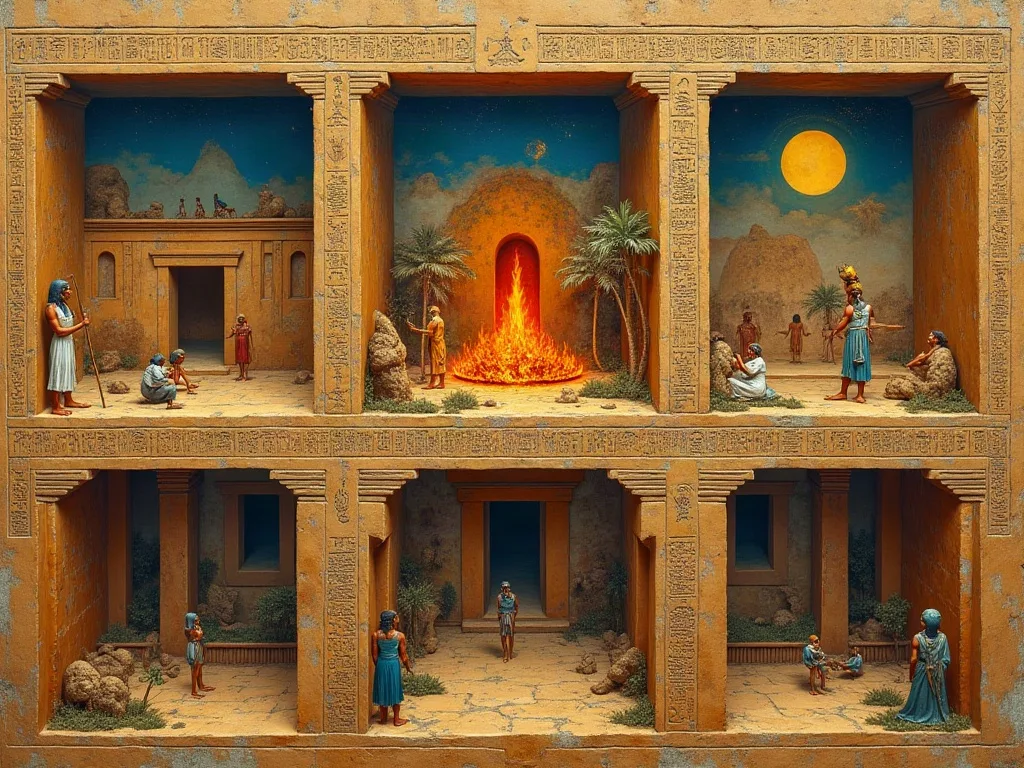
The landscape of the Duat was treacherous. It contained lakes of fire, gates guarded by demons with knives for heads, walls that closed to crush the unwary, and passages blocked by the names of the hostile dead. Most perilous of all was the serpent Apophis (also called Apep), a creature of such immense evil that he was never given a proper name in some contexts, lest speaking it give him power. Apophis embodied chaos itself. Each night, he waited in the depths to devour Ra's barque and prevent the sun from rising.
The Twelve Hours: Ra's Descent and Return
The Egyptians divided the night into twelve hours, each corresponding to a different stage of Ra's journey. This structure comes to us primarily through three sources: the Amduat (literally "That Which Is in the Underworld"), the Book of Gates, and the *Book of Caverns." These texts were inscribed on the walls of royal tombs, particularly from the New Kingdom (1550-1070 BC), and they are among the most vivid and strange religious documents ever written.
The First Hour: Entry into Darkness
Ra enters the Duat through the western horizon. His barque is towed by a crew of gods and spirits. The realm is still recognizable; it resembles the land of the living, but dimly lit, as if seen through murky water. The spirits of the dead begin to gather. Some pray to Ra for protection; others simply watch his passage. This first hour represents the acceptance of night, the moment when light itself surrenders to darkness without losing hope.
Hours Two Through Six: The Middle Hours
The deeper Ra travels, the more hostile the landscape becomes. In the fifth hour, he reaches the domain of Seker, a god of decay and the cemetery, typically depicted as a falcon. Seker's realm is particularly dangerous because it lies at the literal bottom of the Duat, the deepest, darkest point. Here, Apophis usually makes his first attack.
The serpent rises from a lake of poison. He is enormous; ancient texts describe him as being thirty feet long, with the power to darken the stars themselves. His jaws open to swallow Ra's barque whole. But Ra's crew does not flee. His son Horus, the falcon-headed god, stands at the prow. Nearby is Set, the god of chaos and violence (despite his dangerous reputation, Set fights against chaos in the form of Apophis). Thoth, the ibis-headed god of wisdom and writing, uses magic to bind or stun the serpent.
This is not a single combat. Apophis cannot truly be killed. He is the embodiment of entropy, the force that would unmake the world if left unchecked. Each night, he must be defeated. Each dawn, he regenerates. This eternal struggle reflects the Egyptian understanding of existence: life requires constant vigilance against disorder. Order (Ma'at) must be maintained through action and will. Passivity means collapse.

Hours Seven Through Eleven: Ascent and Restoration
Once Ra passes Seker's domain, the worst is behind him. The barque begins to ascend. In the eighth hour, Ra is greeted by the souls of the righteous dead, who row alongside him. In the ninth hour, he encounters the spirits of the stars, who pay him homage. By the tenth and eleventh hours, Ra is transformed. He is no longer shown as the falcon-headed Ra or the aging Atum. He is now depicted as Khepri, the scarab beetle, the symbol of rebirth and resurrection. Khepri pushes the sun forward, using only his legs, like a scarab rolling the ball of dung that will become the next generation.
This transformation is key. The Egyptians saw the scarab as a symbol of self-creation. The insect emerges from decay, from seemingly lifeless matter. Khepri represents the moment before dawn, the promise that birth always follows death.
The Twelfth Hour: Rebirth
Ra emerges from the eastern horizon at dawn. He is Khepri no longer. He is Ra again, young, powerful, ready to race across the sky in his solar barque. The cycle is complete. The dead who have proven themselves pure may follow a similar path; they do not literally sail with Ra, but they are believed to share in his resurrection. This is why the Egyptians mummified the dead and placed amulets in tombs depicting Ra's journey. They wanted their souls to have passage through the Duat, protected by the same forces that protected the god himself.
Key Deities of the Underworld Journey
Osiris stands at the center of underworld mythology. He is the god who died and was restored to life by his wife Isis and his son Horus. In some texts, Osiris and Ra are merged into a single deity called Amun-Ra or Osiris-Ra, acknowledging that the cycle of death and resurrection belongs to all beings, even gods. Osiris judges the dead but also enables their transformation. Every pharaoh was believed to become Osiris upon death, and every commoner who achieved purity hoped for the same.
Maat, depicted as a woman wearing a single ostrich feather on her head, is the living principle of justice, balance, and truth. Her feather is placed on a scale to weigh the hearts of the dead. If the heart is heavy with sin, the scales tip and a monster called Ammit (part crocodile, part lion, part hippopotamus) devours it, condemning the soul to annihilation. If the heart is light, the soul is granted passage into the afterlife. Ra's nightly battle against Apophis is ultimately a battle to maintain Ma'at; without it, the cosmos dissolves.
Thoth, the god of wisdom, writing, and magic, is Ra's chief advisor in the underworld. He is depicted with the head of an ibis or sometimes as a baboon. Thoth speaks the secret names of demons and uses spells to ward them off. In some passages of the Amduat, it is Thoth who advises Ra on which path to take, which names to invoke, which gates to pass through. The association between Thoth and writing is crucial: the Egyptians believed that knowing the true name of something gave you power over it. Thus, the Amduat and similar texts were not merely descriptive. They were magical documents. A pharaoh or priest who read them gained the knowledge necessary to navigate the afterlife himself.
Seker, the god of the cemetery and decay, represents the natural process of dissolution. He is neither evil nor entirely benevolent. He simply is the force that transforms bodies into dust. In the middle hours of Ra's journey, when the sun passes through Seker's domain, it is passing through the stage of greatest darkness and transformation. Some texts describe Seker as a falcon lying on a shrine; others show him as a serpent. His realm is so dangerous that even Ra must move carefully.
Apophis deserves special attention. Unlike most Egyptian gods, Apophis is not worshipped. He is not given offering chapels or temples. His sole function is to embody the chaos that must be resisted. Some texts suggest he was originally a chaos-god who predated Ra, a remnant of the primordial darkness. By the New Kingdom, he had become the most common symbol of evil in Egyptian religion. Spells were recited to bind him, wax figures were burned in rituals called "execration texts" to curse him, and his name was often deliberately omitted or misspelled in religious documents, as if to deny him full existence. Yet he cannot be eliminated. He is eternal, and so the battle eternal.
The Symbolism of the Twelve Hours
The twelve hours of night correspond to twelve stages of spiritual transformation. They map onto the human afterlife. When a pharaoh died, his tomb was designed to mirror the geography of the Duat. The sarcophagus was placed in the deepest chamber, equivalent to Seker's domain. As the dead king's spirit moved through the tomb, guided by inscriptions from the Amduat, it experienced each of the twelve hours in sequence. By emerging from the western wall of the tomb at sunrise, the dead king was symbolically reborn alongside Ra.
This was not metaphorical for the Egyptians. The tomb texts were not poetry or allegory. They were practical guides, maps, and spells meant to ensure that the soul could navigate the real landscape of the afterlife. A pharaoh without the correct texts was thought to be lost, unable to find the path, vulnerable to demons.
The journey also symbolized the eternal cycle of sacrifice and renewal that governed Egyptian cosmic thought. Ra must die each night so that the sun can be born each morning. This is not suffering, but necessity. Life requires darkness as much as light. The Duat is not opposed to the world of the living; it is continuous with it. The same forces that move the sun across the sky move it through the underworld.
Ra's Battle Against Apophis: Chaos Versus Order
The combat between Ra and Apophis is the spiritual heart of the Duat mythology. It is described in vivid detail in the Amduat and the Book of Gates. Apophis is shown as a serpent of immense size, sometimes depicted with multiple coils or even multiple heads. He rises from a lake in the lower hours, attempting to block Ra's passage or swallow his barque whole.
Ra's crew fights back with weapons and magic. Set, the red-skinned god of storms and chaos (and paradoxically, also a protector of Ra), stands at the prow with a spear. Horus uses his divine power to strike at Apophis. Thoth recites spells and invokes divine names. In some accounts, the entire crew transforms into fierce spirits, sometimes depicted as demons themselves, to match Apophis in ferocity.
The battle is won, but never finally. Apophis is bound or stunned, his coils wrapped in magical chains. His mouth is sealed with wax or magical seals. But he is not killed. The spell wears off. By the next night, he rises again. This reflects a sophisticated understanding of evil and entropy: they cannot be permanently eradicated from the cosmos. They can only be resisted, managed, and held in check through constant effort.
Modern readers sometimes find this frustrating. Why not simply kill Apophis? But the Egyptian answer is profound: because chaos is not a separate thing that was created and can be uncreated. Chaos is the absence of order. It is what exists when order stops being maintained. To kill Apophis would be to believe that evil can be eliminated, that entropy can be defeated permanently. The Egyptians knew better. They had built a civilization in the shadow of the Nile, depending entirely on the river's annual flood. Some years it came abundantly; some years it failed. Drought and famine were always possible. Order was always fragile. The night always returned.
The Amduat: Ancient Egypt's Most Detailed Underworld Map
The Amduat is our richest source for Ra's underworld journey. The name translates as "That Which Is in the Underworld." The text first appears in the tomb of the pharaoh Thutmose III (1479-1425 BC) and became a standard feature of royal tombs throughout the New Kingdom.
The Amduat divides the night into twelve hours, and for each hour, it provides a map, a description of the inhabitants, the dangers, and the spells necessary to pass through. The text is accompanied by elaborate illustrations, which makes it one of ancient Egypt's great visual documents. The figures are drawn in profile, in the characteristic Egyptian style, with gods, demons, and the souls of the dead all rendered in vivid color (though the pigments have often faded to browns and reds).
What strikes a modern reader first is the strangeness. The Duat is not a moral landscape in the way that Dante's Inferno is. There are demons, yes, and danger. But there are also peaceful gardens, where the righteous dead rest under trees. There are lakes, some of which are safe and some of which burn with fire. There are gates, each guarded by a demon whose name must be spoken correctly to pass through. If you speak the name wrong, the gate remains sealed.
This emphasis on names is crucial. In Egyptian religious thought, knowing the true name of something was equivalent to having power over it. The Amduat is therefore not merely a description of the afterlife; it is a grimoire, a book of magic. A pharaoh who memorized the Amduat (or, more realistically, had it inscribed on his tomb walls so his spirit could read it eternally) possessed the knowledge needed to navigate the dangers.
The Amduat also reflects Egyptian geography and daily life. The hours are laid out much like the nomes, or provinces, of Egypt. The creatures that inhabit the Duat are often drawn from the animals and demons of the waking world. The Nile itself appears in the underworld, flowing in reverse. This was not fantasy for its own sake. The Egyptians believed that the underworld was as real and as structured as the world above. The only difference was visibility. The living could not see it, but it was there.

Parallels with Other Underworld Journeys
Ra's descent into the Duat is often compared to other underworld myths: Inanna's descent in Sumerian religion, Persephone's abduction in Greek mythology, Orpheus attempting to rescue Eurydice, or the descent of Heracles into Hades. Yet Ra's journey is distinctive in several ways.
First, it is nightly, not a single exceptional event. Ra does not struggle to escape the underworld. He moves through it with the confidence of a divine being and emerges into the light without resistance. There is danger, but it is not a punishment or a test of worth. It is simply the condition of existence.
Second, the journey is cosmically necessary. Ra must descend for the sun to rise. Persephone, by contrast, is abducted against her will. Orpheus ventures into the underworld to rescue a lost love. Ra's journey is neither punishment nor love-driven. It is the rhythm of the cosmos itself.
Third, the Duat is not presented as a place of eternal residence. Even the dead do not stay there permanently. They rest, they are judged, and then they are believed to ascend to the Field of Reeds or to follow Ra himself. The underworld is a waystation, not a destination.
What the Egyptians Believed Would Happen to Them
The average Egyptian, whether a farmer, a scribe, or a merchant, did not expect to sail in Ra's barque after death. That privilege was reserved for the pharaoh, and possibly for the wealthy elite who could afford elaborate tombs and funerary texts. But every Egyptian hoped that their death would follow the pattern that Ra's death-and-rebirth established.
To achieve this, the body had to be preserved through mummification. The name had to be remembered (which is why people were so concerned with being forgotten; to have one's name erased was to cease to exist). And one had to have lived a life of ma'at, or truth and order. A person who had lied, stolen, murdered, or abandoned their family could not hope for eternal life. Their heart would be heavy when placed on the scales against Ma'at's feather, and Ammit would devour their soul.
This was not hell in the Christian sense, with eternal punishment. It was annihilation, which the Egyptians may have found worse. To an ancient Egyptian, to cease to exist after death was the ultimate tragedy. But to be remembered, to be mummified, to have one's name carved on a tomb, to have prayers recited for you by your children and grandchildren: this was a form of immortality.
The Twelve Hours in Art, Amulets, and Popular Practice
The twelve hours of Ra's journey appeared not only on tomb walls but in everyday objects. Amulets called ushabti depicted Ra in different forms; a wealthy person might carry several, one for each hour, as protective talismans. The scarab beetle (Khepri) became one of Egypt's most popular amulets because it represented rebirth and transformation. Worn on the heart, it was believed to help the wearer navigate their own spiritual challenges.
Priests used the Amduat in rituals meant to guide souls of the recently deceased through the underworld. The rituals involved recitation of spells, the presentation of offerings, and the invocation of divine names. Priests were thought to be skilled navigators of the Duat. This is why they were trusted with the funerary rites and why the temples maintained libraries of religious texts.
The journey was not purely spiritual, either. It had moral and political implications. A pharaoh's successful passage through the Duat, mirrored in the inscription of the Amduat on his tomb walls, was a statement of his fitness to rule. A pharaoh who could not safely navigate the underworld was unfit for kingship. Conversely, a pharaoh who lived a life of ma'at and was properly entombed would be assured of eternal life in the underworld, alongside Ra.
Modern Scholarship and the Evolution of Belief
Egyptian underworld beliefs evolved significantly over the three-thousand-year span of pharaonic civilization. The earliest references to Ra's journey appear in the Middle Kingdom (2055-1650 BC), but they are brief and cryptic. By the New Kingdom, the texts are elaborate and detailed. The Amduat itself represents a relatively late development, though its cosmology may reflect older ideas.
Some scholars suggest that Ra's underworld journey represents a merger of two older traditions. One tradition may have involved a sun god who dies and is reborn (a common pattern in ancient agricultural religions). Another may have involved Osiris, who was originally a vegetation god or a god of the inundation. By merging them, the Egyptians created a more comprehensive mythology that explained both the daily cycle of the sun and the eternal cycle of death and resurrection.
What is clear is that the Egyptians took the underworld seriously. The Amduat and related texts are not entertainment or folklore. They are theological and practical documents, written by priests and scholars to ensure the correct navigation of the afterlife. This is why they were copied and recopied for centuries. This is why they were inscribed on the walls of tombs where they would be needed eternally.
The Duat in Later Times and Modern Memory
As Egyptian civilization declined and Greek and Roman rule came to Egypt, underworld beliefs shifted. By the Ptolemaic period (305-30 BC), the Duat was less central to popular religion. Greek ideas about the underworld, particularly the concept of a divided afterlife with rewards and punishments, began to influence Egyptian thought.
Yet the core image of Ra's journey persisted. The symbolism of the scarab, of death followed by rebirth, of a solar deity moving through darkness and emerging reborn, became woven into late Egyptian and Coptic Christianity. Some scholars see echoes of Ra's resurrection in early Christian concepts of resurrection itself. Whether this is direct influence or coincidental parallelism is debated.
In modern popular culture, Ra's journey has been reimagined in fiction, games, and museums. The aesthetic of the Amduat, with its strange demons and vivid colors, has fascinated audiences since European Egyptologists first deciphered the texts in the nineteenth century. Yet popular retellings often miss the sophisticated theology beneath the surface. The journey was not meant to thrill or frighten, but to explain. It answered the deepest questions: What happens when we die? How does the cosmos remain ordered? Why does the sun rise again?
Frequently asked questions about Ra's journey through the underworld?
Frequently asked questions
Was Ra's underworld journey the same every night, or did it change?
The basic structure of the twelve hours was fixed, described in texts like the Amduat as an unchanging pattern. However, ancient Egyptian texts do describe variations in the encounters and dangers. Apophis' strength might vary; he could be more or less of a threat depending on cosmic circumstances. Some ritual texts suggest that the specific spells recited by Thoth or the particular battles Ra's crew fought could differ, though the outcome (Ra's emergence at dawn) was always assured.
Did ancient Egyptians believe other gods also had to pass through the Duat?
The texts focus overwhelmingly on Ra's journey, but Egyptian theology suggests that all beings, including gods, were subject to the cycle of death and rebirth. Osiris himself had been torn apart by his brother Set and reassembled by Isis; he did not return to the waking world but became lord of the Duat, a transformed existence. The pharaoh, upon death, was believed to become Osiris and experience a similar transformation. However, only Ra's underworld journey is consistently depicted across multiple texts, suggesting it held special cosmological importance.
What was the relationship between Ra and Osiris in the underworld?
Ra was the god of the living sun and the day sky; Osiris was the god of death, fertility, and the afterlife. In the Duat, they occupied different roles. Ra was the traveler, passing through Osiris's realm without stopping. Osiris was the lord and judge, presiding over the souls of the dead. However, some later texts merge them into Amun-Ra or Osiris-Ra, suggesting that by the New Kingdom, Egyptians understood them as complementary aspects of a single cosmic principle: the eternal cycle of death and rebirth.
Why couldn't Ra simply defeat Apophis once and for all?
The Egyptian cosmos was built on the principle of eternal struggle between order and chaos. Apophis was not merely a monster but the embodiment of entropy itself, the force that would dissolve the world if left unchecked. Egyptian theology did not envision a final victory over evil in which evil ceases to exist. Instead, order had to be maintained continuously through effort, will, and knowledge. This reflects the Egyptians' practical understanding of survival in a fragile environment: the Nile's flood could fail, droughts could strike, and vigilance was always required.
How did ordinary Egyptians use the knowledge of Ra's journey in their own lives or deaths?
Wealthy Egyptians had funerary texts inscribed in their tombs; many of these were derived from or parallel to the Amduat. Even those who could not afford complete texts hoped their mummified bodies and preserved names would secure their passage through the Duat. Priests recited spells from the Amduat in funerary rituals to guide the deceased. Common people wore scarab amulets (representing Khepri, the rebirth form of Ra) for protection. The underlying belief was that by honoring Ra's journey and living a life of ma'at (truth and order), one could share in his eternal renewal after death.
Are the demons in the Amduat the same as demons in other ancient religions?
Egyptian demons serve a different function than demons in religions like Christianity or Islam. They are not rebellious or necessarily malevolent; they are agents of the divine order, guardians of gates and boundaries. A demon in the Amduat blocks passage to ensure that only the pure may advance. The chaos serpent Apophis is the closest Egyptian equivalent to an evil force, but even Apophis is not a fallen angel or a rebel god. He is simply chaos, entropy, the absence of order. Treating him requires not moral conversion but magical knowledge and divine will.
The Eternal Cycle: What Ra's Journey Still Teaches
The Egyptians did not invent the idea of a death-and-rebirth cycle, but they developed it with extraordinary sophistication. Every pharaoh saw himself as Ra. Every commoner hoped to follow Ra's path after death. The rituals of mummification, the spells in the Amduat, the paintings on tomb walls, the scarab amulets worn on living bodies: all of these were practical responses to a deep theological conviction that the cosmos depends on Ra's nightly descent and his daily rebirth.
What is striking to a modern reader is that this mythology is not comforting in a simple way. The underworld in the Egyptian vision is not a restful place. It is dangerous, strange, and utterly unlike the waking world. The battle against Apophis is never won permanently. Order must be restored every single night. Yet the Egyptians faced this reality without despair. They built elaborate tombs to ensure their safe passage. They recited spells to give themselves power. They lived according to ma'at, truth and justice, to make themselves worthy of resurrection.
In other words, they took responsibility for their own eternal survival. They did not pray for salvation from without. They prepared themselves through knowledge, ethics, and ritual practice. Ra's journey became a template for living: move through the darkness with courage, trust in the guidance of wisdom, hold fast to order and truth, and know that the light will return.
The Amduat, the Book of Gates, the thousands of scarab amulets and funerary spells: these were not produced by a civilization obsessed with death. They were produced by a civilization that refused to accept death as final. And they did so by understanding that rebirth requires descent, that light requires darkness, and that the cosmos itself depends on the eternal willingness of a god to descend into the abyss and emerge anew.
Free 25-page sample
Want the whole story?
Take the first 25 pages free. If it pulls you in, the full edition is yours as an instant PDF download, with a paperback on Amazon for selected titles.

Mythology
The World Mythology Book: The Gods, Heroes and Myths of Every Culture
The Gods, Heroes and Myths of Every Culture, in One Volume
The whole of world mythology in a single volume: Greek, Norse, Egyptian, Japanese, Hindu, Celtic, Slavic, Mesoamerican and African myths gathered side by side, each drawn from the primary sources.