
The Ramayana Epic Summary: Rama's Journey from Prince to God
The Ramayana, one of the world's longest poems, tells how Rama fights to rescue his wife Sita and reclaim his throne. This ancient Indian epic is far more than a heroic tale: it shapes how 1 billion Hindus understand duty, virtue, and the nature of god.
Contents
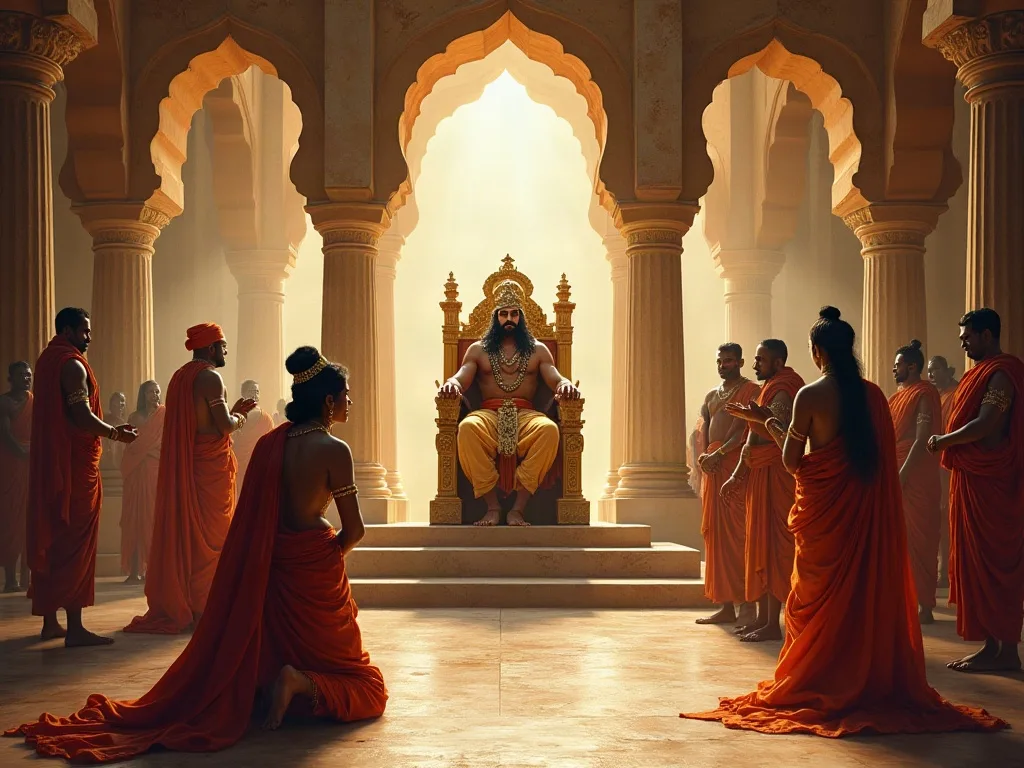
Rama's father, King Dasharatha of Ayodhya, has just announced that his eldest son will rule after him. The kingdom celebrates. But the king's youngest wife, Kaikeyi, remembers an old promise: Dasharatha had once sworn to grant her any two wishes. She cashes them in now. First wish: banish Rama to the forest for fourteen years. Second wish: crown her own son, Bharata, as king instead.
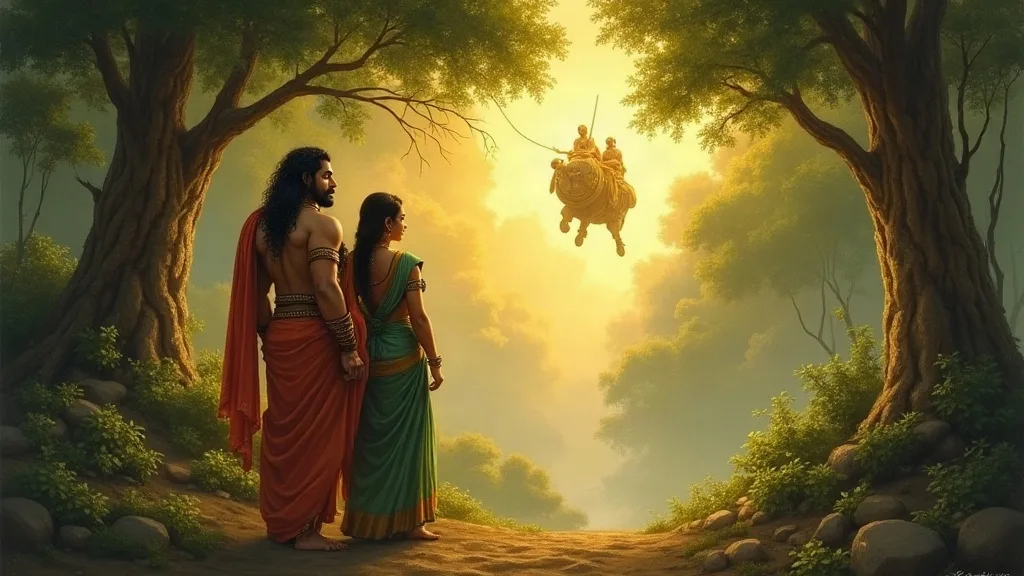
Rama accepts the exile without protest. His younger brother Lakshman refuses to stay behind and follows him into the wilderness. Rama's wife Sita insists she will not remain in the palace without him. The three vanish into the forest. Behind them, a kingdom grieves, a usurper king wrestles with guilt, and a darkness gathers in the east.
This is how the Ramayana, one of the two great epics of ancient India, begins. It is not a quick story. The full poem runs to some 24,000 verses across seven books, making it roughly ten times longer than Homer's Iliad and Odyssey combined. Yet for over two thousand years, it has shaped how Hindus, Buddhists, Jains, and people across Southeast Asia understand heroism, duty, and the possibility that god can walk the earth as a human being.
The Poem's Age and Authorship
The Ramayana as we know it was likely composed between 400 BCE and 100 CE, during India's classical period. Hindu tradition credits the poet Valmiki with writing it. According to the story embedded in the epic itself, Valmiki was once a highway robber named Ratnakara until a sage taught him to meditate. After his transformation, Valmiki retired to the forest and composed the Ramayana as the ultimate tale of virtue.
Modern scholars debate whether one author wrote the whole poem or whether it grew over centuries, absorbing local tales and regional versions. What matters for readers today is that the Ramayana epic summary we know rests on a foundation older than Christianity, drawing on folk traditions possibly stretching back to 1200 BCE or earlier.
The text survives in multiple recensions (official versions). The two most important are the Northern recension (used in North India and standardized around 100 CE) and the Southern recension (found in Tamil and other South Indian traditions, often considered more conservative). There are also vernacular adaptations: Tulsidas's 16th-century Hindi Ramcharitmanas is beloved across North India and arguably more widely read than the Sanskrit original today.
Rama and the Avatar Concept
To understand the Ramayana, you must first grasp what Rama is. In Hindu theology, Vishnu, one of the three supreme gods, takes physical form in the world whenever chaos threatens cosmic order (dharma). These descents are called avatars. Rama is Vishnu's seventh avatar; Krishna, the hero of the other great epic, the Mahabharata, is his eighth.
This matters because it reframes every episode. When Rama refuses to claim the throne that is his right, he is not simply being noble; he is embodying perfect duty even when it costs him everything. When he remains faithful to Sita despite public scandal, he is not being sentimental; he is demonstrating that virtue is unwavering. When he kills Ravana, he is not just winning a war; he is an avatar restoring cosmic balance.
The poem itself was composed in classical Sanskrit, the language of gods and courts in ancient India. This elevated tongue gives the narrative an almost liturgical weight. Every battle scene, every moment of doubt, every act of mercy resonates with the gravity of a world-ordering event.
The Kidnapping: Sita and Ravana
Fourteen years in the forest test Rama's resolve. He and his companions live simply, though Sita misses palace life. One day, the demoness Surpanakha, sister of the demon king Ravana, appears in the forest. She falls in love with Rama and proposes marriage. Rama refuses, saying he is faithful to his wife. Surpanakha grows enraged and lunges to attack Sita in revenge. Lakshman blocks her and in his fury cuts off her nose and ears.
Surpanakha flees to her brother Ravana. She tells him of Sita's beauty and suggests he abduct her. Ravana, who had already heard of Rama's wife and desired her, plots in silence.
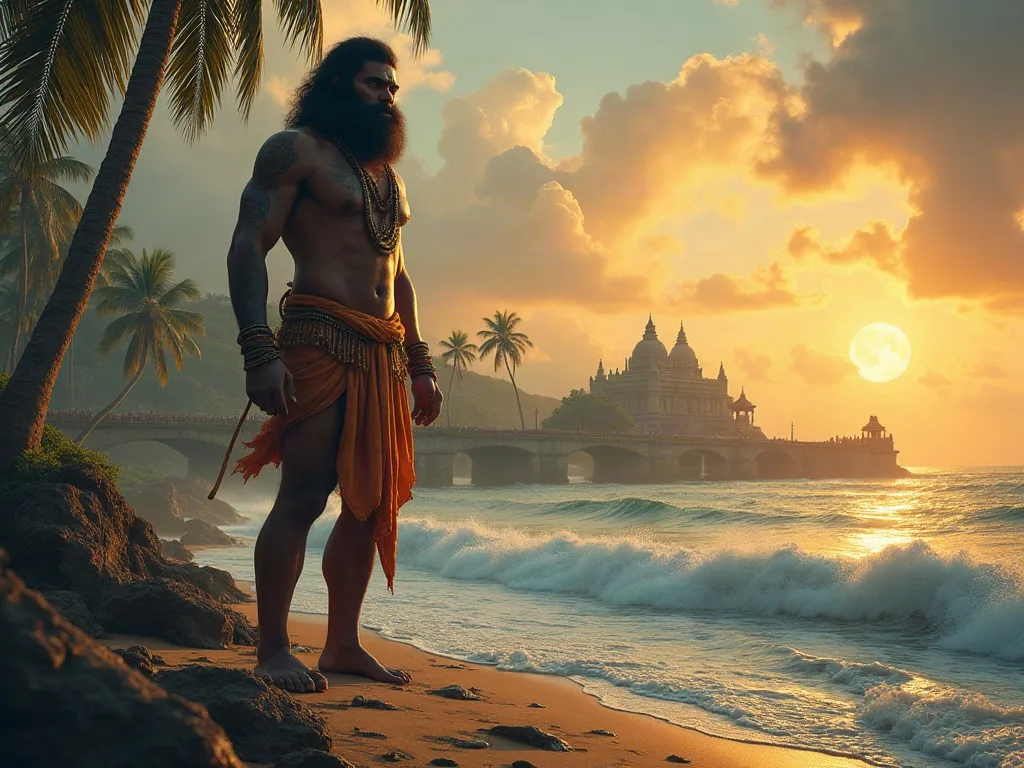
Ravana is no cartoon villain. He is the king of Lanka (now Sri Lanka), a powerful sorcerer, and himself a descendant of gods. He earned his power through ages of meditation and sacrifice. He commands an army of demons. By any standard of the age, he is a worthy foe.
He uses a trick. His servant Maricha, a demon who can change shape, transforms into a golden deer. Sita sees it in the forest and begs Rama to capture it for her. Rama knows it is a trap but cannot refuse her. He sets off after the deer, leaving Lakshman to guard Sita. When Rama finally realizes the deception and kills the disguised demon, Maricha cries out in Rama's voice for help. Sita hears what she believes is her husband dying. She begs Lakshman to rush to him. Lakshman, bound by his brother's command to stay with Sita, is torn by duty. He finally goes to find Rama, leaving Sita alone.
That moment is Ravana's opening. He appears before Sita in disguise as a wandering holy man. When she offers him hospitality, he drops the disguise and seizes her, lifting her bodily and carrying her away to Lanka in a flying chariot.
This abduction is the fulcrum of the entire Ramayana. It is not presented as a seduction plot or a love story. Sita remains completely faithful and rejects Ravana's advances completely. The poem emphasizes her suffering and her steadfast devotion to Rama. What drives the narrative from this point forward is Rama's search for his wife and his war to reclaim her.
The Search and the Alliance with Hanuman
Rama and Lakshman search frantically through the forest. They encounter Sugriva, the king of the monkeys, who is hiding in the mountains, deposed by his brother Vali. Rama and Sugriva form an alliance. Rama helps Sugriva defeat Vali and reclaim his throne. In return, Sugriva sends his best commander, Hanuman, to search for Sita.
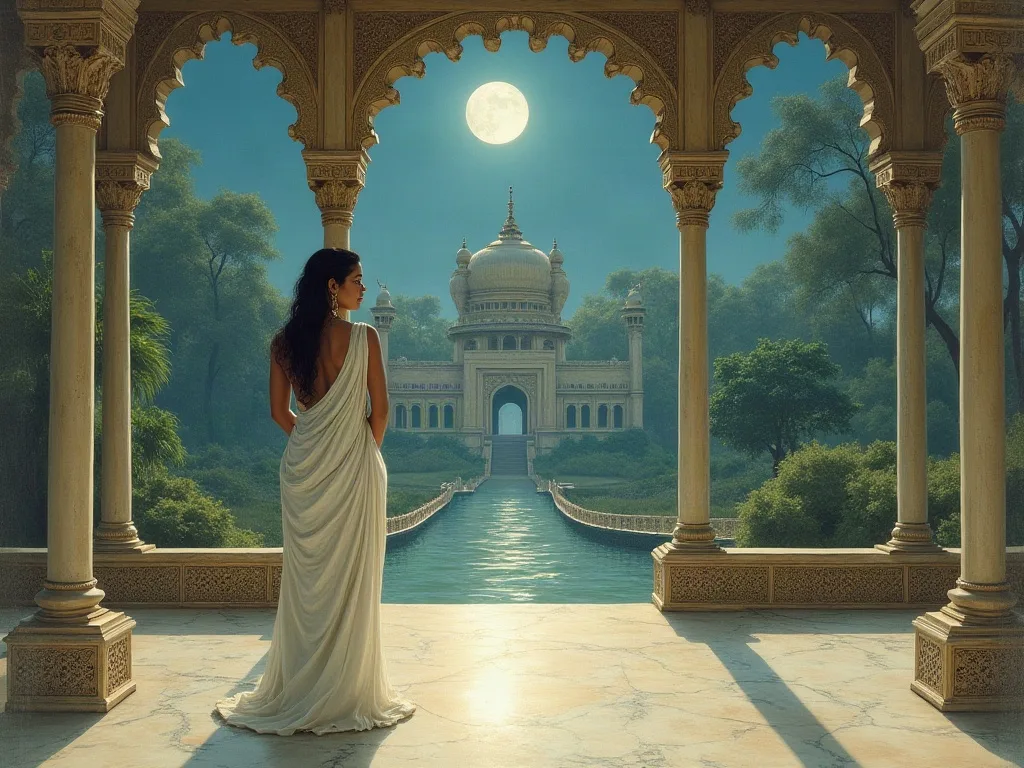
Hanuman is one of the most beloved figures in the entire Hindu pantheon. He is part monkey, part immortal (his father is the wind god Vayu). Hanuman is utterly devoted to Rama; his love is not romantic or familial but spiritual, the ideal of complete surrender to god. When he leaps across the ocean to Lanka, he grows to enormous size to clear the distance. He finds Sita in a garden prison, still faithful, refusing Ravana's marriage proposals. Hanuman comforts her and tells her Rama will come.
Ravana grows impatient. He gives Sita an ultimatum: marry him within a year or die. Sita chooses to wait for Rama, knowing he will come.
The War and the Siege of Lanka
Rama gathers Sugriva's monkey army and marches to the ocean. With Hanuman's help, they build a bridge across the sea. The monkeys swarm across and reach Lanka. The war that follows occupies nearly a quarter of the entire Ramayana. It is not presented as simple good defeating evil. Ravana's generals are noble and fight with honor. Many of Rama's allies fall. The battles test Rama's courage and his faith.
The climax arrives when Rama and Ravana face each other in single combat. After a ferocious duel, Rama fells his opponent. As Ravana lies dying, Rama, displaying the epic's moral complexity, sits with him as a sign of respect. Ravana, before death, utters profound teachings about virtue and duty.
The Homecoming and the Scandal
Rama retrieves Sita and they begin their journey home. But as they near Ayodhya, a harsh test arrives. Rama's subjects whisper: Sita spent months in another man's palace. How can Rama take her back? Even if she was innocent, public reputation matters. Rama, bound by duty to his kingdom, asks Sita to prove her innocence through an ordeal.
Sita, heartbroken, calls on the earth goddess to witness her fidelity. The earth opens beneath her and receives her into its depths. Rama is left alone, having lost both wife and throne for years, only to lose his wife again when he finally recovers his kingdom.
This is where the original Valmiki text ends. Later authors added an epilogue: Sita is eventually recovered from the earth, and Rama accepts her again. But even this reconciliation is bittersweet. Sita chooses to return to the earth rather than remain with Rama in a world that has judged her. Rama rules justly as king but never remarries, keeping an empty throne for his absent queen.
Why the Ramayana Endures: Duty Over Desire
The Ramayana epic summary is not a simple hero's journey. The poem's power lies in how it treats duty (dharma) as more binding than love, desire, or even happiness.
Rama gives up his kingdom for his father's honor. He abandons his pregnant wife because public duty demands it. Sita submits to trial even when innocent because a queen must answer to the kingdom's voice. Lakshman serves his brother above all, even when doing so costs him. Hanuman loves Rama with a devotion that transcends reason.
This is alien to modern Western storytelling, which tends to celebrate individuals who break rules for love or personal truth. The Ramayana asks: what if duty itself is the highest good? What if accepting loss with grace is the truest victory?
For Hindu readers across centuries, Rama became the ideal man: not powerful because of his strength but because of his adherence to righteousness even when it destroys him. This is why Diwali, the Festival of Lights, celebrates Rama's return to Ayodhya each year. The festival marks not a simple military victory but the triumph of cosmic order and virtue.
Regional Variations: The Ramayana Across Asia
The story did not remain confined to Sanskrit or India. It spread throughout Southeast Asia, taking on new forms in each culture.
In Thailand, the Ramakien retells the tale with Thai heroes and demons. The King of Thailand even takes the title "Rama," directly tracing his royal authority through the epic's protagonist. The Ramakien is recited at temple festivals and depicted in Thai classical dance.
In Indonesia and Malaysia, the Hikayat Seri Rama blends Islamic and Hindu elements. Rama becomes a noble warrior in a Muslim sultanate, and the demon Ravana appears as a sorcerer opposed to divine will. This version shows how the Ramayana can be retold across religious boundaries while keeping its core moral architecture intact.
In Cambodian and Laotian traditions, the story similarly transforms, absorbing local spirits and customs while maintaining the essential narrative: a prince's exile, a wife's abduction, a war to restore cosmic order.
The Ramayana in Hindu Daily Life
The Ramayana is not an ancient text studied in museums. It lives in Hindu practice today.
Recitations of the Ramayana, called ramlilas, are performed across India, particularly during Diwali. These can last weeks, with entire communities gathering to watch actors perform each episode. In Varanasi, the holiest city in Hinduism, performances of the Ramcharimnnas (Tulsidas's vernacular version) happen year-round.
Rama's name itself is considered sacred. Many Hindus keep an image of Rama and Sita in their homes as a reminder of ideal love and duty. Pilgrims visit sites associated with the epic: the city of Ayodhya, where Rama was born; Rishyamukh Mountain, where Rama allied with Sugriva; Rameshwaram, a temple in South India built by Rama before crossing to Lanka.
The epic also shapes Hindu ethics. Children learn about duty by hearing Rama's story. Philosophers cite the Ramayana when debating right action. Even in modern India, political leaders invoke Rama and the ideal of Ramarajya, Rama's just rule, as a model for governance.
Scholarly Debates: History, Archaeology, and Faith
For modern scholars, the Ramayana raises fascinating questions. Was there a historical Rama? Did the events of the epic actually occur?
Archaeological surveys have found sites that may correspond to places named in the poem. Ayodhya, Rama's birthplace, is a real city in North India. Some researchers have proposed that the epic preserves memories of actual historical conflicts, perhaps between Aryan and Dravidian kingdoms. Others argue that the poem is entirely mythological, a teaching story without historical anchor.
In 1992, the destruction of the Babri Masjid mosque in Ayodhya became a flashpoint of Indian politics partly because of competing claims about whether that site was the birthplace of Rama. The incident shows how the Ramayana, ancient as it is, remains politically and emotionally charged.
What most scholars agree on is that the epic, as written, is a literary and theological text first. Its value lies not in whether Rama was a historical person but in what the story teaches about virtue, sacrifice, and the Hindu understanding of god becoming human.
The Ramayana and Modern Retellings
The epic continues to inspire new adaptations. In 1987, Indian television broadcast a serialized Ramayana directed by Ramanand Sagar that became a national phenomenon, drawing audiences of 100 million. During airings, the streets of Indian cities emptied as families gathered to watch.
Contemporary Indian authors have reimagined the Ramayana. Amish Tripathi's The Immortals of Meluha series presents the gods of the Ramayana as advanced humans in an ancient Indian civilization. Devdutt Pattanaik's graphic novels make the epic accessible to younger readers, often emphasizing perspectives of characters like Sita or Lakshman.
Western scholars and authors have also engaged with the text. novelist Salman Rushdie drew on the Ramayana in his work. Academics study it as a foundational text of world literature. Universities now teach the Ramayana epic summary alongside Homer and Virgil.
Frequently asked questions about the Ramayana epic
Frequently asked questions
How long is the Ramayana compared to other epics?
The Ramayana contains approximately 24,000 verses and is about ten times longer than Homer's Iliad and Odyssey combined. Its length rivals the Hebrew Bible and far exceeds Dante's Divine Comedy. Only a few texts in human literature rival it in scale.
Is Rama worshipped as a god or honored as a hero?
Both. In Hindu theology, Rama is an avatar of Vishnu and therefore divine. Temples dedicated to Rama exist across India and Southeast Asia, and devotees pray to him. Simultaneously, his story teaches human virtue: he is studied as an ideal man, not worshipped only as a distant deity.
What is the difference between the Ramayana and the Mahabharata?
Both are ancient Hindu epics, but they differ in scope and focus. The Mahabharata is longer (100,000 verses) and centers on a dynastic war and the dilemmas of duty in complex situations. The Ramayana is more focused narratively: it follows Rama's exile and quest to rescue his wife. The Ramayana is often considered more accessible to new readers, while the Mahabharata is philosophically denser.
Why does Rama banish Sita if she was innocent?
This is deliberate tragedy in the epic. Rama must choose between his love for Sita and his duty as king to respond to public scandal. The poem does not make this easy or judge him harshly; instead, it presents a world where duty sometimes demands personal sacrifice. Later versions of the text reunite Rama and Sita, but the original Valmiki Ramayana emphasizes the cost of righteousness.
Is there historical evidence that the Ramayana describes real events?
Scholars debate this. Ayodhya and other cities named in the epic are real places. Some researchers believe the poem preserves distant memories of ancient Indian conflicts. However, most scholars treat the Ramayana as a theological and literary work first, not a historical chronicle. Its value lies in its teachings about duty and virtue rather than in historical accuracy.
How is the Ramayana celebrated today?
The Ramayana remains central to Hindu life. Diwali, celebrated by over 1 billion Hindus, marks Rama's return to Ayodhya. Recitations called ramlilas are performed during festivals. Many Hindus keep images of Rama in their homes, and pilgrims visit sites linked to the epic. It is studied in schools and universities worldwide, treated as one of humanity's greatest literary works.
The Eternal Return: Why Rama's Journey Still Speaks
What makes the Ramayana extraordinary is that it never feels like a relic. The poem speaks to recurring human questions: What do we owe others? Can love survive duty? What happens when doing the right thing destroys us? Is there a difference between innocence and vindication?
Modern readers find themselves wrestling with Rama's choices. Many feel sympathy for Sita, who suffers unjustly. Others see Rama's dilemma as genuinely tragic: a good man caught between competing goods. The poem does not resolve this tension; it holds it, asking readers to sit with the complexity.
For Hindus, the epic is scripture and story at once. It teaches theology: the nature of god, the structure of cosmos, the relationship between divine will and human action. It teaches ethics: how to behave, what to sacrifice, where integrity lies. And it teaches aesthetics: what beauty sounds like, how suffering can be noble, what it means to tell a story that lasts two thousand years.
The Ramayana endures because it is simultaneously ancient and immediate. When you read Rama's despair at exile or Sita's courage in captivity, you are reading events that happened centuries ago in a culture not your own. Yet you are also reading about yourself: about the choices that break us, the loves we cannot keep, and the possibility that in losing everything, we might find what truly matters.
Free 25-page sample
Want the whole story?
Take the first 25 pages free. If it pulls you in, the full edition is yours as an instant PDF download, with a paperback on Amazon for selected titles.

Mythology
The World Mythology Book: The Gods, Heroes and Myths of Every Culture
The Gods, Heroes and Myths of Every Culture, in One Volume
The whole of world mythology in a single volume: Greek, Norse, Egyptian, Japanese, Hindu, Celtic, Slavic, Mesoamerican and African myths gathered side by side, each drawn from the primary sources.