

Saraswati: Goddess of Knowledge, Music, and Sacred Speech in Hindu Tradition
Saraswati embodies the Hindu ideal of knowledge as a living force: wisdom flows through language, music, and creative thought. Discover how this ancient goddess evolved from a river into one of Hinduism's most venerated figures, shaping education, arts, and spiritual practice across centuries.
Contents
Saraswati emerges from water and word. In the beginning, before temples were built or prayers recited, she was a river. But rivers in Hindu cosmology are never mere geography; they are goddesses, carriers of blessing, channels of transformation. The ancient Vedic poets heard her flowing between the mountains and recognized something more: the sound of creation itself, the vibration of knowledge pouring into consciousness.
Over millennia, Saraswati, goddess of knowledge, became far more than a river deity. She crystallized into the supreme patroness of learning, the arts, music, and intellectual pursuits. In Hindu homes and temples across the world, students pray to her before exams. Musicians invoke her before performances. Scholars light lamps in her honor. She sits at the intersection of all Hindu culture: without her blessing, nothing learned endures; without her grace, no word becomes sacred.
The River That Became Divine
The earliest hymns of the Rigveda, composed around 1500 BCE, celebrate the Saraswati as one of India's greatest rivers. In the "Nadistuti Sukta" (hymn to the rivers), poets rank her above all other waterways: "Of all these rivers, O Saraswati, you flow with supreme power." The Saraswati River itself, once mighty enough to rival the Indus, dried up over centuries as climate and tectonic shifts redirected its waters. But her spiritual presence only grew.
The transformation from river to goddess was gradual, organic to Hindu thought. In the Vedas, she remains primarily a geographical force, though her name carries symbolic weight: Saraswati means "flowing water" or "she who flows," from the Sanskrit root saras (water, lake). But the priests heard another meaning in her name: sara also suggests "essence" or "truth." A river flows; truth also flows, they believed, through the minds of the wise.
By the time the later Vedas and early Upanishads were composed (roughly 1200-800 BCE), Saraswati had begun her ascent into the celestial realm. She appeared less as a waterway and more as a cosmic principle. The Yajurveda invokes her not just as a river but as the embodiment of sacred speech itself, the Vak (voice). The Brahmana texts, which interpret Vedic ritual, place her at the heart of Brahmanical culture: she presides over the spoken word, the chanted mantra, the precise utterance that holds cosmic power.

The Consort, The Creator, The Triple Goddess
The Puranas, composed between roughly 400 and 1500 CE, reshaped Saraswati's mythological role entirely. No longer content as a river or a symbolic principle, she became a character in dramatic narratives, a consort to the creator god Brahma, and eventually one of the Hindu trinity of divine feminine energy (the Tridevi).
The story of Saraswati's union with Brahma is told with variations across different texts. In one widespread account, Brahma created Saraswati from his own mind or body to assist in creation. Some texts describe her as emerging from his mouth, others from his breath, still others as being born directly from his consciousness. This intimacy reflects the Hindu understanding that knowledge and creation are inseparable: you cannot create a universe without understanding it; you cannot understand it without language and thought.
Their relationship grew complicated. In one narrative from the Bhagavata Purana, after Saraswati emerges, Brahma becomes so entranced by her beauty that he sprouts four additional heads to gaze upon her as she moves in every direction. Rather than accept his devotion, Saraswati feels violated, embarrassed by this unwanted attention. The tension never fully resolves. In later Hindu practice, temples honoring Brahma are remarkably rare worldwide, while temples to Saraswati flourish. Some scholars suggest that Hindu theology subtly shifted the blame to Brahma for his transgressive desire, elevating Saraswati as the more worthy of worship.
As the Tridevi (the three goddesses), Saraswati takes her place alongside Lakshmi (goddess of wealth and fortune) and Parvati (goddess of love and power). Together they represent the three primary modes of divine feminine energy: wisdom, prosperity, and devotion. Each is married to a god of the Trimurti (the three forms of ultimate reality): Saraswati to Brahma, Lakshmi to Vishnu, Parvati to Shiva. The arrangement reflects Hindu cosmology: creation requires knowledge, sustenance requires prosperity, and transformation requires power.
The Iconography of Wisdom
When you encounter an image of Saraswati in a temple, her appearance tells a complete story. Every element carries symbolic weight, the visual language of Hindu theology made tangible.
She sits or stands upon a lotus, the flower that Hindu and Buddhist cultures associate with purity and enlightenment. The lotus rises from mud and water yet remains unstained, emerging pristine and white. For Saraswati, the lotus signifies that true knowledge arises even from confusion and ignorance; wisdom blooms where it is needed.
She wears white garments, sometimes robes of pure silk, symbolizing purity of thought and the clarity of knowledge unmarred by ego or prejudice. Some images show her draped in white cloth so fine it appears translucent, as if knowledge itself were woven into the very fabric of her presence. The white also associates her with the moon, another symbol of mind and inner illumination in Hindu thought.
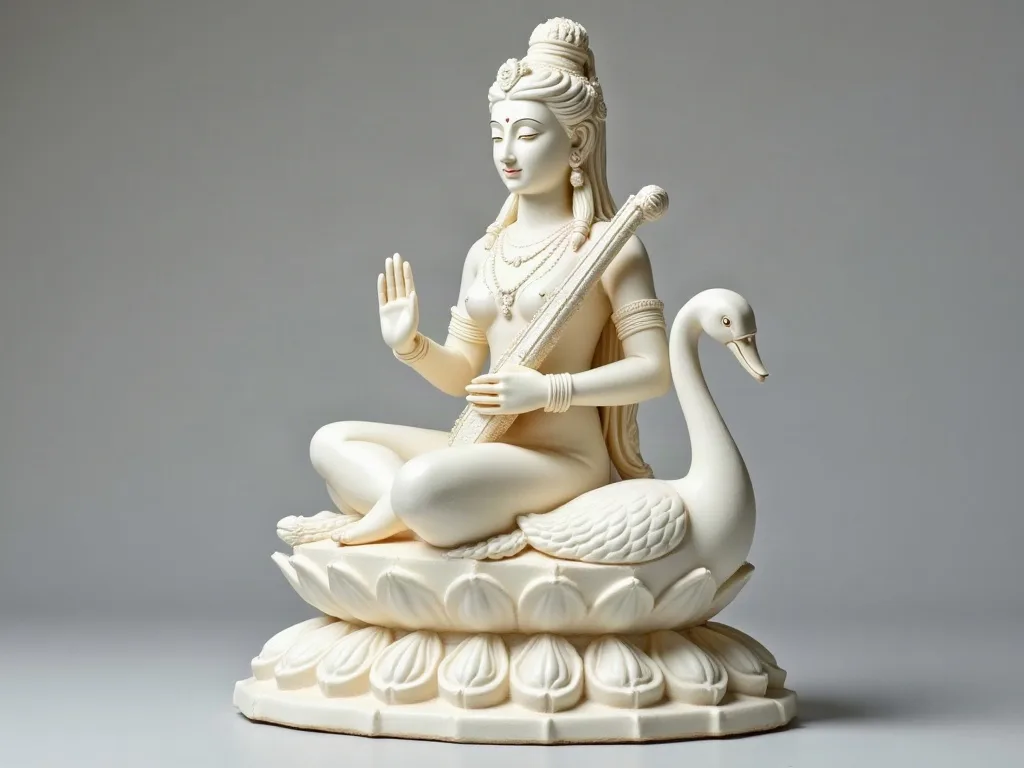
In her four hands, she carries objects that together compose the complete scholar's identity. Most characteristically, she holds a vina, a stringed musical instrument resembling a sitar or lute. The vina connects her to music, one of the highest arts in Hindu culture; to play an instrument is to understand mathematics, physics, and emotion simultaneously. The vina represents the harmony of knowledge, its capacity to move the soul.
She carries a manuscript or holy text, often the Vedas themselves symbolized as a bound scroll. This book is not mere words on paper but the repository of all true knowledge, the accumulated wisdom of the tradition. By holding it, Saraswati claims dominion over all learning.
The rosary (mala) in another hand contains 108 beads, the sacred number that appears throughout Hindu cosmology. It symbolizes the cycle of spiritual practice, the repetition through which knowledge deepens. It also links her to meditative practice and the inward journey toward enlightenment.
Her swan, the hamsa, is her vehicle or mount. In Hindu and Buddhist symbolism, the hamsa represents discrimination, the capacity to separate truth from falsehood, good from harmful. The hamsa can drink milk while leaving water behind; so too can the seeker of wisdom distinguish essence from superficiality. Some texts describe her as riding the swan; others show it beside her. Either way, the hamsa embodies the discriminative faculty that accompanies knowledge.
Knowledge in Motion: The Vedic and Tantric Streams
Saraswati, goddess of knowledge, flows through two major currents in Hindu practice: the Vedic-Brahmanical tradition emphasizing intellectual learning and ritual precision, and the Tantric tradition emphasizing experiential wisdom and inner transformation.
In Vedic culture, she is the patroness of Brahmacharya, the first stage of life devoted to studenthood and disciplined learning. A young scholar undertaking the study of Sanskrit grammar, the Vedas, or philosophy would begin the morning with an invocation to Saraswati. Teachers received her blessing before instructing their pupils. The relationship between guru and student is sacred in Hindu culture precisely because Saraswati oversees it; she is the intelligence that flows from teacher to student, the transmission of understanding across generations.
The Tantric traditions, which emerged around the 6th-7th centuries CE and developed elaborate ritual and yogic systems, integrated Saraswati into their complex cosmology. Here, she represents not merely intellectual knowledge but Vidya (transcendent knowledge), the experiential realization of ultimate reality. In some Tantric texts, Saraswati is associated with the throat chakra (Vishuddha), the energy center governing speech, creativity, and truth-telling. The Tantric practitioner who activates this chakra gains not just eloquence but the capacity to perceive and speak truth directly.
In both streams, she remains what she was in the Vedas: the goddess of Vak, sacred speech. But the definition of "sacred" expanded. It no longer meant only Vedic chanting performed by qualified priests; it meant any authentic expression of truth, whether through teaching, art, music, or spiritual realization.
Vasant Panchami and Saraswati Puja: Knowledge Celebrated
Every year, on the spring festival of Vasant Panchami (or Saraswati Puja), Hindu communities worldwide honor the goddess. The festival falls in late January or early February, marking the beginning of spring and the renewal of learning.
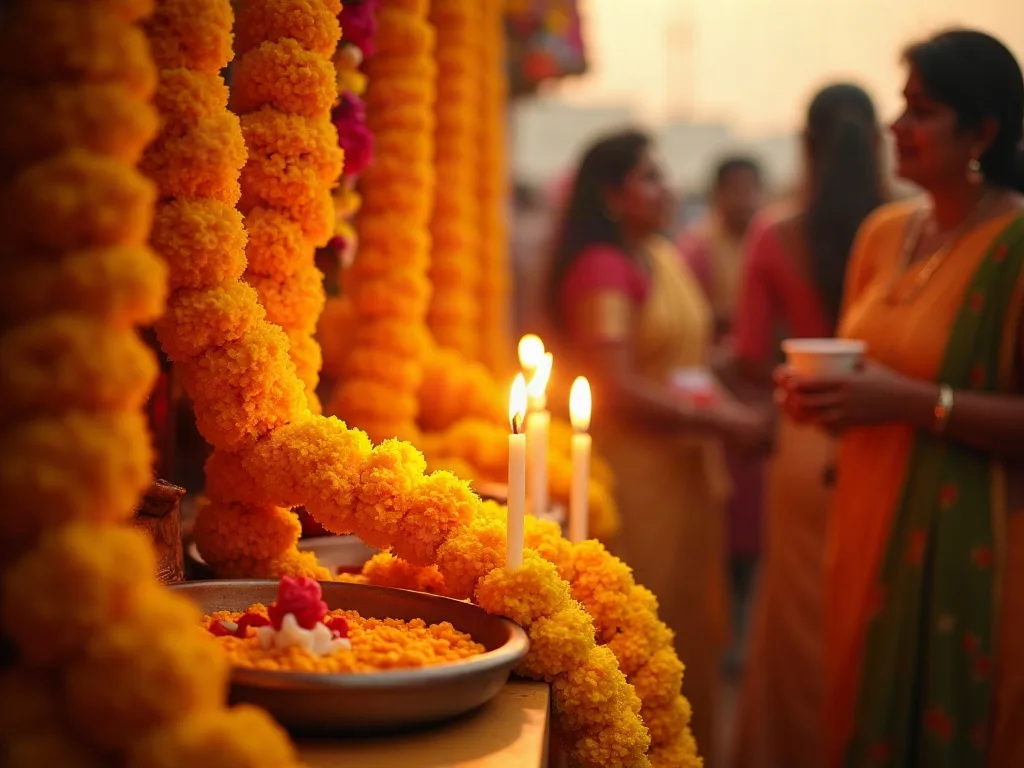
On this morning, students and scholars visit temples draped in yellow cloth and yellow flowers. Yellow is Saraswati's color, representing energy, creativity, and intellectual alertness. Homes fill with yellow blossoms. Schools organize special pujas (worship ceremonies). Children place their books and writing instruments at an altar for blessing. The ritual message is clear: learning is sacred, and it deserves ceremonial respect.
In the most widespread practice, worshippers refrain from studying or writing on Vasant Panchami itself. Instead, they engage in worship, song, and community. The paradox is intentional: on the day dedicated to knowledge, the practice is to pause from intellectual work and remember that knowledge serves life, not the reverse. The day reminds practitioners that wisdom includes knowing when to rest, when to celebrate, when to remember that understanding flows from grace rather than effort alone.
The festival takes different forms across India's regions and diaspora communities. In Bengal, it is celebrated with great fanfare; students organize processions, temples hold special recitations of Vedic hymns and devotional songs. In South India, Saraswati Puja often coincides with or precedes Navaratri, the nine-day festival honoring the divine feminine in multiple forms. In the diaspora, temples in London, New York, Singapore, and Toronto adapt the celebration to local contexts, introducing students to Saraswati's blessings through workshops, music performances, and educational seminars.
Saraswati in Regional Traditions and Variants
While Saraswati is pan-Hindu, her worship takes distinctive forms across India's vast landscape of regional languages, art forms, and devotional practices.
In Bengal, home to centuries of Sanskrit learning and literary genius, Saraswati commands extraordinary devotion. The great Bengali poets, philosophers, and saints recognized her as their muse. When the Bengal Renaissance of the 19th century revitalized Hindu learning, scholars placed Saraswati at the center of their vision of a renewed tradition. She became a symbol not just of education but of cultural pride and intellectual revolution. Contemporary Bengali artists depict her with particular tenderness, emphasizing her grace and the accessibility of her blessing.
In South India, particularly in Tamil and Kannada regions, Saraswati knowledge deity often appears alongside or merges with local traditions of learning. She is recognized as Sharada ("autumn," suggesting the season of harvest and fulfillment) in some Karnataka temples. In Tamil Nadu, she is integrated into the festival calendar and educational institutions in ways that honor both Vedic Sanskrit and the region's ancient Tamil literary tradition. The great temples of South India, such as those dedicated to Shiva, frequently include shrines to Saraswati, acknowledging her role in the spiritual and cultural life of the community.
In Kashmir, home to a profound non-dual philosophy (Advaita Vedanta as developed in neighboring Kerala, and Kashmir Shaivism), Saraswati appears as Mahasaraswati, the "Great Saraswati," representing not just learning but the supreme consciousness expressing itself through language and thought. The philosophical traditions of Kashmir emphasized the absolute reality of consciousness; Saraswati embodied its articulate, creative dimension.
The Goddess of the Arts and Sciences
Outside the religious realm, Saraswati remains the patron of all intellectual and artistic endeavors. Musicians invoke her name before concerts and recordings. Universities and schools across the Hindu world bear her name. The Indian government instituted the Saraswati Samman, a major literary award, honoring her association with language and expression.
In classical Indian music (both Hindustani and Carnatic), which developed within Hindu philosophical and devotional frameworks, Saraswati occupies a central place. Musicians describe the descent of melody and rhythm as the gift of Saraswati; the moment when technical skill transforms into inspired performance is her blessing. Ragas, the melodic frameworks of Indian music, are understood not as mere technical constructs but as pathways to deeper understanding. To master a raga, one must study it intellectually, practice it physically, and ultimately, surrender to it spiritually. Saraswati presides over all three dimensions.
In dance, particularly Bharatanatyam and other classical forms that emerged from Hindu temples, Saraswati's presence flows through the dancer's body. The mudras (hand gestures) and hastas (positions) that express abstract ideas through physical form are, in essence, a conversation with Saraswati: the translation of inner knowledge into visible art.
In the sciences, her association is more subtle but no less real. Hindu scientific traditions, including astronomy, mathematics, medicine (Ayurveda), and architecture (Vastu Shastra), developed within a worldview where knowledge was sacred. The Sulbasutras, ancient texts on geometry and altar construction, were considered branches of Vedic knowledge and thus fell under Saraswati's domain. Indian mathematicians, from Aryabhata to Bhaskara, were often scholars versed in Sanskrit and philosophy; they saw mathematics not as separate from spiritual knowledge but as one expression of it.
Saraswati and the Global Conversation on Wisdom
As Hinduism has expanded globally and Hindu ideas have influenced Western thought, Saraswati has become a figure in a broader conversation about the nature of knowledge itself.
In the 20th century, Hindu teachers and philosophers bringing traditional learning to Western audiences often drew on Saraswati as a symbol. When Swami Vivekananda argued for the importance of education and women's learning in his reinterpretation of Hinduism, he implicitly invoked Saraswati's blessing. When Sri Aurobindo developed his philosophy of integral yoga, emphasizing the transformation of knowledge into lived experience, he positioned Saraswati as the goddess of this synthesis.
Contemporary Hindu scholars working at the intersection of Eastern and Western epistemology cite Saraswati as representing an alternative understanding of knowledge itself: not as mere accumulation of facts but as a transformative force that integrates the knower with what is known. This resonates with modern philosophy of mind and phenomenology, creating unexpected bridges between ancient Hindu thought and contemporary Western inquiry.
Saraswati Beyond the Subcontinent
Hindu diaspora communities have established Saraswati worship in every region where Hindus have settled. Temples in London's East End, New York's Queens borough, Singapore's Little India, and Toronto's temples all dedicate spaces to her. These shrines serve dual functions: they maintain connection to ancestral tradition and they present Saraswati to new cultural contexts.
Interestingly, Saraswati has also begun to circulate in Western spiritual and educational spaces beyond formal Hindu communities. Universities with South Asian studies programs sometimes acknowledge Saraswati in their chapel or meditation spaces. Some contemporary educators and writers have drawn on her symbolism to reimagine learning as a holistic, creative process rather than a mechanistic transfer of information. These appropriations are uneven and sometimes superficial, but they also reflect the genuine universality of her appeal: the longing for knowledge to be transformed into wisdom, and wisdom to be inseparable from beauty and truth.
The Scholarly Debate: History, Mythology, and Meaning
Hindu scholars and historians continue to debate the precise historical emergence of Saraswati as a fully developed goddess. Some scholars propose that the transition from river to deity reflects the actual drying of the Saraswati River around 1900 BCE, a cataclysm that may have driven the symbolization of her spiritual essence as her physical form disappeared. Others argue the transformation was more gradual, a function of how religious thought naturally abstracts physical realities into metaphysical principles.
The relationship between Saraswati and the Vedic concept of Vak (sacred speech, personified as a goddess in some hymns) remains contested. Are they the same deity at different historical moments, or distinct figures who merged in popular devotion? Textual evidence suggests the latter, though the boundaries blur in practice.
Another scholarly question concerns the tension between Saraswati's association with intellectual learning and her association with music and the arts. In Vedic culture, these domains were not cleanly separated; both music and scholarly recitation required mastery of Sanskrit phonetics and rhythm. Yet in later Hinduism, the divide between intellectual and artistic knowledge sometimes widened. How Saraswati holds both remains a matter of interpretation: is she the goddess of all knowledge, or is her domain specifically language and expression?
Frequently asked questions about Saraswati, goddess of knowledge
Frequently asked questions
Why is Saraswati depicted with a swan, and what does it symbolize?
The swan, or hamsa, is Saraswati's traditional mount and represents discrimination. In Hindu philosophy, the hamsa has the capacity to separate milk from water; similarly, the swan symbolizes the seeker's ability to distinguish truth from illusion, essence from superficiality. It embodies the discriminative wisdom that accompanies authentic knowledge.
What is the difference between Saraswati and Lakshmi, the other major Hindu goddesses?
Saraswati embodies knowledge, creativity, and intellectual wealth; Lakshmi represents material prosperity and fortune. Parvati represents power, devotion, and the generative force of creation. The three goddesses together represent the Hindu understanding of wholeness: wisdom, prosperity, and transformative power all working in harmony. A person or society needs all three.
Why are there so few temples dedicated solely to Brahma, despite Saraswati being his consort?
Hindu theology and practice have subtly positioned Saraswati as more worthy of independent worship than Brahma himself. Some interpretations suggest this reflects the Hindu valuation of wisdom as a higher principle than creation; others point to narrative tensions in the Puranas in which Brahma's actions are portrayed ambiguously. Whatever the cause, Saraswati shrines and pujas far outnumber those dedicated to Brahma alone.
How does Saraswati appear in classical Indian music and dance?
Musicians and dancers invoke Saraswati as the source of inspiration, melody, and the capacity to transcend technical skill and touch the sacred. Ragas in Indian classical music are understood as pathways to deeper knowledge; the dancer's mudras (hand gestures) translate thought into physical form. Saraswati presides over this transformation of inner understanding into outward expression.
Is there historical evidence that the Saraswati River actually dried up, and did this inspire Saraswati's transformation into a goddess?
Yes, the Saraswati River, once one of India's major waterways, gradually dried up over centuries, likely around 1900 BCE, due to shifts in rainfall patterns and tectonic changes. Some scholars propose this geographical disappearance prompted the spiritualization of Saraswati into a cosmic principle. However, the full transformation into a consort of Brahma and a developed mythology took place over many centuries in later Vedic and Puranic texts, so causality is complex.
Saraswati in the Modern Spiritual Imagination
Today, Saraswati remains vital not as a historical relic but as a living principle in Hindu practice and in the broader global conversation about learning, creativity, and wisdom. For students across India and the diaspora, her name on the lips before an exam is not mere superstition but an invocation of clarity and presence. For musicians, it is a prayer that technical mastery will transform into beauty. For teachers, it is a reminder that their work participates in something sacred.
Contemporary Hindu feminism has also reclaimed Saraswati as a figure of intellectual agency and female power. Unlike some Hindu goddesses who are depicted primarily through devotion to male consorts, Saraswati retains her independence. She is not defined by marriage; she is defined by knowledge itself. This has made her an emblem for Hindu women scholars, educators, and artists reclaiming their authority and intellectual heritage.
The fact that Saraswati emerged from a river, was absorbed into cosmological mythology, became a focus of ritualized worship, spread across the world, and continues to evolve in meaning as cultural contexts change is itself a perfect illustration of her nature. Knowledge, like water, takes the shape of the vessel it fills. It flows where needed. It refreshes, transforms, and sustains. The ancient Vedic poets knew this when they first heard the river's name and recognized in its sound the voice of wisdom itself.
Free 25-page sample
Want the whole story?
Take the first 25 pages free. If it pulls you in, the full edition is yours as an instant PDF download, with a paperback on Amazon for selected titles.

Mythology
The World Mythology Book: The Gods, Heroes and Myths of Every Culture
The Gods, Heroes and Myths of Every Culture, in One Volume
The whole of world mythology in a single volume: Greek, Norse, Egyptian, Japanese, Hindu, Celtic, Slavic, Mesoamerican and African myths gathered side by side, each drawn from the primary sources.